ISSN 0104-6632 Printed in Brazil
www.abeq.org.br/bjche
Vol. 34, No. 01, pp. 119 - 129, January - March, 2017 dx.doi.org/10.1590/0104-6632.20170341s20150208
Brazilian Journal
of Chemical
Engineering
BIOLEACHING OF METALS FROM A SPENT
DIESEL HYDRODESULFURIZATION CATALYST
EMPLOYING
Acidithiobacillus thiooxidans
FG-01
P. F. Ferreira
1, E. F. C. Sérvulo
1, A. C. A. da Costa
2, D. M. Ferreira
1,
M. L. D. P. Godoy
3and F. J. S. Oliveira
4*1Universidade Federal do Rio de Janeiro, 21941-909, Rio de Janeiro - RJ, Brazil. 2Universidade do Estado do Rio de Janeiro, 20550-900, Rio de Janeiro - RJ, Brazil.
3Comissão Nacional de Energia Nuclear, 22780-160, Rio de Janeiro - RJ, Brasil. 4Petróleo Brasileiro S.A., 20031-004, Rio de Janeiro - RJ, Brazil.
Phone: + 55 21 32291372; Fax: + 55 21 32291346
*E-mail: [email protected]
(Submitted: April 4, 2015 ; Revised: October 13, 2015 ; Accepted: October 14, 2015)
Abstract - This study evaluates the recovery of heavy metals employing a spent catalyst from the hydrodesulfurization (HDS) of diesel, with no chemical, thermal or physical pretreatment, using the bacterial strain Acidithiobacillus thiooxidans FG-01. Direct and indirect bioleaching tests were carried out in Erlenmeyer flasks (500 mL). The influence of the pulp density and supplementation with elemental sulfur on the bioleaching were also investigated. The spent catalyst contained organochlorines, petroleum hydrocarbons and heavy metals in its composition. The best recovery results (26% Al, 26% V and 39% Mo) were achieved in the two-stage (indirect) bioprocess, with a pulp density of 50 g/L. It was not possible to recover Co, Cu and Ni (< 5%) under any of the conditions tested. The bacterial strain A. thiooxidans FG-01 was found to be a promising candidate for the recovery of Al, V and Mo using the crude spent HDS catalyst.
Keywords: Bioleaching; Spent hydrodesulfurization catalyst; Acidithiobacillus thiooxidans.
INTRODUCTION
A petroleum refinery is comprised of a set of units carrying out physical, chemical and thermal pro-cesses which are aimed at the separation of the crude oil components into fractions of hydrocarbon mix-tures (Gary et al., 2007). Catalysis is an essential process employed at petroleum refineries to obtain gasoline, diesel and kerosene (aviation fuel). During the operations the catalysts become impregnated with impurities and are deactivated. After the deacti-vation the catalysts are sent to on-site or off-site re-generation units. With the continual processing of loads the catalysts become impregnated with coke, nickel, vanadium, sulfur, toxic hydrocarbons and
other impurities to such a level that their regenera-tion becomes impracticable. At this stage the cata-lysts are referred to as ‘spent’ (Marafi and Stanislaus, 2008).
the presence of heavy metals, hydrocarbons and other toxic chemicals, these materials are hazardous (Noori Felegri et al., 2014).
Besides the environmental issues, there is concern at the economic-strategic level, considering that the content of valuable heavy metals in spent catalysts is often higher than that found in natural sources (ores). Thus, the recovery of metals from spent catalysts can ensure the supply of metals of commercial value and consequently reduce the dependency on external suppliers and the degradation of new areas through mining activities. Therefore, besides being economi-cally advantageous, the recovery of metals from spent catalysts also lies within the concept of sustainable development (Thosar et al., 2014).
Many researches have indicated that chemical leaching (employing inorganic and organic acids) and bioleaching are promising alternatives for the re-covery of metals (Asghari et al., 2013; Jadhav and Hocheng, 2012; Marafi and Stanislaus, 2011). In con-trast to chemical processes, biotechnological pro-cesses do not require high temperatures and pres-sures and they can therefore be more economically attractive. In this regard, several species of microor-ganisms which produce acids have been studied as heavy metal leaching agents, the most cited being of the genera Acidithiobacillus and Aspergillus (Thosar
et al., 2014; Asghari et al., 2013; Bharadwaj and
Ting, 2013; Mishra et al., 2008, Mishra et al., 2007). Recent publications in the literature report the mi-crobial recovery of metals contained in spent cata-lysts from petroleum refining, pretreated through washing with solvents, thermal treatment and grind-ing or sievgrind-ing (Srichandan et al., 2014a, Thosar et al., 2014; Noori Felegri et al., 2014; Bharadwaj and Ting, 2013). However, pretreatment operations can increase the costs associated with the bioleaching process on an industrial scale. Environmental and economic considerations motivated the carrying out of this innovative research, the objective of which was to verify the efficacy of the bacterial strain
Acidithiobacillus thiooxidans FG-01 in the leaching of
heavy metals from a crude spent HDS catalyst, that is, with no chemical, thermal or physical pretreatment.
MATERIALS AND METHODS
Characterization of Hydrodesulfurization Catalyst
The spent HDS catalyst, generated at a diesel treatment unit, was obtained from a petroleum re-finery which processes heavy oils in Brazil. A plastic bag containing 200 kg of the solid waste (spent
cata-lyst) was received from the refinery and samples were obtained using a stainless steel grain sampler, according to the procedures described by USEPA, (1980). Five kilograms of solid waste was sub-sampled by coning and quartering (USEPA, 1995) in a laminar flow cabinet, using a sterile scoop, and stored in sterile flakes prior to the bioleaching tests and analyses. Organic and inorganic determinations were chosen taking into account the waste generation source and the typical composition of HDS catalyst support (Beolchini et al., 2010).
Aliquots (100.0 mg) of the spent catalyst, 4.0 mL of nitric acid, 2.0 mL of hydrochloric acid and 2.0 mL of hydrogen peroxide were placed in Teflon ves-sels. A microbalance (Mettler) was used to obtain the mass measurements for all samples. The sample digestions were carried out in a microwave oven (Ethos Plus, Milestone) equipped with an evapora-tion accessory (VAC 1000, Milestone). The tempera-ture program was carried out in the following steps: 1) heating from 25 °C to 140 °C (5 min); 2) heating, from 140 °C to 210 °C (5 min); 3) Plateau, 210 °C (15 min) and, finally 4) ventilation for cooling down to 25 °C (15 min). The potency of the microwave oven for following the temperature program varied from 400 to 850 W. The acid-digested samples ob-tained were analyzed to determine the chemical elements composition using atomic absorption spec-trometry (AAS) on a Perkin-Elmer spectrometer (AAnalyst 300).
Samples of the spent catalyst (1 g) were submit-ted to ultrasonic extraction with ultrapure dichloro-methane and cleaned by silica gel column chroma-tography prior to the determination of organic sub-stances. The concentrations of total hydrocarbons were determined by gas chromatography using a Thermo Finnigan Focus GC gas chromatograph, equipped with a column and a flame ionization de-tector (FID). The chlorinated organic compounds were quantified using the same instrument, equipped with a column and an electron capture detector. Poly-cyclic aromatic hydrocarbons (PAHs), benzene, xy-lenes and ethylbenzene were quantified by gas chro-matography coupled to mass spectrometry, using a Thermo Finnigan, Focus GC / Themo Finnigan, Focus DSQ.
Scanning Electron Microscopy (SEM) and Energy Dispersive X-Ray Spectroscopy (EDS)
Bioleaching of Metals from a Spent Diesel Hydrodesulfurization Catalyst Employing Acidithiobacillus thiooxidans FG-01 121
of the HDS spent catalyst before and after the chemi-cal or microbiologichemi-cal leaching tests. Prior to the microscopic analysis the samples were dried in an oven at 37 °C and then coated with silver. The ob-servation of the catalyst particles was carried out with the aid of a scanning electron microscope (Zeiss DSM 940) equipped with an EDX Link detector and a Kontron (Zeiss) automatic image analysis system, under the following conditions: high voltage = 25 kV, secondary electrons mode, working distance = 12.4 - 13.0 mm. The chemical analysis was carried out by EDS (Oxford Link L300), with an SiLi Pen-tafet detector and an ultrafine window (ATW2), with 45 cps/eV (y axis) x 18 KeV (x axis) of resolution, coupled to SEM.
Bioleaching Tests
The bioleaching tests were conducted using the bacterial strain Acidithiobacillus thiooxidans FG-01, kindly donated by the Institute of Chemistry at the State University of São Paulo (GARCIA Jr., 1991). The bacterial sample was isolated from an uranium mine in the state of Paraná, Brazil.
The bacterial strain was stored in T&K liquid medium (Tuovinen and Kelly, 1973). The stock cul-tures were maintained at a temperature of 5 ± 1 ºC, with subculturing every two months. The inoculums were prepared through the activation and propaga-tion of 10 mL of the stock culture in 100 mL of T&K medium, corresponding to an inoculum of 9.1% (v/v). The cultures were then incubated at 30 ± 1 ºC, under shaking at 150 rpm to provide the microorgan-isms with dissolved oxygen and thus accelerate their propagation. After 4 days of growth the cultures were submitted to verification of the purity by mi-croscopic analysis (optical microscope, Olympus, model CX 40). The cellular concentration was de-termined using a Neubauer camera (Plumb et al., 2008; Mousavi et al., 2008), immediately prior to the bioleaching studies, to establish an initial concentra-tion of 105 cells/mL.
For the culture, the liquid media used were modi-fied Deutsche Sammlung von Mikroorganismen und Zellkulturen - DSMZ (Silverman and Lundgren, 1959; Moura et al., 2008) and T&K. These media were selected considering the claims of Kim et al. (2009) and Garcia Jr (1991) of successful microbial growth and sulfuric acid production. The pH value of the medium was adjusted to 2 using 0.5 mol/L H2SO4, and 100 mL aliquots were placed in 500 mL Erlenmeyer flasks. The media were sterilized at 121 ºC for 20 min and then supplemented with elemental sulfur (Sº), previously treated at 110 ºC/ 60 min, to
obtain a concentration of 10 g/L. The bioleaching tests were carried out in 500 mL Erlenmeyer flasks containing 100 mL of medium and the selected amount of the spent catalyst. The flasks were shaken on a thermostatic incubator table (CIENTEC, model CT-712R), at 29 1 ºC and 150 rpm, for different periods of time according to the test carried out. The concentrations of Al, Co, Cu, Mo, Ni and V in the solutions, the cell concentration, the pH and the acidi-ty (expressed as sulfuric acid) were monitored. Ali-quots (25 mL) of the suspension were removed from the flasks and filtered through polyacetate mem-branes (Millipore, 0.22 µm) prior to analysis. Abiotic controls were prepared by autoclaving the systems under a pressure of 1 atm for 20 min. (Bharadwaj and Ting, 2013). Samples of abiotic controls were periodically examined for acid production and by light microscopy to verify microbial activity. To determine the pH a potentiometer (Digimed, model DMPH-1) equipped with a glass combination elec-trode (platinum working elecelec-trode and Agº/AgCl reference electrode) was used. Before each pH read-ing, and prior to the calibration with buffer solutions, the electrodes were immersed in a 5% (v/v) formal-dehyde solution for a period of 30 min for decontam-ination purposes. The acidity values for the samples of the medium were determined by titration with 0.1 mol/L NaOH, using 0.1 mL of phenolphthalein as an indicator. The metal concentrations were determined by AAS (Perkin-Elmer, model AAnalyst 300).
Effect of the Pulp Density
The bioleaching texts were carried out under the above-described conditions, with different concen-trations of spent catalyst: 5, 10, 25 and 50 g/L. The tests were conducted over 7 days. Each test was car-ried out with at least three replicates and the results were presented as the mean value for the replicates. The process was monitored by sacrificing replicate flasks.
Bioleaching in One or Two Stages
In the one-stage process the growth of A.
thiooxi-dans FG-01 and the solubilization of the metals were
diluted leaching solutions appropriate quantities of the catalyst to establish a pulp density of 5, 10, 25 or 50 g/L were added. To allow comparisons, control tests were carried out for each acid concentration, where a commercial sulfuric acid solution was added in a concentration equal to that established for the acid produced by the bacteria. Abiotic controls were prepared by autoclaving the systems under a pressure of 1 atm for 20 min. (Bharadwaj and Ting, 2013). Samples of abiotic controls were periodically ex-amined for acid production (near to 0 mg/L) and by light microscopy to ensure that there was no micro-bial activity. Each test was carried out with at least three replicates and the results were presented as the mean of the replicates. To monitor the bioprocess, replicate flasks were sacrificed periodically during the test.
Statistical Analysis
The results for the average metal recovery ob-tained in the indirect bioleaching tests, as a function of the pulp density of the crude spent catalyst, were submitted to analysis of variance (ANOVA) and multiple comparison of means (Tukey Test), under a completely randomized design, at the 5% signifi-cance level. In all cases, the analyses were carried out with the aid of the computational software pro-gram Statistica, version 5.5 (StatsoftInc).
RESULTS AND DISCUSSION
Petroleum refineries use different types of cata-lysts for the desulfurization of fuels (Dhar et al., 2003). In this regard, NiMo and CoMo-supported
catalysts are the most commonly used types due to their activity and commercial interest. Table 1 shows the chemical characterization of the spent CoMo/ Al2O3 catalyst. All results are expressed as the mean of three replicates. The presence of high concentra-tions of Al, Co and Mo in the catalyst is due to its chemical composition, since it is comprised of an alumina support. Benzene and toluene were present in the samples in concentrations below the limit of detection (LOD; 521 µg/kg).
Microbial Growth and Acid Production
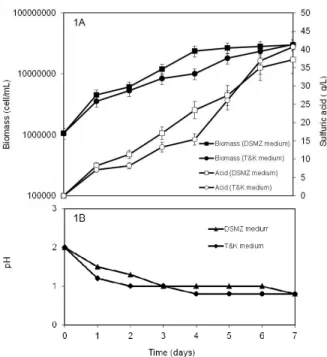
Figure 1A shows the profiles for the growth and sulfuric acid production of the A. thiooxidans FG-01 bacteria in the two mineral media tested. It was noted that, with the use of the DSMZ medium, the bacterial strain showed a higher specific growth rate, reaching a maximum concentration (3.0 x 10⁷ cells/mL) on the fourth day of cultivation. A similar cell concen-tration was obtained with the growth in the T&K medium, although a longer time period was required (five days of cultivation). The behavior of the bacte-rial strain was also distinct in relation to the produc-tion of acid, showing approximately linear and expo-nential profiles in the DSMZ and T&K media, re-spectively. However, regardless of the composition of the medium, the yield and productivity of the pro-cess were similar, reaching maximum sulfuric acid concentrations of around 40 g/L. During the bacterial cultivation in modified DSMZ medium, inorganic acid was still produced, even after the maximum cell concentration had been reached (Figure 1A). Thus, in this medium the acid production was partially associated with the synthesis of cellular material. However, microbial growth and acid production
Table 1: Composition of spent hydrodesulfurization catalyst originating from a petroleum refinery.
Parameter Result (mg/kg)
Parameter Result (µg/kg)
Mercury 0.2 ± 0.1 2,4,5-Trichlorophenol 9727 ± 1742
Aluminum 21615 ± 1743 2,4,6-Trichlorophenol 10190 ± 1659
Arsenic 91 ± 5 2,3,4,5-Tetrachlorophenol 5258 ± 1004
Barium 4 ± 1 2,3,4,6-Tetrachlorofenol < 502
Lead 120 ± 4 Anthracene 2374 ± 685
Cobalt 9715 ± 837 Benzo(a)anthracene 852 ± 232
Copper 557 ± 42 Benzo(k)fluoranthene < 502
Chromium 145 ± 9 Benzo(g,h,i)perylene < 502
Iron 8484 ± 752 Benzo(a)pyrene < 502
Manganese 76 ± 8 Chrysene 4600 ± 1115
Molybdenum 16083 ± 1239 Dibenzo(a,h)anthracene < 502
Nickel 387 ± 28 Phenanthrene 89553 ± 6008
Vanadium 120 ± 17 Indeno(1,2,3-cd)pyrene < 502
Zinc 307 ± 50 Ethylbenzene 20517 ± 1269
Sulfides 181002 ± 1590 m,p-Xylenes 34443 ± 6279
Bioleaching of Metals from a Spent Diesel Hydrodesulfurization Catalyst Employing Acidithiobacillus thiooxidans FG-01 123
were observed during the entire assayed period when the T&K medium was employed. The reduction in the pH (Figure 1B) of the cultivation medium is re-lated to an increase in the acidity which, due to the value for the dissociation constant of sulfuric acid, enables values of less than 1.0 to be reached. The decrease in the pH of the medium is indicative of bacterial activity in the bioleaching system, since an increase or decrease in the pH is dependent on, re-spectively, the consumption of acid by the material and/or by the bacteria and the production of acid resulting from biochemical sulfide oxidation reac-tions (Francisco et al., 2007). Chang et al. (2008) cultivated the bacterial strain A. thiooxidans BCRC 15616 and observed that an exponential growth phase began on the fifth day and lasted 10 days, re-sulting in a decrease in the pH from 4.5 to 1.4. Moura et al. (2008) also observed that the growth of sulfur-oxidizing bacteria, in the medium 9K (Silver-man and Lundgren, 1959), resulted in an increase in the acidity, but the minimum value of pH 1.0 was reached only after 20 days. This verifies the potential
of A. thiooxidans FG-01 to produce acids, which
favors the leaching of metals from the spent HDS catalyst as a solid residue. Another important factor is that the T&K medium contains a lower quantity of nutrients, which makes it more economically advan-tageous than DSMZ, and thus this mineral medium was selected for the subsequent tests.
Figure 1: Cultivation of bacterial strain A. thiooxi-dans FG-01 in the DSMZ and T&K media: (A) Ki-netic profiles for the growth and production of sulfu-ric acid and (B) behavior of the pH.
Effect of the Catalyst Density and A. thiooxidans FG-01 Activity
The pulp density is an important variable which affects the success of the bioprocess. It can influence the oxygen mass transfer from gas to liquid phase, microbial adhesion and the release of toxic chemi-cals from solids to the solution (Wang et al., 2014). Thus, tests of the effect of the pulp density on the A.
thiooxidans FG-01 strain as a function of the contact
time were carried out. Figure 2 shows the results obtained after 5 days of cultivation in T&K medium using different catalyst densities (5 to 50 g/L). It can be observed that there was only significant bacterial growth, of around one order of magnitude, when the cultivation was carried out in medium containing 5 g/L of catalyst, resulting in the production of approx-imately 29 g/L of sulfuric acid. The cell concentra-tion remained almost unaltered, reaching 3.1 x 10⁶ cells/mL, with a pulp density of 10 g/L, while slightly lower cell concentrations were observed for the other catalyst densities.
0 5 10 15 20 25 30 35
1 10 100 1000 10000 100000 1000000 10000000 100000000
0 10 20 30 40 50
P
rodu
c
ti
on
of
a
c
id (
g
/L)
B
iom
as
s
(
c
e
ll
/m
L)
Spent catalyst (g/L) Biomass
Sulphuric acid
Figure 2: Influence of pulp density on the cell concentration and production of acid (initial average cell concentration of 105 cells/mL).
2009). Also, the decrease in the activity can nega-tively affect the electron transfer mechanism and influence the metal leaching process. In addition to these factors, the oxidation of sulfide due to the mi-crobial activity can increase the recovery efficiency of the metals encapsulated by this form of sulfur. Based on the results, a pulp density of 5 g/L was selected for the subsequent tests and it can be con-cluded that the solubilized metal concentration and the presence of the other contaminants had an im-portant influence on the cell activity and consequent-ly the bioleaching process.
Direct Microbial Leaching
Of the direct microbial leaching procedures avail-able, two basic approaches are generally applied for the recovery of metals from solid wastes: the produc-tion of acid associated with (one-stage batch bi-oleaching) or not associated with (two-stage batch bioleaching) metal recovery (Coto et al., 2008). Both approaches were investigated in this study. The cell growth and the production of acid in the presence of the spent catalyst, with or without supplementation with elemental sulfur, are shown in Figure 3.
10000 100000 1000000 10000000 100000000
0 3 6 9 12 15 18 21
0 1 2 3 4 5 6 7
Sulphuric acid - MC Sulphuric acid - MCC
Sulphuric acid - MCSC Biomass - MCC
Biomass - MCSC
Time (days)
S
u
lp
h
u
ric
a
c
id
(
g
/L
)
B
iom
ass
(c
e
ll
/m
L
)
Figure 3: Profiles for growth and sulfuric acid pro-duction during the cultivation of A. thiooxidans FG-01 in: MC – abiotic control, mineral medium sup-plemented with spent catalyst (5 g/L); MCC - mineral medium supplemented with spent catalyst and inocu-lated with cells; and MCSC - mineral medium sup-plemented with spent catalyst, elemental sulfur and cells.
It can be observed from Figure 3 that the addition of elemental sulfur as an energy source had a posi-tive influence on the cell growth, even though the spent catalyst contains sulfide, another potential energy source for use by the bacteria. This indicates that the catalyst alone was not able to provide the support required for the bacterial growth and that, at
this pulp density, the quantity of the energy source present allowed the microbial population to survive. The addition of Sº (MCSC) resulted in an increase in the cell concentration of one order of magnitude, reaching the maximum value on the fifth day. It can be verified from Figure 3 that the presence of organic contaminants did not inhibit the bacterial growth and that, up to the fifth day of cultivation, the solubilized metals did not affect the cell growth, since the yield and cell productivity were similar to those obtained in the T&K medium without catalyst (Figure 1A).
The MCSC conditions were the most favorable for the microbial production of acid, which was found to be associated with the cell growth. The maximum sulfuric acid concentration of 16.7 g/L was reached on the fifth day. In comparison, under the MCC conditions the acid production was negli-gible. It was noted that the initial acid concentration in the medium was introduced by the inoculation. Furthermore, the acid production was negligible in the abiotic control, suggesting that, in the absence of cells, oxidative reactions did not occur.
The leaching solutions obtained in the MCC and MCSC tests were analyzed for metals in solution, and the contents were used in the calculation of the percentage recovery from the catalyst, based on their concentrations before the application of the treat-ment. For comparison purposes, the chemical leach-ing of the catalyst with commercial sulfuric acid (abiotic control) was also carried out, and the solu-tions were obtained after the same time interval (Ta-ble 2). The data related to the abiotic control medium are not shown since the metal concentrations in the leaching solutions during the period monitored were negligible (< 0.5%).
It is of interest to note that the solubilization of the metals, in general, increased over time, although the acid production stopped on the fifth day, when it suddenly declined (Figure 3). This could explain the inhibition of the microbial activity since, as previ-ously observed, the culture employed in this study reached its maximum growth around the fifth day of cultivation. However, in the medium without catalyst it was possible to reach around 40 g/L of sulfuric acid, while in the presence of metals the maximum acid concentration was much lower (around 17 g/L), which was probably a consequence of the toxicity of the metals in solution toward the bacteria.
Bioleaching of Metals from a Spent Diesel Hydrodesulfurization Catalyst Employing Acidithiobacillus thiooxidans FG-01 125
of the order of 37% and 29%, respectively. In the case of Mo, the chemical leaching was more efficient with a recovery of 65%, while no difference was observed for V recovery on comparing chemical and microbial leaching. The Ni recovery was considered to be low, particularly compared with the value of approximately 85% reported by Kim et al (2009), probably due to the differences in terms of the solid matrix, pulp density and bacterial strain employed. Mishra et al. (2008) managed to recover 88.2% of Ni, 93% of V and 17.4% of Mo in a one-stage bi-oleaching process using spent catalysts previously treated with acetone and dried at 50 ºC, triturated to approximately 100 µm, at a pulp density of 15 g/L, in a medium containing Sº, in 7 days. Thus, the A.
thiooxidans strain FG-01 can be considered as a
po-tential alternative for the leaching of Mo, a valuable metal, avoiding the need for preliminary grinding and/or a thermal or washing process to remove or-ganic compounds from catalyst, which can reduce the cost effectiveness of the industrial bioprocess.
Table 2: Percentage recovery of metals from spent HDS catalyst by chemical leaching (CL) with com-mercial sulfuric acid and by bioleaching employing MCC (medium, cells and catalyst) or MCSC (me-dium, cells, Sº and catalyst), all with 5 g/L of catalyst, under incubation conditions of 30 ºC at 150 rpm.
Element Time (days)
Recovery (% m/m)
CL MCC MCSC
Al
1 13 ± 2 13 ± 3 13 ± 2 3 16 ± 1 15 ± 2 17 ± 2 7 27 ± 5 27 ± 4 30 ± 5
Co
1 1 ± 1 1 ± 1 1 ± 1
3 2 ± 1 2 ± 1 2 ± 1
7 2 ± 1 2 ± 1 2 ± 1
Cu
1 1 ± 1 2 ± 1 2 ± 1
3 2 ± 1 2 ± 1 2 ± 2
7 2 ± 1 2 ± 1 2 ± 1
Mo
1 15 ± 3 12 ± 4 11 ± 2 3 32 ± 5 21 ± 3 22 ± 3 7 65 ± 5 39 ± 4 37 ± 3
Ni
1 4 ± 1 4 ± 1 4 ± 1
3 4 ± 1 4 ± 2 4 ± 1
7 5 ± 2 5 ± 2 5 ± 2
V
1 21 ± 2 21 ± 1 20 ± 3 3 23 ± 2 23 ± 4 25 ± 4 7 27 ± 3 30 ± 4 29 ± 3
Based on the data obtained, it can be established that the solubilization of metals through microbial action occurs in the following decreasing order, as observed from the recovery obtained from the action
of A. thiooxidans FG-01: Mo > V = Al > Ni > Cu >
Co. On comparing the microbial and chemical
leach-ing for the process carried out in one-stage, it can be concluded that the bioprocess is equivalent to the chemical process. These results show the potential for the use of this microorganism as an alternative process for the recovery of Mo from the spent cata-lyst studied. In the present study, the differences in metal removals can be particularly related to their binding forms and sulfuric acid concentration. The biosurfactant action may not be dismissed, although its microbial production was not investigated. Spent catalysts have different metal-binding capacity; there-fore, metals can be divided into acid soluble/exchange-able, and reducible/oxidizable or residual fractions (Srichandan et al., 2014b). The exchangeable and reducible fractions are related to weekly adsorbed elements retained on the surface by relatively weak electrostatic attraction. The oxidizable fraction con-tains the metals involved in complexation with or-ganic matter. At last, the residual fraction comprises metals incorporated into the crystal lattice of minerals. So, comparatively, the metals in the residual fraction are strongly bound, whereas metals in the other frac-tions bind weakly through electrostatic attraction (Srichandan et al., 2014b).
Indirect Microbial Leaching
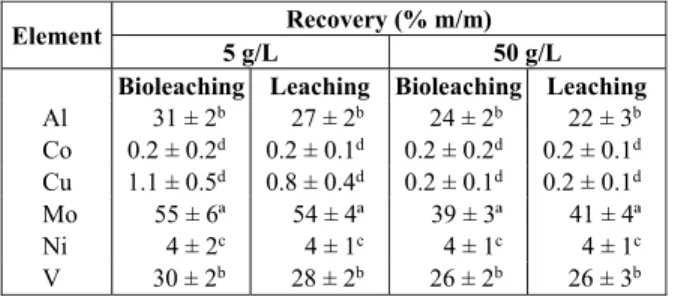
In the set of two-stage bioleaching tests the metal recovery occurred due to the treatment of the catalyst with the leaching solution originating from the pre-vious microorganism growth in the T&K medium, in the absence of the catalyst. The aim of this stage of the study was to evaluate whether the metabolites, produced during the microbial growth, participated effectively in the solubilization of the metals, as well as to verify if this second approach to the bioprocess is more effective. It is known that the bacteria of the genus Acidithiobacillus can produce tensioactive agents which can aid in the recovery of metals (Schaeffer and Umbreit 1963; Beebe and Umbreit 1971; Fazzini et al., 2011). To allow a comparative analysis, the catalyst was also treated with a solution of commercial sulfuric acid, applying the same ratios of catalyst density/acid concentration in the leaching solutions. The results obtained for the metal concen-trations in solution are shown in Table 3.
in-crease in the pulp density from 5 to 50 g/L led to a reduction in the Mo recovery. Beolchini et al. (2010) reported yields for the microbial leaching of Mo from spent HDS catalysts of below 30% after 20 days of contact. The results reported herein are con-sistent with those reported by Mishra et al. (2007), who studied different pulp densities (5 g/L to 50 g/L) and obtained the maximum value for Mo recovery (71.1%) in the tests conducted with 5 g/L of catalyst in a two-stage process with 7 days of incubation. For a pulp density of 50 g/L, a recovery of 21.5% was observed. Under the same process conditions, Ho et al. (1994) obtained Mo recoveries of 78.6% to 42.6% for pulp densities of 5 g/L to 50 g/L.
Table 3: Indirect bioleaching as a function of the pulp density of the crude spent catalyst.
Element Recovery (% m/m)
5 g/L 50 g/L
Bioleaching Leaching Bioleaching Leaching Al 31 ± 2b 27 ± 2b 24 ± 2b 22 ± 3b
Co 0.2 ± 0.2d 0.2 ± 0.1d 0.2 ± 0.2d 0.2 ± 0.1d
Cu 1.1 ± 0.5d 0.8 ± 0.4d 0.2 ± 0.1d 0.2 ± 0.1d
Mo 55 ± 6ª 54 ± 4ª 39 ± 3ª 41 ± 4ª Ni 4 ± 2c 4 ± 1c 4 ± 1c 4 ± 1c
V 30 ± 2b 28 ± 2b 26 ± 2b 26 ± 3b
Note: For the same pulp density, the same lowercase letters indicate that the data are not significantly different, according to the Tukey test (p > 0.05)
It can be verified from the data in Table 2 that, regardless of the pulp density, the same percentages of V and Al were removed from the solid matrix. In the case of Al, a similarity was observed between the leaching carried out with acid produced by bacteria and commercial sulfuric acid (confidence level 95%). Also, an increase in the pulp density from 5 to 50 g/L did not affect the solubilization of this ele-ment. Some studies have revealed that the bioleach-ing of Al can be carried out in cultures of A. thiooxi-dans with a yield of approximately 40% (Krebs et al., 1997). Other authors have reported that, on ap-plying bioleaching with fungi, it is also possible to recover Al, with around 30% recovery (Aung and Ting, 2005; Santhiya and Ting, 2005). The solubili-zation of V was not influenced by the pulp density or by the type of leaching (chemical or microbial) used. The recovery results are promising since, during the use of catalysts in the HDS process, vanadium com-plexes are deposited on the catalyst particles and, subsequently, these complexes decompose due to the high temperatures in the reactors (Trujillo et al., 1997). During the regeneration of the catalyst, the water vapor produced from the combustion of coke,
deposited on the particles, oxidizes vanadium and the resulting oxide hydrolyzes, forming a volatile spe-cies, vanadic acid, which can permeate the inner layers of the catalyst particles, hindering the extrac-tion of vanadium. The literature reports high values for V recovery (> 90%), however, for spent catalysts submitted to chemical or thermal pretreatment and with contact times exceeding one week (Mishra et al., 2008; Kim et al., 2009).
In the case of Ni, no statistically significant dif-ference was observed on employing chemical or mi-crobial leaching, regardless of the pulp density stud-ied. Pradhan et al. (2009), Beolchini et al. (2010), Noori et al. 2014, and Bharadwaj and Ting (2013) reported values for Ni recovery of over 50% for pre-treated HDS catalysts. Thus, the bacterial strain A.
thiooxidans FG-01 is not considered to be promising
for the recovery of this element. The values for the recovery of Co and Cu were also low (< 2%). For these elements it was not possible to verify the influ-ence of the type of leaching used (chemical or mi-crobial), but the influence of the pulp density was verified in the case of Cu. In the literature, most publi-cations report the recovery of Co from pretreated residues with the use of commercial solvents. For instance, Hubred (1984) extracted 45% of the Co present in a spent catalyst using chemical treatment with ammonium sulfate or carbonate, with pH values between 9.5 and 11, at high temperature (85-95 °C). Gómez et al. (1999) obtained a maximum solubiliza-tion of 25% for copper in the bioleaching of an ore originating from Spain, with high concentrations of sulfide, using Acidithiobacillus ferrooxidans at a pulp density of 5%, at pH 2.0 after 15 days. Xia et al. (2008) reported a differentiated bioleaching of chal-copyrite, using A. ferrooxidans, adapted or not adapted to Cu. After 21 days of the test, employing a pulp density of 5%, the recoveries were 47.5% and 39.5%, respectively.
Based on a comparison of the data in Tables 2 and 3 it can be verified that, for a pulp density of 5 g/L, the two-stage bioleaching led to higher recovery per-centages for Mo, V and Al. In the case of the other elements analyzed, no difference was observed re-garding the type of recovery process applied. How-ever, considering the mass recovery data, it can be verified that the two-stage bioprocess, with a pulp density of 50 g/L, provided higher quantities of the leached metals analyzed (31.3 g/L Al, 54.6 g/L Mo and 30.4 g/L Mo), this being the best condition tested.
Bioleaching of Metals from a Spent Diesel Hydrodesulfurization Catalyst Employing Acidithiobacillus thiooxidans FG-01 127
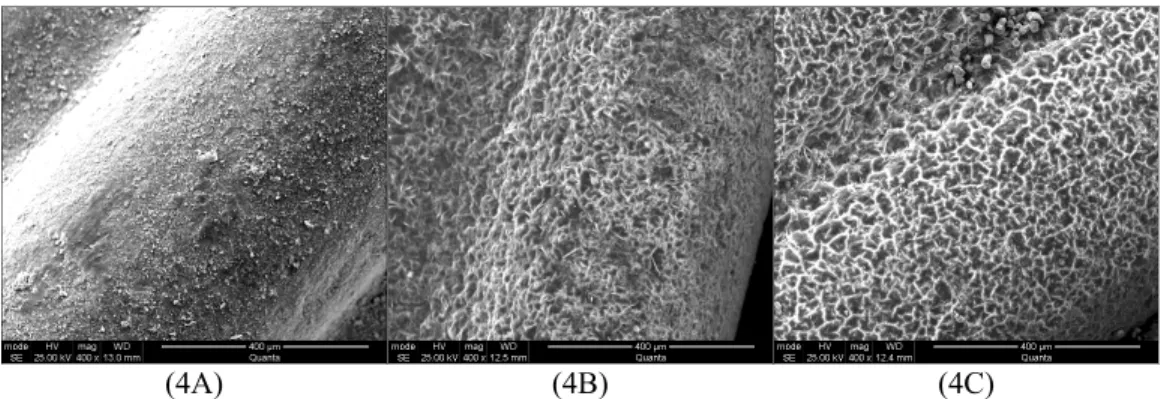
(4A) (4B) (4C) Figure 4: SEM micrographs of the surface of the spent catalyst samples: non-treated (A), treated
with commercial sulfuric acid (CSA) (B) and treated with acid produced by A. thiooxidans (C).
leaching (Figure 4C), for the recovery of metals. The leached catalyst samples show a thick surface layer with an aspect which differs considerably from that of the surface of the material observed before the treatment.
Scanning electron microscopy (SEM) coupled to energy dispersive X-ray spectroscopy (EDS) was carried out to examine the surface aspect of the HDS spent catalyst before and after the chemical or mi-crobiological leaching tests. Changes in concentra-tions of chemical elements on the surfaces of the catalyst samples were also investigated in this analy-sis. The EDS peaks for the treated catalysts, regard-less of the solution employed, showed similar pro-files. However, the spectrum for the catalyst prior to the treatment differed from those of the treated sam-ples, demonstrating the efficiency of the process. The values corresponding to the main elemental constitu-ents of the layer adhered to the surface of the catalyst are shown in Table 4.
Table 4: Concentration of metals in samples of the spent HDS catalyst obtained by EDS before and after chemical (CL) or microbial (ML) leaching.
Element
Concentration (% m/m) Spent
catalyst
CL ML
Al 10.06 7.90 8.18
Co 0.07 0.06 0.05
Cu 0.15 0.14 0.12
Mo 7.32 1.82 1.49
Ni 2.14 1.48 1.06
V 0.02 0.02 0.02
Fe 7.00 0.08 0.05
O 21.01 52.83 64.51
The increase in the oxygen concentration of the samples treated by direct microbial bioleaching demonstrated the deposition of organic material. Based on a comparison of the data in Tables 2, 3 and 4, it can be concluded that preferential dissolution of
the metals adhered to the catalyst surface occurred, since the EDS analysis quantifies the elements of the superficial layer and cannot detect elements deposited in the micropores of the catalyst. Since the AAS technique is preceded by the acid dissolution of the material, the differences between the quantities of metals recovered is explained.
CONCLUSIONS
The bacterial strain Acidithiobacillus thiooxidans
FG-01 was used successfully to recover metals of aggregated value from a spent HDS catalyst (CoMo/ Al2O3) without chemical, thermal or physical pre-treatment. The two-stage bioprocess carried out with a pulp density of 50 g/L yielded the highest quanti-ties of leached metals (Al, V and Mo) and these were considered to be the best conditions tested. It was not possible to recover Co, Cu or Ni (< 5%) under any of the conditions tested. The hazardous solid waste investigated in this study appears to represent a low cost material for the recovery of valuable metals. The application of this process could reduce the need for mining activities and thus the degradation of new areas, thereby contributing to environmental sustain-ability.
NOMENCLATURE
AAS Atomic absorption spectrometry CL Chemical leaching
CSA Commercial sulfuric acid
DSMZ Deutsche sammlung von mikroorganismen und zellkulturen
EDS Energy dispersive X-ray spectroscopy FID Flame ionization detector
MC Mineral medium supplemented with spent catalyst
MCC Mineral medium supplemented with spent catalyst and inoculated with cells
MCSC Mineral medium supplemented with spent catalyst, elemental sulfur and cells MC Abiotic control
ML Microbial leaching
PAHs Polycyclic aromatic hydrocarbons SEM Scanning electron microscopy T&K Tuovinen and Kelly medium
REFERENCES
Asghari, I., Mousavi, S. M., Amiri, F., Tavassoli, S., Bioleaching of spent refinery catalysts: A review. Journal of Industrial and Engineering Chemistry, 19, 1069-1081 (2013).
Aung, K. M. M., Ting, Y., Bioleaching of spent fluid catalytic cracking catalyst using Aspergillus niger. Journal of Biotechnology, 116, 159-170 (2005). Beebe, J. L., Umbreit, W. W., Extracellular lipid of
Thiobacillus thiooxidans. Journal of Bacteriology,
108, 612-614 (1971).
Beolchini, F., Fontia, V., Ferella, F., Vegliò, F., Metal recovery from spent refinery catalysts by means of biotechnological strategies. Journal of Hazard-ous Materials, 178, 529-534 (2010).
Bharadwaj, A., Ting, Y-P., Bioleaching of spent hy-drotreating catalyst by acidophilic thermophile
Acidianus brierleyi: Leaching mechanism and
ef-fect of decoking. Bioresource Technology, 130, 673-680 (2013).
Chang, J. H., Hocheng, H., Chang, H. Y., Shih, A., Metal removal rate of Thiobacillus thiooxidans
without pre-secreted metabolite. Journal of Mate-rials Processing Technology, 20(1), 560-564 (2008).
Chen, S-Y., Chen, W-H., Thermophilic bioleaching of heavy metals from waste sludge using response surface methodology. Journal of Environmental Science and Health, Part A, 48(9), 1094-1104 (2013).
Coto, A., Galizia, F., Hernández, I., Marrero, J., Donati, E., Cobalt and nickel recoveries from lat-erite tailings by organic and inorganic bio-acids. Hydrometallurgy, 94, 18-22 (2008).
Dhar, G. M., Srinivas, B. N., Rana M. S., Kumar, M., Maity, S. K., Mixed oxide supported hydrodesul-furization catalysts-a review. Catalysis Today, 86, 45-60 (2003).
Fazzini, R. A. B., Levican, G., Parada, P.,
Acidithio-bacillus thiooxidans secretome containing a
new-ly described lipoprotein Licanantase enhances
chalcopyrite bioleaching rate. Applied Microbi-ology and BiotechnMicrobi-ology, 89, 771-780 (2011). Felegari, Z. N., Haghi, N. B., Amoabediny, G.,
Mousavi, S. M., Torkmahalleh, A. M., An opti-mized integrated process for the bioleaching of a spent refinery processing catalysts. International Journal Environmental Research, 8(3), 621-634 (2014).
Francisco Jr, W. E., Bevilaqua, D., Garcia Jr, O., Estudo da dissolução oxidativa microbiológica de uma complexa amostra mineral contendo pi-rita (FeS2), pirrotita (Fe1-xS) e molibdenita (MoS2). Química Nova, 30(5), 1095-1099 (2007). (In Portuguese).
Garcia Jr, O., Isolation and purification of
Thiobacil-lus ferrooxidans and Thiobacillus thiioxidans
from some coal and uranium mines of Brazil. Re-vista de Microbiologia, 22, 1-6 (1991).
Gary, J. H., Handwerk, G. E., Kaise, M. J., Petroleum Refining: Technology and Economics. CRC Press, Boca Raton (2007).
Gómez, C., Blázquez, M. L., Ballester, A., Bioleach-ing of a Spanish complex sulphide ore bulk con-centrate. Minerals Engineering, 12(1), 93-106 (1999).
Han, W., Yuan, P., Fan, Y., Shi, G., Liu, H., Baic, D., Bao, X., Preparation of supported hydrodesulfuri-zation catalysts with enhanced performance using Mo-based inorganic-organic hybrid nanocrystals as a superior precursor. Journal of Material Chemistry, 22, 25340-25353 (2012).
Ho, E. M., Kyle, J., Lallenec, S., Muir, D. M., Parker, A. J., Recovery of vanadium from spent catalysts and alumina residues. Proc. Hydrometallurgy, Lon-dres, Chapman and Hall, p. 1105-1121 (1994). Hubred, G. L., Leaching nickel, cobalt, molybdenum,
tungsten and vanadium from spent hydropro-cessing catalysts. American Patent nº 4.514.368 (1984).
Jadhav, U. U. and Hocheng, H., A review of recovery of metals from industrial waste. Journal of Achievements in Materials and Manufacturing Engineering, 54(2), 159-167 (2012).
Kim, D. J., Mishra, D., Ahn, J., Chaudhury, G. R., Ralph, D. E., A novel process to treat spent petro-leum catalyst using sulfur-oxidizing lithotrophs. Journal of Environmental Science and Health, Part A, 44, 1585-1591 (2009).
Krebs, W., Brombacher, C., Bosshard, P. P., Bacho-fen, R., Brandl, H., Microbial recovery of metals from solids. FEMS Microbiology Reviews, 20, 605-617 (1997).
Bioleaching of Metals from a Spent Diesel Hydrodesulfurization Catalyst Employing Acidithiobacillus thiooxidans FG-01 129
Resources, Conservation and Recycling, 53, 1-26 (2008).
Marafi, M. and Stanislaus, A., Waste catalyst utiliza-tion: Extraction of valuable metals from spent hydroprocessing catalysts by ultrasonic-assisted leaching with acids. Industrial and Engineering Chemistry Research, 50, 9495-9501 (2001). Mishra, D., Kim, D. J., Ralph, D. E., Ahn, J. G.,
Rhee, Y. H., Bioleaching of spent hydro-processing catalyst using acidophilic bacteria and its kinetics aspect. Journal of Hazardous Materials, 152, 1082-1091 (2008).
Mishra, D., Kim, D. J., Ralph, D. E., Ahn, J. G., Rhee, Y. H., Bioleaching of vanadium rich spent refinery catalysts using sulfur oxidizing litho-trophs. Hydrometallurgy, 88, 202-209 (2007). Moura, M. J., Ribeiro, B., Sousa, J., Costa-Ferreira
M., Leaching of petroleum refinery ash by aci-dophilic sulfur-oxidizing microbial cultures. Bio-resource Technology, 99, 8840-8843 (2008). Mousavi, S. M., Yaghmaei, S., Vossoughi, M.,
Roostaazad, R., Jafari, A., Ebrahimi, M., Chabok, O. H., Turunen, I., The effects of Fe(II) and Fe(III) concentration and initial pH on microbial leaching of low-grade sphalerite ore in a column reactor. Bioresource Technology, 99, 2840-2845 (2008).
Noori, F. Z., Nematdoust, H. B., Amoabediny, G., Mousavi, S. M., Amouei T. M., An optimized in-tegrated process for the bioleaching of a spent re-finery processing catalysts. International Journal Environmental Research, 8, 621-634 (2014). Plumb, J. J., Mcsweeney, N. J., Franzmann, P. D.,
Growth and activity of pure and mixed bioleach-ing strains on low grade chalcopyrite ore. Miner-als Engineering, 21, 93-99 (2008).
Pradhan, D., Mishra, D., Kim, D. J., Chaudhury, G. R., Lee, S. W., Dissolution kinetics of spent pe-troleum catalyst using two different acidophiles. Hydrometallurgy, 99, 157-162 (2009).
Sahu, K. K., Agrawal, A., Mishra, D., Hazardous waste to materials: Recovery of molybdenum and vana-dium from acidic leach liquor of spent hydropro-cessing catalyst using alamine 308. Journal of Environmental Management, 125, 68-73 (2013). Santhiya, D., Ting, Y., Bioleaching of spent refinery processing catalyst using Aspergillus niger with high-yield oxalic acid. Journal of Biotechnology, 116, 171-184 (2005).
Schaeffer, W. I., Umbreit, W. W., Phosphotidylinosi-tol as a wetting agent in sulfur oxidation by
Thio-bacillus thiooxidans. Journal of Bacteriology, 85,
492-493 (1963).
Silverman, M. P., Lundgren, D. G., Studies on the
chemoautotropic iron bacterium Ferrobacillus
ferroxidans. I. An improved medium and a
har-vesting procedure for securing high cell yields. Journal Bacteriology, 77, 642-647 (1959).
Srichandan, H., Pathak, A., Kim, D. J., Lee, S-W., Optimization of two-step bioleaching of spent pe-troleum refinery catalyst by Acidithiobacillus
thi-ooxidans using response surface methodology.
Journal of Environmental Science and Health, Part A: Toxic/Hazardous Substances and Environ-mental Engineering, 49(14), 1740-1753 (2014a). Srichandan, H., Singh, S., Pathak, A., Kim, D. J.,
Lee, S-W., Heyes, G., Bioleaching of metals from spent refinery petroleum catalyst using moderate-ly thermophilic bacteria: Effect of particle size. Journal Environmental Science and Health, Part A, 49(7), p. 807-818 (2014b).
Thosar, A., Satpathy, P., Nathiya, T., Rajan, A. P., Biomining: A revolutionizing technology for a safer and greener environment. International Jour-nal of Recent Scientific Research, 5(9), 1624-1632 (2014).
Trujillo, C. A., Uribe, U. N., Knops-Gerrits, P., Ovie-do, L. A., Jacobs, P. A., The mechanism of zeolite Y destruction by steam in the presence of vana-dium. Journal of Catalysis, 168, 1-15 (1997). Tuovinen, O. H., Kelly, D. P., Studies on the growth
of Thiobacillus ferroxidans. I. Use of membrane
filters and ferrous iron agar to determine viable number and comparison with 14CO2- fixation and iron oxidation as measures of growth. Ar-chives of Microbiology, 88, 285-298 (1973). USEPA, United States Environmental Protection
Agency 1980. Procedures for laboratory analysis of surface/bulk dust loading samples. <http://www. epa.gov/ttnchie1/ap42/appendix/app-c2.pdf> (Ac-cessed: December 20, 2011).
USEPA, United States Environmental Protection Agency 1995. Samplers and sampling procedures for hazardous waste streams. <http://nepis.epa.gov/ Exe/ZyPURL.cgi?Dockey=30000APW.txt> (Ac-cessed: December 20, 2011).
Wang, Y., Su, L., Zeng, W., Wan, L. Chen, Z., Zhang, L., Qiu, G., Chen, X. Zhou, H., Effect of pulp density on planktonic and attached community dynamics during bioleaching of chalcopyrite by a moderately thermophilic microbial culture under uncontrolled conditions. Minerals Engineering, 61, 66-72 (2014).
Xia, L., Xinxing, L., Zeng, J., Yin, C., Gao, J., Liu, J., Mechanism of enhanced bioleaching efficiency
of Acidithiobacillus ferrooxidans after adaption