332 Polímeros: Ciência e Tecnologia, vol. 16, nº 4, p. 332-335, 2006 Autor para correspondência: Edcleide M. Araújo, Departamento de Engenharia de Materiais, Universidade Federal de Campina Grande, Av. Aprígio Veloso 882, Bodocongó, Caixa Postal 10034, CEP: 58109-970, Campina Grande, PB, Brasil. E-mail: [email protected]
!
2
4
)
'
/
4
#
.
)
#
/
#
)
%
.
4
Ù
&
)
#
/
Fiberglass Wastes/Polyester Resin Composites: Mechanical
Properties and Water Sorption
Edcleide M. Araújo, Kasselyne D. Araújo, Osanildo D. Pereira, Pollyana C. Ribeiro, Tomás J. A. de Melo
Departamento de Engenharia de Materiais, UFCG
Abstract: The mechanical properties of polyester/fiberglass composites were studied. The aim of this work was to evaluate the possibility of reusing the wastes taken from spray-up processing of Paraíba state Industries as reinforcement in polyester matrix composites. Composites with 20, 30, 40, 50 and 60 wt. (%) of recycled fiberglass were prepared by compression molding and compared with polyester/ virgin glass fiber composites. The mechanical properties and water sorption behavior were evaluated. The results showed that fiberglass wastes are promising to be reused in polyester resin composites. The impact strength was excellent. It can be concluded that the reusing of the fiberglass wastes is viable.
Keywords: Fiberglass wastes, polyester, composites.
Introduction
Composite materials are made from two or more consti-tuent materials (matrix and reinforcement) with significan-tly different mechanical properties and which remain sepa-rate and distinct within the finished structure. They display a combination of the best characteristics of each individual material. The matrix forms the continuous phase while the reinforcement forms the disperse phase. The most common reinforcement is fiberglass, in which glass fibers are embed-ded within a polymer material. Fiberglass acquires strength from the glass and flexibility from the polymer. However, the mechanical performance of fiberglass reinforced com-posites depends on not only the properties of constituent components but also the interfacial interactions established between the reinforcing agent and the matrix material[1-10].
The crescent use of fiberglass in composite materials by industries has become a big problem, since its wastes are thrown in the nature. An alternative way is to recycle these wastes. Several works and techniques have been developed with the aim of reducing this residues volume such as in-cineration, chemical degradation, etc.[1]. Hand-lay-up and
spray-up techniques have been used to produce materials in layers such as resin and fiber and the obtained properties are: high strength and rigidity, light weight, good corrosion resistance and thermal isolation[9]. The aim of this work is to
investigate the effect of fiberglass wastes on the mechanical properties and water sorption of polyester resin composites. Polyester/virgin fiberglass composites were also produced for comparison with polyester/fiberglass wastes composi-tes.
Experimental
The unsatured polyester resin was reinforced using fi-berglass wastes. These wastes were supplied by Equifiber as an agglomerate of glass fibers embedded in a polyester resin. Prior to each processing the wastes were separated and cut. The composites were prepared by compression, with 88.3 kN and the fibers were dispersed by hand in the mold and impregnated with the catalyzed resin. 1 wt. (%) of MEK (methyl ethyl ketone) catalyser was used.
Mechanical Properties: the composites in the form of
plates with dimensions of 150 x 180 x 3 mm were pressed and then cut by a metallic circular disc according to ASTM D3039 and ASTM D256. Tensile properties were measured using a universal tensile machine (Lloyd LR/10 kN) with crosshead speed of 5mm/min at room temperature. Izod impact tests were carried out at room temperature using a CEAST Resil apparatus with a hammer of 2.75 J. The hardness tests were carried out using the shore D hardness according to ASTM D2240 during 10 s. An average of five samples were tested for each composition (20, 30, 40, 50 and 60 wt. (%)).
Water Sorption: the cut samples were subjected to
wa-ter sorption tests. The samples were dried in an oven, wei-ghed and immersed in distilled water at room temperature. After pre-determined times, samples were removed from the water. After removing the water excess, they were wei-ghed in an analytical balance. The amount of sorbed water was calculated by comparing the initial and final weights. Three samples were tested for each composition.
Scan-Araújo, E. M. et al. - Fiberglass wastes/polyester resin composites
Polímeros: Ciência e Tecnologia, vol. 16, nº 4, p. 332-335, 2006 333
ning Microscope. The specimens were coated with gold using a Sputter Coater SCD 050 Balzers.
Results and Discussion
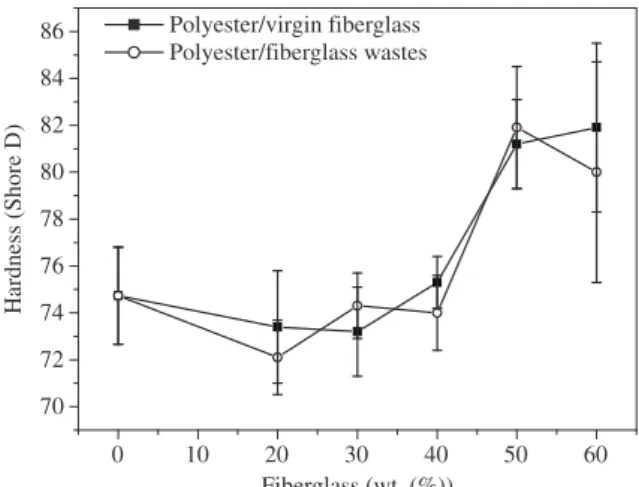
Table 1 shows the mechanical properties of neat polyes-ter, polyester/virgin fiberglass and polyester/fiberglass waste composites. Figures 1 to 4 show the result of tensile modu-lus, elongation at break, Izod impact strength and hardness respectively of pure resin and its composites with fiberglass. It can be observed in general that increasing both virgin fi-ber and fifi-ber waste content, the modulus also increases. As reported by Ozkoc et al.[5], the incorporation of fiberglass
im-proves the properties of the polymer materials. The modulus of the composite containing 40% of virgin fiber was much greater than that of both pure resin and polyester/fiberglass waste composites. It can be observed also that increasing fi-ber waste content up to 40%, the modulus increases by 20% when compared to pure polyester resin. This is interesting from the recycling point of view the final cost of the product and the smaller the amount of wastes thrown in the environ-ment. Figure 2 shows a decrease in elongation at break when the fiber content increases up to 40% for both virgin fibers and fiber wastes. This is according to the literature because the rigid fibers hinder the movement of the polymer chains. However, these results will be studied and reported later. Figure 3 shows the Izod impact strength of the composites. A significant increase in this property can be observed with the increase in fiber content in comparison to pure polyes-ter resin. It is inpolyes-teresting to observe that the composite with 50 wt. (%) of fiber waste presented a significant increase when compared to pure resin. This confirms the efficiency of these wastes as reinforcement for polyester resin composi-tes. For contents above 50 wt. (%), the impact property value decreases. This fact can be related with the high content of fiber and the poor dispersion and distribution of the fibers in the matrix. It seems that 50 wt. (%) of fiber constitutes a limit value to increase the properties. Figure 4 shows the hardness behavior of the composites. It is interesting to note that this property was not affected significantly by simply adding fiber
Table 1. Mechanical properties of polyester/fiberglass composites.
Samples Tensile modulus
(GPa)
Tensile strength
(MPa)
Elongation at break
(%)
Impact strength
(J/m)
Hardness
(Shore D)
Pure Polyester 1.1 ± 0.2 40.6 ± 4.9 5.1 ± 1.2 62.6 ± 11.5 74.7 ± 2.1 Polyester/virgin fiberglass
(wt. (%))
20 2.6 ± 0.2 36.2 ± 2.4 2.8 ± 0.4 227.0 ± 52.9 73.4 ± 2.4 30 2.5 ± 0.5 41.9 ± 0.9 3.1 ± 1.1 464.3 ± 82.2 73.2 ± 1.9 40 7.2 ± 0.2 64.4 ± 4.8 1.8 ± 0.1 645.1 ± 73.7 75.3 ± 1.1 50 0.1 ± 0.0 6.8 ± 0.9 13.5 ± 1.9 811.3 ± 2.0 81.2 ± 1.9 60 0.1 ± 0.0 9.5 ± 1.1 17.9 ± 2.0 809.9 ± 21.9 81.9 ± 3.6 Polyester/fiberglass wastes
(wt. (%))
20 1.9 ± 0.2 20.1 ± 0.9 1.8 ± 0.4 86.7 ± 11.7 72.1 ± 1.6 30 1.9 ± 0.1 26.2 ± 1.8 1.9 ± 0.3 122.9 ± 7.9 74.3 ± 1.4 40 2.0 ± 0.2 27.9± 3.1 1.8 ± 0.2 159.6 ± 30.8 74.0 ± 1.6 50 0.1 ± 0.0 3.2 ± 0.4 8.6 ± 0.8 385.8 ± 0.8 81.9 ± 2.6 60 0.1 ± 0.0 3.2 ± 0.3 9.0 ± 1.1 229.3 ± 42.1 80.0 ± 4.7
0 10 20 30 40 50 60
0 1 2 3 4 5 6 7 8
Polyester/virgin fiberglass Polyester/fiberglass wastes
T
ensile modulus (GP
a)
Fiberglass (wt. (%))
0 10 20 30 40 50 60
0 2 4 6 8 10 12 14 16 18 20 22
Polyester/virgin fiberglass Polyester/fiberglass wastes
Elong
ation at break (%)
Fiberglass (wt. (%))
Figure 2. Elongation at break of polyester/fiberglass composites. Figure 1. Tensile modulus of polyester/fiberglass composites.
to polyester up to 40 wt. (%) of fiber. Apparently, only above 40 wt. (%) of fiber an increase in the hardness with increase in fibers content was observed.
Araújo, E. M. et al. - Fiberglass wastes/polyester resin composites
334 Polímeros: Ciência e Tecnologia, vol. 16, nº 4, p. 332-335, 2006
0 10 20 30 40 50 60
70 72 74 76 78 80 82 84
86 Polyester/virgin fiberglass Polyester/fiberglass wastes
Hardness (Shore D)
Fiberglass (wt. (%)) Figure 4. Hardness of polyester/fiberglass composites.
0 10 20 30 40 50 60
0 100 200 300 400 500 600 700 800 900
Polyester/virgin fiberglass Polyester/fiberglass wastes
Izod impact strength (J/m)
Fiberglass (wt. (%))
Figure 3. Izod impact strength of polyester/fiberglass composites.
and its composites. As expected, the fiberglass is not hydro-philic and as the fiber content (20-40 wt. (%)) increases, water sorption decreases in the composite. This can indicate high stability of the composite for specific applications.
The fracture surfaces of the samples subjected to Izod impact strength tests were analyzed by scanning electron microscope (SEM) in order to investigate the microstruc-ture and extent of the adhesion between fibers and matrix. Figure 7 shows the micrographs of fracture surfaces of polyester resin and polyester/fiber composites containing 20, 30 and 40 wt. (%) of fibers. Figure 7a illustrates the brittle aspect of the matrix and in the other figures it can be seen that the fibers are debonded, leaving a dark region at the interface as reported by Ozkoc et al.[5]. Most of the
fibers were pulled-out from the matrix during deformation. Moreover, as the fiber content increases it is evident that the agglomeration of the fiberglass in the resin also increases. As a result of poor adhesion between the components, fai-lure has occurred at the interface of both, polyester/virgin fiberglass and polyester/fiberglass waste. For this reason, the mechanical properties did not increase sufficiently by the addition of the fiberglass to polyester. It is clear that
0 100 200 300 400 500 600
0.0 0.2 0.4 0.6 0.8 1.0 1.2 1.4
Polyester
Polyester/Fiberglass Wastes (20%) Polyester/Fiberglass Wastes (30%) Polyester/Fiberglass Wastes (40%)
W
ater sorption (%)
Time (h)
0 100 200 300 400 500 600 0.0
0.2 0.4 0.6 0.8 1.0 1.2 1.4
Polyester
Polyester/Virgin Fiberglass (30%) Polyester/Fiberglass Wastes (30%)
W
ater sorption (%)
Time (h)
Figure 5. Water sorption content of polyester resin with 30 wt. (%) of fi-berglass.
Figure 6. Water sorption content of polyester resin with 20, 30 and 40 wt. (%) of fiberglass wastes.
the use of fiberglass wastes in polyester matrix composites is viable for some applications as shown by the enhanced properties.
Conclusions
The effect of fiberglass wastes as reinforcement of polyes-ter matrix composites was studied. Incorporation of the was-tes in the composiwas-tes enhanced considerably the mechanical properties such as tensile modulus and impact strength. The-se results are evidence that the fiberglass wastes are an effi-cient alternative for the recycling and that they can be used as reinforcement for polyester matrix composites.
Acknowledgment
Araújo, E. M. et al. - Fiberglass wastes/polyester resin composites
Polímeros: Ciência e Tecnologia, vol. 16, nº 4, p. 332-335, 2006 335
References
1. Callister Jr., W. D. - “Materials Science and Engineering”, John Wiley & Sons, New York (1996).
2. Blass, A. - “Processamento de Polímeros”, UFSC, Florianópolis (1985).
3. Michaeli, W.; Greif, H.; Kaufmann, H. & Vosseburger, F. J. - “Tec-nologia dos Plásticos”, Edgard Blucher, São Paulo (1995). 4. Sutherland, L. S. & Soares, C. G. - Int. J. of Impact Eng., 31, p.
1 (2005).
5. Ozkoc, G.; Bayram G. & Bayramli, E. - Polymer, 45, p. 8957 (2004).
6. Filho, R. D. T. - “Reforços Naturais-Estrutura e Propriedades Mecânicas”, Pos-graduation Course PUC, Rio de Janeiro (1993).
7. Wu, S. H. ; Wang, F. Y.; MA, C. C. M.; Chang, W. C.; Kuo, C. T.; Kuan, H. C. & Chen, W. J. - Mat. Letters, 49, p. 327 (2001).
8. Lee, S. M. - “Int. Encyclopedia of Composites”, 1-6 (1991).
9. Carvalho, G. A.; Risson, P.; Vieira, S. L.; Zeni, M. & Zattera, A. J. - Polímeros: Ciência e Tecnologia, 3, p. 89 (1998).
10. Navarro, R. F. - “Materiais e Ambiente”, Ed. Universitária, João Pessoa (2001).
Enviado: 10/03/06
Reenviado: 25/09/06 Aprovado: 28/09/06 Figure 7. SEM photomicrographs of impact fractured surfaces (500x) of a) pure polyester and fiberglass reinforced polyester; b) 20 wt. (%) virgin fiberglass; c) 30 wt. (%) virgin fiberglass; d) 40 wt. (%) virgin fiberglass; e) 20 wt. (%) fiberglass wastes; f) 30 wt. (%) fiberglass wastes; and g) 40 wt. (%) fiberglass wastes.
(a) (c)
(b)
(e)
(d)
(g)