Mechanical and Microstructural Response of an Aluminum Nanocomposite Reinforced with
Carbon-Based Particles
José Manuel Mendoza-Duartea, Ivanovich Estrada-Guela,b*, Francisco Carlos Robles-Hernandezb,
Caleb Carreño-Gallardoa, Claudia López-Meléndezc, Roberto Martínez-Sáncheza
Received: October 14, 2015; Revised: June 1, 2016; Accepted: June 25, 2016
The present work deals with the study of some aluminum (Al) composites reinforced with metallized-graphite (MG) particles prepared by mechanical milling and powder metallurgy routes. Density, morphology evolution and mechanical performance of composites were investigated as a function of MG concentration and milling time. The as-milled powders were characterized by X–ray
difraction and optical/electron microscopy; meanwhile, the mechanical testing was carried out on
cylindrical specimens prepared from powders by powder metallurgy. Evidence reveals that high-energy ball milling induce a homogeneous dispersion of graphite nanoparticles in the Al matrix; this is related to an enhancement of hardness and strength response of studied composites. The composite sample with 0.5% MG addition (in weight) reached an increase of 40% on hardness and 50% on strength
(compared with pure Al sample); nevertheless an adverse efect was observed with longer milling and/or higher MG concentration.
Keywords: composites, high-energy ball milling, powder metallurgy
* e-mail: [email protected]
1. Introduction
Eforts have been made to development new aluminum
(Al) based materials for aerospace and aeronautical
applications. Some of the advantages ofered on those new
Al-base components include: better wear resistance, strength to rupture1-4, modulus5,6, thermal stability7, among others. The
aim of a composite material is to get a spectrum of properties that cannot be obtained by any of the constituent alone.
The engineering to design a composite aims to achieve properties that are superior to those observed in castings or forged products8,9. Metal matrix composites (MMC´s) are
fabricated by diferent methods such as: powder metallurgy10,
spray atomization, co-deposition, plasma spraying, stir casting1-4
and squeeze casting5, where the processing method has a
strong influence on the inal properties of the composites (e.g.
mechanical, tribological, etc.)11,12. Composites manufactured
by the casting route5,6,8 are usually challenging due to the
diferent nature of the reinforcement that may have poor
wettability and agglomeration problems13. Some reinforcements
are highly reactive particularly at high temperature, which induce unwanted reactions between components14. As a result
this can afect the strength of inal composite.
On the other hand, powder metallurgy reduces segregation, porosity, process temperature, grain size6, recrystallization rate5
and improves homogeneity of inal products15. The powder
metallurgy products can be consolidated by hot extrusion or
sintering10,11. Fiber or particulate graphite is recognized by
their high strength and low density16. This makes this type
of reinforcements attractive in the manufacturing of MMC´s, particularly Al-matrix composites, due to its low density, high workability and increased properties17.
A major goal of this work is to show that we have been
identiied a methodology to improve bonding between
particles, which in turn, minimize porosity and prevent undesirable chemical reactions8 that is accomplished by
mechanical milling (MM) resulting an high homogeneity
and grain size reining (100 nm or less)18-20. Experience
has shown that milling of Al and graphite is not the right processing method21. In fact, some authors have used copper,
silicon, magnesium and nickel-coated graphite as a ways to
improve difusion and bonding with the Al matrix: In the
case of nickel (Ni) addition, it serves as a stronger overcoat of the graphite particles, but Ni coating reacts with Al forming brittle NiAl intermetalics at the interface, reducing
signiicantly the toughness of the composites22. On the other
hand, copper was used to improve surface wettability and interface bonding between Al and graphite particulate, using a wet cementation process, unfortunately with the following drawbacks: agitating produced an uneven copper-coat on the surface of graphite particulates, great accumulation of particles at the rim of the reaction box due centrifugal force action and unwanted chemical reactions23. Here we show an
alternative mechanical method to improve the wettability of Al-graphite couple without the above disadvantages.
aCentro de Investigación en Materiales Avanzados – CIMAV, Laboratorio Nacional de Nanotecnología,
Miguel de Cervantes, No. 120, C.P. 31136, Chihuahua, Mexico
Mendoza-Duarte et al.
14 Materials Research
The mechanical and microstructural characterization of some Al matrix composites reinforced with copper coated graphite is described. Our method is unique in the sense that we discovered a route to cover copper with graphite giving quite promising results along with the fact that it is
cost efective, fast and in solid state.
2. Material and Methods
Preparation method is divided into two parts: a) synthesis of the reinforcement copper coated graphite (metallized graphite, MG), and b) Formulation of Al-MG composites. Raw materials are: graphite (99.9% purity and -850 +200
μm, in size), copper (99.5% -100 μm) and aluminum (99.5% -45 μm) in powder form.
2.1. MG preparation
A weighted mixture of graphite and metallic copper with the ideal composition tested before of 15 at. % Cu24 was
processed in a high-energy SPEX 8000M mill. The milling media was hardened steel vial and balls. The balls to powder ratio was 5 to 1 (in weight). Milling was accomplished after a period of 4h, under an inert argon atmosphere.
2.2. Composite preparation
The Al-MG composites were prepared by milling mixtures of Al powder and MG particles with the following concentrations: 0, 0.5 and 1.0 (in weight %). This second process was carried out in a ZOZ-CM01 Simoloyer device for times between 1 to 8 h. Methanol was added to as a control agent (0.8 wt. %).
2.3. Characterizations and Testing
Scanning electron microscopy (SEM) characterization
was conducted on a JEOL-JSM 7201F SEM/EDS. X-ray
diffraction (XRD) analyses were carried out using a PAN
analytical X´pert PRO diffractometer using a CuKα (λ
= 1.5405 Å). The density of the sintered specimens was calculated according to Archimedes’ method. Cold-consolidated samples were obtained by room temperature pressing (950 MPa) in a cylindrical die followed by sintering at 823K for 3h under an inert Ar atmosphere. Hardness tests were performed following the ASTM E18 standard using a Wilson Rockwell hardness meter
(model C503 R) using HRF scale (1/16” ball indenter
and 60 kgf of load) and compression tests were done in an Instron universal machine (model 4468); both test were achieved at room temperature (20°C). Using the experimental strain stress plot by triplicate, the mechanical behavior of samples was determined as the strength at the elastic limit.
3. Results and Discussion
3.1. Morphological analysis
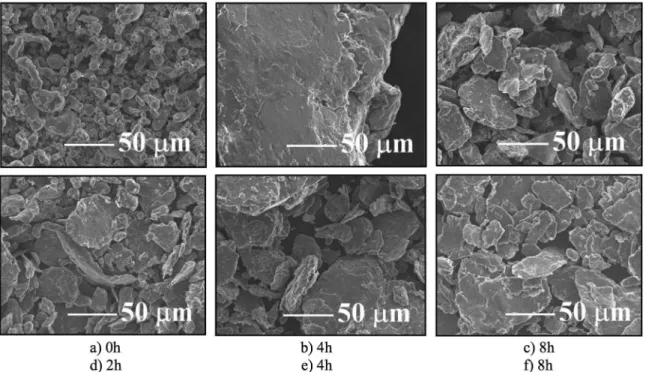
The initial particles (Figure 1a) present a spheroidal morphology characteristic of atomized metal powders. The particles milled for 4h (Figure 1b) are large due to a particle-particle weld process, forming big agglomerates. With further milling, the fracture of agglomerates (due hardening by cold working) reduces the particle size of the sample (Figure 1c). The Figure 2 shows the internal characteristics of the
particles (cross section), inding a typical convoluted lamellar
morphology at short milling times (Figs. 2a and 2c), after 8h of milling a more homogeneous structure with absence of coarser layers is evident (Figures 2b and 2d). As a general result, the composite particles become more homogeneous and isotropic with the milling process. Once the powders are
homogeneous in size, further milling can reine the layered
structure as Figures 2b and 2d show. On the other hand, the Al-0.5%MG composite does not form large particles even after 4h of milling (Figure 1e), with 8h of milling is noticeable that
particles get a flat morphology (Figure 1f). We attribute those changes to a modiication of the weld and fracture equilibrium
induced by the presence of the MG particles. The small
particles (white arrows) are identiied as the reinforcement
phase composed by copper and carbon (Figure 2c and 2d). MG particles were homogeneously distributed by trapping them between the ductile lamellae and surrounding by the Al matrix during the milling process (further milling means higher homogeneity), as was reported elsewhere16. Also, the
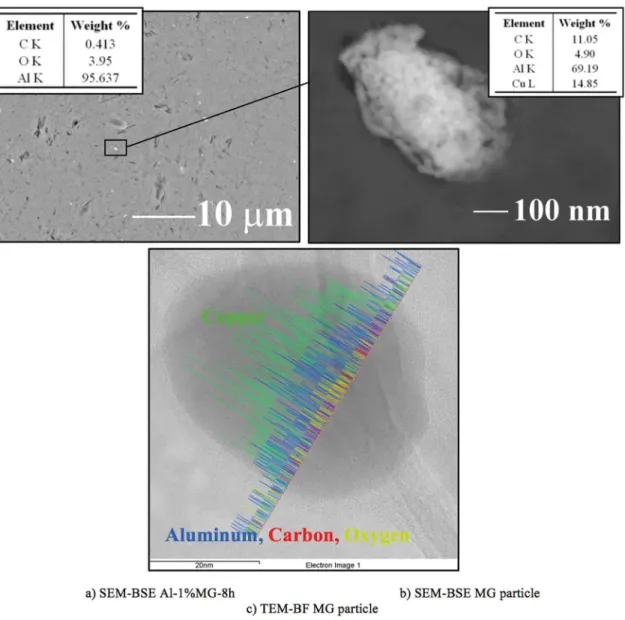
lamellar microstructure, homogeneity and MG distribution in the Al-1.0%MG composite was improved after 8h of milling. Figure 3a shows a close-up of a single MG particle, where
is possible to observe that this “single” particle is in fact
composed by a group of nanometric agglomerates. Through energy dispersive spectroscopy (EDS) elemental analyses we could identify the presence of carbon and copper on the matrix (Figures 3a and 3b). Figure 3c exhibits a transmission electron microscopy (TEM) micrograph of a particle showing its chemical composition of copper and carbon. Apparently, this thin layer of carbon is enough to maintain the copper particles insoluble during the sintering process; otherwise they would be easily dissolved due to the high solubility of copper in aluminum particularly at high temperature25.
3.2. X-Ray difraction
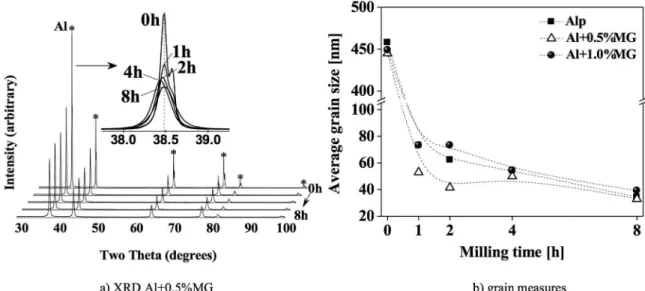
Figure 4a shows the XRD pattern of the Al-0.5%MG
composites in powder form, processed at diferent milling
times. The presence of the MG particles is not detected by XRD due to their low concentration. The intensity of the Al
reflections decreases with milling time, milling of ductile Al particles induces signiicant microstructural changes
Figure 1. SEM-SE micrographs of sample powders: Al and Al-0.5%MG composite at diferent milling times: a) 0h, b-e) 4h, c-f) 8h and d) 2h.
Figure 2. Cross section optical images of Al milled samples a) 1h and b) 8h. SEM-BSE micrographs of Al-1.0%MG composites milled
Mendoza-Duarte et al.
16 Materials Research
Figure 3. a) SEM-BSE micrograph of Al-1%MG-8h composite after sintering process, the tabulated data shows the general composition
of composite, b) SEM-BSE image of MG particle with its elemental composition and c) TEM-BF micrograph of a single MG particle showing the chemical distribution of components.
hardening and grain reining. The change in lattice parameter
is measured by the distortion and shift of characteristics Al
peaks. Variations in the Al (111) reflection are observed
in Figure 4 along with the grain size determination as a function of milling time and MG addition. The absence of shift suggests a limited presence of dissolved Cu into the Al matrix by milling. In the SEM micrographs (Figures 3a and 3b) the MG particles remain distributed within the Al matrix and they do not dissolve. In Figure 4b are given the
results of grain size based on the reflection (111) for Al.
This calculations were conducted using the Williamson-Hall method26. It is observed a clear reduction of the grain
size even for short milling times (1h). After this sharp reduction in grain size, it stays almost constant up to 8h of
milling; inal grain sizes are about 35 nm for further milled
samples. The presence of MG particles does not afect the
grain size evolution due these possible causes: There is a critical concentration of particles of second phase that allow a grain size reduction, in our study 0.5 and 1.0% (in weight)
apparently is not enough to induce further grain reining. If
we reach a minimum critical size, any addition of particles or further milling, induce an opposite behavior (grain growth).
3.3. Density
This parameter is measured as a general approach to assess the soundness of the mechanical performance
of specimens. Figure 5 shows the efect of milling time
Figure 4. a) XRD patterns of Al+0.5%MG composite after milling time with a close up on aluminum (111) main difraction peak and b)
composites grain measures calculated from Al (111) plane.
Figure 5. Density variation of sintered samples as a function of
the milling time and MG addition.
Figure 6. Mechanical response of composites: a) Hardness and b) strength as a function of milling time.
times (< 2h). These samples have a broad particle size distribution, which allows them to become denser due to a high interstitial occupancy by the smaller particles in the vacant spaces. Contrary, samples with 4h of milling present an important decrease in density caused essentially by poor packing of particles due their increased hardness by severe deformation27, this behavior has been previously reported28.
In addition, the presence of MG particles also afects the densiication, because the modiication of particle size
distribution due increased small particles generation. The
densiication in the studied samples reach values above
95% with respect to the theoretical. The exceptions are samples Al-4h, Al-8h and Al-0.50%MG-8h. Although a stable state was reached with the composites after 8h of
milling, this does not necessarily mean that densiication
Mendoza-Duarte et al.
18 Materials Research
density is negatively afected when the powder particles are
severely deformed by further milling resulting an increase of work hardening. Because, the particles with high levels
of plastic deformation do not compact eiciently (due their
reduced ductility), the samples reach low-density values due high porosity derived from poor compaction of powder particles as mentioned above.
3.4. Mechanical Testing
Sintered samples prepared from mixed powders (Al-0h, Al-0.5%MG-0h and Al-1.0%MG-0h) present lower hardness when are compared with their milled counterparts. In Figures 6a and 6b can be observed that both: milling
time and MG additions have a direct influence on the
mechanical properties of composites. For instance the hardness increased exponentially from 0 HRF in the raw samples to 28 (Al), 46 (Al-0.5%MG) and 36 (Al-1.0%MG)
after just 1h of milling, as the irst part of the plot shows
(Figure 6a). With 2h of milling, we reach the optimum processing time, where the mechanical properties are maximized for Al (52) and Al-1.0%MG (64) composite. Meanwhile the composite prepared with the composition Al-0.5%MG with 4h of milling reaches a value of 73 HRB (the highest hardness value of studied samples). The Figure 6b presents a graph of the strength of the composites as a
function of milling time. In the igure can be noticed that
the mechanical performance of the prepared composites is related with hardness and strength, show a similar behavior (dotted lines): values ranging from a minimum at 0h (un-milled samples), passing for an optimum (2 or 4h) showing a fall of the properties with 8h of milling. This pattern can be attributed to grain size reduction, increase of porosity, poor bonding between particles, etc. For this study, the highest strength in Al sample is 15 MPa and 17 MPa in the Al-1.0%MG composite, in both cases the best mechanical properties were observed in the samples milled for 2 h. On the other hand, the composite Al-0.05%MG presented the highest strength of all (20.6 MPa) with 4 h of milling. This represents a 37 % and a 24 % improvement in strength with respect to pure aluminum and the Al-1.0%MG composite.
4. Conclusions
The Al-MG composites produced herein demonstrated that milling improves homogeneity, grain size reduction and strength. The X-ray results show that there is no solid solution between Al and the added reinforcements, which is
observed by the lack of shifting of the Al (111) reflection. The
SEM studies show the microstructure changes as a function of the milling time and MG particles concentration. The TEM results demonstrated that the reinforcement particles (MG) are core-shell structures where the core is copper and the shell carbon, which prevents the dissolution of copper
by Al; however, this does not prevent the integration of the MG particles in the matrix having clear improvements in mechanical characteristics. The composite with the best mechanical properties is Al-0.50%MG milled for 4h having a hardness of 73 HRF and an elastic limit of 20.6 MPa. Further possessing and higher MG concentration cause a reduction of 43% on hardness and 50% on strength with respect to the
Al-0.5%MG. For Al (52 HRF/14.9 MPa) and Al-1wt%MG the (64 HRF/17.1 MPa) best mechanical properties were
found in the samples milled for 2h.
5. Acknowledgments
This research was supported by CONACYT (Project No. 169262). Thanks to D. Lardizábal-Gutierrez, W. Antúnez-Flores and E. Torres-Moye for their valuable technical assistance.
6. References
1. Achutha MV, Sridhara BK, Abdul Budan D. A reliability based stress–life evaluation of aluminium–graphite particulate composites. Materials & Design. 2008;29(4):769-774.
2. Xu Z, Ma L, Yan J, Yang S, Du S. Wetting and oxidation during ultrasonic soldering of an alumina reinforced aluminum–copper– magnesium (2024 Al) matrix composite. Composites Part A: Applied Science and Manufacturing. 2012;43(3):407-414.
3. Suresha S, Sridhara BK. Efect of silicon carbide particulates
on wear resistance of graphitic aluminium matrix composites.
Materials & Design. 2010;31(9):4470-4477.
4. Suresha S, Sridhara BK. Wear characteristics of hybrid aluminium matrix composites reinforced with graphite and silicon carbide particulates. Composites Science and Technology. 2010;70(11):1652-1659.
5. Yılmaz O, Buytoz S. Abrasive wear of Al2O3-reinforced
aluminium-based MMCs. Composites Science and Technology. 2001;61(16):2381-2392.
6. Yilmaz SO. Comparison on abrasive wear of SiCrFe, CrFeC and Al2O3 reinforced Al2024 MMCs. Tribology International. 2007;40(3):441-452.
7. Lipecka J, Andrzejczuk M, Lewandowska M, Janczak-Rusch
J, Kurzydłowski KJ. Evaluation of thermal stability of ultraine grained aluminium matrix composites reinforced
with carbon nanotubes. Composites Science and Technology. 2011;71(16):1881-1885.
8. Hashim J, Looney L, Hashmi MSJ. Metal matrix composites: production by the stir casting method. Journal of Materials Processing Technology. 1999;92-93:1-7.
9. Gudlur P, Boczek A, Radovic M, Muliana A. On characterizing the mechanical properties of aluminum–alumina composites.
Materials Science and Engineering: A. 2014;590;352-359.
11. Akhlaghi F, Pelaseyyed SA. Characterization of aluminum/
graphite particulate composites synthesized using a novel
method termed “in-situ powder metallurgy”. Materials Science and Engineering: A. 2004;385(1-2):258-266.
12. Akhlaghi F, Zare-Bidaki A. Influence of graphite content on
the dry sliding and oil impregnated sliding wear behavior of Al 2024–graphite composites produced by in situ powder metallurgy method. Wear. 2009;266(1-2):37-45.
13. Liao J, Tan MJ. Mixing of carbon nanotubes (CNTs) and aluminum powder for powder metallurgy use. Powder Technology. 2011;208(1):42-48.
14. Lahiri D, Hadjikhani A, Zhang C, Xing T, Li LH, Chen Y, et al. Boron nitride nanotubes reinforced aluminum composites prepared by spark plasma sintering: Microstructure, mechanical properties and deformation behavior. Material Science and Engineering: A. 2013;574:149-156.
15. Esawi AMK, Morsi K, Sayed A, Taher M, Lanka S. Efect of
carbon nanotube (CNT) content on the mechanical properties of CNT-reinforced aluminium composites. Composites Science and Technology. 2010;70(16):2237-2241.
16. Shamanian M, Mohammadnezhad M, Szpunar J. Texture analysis
of a friction stir welded ultraine grained Al–Al2O3 composite
produced by accumulative roll-bonding. Journal of Alloys and Compounds. 2014;615:651-656.
17. Silvestre N, Faria B, Lopes JNC. Compressive behavior of CNT-reinforced aluminum composites using molecular dynamics.
Composites Science and Technology. 2014;90:16-24.
18. Suryanarayana C. Mechanical alloying and milling. Progress in Materials Science. 2001;46(1-2):1-184.
19. Hassan MTZ, Esawi AMK, Metwalli S. Efect of carbon nanotube
damage on the mechanical properties of aluminium–carbon nanotube composites. Journal of Alloys and Compounds. 2014;607:215-222.
20. Kim WJ, Lee SH. High-temperature deformation behavior of
carbon nanotube (CNT)-reinforced aluminum composites and prediction of their high-temperature strength. Composites Part A: Applied Science and Manufacturing. 2014;67:308-315.
21. Robles Hernández FC, Calderon HA. Nanostructured Al/Al4C3
composites reinforced with graphite or fullerene and manufactured by mechanical milling and spark plasma sintering. Materials Chemistry and Physics. 2012;132(2-3):815-822.
22. Ted Guo ML, Tsao CYA. Tribological behavior of aluminum/ SiC/nickel-coated graphite hybrid composites. Materials Science and Engineering: A. 2002;333(1-2):134-145.
23. Yang JB, Lin CB, Wang TC, Chu HY. The tribological
characteristics of A356.2Al alloy/Gr(p) composites. Wear.
2004;257(9-10):941-952.
24. Estrada-Guel I, Carreño-Gallardo C, Cardoso-Cortés JL,
Rocha-Rangel E, Herrera-Ramírez JM, Martínez-Sánchez R. Efect of
metallic addition on mechanical properties in an aluminum– graphite composite synthesized by means of mechanical milling.
Journal of Alloys and Compounds. 2010;495(2):403-407.
25. ASM International. ASM Handbook Volume 3: Alloy Phase Diagrams. 10th ed. Materials Park: ASM Internation; 1992.
26. Williamson GK, Hall WH. X-ray line broadening from iled
aluminium and wolfram. Acta Metallurgica. 1953;1(1):22-31.
27. Razavi Hesabi Z, Simchi A, Seyed ReihaniSM. Structural evolution during mechanical milling of nanometric and micrometric Al2O3 reinforced Al matrix composites. Materials Science and Engineering: A. 2006;428(1-2):159-168.
28. Fogagnolo JB, Robert MH, Ruiz-Navas EM, Torralba JM. 6061 Al reinforced with zirconium diboride particles processed by conventional powder metallurgy and mechanical alloying.