THE IMPACT OF BLOCKING THE ACTIVATION OF FACIAL
MUSCLES IN THE PROCESSING OF SUBSEQUENT
EMOTIONAL INFROMATION, AND ITS MECHANISM
Ana Maria Basílio Cabral Domingos
Tese orientada por
Proferssora Doutora Teresa Garcia-Marques ISPA – Instituto Universitário
e
co-orientada por PhD. Paula Niedenthal
Centre National de la Recherche Scientifique e University of Wisconsin-Madison
Tese submetida como requisito parcial para obtenção do grau de
Doutoramento em Psicologia
Área de especialidade... Psicologia Cognitiva
Tese apresentada para cumprimento dos requisitos necessários à obtenção do grau de Doutor em Psicologia na área de especialização de Psicologia Cognitiva realizada sob a orientação de Teresa Garcia-Marques e co-orientação de Paula Niedenthal, apresentada no ISPA - Instituto Universitário no ano de 2012.
O presente trabalho foi financiado pelo Programa Operacional Ciência e Inovação (POCI 2010) da Fundação para a Ciência e Tecnologia (SFRH/BD/ 28950 / 2006).
Acknowledgments
I would like to express my endless gratitude to my parents, Bernarda and Aníbal for their unconditional support in countless ways and their love.
I am also thankful to my niece, Andreia, who always cheered me up, with her peculiar sense of humour. Also a word of gratitude to Diana Tavares and Mónica Frechaut who had the patience to hear me whenever I was down, always saying words of encouragement. Thanks to all my friends who always told me to believe in me: Marta Coelho, Helena Pires and Helena Patrício. For Pedro Barão without him I could never make it this far and always told me the best to do. I also thank Pedro Frada, for their unwavering faith in me. Thanks to Ricardo Matuto for bringing a new perspective on life.
To Alexandre Fernandes, David Rodrigues, Hugo Alves, Mariana Miranda, Inês Dias, Marilia Prada, Pedro Silva, Ricardo Fonseca, Rita Ricot, for their emotional support, comforting words in difficult moments and also for their brilliant insights on this thesis. I also would like to express my eternal gratitude to Ricardo Fonseca who got the software of analysis without which it was not possible to make this thesis. Also to Alexandrande Fernandes, who trained me in EMG data collection and shared his absolutely precious knowledge about data analysis.
Also a thank you word for other with whom I shared this road: Ana Rita Farias, Cátia Cunha, Cristina Sanches, David Kellen, Leonel Garcia-Marques, Ludmila Nunes, Margarida Garrido, Mário Ferreira, Rita Jerónimo, Rui Costa, Sara Hagá, Sofia Santos, Tânia Ramos, Tomás Palma.
I thank FCT for giving me all the tools to pursue this thesis and greet it for its mission that allows Portuguese science to develop. Also to ISPA, in particular to UIPCDE and Laboratório de Psicologia that put at my disposal every possible mean available to accomplish this complex task as a PhD is. My word to Ana Cristina Quelhas, Jorge Senos, Maria Gouveia-Pereira and Csongor Juhos.
To Paula who shared with me and Teresa her sharp thoughts, and above all, her availability to comment the thesis even during the moving to the USA.
A very special word to Teresa e for her guidance, honesty, brightness, accuracy and comprehension throughout this project, and the countless hours of effort devoted to this work, even in the most unlikely/ “inappropriate” occasions of the year.
Palavras-chave:
Corporalização; primação; expressão facial; bloqueamento
Key words:
Embodiment; priming; facial expression; blocking
Categorias de Classificação da tese
PsycINFO Classification Categories and Codes:
2300 Human Experimental Psychology 2340 Cognitive Processes
2343 Social Psychology 2360 Motivation and Emotion 3000 Social Psychology
ABSTRACT
In this thesis we focus on how previous activation of the representation of an emotional state impacts the processing of subsequent emotional information (within a priming paradigm). Our approach is guided by an embodied perspective on cognition. According to embodied cognition theories, affective representations are partial simulations of emotional experience (Niedenthal, Barsalou, Winkielman, Krauth-Gruber, & Ric, 2005). Among other simulations, re-enacting an emotion may involve the activation of correspondent facial motor activation. In the present work, we directly approach the hypothesis that facial muscle activation has a role in emotional category priming effects within a blocking paradigm. However, because blocking may still allow partial muscle activity, we first address muscular specificities of a facial muscular blocking procedure.
Our first experimental approaches aimed to establish the proper methodology used to test our hypothesis. Experiment 1 addresses our hypothesis within an emotional category priming paradigm similar to the one used by Carroll and Young (2005) and, establishes the proper temporal window to observe the effect. Resutls show a general emotional priming effect, such that all emotional faces impacted all, and only, emotional targets judgment (both congruent and incongruent). This indicates that perceiving emotional primes facilitates emotional judgments of emotional stimuli in general.
Our second Experiment aimed to define the muscular specificities of a blocking procedure (Niedenthal, Brauer, Halberstadt, & Innes-Ker, 2001) necessary to address the role of muscle activation in the observed priming effects. Assuming that the blocking procedure may exert different influences on different muscle’s activation, we characterized this procedure in terms of promotion of muscle activation over zygomaticus major, orbicularis
oris and corrugator supercilii. Results corroborate that blocking exerts different effect for
different muscles, suggesting that its effect on emotion priming effects may be moderated by the type of emotion primed.
Experiment 3, replicated the procedure of Experiment 1, including an additional blocking condition, in order to test the embodiment hypothesis. In this experiment, as well as a general emotion priming effect, we also found some evidence of category emotional priming effects qualified by type of emotion. There was a clear congruency effect for happiness, and a generalized effect for sadness (both for congruent and incongruent trials). As expected, these effects suffered an interference from the facial muscle blocking manipulation (Niedenthal et al., 2001). This supports the hypothesis that muscle facial activation plays a role in the mechanism through which emotional category priming effect occurs. However, under blocking conditions, priming effects only disappeared for happy prime-target pairs. Priming effects became stronger for sadness and anger. These differences seem to be explained by the fact that the blocking procedure (Experiment 2, 4 and 5) has a preponderant blocking impact over the zygomaticus major (the muscle of smiling), and a different impact over muscles associated with other emotions. As it becomes more clear in Experiment 4 and 5, blocking manipulation increased the variability observed in the orbicularis oris, activation. We, thus argue that these different effects of blocking explain why negative emotions may have had a stronger priming effect in Experiment 3, under blocking.
Results are discussed in terms of implications for embodiment theories and in terms of methodological implications for futher research making use of blocking procedures.
Index
Overview 1
Section I 5
Chapter I: Emotion representations and emotion perception 7
The representation of emotions 7
Somatosensory impact on emotion 8
Somatosensory activation role on the perception of emotions 10 Somatosensory activation by emotional constructs 13 Chapter II: Somatosensory activation role in subsequent processing 17
Priming emotions 17
Affective priming 18
A categorical perspective: Emotional priming 19
Mechanisms accounting for priming effects 22
Spread of Activation Account 22
Compound Cue Theory 23
Response Competition 24
The Affective-Matching Mechanism 25
Priming in an embodied perspective 26
Chapter III: Facial muscles’ activity as embodiment of emotion constructs.
Some methodological issues 31
Human facial muscles and emotion 31
Measurement of muscle activity 35
Manipulations of facial activity: expression and blocking 37
Blocking: Inhibition of muscle activity 39
Methodological adaptation of the priming procedure ina an EMG study 41
Section II: Empirical Section 43
Experiment 1: Priming emotion category effect 46
Method 46
Participants and Design 46
Material 47 Primes 47 Targets 47 Procedure 48
Results and Discussion 49
Reaction times 49
Accuracy of responses 50
Experiment 2: Pilot study of the Niedental et al.’s (2001) blocking procedure 52 Method 53
Procedure 53
EMG measurement 54
Results and Discussion 55
Experiment 3: Blocking the priming emotion category effect 57 Method 57
Participants and Design 57
Material 58 Procedure 58 Results 59
Reaction Times 59
Analysis of the pattern of results obtained in Experiment 1 59
Blocking effect 61
Accuracy 64 Discussion 64 Experiment 4: Testing muscle change hypothesis requesting voluntary facial
expressions 65
Method 66
Partcipants and Design 66
Procedure 66
EMG measurement 67
Results and Discussion 67
Experiment 5: Testing muscle change hypothesis under involuntary
conditions of muscle activation 72
Method 72
Partcipants and Design 72
Materials 72 Procedure 73
Results and Discussion 73
General Discussion 79
References 89
Appendixes 105 Appendix A: Pre-testing emotional and non-emotional targets 107 Appendix B: Pre-testing of emotional face primes 113 Appendix C: Statistics for words and facial expressions per condition 121
Appendix D: Statistics of Experiment 1 127
Appendix E: Statistics of Experiment 2 129
Appendix F: Statistics of Experiment 3 131
Appendix G: Statistics of Experiment 4 135
Index of Figures
Figure 1. Facial Muscles 32
Figure 2. Electrode placements for surface EMG recording of the facial muscles 37
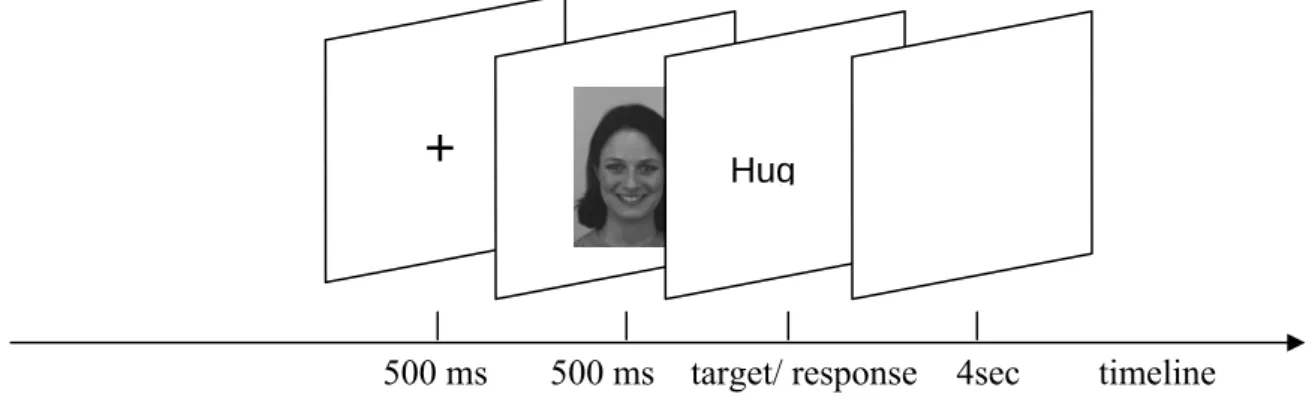
Figure 3. Procedure of Experiment 1 48
Figure 4. Interaction: Presence of the prime x Relation Prime – Target in Experiment 1 50
Figure 5. Measured muscles 53
Figure 6. Niedenthal and colleagues’ (2001) blocking procedure 54 Figure 7. Interaction: Muscle x Mimicry in Experiment 2 56 Figure 8. Interaction : Relation Prime-Target x Primed Emotion in Experiment 3 60 Figure 9. Interaction: Relation Prime-target x Primed Emotion, for primed trials in
Experiment 3 60
Figure 10. Interaction: Relation Prime-target x Primed Emotion, for non-primed trials
in Experiment 3 61
Figure 11. Interaction: Presence of the prime x Primed Emotion, for free individuals in
Experiment 3 63
Figure 12. Interaction: Presence of the prime x Primed Emotion, for blocked
individuals in Experiment 3 63
Figure 13. Interaction: Muscle x Expression in Experiment 4 68 Figure 14. Interaction : Muscle x Mimicry in Experiment 4 69 Figure 15. Interaction: Mimicry x Expression, for Zygomaticus in Experiment 4 70 Figure 16. Interaction: Mimicry x Expression, for Orbicularis Oris in Experiment4 70 Figure 17. Interaction: Mimicry x Expression, for Corrugator Supercilii in
Experiment 4 71
Figure 18. Interaction Muscle x Mimicry in Experiment 5 74 Figure 19. Interaction: Mimicry x Expression, for Zygomaticus in Experiment 5 75 Figure 20. Interaction: Mimicry x Expression, for Orbicularis Oris in Experiment 5 76 Figure 21. Interaction: Mimicry x Expression, for Corrugator Supercilii in Experiment 77
Overview
Processing emotional information is a task we perform more or less automatically in our daily lives. In looking people’s faces we are able to perceive their emotional experiences seemingly effortlessly and this is shown in an impressive number of studies (Buck, 1988; Darwin, 1872; Ekman, 1982; Ellison & Massaro, 1997; Fridlund, 1992; Frijda, 1969; Izard, 1980; Russell & Bullock, 1986; Wallbott & Ricci-Bitti, 1993; Young, Rowland, Calder, & Etcoff, 1997). In this thesis we focus one of the factors that is related with how we perform this kind of task, and how we do it more or less easily: previous activation of the emotional state in ourselves (Niedenthal, Brauer, Halberstadt, & Innes-Ker, 2001; Niedenthal, Halberstadt, Margolin, & Innes-Ker, 2000). On studying this issue we focus on what an emotion is and how we are able to perceive it in others.
Several lines of research focus on the processing of emotional stimuli from different perspectives on the cognitive representation of emotions. According to a number of authors (see Bower, 1981; Ingram, 1984; see Niedenthal, 2008 for a review; Teasdale, 1983), the representation of emotion is similar to the representation of any other concept (e.g. as semantic associative networks). However, as other authors (e.g. Lang, 1984; Niedenthal, Setterlund, & Jones, 1994), early noticed, there are some limitations of those semantic network models in explaining the complexity of emotional information. The components of emotion knowledge such as bodily aspects or physiologic activation seem to be well accounted by modern embodied theories (Barsalou, 1999; Clore & Schnall, 2008; Damasio, 1999; Decety & Jackson, 2004; Gallese, 2003; Glenberg, 1997; Niedenthal, Barsalou, Winkielman, Krauth-Gruber, & Ric, 2005; Semin & Cacioppo, 2008). Because of this, in the present thesis, we endorse this perspective. This perspective holds that representations in general and representations of emotion in particular involve the process of re-enacting and integrating modality-specific states (in motor, somatosensory, affective and reward systems that stands for the meaning of the emotion) generated during the original experience of the concept or emotion (Niedenthal, Mermillod, Maringer, & Hess, 2010), rather than re-describing them into abstract symbols that represent referents.
Embodied approaches to emotion perception have suggested that it may involve a motor simulation of the observed facial expression in the percipient’s face (motor simulation). Here we focus on this as a possible mechanism that explains why previous
activation of an emotion in the perceiver may facilitate perception of others’ emotional expressions. In fact, a number of reported findings suggest that mimicry plays an important role in the perception of other’s facial expression (Niedenthal et al., 2001; Oberman, Winkielman, & Ramachandran, 2007; Stel & van Knippenberg, 2008) although several recent studies suggest that mimicry is not a necessary condition for emotion perception (Adolphs, 2002; Calder, Keane, Cole, Campbell, & Young, 2000; Keillor, Barrett, Crucian, Kortenkamp, & Heilman, 2002; McIntosh, 2006) because contextual effects of previous knowledge or expectancies may play a role when simulation is not able to occur (Niedenthal et al., 2010).
By focusing on previous activation of emotional components (the emotional concept or muscles’ activation) in emotional perception we helped to clarify the assumptions made by the embodied perspective (Winkielman, Niedenthal, & Oberman, 2008, for a review) and take a critical view of one of its most relevant methodological procedures: the blocking mimicry procedure (Niedenthal et al., 2001).
In order to motivate the present research, in Chapter I we explore the notion of affective representation and how it is conceived within an embodied perspective. Chapter II focuses on the effect known as emotional category based priming, which shows how the previous activation of an emotion feature interferes with the perception of subsequent emotional stimuli. We give special attention to the previous activation of facial muscles (one of such features), and develop the idea that prior activation of muscles relevant to an emotion can be a mechanism that explains affective priming phenomena. Chapter III aims to introduce the reader to one of the most popular methodological procedures to study facial muscle activation role on concept’s perception: the blocking of facial expressions.
In Section II, we then present a set of empirical studies, designed to establish whether embodied approach engaging facial muscle activation can account for emotional priming phenomena. The first experiment establishes a temporal window in which a category based emotional priming effect can be found, allowing the test of our hypothesis by the use of a muscle blocking paradigm. We expected that by blocking muscle activity we would change the pattern of the observed priming effects. Before running an experiment providing evidence that mimicry has a role on that effect we wanted to understand the muscular specificities of a blocking procedure (Niedenthal et al., 2001). A pre-test was therefore conducted on the consequences of the blocking manipulation for muscular activation as assessed by EMG. This study characterize the blocking procedure in terms of promotion of
muscle activation over zygomaticus major, orbicularis oris and corrugator supercilii (hyper or hipoactivation). Experiment 3 replciates Experiment 1 adding to it a blocking condition and the two subsequent studies explored other blocking effects on muscle activity in order to better understand the mechanism through which the manipulation produced different results across different emotions in the priming task.
The dissertation then ends with a discussion of the theoretical and empirical issues related to our studies, integrating them in the knowledge already established and in questions to be explored in the future.
Chapter I: Emotion representations and emotion perception
Perceiving is a process that involves the activation of previous knowledge (Postman, Bruner, & McGinnies, 1948). Perception of an emotion is not an exception. Our knowledge of what an emotion is and what constitutes as specific category of emotions guides our perceptions. But how is that knowledge accessed when we perceive an emotion on another’s face?
The answer to this question is not straightforward. It is dependent upon how we conceive knowledge representation. In the present chapter we discuss the notion of affective representation and how it is conceived from an embodied perspective. Within this framework we introduce the emotional category based priming effect, giving special attention to the prior activation of facial muscles.
The representation of emotions
Pure cognitive approaches to emotional information processing have argued that emotion information is no different from other cognitive information. One such approach is represented by the semantic information models. In this group of models: semantic network models of emotion (see Bower, 1981; Ingram, 1984; see Niedenthal, 2008 for a review; Teasdale, 1983), assumes units of representation - concepts (also called nodes) that transduce information in propositional form. Each emotion is represented by a set of nodes. Nodes are linked by pathways that reflect the strength of their semantic association (Collins & Quillian, 1969). When an emotion is experienced, a relevant node is activated and this activation spreads to associated nodes, which can be bodily features of the emotion, its antecedents or other related features.
Cognitive theories have in common the idea that representations are amodal, not preserving analogical features of the perceptual experience. Representations result from the process of redescribing the modality-specific states, generated during the original experience, into abstract symbols that represent referents (Barsalou, 1999). Emotional representation contents, in these pure cognitive models, such as eliciting stimulus, meaning, and emotional responses are stored in a propositional form, which means that an internal symbol stands for a referent which is an internal or external experience previously occurred (Breckler & Wiggins, 1989; Zajonc & Markus, 1984). Even physiological response patterns
that are known to occur in emotional experiences are assumed to be stored in a proposition-based network.
Pure cognitive models of emotion representations have been criticized (e.g. Isen, 1984; see Leventhal & Tomarken, 1986 for discussion) for their poor account of the richness of emotional experience with the assumption that it is plausible that codes other than propositional may preserve somatosensory aspects of experience. Cognitive models lose their power by assuming this somatosensory experience rising from a bidirectional link (Bower, 1981), which signal a potential activation of physiological patterns and subjective state through emotional thoughts and vice versa. This would mean that words and ideas about emotions should activate emotions themselves (Lang, 1984). Emotions are not always primed by words or propositions referring to them (Niedenthal et al., 1994).
An alternative view is offered by embodied theories of cognition. The general idea of these models is that representations of knowledge are grounded in modality-specific systems (Barsalou, 1999; Clore & Schnall, 2008; Damasio, 1999; Decety & Jackson, 2004; Gallese, 2003; Glenberg, 1997; Niedenthal et al., 2005; Semin & Cacioppo, 2008). When the concept is activated, this would involve a partial simulation of the original state generated during the experience with the object (those could be introspective states, perceptual states or motor states). In this approach, processing emotionally charged information involves reactivating part of neural states that occurred when one experienced that emotion or processed a particular emotional cue (Niedenthal, 2007). As an example, activating the concept of happiness, would involve simulating happiness itself, including its somatosensory manifestations such as its specific mimicry, postural features (upright position), and so forth.
Evidence supporting an embodiment approach relative to a pure cognitive one, rises from different fields focusing somatosensory: a) impact on emotions; b) activation in perception of emotions and c) activation by emotional constructs.
Somatosensory impact on emotion. Various studies have shown that embodied simulation can have an impact on the emotional state of the inidvidual. One modality of simulation specifically relevant in the case of emotions is facial mimicry. Two facial muscles are frequently manipulated, in this respect. The zygomaticus (which pushes up lip corners to create a smile) and the corrugator supercilii (which knits the eyebrows to form a frown) which are involved in, respectively, a positive and a negative reaction (Cacioppo, Petty, Losch, & Kim, 1986; Dimberg, 1990). Several studies have suggested that the
contraction of facial muscles is able to initiate/ modulate the subjective experience of the individual. This facial feedback hypothesis (for a review see Adelmann & Zajonc, 1989; McIntosh, 1996) was tested by experiments that induced participants to pose or suppress a facial expression. These studies have shown that different facial expressions influence both the reports of what emotions are felt and their physiological responses. In one of such studies Lanzetta, Cartwright-Smith and Kleck (1976) submitted the participants to series of electrical shocks that varied in terms of intensity, and which aversiveness was announced before its administration. Half of them were asked to suppress or to exaggerate the facial expression during the announcement period. Both self-reports of shock painfulness and skin conductance were measured. Findings showed that the concealing of expressive responses decreased the magnitude of skin conductance changes and subjective reports of painfulness relative to the free expression or exaggeration conditions (see also, Kopel & Arkowitz, 1974). In another study, (Laird, 1974) participants were instructed to adopt facial displays (of happiness and anger) while they watched positive and negative slides. The instructions that induced facial expression did not mention the term facial expression or any association with emotions, leading participants to believe the experiment concerned “the activity of facial muscles under various conditions” during perception. The participants were attached to electrodes allegedly measuring muscular activity. For anger expressions the participants were requested to “touch lightly the electrodes between the eyebrows”, then to contract these muscles. After this, they were asked to “touch lightly the electrodes at the corners of the jaw and then contract these”. For inducing the happy pose, the participants were instructed to “touch lightly the electrodes near the corners of the mouth and contract these muscles”. Findings showed that smiling participants felt happier when viewing positive slides (children playing) and frowning participants felt more anger when viewing negative slides (members of the Ku Klux Klan). However mismatching pairs of expressions and slides produced an attenuation of participants’ feelings.
Another study that provides evidence in favour of the feedback hypothesis is the already classic of Strack’s team (Strack, Martin, & Stepper, 1988). It was this work that introduced the procedure of inducing facial expression, by asking participants to put a pen in the mouth, with its top out, while holding it with the teeth (inducing a smile) or with the lips (preventing the smile). While performing this task, individuals were exposed to a humorous cartoon. Participants reported increased amusement while covertly induced to smile (teeth
condition) than in the lip condition. A comparable procedure was also tried with negative emotions by Larsen, Kasimatis, and Frey (1992), who attached two golf tees to participant’s brow region, specifically above the inner corner of the eye. In order to produce a sad facial expression, the participants were instructed to try to bring the ends of the tees together. When an inhibition of sad expression was required, the instruction involved keeping the ends of the golf tees apart from each other. This task was performed while participants were exposed to unpleasant slides, which caused the participants to feel sadder when accompanied by the instruction to bring the tees together, that is, the production of a sad expression.
Another set of experiments extended the type of emotions that can be induced by facial feedback. Duclos, Laird, Schneider, Sexter, Stern, and Van Lighten (1989) gave participants instructions that covertly induced facial expressions of fear, anger, disgust, and sadness while they were exposed to neutral tones. In all cases, the expressions were generated by a muscle-by-muscle contraction induction. Subsequently participants rated their feelings on emotion scales. As predicted by a facial feedback account, each expression increased the self report of feelings of its particular emotion compared to the remaining.
The impact of muscle activation in reported emotions has a ecological version in Zajonc, Murphy and Inglehart (1989) study. In this study participants had to pronounce among other control sounds, the vowel ü, which should inhibit smile or e than should result in a muscle configuration similar to a smile. The authors found that participants who had the task to pronounce the sound ü reported worse mood, compared to those in the control condition (who pronounced o) and in the e condition. Those who pronounced e as well as reported better moods than ü, also differed from controls.
Taken together, these studies demonstrate that the activation of a somatosensory state is able to trigger by itself an emotional experience or bias it. This is consistent with the general idea of the embodied perspective that holds that emotional experience could be grounded in a previous partial re-enaction of a modality-specific state (such as facial motor behaviour in this case).
Somatosensory activation role on the perception of emotions. Evidence that somatosensory activation exerts a role in perception of emotions comes from the studies that suggest mimicry has a role in our ability to perceive other’s emotions (Niedenthal et al., 2001; Oberman et al., 2007; Stel & van Knippenberg, 2008). Strong evidence of this is presented by, Dimberg (Dimberg, 1982, 1990, 1997; Lundqvist & Dimberg, 1995), whose
studies have demonstrated that perception of an emotional face activates muscular activity in the perceiver. In an initial experiment (Dimberg, 1982) participants were exposed supraliminarly to series of happy and angry emotional facial expressions. The results revealed an increased zygomatic region’s (associated to smile) activity to happy stimuli and increased corrugator region’s (associated to frown) activity to angry stimuli. The experiment was replicated with subliminal exposures of the emotional expressions (Dimberg & Thunberg, 1998; Dimberg, Thunberg, & Elmehed, 2000; Dimberg, Thunberg, & Grunedal, 2002) suggesting that the effect has the characteristics of an automatic process. This automaticity received further support in Dimberg and colleagues’ (2002) study. In this study participants were presented with pictures of facial expressions (that could be of anger or happiness) and asked either to react or not to them immediately. The reactions consisted in wrinkling eyebrows (promoting a frown) or elevating the cheeks (promoting a smile). Faster responding to the stimuli occurred when the facial instruction matched the facial expression in the picture. Relevant to the argument of automaticity, even when subjects were told not to react, electromyographic activity was differentiated over the corrugator and zygomaticus as a function of the emotion that was being perceived.
Along with these correlational data pointing to the involvement of mimicry in the perception of facial expressions, there is also causal evidence that this activation facilitates perception of emotional facial expressions (Niedenthal et al., 2001; Oberman et al., 2007; Stel & van Knippenberg, 2008). Niedenthal and colleagues (2001) reported evidence of the role of mimicry in the perception of facial expression in a study in which participants were requested to identify the transition point of a face in a morph video moving from one facial expression (happy) to a different one (sad) and vice versa. During this task, one group of participants was prevented from mimicking with a procedure that involved holding a pen
sideways with teeth and lips slightly. The other half was free to mimic. Participants whose
mimicry was blocked by the pen procedure were less efficient in detecting the transition of the facial expression, such that this change was detected later than the group of participants who was free to mimic. This result supports the claim that mimicry has a role in the recognition of facial expressions. Oberman and colleagues (2007) also found supportive evidence for the role of muscle activity in perception of another’s smile. These researchers exposed participants to a set of pictures conveying happiness, sadness, fear and disgust at different levels of intensity, each one for a duration of 500ms. Participants performed a
forced-choice identification task. Results showed that participants were more accurate at
recognizing smiling but not other facial expressions when mimicry was free than for
mimicry was blocked. Also using a mimicry constraining paradigm, Stel and Knippenberg, (2008) presented participants with photos of individuals expressing positive and negative emotions for 67ms each. Subjects judged the valence of the expression by pushing a button corresponding to positive emotion vs. negative emotion. Participants who were instructed to clench their teeth were slower in making a response, than those who were free to mimic.
Together these studies add support to the claim that mimicry has a role in processing, this time not in the triggering of emotion itself but in its perception.
However this role does not seems to be one of a “necessary condition”. In fact some evidence shows that mimicry is not a necessary condition to emotion recognition. Blairy, Herrera and Hess (1999) developed an experiment in which participants rated a series of videos of persons expressing anger, sadness, disgust, and happiness. EMG activity was recorded over muscles relevant for each emotion. Although this measurement revealed that participants mimicked all types of expressions, a mediational analyses did not reveal a relationship between mimicry and emotion recognition. Consistent with this claim is the behaviour observed in autistic individuals. Whereas McIntosh and colleagues (McIntosh, Reichmann-Decker, Winkielman, & Wilbarger, 2006) showed that autistic individuals, when confronted with happy and angry photos, do not spontaneously mimic them, Spezio and colleagues (Spezio, Adolphs, Hurley, & Piven, 2007) observed that they are able as normal individuals to categorize facial expressions. The fact that this individuals do not spontaneously mimic, but are able to recognize emotions casts doubt in the role of mimicry for the process, reinforcing the idea that mimic does not seem to be a pre-requisite to perceive other’s emotions.
Further support for this doubt is offered by studies with participants with facial paralysis (e.g. Calder et al., 2000a; Calder, Keane, Manes, Antoun, & Young, 2000; Keillor et al., 2002). For example, Calder and his team (2000) worked with subjects with Moebius Syndrome. These individuals did not reveal increased level of errors in recognizing static photographs (in a forced choice task) or vocal expressions of six basic emotions (happiness, sadness, anger, fear, disgust, and surprise) compared to controls.
Because they imply that mimicry is not a necessary condition to emotion recognition, these studies raised the question of when individuals use facial simulation and when they use other cues (perceptual cues, experiential cues, and conceptual knowledge) to interpret facial
expressions. This question is in the root of the emergence of SIMS model (Niedenthal et al., 2010) which focuses on the particular case of the interpretation of smiles. The SIMS model states that the perception of a smile activates the amygdala, which in turn increases the probability of eye contact, which will be responsible for triggering the embodied simulation. However, there are many situations in which eye contact is not achieved, or mimicry is inhibited, for experimental or social reasons. In those cases, processing focus on perceptive features of the smile is in charge, and the individuals perform a match between the perceived smile and stored perceptual representation of previous experienced smiles. In cases, such as in socially inhibited mimicry, it may be that simulation is not completely impaired, so that conceptual knowledge may influence judgment via embodied simulation.
Somatosensory activation by emotional constructs. The emotional lexicon is also able to preserve something about the actual experience of emotion. This is suggested by work of Mendolia and Kleck (1993) who observed that the manner in which a person describes an event shapes the reaction to the same event in a later point in time. Also Halberstadt and Niedenthal (2001) demonstrated that perceptual memory for ambiguous facial expressions was influenced by the presence of a word label accompanying the previous exposure to the face (Halberstadt & Niedenthal, 2001). These studies seen from the embodiment sight, point out the possibility of words being simulators of emotional states.
Concerning specifically the motor reenaction of an emotion, Larsen, Norris and Cacioppo (2003) showed that lexical stimuli are able to elicit motor resonance exposing participants to series of positive and negative words (6 seconds each) where no other task was requested during the exposure, except that EMG activity over the zygomaticus and
corrugator was recorded. The experiment supported the conclusion that positive valenced
words were able to exert inhibition over the corrugator and negative words over the zygomaticus. In addition to this also Foroni and Semin (2009) tested the supraliminal exposure, to words, this time, focusing on positive and negative representing the facial expressions of two specific emotions (i.e., to smile, to frown) or states associated with these expressions (e.g. happy, angry). For the purpose, EMG activity was also recorded for
zygomaticus and corrugator. The measurement revealed a correspondence between greater
negative words. The pattern holds both for action words of emotion or emotions states, being less clear in the case of the emotional states (adjectives).
Words are not only able to elicit motor responses in the face but also are shown to be impacted by external motor simulations of emotion. Havas, Glenberg, and Rinck (2007) conducted a study in which they manipulated facial expression using Strack and colleagues’ (1988) procedures in order to covertly induce a smile or inhibit smile facial expressions. They found that the facial pose had an impact in the understanding of language. Participants had to rate the pleasantness of valenced sentences. Reading times were the measure of text comprehension, and smiling subjects were faster reading positive sentences valence while
inhibited participants were faster reading negative sentences. A second experiment produced
the same results in a different variable: the perception of difficulty in understanding the sentences. In the area of language comphension but using an novel way of experimentally blocking mimicry through muscle paralyzing, Havas, Glenberg, Gutowski, Lucarelli and Davidson (2009) studied people who voluntarily were subjected to botulinum toxin-A injections over the corrugator, with the cosmetic purpose to treat gabellar lines (frowning lines). As expected, individuals who were injected with botox, were faster in reading sentences of other emotions (happy and sad) than anger sentences processing information. This again strengthened the idea that peripheral feedback in language has a role in the processing of language.
Another interesting study reports that even at the response level muscular compatibility between the response and the form of the response facilitates the performance. In Neumann and colleagues’ experiment (Neumann, Hess, Schulz, & Alpers, 2005), the response was not made on a computer keyboard but with the contraction of specific muscles (the zygomaticus and the corrugator). No reference was made to the muscles. Instead, they were instructed to “pull eyebrows together” in the case of corrugator, and to “raise the corners of your mouth”, for zygomaticus. The authors found that contractions were faster when there was congruence between the valence of the facial pose and the valence of the word compared to the cases where incongruence occurred.
It seems clear at this point that emotional words can stimulate emotion facial muscle activation. However and according to embodied view, whether the individual engages in deep simulation of the concept or makes a superficial analysis of it, may be dependent on the characteristics of task at hand (time, exposure, motivation or even the instruction driving selective attention for relevant features of the concept to be simulated). And the extent of
this simulation determines the quality of the response output. For example the detection of a congruence effect may be easier when the extent of simulation is wider (Niedenthal, Rohmann, & Dalle, 2003).
Illustrating this idea Niedenthal, Winkielman, Mondillon, and Vermeullen (2009) asked participants to judge words according to two different criterions: indicating whether a word was emotional or not (conceptual task), or indicating if it was written in lower or upper case (perceptual task). In one case, the emotional processing was relevant for the task, on the other, was irrelevant. Only in the case of an emotional goal (indicating whether the word was emotional or not) was there evidence of recruitment of muscular activity (measured by EMG resonance in the check, eye, brow and nose region). Adding causal evidence to this interpretation, the authors ran a follow-up study, inviting participants to decide whether the words were associated to an emotion or not, this time, contrasting a group of individuals whose mimicry was free, and another whose mimicry was blocked through Niedenthal and colleagues’ (2001) procedure. The participants made more errors when judging the words when individuals were prevented to mimic than when their mimicry was free. However, this inhibitory effect of the pen manipulation was restricted to specific emotions. The authors hypothesised that holding a pen could only influence the activity in the lower part of the face, by decreasing the ability to raise the lip in smile, lower it in sadness, in contrast to the brow and other muscles in the upper face which should not suffer the impact of the manipulation. This could explain how, as sadness and happy concepts were impaired by the pen manipulation, but processing of anger or neutral was unaffected, suggesting that the blocking effects were limited to emotions that engage relevant muscles.
In this chapter we have been focusing on emotion representation in order to answer to the question: “How is knowledge accessed when we perceived an emotion on others face?” The evidence reviewed here suggests that not only concpetual knowledge is activated when we perceive emotions in others, our body may also react to it by simulating the usual bodily activity associated with that emotion. The muscles of our face may be one important aspect of that reaction.
The literature reviewed suggests that somatosensory activation is present both when we perceive an emotional face or an emotional word. The congruence of these activations may be a source of facilitation os processing one after the other. If this is so, we would argue that the presence of an emotional face can prime emotional processing through an embodied
mechanism. In Chapter II we addressed this hypothesis reviewing the concept of priming and the evidence that can suggest as likely this hypothesis.
Chapter II: Somatosensory activation role in subsequent processing
In Chapter I we provided evidence and theory to suggest that emotion representation involve somatosensory processes, particularly in face muscle activity.
We postulated that this muscle activation occurs when the perception of an emotional face primes the emotion and impacts subsequent processing of congruent or incongruent emotional stimuli. In order to understand this as a hypothesis that is worth being addressed, in the present chapter we defined priming as a general phenomenon that translates into a memory activation that interferes (in terms of latency and accuracy) with subsequent stimulus processing and focused on the impact of priming specific emotions (Carroll & Young, 2005; Kemp-Wheeler & Hill, 1992; Matthews & Southall, 1991; Niedenthal, Halberstadt, & Setterlund, 1997; Rossell & Nobre, 2004). These priming effects were explored here not only at the valence level but also at the emotional level. That is to say that an emotion was expected to affect, differently, the processing of related and unrelated emotional stimuli. This revision focused on anchors for our assumption that embodiment is a route for emotional priming. If the perception of emotions involves reactivation of the emotional experience, including its muscular correlates, then those may be involved in priming.
Priming emotions
Priming occurs when a presentation of a stimulus influences either positively or negatively the efficiency of subsequent processing of a related or unrelated stimulus. In some way, the temporary activation of the mental representation of those stimuli seems to affect subsequent perception, evaluation, motivation and even behaviour (e.g. Bargh & Chartrand, 2000). Such priming effects seem to be automatic in the sense that it is fast and short-lived (Hermans, De Houwer, & Eelen, 2001; Klauer, Rossnagel, & Musch, 1997), depending neither upon explicit evaluative goals (e.g. Bargh, Chaiken, Raymond, & Hymes, 1996; Hermans, De Houwer, & Eelen, 1994), nor on the presence of deep processing resources (Hermans, Crombez, & Eelen, 2000). Furthermore, priming is not dependent on subject’s awareness, which means it can be observed if subliminal primes are presented (e.g. Draine & Greenwald, 1998; Greenwald, Klinger, & Liu, 1989; Greenwald, Klinger, & Schuh, 1995).
Methodologically, we refer to the context stimulus that is previously presented as a
prime. Primes can have different natures and influence processing in different dimensions as
for example, attitudes (e.g. Fazio, Sanbonmatsu, Powell, & Kardes, 1986), stereotypes (for an overview see Brauer, Wasel, & Niedenthal, 2000; Devine, 1989), and behaviours (e.g. Bargh, Chen, & Burrows, 1996). Different stimuli features can act as primes in a specific context (such as its function, taxonomic category, affective colour, perceptive colour, status, gender, race). When the stimuli feature is affect/valence, and it seems to impact subsequent affective reactions (e.g. evaluations) it has been referred as affective priming.
Affective priming. Affective priming has been defined as an unintended influence of a first evaluative response to a stimulus (prime) on a subsequent target stimulus (see reviews Fazio, 2001; Klauer, 1998; for related results on influence paradigm Murphy, Monahan, & Zajonc, 1995; Murphy & Zajonc, 1993; Rotteveel, de Groot, Geutskens, & Phaf, 2001). Fazio and collegues (1986) defined this phenomenon, demonstrating that presenting a word towards which an individual has an accessible attitude facilitates the processing of a subsequent one that is charged with a congruent affective valence. Fazio and colleagues presented to participants, as primes, negative and positive attitude objects (nouns) that were previously evalutated as having a strong versus a weak evaluative association (strongly good/ bad or weakly good/ bad). There was also a baseline condition, in which primes were neutral strings of letters (e.g. BBB). These primes were presented for 200 ms (SOA 300ms or 1000 ms) in task that involved saying whether other subsequent target words were good or bad, as fast as possible. Targets were 10 clearly positive and 10 clearly negative adjectives. Greater facilitation was observed on trials that had a relation of congruence between primes and targets than on trials involving incongruent valences for primes involving a strong evaluative association but not for primes involving a weak association.
The effect identified by Fazio and colleagues was highly replicable (e.g. Bargh et al., 1996; Hermans et al., 1996; Klauer et al., 1997; Wentura, 1999). But affective priming can also be seen in the influence that the prime exerts on the valence of the judgment itself. Niedenthal (1990) offers us some examples of this. The author primed participants with happy, disgusted or neutral facial expressions for 2 seconds, having them to subsequently form an impression about a cartoon character. Participants who were exposed to the happy primes formed more positive impressions of the character than those who were primed with
disgust. Also Murphy and Zajonc (1993) reported a similar finding. They used happy and angry facial expressions as primes, which were found to influence evaluations of neutral Chinese characters in an affect-congruent manner. When preceded by a happy prime, the neutral Chinese ideographs received higher ratings of likeability than when preceded by an angry one. And both types of primes were significantly different from the no prime and neutral control conditions.
A categorical perspective: Emotional priming. Fazio’s approach focused on valence of the prime as the affective feature able to prime subsequent evaluations. Fazio’s view is thus an unidimensional model which attributes to valence (the level of positivity) of the emotional experience the greatest part of the variance encountered in the predicting valence congruent results. Other authors (Osgood & Suci, 1955) pointed that such a valence model is limited because ultimately all information in memory carries some information about valence. For this reason, “an activated emotion unit would spread minimal activation to any given item to which was linked by valence” (e.g. Anderson & Bower, 1973; see also Isen, 1984). An emotion should be stronger prime to information that is highly associated with that emotion (e.g. Gernsbacher, Goldsmith, & Robertson, 1992; Halberstadt, Niedenthal, & Kushner, 1995; Hansen & Shantz, 1995; Laird, Wagener, Halal, & Szegda, 1982).
Some evidence suggests this to be the case. That is, specific emotions have been shown to influence subsequent processing of emotional stimuli (Niedenthal et al., 1997, 1999). In an attempt to test specific priming with emotions, Niedenthal, and colleagues (1994) induced participants to feel happy or sad, by exposing them to music (allegros vs. adagios, respectively). In Experiments 1 and 2, participants were asked to perform a lexical decision task where they had to verify whether a string of letters was a word or not. In the pool of stimuli, they included positive words, (e.g. charm, insight, grace), words directly associated to happiness (e.g. joy, cheer, delight), negative words (e.g. blame, decay, crime) and words closely associated to sadness (e.g. hurt, despair, regret). Happy participants were more efficient (faster) in processing happy words than sad words, while there was a decrease in reaction times for sad participants when processing sad words relative to happy words. An additional exploration in terms of valence did not reveal significant differences. These results are suggestive of categorical congruence in perception. Additional analysis provided
evidence that the categorical account fit more elegantly for sad words than for happy. This is because sad subjects made lexical decisions about sad words faster than happy subjects, but not for negative words. On the other hand, happy subjects were no faster in processing happy words than positive words compared to sad participants. In Experiment 3, participants performed gender discriminations over happy and sad photos of males and females, after being induced to feel happy or sad. The results revealed that happy facial expressions were better discriminated in terms of gender when happy subjects performed the task compared to sad ones. The reverse was true for sad words. Although this does not provide evidence contrasting a categorical model to a valence model, it already provided support for emotion congruence in perception.
Other studies brought more clarity to the claim of an emotion priming effect. One of such studies was carried by Niedenthal and collaborators (1997) who tried to reveal in a more powerful way this specific effect by contrasting different emotions that shared or did not share the same affective charge. They did this by first inducing participants to be happy, sad or neutral through the same procedure described above. After the induction participants completed a lexical decision task in which word stimuli were related to the following emotions: happiness, love, sadness and anger. The emotional state of the perceiver produced facilitation in the recognition of words that matched in emotional meaning. That is to say, happy participants were faster in recognizing happy words compared to neutral sad words. And conversely sad individuals were faster in recognizing sad words than happy words and controls. No facilitation effect was observed for love or anger words. The study clearly supports categorical priming (emotion priming). The same effect was achieved in a third experiment where instead of a performing a lexical decision, the participants pronounced a word as soon as it become visible on the screen.
This same categorical effect of emotion has also been observed in studies in which specific emotions are primed with words, demonstrating that the effect is not only limited to the inducing of a particular emotional state in the subject as in the previous case, but can occur when subjects are primed with emotional words. Rossell and Nobre (2004) illustrated this idea, calling attention to the fact that the impact of priming specific emotions can differ across emotion category. In happy prime–target pairs the authors demonstrated the existence of priming effects, similar to the effect found for neutral pairs. This corroborates a previous study of Matthews and Southall (1991) who besides this, demonstrated that negative emotion word pairs produced the same pattern of facilitation. Rossell and Nobre (2004), on their side,
observed that in fearful pairs there was an absence of a priming effect or slight priming facilitation. Sad pairs displayed an inhibition effect that slowed responses to sad word targets. The authors speculated that this is due to a compensatory mechanism that leads to the inhibition in the spread of sad affect. Alternatively, the spread of sad affect may have reduced the capacities of the word-processing system, requiring additional effort to process the targets, suggesting the operation of a controlled process. The authors proposed that this asymmetry verified in negative categories is due to an increased vigilance necessary in adverse contexts (controlled processing), or it may reflect that the associative mechanisms that links words of negative valence has a different nature. According to Rossell and Nobre (2004), the incongruent results on the patterns of priming using emotional categories, shown by different studies reflects a reality that emotional relatedness can be a less powerful form of semantic relatedness.
The authors (Rossell and Nobre, 2004) also suggested that the focus on deeper levels of semantic or affective analysis of words, such as the affective judgment task and may yield different results, more approximate to the facilitation patterns encountered for happy pairs (De Houwer, Hermans, & Eelen, 1998; Fazio et al., 1986; Hermans et al., 1994). This idea was empirically confirmed in the experiment by Carroll and Young (2005) in which participants were primed supraliminarly with facial expressions displaying, anger, happiness, sadness, fear, disgust and also a neutral facial display. Immediately after the exposure, participants were confronted with words belonging to the above emotion categories, which they verbally categorized in terms of the emotion with which it was related, in a force choice task. The authors observed that when prime (facial expression) and target (word) where strictly related in terms of the emotion they expressed, the reaction times were faster compared to the condition in which words were preceeded by neutral faces or to incongruent faces. Although there was a facilitation of the congruent responses over the responses of the neutral condition, no inhibition of incongruent pairs was observed. That is to say, incongruent trials did not differ significantly from the neutral condition. This finding suggests that categorical emotional priming is not a simple variant of semantic category priming, because it does not follow a typical semantic priming pattern of inhibition of the incongruent trials.
In the next section we discuss how priming effects have been framed and how embodiment can be a plausible alternative in their expalanation, specifically in the case of emotional category based priming effects.
Mechanisms accounting for priming effects
Several mechanisms have been proposed to account for priming effects. Most of the explanations account for the findings of a single experimental task, but fail to account for priming observed in other tasks. All accounts fail to explain why muscular feedback would interfere in priming effects (Foroni & Semin, 2009).
The most popular explanations of the mechanisms assumed to underlie affective/ emotional priming effect is the mechanism of spreading activation similar to the one that explains semantic priming (Neely, 1991). A compound cue mechanism (Dosher & Rosedale, 1989; Ratcliff & McKoon, 1988) is also offered as an explanation of semantic priming effects and at the same time is able to account for affective priming. Differing form those two hypothesis because turns the effect independent of memory representations, the
response competition mechanism (Klauer, 1998; Klauer et al., 1997), which makes an
analogy of affective priming tasks with the Stroop paradigm (MacLeod, 1991). Finally we describe the affective-matching hypothesis developed by Klauer (1998; Klauer & Stern, 1992), which views this priming as a result of responses bias.
Spread of Activation Account. When one is perceiving the prime it is activated its corresponding node in a semantic network (Bower, 1981; Fazio et. al, 1986), and this activation then spreads to other nodes of evaluatively related targets, but not to inconsistent targets, this way facilitating processing of the target when there is a congruence between prime and target.
Although this mechanism seems to be very straight forward in explaining the affective priming effects, there are many findings that are difficult to reconcile with it.
This view does not predict context dependency effects, and facilitation of prime-target congruent trials processing is expected, meaning that it is a context-independent effect, that occurs no matter the processing goal or task required. However there is a literature demonstrating that affective priming is task-dependent (e.g. De Houwer, Hermans, Rothermund, & Wentura, 2002; Klauer & Musch, 2002; Klinger, Burton, & Pitts, 2000). Several studies have challenge the idea that affective priming holds for tasks that do not require an explicit evaluation of the target, as for example the naming task, where participants have to pronounce words as soon as they are displayed (Klauer & Musch, 2003). In a relevant study, De Houwer, and collaborators (2002; Exp. 2) compared a group of
participants that had to categorize targets as persons versus animals (semantic classification) to a group in which the participants were told to make evaluative decisions on these same targets. An affective priming congruence pattern only emerged for the evaluative decision task, contrary to the semantic-classification task condition where no affective priming effects were significant (e.g., for similar results Klinger et al., 2000; Wentura & Rothermund, 2003).
This task dependence should be difficult to explain for those who propose a spreading activation mechanism as explanation, once it defeats one of its assumptions (Fazio, 2001; Ferguson & Bargh, 2003; Klauer & Musch, 2003; Niedenthal et al., 2003; Wentura & Rothermund, 2003). The automatic spread of activation that occurs during priming is, as its name suggests, automatic. These models do not consider a priori that task type influences the automatic spread of activation, they rather establish that efficiency in priming is defined by strength of association.
Spread of activation also does not do a good job of explaining findings related to tasks in which affirmative and negative responses are required. In those cases the results indicate less pronounced effects as well as a tendency to verify reversed effects when negative responses are requested (Klauer & Musch, 2002; Klauer & Stern, 1992; Wentura, 2000).
Similarly, a spreading activation model has trouble accouting for list-context effects such as sequential effects found by Wentura (1999) and Greenwald and his team (Greenwald, Draine, & Abrams, 1996). This gap in accounting contextual effects is fulfilled by more recent theories as those described above.
Compound Cue Theory. Ratcliff and McKoon (1988) and Dosher and Rosedale (1989) proposed that information is retrieved in memory through a process that combine various cues present in the context into a compound cue.
Instead of considering temporary associations in long term memory, as in a spreading activation account, compound cue models presuppose that prime and target are processed as a composite cue in the short term memory. When a comparison process, between composites and long term memory associations is triggered, a level of familiarity is experienced by the individual. And it is this level of familiarity of the composite prime-target resulting from this matching that determines the facilitation of congruent primes-target pairs both in terms of accuracy and response latency.
McKoon and Ratcliff (1992), and Seidenberg, Waters, Sanders, and Langer (1984) observed priming effects for pairs lexical stimuli which were not associated in terms of free-association production measures. Even in cases in which free free-association does produce connections between words, “the production probabilities do not correctly predict priming effects” (Ratcliff & McKoon, 1994). For this reason, these authors believe free association as it is conceived by spreading activation, it is not a “veridical measure of distance in memory, and thus priming effects should be explained using other measures such as co-occurrence statistics” (McKoon & Ratcliff, 1992).
The fact that this approach takes into account the context and relies on short term memory associations makes it a powerful approach to explain order effects (Ratcliff & McKoon, 1994). For example, a nonword preceeding a target should slow the responses to this target, as well as a prime related to a target should have an impact even if there is another item in between.
Critics of compound-cue theories highlight its failure to explain results from tasks such that do not deal with recognition memory such as the naming task and lexical decision task McNamara (1992). According to Ratcliff and McKoon (1994) to produce semantic priming effects, it would be necessary to add a semantic component to the assumed priming effects.
As we can see this theory is a powerful explanation to affective priming effects if we assume that evaluation or emotional judgment tasks make use of recognition processes. If not, the model fails in understanding the phenomena. As with the spreading of activation assumption this mechanism does not deal fully with the context effects found to be associated with affective priming, since cues should activate the same memory representation independent upon the goal with which this is done.
Response Competition. Assuming independence of priming effects of simple memory representation, the response competition hypothesis views priming as a Stroop-like effect (Logan & Zbrodoff, 1979), a mechanism also capable of explaining context effects. The Response Competition Model (e.g. Bargh et al., 1996; Hermans et al., 1996; Klauer et al., 1997; Wentura, 1999) puts the focus on the response instead of in memory representation. Prime and target develop simultaneously motor response tendencies on the keyboard. The response towards the prime can be compatible or incompatible with the response that is activated by the target. However, this tendency to respond to the prime is
irrelevant, because the task requires the individual just to respond the target. The latency to respond to the target is the time to eliminate this irrelevant tendency to respond to the prime. When prime and target are congruent there’s no need to eliminate this tendency, so the response to the target is faster than in the case of incongruency.
The model hypothesizes the existence of two response thresholds when a response is delivered. First, there is an automatic component of the prime weight which is positive. This is no more than an automatic influence of irrelevant prime evaluations. Besides this, the prime weight has a strategic component related to attention allocation, requiring conscious processing, occurring when the prime information is generally useful (Cheesman & Merikle, 1986). A response is given as soon as the gathered evidence falls outside the interval defined by the two thresholds. The available evidence is given by a weighted sum of the accumulated prime information and the accumulated target information.
Because this Stroop-like mechanism integrates the impact of irrelevant information, is specially successful explaining visible and masked affective priming in evaluative decisions (MacLeod, 1991), consistency proportion effects and sequential effects (Greenwald et al., 1996). Negative priming effects as demonstrated by Wentura (1999) for affective priming are generally found in Stroop-like tasks, as well as effects of prime strength (Musch, 2000) where prime and target evaluations are integrated in the form of a weighted sum. This mechanism also explains the absence of affective priming in tasks that require nonevaluative responses to target stimuli. This weighting mechanism allows that only response-relevant prime information is integrated. This strength ends up being also a limitation. This model cannot explain priming in nonevaluative tasks that require both affirmative and negative responses such as the lexical decision task. It also fails to explain the complex results in the pronunciation task. Summarizing, the Stroop mechanism well integrates the task dependency issue, but isn’t able to explain why in some nonevaluative tasks there’s still priming effects.
The Affective-Matching Mechanism. The affective-matching mechanism is a postlexical mechanism and was originally proposed to explain evaluative consistency in social judgments (e.g. Abelson & Rosenberg, 1958; Cooper, 1981; Klauer & Stern, 1992; Nisbett & Wilson, 1977). The model has three basic assumptions: a) evaluations of both prime and target are activated automatically and compared in terms of evaluative consistency independently of the individual’s processing goal/task; b) evaluative consistency
of the prime-target pairs creates a feeling of plausibility and evaluative inconsistency produces a feeling of implausibility; c) the feeling of plausibility facilitates the delivery of affirmative responses, while the feeling of implausibility inhibits them. On the other hand, a feeling of implausibility facilitates the emergence of negative responses, whereas a feeling of plausibility inhibits such responses.
The advantage of this mechanism lies in the fact that it can explain priming effects whenever affirmative or negative responses are required by the task at hand (e.g. lexical decisions), integrating both congruent and incongruent pairs, as the case of lexical decision task. In this case, an affective priming effect is predicted for word targets although the evaluations of prime and target are irrelevant (contrary with what would be predicted by the response competition mechanism). In summary, the explanation power of the affective-matching model overcomes processing goal effects, and accounts for affective priming in wide contexts, integrating effects in non-evaluative tasks and negative response patterns, at least in binary response tasks.
Priming in an embodied perspective. Embodied cognition offers a suitable famework for explaining priming that although anchored in concept representation, goes far away from the assumptions made by the two models described above. In addition, the framework accounts for evidence that the four previously-described cannot elegantly explain. Studies such as the ones (referred to in Chapter I) were developed by Foroni and Semin, (2009, 2011) and reveal that disrupting facial mimicry eliminates priming effect of valenced words on ratings of an evaluative judgment. These authors primed positive and negative words, and showed that the primes had a congruence effect on the funniness ratings of a cartoon. When the participants performed the task when their facial mimicry had been blocked , no differences were detected in the funniness ratings of positively primed and negatively primed individuals.
In addition, findings revealing that pre-motor cortex is involved when facial expressions are primed suggest that embodied cognition may be a relevant approach in explaining the priming phenomenon. Hsu, Hetrick, & Pessoa (2008) primed participants with facial expressions of anger, happiness and neutral in high (90ms) and low (33ms) visibility conditions over target words pertaining to happy and fear categories. Then, subjects were asked to press a button to indicate whether the word was happy or fearful. Results suggested a priming effect, in that reaction times in response to the targets were
faster when congruent trials were presented compared to incongruents, in high visibility conditions, contrary to low visibility, where no difference was found. Important to our claim that embodied simulation is in charge in priming effects, was that lateralized readiness potentials (LRP’s) were measured over the motor cortex. The analysis of these electrophysiological results provides data on the initiation of a preparation process on motor cortex towards the stimuli. The authors were able to detect, in high visibility, but not in low visibility conditions a difference between congruent and incongruent trials, respecting the values of LRP’s. This is considered a marker of an initiation process on the motor cortex. 1
Studies such as the ones described above provide initial evidence that amodal theories do not have enough power to account for priming phenomena, and that embodiment theories can be a suitable explanation. One of the criticisms of spreading activation models is their inability to explain task dependency effects. As well as the other models, this is a limitation that embodied theories of cognition are prepared to overcome. In an experiment demonstrating that embodiment is not a simple case of spread of activation, of memory features together with other physiological features, and embodiment effects rely on processing goals, Niedenthal and colleagues (2009) asked participants to respond whether presented words were written in upper or lower case. If that was the case, an automatic spread of activation from the concept to the facial expression facial expression of the participant that was being measured should have occurred. However, no specific activation of the muscles occurred even though the exposure time to the words was relatively long, sufficient for somatic responses to be primed automatically (Stroop, 1935). The activation of facial muscles only occurred when the task requested the activation of relevant simulations, that is emotional task that involved deciding whether the word was emotional or not. In fact “the more priming is shown to be dependent of the task requirements, stimuli and other procedural factors, the more likely that the effect is not caused by the production of an automatic affective response” (Niedenthal et al., 2003). This evidence of task dependence raises the possibility that, although affective priming can occur across dimensions of stimuli, it may be that the process also anchors in more specific features of stimuli representation. Thus, across generality of priming effects, bodily correlates can also have a role in priming
1 We should be alert to the idea that, high that supraliminal exposure should be more prone in revealing behavioural responses as well as neural responses which is completely in line with the embodied perspective that states that exposure time is able to influence the extent of simulation.