Connecting the Dots: Improving Extension Program Planning
with Program Umbrella Models
Mary E. Arnold Oregon State University
This paper builds on the Extension program planning framework presented by Seevers, Graham, Gamon, and Conklin (1997) in an effort to enhance and improve program planning in Extension. Using the 4-H Youth Development Program as an example, the paper considers the importance of program theory of change and theory of action in program planning, and the need for the translation of research into practice in order to elucidate the theory. In addition, the paper
explores the utility of “umbrella” program models, based on sound theory and
translated research, for guiding and supporting the program planning efforts of local Extension professionals. Umbrella program models have important
implications for the renewed utility of the Seevers et al. (1997) framework, as well as Extension program planning training needs. Implications that extend beyond the 4-H Youth Development Program to other Extension program areas are explored as well.
Keywords: program planning, logic models, theory of change, theory of action, program models, umbrella models, 4-H youth development, positive youth development
The Extension program development framework presented by Seevers, Graham, Gamon, and Conklin (1997) provides a comprehensive method for Extension professionals to think holistically about the programs they plan and implement. The model highlights the critical connections between the program plan, design, implementation, and evaluation. Furthermore, the framework is clearly situated in the context of the overall Extension program (e.g., the Land- Grant mission and structure of the Extension organization) and the needs of the community in which the program is taking place. In addition, this framework considers the expertise and interest of the local Extension professional, thus emphasizing that designing Extension programs is a complex and multifaceted process, and highlighting the potential for great variation among programs designed to address similar concerns.
While the Extension ideal remains strong, and the principles proposed by Seevers et al. (1997) remain useful, contemporary Extension program planning is more often a rushed process, with an emphasis on conducting activities with little attention to a complete program plan. While these traditional Extension program development strategies are sound and useful, they reveal, whether intentionally or not, that program development is often conducted in relative isolation by professionals at the local level. This leaves professionals to sort through the many facets of program planning on their own, often with little expertise or confidence to utilize the program planning framework effectively.
The individual approach to Extension program development was taken even further through the emphasis on logic modeling for program planning that swept Extension in the early 2000s, primarily due to the program planning and evaluation capacity-building efforts led by the team at the University of Wisconsin – Extension. While many professionals now understand the
concepts of inputs, outputs, and outcomes as a result of this effort, there is little evidence that this understanding resulted in better program planning practices among Extension professionals. The research conducted suggests a trend towards the use of logic models to improve program
planning, and thus evaluation. For example, Workman and Scheer (2012) documented the increase in evaluation studies reporting outcomes rather than outputs that occurred after 2000, which they attribute to the increased emphasis on logic modeling across the Extension system. At the same time, they note, however, that the most frequent measurements in the subsequent program evaluations were at the knowledge and practice change level, without ever determining a full sense of the program’s impact. So, while logic modeling has been more commonly utilized in Extension program planning in the past 15 years, the utility falls short of the intended goal to plan programs that lead to robust program impact.
One reason for this underutilization is because logic modeling, as it was taught through capacity-building efforts, left local professionals to invent their own programs. Professionals often developed programs without a sufficient understanding of the research base to do so and without a clear understanding of the program theory that is essential for putting the boxes of the logic model into motion in order to achieve the articulated outcomes. In addition, except for a few institutions, logic modeling was not fully understood or valued by Extension administrators, resulting in inadequate capacity-building support that professionals needed to develop sound program plans. Building capacity for program planning and evaluation requires organizational support (Taylor-Powell & Boyd, 2008), an understanding articulated by Preskill and Boyle (2008) in their model of evaluation capacity building that details the synergistic relationship between evaluation capacity building (ECB) efforts and the organization pushing for better program planning and evaluation practice.
of a logic model is to describe the program, while a theory of change model is both descriptive and predictive. Program logic models help professionals define the logical connections between programs and outcomes, and imply an underlying program theory (McLaughlin & Jordan, 2004); Extension logic models often fall short of articulating program theory (Patton, 2002). According to Chen (2004), program success depends on the accuracy of the program’s assumptions
regarding the proposed logical connections. Without an understanding of a program’s underlying theory, the program’s success is left largely to chance, and measurement of the resultant outcomes is suspect at best.
In addition to articulating the connections between program activities and outcomes, program theory needs to provide an explanation of how the activities contribute to the realization of the results (Funnell & Rogers, 2011). To do this, two additional aspects of program theory need to be unpacked. The first is the program’s theory of change, which is the way in which the desired change comes about (Funnell & Rogers, 2011). The second is the program’s theory of action, which refers specifically to what actions need to happen, at what level of success, for the program to reach its intended outcomes (Funnell & Rogers, 2011). Logic models alone are insufficient for adequate program planning without careful attention to these two elements. Because of this, articulating program theory of change and theory of action are increasingly considered to be an important part of Extension program planning (Arnold, Davis, & Corliss, 2014; Arnold & Nott, 2010; Braverman & Engle, 2009; Patton, 2002). In doing so, some professionals are discovering that the linear logic model based on reasonable assumptions may not take into account important root causes, multiple contexts, or mediating variables that influence the outcome of a program (Arnold et al., 2014; Arnold & Nott, 2010; Lerner et al., 2014). For example, a program designed to address childhood obesity based on increasing children’s physical activity level alone does not take into consideration the role of diet, food availability, or family economics related to purchasing healthy food.
Another aspect of Extension program planning that has changed considerably since Seevers et al. (1997) published their work is the immediacy of access to the research base upon which
Extension programs are developed. Most professionals now have remote access to online university databases, and research articles can be sought and delivered electronically almost instantaneously into the hands of Extension professionals. Access to the research that underpins a program and examples of the use of that research to develop a program are two very different things. While access to research has improved, the use of research to develop sound Extension programs is limited – primarily due to a missing necessary step: the translation of research into educational practice.
theory in planning and the need for the translation of research into practice to elucidate the theory. In addition, this paper explores the utility of umbrella program models, based on sound theory and translated research, for guiding and supporting the program planning efforts of local Extension professionals. The creation of umbrella program models has implications for the program planning responsibilities of local Extension professionals, as well as implications that extend beyond 4-H to other Extension program areas.
From Logic Models to Program Theory
Many Extension professionals are familiar with Bennett’s (1975) hierarchy that is credited as the first framework for planning Extension programs. This model sets the stage for program
implementation and evaluation through an articulation of the relationships between program elements and outcomes at several levels. By the 1990s, Bennett’s hierarchy was the cornerstone of nascent Extension program planning and evaluation efforts and was included by Seevers et al. (1997) as a key framework for program planning practice. While Bennett’s hierarchy provided an effective and easy-to-understand way to describe and organize program planning and
evaluation, with an emphasis on the steps and the connections between them as one moves up the hierarchy, it lacked any emphasis on articulating, let alone testing, program theory. This left the connections between program components and outcomes to be based on the professional’s intuitive or logical assumptions, often with little evidence to support the accuracy of the connections. Furthermore, Bennett’s framework facilitated a focus on evaluating outcomes rather than the processes that make up the program’s theory.
Federal drivers for accountability set the stage for an increased singular focus on outcome measurement. For example, the 1993 Government Performance Results Act (GPRA), which focused attention on accountability for publicly-funded programs, and the 1998 Agriculture, Research, Extension and Education Reform Act (AREERA), mandated that annual plans of work and reports demonstrate the achievement of medium-term outcomes and long-term impacts for Extension programs. This mandate set the stage for an increased singular focus on outcome measurement. As a result, the national Extension System invested heavily in educating its workforce in the development of program logic models, a system of program planning that paralleled Bennett’s hierarchy for program planning (Knowlton & Phillips, 2009; W. K. Kellogg Foundation, 2004). Leading this effort was a team from the University of Wisconsin – Extension who provided intensive workshops and train-the-trainer sessions for many state Extension
However, as Patton (2008) pointed out in his reflection on program planning and evaluation efforts in Extension, many program logic models are built on the “assumption that new
knowledge leads to attitude change, which leads to behavior change” (p. 108, emphasis added). At the very least, the sometimes simplistic program plans developed in Extension, when they are developed at all, focus on creating change without considering the pervasive systems in which that change happens and the influence the system can have on whether changes take place (Patton, 2008). While the logic model templates typically used in Extension do highlight the importance of environmental factors (Rennekamp & Engle, 2008), the practice of logic modeling in Extension rarely moves beyond a simple linear presentation of the model components based on unsupported assumptions of the causal links between the components (Patton, 2008). At the very worst, logic models are developed based on erroneous assumptions and unsound theory, which leaves the measurement of program outcomes incapable of demonstrating program impact.
It is interesting to note that the logic modeling movement in Extension appears to have lost some traction. As Rennekamp and Arnold (2009) point out, Extension needs to move from logic modeling as a fill-in-the-box exercise toward paying more attention to the plausibility of the connections within the model, and even more ideally, to articulating program theory. This push to create accurate and meaningful logic models meant that even more program planning capacity efforts were needed to ensure that local Extension professionals could develop sound program plans. Instead of increased focus on capacity building, however, many states began to reassess the direction of program planning and evaluation, and turned attention elsewhere. For example, some states moved evaluation responsibilities to a higher level in the organization, which resulted in less need to build program planning capacity among professionals (Arnold & Cater, in press).
As mentioned earlier, Extension capacity-building efforts have lost traction in the past few years, despite the increased need for better Extension program planning. One reasonable explanation is the reduction in staff that has occurred across the Extension system as budgets tighten and priorities for staffing evolve. Another explanation is the slow erosion of Extension evaluation expertise as past leaders in this area retire or move on to other positions. Some Extension evaluators are rethinking their approach to capacity building for program planning and evaluation, however, and are asking what the appropriate burden for program planning is that should be placed on local Extension professionals (Arnold & Cater, in press). Local
professionals are struggling with expectations to be skilled at program development,
management, and evaluation, as they juggle increased workloads and expectations with less support. All of this means a limited utilization of traditional program planning practices at the local level, and meanwhile, Extension programs chug on, trying to meet local needs without a firm foundation of how or what is happening to create the change. To continue to insist that quality program planning is the responsibility of local professionals as presented in the Seevers et al. (1997) model is to continue the support of lackluster programming conducted by Extension professionals who feel inadequate and pressured in program planning and evaluation. In so doing, Extension misses the chance to measure and share the impact of the considerable public investment in its work, a misstep that we continue to facilitate to the organization’s peril (e.g., Borden, Perkins, & Hawkey, 2014).
There is another way, however, that has potential to reinvigorate the quality of Extension programs and relieve some of the burden on local professionals, and that is through the use of umbrella program models that define program theory and process, under which local
professionals can plan more effective programming.
Program Models: A 4-H Youth Development Example
Extension priorities and programs do, and should, continually evolve (Bowling, 2001). For example, programmatic changes are frequently driven by the interests of local stakeholders (e.g., Allen, Bowker, Stamper, Owusu-Amankwah, & Davis, 2014). Changes are also driven by emerging social concerns that require creative methods to address them (e.g., Benke et al., 2013), as well as evolving organizational structures and priorities (e.g., Braverman, Franz, &
Rennekamp, 2012). Despite changing needs and evolving priorities, the 4-H Youth
Development Program has remained strikingly static in its description of itself over the years. Surely, part of the consistency is driven by over 100 years of tradition and the intergenerational transmission of 4-H program experiences, values, and expectations. In addition, organizational structures that include 4-H National Headquarters at the National Institute for Food and
Extension Agents (NAE4-HA), directed by 4-H professionals that hosts a robust annual
conference, providing opportunities for unifying 4-H programs and practice across the system. These entities, together with their ongoing engagement of 4-H professionals on committees and task forces, simultaneously unify the tradition of 4-H and set the stage for new program
directions.
Given these factors, it is not surprising that the description of the 4-H program presented by Seevers et al. (1997) and updated by Seevers and Graham (2012) could be presented in the same manner today with very few modifications. According to Seevers et al. (1997), the 1991
National 4-H Strategic Planning Conference defined the mission of 4-H as “helping youth become productive citizens” who are “self-directing, contributing members of society” (pp. 78-79). In 2012, 4-H National Headquarters described the purpose of the 4-H program as
“support[ting] the positive and successful development of youth” (Seevers & Graham, 2012, p. 83). Throughout the years, 4-H has been defined as providing a supportive environment for culturally diverse youth to reach their full potential and opportunities for youth to learn experientially to become self-directing. 4-H also helps youth set and achieve goals, and keep records of their achievements. All the while, youth in 4-H are learning content about subjects in which they are interested; building life skills, such as decision making and communication, developing character through leadership; and becoming better citizens on the way to a healthy and productive adulthood (Seevers et al., 1997).
A perusal of contemporary 4-H artifacts and publications shows the 2015 version of 4-H is still based on these enduring program principles. However, 4-H has changed considerably, especially in the past 15 years with the emergence of the scholarly body of work related to positive youth development (PYD). The 2012 description of the 4-H program presented by Seevers and Graham reveals a considerable descriptive update for the 4-H program from the 1997 version, with a particular emphasis on the program environment and life skill development, yet nowhere does it describe 4-H as a positive youth development program. The PYD perspective has gained momentum because of the work of developmental scientists who have focused on the adolescent years in particular, landing collectively on the principle that youth are resources waiting to be developed (Silbereisen & Lerner, 2007). An emphasis on PYD represents a bold departure from a focus on intervention and prevention models that had already emerged.
Silbereisen and Lerner (2007) emphasize that enhanced adolescent development occurs when the strengths of youth are aligned with resources for healthy growth that are possible in the home, school, and other community settings. Furthermore, positive opportunities set the stage for the “systematic promotion of healthy positive development over time” (Silbereisen & Lerner, 2007, p. 7), which is frequently referred to in the literature as thriving (Benson & Scales, 2011; Lerner, Lerner, von Eye, Bowers, & Lewin-Bizan, 2011). In addition, contemporary PYD theory
inform and enhance each other (Overton, 2015). Of particular interest is the context of out-of-school programs, like 4-H, in which youth voluntarily participate (Lerner et al., 2014).
As the field of PYD continues to grow, an increasing number of youth-serving organizations are framing their programmatic approach as PYD, leading to greater clarity of program focus, purpose, and outcomes. In addition, the 4-H program has been at the center of the most comprehensive research on PYD to date in the 4-H Study of Positive Youth Development conducted by Richard Lerner and his colleagues at Tufts University (Lerner & Lerner, 2011). Conducted in seven annual waves, this study longitudinally assessed key characteristics of PYD across adolescence and provided the data necessary to construct a testable structure of PYD (Geldhof, Bowers, & Lerner, 2013). Indeed, much of the current scholarship related to PYD is based on data from this study (Hamilton, 2014), which has positioned the Extension 4-H Youth Development Program forefront in the positive youth development field.
Ironically, despite being the program of focus for much of the PYD research, there is still no cohesive, clear theory that guides the 4-H Youth Development Program. Another perusal of 4-H program websites finds a conglomeration of program descriptions and goals, such as developing life skills (Hendricks, 1996), the Community Action Framework for Youth Development
(Gambone, Klem, & Connell, 2002), and the 4-H Essential Elements, which is based on the Circle of Courage put forth by Brendtro, Brokenleg, and Van Bockern (2002). Perhaps most common is the Five C’s (Confidence, Competence, Character, Caring, and Connection), which is the structure of PYD brought forth through the 4-H Study of Youth Development (Lerner & Lerner, 2011). Currently, these principles, constructs, methods, and outcomes are used
interchangeably throughout literature related to 4-H, with little consensus on what is what. In no case are these concepts brought forth into any form of program model that elucidates program theory to set the stage for high-quality program development, implementation, and evaluation.
What is missing is the critical and practical translation of the abundance of PYD research and theory into a practical program model that articulates the 4-H program theory of change and chain of action to guide program development and implementation from the most remote county programs to the national level. Is not the translation of research the idea upon which the
Extension system was founded? Furthermore, the clear articulation of program theory can provide local professionals with a concrete understanding of how the program must be
Program Umbrella Models: A 4-H Example
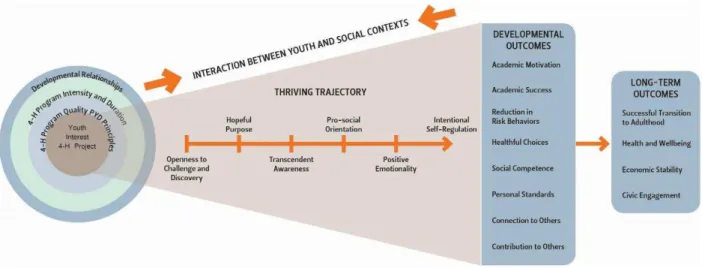
Today’s 4-H program operates on many of the same principles outlined by Seevers et al. (1997) and Seevers and Graham (2012). This consistency reflects the fact that 4-H has done a lot of things right in the area of youth development. But the program can benefit from a better connection to current youth development research; research that supports the principles and practices of 4-H and ensures a strong translation of current research into practice as the key aspect of Extension’s Land-Grant mission. In an effort to do just that, I propose a new 4-H program umbrella model (Figure 1) that reframes traditional aspects of 4-H into contemporary PYD understandings. The term umbrella is used for this model because it serves as an
overarching model under which local 4-H programs can be planned. In addition to connecting 4-H to PYD nomenclature, the model illustrates three important elements that will assist local professionals in program planning. First, a clear program theory of change is presented based on our understanding of how youth develop in the context of out-of-school time programs. Second, the model reveals a chain of action that is needed for the theory to work. Third, it provides multiple opportunities for program evaluation that includes implementation, as well as outcome measurement. A few highlights help illustrate the usefulness of this model for program planning.
Figure 1: A 4-H Youth Development Program Model
raising a lamb, or something new, like ocean conservation, 4-H begins with a young person’s interests and builds toward youth development. Benson and Scales (2011) highlighted the idea of a personal spark, the importance of helping youth discover their spark, and the connection of sparks to a thriving trajectory as a key building block of PYD. Engaging youth in activities that captivate them and facilitating their interests is synonymous with the concept of sparks. Again, we see something the 4-H program has done for years centrally placed in contemporary
adolescent research. Not only does this circle represent the translation of research into practice, it also highlights the theory of action and change (engaging youth in something they enjoy that is provided in a PYD context) necessary for the model of youth development to unfold.
The remaining three circles represent important aspects of the 4-H program with clear
connection to program theories of change and action: (1) Surround the young person with a high quality program built on best practices for youth development (Eccles & Gootman, 2002); (2) Provide sufficient program exposure, the understanding of which is still unclear in the field of youth development [see Gagnon et al. (2015) for a discussion of program dosage]; and (3) Provide developmental relationships (Search Institute, 2014a) that illuminate the various important supportive relationships youth have with adults and other youth. The long-standing program practice of adult volunteer-led 4-H clubs, with abundant opportunity for peer
interactions, vibrantly demonstrates the foundational presence of developmental relationships in 4-H Youth Development programs. This concept is also consistent with supporting dimensions of adolescent thriving (Scales, Benson, & Roehlkepartain, 2011).
Together, the concentric circles of the model that illustrate the 4-H program reveal a detailed program theory of change and action. The success of 4-H programs is contingent upon the specific interest and engagement that brings youth to the program. Success is also realized through high program quality that ensures youth have a positive and developmentally-appropriate experience, with sufficient time (dosage) to influence the direction of a young person’s life. What constitutes sufficient program dosage is somewhat imprecise and in need of further research. However, a meta-analysis of positive youth development programs conducted by Catalano, Berglund, Ryan, Lonczak, and Hawkins (2004) found that the most effective programs were at least nine months in duration. Other research points to the importance of the quality of the time in the program, not just the quantity (Goleman, 2013). Finally, the outside circle of the umbrella program model illustrates that PYD programs are marked by the presence of developmental relationships that emphasize specific qualities that support and facilitate growth in youth (Search Institute, 2014a).
positive way. Other ways of descripting and predicting youth development could be used here, for example the Five C’s (Lerner & Lerner, 2011) or the Targeting Life Skills Model (Hendricks, 1996). The point is that whatever is contained in the middle section of the model needs to describe exactly how a youth will develop as a result of participating in 4-H.
For example, the thriving trajectory portrayed in the umbrella model presented here contains six indicators that define thriving and that encompass the different aspects of positive youth
development. Returning to Seevers et al. (1997), 4-H has a long history of encouraging youth to set and achieve goals, based on the principle that doing so helps young people challenge
themselves to achieve excellence and learn to navigate obstacles when goals are not easily met. In today’s PYD understanding, this is called adaptive or intentional self-regulation (Geldhof et al., 2013; Search Institute, 2014b) and is supported by research as a key function of how youth grow. Similarly, encouraging youth to have a growth mindset (Dweck, 2006; Yeager & Dweck, 2012) and an openness to challenge and change (Search Institute, 2014b) have been
demonstrated to be key PYD principles. This middle section of the model reveals the initial outcomes that are typically found on a traditional program logic model, but with the addition of a theory of change (youth who thrive do better than those who do not) and a theory of action (youth who are provided opportunities to develop a growth mindset through 4-H are more likely to thrive). Youth who possess this type of mindset can set goals and adapt to challenges. When combined with the strengths found in the other five thriving indicators, a young person is
described as being on a thriving trajectory toward achieving the medium- and long-term program outcomes at the far right side of the model.
Without all of these components working together, the 4-H program falls short of developing a program of best practices for youth development based on research. Yet, how many 4-H program planners have this understanding when they draft a 4-H program to meet a local need? And how many well-intentioned program logic models for 4-H programs carefully consider these critical program ingredients? And perhaps even more to the point, does this theoretical burden properly belong on the shoulders of local Extension professionals to plan high-quality programs? As with the case of program evaluation (Arnold & Cater, in press; Lambur, 2008), I would argue that the proper place for ensuring accurate program theory of change and action lies higher up in the organization. The development of umbrella program models, such as the one presented here, provides the program theory under which local professionals can plan effective local programs.
Implications of Umbrella Program Models for Local Extension Professionals
based on current research. With such models in hand, the framework of program planning outlined by Seevers et al. (2012) can be better utilized. The process of translating research into umbrella program models is not an easy or quick endeavor and requires a team knowledgeable in the subject matter to translate research into program theory. In addition, as further knowledge emerges from ongoing research, program models must be updated regularly to stay current and accurate.
Perhaps of greater concern is the investment needed for ongoing capacity building for
professionals to understand, embrace, and utilize a program umbrella model when planning local Extension programs. Turning to the use of umbrella models as the basis for building Extension program planning capacity-building efforts could bring renewed energy and purpose to logic model training efforts in Extension and help local professionals better utilize the program-planning framework presented by Seevers et al. (2012).
One of the enduring principles of Extension education is the creation of local programs to address local needs (Garst & McCawley, 2015). Indeed, Seevers et al. (1997) emphasize the importance of local input and collaboration as a key aspect of Extension program planning. Far from taking away locally-driven programming, an umbrella program model can help strengthen local programs. Let us consider, for example, the results of a local needs assessment that revealed an emerging interest in 4-H programming for middle school youth to ameliorate youth screen time and encourage exploration of local opportunities for outdoor recreation that are plentiful because of the community’s proximity to parks, hiking trails, skate parks, swimming pools, and playfields. By using the umbrella program model, the local professional can create a program plan that not only addresses local needs and interests, but also includes elements critical to the program theory of change and action. In addition to planning a series of outings to explore recreation opportunities, the professional can use the umbrella model to define the theoretical action these outings accomplish within the larger program model. What might be an afternoon of hiking with 4-H friends can turn into a deliberately-planned youth development action that contributes to a greater overall youth development program. In this way, the local professional is not just planning a locally-relevant program, but also contributing clearly to the overall effort of the larger 4-H Youth Development Program.
Working from an umbrella program model can also enhance a local professional’s ability to bring the research to the people. Professionals who are well-informed and clear about a
what young people need to be successful overall and the important strategies needed to ensure program success. In this way, the community can move from a desire to help youth to a clear understanding of the process of youth development and the important role that youth interaction with their community contexts plays in optimal development. Communities then can move from isolated short-term program activities that may not accomplish much to an understanding of how multiple efforts, when contained within a larger program model of change and action, can lead to more significant change in the health of youth. At the same time, a well-defined program model can help connect a professional’s local work to a more robust state- or national-level program based in research, thus increasing the possibility of more sophisticated program evaluation, and ultimately, program accountability (Borden et al., 2014). But this is only possible if the local Extension professional is clear on the theory and action at the start, which has clear implications for Extension professional development efforts related to the dissemination of umbrella models for effective program planning.
Umbrella program models can also help with the perennial Extension problem of priority setting (Forest & Mulcahy, 1976). Using program planning to set program priorities is a large part of Seevers et al.’s (1997) section on program planning. Using an umbrella model centrally when planning local programs can help professionals and stakeholders develop programs that provide the greatest fidelity to the program model (and thus the greatest likelihood of achieving
outcomes), which can serve as a determinant for which programs should receive priority.
Perhaps most importantly, umbrella models can provide clarity of focus and purpose for local professionals, and a place to begin planning quality local programs, rather than starting from scratch and without the guidance of relevant research and program theory. If every local professional begins at the same place when planning programs, the potential exists for a workforce that is more unified in purpose and message, which in turn can contribute to the recognition of 4-H, not just because of tradition or the presence of the 4-H Clover, but because of a common articulated program plan that produces consistent and measureable outcomes.
Implications for Other Extension Program Areas
The umbrella model presented in this paper represents only one of the Extension program areas, and admittedly, the 4-H Youth Development Program may be more conducive for the
program theory of change and theory of action. The national 4-H program has also invested considerable time and energy into developing detailed program logic models for its three signature program mandates: Healthy Living, Science, and Citizenship. While still lacking articulated theories of change and action, these models mean that local 4-H professionals do not have to start from scratch when planning programs in these areas.
Other Extension program areas are more complex for a variety of reasons. First, many program areas are interdisciplinary, covering a variety of topics (and thus research bases). For example, Extension family and community programs may cover topics from economic vitality to obesity, to disease prevention, to gerontology, to personal finance, to parenting, all of which have separate research bases. The intention at the core of these programs, however, is to provide education to citizens to change behavior and practice for the better. The programs planned in this area can benefit greatly from a common understanding of the theory of change (How do people change behavior based on new knowledge?) and theory of action (What needs to be done to support people to translate new knowledge into action?) (Anderson, 2005). So, while the specific content may differ, an umbrella model for Extension family and community programs can help local professionals design programs using methods that align with creating change. One such model is the Transtheoretical Model of Health Behavior Change (Pochaska & Velicer, 1997) that outlines six stages of change through which humans typically go when adopting a new health behavior. Such theoretical models of change can be included in umbrella program models for Extension programs that address health-behavior change, regardless of the specific health topic being addressed.
Similar understandings of the processes involved in the adoption of new methods and behaviors, as well as the activities that lead to successful behavior change, can form the basis of umbrella program models in other Extension program areas. For example, Tobler, Visschers, and Siegrist (2011) reported a study that examined the willingness of consumers to adopt behaviors that support ecological food consumption, the results of which have theoretical implications for Extension environmental, agricultural, and consumer health programs. This study revealed that certain people were more likely to adopt ecological food consumption than others (i.e., women and individuals who already preferred natural foods). Including this information in program plans targeted at changing food consumption patterns to improve agricultural, environmental, and health-related concerns will help develop a stronger program theory of change, which in turn influences the planned theory of action.
Conclusion
the framework has continued applicability and utility for today’s Extension professionals and still serves as the basis for developing program logic models. However, logic models fall short of full effectiveness if sufficient attention is not paid to articulating the program’s theory of change and theory of action. These theoretical aspects of program planning underscore the need for attention to program implementation, specifically in relationship to program fidelity and the critical components and actions that are necessary to ensure program success.
In addition to articulating program theory, the use of an umbrella program model approach was proposed as a method for connecting Extension programs more clearly to the research base that informs them. This calls for an increased focus on the translation of research into Extension practice. While umbrella models that articulate theory have potential for transforming the quality of Extension programs and aiding in the achievement of program outcomes, they will not be adequately used at the local level without a renewed emphasis on program planning capacity-building efforts across the system. In addition, while the emphasis on logic modeling for
Extension in the past 15 years has changed the way we think about and report on programs, there is little evidence to support its impact on program quality, unity, or convincing program
outcomes. The expectations for Extension program accountability are more pressing than ever, and a renewed investment in program planning and evaluation capacity building is needed. Attention to program theory, translation of research, and umbrella program models are three ways in which capacity-building efforts may be directed.
References
Anderson, A. A. (2005). The community builder's approach to theory of change: A practical guide to theory development. New York, NY: The Aspen Institute Roundtable on Community Change. Retrieved from
http://www.dochas.ie/Shared/Files/4/TOC_fac_guide.pdf
Allen, J. E., IV, Bowker, S. F., Stamper, C. E., Owusu-Amankwah, E., & Davis, A. (2014). Resident valuation of Kentucky’s Extension fine arts program. Journal of Extension, 52(2), Article 2FEA10. Retrieved from http://www.joe.org/joe/2014april/a10.php Arnold, M. E. (2006). Developing evaluation capacity in Extension 4-H field faculty: A
framework for success. American Journal of Evaluation, 27(2), 257–269. doi:10.1177/1098214006287989
Arnold, M. E., & Cater, M. (in press). Program theory and quality matter: Changing the course of Extension program evaluation. Journal of Extension.
Arnold, M. E., Davis, J., & Corliss, A. L. (2014). From 4-H international youth exchange to global citizen: Common pathways of ten past program participants. Journal of Youth Development, 9(2), Article 140902RS001. Retrieved from
Arnold, M. E., & Nott, B. D. (2010). What’s going on? Developing a context for program evaluation: From logic models to program theory. Journal of Youth Development, 5(2), Article 100502RS001. Retrieved from
http://www.nae4ha.com/assets/documents/JYD_100502_finalx.pdf
Baughman, S., Boyd, H. H., & Kelsey, K. D. (2012). The impact of the Government Performance and Results Act (GPRA) on two state Cooperative Extension systems. Journal of Extension, 50(1), Article 1FEA3. Retrieved from
http://www.joe.org/joe/2012february/a3.pdf
Bennett, C. F. (1975). Up the hierarchy. Journal of Extension, 13(1), 7–12. Retrieved from http://www.joe.org/joe/1975march/1975-2-a1.pdf
Benke, C. J., Bailey, S. J., Martz, J., Paul, L., Lynch, W., & Eldridge, G. (2013). Developing a parent-centered obesity program for 4-H families: Implications for Extension family programming. Journal of Extension, 51(3), Article 3FEA8. Retrieved from
http://www.joe.org/joe/2013june/a8.php
Benson, P. L., & Scales, P. C. (2011). Thriving and sparks. In R. J. R. Levesque (Ed.), Encyclopedia of adolescence (pp. 2963–2976). doi:10.1007/978-1-4419-1695-2_199 Borden, L., Perkins, D. F., & Hawkey, K. (2014). 4-H Youth Development: The past, the
present, and the future. Journal of Extension, 52(4), Article 4COM1. Retrieved from http://www.joe.org/joe/2014august/comm1.php
Bowling, C. J. (2001). Using the program life cycle can increase your return on time invested. Journal of Extension, 39(3), Article 3FEA2. Retrieved from
http://www.joe.org/joe/2001june/a2.php
Braverman, M. T., & Engle, M. (2009). Theory and rigor in Extension program evaluation planning. Journal of Extension, 47(3), Article 3FEA1. Retrieved from
http://www.joe.org/joe/2009june/a1.php
Braverman, M. T., Franz, N. K., & Rennekamp, R. A. (2012). Extension’s evolving alignment of programs serving families and youth: Organizational change and its implications. Journal of Extension, 50(6), Article 6FEA1. Retrieved from
http://www.joe.org/joe/2012december/a1.php
Brendtro, L. K., Brokenleg, M., & Van Bockern, S. (2002). Reclaiming youth at risk: Our hope for the future (Revised ed.). Bloomington, IN: Solution Tree Press.
Catalano, R. F., Berglund, M. L., Ryan, J. A. M., Lonczak, H. S., & Hawkins, J. D. (2004). Positive youth development in the United States: Research findings on evaluations of positive youth development programs. The Annals of the American Academy of Political and Social Science, 591(1), 98–124. doi:10.1177/0002716203260102
Chen, H. T. (2004). Practical program evaluation: Assessing and improving planning, implementation, and effectiveness. Thousand Oaks, CA: Sage Publications.
Eccles, J., & Gootman, J. A. (Eds.). (2002). Community programs to promote youth development. Washington, DC: National Academy Press. Retrieved from http://files.eric.ed.gov/fulltext/ED465844.pdf
Forest, L., & Mulcahy, S. (1976). First things first: A handbook of priority setting in Extension. Madison, WI: University of Wisconsin – Extension. Retrieved from
http://www.uwex.edu/ces/pdande/learning/pdf/ftf.pdf
Funnell, S. C., & Rogers, P. J. (2011). Purposeful program theory: Effective use of theories of change and logic models. San Francisco, CA: Jossey-Bass.
Gagnon, R., Franz, N., Garst, B. A., & Bumpus, M. F. (2015). Factors impacting program delivery: The importance of implementation research in Extension. Journal of Human Sciences and Extension, 3(2), 68–82.
Gambone, M. A., Klem, A. M., & Connell, J. P. (2002). Finding out what matters for youth: Testing key links in a community action framework for youth development. Philadelphia, PA: Youth Development Strategies, Inc., and the Institute for Research and Reform in Education.
Garst, B. A., & McCawley, P. F. (2015). Solving problems, ensuring relevance, and facilitating change: The evolution of needs assessment within Cooperative Extension. Journal of Human Sciences and Extension, 3(2), 26–47.
Geldhof, G. J., Bowers, E. P., & Lerner, R. M. (2013). Positive youth development. Journal of Youth and Adolescence, 42(1), 1–5. doi:10.1007/s10964-012-9855-7
Goleman, D. (2013). Focus: The hidden driver of excellence. New York, NY: HarperCollins. Hamilton, S. F. (2014). On the 4-H Study of Positive Youth Development. Journal of Youth and
Adolescence, 43(6), 1008–1011. doi:10.1007/s10964-014-0121-z
Hendricks, P. A. (1996). Targeting Life Skills Model. Ames, IA: Iowa State University Extension.
Hunter, D. E. K. (2006). Using a theory of change approach to build organizational strength, capacity and sustainability with not-for-profit organizations in the human services sector. Evaluation and Program Planning, 29(2), 193–200. doi:10.1016/j.evalprogplan.2005.10 .003
Knowlton, L. W., & Phillips, C. C. (2009). The logic model guidebook: Better strategies for great results. Thousand Oaks, CA: Sage Publications.
Lambur, M. T. (2008). Organizational structures that support internal program evaluation. In M. T. Braverman, M. Engle, M. E. Arnold, & R. A. Rennekamp (Eds.), Program evaluation in a complex organizational system: Lessons from Cooperative Extension (pp. 41–54). New Directions for Evaluation, 2008(120). San Francisco, CA: Jossey-Bass.
doi:10.1002/ev.275
Lerner, R. M., & Lerner, J. (2011). The positive development of youth: Report of the findings from the first seven years of the 4-H Study of Positive Youth Development. Washington, DC: National 4-H Council. Retrieved from:
Lerner, R. M., Lerner, J. V., von Eye, A., Bowers, E. P., & Lewin-Bizan, S. (2011). Individual and contextual bases of thriving in adolescence: A view of the issues. Journal of Adolescence, 34(6), 1107–1114. doi:10.1016/j.adolescence.2011.08.001
Lerner, R. M., Wang, J., Chase, P. A., Gutierrez, A. S., Harris, E. M., Rubin, R. O., & Yalin, C. (2014). Using relational developmental systems theory to link program goals, activities, and outcomes: The sample case of the 4-H Study of Positive Youth Development. New Directions for Youth Development, 2014(144), 17–30. doi:10.1002/yd.20110
McLaughlin, J. A., & Jordan, G. B. (2004). Using logic models. In J. S. Wholey, H. P. Hatry, & K. E. Newcomer (Eds.), Handbook of practical program evaluation (2nd ed., pp.7–32). San Francisco, CA: Jossey-Bass.
Monroe, M., Fleming, M., Bowman, R., Zimmer, J., Marcinkowski, T., Washburn, J., & Mitchell, N. (2005). Evaluators as educators: Articulating program theory and building evaluation capacity. In E. Norland & C. Somers (Eds.), Evaluating nonformal education programs and settings (pp. 57–71). New Directions for Evaluation, 2005(108). San Francisco, CA: Jossey-Bass. doi:10.1002/ev.171
Overton, W. F. (2015). Process and relational developmental systems. In W. F. Overton & P. C. M. Molenaar (Eds.) and R. M. Lerner (Editor-in-Chief), Theory and method. Vol. 1: The handbook of child psychology and developmental science (7th ed., pp. 9–62). Hoboken, NJ: Wiley.
Patton, M. Q. (2002). Qualitative research and evaluation methods (3rd ed.). Thousand Oaks, CA: Sage Publications.
Patton, M. Q. (2008). sup wit eval ext? In M. T. Braverman, M. Engle, M. E. Arnold, & R. A. Rennekamp (Eds.), Program evaluation in a complex organizational system: Lessons from Cooperative Extension (pp. 101–115). New Directions for Evaluation, 2008(120). San Francisco, CA: Jossey-Bass. doi:10.1002/ev.279
Preskill, H., & Boyle, S. (2008). A multidisciplinary model of evaluation capacity building. American Journal of Evaluation, 29(4), 443–459. doi:10.1177/1098214008324182 Prochaska, J. O., & Velicer, W. F. (1997). The Transtheoretical Model of Health Behavior
Change. American Journal of Health Promotion, 12(1), 38–48. doi:10.4278/0890-1171-12.1.38
Rennekamp, R. A., & Arnold, M. E. (2009). What progress, program evaluation? Reflections on a quarter-century of Extension evaluation practice. Journal of Extension, 47(3), Article 3COM1. Retrieved from http://www.joe.org/joe/2009june/comm1.php
Rennekamp, R. A., & Engle, M. (2008). A case study in organizational change: Evaluation in Cooperative Extension. In M. T. Braverman, M. Engle, M. E. Arnold, & R. A.
Rennekamp (Eds.), Program evaluation in a complex organizational system: Lessons from Cooperative Extension (pp. 15–26). New Directions for Evaluation, 2008(120). San Francisco, CA: Jossey-Bass. doi:10.1002/ev.273
Scales, P. C., Benson, P. L., & Roehlkepartain, E. C. (2011). Adolescent thriving: The role of sparks, relationships, and empowerment. Journal of Youth and Adolescence, 40(3), 263– 277. doi:10.1007/s10964-010-9578-6
Seevers, B., & Graham, D. (2012). Education through Cooperative Extension (3rd ed.). Fayetteville, AR: University of Arkansas.
Seevers, B., Graham, D., Gamon, J., & Conklin, N. (1997). Education through Cooperative Extension. Albany, NY: Delmar Publishing.
Search Institute. (2014a). Developmental relationships: A research update from Search Institute. Minneapolis, MN: Search Institute. Retrieved from: http://www.search-institute.org/ Search Institute. (2014b). Search Institute model of youth thriving orientation: Overview of its
evolution through recent funding from the Thrive Foundation for Youth. Minneapolis, MN: Search Institute. Unpublished paper.
Silbereisen, R. K., & Lerner, R. M. (2007). Approaches to positive youth development: A view of the issues. In R. K. Silbereisen & R. M. Lerner (Eds.), Approaches to positive youth development (pp. 3–30). Thousand Oaks, CA: Sage Publications.
doi:10.4135/9781446213803.n1
Smith, C., Akiva, T., Sugar, S., Lo, Y. J., Frank, K. A., Peck, S. C., Cortina, K. S., & Devaney, T. (2012). Continuous quality improvement in afterschool settings: Impact findings from the Youth Program Quality Intervention study. Washington, DC: The Forum for Youth Investment. Retrieved from:
http://www.cypq.org/content/continuous-quality-improvement-afterschool-settings-impact-findings-youth-program-quality-in
Taylor-Powell, E., & Boyd, H.H. (2008). Evaluation capacity building in complex organizations. In M. T. Braverman, M. Engle, M. E. Arnold, & R. A. Rennekamp (Eds.), Program evaluation in a complex organizational system: Lessons from Cooperative Extension (pp. 55–69). New Directions for Evaluation, 2008(120). San Francisco, CA: Jossey-Bass. doi:10.1002/ev.276
Tobler, C., Visschers, V. H. M., & Siegrist, M. (2011). Eating green: Consumer’s willingness to adopt ecological food consumption behaviors. Appetite, 57(3), 674–682.
doi:10.1016/j.appet.2011.08.010
W. K. Kellogg Foundation. (2004). Logic model development guide: Using logic models to bring together planning, evaluation, and action. Battle Creek, MI: W. K. Kellogg Foundation. Retrieved from http://www.smartgivers.org/uploads/logicmodelguidepdf.pdf
Workman, J. D., & Scheer, S. D. (2012). Evidence of impact: Examination of evaluation studies published in the Journal of Extension. Journal of Extension, 50(2), Article 2FEA1. Retrieved from http://www.joe.org/joe/2012april/a1.pdf