241
Revista da Sociedade Brasileira de Medicina Tropical 39(3):241-244, mai-jun, 2006
ARTIGO/ARTICLE
Viability and molecular authentication of Coccidioides immitis
strains from Culture Collection of the Instituto Oswaldo Cruz,
Rio de Janeiro, Brazil
Viabilidade e autenticação molecular de cepas de
Coccidioides immitis
da
Coleção de Culturas do Instituto Oswaldo Cruz, Rio de Janeiro, Brasil
Claudia C.F. Bezerra
1, Renata F. de Lima
2, Márcia S. Lazera
1, Bodo Wanke
1and Cíntia M. Borba
2ABSTRACT
Twenty Coccidioides immitis strains were evaluated. Only 5 of the 20 strains kept under mineral oil maintained their viability while all 5 subcultures preserved in water remained viable and none of the 13 subcultures kept in soil were viable. A 519 bp PCR product from the csa gene confirmed the identity of the strains.
Key-words: Coccidioides immitis. Long-term preservation. PCR.
RESUMO
Vinte cepas de Coccidioides immitis foram avaliadas. Cinco das 20 cepas preservadas sob óleo mineral mantiveram-se viáveis, todas as 5 subculturas preservadas em água permaneceram viáveis e nenhuma das 13 subculturas mantidas em solo foi viável. Um produto de PCR de 519 pb do gene csa confirmou a identidade das cepas.
Palavras-chaves:Coccidioides immitis. Preservação por longos períodos. PCR.
1. Serviço de Micologia do Instituto de Pesquisa Clínica Evandro Chagas da Fundação Oswaldo Cruz, Rio de Janeiro, RJ. 2. Departamento de Micologia do Instituto Oswaldo Cruz da Fundação Oswaldo Cruz, Rio de Janeiro, RJ.
This research was supported by Conselho Nacional de Desenvolvimento Científico e Tecnológico – CNPq no 475.219/2006
Address to: Dra. Cintia de Moraes Borba. Depto. de Micologia IOC/FIOCRUZ. Av. Brasil 4365, 21040-900, Rio de Janeiro, RJ, Brasil. Tel: 55 21 3865-8114; Fax: 55 21 3865-8113.
e-mail: [email protected] Recebido para publicação em 1/6/2005 Aceito em 12/4/2006
Coccidioides immitis is a dimorphic, geophilic fungus that causes coccidioidomycosis, a systemic mycosis affecting humans and a wide variety of animals. This mycosis is endemic in many countries of the American continent. The highest prevalence of infection occurs in the Southwestern states of the USA and the Northern Mexican states. However, endemic foci are known in Central and South America. More recently, a large semiarid area in the Northeastern region of Brazil was identified as endemic for this mycosis11 23.
Twenty C. immitis strains are maintained in the Culture Collection of the Oswaldo Cruz Institute using different long term storage methods. They were deposited in the collection between 1929 and 1955 and their records show that they came from the USA (9), Venezuela (4), Brazil (1), Netherlands (1), Norway (1) and Argentina (4). Fisher et al13 described the
division of Coccidioides immitis into two species, C. immitis
andC. posadasii, respectively the agents of coccidioidomycosis in California and non-California population. Thus, despite the fact that C. posadasii is the agent of mycosis in Brazil, we decided to maintain the older taxonomic status due to the earlier isolation of the strains.
Fungi preservation methods have been used in many laboratories with differing results, depending on the species1 12 16 24. However, some studies have demonstrated
that the storage of fungi in vitro for long periods of time
may induce morphological changes22, alterations in cell
wall components21, spontaneous mutations3 and loss or
attenuation of virulence4. The preservation of fungi which are
242
Bezerra CCF et al
techniques have proved to be useful for specimen authentication and for obtaining molecular genetic data.
C. immitis produces a specific 19-kDa antigen encoded by the csagene, with no cross-reaction with other fungi. The primer pair derived from this gene amplify a 519 bp product only when the C. immitis genomic DNA is used as template17.
The objective of the present study was to evaluate the viability
and morphological characteristics of C. immitis strains
maintained for many years under mineral oil, in soil and in water from the Culture Collection of the Oswaldo Cruz Institute (IOC) in Rio de Janeiro, Brazil, and to authenticate them by PCR.
MATERIAL AND METHODS
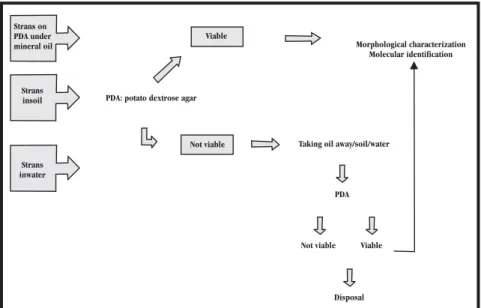
A total of 20 Coccidioides immitis strains were first preserved at the IOC by successive transplants and maintained at room temperature. In the 1940’s the strains were transferred to potato dextrose agar (PDA) medium under mineral oil. Each strain preserved under mineral oil was distributed among a maximum of 5 tubes with different dates, whereas each of the strains preserved in soil and water was represented by only one tube. Samples of the strains subjected to the different preservation methods were grown on PDA (Difco Laboratories, MI, USA) and incubated for 90 days at room temperature to evaluate viability. Figure 1 shows the procedure followed to extract the strains from the preservation methods and their evaluation.
A fragment of the colony grown on PDA was removed and then placed on a slide with one drop of Amann lactophenol – cotton blue (20g of phenic acid, 20ml of lactic acid, 20ml of distilled water, 40ml of glycerol and 0.05g of cotton blue) and covered with a coverslip for examination with a Nikon model Labophot microscope.
The viable strains were cultured in 100ml GYE medium (2% glucose, 1% yeast extract, all from Difco) and incubated at 30oC in a reciprocating shaker at 120 oscillations/min.
After 9 days of growth, the strains were subjected to 100oC in
order to kill them. The mycelium mat was separated by vacuum filtration using a sterile filter paper, followed by continuous vacuum until dry. The mycelium mat was lyophilized overnight in a freeze dryer, model L4KR 156 (Edwards, São Paulo, Brazil). Ten milligrams of the dried mycelia were grounded in liquid nitrogen. The resulting mycelium powder was suspended in 400ml of extraction buffer (50mM Tris-HCl pH 8.0; 100mM NaCl; 5mM EDTA and 1% SDS) incubated at 80oC for 10 min,
and incubated again at 40oC with 10ml of proteinase
K (10mg/ml) for 3h. Afterwards, the solution was incubated at 80oC for 10 min in accordance with Burt et al7. The nucleic
acids were then immediately extracted with 400ml of phenol: chloroform: isoamyl alcohol (25:24:1) and briefly homogenized. The solution was centrifuged at 10,000 x g for 15min. The upper aqueous phase was removed and the DNA precipitated with 3M sodium acetate and isopropanol. After washing with 70% cold ethanol the DNA was dried by continuous vacuum. The DNA was quantified in a
spectrophotometer (GeneQuant™ pro RNA/DNA Calculator,
Amersham Pharmacia, Biotech, USA) using 1:1,000 dilutions and visualized on 0.8% agarose gel.
Five nanograms of DNA were used as a template in PCR using specific primers designed on the basis of the csagene sequence (sense = 5’ AAG TTC TCA CTC CTC AGC GCT ATC G 3’; anti-sense = 5’ ACA TTA AGG TTC CTC CCC TTC AAC C
3’)17. The reaction mixture contained 10x buffer PCR
(Amersham Pharmacia), 200mM of dNTPs, 10mM of each primer, 1 unit of Taq polymerase (Gibco), DNA template in a final volume of 50ml. Thirty cycles were conducted for amplification in a thermocycler (Gene Amp® PCR System 2,400 – Applied Biosystems). The amplification program was 1 cycle of 940C for 4 min and 30 cycles of 940C for 1 min,
500C for 1 min, 740C for 1 min, followed by 740C for 10 min.
After thermal cycling, 20ml of the amplified product was run on a 1.6% (w:v) agarose gel, with 1x TBE as buffer, stained with ethidium bromide and visualized under UV light.
Strans on PDA under mineral oil
Strans insoil
Strans inwater
PDA: potato dextrose agar
Morphological characterization Molecular identification
Taking oil away/soil/water
PDA
Not viable Viable
Disposal Viable
Not viable
243
Revista da Sociedade Brasileira de Medicina Tropical 39(3):241-244, mai-jun, 2006
RESULTS AND DISCUSSION
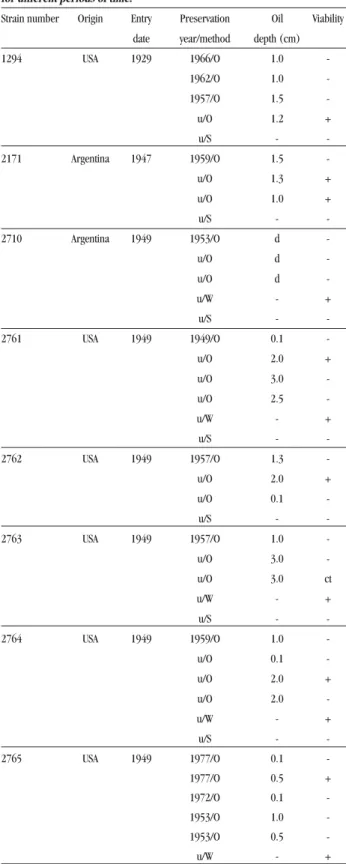
Only 5 (25%) of the 20 C. immitis strains maintained under oil remained viable, whereas all 5 (100%) strains preserved in water were viable and none of the 13 subcultures kept in soil were revealed as viable. Table 1 shows the data concerning the viable strains preserved over different periods of time.
Table 1 - C. immitis viable strains preserved using three preservation methods for different periods of time.
Strain number Origin Entry Preservation Oil Viability date year/method depth (cm)
1294 USA 1929 1966/O 1.0
-1962/O 1.0 -1957/O 1.5
-u/O 1.2 +
u/S -
-2171 Argentina 1947 1959/O 1.5
-u/O 1.3 +
u/O 1.0 +
u/S -
-2710 Argentina 1949 1953/O d
-u/O d
-u/O d
-u/W - +
u/S -
-2761 USA 1949 1949/O 0.1
-u/O 2.0 +
u/O 3.0
-u/O 2.5
-u/W - +
u/S -
-2762 USA 1949 1957/O 1.3
-u/O 2.0 +
u/O 0.1
-u/S -
-2763 USA 1949 1957/O 1.0
-u/O 3.0
-u/O 3.0 ct
u/W - +
u/S -
-2764 USA 1949 1959/O 1.0
-u/O 0.1
-u/O 2.0 +
u/O 2.0
-u/W - +
u/S -
-2765 USA 1949 1977/O 0.1
-1977/O 0.5 +
1972/O 0.1 -1953/O 1.0 -1953/O 0.5
-u/W - +
u = unknown; ct = contaminated; d = dry; O = mineral oil; W = water; S = soil
TheC. immitis strains studied here were kept for long periods of time under mineral oil. This preservation method is based on the reduction of microorganism metabolic rates due to reduced oxygen consumption6. However, this decreased metabolic activity
over long periods of time may affect the viability, development, spore formation and dimorphic process of many fungal strains2 14 22. Other determinants of the fall in viability are the
depth of the mineral oil layer and the quality of the product used10 19. The small percentage of viable C.immitis strains after
preservation under mineral oil detected in this study may be related to their intrinsic characteristics and also to variations in the attributes of the preserved cells and of the technique used. Thus, the low viability of the strains studied clearly shows the high requirements of this fungus for factors related to good developmentin vitro.
In contrast, the C. immitis cells evaluated here that were preserved in distilled water remained viable for 36 years. Water storage is a simple and inexpensive method of culture
preservation described by Castellani8, who stored fungi
pathogenic to man. Of the fungi studied by Castellani9,C immitis
grew very well, producing colonies exactly like the original, with the same biochemical characters after 12 months in sterile distilled water. McGinnis et al15 obtained 93% revival for 12-60
months in cultures preserved in distilled water and recorded reduced pleomorphism in pathogens.
Many of the fungal pathogens of humans accommodated in the Onygenales, like C. immitis, including agents of cutaneous
infection (Microsporum and Trichophyton) and human
respiratory pathogens (Histoplasma and Blastomyces), showed a rate of viability ranging between 73% and 100% after 6, 12, 18 and 24 months in sterile distilled water20. These data are in
agreement with our results which show 100% viability for C. immitis strains preserved in distilled water for a long period of time (36 years). According to Onions16 this method appears to
produce very satisfactory results for some isolates.
None of the strains studied survived when preserved in soil, in agreement with Windels24, who reported that the use
of soil culture for long-term storage may cause mutations with the loss of morpho- and physiological characteristics or cellular death.
The viable strains presented macro and microscopic aspects suggestive of C. immitis as white cream colored velvety colonies formed by hyaline, septate, branched hyphae and only one strain (Ci IOC 2761 preserved in water) presented arthroconidia alternating with empty cells. However, in accordance with Pappagianis18 the hyphal form is not sufficiently specific for that
to yield more than a presumptive diagnosis. In order to avoid the animal inoculation method to demonstrate their virulence, these isolates were authenticated by a molecular tool (PCR). A 519bp PCR product was obtained with the primer pair used and
C. immitis genomic DNA was used as the template to confirm the identity of the viable strains (Figure 2). The results of the PCR method for the detection of C. immitis DNA using oligonucleotide
primer pair derived from csa gene sequence showed an
244
the pathogen in accordance with Pan and Cole17, demonstrating
the usefulness of this molecular marker for culture collections. Culture collections are an important resource for obtaining molecular genetic data and the PCR technique is an effective method for this. The problems of the correct classification of species names, alterations in morphological characteristics, which prevent precise identification and changes in population structure over time, can be examined by analysis of DNA regions. According to Bruns et al5, extensive
use of preserved specimens for molecular genetic investigations may soon make it desirable for curators to develop guidelines for the sampling of type collections and for methods of storage and retrieval of extracted DNA.
ACKNOWLEDGEMENTS
We thank the CNPq for financial support.
REFERENCES
1. Barnes GL. Long-term survival of isolates of various Cladosporium and
Fusicladium species under mineral oil. Mycopathologia 87: 95-97, 1984. 2. Borba CM, Rodrigues KF. Viability and sporulating capability of Coelomycetes preserved under a range of different storage regimes. Revista Iberoamericana de Micología 17: 142-145, 2000.
3. Brass C, Volkmann CM, Philpott DE, Klein HP, Halde CJ, Stevens D. Spontaneous mutant of Blastomyces dermatitidis attenuated in virulence mice. Sabouraudia 20: 145-158, 1982.
4. Brummer E, Restrepo A, Hanson LH, Stevens DA. Virulence of
Paracoccidioides brasiliensis: The influence of in vitro passage and storage. Mycopathologia 109: 13-17, 1990.
5. Bruns TD, Fogel R, Taylor JW. Amplification and sequencing of DNA from fungal herbarium specimens. Mycologia 82: 175-184, 1990.
6. Buell CB, Weston WH. Application of the mineral oil conservation method to maintaining collections of fungous cultures. American Journal of Botany 34: 555-561, 1947.
7. Burt A, Carter DA, Koenig GL, White TJ, Taylor JW. A safe method to extract DNA from Coccidioides immitis. Fungal Genetic Newsletter 42: 23, 1995. 8. Castellani A. Viability of some pathogenic fungi in distilled water. Journal
of Tropical Medicine and Hygiene 42: 225-226, 1939.
9. Castellani A. Maintenance and cultivation of common pathogenic fungi of man in sterile distilled water. Further researches. Journal of Tropical Medicine and Hygiene 70: 181-184, 1967.
10. Edwards GA, Buell CB, Weston WH. The influence of mineral oil upon the oxygen consumption of Sordaria fimicola. American Journal of Botany 34: 551-555, 1947.
11. Eulalio KD, Macedo RL, Cavalcanti MAS, Martins LMS, Lazera MS, Wanke B.Coccidioides immitis isolated from armadillos (Dasypus novemcinctus) in the state of Piauí, Northeast Brazil. Mycopathologia 149: 57-61, 2000.
12. Fernandes MJS. Preservação dos fungos Dematiaceae em óleo mineral I. Revista de Microbiologia de São Paulo 13: 211-214, 1982.
13. Fisher MC, Koenig GL, Taylor JW. Molecular and phenotypic description of
Coccidioides posadasii sp. nov., previously recognized as the non-California population of Coccidioides immitis. Mycologia 94: 73-84, 2002. 14. Lima RF, Borba CM. Viability, morphological characteristics and dimorphic
ability of fungi preserved by different methods. Revista Iberoamericana de Micología 18: 191-196, 2001.
15. McGinnis MR, Padhye AA, Ajello L. Storage of stock cultures of filamentous fungi, yeasts and some aerobic actinomycetes in sterile distilled water. Applied and Environmental Microbiology 28: 218-222, 1974.
16. Onions AHS. Preservation of fungi. In: Smith JE, Berry DR, Kristiansen B (eds) The filamentous fungi, Edward Arnold, London, p. 373-390, 1983. 17. Pan S, Cole GT. Molecular and biochemical characterization of Coccidioides immitis specific antigen. Infection and Immunity 63: 3994-4002, 1995. 18. Pappagianis D. Coccidioidomycosis. Seminars in Dermatology 12:
301-309, 1993.
19. Pumpyanskaya LY. Storage of microorganisms under mineral oil. Mikrobiologiya 33: 1065-1070, 1964.
20. Rodrigues EG, Lirio VS, Lacaz CS. Preservação de fungos e actinomycetos de interesse médico em água destilada. Revista do Instituto de Medicina Tropical de São Paulo 34: 159-165, 1992.
21. San-Blas G, San-Blas F, Serrano LE. Host-parasite relationships in the yeastlike form of Paracoccidioides brasiliensis strain IVIC Pb9. Infection and Immunity 15: 343-346, 1977.
22. Silva AMM, Borba CM, Oliveira PC. Viability and morphological alterations ofParacoccidioides brasiliensis strains preserved under mineral oil for long periods of time. Mycoses 37: 165-169, 1994.
23. Wanke B, Lazera MS, Monteiro PCF, Lima FC, Leal MJS, Ferreira Filho PL, Kaufman L, Pinner RW, Ajello L. Investigation of an outbreak of endemic coccidioidomycosis in Brazil’s Northeastern State of Piauí with a review of distribution of Coccidioides immitis in three other Brazilian states. Mycopathologia 148: 57-67, 1999.
24. Windels CE, Burnes PM, Kommendahl T. Fusarium species stored on silica gel and soil for ten years. Mycologia 85: 21-23, 1993.
Figure 2 - Agarose gel showing PCR products obtained by amplification of 5 ng of DNA, extracted from the C. immitis strains. Lane 1: no template DNA; Lane 2: Ci IOC 1294; Lane 3: Ci IOC 2171; Lane 4: Ci IOC 2762; Lane 5: Ci IOC 2763; Lane 6: Ci IOC 2764; Lane 7: Ci IOC 2765; Lane 8: Ci IOC 2761. The amplification reactions are described in the text. Molecular weight markers (bp) are indicated on the left side.