323
Revista da Sociedade Brasileira de Medicina Tropical 39(4):323-236, jul-ago, 2006
ARTIGO/ARTICLE
An alternative antimonial schedule to be used in cutaneous
leishmaniasis when high doses of antimony are undesirable
Um esquema antimonial alternativo para ser empregado na leishmaniose cutânea
quando altas doses de antimônio são indesejáveis
Manoel Paes de Oliveira-Neto
1and Marise da Silva Mattos
1ABSTRACT
Despite more than half a century of use in leishmaniasis, antimony therapy still presents serious problems concerning dosage and toxicity. Low and high doses have been shown to be equally effective. In this paper, the feasibility of injecting one ampoule of meglumine antimoniate intramuscularly every other day until clinical cure is demonstrated, while studying a series of 40 cutaneous leishmaniasis cases. Total dose used varied from 1,822.5 to 12,150mg of pentavalent antimony and total time of treatment varied from 3 to 10 weeks, with 86% efficacy. Thirty-six out of the 40 patients are still on follow-up with a mean time of 10.7 ± 7 months and a median of 9 months. No relapse or mucosal lesions have been noted so far. The schedule showed good tolerance and easy application and its efficacy was comparable to the officially recommended WHO schedule. Therefore, such a schedule represents a valuable alternative for the cases with high toxicicity to antimony or daily injections are an obstacle to the treatment.
Key-words:Cutaneous leishmaniasis. Pentavalent antimony. Low dose. Systemic therapy.
RESUMO
Apesar de utilizado há mais de meio século no tratamento da leishmaniose, o antimônio apresenta ainda problemas quanto a sua toxicidade e dose ideal. Doses baixas têm se mostrado tão eficazes quanto doses altas. Neste trabalho, apresentamos o resultado do emprego de uma ampola de antimoniato de meglumina intramuscular, em dias alternados, até a cura clínica, numa série de 40 casos. A dose total utilizada, por paciente, variou de 1.822,5 a 12.150mg de antimônio pentavalente e o tempo de tratamento de 3 a 10 semanas com eficácia de 86%. Dos 40 pacientes estudados, 36 ainda estão em acompanhamento, com um tempo médio de 10,7 + 7 meses e média de 9 meses. Não houve recidivas nem lesões mucosas. O esquema utilizado foi bem tolerado, de fácil aplicação, eficácia comparável ao esquema oficialmente preconizado pela OMS, mostrando-se como valiosa alternativa para os casos com potencial toxicidade ao antimônio ou cuja aplicação de injeções diárias represente um obstáculo ao tratamento. Palavras-chaves:Leishmaniose cutânea. Antimônio pentavalente. Baixa dose. Tratamento sistêmico.
1. Ambulatório de Leishmaniose do Instituto de Pesquisas Clínicas Evandro Chagas da Fundação Oswaldo Cruz, Rio de Janeiro, RJ.
Address to: Dra. Marise da Silva Mattos. Rodovia Haroldo Soares Glavan 929, Casa 2, Cacupé, 88050-005 Florianópolis, SC. e-mail: [email protected]
Recebido para publicação em 19/7/2005 Aceito em 15/5/2006
Ninety-three years ago antimony was used for the first time to treat leishmaniasis (Vianna, 1912)9. Since that time
numerous therapeutic schedules have been tested, mainly to treat visceral leishmaniasis. The original preparation of emetic tartar was gradually superseded by other compounds such as stibamine glucoside (Neostamv+
) per kg per day for three or four weeks1 8. Nevertheless, for many years in our
324
Oliveira-Neto MP and Mattos MS
after 5 years, it was demonstrated that the individual doses according to body weight were highly variable, from 3.8 to 22.3mg of SbV+/kg4. In other subsequent papers, the effect of a
lower dose was studied, 5mg of SbV+/kg/day for four weeks,
demonstrating the efficacy of such a dose5 6. It is also true that
the first manufacturer of meglumine antimoniate (Specia), initially recommended a regimen of injections on alternate days up to clinical cure1. A scheme of alternate-day injections up to
clinical cure was used by one of the authors, with good results, in the Dermatology Clinic of Policlínica Geral do Rio de Janeiro some 37 years ago (MP Oliveira-Neto: unpublished data). Based on that previous successful experience, we decided to try a regimen of IM injections on alternate days again and show the results of a series of cutaneous leishmaniasis cases treated in Rio de Janeiro at the present time.
PATIENTS AND METHODS
Forty patients who attended our service (the out-patients unit of the Institute of Clinical Research, Oswaldo Cruz Foundation, Rio de Janeiro, Brazil) were enrolled for the study. No distinction was made between gender or age. All the patients were inhabitants of Rio de Janeiro State, presented cutaneous ulcers and presented parasitologically confirmed cutaneous leishmaniasis. They were all submitted to the routine procedures of parasitological diagnosis: biopsy, in-prints, histopathological examination, culture in appropriate media and the detection of parasite DNA by polymerase chain reaction (PCR). The inclusion criterion was diagnostic confirmation by at least one of the above mentioned methods. An exception was made for two children and one elderly person with a clinical-epidemiological diagnosis supported by a positive intradermal leishmanin test. The exclusion criterion was the presence of associated mucosal disease. Routine laboratory tests and an electrocardiogram were performed before treatment in all patients.
325
Revista da Sociedade Brasileira de Medicina Tropical 39(4):323-236, jul-ago, 2006
Minor side effects, mainly pain at the injection sites, light arthralgias and/or nausea, were registered in six patients. Five (13.8%) patients (5/36) failed; two (5.5%) (2/36) of these 5 patients, who showed no sign of improvement after six weeks of treatment, were retreated with a dose of 15mg Sb5+/
kg/day for 21 days, with good response, indicating that the use of a prior low dose did not induce Sb5+ resistance. Another
two (5.5%) patients (2/36) presented relapse after an apparent cure and were retreated with the same schedule with good results; and one (2.7%) patient (1/36) who still presented inflammatory papules at the end of two months of treatment, was retreated with intralesional therapy, three intralesional applications at 15 day intervals, with complete remission of the lesions.
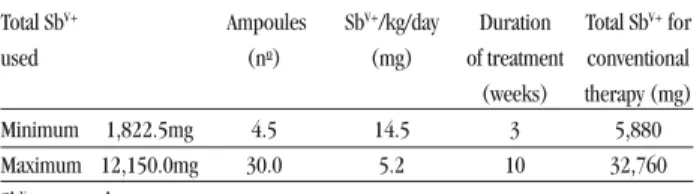
Since as many ampoules as necessary were used to reach epithelization, the number of ampoules and, consequently, the time interval required to obtain cure were variable. The lowest number of ampoules used to obtain cure was nine, corresponding to 3 weeks of therapy, and the highest number was 30 ampoules, or 10 weeks of therapy, with a mean of 6.2 weeks of therapy. The lowest total dose of antimony used was 1,822.5mg, for a patient weighing 14kg (30.86 pounds), who used only half an ampoule 3 times a week, for 3 weeks, and the highest dose was 12,150mg, in a patient weighing 78kg (171.96 pounds), who used one ampoule 3 times a week for 10 weeks. Table 1 shows the extremes of total antimony used compared to the expected conventional therapy of 20mg of Sb5+/kg/dia regimen for three weeks. The economic
advantage varied from R$35.00 for the shortest treatment to R$135.00 for the longest (R$3.50/ampoule).
Table 1 - Total SbV+ dose of the alternative schedule compared with that
employed in the conventional schedule.
Total SbV+ Ampoules SbV+/kg/day Duration Total SbV+ for
used (no) (mg) of treatment conventional
(weeks) therapy (mg) Minimum 1,822.5mg 4.5 14.5 3 5,880 Maximum 12,150.0mg 30.0 5.2 10 32,760 SbV+: pentavalente antomony
DISCUSSION
The possibility of treating cutaneous leishmaniasis with low doses of antimony has been explored in Rio de Janeiro since 19904 5 6 7. The present schedule represents a true and
solid possibility of dealing with the challenges presented by antimonial therapy. Some advantages brought about by the reduced number of ampoules can be promptly noted, such as the economic gain, which is not negligible for developing countries. The other advantages cannot be directly measured, such as the ease of administration and the achievement of patient comfort, for those who received only three injections per week with a rest period on weekends. Such a scheme could be an alternative to the regimen of high doses applied every day for three to four weeks. The current officially recommended regimen is often very difficult to apply in many regions of Brazil, including Rio de Janeiro State, where appropriate primary health care centers are frequently located far away from patients’ residences; making the daily journey
to receive attendance becomes a heavy burden for the patients. In the case of intravenous application the difficulties are even greater, because many primary health centers refuse to perform this kind of treatment and patients must travel long distances to the nearest general hospital. Furthermore, the side effects are minimal; only six patients presented slight arthralgias, nausea or pain at the injection sites. In contrast, one of the patients who did not achieve cure was submitted to the conventional high dose therapy and had to be hospitalized to treat severe arthralgias. It was noticeable that cure was achieved with a much smaller dose than that recommended by the WHO, at least in Rio de Janeiro State8. It also seems evident that this goal was achieved due to
the prolongation of the administration period. We believe that this could be the main disadvantage related to this schedule. However, the large reduction in the occurrence of side effects added to the practicality of the schedule, thus showing a good cost-benefit relation. This raises the question as to why time cannot be used as a co-adjuvant to therapy. Most intracellular pathogens are treated with long term therapy, such as
Trypanosoma cruzi, Mycobacterium tuberculosis, Mycobacterium leprae, Paracoccidiodes brasiliensis, butLeishmania is not. It is also known that spontaneous healing of leishmaniasis is related to the long evolution of the disease. It was recently demonstrated that time can act as a positive independent factor for cure during antimonial therapy3. Indeed, host-parasite relationship must be
better understood in order to explain the mechanisms related to the molecular, intra-cellular and immunological controls of
Leishmania over time. When all the patients in this series reach the two year observation period, we will know the incidence of relapse and a new communication will be published. Based on current experience, however, it is highly improbable that a significant number of patients will develop relapse or mucosal lesions. This schedule has shown that good results can be achieved without the use of high doses, like those suggested by the WHO, and our service has demonstrated that such an alternative schedule is feasible. This schedule could be an effective choice in patients for whom a less aggressive antimony therapy is desirable. The practice of clinical medicine has taught us that the prescription of a drug should be customized for each sick individual and their particular epidemiological and familial history. Thus, the proposed schedule should be tried, without recrimination, whenever antimony toxicity is undesirable or predictable.
ACKNOWLEDGEMENTS
The authors would like to thank Mary Lucy Ribeiro Pinto for her valuable help with the illustrations.
REFERENCES
1. Chulay JD, Oster CN, McGreevy PB, Hendricks LD, Kreutzer RD. Pharmakokinetics of antimony during treatment of visceral leishmaniasis with sodium stibogluconate or meglumine antimoniate. Transactions of the Royal Society of Tropical Medicine and Hygiene 82:69-72, 1988. 2. Fundação Nacional de Saúde. Manual de Controle da Leishmaniose
326
3. Mattos M. Determinação de parâmetros clínicos e prognósticos para o controle de cura da leishmaniose tegumentar americana. Thesis. Oswaldo Cruz Foundation, Rio de Janeiro, 2004.
4. Oliveira-Neto MP, Schubach A, Araujos ML, Pirmez C. High and low doses of antimony (Sbv) in American cutaneous leishmaniasis. A five-year follow-up
study of 15 patients. Memórias do Instituto Oswaldo Cruz 91:207-209, 1996. 5. Oliveira-Neto MP, Schubach A, Mattos M, Gonçalves-Costa SC, Pirmez C. A low dose antimony treatment in 159 patients with American cutaneous leishmaniasis: extensive follow-up studies (up to 10 years). American Journal of Tropical Medicine and Hygiene 57:651-655, 1997.
6. Oliveira-Neto MP, Schubach A, Mattos M, Gonçalves-Costa SC, Pirmez C. Treatment of American cutaneous leishmaniasis: a comparison between low dosage (5mg/kg/day) and high dosage (20mg/kg/day) antimony regimens. Pathologie Biologie 45:496-499, 1997.
7. Oliveira-Neto MP, Schubach A, Mattos M, Gonçalves-Costa SC, Pirmez C. Intralesional therapy of American cutaneous leishmaniasis with pentavalent antimony in Rio de Janeiro, Brazil – an area of Leishmania (Viannia)braziliensis
transmission. International Journal of Dermatology 36:463-468, 1997. 8. Schubach AO, Marzochi KB, Moreira JS, Schubach TM, Araújo ML,
Vale AC. Retrospective study of 151 patients with cutaneous leishmaniasis treated with meglumine antimoniate. Revista da Sociedade Brasileira de Medicina Tropical 38: 213-217, 2005.
9. Vianna G. Comunicado à Sessão de 24 de abril de 1912 da Sociedade Brasileira de Dermatologia. Boletim da Sociedade Brasileira de Dermatologia 1:36-38, 1912.
10. World Health Organization. The leishmaniasis. Technical report series 793:59-62, 1990.