611
Revista da Sociedade Brasileira de Medicina Tropical 43(6):611-614, nov-dez, 2010
INTRODUCTION
Article/Artigo
1. Bauru State Hospital, Botucatu School of Medicine, São Paulo State University, Bauru, SP, Brazil. 2. Américo Brasiliense State Hospital, Botucatu School of Medicine, São Paulo State University, Américo Brasiliense, SP, Brazil. 3.Department of Tropical Diseases, Botucatu School of Medicine, São Paulo State University, Botucatu, SP, Brazil.
Address to: Dr. Carlos Magno Castelo Branco Fortaleza. Depto Doenças Tropicais e Diagnóstico por Imagem/UNESP. Distrito de Rubião Junior s/n, 18618-979 Botucatu, SP, Brazil.
Phone: 55 14 3811 6212 e-mail: [email protected]
Received in 22/12/2009
Accepted in 20/08/2010
Predictors of adherence to inluenza vaccination for healthcare workers
from a teaching hospital: a study in the prepandemic era
Preditores de adesão à vacinação contra inluenza em proissionais de um hospital de ensino:
um estudo na era pré-pandêmica
Ricardo de Souza Cavalcante
1,2, Aline Maia Zambonato Jorge
1and Carlos Magno Castelo Branco Fortaleza
1,2,3ABSTACT
Introduction: Even before the 2009 pandemics, inluenza in healthcare workers (HCW)
was a known threat to patient safety, while Inluenza vaccine coverage in the same group was generally low. Identiication of predictors for HCW adherence to Inluenza vaccination has challenged infection control commitees. Methods: Our group conducted a cross-sectional survey in December 2007, interviewing 125 HCWs from a teaching hospital to identify adherence predictors for Inluenza vaccination. he outcomes of interest were: A - adherence to the 2007 vaccination campaign; B - adherence to at least three yearly campaigns in the past ive years. Demographic and professional data were assessed through univariate and multivariate analysis. Results: Of the HCWs interviewed, 43.2% were vaccinated against Inluenza in 2007. However, only 34.3% of HCWs working in healthcare for more than ive years had adhered to at least three of the last ive vaccination campaigns. Multivariate analysis showed that working in a pediatric unit (OR = 7.35, 95%CI = 1.90-28.44, p = 0.004) and number of years in the job (OR = 1.32, 95%CI = 1.00-1.74, p = 0.049) were signiicant predictors of adherence to the 2007 campaign. Physicians returned the worst outcome performances in A (OR = 0.40, 95%CI = 0.16-0.97, p = 0.04) and B (OR = 0.17, 95%CI = 0.05-0.60, p = 0.006). Conclusions:
Strategies to improve adherence to Inluenza vaccination should focus on physicians and newly-recruited HCWs. New studies are required to assess the impact of the recent Inluenza A pandemics on HCW-directed immunization policies.
Key-words: Inluenza. Vaccination. Healthcare workers.
RESUMO
Introdução: Mesmo antes da pandemia de 2009, o acometimento de proissionais da área da saúde (PAS) pela inluenza já era uma ameaça conhecida para pacientes internados. A cobertura vacinal desse grupo era geralmente baixa. A identiicação de preditores de adesão de PAS à vacinação contra inluenza é um desaio para Comissões de Controle de Infecção.
Métodos: Realizou-se estudo transversal em Dezembro de 2007, entrevistando 125 PAS de um hospital de ensino para identiicar preditores de adesão à vacinação contra inluenza. Os desfechos de interesse foram: A - adesão à campanha de 2007; B - adesão a pelo menos três campanhas nos últimos cinco anos. Dados demográicos e proissionais foram analisados em modelos univariados e multivariados. Resultados: Dos entrevistados, 43,2% haviam sido vacinados em 2007. No entanto, apenas 34,3% daqueles trabalhando há mais de cinco anos aderiram a três ou mais campanhas nesse período. Análise multivariada demonstrou que trabalhar em enfermaria pediátrica (OR = 7.35, 95% CI = 1.90-28.44, p = 0,004) e o número de anos no emprego (OR = 1.32, 95% CI = 1.00-1.74, p = 0.049) foram preditores signiicantes de adesão em 2007. Médicos tiveram má performance nos desfechos A (OR = 0,40, 95% CI = 0.16-0.97, p = 0,04) e B (OR = 0,17, 95% CI = 0,05-0,60, p = 0,006). Conclusões: Estratégias para aumentar adesão à vacinação contra inluenza devem priorizar médicos e PAS admitidos recentemente ao emprego. Novos estudos são necessários para abordar o impacto da recente pandemia de inluenza sobre as políticas de vacinação para PAS.
Palavras-chaves: Inluenza. Vacinação. Proissionais da Saúde.
he 2009 Inluenza A pandemics highlighted an old problem, the role of healthcare workers (HCWs) in nosocomial transmission of inluenza1. he spread of inluenza virus within acute-care hospitals is well documented. Outbreak reports from non-pandemic years provide evidence of both patient-to-patient and staf-to-patient cross-infection. his is worrying, since inpatients usually belong to groups that are vulnerable to severe complications from inluenza. hose groups comprise the elderly, infants and patients with chronic diseases or immune suppressed conditions2,3.
Staf members play a major role in inluenza spread in hospitals. It is estimated that 13 to 20% of unvaccinated HCWs are infected with inluenza virus each winter. Since many of them have mild symptoms, they usually continue working while infectious. hey can therefore act as a source of the virus for other HCWs and patients4,5.
Inluenza vaccine coverage in HCWs is usually low, ranging from 18 to 40%2-4. Poor adherence to vaccination in HCWs has been a mater of intense debate. Misperception of inluenza risks and the lack of conveniently available vaccine are usually cited as reasons for this phenomenon6.
Knowledge concerning HCW characteristics that are associated with adherence to vaccination is a starting point for implementing strategies aimed at improving inluenza vaccine coverage. his was the purpose of the present study.
METHODS
Seting
612
RESULTS Cavalcante RS et al - Inluenza vaccination in healthcare workers
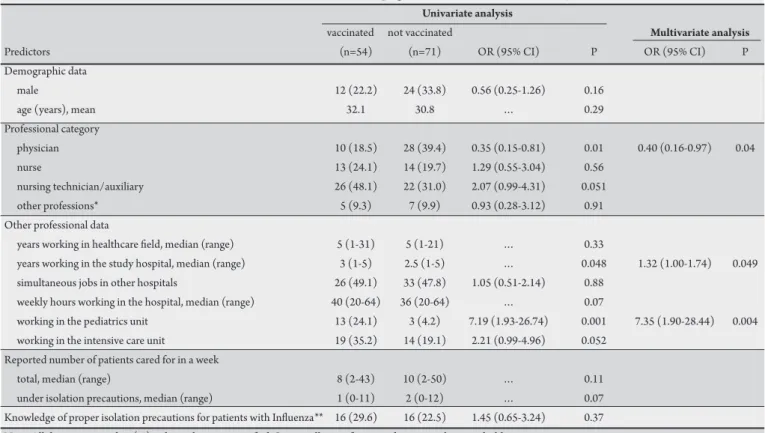
TABLE 1 - Predictors of HCW adherence to the 2007 inluenza vaccination campaign: univariate and multivariate analysis.
Univariate analysis
vaccinated not vaccinated Multivariate analysis
Predictors (n=54) (n=71) OR (95% CI) P OR (95% CI) P
Demographic data
male 12 (22.2) 24 (33.8) 0.56 (0.25-1.26) 0.16
age (years), mean 32.1 30.8 … 0.29
Professional category
physician 10 (18.5) 28 (39.4) 0.35 (0.15-0.81) 0.01 0.40 (0.16-0.97) 0.04
nurse 13 (24.1) 14 (19.7) 1.29 (0.55-3.04) 0.56
nursing technician/auxiliary 26 (48.1) 22 (31.0) 2.07 (0.99-4.31) 0.051
other professions* 5 (9.3) 7 (9.9) 0.93 (0.28-3.12) 0.91
Other professional data
years working in healthcare ield, median (range) 5 (1-31) 5 (1-21) … 0.33
years working in the study hospital, median (range) 3 (1-5) 2.5 (1-5) … 0.048 1.32 (1.00-1.74) 0.049 simultaneous jobs in other hospitals 26 (49.1) 33 (47.8) 1.05 (0.51-2.14) 0.88
weekly hours working in the hospital, median (range) 40 (20-64) 36 (20-64) … 0.07
working in the pediatrics unit 13 (24.1) 3 (4.2) 7.19 (1.93-26.74) 0.001 7.35 (1.90-28.44) 0.004 working in the intensive care unit 19 (35.2) 14 (19.1) 2.21 (0.99-4.96) 0.052
Reported number of patients cared for in a week
total, median (range) 8 (2-43) 10 (2-50) … 0.11
under isolation precautions, median (range) 1 (0-11) 2 (0-12) … 0.07
Knowledge of proper isolation precautions for patients with Inluenza** 16 (29.6) 16 (22.5) 1.45 (0.65-3.24) 0.37 Note. All data are in number (%) unless otherwise speciied. Statistically signiicant predictors are shown in bold.
N: number of subjects, OR: odds ratio, CI: conidence interval.
*Physiotherapists, Nutritionists, Psychologists, ** As recommended in the 1996 Centers for Disease Control Guidelines for Isolation Precautions in Hospitals7. Study design
A cross-sectional survey was conducted in December 2007. A random sample of HCWs was selected for interview by one of the researchers. he interview consisted of two sections: the irst aimed at identifying adherence predictors for inluenza vaccination; the second to assess HCW knowledge on isolation precaution practices for several infectious diseases. his paper presents the results of the irst part of the study. However, since knowledge regarding inluenza isolation precautions may interfere in the likelihood of being vaccinated, this variable was included in the analysis.
Sample size
Sample size was calculated using statistical software (Open EPI, © Emory University). Vaccination coverage of 40% with 10% absolute precision was anticipated. he suggested sample size was 86 HCWs. However, in order to achieve a beter representation of all the hospital units, the sample was expanded to 125 individuals.
Study variables
Data collected during interview included demographics, professional category, number of years since graduation, number of years working in the hospital and simultaneous jobs in other healthcare settings. HCWs were also asked to report the average number of patients they cared for on a weekly basis, including those under isolation precautions. They were also asked to identify the correct isolation precautions indicated for patients with suspected or confirmed influenza. Answers were evaluated according to the Centers for Disease Control and Prevention Guidelines for Isolation Precautions in Hospitals (1996)7, which recommend placing patients with inluenza-like illnesses under precautions for contact and droplet transmission.
Adherence to the 2007 inluenza vaccination campaign
Of the 125 HCWs interviewed, 54 (43.2%) had been vaccinated against influenza in 2007. Analysis of adherence predictors to vaccination in 2007 is presented in Table 1. Multivariate analysis
Outcomes of interest
he study focused on two outcomes: 1) vaccination against in inluenza in 2007; 2) vaccination against inluenza in at least three campaigns in the last ive years. In analysis of the irst outcome, data from all 125 HCWs interviewed was included. For the second, only data from HCWs working in the healthcare ield for ive years or more prior to the interview was analyzed.
Statistical analysis
he data was submited to univariate and multivariate analyses using statistics sotware (SPSS 15.0, © SPSS inc). Univariate analysis used the Chi square and Fisher’s Exact texts for dichotomous variables and Student T or Mann-Whitney U test for continuous variables. Multivariate analysis consisted of logistic regression models. A conditional stepwise forward approach was used to select variables8. P values < 0.1 and < 0.05 were required to enter and remain in the models, respectively. A P value of less than 0.05 was also set as the inal limit for statistical signiicance.
Ethical
613
Rev Soc Bras Med Trop 43(6):611-614, nov-dez, 2010
DISCUSSION
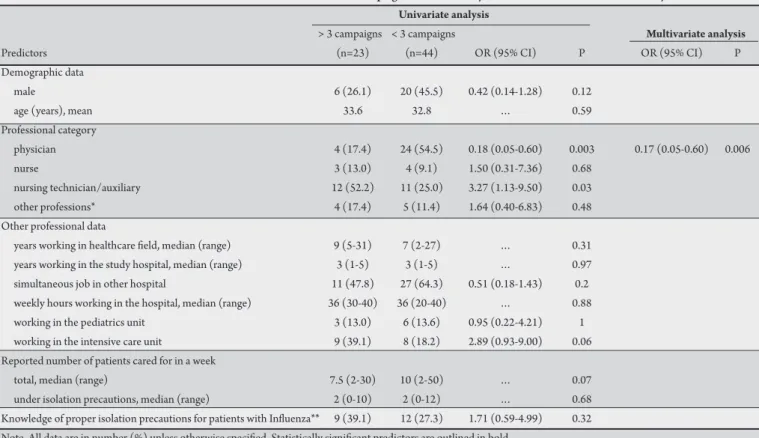
TABLE 2 - Predictors for adherence to three or more inluenza vaccination campaigns in the last ive years: univariate and multivariate analysis.
Univariate analysis
> 3 campaigns < 3 campaigns Multivariate analysis
Predictors (n=23) (n=44) OR (95% CI) P OR (95% CI) P
Demographic data
male 6 (26.1) 20 (45.5) 0.42 (0.14-1.28) 0.12
age (years), mean 33.6 32.8 … 0.59
Professional category
physician 4 (17.4) 24 (54.5) 0.18 (0.05-0.60) 0.003 0.17 (0.05-0.60) 0.006
nurse 3 (13.0) 4 (9.1) 1.50 (0.31-7.36) 0.68
nursing technician/auxiliary 12 (52.2) 11 (25.0) 3.27 (1.13-9.50) 0.03
other professions* 4 (17.4) 5 (11.4) 1.64 (0.40-6.83) 0.48
Other professional data
years working in healthcare ield, median (range) 9 (5-31) 7 (2-27) … 0.31 years working in the study hospital, median (range) 3 (1-5) 3 (1-5) … 0.97 simultaneous job in other hospital 11 (47.8) 27 (64.3) 0.51 (0.18-1.43) 0.2 weekly hours working in the hospital, median (range) 36 (30-40) 36 (20-40) … 0.88 working in the pediatrics unit 3 (13.0) 6 (13.6) 0.95 (0.22-4.21) 1 working in the intensive care unit 9 (39.1) 8 (18.2) 2.89 (0.93-9.00) 0.06 Reported number of patients cared for in a week
total, median (range) 7.5 (2-30) 10 (2-50) … 0.07
under isolation precautions, median (range) 2 (0-10) 2 (0-12) … 0.68
Knowledge of proper isolation precautions for patients with Inluenza** 9 (39.1) 12 (27.3) 1.71 (0.59-4.99) 0.32 Note. All data are in number (%) unless otherwise speciied. Statistically signiicant predictors are outlined in bold.
N: Number of subjects; OR: odds ratio, CI: conidence interval.
*Physiotherapists, Nutritionists, Psychologists, ** As recommended in the 1996 Centers for Disease Control Guidelines for Isolation Precautions in Hospitals7.
showed that HCWs working in pediatric units and those working in the hospital for a longer period were more likely to have been vaccinated against inluenza. However, physicians displayed lower adherence to vaccination.
Adherence to three or more inluenza vaccination campaigns in the last ive years
A total of 67 HCWs were eligible for this analysis. Twenty-three (34.3%) had been vaccinated three or more times in the last ive years. Table 2 presents results from univariate and multivariate analyses. he medical profession was once again associated with poorer adherence according to the later.
he nonmaleicence axiom, primum non nocere, is perhaps the soundest argument for HCW immunization. However, claims regarding the moral obligation of not infecting patients are clearly insuicient to ensure adherence to inluenza vaccination campaigns9,10.Hospitals must therefore develop their own strategies of improving vaccine coverage among staf. his is why studies concerning vaccination adherence predictors are of the utmost importance.
A recent paper by Hollmeyer et al11 reviewed literature on knowledge and adherence predictors for influenza vaccination in HCWs working in hospitals. Twenty-one published articles were included in the review. he most commonly cited reason for non-receipt of inluenza vaccine was fear of adverse reaction, closely followed by lack of concern. However, the most common reason for adhering to inluenza vaccination campaigns was self-protection with
protection of patients ranking a poor second. he authors concluded that when HCWs are immunized against inluenza, they do so for their own beneit and not as a concern for patient safety. his poses a major challenge for infection control.
Shortly ater this review came out, Loulergue et al12 published a paper focusing on the knowledge and attitudes of HCWs to occupational vaccinations.he authors reported that only 52% of HCWs from a teaching hospital in Paris (France) were aware of the occupational indication for inluenza vaccination. hey veriied greater awareness among physicians and pediatric staf. Knowledge regarding vaccine recommendations was an independent predictor of vaccination adherence. hese results have both similarities and contrasts with those obtained in this work.
In the present study, HCWs working in pediatric units were more likely to have been vaccinated. his is rather puzzling, since annual Brazilian inluenza campaigns stress the risks of inluenza for the elderly13. It is worth noting that all but the pediatric units in our hospital predominantly admit patients aged 60 years-old or over. Greater inluenza vaccine uptake for HCWs caring for these elderly patients would be expected; however, the results were exactly the opposite and could imply serious misconceptions regarding the importance of immunization.
614
REFERENCES
this is not a mater of lack of knowledge; rather, that it relects the poor likelihood of physicians to adhere to infection control guidelines. his does not apply only to immunization issues. A recent review reports that physicians had the worst performance in several studies of compliance to hand hygiene procedures16.
he number of years since admission to our hospital was positively associated with adherence to the 2007 vaccination campaign. his may imply the occurrence of a virtuous cycle: the longer the HCWs work in our hospital, the greater the likelihood of receiving a vaccine. Other authors have described this virtuous cycle based on a diferent inding. In their results, receiving inluenza vaccination in one year strongly predicted adherence to the following year’s campaign12,14.
Other findings from this study must also be highlighted. Receiving inluenza vaccine was not inluenced by knowledge of the proper isolation precautions for patients with inluenza-like illnesses. Moreover, frequent care for patients under isolation precautions did not predict vaccination. hese indings suggest that adherence has litle to do with knowledge or experience. It probably has more to do with behavioral paterns and future research should focus on this issue using both quantitative and qualitative approaches.
Taken together, the results of our group suggest that policies to assure good inluenza vaccine coverage in our hospital should focus on physicians and newly-admited HCWs. hese policies should be designed to assess not just knowledge, but also the atitudes, beliefs and lifestyle of different professional categories. Furthermore, previous experience demonstrates that interventions must be continuous; otherwise, adherence may rapidly fall rapidly over time17. Finally, following the emergence of the 2009 A H1N1 inluenza pandemic, the question of whether the present indings are still valid should be asked. It is true that memory of recent events prompted greater adherence by HCWs for vaccination against the pandemic strain. However, attitudes concerning pandemic Influenza still vary widely among professional categories18. In the future, now the pandemic has ended, it is possible that HCWs will behave as they did in the prepandemic era. herefore, knowledge regarding vaccination predictors will still contribute toward the challenge of assuring good coverage for vaccination campaigns and, ultimately, in preventing the transmission of the inluenza virus within hospitals.
1. Ferguson JK, Stuart RL, Cheng AC, Marshall CL. Healthcare infection control special interest group of the Australian Society for Infectious Diseases. ASID (HICSIG) position statement: infection control guidelines for patients with Influenza-like illnesses, including pandemic (H1N1) Influenza 2009, in Australian health care facilities. Med J Aust 2009; 191:454-458.
2. Salgado CD, Barr BM, Hall KK, Hayden FG. Inluenza in the acute hospital seting. Lancet Infect Dis 2002; 2:145-155.
3. Maltezou HC. Nosocomial Inluenza: new concepts and practice. Curr Opin Infect Dis 2008; 21:337-343.
4. Talbot TR, Bradley SE, Cosgrove SE, Ruef C, Siegel JD, Weber DJ. Inluenza vaccination of healthcare workers and vaccine allocation for healthcare workers during vaccine shortages. Infect Control Hosp Epidemiol 2005; 26:882-890. 5. Elder AG, O’Donnel B, McCruden EA, Symington IS, Carman WF. Incidence
and recall of Inluenza in a cohort of Glasgow healthcare workers during the
1993-4 epidemic: results of serum testing and questionnaire. BMJ1996; 313: 1241-1242.
6. Heimberger T, Chang HG, Shaikh M, Croty L, Morse D, Birkhead G. Knowledge and atitudes of healthcare workers about Inluenza: why are they not geting vaccinated? Infect Control Hosp Epidemiol 1995; 16:412-415.
7. Garner JS. Guideline for isolation precautions in hospitals. The Hospital Infection Control Practices Advisory Commitee. Infect Control Hosp Epidemiol 1996; 17:53-80.
8. Greenland S. Modeling and variable selection in epidemiologic analysis. Am J Public Health 1989; 79:340-349.
9. Harris J, Holm S. Is there a moral obligation not to infect others? BMJ 1995; 311:1215-1217.
10. Lugo NR. Will carrots or sticks raise Inluenza immunization rates of health care personnel? Am J Infect Control 2007; 35:1-6.
11. Hollmeyer HG, Hayden F, Poland G, Buchholz U. Inluenza vaccination of healthcare workers in hospitals - a review of studies on atitudes and predictors. Vaccine 2009; 27:3935-3944.
12. Loulergue P, Moulin F, Vidal-Trecan G, Demontipion C, Menager C, Gorodetsky M, et al. Knowledgem atitudes and vaccination coverage of healthcare workers regarding occupational vaccinations. Vaccine 2009; 27:4240-4243.
13. Donalisio MR. Brazilian policy for Inluenza vaccination and its impact on the health of the elderly. Cad Saude Publica 2007; 23:494-495.
14. Beguin C, Boland B, Ninane J. Healthcare workers: vectors of Inluenza virus? Low vaccination rate among hospital health care workers. Am J Med Qual 1998; 13:223-227.
15. Doebbeling BN, Edmond MB, Davis CS, Woodin JR, Zeitler RR. Inluenza vaccination of healthcare workers: evaluation of factors that are important in acceptance. Prev Med 1997; 26:68-77.
16. Pitet D. Improving adherence to hand hygiene practice: a multidisciplinary approach. Emerg Infect Dis 2001; 7:234-240.
17. Takayanagi IJ, Cardoso MA, Costa SF, Araya ME, Machado CM. Atitudes of health care workers to Inluenza vaccination: Why are they not vaccinated? Am J Infect Control 2007; 35:56-61.
18. La Torre G, Di hiene D, Cadeddu C, Ricciardi W, Boccia A. Behaviours regarding preventive measures against pandemic H1N1 Inluenza among Italian healthcare workers, October 2009. Euro Surveill 2009;14:pii-19432.
Cavalcante RS et al - Inluenza vaccination in healthcare workers