INTRODUCTION
Article/Artigo
1. Graduate Course in Health Science: Infectology and Tropical Medicine, Faculty of Medicine, Federal University of Minas Gerais, Belo Horizonte, MG. 2. Eduardo de Menezes Hospital, Minas Gerais Health Foundation, Belo Horizonte, MG.
Address to: Dr. José Roberto Lambertucci. Depto de Clínica Médica/FM/UFMG. Av. Alfredo Balena
190, 30130-100 Belo Horizonte, MG. Phone: 55 31 3337-7781
e-mail: [email protected] Received in 13/02/2010 Accepted in 06/10/2010
Antituberculosis drug-induced hepatotoxicity: a comparison between
patients with and without human immunodeiciency virus seropositivity
Hepatotoxicidade induzida pelos tuberculostáticos: comparação em pacientes com e sem
soropositividade para o vírus da imunodeiciência humana
Natalia Saldanha Magalhães Coca
1, Marcelo Silva Oliveira
2, Izabela Voieta
1, Carlos Maurício de Figueiredo Antunes
1and José Roberto Lambertucci
1ABSTACT
Introduction: The prevalence and risk factors for rifampin, isoniazid and pyrazinamide hepatotoxicity were evaluated in HIV-infected subjects and controls. Methods: Patients with tuberculosis (30 HIV positive and 132 HIV negative), aged between 18 and 80 years-old, admited to hospital in Brazil, from 2005 to 2007, were selected for this investigation. hree deinitions of hepatotoxicity were used: I) a 3-fold increase in the lower limit of normal for alanine-aminotransferase (ALT); II) a 3-fold increase in the upper limit of normal (ULN) for ALT, and III) a 3-fold increase in the ULN for ALT plus a 2-fold increase in the ULN of total bilirubin.
Results: In groups with and without HIV infection the frequency of hepatotoxicity I was 77% and 46%, respectively (p < 0.01). Using hepatotoxicity II and III deinitions no diference was observed in the occurrence of antituberculosis drug-induced hepatitis. Of the 17 patients with hepatotoxicity by deinition III, 3 presented no side efects and treatment was well tolerated. In 8 (36.4%) out of 22, symptoms emerged and treatment was suspended. Alcohol abuse was related to hepatotoxicity only for deinition I. Conclusions: Depending on the deinition of drug-induced hepatitis, HIV infection may or may not be associated with hepatotoxicity. he impact that minor alterations in the deinition had on the results was impressive. No death was related to drug-induced hepatotoxicity. he emergence of new symptoms ater initiating antituberculosis therapy could not be atributed to hepatotoxicity in over one third of the cases.
Key-words: Hepatotoxicity. Antituberculosis drugs. Human immunodeficiency virus. Antiretroviral drugs. Hepatitis. Tuberculosis.
RESUMO
Introdução: Avaliou-se a prevalência e os fatores de risco para hepatotoxicidade aos tuberculostáticos em pacientes HIV positivos e controles. Métodos: Selecionou-se 162 pacientes com tuberculose, tratados com rifampicina, isoniazida e pirazinamida, na faixa etária de 18 a 80 anos, internados em hospital público no Brasil, entre 2005 e 2007. Eles foram divididos em dois grupos: 30 infectados pelo HIV e 132 controles. Adotou-se três deinições para hepatotoxicidade: I) aumento de três vezes no valor inferior normal da alanina-aminotransferase (ALT); II) aumento de três vezes no valor superior normal (VSN) da ALT; III) aumento de três vezes no VSN da ALT e duas vezes no VSN da bilirrubina total. Resultados: Nos grupos com e sem infecção pelo HIV, a frequência de hepatotoxicidade I foi de 77% e 46%, respectivamente (p<0,01). Para as deinições II e III a frequência de hepatotoxicidade não diferiu entre os grupos estudados. De 17 pacientes com hepatotoxicidade induzida por droga (deinição III), três não apresentaram sintomas e o tratamento foi mantido sem intercorrências. Oito (36,4%) de 22 indivíduos apresentaram efeitos colaterais e interromperam o tratamento, mas não apresentavam hepatotoxicidade pela deinição III. O abuso de álcool associou-se à hepatotoxicidade apenas para a deinição I. Conclusões: Na dependência da deinição escolhida, a infecção pelo HIV pode ou não associar-se à hepatotoxicidade. Foi grande o impacto que pequenas alterações na deinição de hepatotoxicidade tiveram nos resultados. Nenhuma morte associou-se ao uso de tuberculostáticos. O surgimento de sintomas não pôde ser atribuído aos tuberculostáticos em um terço dos casos.
Palavras-chaves: Hepatoxicidade. Tuberculostáticos. Vírus da imunodeiciência humana adquirida. Drogas antirretrovirais. Hepatite. Tuberculose.
Eighty ive thousand cases of tuberculosis and 30,000 new cases of HIV infection were reported in Brazil in 20081. Tuberculosis is the most common
opportunistic disease in HIV-infected patients2-8.
In Africa, tuberculosis has been reported to be the worst epidemic faced by local health authorities ever. he average incidence of tuberculosis increased from 149 to 343 cases per 100,000 inhabitants between 1990 and 20059.
he usual drug regimens for treating tuberculosis are the same as those recommended for HIV coinfected patients. However, therapeutic failures and recurrences have been more frequently reported among the later9.
Toxic hepatitis is the most severe adverse reaction to antituberculosis drugs. It usually installs in the irst few weeks of treatment, in parallel with liver necrosis, which may evolve to encephalopathy and death. he risk factors most frequently associated with drug-induced hepatitis are: old age, undernourishment, chronic alcohol abuse, B and C viral hepatitides and the use of antiretroviral therapy10,11.
Increased hepatotoxicity with antituberculosis drugs has been reported in HIV-infected patients by some authors12,13; however, others do not
corroborate this association14-18. In addition, a
diversity of definitions for toxic hepatitis are currently in use and numerous drug regimens are involved in treating tuberculosis.
In this study, the prevalence and risk factors for hepatotoxicity to rifampin, isoniazid and pyrazinamide were evaluated in HIV-infected subjects.
METHODS
RESULTS
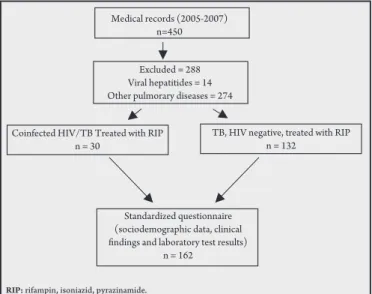
negative), with ages ranging from 18 to 80 years, were selected for this investigation (Figure 1).
Medical records (2005-2007) n=450
Excluded = 288 Viral hepatitides = 14 Other pulmorary diseases = 274
Coinfected HIV/TB Treated with RIP n = 30
TB, HIV negative, treated with RIP n = 132
Standardized questionnaire (sociodemographic data, clinical indings and laboratory test results)
n = 162
RIP: rifampin, isoniazid, pyrazinamide.
FIGURE 1 - Flow chart of patients with tuberculosis selected for the present study.
Deinition of hepatotoxicity
hree deinitions of hepatoxicity were used:I,a 3-fold increase in the lower limit of normal for alanine-aminotransferase (ALT); II, a 3-fold increase in the upper limit of normal (ULN) for ALT; and III, a 3-fold increase in the ULN for ALT plus a 2-fold increase in the ULN of total bilirubin19-21.
Alcohol abuse
Excessive alcohol use was deined as the ingestion of more than 60g of alcohol per day, which is the equivalent to 140mL of a local distilled sugarcane derived drink, pinga, or two botles of beer22.
Data collection
Information obtained from the medical records of patients admited to the Hospital Eduardo de Menezes, Belo Horizonte, Brazil, from 2005 to 2007, were transferred to a data bank and analyzed by SPSS 12.0. For each patient, a standardized questionnaire was illed out with sociodemographic data, clinical indings and laboratory test results.
Laboratory and radiological tests
Hemogram and erythrocyte sedimentation rate;amylase, bilirrubin, BUN, LDH, alkaline phosphatase, glucose, alanine amino-transferase (Merck-Selectra and Roche-Cobas-Mira),HBsAg, anti-HBcAg and anti-HCV were tested in sera samples (AXSYM HCV 3.0. Abbot Laboratories, Brasil) and chest x-rays were taken.
HIV serology and lymphocyte count
Enzyme-linked immunosorbent assay(ELISA) and western-blot were used according to Brazilian Ministry of Health recommendations. For thewestern-blot, a commercial kit was used (HBB 404 - HEMOBIO, HIV-1 Imunoblot, Westernblot, Empresa Brasileira de Biotecnologia SA).CD4+ and CD8+ counts in blood were quantiied by low cytometry(Coulter, Becton and Dickinson, Facscalibur low cytometer, San Diego, California, USA).
Culture for Mycobacterium tuberculosis
he samples were decontaminated using monosodium phosphate and trisodium phosphate (modiied Corper & Stoner method)23,24
and were concentrated by centrifugation. Subsequently, smears prepared from an aliquot of the sediment were submited to staining
under microscopy. A quantity (0.1mL) of the sediment was added to at least two tubes containing Löwenstein-Jensen (LJ) medium, which were incubated at 37ºC for up to eight weeks. he results were described using a semiquantitative scale.he strains isolated were identiied by means of the growth inhibition test using p-nitro-alpha-acetylamino-beta-hydroxypropiophenone (NAP) in the BACTEC 460 system (Becton Dickinson Microbiology Systems, Sparks, MD, USA) and by means of other phenotyping tests (morphological analysis of colonies and classical biochemical tests)27.
Diagnosing tuberculosis
he diagnosis of tuberculosis was accepted when the agent was identiied in smear/culture of biological material (blood, tissue, sputum) or based on clinical and radiological evidence associated with a deinitive response to antituberculosis treatment.
Tuberculin test
Purified protein derivative (PPD) test was administered by injecting a 0.1mL volume containing 5 TU (tuberculin units) under the skin of the forearm. he test was read between 48 and 72h ater injection. A positive induration from 0 to 4mm was considered negative; 5 to 9mm of induration was considered a positive weak skin test result and above 9mm a strong response.
Statistical analysis
Data from the questionnaires were transferred to a data bank using EpiData 3.1 (EpiData Association, Odense, Denmark) and analyzed by the Statistical Package for Social Sciences (SPSS) 12.0 (SPSS inc, IBM Company, Chicago, Illinois). As a irst step, descriptive analysis (frequency tables and exploratory data analysis for qualitative and quantitative variables, respectively) was conducted. Cases and controls were compared using the Chi square or Fisher exact (qualitative variables) and Mann-Whitney (quantitative variables) tests. Pre and postreatment information was analyzed by the McNemar (qualitative)
and Wilcoxontests.Comparisonof the time until hepatotoxicity
between the two groups was done using Kaplan-Meiercurvesand
log-rank test.Logistic regression models were performed to identify risk factors associated with hepatotoxicity. For variables to enter the model, a p value of 0.2 was used; to remain in the inal model, a p value of 0.05 was adopted.Odds ratios(OR) and respective 95% conidence intervals (95%CI) were used to estimate hepatotoxicity risk. Model adjustment was tested by the Hosmer & Lemeshowtechnique28.
Ethical
he present investigation was approved by the Human Research Ethical Boards of the Eduardo de Menezes Hospital and the School of Medicine of the Federal University of Minas Gerais.
Sociodemographic and clinical data
he mean age was 35.7±0.6 and 43.8±3.9 years-old for the HIV positive and negative groups, respectively (p < 0.003). For weight, skin color, sex and alcohol abuse, no significant difference was observed between the groups studied(Table 1).
Pulmonary or extrapulmonary tuberculosis
DISCUSSION TABLE 1 - Sex, age, skin color, alcohol abuse and body weight of 162 patients
(HIV positive and negative) with tuberculosis admitted to the Eduardo de Menezes Hospital in Belo Horizonte, Minas Gerais, Brazil, from 2005 to 2007.
Study groups HIV+ (n=30) HIV- (n=132)
Characteristics n % n % p
Sex (male) 23 76.7 94 71.2 0.55
Age (median, yr) 36 29-41* 42 33-54 0.03
Skin color
white 3 10 18 14
black 2 6.7 11 8 0.56
other 2 7 20 15
ignored 23 77 83 63
Alcohol abuse 15 68 68 64 0.99
Body weight (median) 54 48-58* 53 48-60* 0.52 *First and third quartiles
TABLE 2 - Patients with hepatotoxicity according to deinition III*, 3 weeks ater treatment for tuberculosis with rifampin, isoniazid and pyrazinamide (HIV positive/negative) at the Eduardo de Menezes Hospital, Belo Horizonte, Minas Gerais, Brazil, 2005-2007.
Patients ALT Total bilirubin HIV serological
(UI/L) (mg/dL) status
1 333 2.7
-2 279 4.8
-3 205 4.4 +
4 199 3.2
-5 910 2.9
-6 260 2.5
-7 307 3.6 +
8 313 6.3 +
9 382 5.2
-10 235 2.3
-11 200 3.6
-12 882 4.5
-13 306 2.5
-14 214 2.2 +
15 277 3.5 +
16 516 4.9
-17 1,270 5.7 +
*deinition III: a 3-fold increase in the upper limit of normal for ALT (65UI/L) plus a 2-fold increase in the upper limit of normal for total bilirubin (2mg/dL). ALT: alanine-aminotransferase.
Comorbidities
Twenty one patients presented diabetes mellitus, 17 presented systemic arterial hypertension, 2 presented heart failure and 1 presented chronic renal failure. No relation was observed between these comorbidities and hepatotoxicity.
Hepatotoxicity
Hepatotoxicity I occurred in 23 (77%) out of 30 HIV positive patients and in 60 (45.5%; p < 0.01) out of 132 HIV negative patients. Hepatotoxicity II occurred in 6 (20%) out of 30 HIV positive patients and in 12 (9%; p = 0.107) out of 132 HIV negative patients. Hepatotoxicity III occurred in 6 (20%) out of 30 HIV positive patients and in 11 (8.3%; p = 0.09) out of 132 HIV negative patients.
Liver enzymes
A signiicant increase in liver enzymes ater initiating treatment (ALT, AST, GGT, alkaline phosphatase and total bilirubin) was reported for both groups (p < 0.01).
Factors associated to hepatotoxicity
Hepatotoxicity was more frequent in men. Using deinition I, alcohol abuse was equally associated with hepatotoxicity in both groups.
Treatment interruption
Antituberculosis treatment was suspended in 22 patients; 7 (23.3%) out 30 were HIV positive and 15 (11.4%) out of 132 were HIV negative (p = 0.08). Fourteen (63.6%) out of 22 fulilled the criteria for toxic hepatitis by deinition III. he remaining 8 (36.4%), who did not have hepatotoxicity by deinition III, stopped treatment for tuberculosis because they presented symptoms (nausea, vomiting, abdominal pain and hyporexia) which precluded further use of antituberculosis therapy. hey presented comorbidities (4 with toxoplasmosis, 1 with cor pulmonale and 3 with CMV infection) and prescribed drugs for these diseases may be the explanation for their complaints.
Table 2 lists the 17 patients with hepatotoxicity III. In 14, treatment was suspended because they developed symptomatic toxic hepatitis, while in 3 asymptomatic individuals, treatment with antituberculosis drugs was maintained and well tolerated.
he frequency of hepatotoxicity caused by rifampin, isoniazid and pyrazinamide varied, in the present study, according to the deinition used. For hepatotoxicity I, 77% (23 out of 30) of the HIV-infected group and 45.5% (60 out of 132) of the noninfected group developed toxic hepatitis (p = 0.002). For deinitions II and III, no statistical diference in toxic hepatitis was observed between HIV-infected and noninfected patients.
he deinition of drug induced hepatitis difers in the literature, making comparisons between studies diicult. he World Health Organization (WHO)1, for example, divides the intensity of hepatitis
into four grades: I (slight), ALT ≤ 2.5 times the ULN; II (mild), ALT 2.6-5.0 the ULN; III (moderate), 5-10 times the ULN; and IV (severe), >10 times the ULN. In this study, three patients (cases 5, 12 and 17) presented severe hepatitis according to the WHO deinitions (Table 2). he American Society for the Study of the Liver states that a three-fold increase in ALT above the ULN plus a two-fold increase in the ULN of total bilirubin and veriication of clinical data are necessary to deine toxic hepatitis29. For the Brazilian
Ministry of Health30, a three-fold increase in ALT and AST, with
symptoms or jaundice would be necessary to deine hepatotoxicity. In the recommendations published by the Ministry of Health of Brazil30 prior to 2009, the normal value to be used in the deinition of toxic
he authors declare that there are no conlicts of interest.
CONFLICT OF INTEREST
FINANCIAL SUPPORT
REFERENCES
of Brazil in 200931, hepatotoxicity that occurs ater the onset of
antituberculosis therapy was deined as an increase in ALT serum levels > 5 times the upper limit of normal (ULN) (with or without jaundice) or jaundice (with or without ALT increase). In Table 2 it is possible to see that only 6 (35.3%) out of the 17 patients listed would fulill the criterion of ALT > 5 times the ULN.
Eighty-three (51.2%) out of 162 patients in both groups (HIV positive and negative) presented hepatotoxicity when deinition I was used. Ater 15 days, 17 (20.5%) of the 83 developed hepatotoxicity by deinition III. his inding is worth mentioning because, once a patient presents hepatotoxicity by deinition I, given enough time, 1/5 will develop toxic hepatitis by deinition III and, in most cases, treatment for tuberculosis would be suspended.
In the literature, the prevalence of hepatotoxicity to antituberculosis drugs ranges widely from 5% to 27%12,32-36. One possible explanation
is that diferent deinitions were used for drug-induced hepatitis37-39.
Here, hepatotoxicity ranged from 8.3% to 45.5% in the HIV-negative group and from 20% to 77% in the HIV-positive group, depending on the deinition applied.
herefore, depending on the deinition of hepatotoxicity, this potentially severe adverse reaction to antituberculosis drugs, may or may not be identiied34. Evidence both in favor of12,13,15 and against a
role for HIV infection in the frequency of toxic hepatitis caused by antituberculosis therapy has been reported18,32,38.
Treatment for tuberculosis was suspended for 22 patients, 14 (63.6%) of whom fulilled the criteria for toxic hepatitis by deinition III. In the remaining 8 (36.4%), who did not have hepatotoxicity according to deinition III, treatment for tuberculosis was suspended because they presented symptoms (nausea, vomiting, abdominal pain and hyporexia) that precluded the continued use of the drugs.
They presented comorbidities (4 with toxoplasmosis, 1 with cor
pulmonale and 3 with CMV infection) and the drugs prescribed
for these conditions may partially account for their complaints. Seventeen out of 136 patients had toxic hepatitis according to deinition III and in 14, RIP was suspended; however, in three asymptomatic patients, treatment for tuberculosis was maintained (ALT of 205, 199 and 235U/L) and no complications evolved. his conirms the importance of using associated clinical indings (e.g., vomiting, jaundice, nausea, fever) to suspend treatment.
While investigating hepatotoxicity caused by antiretroviral drugs in 868 HIV-infected patients in Africa, Hofman et al13 observed that
the frequency of toxic hepatitis was highest in patients concomitantly treated for tuberculosis. Information concerning the concomitant use of antiretroviral drugs and antituberculosis therapy was not possible in the present investigation, because data obtained from the medical records regarding drug interaction were scarce and unreliable.
Seventeen (10.5%) out of 162 patients died during treatment for tuberculosis: two in the HIV-infected group and 15 in the controls (p = 0.45). Five (22.7%) out of the 22 patients who did interrupt treatment died thereater: seven (28.6%) were HIV positive and 15 (20%), HIV negative (p = 0.66). Based on previous reports, our hypothesis was that death would be more frequent in HIV-infected individuals12. Two explanations for our incorrect prediction
may be offered: 1) following the introduction of highly active antiretroviral therapy, mortality decreased in HIV-infected patients with tuberculosis, and 2) since tuberculosis is more common in
of tuberculosis earlier and treat their patients at once, therefore, resulting in beter survival.
It has been well documented that alcohol abuse is associated with higher toxic hepatitis in patients treated with antituberculosis drugs40. In this work, alcohol abuse was conirmed as associated
with tuberculosis treatment, although toxicity was not increased in the HIV-infected group.
he frequency of toxic hepatitis was not diferent for deinitions II and III (only one patient had hepatotoxicity according to deinition II and not III). he diference between deinitions II and III is the presence of jaundice in deinition III. his kind of result raises the question of whether jaundice is really important in the diagnosis of toxic hepatitis caused by antituberculosis drugs.
To our knowledge, this is the irst investigation comparing three distinct deinitions of antituberculosis drug -induced hepatotoxicity. Analysis of the findings obtained suggest that the definition of hepatotoxicity outlined by the Brazilian Ministry of Health should be updated and standardized41.
In conclusion, depending on the deinition of toxic hepatitis, HIV infection may or may not be associated with hepatotoxicity. he impact that minor alterations in the deinition; i.e., upper or lower limits of normal for ALT and how many times these normal values (2X, 3X, 5X), had on the results is impressive. No death was related to hepatotoxicity. Alcohol abuse is associated with toxic hepatitis, but not with HIV infection and mortality was not higher in the HIV-infected group. Symptoms are important in the deinition of toxic hepatitis; however, the emergence of new symptoms following the onset of antituberculosis therapy could not be atributed to hepatotoxicity in over one third of the cases studied.
his work was supported by the Coordenação de Aperfeiçoamento de Pessoal de Nível Superior (CAPES) and Conselho Nacional de Desenvolvimento Cientíico e Tecnológico (CNPq), Brazil.
1. World Health Organization. Global tuberculosis control: a short update to the 2009 report. WHO Press; WHO/HTM/TB/2009.426.
2. Lambertucci JR, Rayes AA, Gerspacher-Lara R. Salmonella-S. mansoni association in patients with acquired immunodeiciency syndrome. Rev Inst Med Trop Sao Paulo 1998; 40:233-235.
3. Herzog H. History of tuberculosis. Respiration 1998; 65:5-15.
4. Dye C, Scheele S, Dolin P, Pathania V, Raviglione MC. Consensus statement. Global burden of tuberculosis: estimated incidence, prevalence, and mortality by country. WHO Global Surveillance and Monitoring Project. JAMA 1999; 282:677-686. 5. Lambertucci JR, Rayes AA, Nunes F, Landazuri-Palacios JE, Nobre V. Fever of
undetermined origin in patients with the acquired immunodeiciency syndrome in Brazil: report on 55 cases. Rev Inst Med Trop S Paulo 1999; 41:27-32. 6. Teixeira Jr AL, Nobre V, Lambertucci JR. Respiratory failure due to opportunistic
diseases in AIDS. Rev Soc Bras Med Trop 2002; 35:411-412.
8. Aaron L, Saadoun D, Calatroni I, Launay O, Mémain N, Vincent V, et al. Tuberculosis in HIV-infected patients: a comprehensive review. Clin Microbiol Infect 2004;10:388-398.
9. Nunn P, Williams B, Floyd K, Dye C, Elzinga G, Raviglione M. Tuberculosis control in the era of HIV. Nat Rev Immunol 2005; 5:819-826.
10. Comitê Técnico-Cientíico de Assessoramento à Tuberculose e Comitê Assessor para Coinfecção HIV-Tuberculose.Guia de Vigilância Epidemiológica. Brasília: Ministério da Saúde; 2002. v.1.p.31-33.
11. Rodrigues MC, Vioti JB, Braga RF, Lourenço LF, Antunes CM, Lambertucci JR. HIV/HCV coinfection in Infectious Disease Units in Mozambique and Brazil: a comparative study. Rev Soc Bras Med Trop 2008; 41:518.
12. Pedral-Sampaio DB, Martins Neto E, Alcântara AP, Souza J, Moura L, Brites C, et al. Use of standard therapy for tuberculosis is associated with increased adverse reactions in patients with HIV. Braz J Infect Dis 1997;1:123-130.
13. Hofmann CJ, Charalambous S, hio CL, Martin DJ, Pemba L, Fielding KL, et al. Hepatotoxicity in an African antiretroviral therapy cohort: the efect of tuberculosis and hepatitis B. AIDS 2007; 21:1301-1308.
14. Askgaard DS, Wilcke T, Døssing M. Hepatotoxicity caused by the combined action of isoniazid and rifampicin. horax 1995; 50:213-214.
15. Breen A, Miller RF, Gorsuch T, Smith CJ, Schwenk A, Holmes W, et al. Adverse events and treatment interruption in tuberculosis patients with and without HIV co-infection. horax 2006; 61:791-794.
16. El-Sadr WM, Tsiouris SJ. HIV-associated tuberculosis: diagnostic and treatment challenges. Semin Respir Crit Care Med 2008; 29:525-531.
17. Saraceni V, King BS, Cavalcante SC, Golub JE, Lauria LM, Moulton LH, et al. Tuberculosis as primary cause of death among AIDS cases in Rio de Janeiro, Brazil. Int J Tuberc Lung Dis 2008; 12:769-772.
18. Perriëns JH, St Louis ME, Mukadi YB, Brown C, Prignot J, Pouthier F, et al. Pulmonary tuberculosis in HIV-infected patients in Zaire. A controlled trial of treatment for either 6 or 12 months. N Engl J Med 1995; 332:779-784. 19. Yew W, Leung C. Antituberculosis drugs and hepatotoxicity. Med Bull
2007; 12:7-9.
20. American Thoracic Society/Centers for Disease Control and Prevention/ Infectious Diseases Society of America. Treatment of Tuberculosis. Am J Respir Crit Care Med 2003; 167:603-662.
21. Fernandez-Villar A, Sopena B, Fernandez-Villar J. he inluence of risk factors on the severity of antibuterculosis drug-induced hepatotoxicity. Int J Tuberc Lung Dis 2004; 8:1499-1505.
22. Lambertucci JR, Cota GF, Pinto-Silva RA, Serufo JC, Gerspacher-Lara R, Costa Drummond S, et al. Hepatosplenic schistosomiasis in ield-based studies: a combined clinical and sonographic definition. Mem Inst Oswaldo Cruz 2001; 96 (suppl 1):147-150.
23. Centro Panamericano de Zoonosis. Manual de normas y procedimientos tecnicos para la bacteriologia de la tuberculosis: Parte I. La muestra, El examen microscopico. CEPANZO. Notas Tecnicas, nº 26/Rev. 1. Buenos Aires: CEPANZO; 1988.
24. Smithwick RW. Laboratory manual acid-fast microscopy. Atlanta (GA): Public Health Service, Center for Disease Control, Bureau of Laboratories; 1976. 25. Union International Contra la Tuberculosis. Guia tecnico para recoleción,
conservación y transporte de las muestras de esputo y examen por microscopia direct para la tuberculosis. Bol Un Int Tuberc 1978; 53 (supl 2):1-21. 26. Fundação Nacional de Saúde. Centro de Referência Professor Helio Fraga.
Manual de Bacteriologia da Tuberculose. 2nd ed. Rio de Janeiro: Ministério da
Saúde; 1994.
27. Siddiqi SH. BACTEC 460 TB system. Product and procedure manual, revision D. Sparks (MD): Becton Dickinson Diagnostic Systems; 1995.
28. Dupont WD. Statistical Modeling for Biomedical Researchers, 2nd ed. Cambridge:
Cambridge University Press UK; 2009.
29. Navarro VJ, Senior JR. Drug-related hepatotoxicity. N Engl J Med 2006; 354:731-739.
30. Ministério da Saúde. Programa Nacional de Controle da Tuberculose. Brasília: Editora Ministério da Saúde; 2002.
31. Ministério da Saúde. Guia de Vigilância Epidemiológica da Tuberculose. Brasília: Ministério da Saúde; 2009.
32. Chaisson RE, Clermont HC, Holt EA, Cantave M, Johnson MP, Atkinson J, et al. Six-month supervised intermitent tuberculosis therapy in Haitian patients with and without HIV infection. Am J Respir Crit Care Med 1996; 154:1034-1038. 33. Nathwani RA, Kaplowitz N. Drug hepatotoxicity. Clin Liver Dis 2006;
10:207-217.
34. Pessayre D, Bentata M, Degot C, Nouel O, Miguet JP, Ruef B, et al. Isoniazid-rifampin fulminant hepatitis. A possible consequence of the enhancement of isoniazid hepatotoxicity by enzyme induction. Gastroenterology 1977; 72:284-289.
35. Saukkonen JJ, Cohn DL, Jasmer RM, Schenker S, Jereb JA, Nolan CM, et al. An official ATS statement: hepatotoxicity of antituberculosis therapy. Am J Respir Crit Care Med 2006; 174:935-952.
36. Schaberg T. he dark side of antituberculosis therapy: adverse events involving liver function. Eur Respir J 1995; 8:1247-1249.
37. Tostmann A, Boeree MJ, Harries AD, Sauvageot D, Banda HT, Zijlstra EE. Short communication: antituberculosis drug-induced hepatotoxicity is unexpectedly low in HIV-infected pulmonary tuberculosis patients in Malawi. Trop Med Int Health 2007; 12:852-855.
38. Tostmann A, Boeree MJ, Aarnoutse RE, de Lange WC, van der Ven AJ, Dekhuijzen R. Antituberculosis drug-induced hepatotoxicity: concise up-to-date review. J Gastroenterol Hepatol 2008; 23:192-202.
39. Yew WW, Leung CC. Antituberculosis drugs and hepatotoxicity. Respirology 2006; 11:699-707.
40. Willner IR, Reuben A. Alcohol and the liver. Curr Opin Gastroenterol 2005; 21:323-330.