Sandra de Morais PereiraI Stella Regina TaquetteII Maurício de Andrade PérezIII
I Serviço de Ginecologia. Hospital Federal de Bonsucesso. Ministério de Saúde. Rio de Janeiro, RJ, Brasil
II Departamento de Medicina Interna. Faculdade de Ciências Médicas. Universidade do Estado do Rio de Janeiro. Rio de Janeiro, RJ, Brasil
III Instituto de Estudos em Saúde Coletiva. Universidade Federal do Rio de Janeiro. Rio de Janeiro, RJ, Brasil
Correspondence: Sandra de Morais Pereira
Rua Marquês de Valença, 46/501 Tijuca 20550-030 Rio de Janeiro, RJ, Brasil E-mail: [email protected] Received: 7/9/2012
Approved: 7/26/2012
Article available from: www.scielo.br/rsp
High school students' opinions
of gynecological consultations
in Rio de Janeiro, Southeastern
Brazil
ABSTRACT
OBJECTIVE: To analyze sociocultural differences and perceptions of gynecological consultations for high school girls.
METHODS: A transversal study with 418 high school girls from three schools of different profi les in the city of Rio de Janeiro, Southeastern Brazil, in 2010. A structured questionnaire encompassing socio-demographic characteristics, sexual behavior and evaluation of gynecological consultations was completed. Yates’ Chi-square test and the Student’s t-test were utilized adopting a value of p < 0.05.
RESULTS: The students of private and federal public schools presented similar profi les but both were different from the state school girls. The latter had lower socioeconomic status, and their parents had lower levels of education, the predominance of afro-descendants was observed, as were a larger number of sexual partners, pregnancy and cases of sexual violence. The average age of menarche and sexarche among the students were similar, but the fi rst gynecological consultation was signifi cantly later among the state school students. The majority showed some knowledge of contraception and STDs, although only a minority received guidance from the consultations. Students expressed the desire that the professionals dedicate more time, patience and availability to them during consultations.
CONCLUSIONS: The provision of gynecological services for teenagers is not satisfactory, according to the teenagers’ evaluations. Users of the private health system have gynecological consultations earlier than those who only have access to the public system. It is necessary to create mechanisms that facilitate access and adhesion to a routine of gynecological prevention for this age group.
Research on gynecological services does not, in general, differentiate between adult and adolescent, leaving gaps which require fi lling. Limiting adolescence to a transition period encourages neglect of their needs and failure to guarantee their rights.
Concern with adolescents’ quality of life and health care is an integral part of the Brazilian Ministry of Health’s programs through health care policies and establishing norms which guide various activities. Each professional should act within their respective area to ensure this group’s sexual and reproductive rights are guaranteed.a
Inadequate access to basic care may discourage patients from utilizing health care services. Gynecological specialists who treat many adolescents should be prepared to evaluate and deal with their primary health needs, in addition to reproductive issues.9 Services must
be organized in order to accommodate the specifi c needs of this clientele, so that access to campaigns, care and health supplies are guaranteed without the limits actu-ally imposed. This requires refl ection upon the diverse roles played by those in the health sector involved in caring for this particular age group.a
The health of this group is extremely vulnerable to such things as unplanned pregnancies with their attendant complications and the increased prevalence of high grade cervical squamous intraepithelial lesions, which suggest the necessity for sexually active adolescents to be included in cervical cancer screening programs.12 Moreover, they are at high risk of sexually transmitted disease which can lead to gynecological problems which, if not properly dealt with, may affect the future fertility of these young people.7 It is necessary that
healthcare services fulfi ll their obligations to fully care for this population in order to minimize the occurrence of these complications.
Gynecological examinations should be conducted along the appropriate guidelines and in a suitable environment, with the aim of initiating a routine of prevention and care for the adolescents’ reproductive health. However, obstacles such as diffi culty in making appointments, not being able to choose the professional and care inadequate to the needs of this age group are encountered, which can lead to reluctance to attend gynecological examinations. These are not problems which solely affect public health care, but also the private sector. Currently, health care plans limit patient choice, as well as making confi dentiality impossible, as medical appointments are registered to later be checked by the insurance holder.
INTRODUCTION
a Ministério da Saúde. Secretaria de Atenção à Saúde. Departamento de Ações Programáticas Estratégicas. Marco teórico e referencial: saúde sexual e saúde reprodutiva de adolescentes e jovens. Brasília (DF); 2006.
Another problem highlighted by the adolescents6 is the
requirement by some services for a parent or guardian to be present at the appointment, or even to make the appointment. This population requires individual care, with privacy, in an appropriate and private setting including during the physical examination. These obsta-cles lead to the adolescents seeking other forms of guid-ance and only seeking specialized medical assistguid-ance when suffering from health problems. Adolescents do not customarily share their sexual health decisions with their parents or guardians and seek the help of a gynecologist. Professionals, in addition to carrying out the technical aspect of their profession, should also invest in the personal side of their relationship with their patient so as to satisfy ethical precepts, social norms and the patients’ needs and legitimate expectations. The doctor should be appropriately prepared, recognizing the problems peculiar to this age group in order to meet their needs.9
This research aims to analyze sociocultural differences and adolescents’ perceptions of gynecological appoint-ments. We seek to understand the diffi culties in order to assist in this service moving from being a taboo subject to being a routine step in adolescents’ sexual and reproductive health.
METHODS
Transversal knowledge, attitude and practice study of 418 high school students from three urban schools: 165 from state schools, 122 from private schools and 131 from federal public schools in Rio de Janeiro, Southeastern Brazil, between March and July 2010.
Three educational establishments were selected: a state school (A) located in a suburban neighborhood of the city with low socio-economic status; a private institu-tion (B) in a privileged area, with pupils from well-off backgrounds, and a technical federal public school (C) located in a middle class neighborhood, which set an entrance exam. Inclusion criteria which ensured a heterogeneous and representative sample were adopted.
Preliminary semi-structured qualitative interviews with a sample of female adolescents took place, asking about gynecological consultations in this age group.5
different times (n = 52) to evaluate the reliability of the instrument. The variables showed percent agreement values above 90% of the Kappa statistic, confi rming the instrument’s reliability and validity.
A structured, self-administered,anonymous question-naire was completed. The instrument contained sections with questions on socio-demographic characteristics, behavior (related to sexual activity: sexually transmitted diseases, sexuality and contraception), and attitudes and opinions towards gynecological consultations. The adolescents had been previously invited to take part in the research. The questionnaires were completed in a hall provided by the school, without the presence of teachers or school employees, between March and July 2010. The researcher was present to respond to any questions about how to complete the questionnaire.
The sample size was calculated based on data from the preliminary stage, which showed that 70% of adolescents in schools where the income and or level of education of the mothers was higher had visited a gyne-cologist, as had 50% of adolescents in state institutions.
A sample which would enable us to compare two propor-tions, with an error of 5% and a test power of 80% was calculated to be at least 103 students per school.
The data were analyzed using Statistical Package for the Social Sciences (SPSS – 14.0). The comparison between proportions was carried out using Yates’ Chi-square text. Where necessary we used Fisher’s correction (expected value < 5). The Student’s t-test was used to compare measures. The Pearson correla-tion coeffi cient was used to measure linear correlacorrela-tion between two continuous variables. When the prob-ability of error was < 5%, this was considered to be statistically signifi cant.
This research complies with ethical precepts established by CONEP Resolution nº 196/96 and was approved by the Universidade do Estado do Rio de Janeiro, Research and Ethics Committee Process nº 1989-CEP/HUPE, 2008). The parents or guardians of the adolescents who
agreed to take part signed a consent form. Anonymity and confi dentiality were guaranteed.
RESULTS
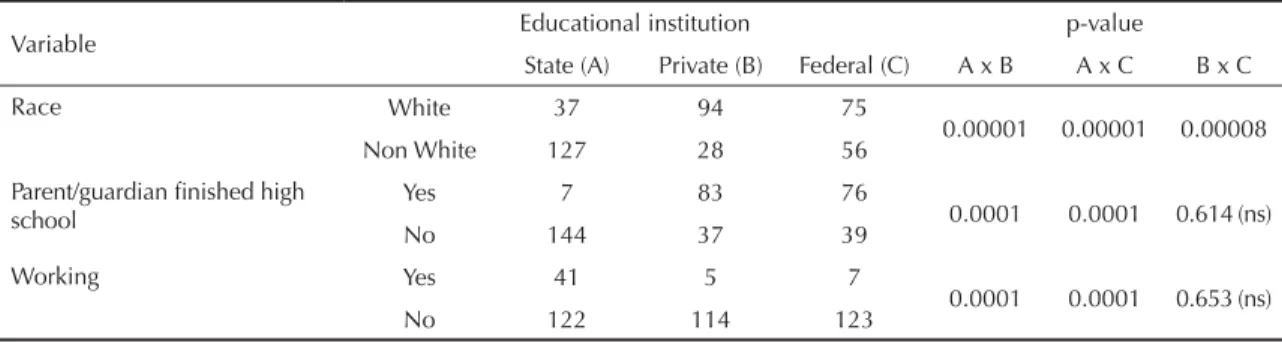
The average age of the population studied was: 17.2 in school A; 15.9 in B and 16.1 in C. The ratio of black and mixed race students in the state school was signifi cantly greater (p < 0.0001) than in the other two schools. The pupils showed lower monthly incomes (p < 0.0001) and reported more inhabitants per room (p < 0.0001). It was noted that the proportion of parents or guardians who had attended high school education (whether or not they graduated), was signifi cantly higher (p < 0.0001) in institutions B and C when compared with the state school. The percentage of adolescents carrying out remunerated activities was 12.9%: 25.2% in school A, 4.2% in school B and 5.4% in school C and there was a statistically signifi cant difference (p < 0.0001) when school A was compared with the others (Table 1).
Students in common law marriages belonged to the state school (p < 0.0001). The mean ages for menarche and sexarche were similar for all of the pupils. The majority of pregnancies (p < 0.0002) occurred in school A. There was a higher proportion of miscarriages in the state school (p < 0.03) compared with the sum of the students (B) and (C). The mean age for the fi rst gyne-cological consultation was higher in state schools (p < 0.0001) when compared with that of students at other educational institutions (Table 2).
The proportion of interviewees who stated that they had been the victim of some kind of sexual abuse was 8.9%, 20 from school (A), seven (B) and ten (C). One adolescent from school B had reported this to the Council of Guardianship. Eighteen pupils from the state school who stated that they had been the victim of sexual abuse had not reported it to anyone or taken any actions.
Overall, the students had access to information about contraception and sexually transmitted diseases (STDs). Much of this knowledge comes from their parents or
Table 1. Absolute distribution of the adolescents according to race, level of education of parent/guardian and number who
were working, according to type of school. Rio de Janeiro, Southeastern Brazil, 2010.
Variable Educational institution p-value
State (A) Private (B) Federal (C) A x B A x C B x C
Race White 37 94 75
0.00001 0.00001 0.00008
Non White 127 28 56
Parent/guardian fi nished high school
Yes 7 83 76
0.0001 0.0001 0.614 (ns)
No 144 37 39
Working Yes 41 5 7
0.0001 0.0001 0.653 (ns)
No 122 114 123
Table2. Distribution of means of age at menarche, age at fi rst sexual relationship, number of sexual partners, number of pregnancies and age of fi rst gynecological consultation according to type of school. Rio de Janeiro, Southeastern Brazil, 2010.
Educational
Institution State (A) Private (B) Federal (C) p
Variable Mean
±
Standard deviation
Mean ±
Standard deviation
Mean ±
Standard
deviation A x B A x C B x C
Menarche
(age) (n = 161) 12.1 (1.6) (n = 119) 12.1 (1.4) (n = 129) 11.8 (1.3) 0.866 0.069 0.260
1st sexual
relation (age) (n = 116) 15.1 (1.5) (n = 29) 15.3 (1.2) (n = 32) 15.1 (1.3) 0.720 0.997
0.836 (ns) Nº of sexual
partners (n = 115) 2.7 (3.1) (n = 26) 1.2 (0.6) (n = 31) 1.5 (0.8) 0.038 0.101
0.896 (ns)
Pregnancy (n = 25) 1.2 (0.6) (n = 0) 0 (n = 1) 1.0 ns ns ns
1st
Gynecological consultation (age)
(n = 107) 14.5 (2.3) (n = 89) 12.9 (1.9) (n = 95) 12.5 (2.2) 0.0001 0.0001 0.389
ns: not signifi cant
Table 3. Absolute and proportional distribution of the evaluation of the high school students’ knowledge about contraception
and sexually transmitted diseases. Students in state and private education. Rio de Janeiro, Southeastern Brazil, 2010.
Knowledge State (A) Private (B) Federal (C)
na % n % n %
Hormonal contraception No 25 14.4 7 4.6 5 2.8
Gynecologist 38 22.0 31 19.7 32 18.2
Other 110 63.6 119 81.7 139 79.0
Total 173 100.0 157 100.0 176 100.0
Male condom No 22 13.2 15 11.5 11 7.3
Gynecologist 28 16.8 11 8.5 14 9.3
Other 117 70.0 104 80.0 126 83.4
Total 167 100.0 130 100.0 151 100.0
Female condom No 71 44.7 54 43.6 44 32.8
Gynecologist 28 17.6 11 8.9 10 7.5
Other 60 37.7 59 47.5 80 59.7
Total 159 100.0 124 100.0 134 100.0
Dual protection No 62 38.8 29 22.0 23 16.7
Gynecologist 45 28.1 22 16.7 21 15.2
Other Doctor 4 2.5 0 0.0 0 0.0
Other 49 30.6 81 61.3 94 68.1
Total 160 100.0 132 100.0 138 100.00
Emergency contraception No 17 9.9 20 13.9 8 5.3
Gynecologist 35 20.3 22 15.3 10 6.6
Other 120 69.8 102 70.8 134 88.1
Total 172 100.0 144 100.0 152 100.0
STDs No 4 2.0 1 0.6 1 0.5
Gynecologist 45 23.0 31 18.0 24 12.7
Other 147 75.0 140 81.4 164 86.8
Total 196 100.00 172 100.0 189 100.0
a Differences in n due to some adolescents marking more than one option.
from other sources such as schools, television, the internet and friends. Gynecologists were not proactive in providing the interviewees with information (Table 3).
From school A, 62.7% of the students had seen a gynecologist, 77% from school B and 78.6% from school C; 78.2% of the interviewees had never had a smear test. Students at the state school encountered signifi cantly greater diffi culties in making an appoint-ment with a gynecologist than the other interviewees (2 = 14.5 and p < 0.0001). Students from school A were
primarily dealt with by public health services, which was clearly signifi cant when compared with the others (2 = 114.8 and p < 0.000001), as was the duration of
the appointment ( 15 minutes) which was shorter compared to the service provided by the private sector (2 = 9.0 and p < 0.003).
The students from schools B and C did not mind if a nurse was present during the exams, although this was a cause of signifi cant discomfort (2 = 25.3 e p < 0.00001)
for students from school A. The majority of those who took part in the research preferred to see a female
gynecologist, with there being no statistical difference between the three institutions.
The interviewees’ main reason for visiting the gyne-cologist was for a routine checkup (52.3%). Of the adolescents, 64.9% reported having questions and doubts cleared up during their appointment. Their satisfaction with the service was related to the way they were treated by the gynecologist. The main criteria that stand out were: showing patience during the gyne-cological examination (40.9%) and the professionals’ use of explanatory material (29.9%). A lack of atten-tion (30.1%) and waiting time (29.9%) were shown to be factors affecting dissatisfaction. According to the students (58.9%), the doctor should ideally be patient and available to listen to them (Table 4 and 5).
DISCUSSION
The main determinant of statistical differences in the correlation of the various variables was socio-economic status. The groups from the private and federal public
Table 4. Absolute and proportional distribution of the high school students’ perceptions of gynecological consultations. Students
in state and private education. Rio de Janeiro, Southeastern Brazil, 2010.
Gynecological consultation State (A) Private (B) Federal (C) A x B A x C B x C
na % n % n %
Diffi culty in making appointments
Yes 42 34.1 7 8.0 13 12.5
0.00001 0.00001 ns
No 81 65.9 83 92.0 91 87.5
Total 123 100.0 90 100.0 104 100.0
Appointment in a hospital/public clinic
Yes 65 58.6 3 3.3 4 4.1
0.00001 0.00001 ns
No 46 41.4 88 96.7 93 95.9
Total 111 100.0 91 100.0 97 100.0
Duration of the consultation > 15 minutes
Yes 70 63.1 73 81.1 74 77.1
0.004 0.004 ns
No 41 36.9 17 18.9 22 22.9
Total 111 100.0 90 100.0 96 100.0
Smear test
Yes 38 23.9 19 15.6 34 26.0
ns ns 0.03
No 127 77 103 84.4 97 74.4
Total 165 100.0 122 100.0 131 100.0
Nurse present during examination
Yes 60 52.6 30 31.6 26 26.3
0.00001 0.00001 ns
No 54 47.4 65 68.4 63 73.7
Total 114 100.0 95 100.0 99 100.0
Prefers female gynecologist
Yes 96 67.6 79 73.8 91 78.4
ns ns ns
No 46 32.4 28 26.2 25 21.6
Total 142 100.0 107 100.0 116 100.0
schools had similar characteristics, differing from those of the state school.
The pupils at the state school were predominantly black, more sexually active, their parents and guardians had lower levels of education and they lived in worse condi-tions. In spite of the higher numbers of pregnancies, of partners, of abortions and of cases of sexual violence, the average age for their fi rst gynecological consulta-tion was later. Diffi culties in gaining access to sexual and reproductive health services may be a probable explanation for this.
It is becoming more and more important to differen-tiate the needs of adolescents and to be aware of their specifi c needs, due to the importance this large age group holds for the future development of the popu-lation. There are few Brazilian studies on adolescent
students in different socio-economic contexts. The majority deal with young people in state institu-tions, probably because private institutions are more reluctant to consent to research on their students.4
Collecting data on samples of students in educational networks with different characteristics enables the identifi cation of the prevalence of these behaviors in students from different socio-economic backgrounds.
One of the limitations of this study is that it was only carried out with adolescent students. A large proportion of pupils drop out of education before graduating high school, especially those from poor backgrounds, often in order to work.
According to the results in this article, the majority of students, regardless of whether they studied in public or private institutions, saw a gynecologist during
Table 5. Distribution of the high school students’ evaluations of gynecological consultations. Students in state, private and
federal schools. Rio de Janeiro, Southeastern Brazil, 2010.
Gynecological consultation State (A) Private (B) Federal (C)
na % n % n %
Motive for the consultation
Routine 45 40.2 55 59.1 59 59.6
Contraception (guidance) 33 29.5 8 8.6 2 2.0
Infections 20 17.8 16 17.2 23 23.2
Other 14 12.5 14 15.1 15 15.2
Total 112 100.0 93 100.0 99 100.0
Positive
Speed 22 13.6 40 32.0 26 18.8
Patience 87 53.7 36 28.8 51 37.0
Explanatory material 44 27.2 38 30.4 45 32.6
Other 9 5.5 11 8.8 16 11.6
Total 162 100.0 125 100.0 138 100.0
Negative
Lack of attention 52 33.6 31 25.2 43 30.5
Unable to choose doctor 31 20.0 31 25.2 26 18.4
Waiting time 40 25.8 37 30.1 48 34.1
Quick consultation 25 16.1 11 8.9 11 7.8
Other 7 4.5 13 10.6 13 9.2
Total 155 100.0 123 100.0 141 100.0
Doubts and questions cleared up
Always 66 59.5 66 72.5 62 63.9
Sometimes 10 9.0 3 3.3 8 8.2
Didn’t ask (unwilling to ask) 33 29.7 14 15.4 15 15.5
Other 2 1.8 8 8.8 12 12.4
Total 111 100.0 91 100.0 97 100.0
Ideal gynecologist
Patient and available 90 55.6 74 56.1 93 65.5
Practical and direct 29 17.9 29 21.9 25 17.6
Up to date 40 24.7 19 14.4 18 12.7
Other 3 1.8 10 7.6 6 4.2
Total 162 100.0 132 100.0 142 100.0
adolescence. It is important to motivate those that are sexually active to have a regular smear test. Thus, the results found refl ect the necessity not only of under-standing the importance of starting a preventative routine early in life but also of creating mechanisms which facilitate access to health care so that adolescents from disadvantaged backgrounds do not seek health care only when they are already sick.
A considerable proportion of adolescents (8.9%) reported some kind of sexual abuse, and in one case the adolescent had reported it. Not revealing abuse may be linked to lack of awareness or confi dence in the protective system, or to fear, either because of threats or fear of being stigmatized.1
When gynecological consultations take into account the needs of this age group they represent a space for listening, so that questions and problems can be revealed and help obtained. Sexual violence may lead to psychological traumas as well as to prac-ticing unsafe sex and making the victim vulnerable to commercial sexual exploitation.16 This type of
violence, linked to poverty, low levels of education and low self-esteem reduces the adolescent’s chances of creating self-protective mechanisms and exposes them to becoming victimized again outside of the family environment.18
Students from schools B and C, from better off back-grounds and with parents or guardians with better levels of education and access to private health care, sought gynecological care at a younger age. They had fewer diffi culties in making appointments, were more protected by their network of family and friends and were less vulnerable to sexual violence and accidental pregnancy. Confi rming the fi ndings of previous studies by the authors,14 the students from these two
institu-tions had very similar patterns of knowledge and behavior, suggesting that the parents’ and guardians’ level of education, and that of the girls themselves, is an important factor in factors of protection from and preventing violence.
According to the 2009 PNAD (Pesquisa Nacional por
Amostra de Domicílios – National Household Survey),b
synthesis of social indicators shows lowering rates of fecundity in Brazil over the last few decades and relates this with the level of education. Among 15-19 year ol ds with fewer than 7 years schooling, 20.3% are mothers. The data show that levels of teenage preg-nancy are higher in young people from lower income backgrounds, which is compatible with the results of this study.
Students had little knowledge of female condoms or dual protection. The majority stated that male condoms
were the most popular method of contraception for this age group, as found in other studies.2,10 Many of
them reported knowing about emergency contracep-tion, knowledge of which came from various sources, although without a clear understanding of how it worked. Misinformation tended to compromise the patient’s perception of security and effectiveness.15
This study shows that, although the majority of the interviewees showed some knowledge of contraception and STD, only a small number had sought guidance from a gynecologist during a consultation. The role of the health care professionals was not proactive, as has been seen in other studies.11 Some of the adolescents
consulted family members, but most of them obtained their information from less secure sources, such as the media, the internet or from friends, as observed in the literature.8 Inadequate knowledge about
contracep-tion perpetuates myths about its use, which generates resistance.11 During adolescence, the link between
acquiring knowledge about contraception and using it is small.2 Social context is an infl uencing factor in
contraceptive use. According to the data in this article, adolescents from families with higher socioeconomic status are more likely to use contraceptives, as well as being more likely to comply with treatment, than those from less well-off backgrounds.
Routine checkups were the main reason for seeing a gynecologist, which is contrary to the fi ndings of other studies, in which contraception tended to be the most frequent reason for this age group to visit a gynecologist.3
Gynecological consultations generated a variety of expectations among the students. Both those from group A, who used the public health service, and the others who used the private network, reported that they would like the professional to be more available. They stated that they would prefer to be seen by a female gyne-cologist, with more attention and more time, showing the importance attributed to the role of the doctor. The reproductive future of these young patients depends on the ability of this professional, making them understand the need to look after themselves in order prevent future health problems. There is a clear link between the length of the adolescent’s appointment and the professional’s level of involvement in the consultation.13
Promoting a good doctor-patient is fundamental, it is one of the key tools for encouraging young people to take responsibility for their own health, making effective changes in their attitude so that prevention is prioritized. Regularly monitoring adolescents by health care services aimed at this age group is a signifi cant factor in the reduction of these young people becoming involved in risk-taking behavior.17 It is up to the
profes-sional to take advantage of this opportunity and provide
guidance on the importance of responsible and safe sexual practices according to the age of the patient. The youth’s expectations regarding the consultation should be taken into account. In this age group, the doctor-patient relationship changes from the role the doctor plays with a child and becomes professional-adolescent, with the right to privacy as guaranteed by the ECA (The Child and Adolescent Statute).c
The study shows that access to public sexual health services is not made easy for adolescents who need it and, according to evaluations by users, quality needs to be improved. It is necessary to widen the range of sexual and reproductive health care available to this age group,
especially for those from less well-off backgrounds and those who use the public health services, as well as increasing investment in training doctors to deal with this age group.
The care offered to this age group needs to become more fl exible and inviting, so as to improve the numbers who start and maintain a preventative gynecological routine. It is possible to create a connection between patients and professional, building on the connection created by the duty of care and providing distinguished care, by means of which suffi cient knowledge may be imparted to enable healthy and responsible reproductive practices on the part of the young patient.
1. Bazon MR. Violências contra crianças e adolescentes: análise de quatro anos de notifi cações feitas ao Conselho Tutelar na cidade de Ribeirão Preto, São Paulo, Brasil. Cad Saude Publica. 2008;24(2):323-32. DOI:10.1590/S0102-311X2008000200011
2. Belo MAV, Silva JLP. Conhecimento, atitude e prática sobre métodos anticoncepcionais entre adolescentes gestantes. Rev Saude Publica. 2004; 38(4):479-87. DOI:10.1590/S0034-89102004000400001
3. Botell ML, Bermúdez MR, Rodríguez HM. Intervención educativa en adolescentes atendidas en consulta de ginecología infanto-juvenil. Rev Cubana Pediatr.
2008;80(2):75-85.
4. Carlini-Cotrim B, Gazal-Carvalho C, Gouveia N. Comportamento de saúde entre jovens estudantes das redes pública e privada da área metropolitana do estado de São Paulo.
Rev Saude Publica. 2000;34(6):636-45. DOI:10.1590/S0034-89102000000600012
5. Deslandes SF, Assis SG. Abordagens quantitativa e qualitativa em saúde: o diálogo das diferenças. In: Minayo MCS, Deslandes SF,organizadores. Caminhos do pensamento: epistemologia e método. Rio de Janeiro: Ed Fiocruz; 2002. p.195-26.
6. Donabedian A. The Quality of Medical Care. Science. 1978;200(4344):856-64.
7. Elford KJ, Spence JEH. The forgotten female: pediatric and adolescent gynecological concerns and their reproductive consequences.
J Pediatr Adolesc Gynecol. 2002;15(2):65-77. DOI:10.1016/S1083-3188(01)00146-2
8. Osis MJD, Duarte GA, Crespo ER, Espejo X, Pádua KS. Escolha de métodos contraceptivos entre usuárias de um serviço público de saúde.
Cad Saude Publica. 2004;20(6):1586-94. DOI:10.1590/S0102-311X2004000600016
9. Huff MB, McClanahan KK, Brown HA, Omar HA. It is more than just a reproductive healthcare visit: experiences from an adolescent medicine clinic.
Int J Adolesc Med Health. 2009;21(2):243-8. DOI:10.1515/IJAMH.2009.21.2.243
10. Leite IC, Rodrigues RN, Fonseca MC. Fatores
associados com o comportamento sexual e reprodutivo entre adolescentes das regiões sudeste e nordeste do Brasil. Cad Saude Publica. 2004;20(2):474-81. DOI:10.1590/S0102-311X2004000200015
11. Martins LBM, Costa-Paiva LH, Osis MJD, Sousa MH, Pinto Neto AM, Tadini V. Conhecimento sobre métodos anticoncepcionais por estudantes adolescentes. Rev Saude Publica. 2006:40(1):57-64. DOI:10.1590/S0034-89102006000100010
12. Monteiro DLM, Trajano AJB, Silva KS, Russomano FB. Doença cervical pré-invasiva e câncer cévico-uterino em adolescentes brasileiras: prevalência e fatores
associados. Cad Saude Publica. 2006;22(12):2539-48.
DOI:10.1590/S0102-311X2006001200004
13. Pereira MGA, Azevedo ES. A relação médico-paciente em Rio Branco/Acre sob a ótica dos
pacientes. Rev Assoc Med Bras. 2005;51(3):153-7.
DOI:10.1590/S0104-42302005000300016
14. Pereira SM, Taquette SR. Factores asociados al abandono de la anticoncepción hormonal oral: un estudio con los adolescentes de la ciudad de Rio de Janeiro. Rev Chil Obstet Ginecol. 2007;72(1):26-32. DOI:10.4067/S0717-75262007000100005
15. Ramón F, López L, Martínez H, Kopecky D, Uzcátegui G, Muñoz M. Anticoncepción de emergencia: percepción y conocimiento en nuevas usuarias del servicio de planifi cación familiar. Rev Obstet Ginecol Venez. 2008;68(3):181-6.
16. Roberts TA, Klein JD, Fisher S. Longitudinal effect of intimate partner abuse on high-risk behavior among adolescents. Arch Pediatr Adolesc Med. 2003; 157(9): 875-81. DOI:10.1001/archpedi.157.9.875
17. Shenkman E, Youngblade L, Nackashi J. Adolescents preventive care experiences before entry into the State Children Health Insurance Program (SCHIP). Pediatrics. 2003;112(6 Pt 2):e533-41.
18. Teixeira SAM, Taquette SR. Violência e atividade sexual desprotegida em adolescentes menores de
15 anos. Rev Assoc Med Bras. 2010;56(4):440-6.
DOI:10.1590/S0104-42302010000400017
REFERENCES