José Veríssimo FernandesI Silvia Helena Lacerda RodriguesI
Yuri Guilherme Alexandre Silva da CostaI
Luiz Cláudio Moura da SilvaI Alípio Maciel Lima de BritoI Judson Welber Veríssimo de AzevedoI
Ermeton Duarte do NascimentoI Paulo Roberto Medeiros de AzevedoII
Thales Allyrio Araújo de Medeiros FernandesIII
I Departamento de Microbiologia e
Parasitologia. Centro de Biociências. Universidade Federal do Rio Grande do Norte (UFRN). Natal, RN, Brasil
II Departamento de Estatística. Centro de
Ciências Exatas e da Terra. UFRN. Natal, RN, Brasil
III Departamento de Ciências Biomédicas.
Faculdade de Ciências da Saúde. Universidade do Estado do Rio Grande do Norte. Mossoró, RN, Brasil
Correspondence: José Veríssimo Fernandes
Depto Microbiologia e Parasitologia – UFRN Av. Sen. Salgado Filho, S/N – Lagoa Nova 59072-970 Natal, RN, Brasil
E-mail: [email protected] Received: 6/24/2008 Revised: 1/11/2009 Approved: 2/11/2009
Knowledge, attitudes, and
practices related to Pap test in
Northeastern Brazil
ABSTRACT
OBJECTIVE: To assess the knowledge, attitudes and practices of women related to the Pap test and the association between these behaviors and sociodemographic characteristics.
METHODS: A household survey with quantitative approach was conducted.
A total of 267 women aged 15 to 69 years, randomly selected in a stratiied
manner, living in the city of São José de Mipibu, Northeastern Brazil, were interviewed in 2007. A questionnaire consisting of pre-coded open questions was administered and answers were described and analyzed, as for adequacy of knowledge, attitudes, and practices of women regarding the Pap test. Tests of association were carried out between sociodemographic characteristics and
behaviors studied at a 5% signiicance level.
RESULTS: Although 46.1% of the women interviewed showed adequate
knowledge about the Pap test, a signiicantly higher proportion of adequacy
was seen regarding attitudes and practices, 63.3% and 64.4%, respectively. Higher schooling was associated with adequacy of knowledge, attitudes, and practices. The main barriers to the Pap test were negligence, non-requesting by their physicians, and shame.
CONCLUSIONS: The physician is the main source of information about the Pap test. However, women who more often attend medical visits, despite their good practice, show low adequacy of knowledge and attitudes related to the Pap test, which indicates that they are not receiving appropriate information
on the test’s purpose, advantages and beneits to women’s health.
DESCRIPTORS: Cervix Neoplasms Prevention. Vaginal Smears. Health Knowledge, Attitudes, Practice. Socioeconomic Factors. Women’s Health.Cross-Sectional Studies.
INTRODUCTION
Uterine cervix cancer (UCC) is the second leading cause of cancer death among women worldwide, and higher incidence rates are seen in developing countries.11,21 In Brazil, it is the third most common cancer affecting women, following non-melanoma skin cancer and breast cancer.10,a Crude incidence rates of UCC per 100,000 women, estimated in 2008, were 19.18 nationwide, 17.58 in the northeastern region, 15.8 in the northeastern state of Rio Grande do Norte.a
a Ministério da Saúde. Secretaria de Administração a Saúde. Instituto Nacional do Câncer.
UCC etiology is directly associated to persistent human papillomavirus (HPV) infection with high oncogenic potential. HPV infection is considered a necessary cause
but not suficient for the development of UCC since
viral DNA is found in 99.7% of all cases.14,20,21
The natural history of UCC reveals that it has great potential for prevention and cure as it slowly progresses through several stages of precancerous intraepithelial lesions before developing into an invasive form.7,18 This characteristic associated to the relatively easy diagnosis allows to detect this disease at early stages when treatment results in high cure rates.3 In addition, the infectious nature of UCC etiology makes preventive actions feasible, including vaccination against two HPV types with greater oncogenic potential.3,14, 22
The Papanicolaou cytology test (Pap test) is a simple method that can detect atypical squamous cells from the cervical epithelium. Today it is still the most suitable approach for UCC screening as it is a fast, easy-to-per-form, painless test performed on an outpatient basis at
low cost that has proven effective and eficient for mass
screening.7,13 Pap test effectiveness in reducing UCC mortality rates has been assessed in comparative studies
of time trends that showed signiicant rate reduction in
some countries after the introduction of UCC screening programs. Epidemiological case-control studies carried out in many countries, including Brazil, have shown increased risk of UCC among women who have never had a Pap test, in addition to a risk increase proportional to time elapsed since the last test.5,9
In 1988, the Brazilian Ministério da Saúde (Ministry of Health) adopted the World Health Organization (WHO) recommendations23 for UCC management in women aged between 25 and 60 years that proposes a three-year interval between Pap tests after two prior negative results with one year-interval between them. However, studies have pointed that about 40% of Brazilian women of all ages have never been tested.17,a
The reasons for low testing include: dificult access
to health services; a test procedure involving genital exposure; and emotional discomfort due to modesty and taboo, socioeconomic conditions, and poor knowledge on gynecological cancer.1
In routine practice, there have been evidenced some barriers to Pap test concerning different aspects of
women’s life that make it dificult to achieve the desired
coverage. Information on Pap test coverage and factors associated to non-testing of women living in northeas-tern Brazil is sill scarce.
The objective of the present study was to analyze knowledge, attitudes, and practices of women related
a Ministério da Saúde. Instituto Nacional do Câncer. Conhecendo o Viva Mulher. Programa nacional de controle de câncer do colo do útero e
da mama. Rio de Janeiro; 2007.
b Instituto Brasileiro de Geografia e Estatística. Mapa base dos municípios do estado do Rio Grande do Norte. Brasília; 2005.
to Pap test and their association with behaviors and sociodemographic and sexual and reproductive charac-teristics and other factors that may be potential barriers to testing.
METHODS
Cross-sectional study based on a household survey conducted in the city of São José de Mipibu, northe-astern Brazil, from March to September 2007. São José de Mipibu is located 37 km away from the state capital city. It has an estimated population of 39,148 inhabitants, of which 21,649 living in the rural area and 17,499 in the urban area and 19,692 females.Of all, 70.5% are literate and have incomplete elementary schooling.b The population is mostly of low income and the main economic activities in the city are agricul-ture, cattle farming, extractivism, and trade. The local public health system comprises two state-run hospitals with a total of 66 beds, 20 basic health units and 15 teams of the Programa Saúde da Família (Family Health Program).
The study target population consisted of women from both rural and urban areas aged 15 to 69 years selected
through stratiied random sampling. Adolescents were
included in the study as the Brazilian Ministry of Health
Programa Sistema de Informação do Câncer do Cólo
do Útero (Siscolo – Uterine Cervix Cancer Information
System Program) has reported that many women younger than 25 had abnormal Pap tests.
The sample size was estimated based on the estimated number of women living in the city who met the age criteria. In the sampling plan, the study population was divided into two strata corresponding to rural and urban areas. The urban population was then subdivided into two strata of socioeconomic condition: middle and low. To assess the association between the characteristics studied and knowledge, attitudes and practices related to Pap test χ2 test of association was used. A 5%
signi-icance level was set.
The inclusion criteria included women living in the city aged 15 to 69 who have had sex initiation and agreed to participate in the study. They underwent an interview using a structured questionnaire4,7 applied by trained interviewers.
For the analysis of data about knowledge, attitudes and practices of women related to Pap test, there were
adopted the deinitions as described by Gamarra et al6
• adequate knowledge: when women said they have
heard about the Pap test, and were aware it was for cancer prevention, either for general cancer or
speciically for uterine cervix cancer prevention;
• inadequate knowledge: when women said they have
heard about the Pap test but were not aware of its purpose;
• adequate attitude: when women considered perio
-dical testing necessary, and correctly indicated the reasons to get tested;
• inadequate attitude: when women considered
testing not really necessary or unnecessary or did not have an opinion about it;
• adequate practice: when women said they were last
tested no more than three years ago;
• inadequate practice: when women said they were
last tested more than three years ago, were tested only once in their lifetime, or were never tested.
SPSS program 13.0 was used for database construction and statistical analyses.
Women were provided information about the study,
its objectives and assurance of conidentiality, and
those who met the inclusion criteria were invited to participate in the study. Those who voluntarily agreed to participate signed a free informed consent and were interviewed.
The study was approved by the Research Ethics Committee of Universidade Federal do Rio Grande
do Norte.
RESULTS
The study sample comprised 267 women aged between 15 and 69 years, mean age 37.8 (SD = 14.85) years who had sex initiation. Of these, 34.8% lived in the rural area and 65.2% in the urban area of the study city in different districts. Most (58.4%) were younger than 40 years old, sexually active, Catholic, homemaker, married or had a steady partner, had one to six children, incomplete elementary schooling, and a family income of up to one monthly minimum wage.
In regard to the level of knowledge on Pap test, 98.1% of respondents had heard about it, but only 46.1% had adequate knowledge. The main source of information about the Pap test was the medical doctor (mentioned by 40.1% of respondents), followed by female friends or family (20.2%), community health workers (19.8%), radio and TV (8.4%) and other providers at basic health care units (6.5%) (Table 1). The majority of respondents (96.2%) considered testing necessary. However, only 63.3% of them showed adequate attitudes and were
aware of its advantages and beneits and correctly stated
the importance of periodical testing. Among those who
showed adequate attitudes, 66.9% justiied the need of testing to speciically prevent UCC and 33.1% to
prevent cancer in general (Table 2).
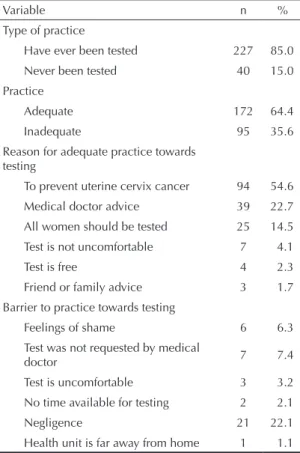
With respect to their practices, 85.0% of women inter-viewed reported that they have been tested, 15.0% reported that they have never been tested, and 64.4% that they have been tested at least once every three years following the Brazilian Ministério da Saúde
recommendations for adequate practice. Of these, most (54.6%) spontaneously sought care services for testing and their main motivation was UCC prevention. Other reasons mentioned were: all women should get tested periodically (14.5%); it is not an uncomfortable test (4.1%); and testing is free (2.3%). The other group of women who also had adequate practice reported getting tested due to medical (22.7%), female friends or family advice (1.7%) (Table 3).
With respect to barriers to testing, the main reasons reported for not getting tested at the recommended frequency were: negligence (22.1%), test was not requested by the medical doctor (7.4%), and feelings of shame (6.3%) (Table 3).
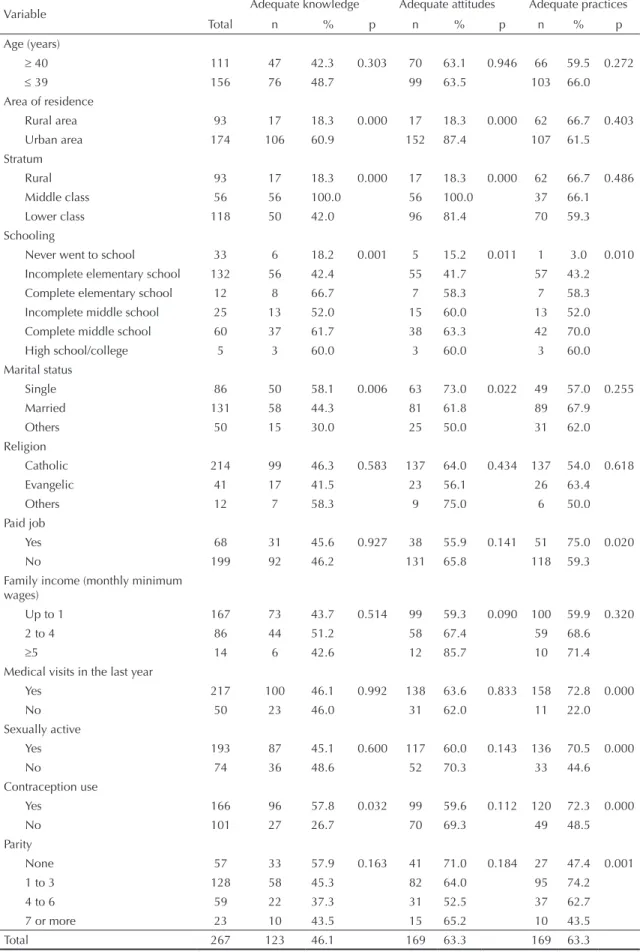
The analysis of sociodemographic characteristics showed an association between schooling and knowl-edge, attitudes and practices related to Pap test. The employment status, frequency of gynecological visits, parity, and being sexually active affected the respon-dents’ practices. Area of residence and marital status had an effect on knowledge and attitudes while
contracep-tion use inluenced their knowledge and practices. As
for family income, a p-value very close to the statistical Table 1. Source of information and adequacy of knowledge related to Pap test. City of São José do Mipibu, Northeastern Brazil, 2007. (n=267)
Variable n %
Aware of the test
Yes 262 98.1
No 5 1.9
Knowledge on the test
Adequate 123 46.1
Inadequate 144 53.9
Who informed on the test
Community health workers 52 19.8 Medical doctor 105 40.1 Health care unit staff 17 6.5
Friend or family 53 20.2
Radio/TV 22 8.4
School 5 2.0
signiicance level was found for adequate attitude of
women with higher family income. When adequacy of the behaviors studied was analyzed according to
socio-economic condition, a signiicantly higher proportion
of middle-class women had adequate knowledge and attitudes towards testing. As for the practice related to Pap test, no association was seen with socioeconomic condition (Table 4).
DISCUSSION
It was found that 85.0% of respondents reported they have had a preventive Pap test at least once in their lifetime. This proportion is similar to that reported in the cities of São Luís4 and São Paulo,15 Northeastern and Southeastern Brazil, respectively. However, when taking into consideration the Brazilian Ministério da
Saúde recommendations of getting tested at least once
every three years, the coverage rate was only 64.4%, which is similar to that seen nationwide (66%)19 but lower than that reported in São Paulo (77.3%)15 and Pelotas (68.9%),8 Southern Brazil. It was also found that 35.6% of respondents had not been tested at the recommended frequency, of which 15% reported they had never been tested, which is consistent with that found in São Luís (17.6%),4 São Paulo (13.9%),15 and Campinas (11.2%),1 Southeastern Brazil.
More educated, middle-class single women living in the urban area who used any contraception method showed higher rates of adequate knowledge on Pap test. This can be explained by the fact that they have more access to information about the test and more opportunities to get tested. Among single women and those using any contraception, higher rates of adequate knowledge can be due to the fact that they more often seek medical advice to prevent unplanned pregnancies.
Only 63.3% of women showed adequate attitude toward
Pap test by stating its advantages and beneits to their
health and correctly justifying their motivation to get periodical testing. This rate is similar to that reported among South African women12 (60.6%) but it is greater than that reported among Brazilian women16 (45.6%) and lower than that reported in Argentinean women6 (80.5%). Among those showing adequate attitudes, 66.9% considered periodical testing necessary to prevent UCC and 33.1% to prevent cancer in general.
A signiicant proportion of women (36.7%), despite
considering testing necessary, were not aware of its
beneits to their health. It may suggest that, when these
women were provided information about the test, they were not informed on its importance for screening and early diagnosis and treatment of lesions to prevent their progression to malign forms, which is crucial for UCC prevention.
More educated, middle-class single women living in the urban area with higher family income had more
adequate attitudes towards testing. This inding is
similar to that reported among Argentinean women6 associated to schooling; among Brazilian women16 associated to schooling and marital status; and associ-ated to schooling and family income.1 These women
Table 2. Attitudes and reasons reported by women for getting Pap test. City of São José do Mipibu, Northeastern Brazil, 2007. (n= 267)
Variable n %
The need of testing
Necessary 257 96.2
Unnecessary 10 3.8
Attitude
Adequate 169 63.3
Inadequate 98 36.7
Reason for testing
Prevent uterine cervix cancer 113 66.9 Prevent cancer 56 33.1 Medical doctor advice 12 7.1
Community health worker advice 8 4.7 Friend or family advice 12 7.1
Table 3. Practices, adequacy of practices, and barriers to Pap test reported by women. City of São José do Mipibu, northeastern Brazil, 2007. (n=267)
Variable n %
Type of practice
Have ever been tested 227 85.0
Never been tested 40 15.0 Practice
Adequate 172 64.4
Inadequate 95 35.6
Reason for adequate practice towards testing
To prevent uterine cervix cancer 94 54.6
Medical doctor advice 39 22.7 All women should be tested 25 14.5 Test is not uncomfortable 7 4.1
Test is free 4 2.3
Friend or family advice 3 1.7
Barrier to practice towards testing
Feelings of shame 6 6.3 Test was not requested by medical
doctor 7 7.4
Test is uncomfortable 3 3.2 No time available for testing 2 2.1
Negligence 21 22.1
Table 4. Assessment of adequacy of knowledge, attitudes and practices of women related to Pap test according to sociodemographic and reproductive characteristics. City of São José do Mipibu, Northeastern Brazil, 2007. (n=267)
Variable Adequate knowledge Adequate attitudes Adequate practices
Total n % p n % p n % p
Age (years)
≥ 40 111 47 42.3 0.303 70 63.1 0.946 66 59.5 0.272
≤ 39 156 76 48.7 99 63.5 103 66.0
Area of residence
Rural area 93 17 18.3 0.000 17 18.3 0.000 62 66.7 0.403
Urban area 174 106 60.9 152 87.4 107 61.5
Stratum
Rural 93 17 18.3 0.000 17 18.3 0.000 62 66.7 0.486
Middle class 56 56 100.0 56 100.0 37 66.1
Lower class 118 50 42.0 96 81.4 70 59.3
Schooling
Never went to school 33 6 18.2 0.001 5 15.2 0.011 1 3.0 0.010 Incomplete elementary school 132 56 42.4 55 41.7 57 43.2 Complete elementary school 12 8 66.7 7 58.3 7 58.3 Incomplete middle school 25 13 52.0 15 60.0 13 52.0 Complete middle school 60 37 61.7 38 63.3 42 70.0
High school/college 5 3 60.0 3 60.0 3 60.0
Marital status
Single 86 50 58.1 0.006 63 73.0 0.022 49 57.0 0.255
Married 131 58 44.3 81 61.8 89 67.9
Others 50 15 30.0 25 50.0 31 62.0
Religion
Catholic 214 99 46.3 0.583 137 64.0 0.434 137 54.0 0.618
Evangelic 41 17 41.5 23 56.1 26 63.4
Others 12 7 58.3 9 75.0 6 50.0
Paid job
Yes 68 31 45.6 0.927 38 55.9 0.141 51 75.0 0.020
No 199 92 46.2 131 65.8 118 59.3
Family income (monthly minimum wages)
Up to 1 167 73 43.7 0.514 99 59.3 0.090 100 59.9 0.320
2 to 4 86 44 51.2 58 67.4 59 68.6
≥5 14 6 42.6 12 85.7 10 71.4
Medical visits in the last year
Yes 217 100 46.1 0.992 138 63.6 0.833 158 72.8 0.000
No 50 23 46.0 31 62.0 11 22.0
Sexually active
Yes 193 87 45.1 0.600 117 60.0 0.143 136 70.5 0.000
No 74 36 48.6 52 70.3 33 44.6
Contraception use
Yes 166 96 57.8 0.032 99 59.6 0.112 120 72.3 0.000
No 101 27 26.7 70 69.3 49 48.5
Parity
None 57 33 57.9 0.163 41 71.0 0.184 27 47.4 0.001
1 to 3 128 58 45.3 82 64.0 95 74.2
4 to 6 59 22 37.3 31 52.5 37 62.7
7 or more 23 10 43.5 15 65.2 10 43.5
are more aware of the advantages and beneits of peri -odical testing, and have better access to information and health services.
The analysis of self-reported information on testing has some limitations. It may be that some respondents do not see a clear distinction between gynecological examination and the procedure of specimen collec-tion for Pap test. Also, some testing may have been performed not for prevention but rather due to gyne-cological complaints in a visit for treatment purposes, which might lead to overestimated testing rates. However, Kahn et al,11 in a study of women based on self-reported data, demonstrated high validity levels of this analysis.
Pap test offering as a single action for UCC prevention is not enough to ensure reduced mortality rates among
women with cancer. The expected beneicial effects of
Pap test require awareness and compliance to practices of periodical testing as recommended by the Brazilian
Ministério da Saúde. The present study found that,
despite 85.0% of respondents reported being tested, only 64.4% had been tested at the desired frequency. Only these women showed adequate practices towards testing. This rate is twice as high as that reported in Argentine,6 slightly higher than that reported in rural women in South Africa,12 and similar to that described in women in Pelotas.16
Among those women showing adequate practices, most (54.6%) spontaneously sought testing at health services with the main motivation of UCC prevention. The most cited barriers to testing were: negligence (22.1%); test was not requested by the medical doctor
(7.4%); feelings of shame (6.3%); uncomfortable test
(3.2%), and others (3.2%). These indings are similar
to that reported in Argentinean women.6
The highest rates of adequate practice towards testing were seen among women with higher schooling, those who had a paid job, more often attended medical visits, were sexually active, had between one and three chil-dren, and were using any contraception. This can be explained by their greater access to information about testing. On the other hand, sexually active women more frequently attend health services seeking advice on family planning or prenatal care and are thus better advised on getting UCC prevention testing. Similar results were reported in Argentinean women6 regarding higher attendance rates to medical visits and parity, and in Campinas,1 with respect to schooling.
In the light of that, it is evident that medical providers have a major role in promoting adequate practices towards testing and therefore increasing Pap test coverage among women in the community studied. Nevertheless, it seems that communication between providers and women seeking care including the level of language used and/or advice on the purposes and advantages of periodical testing may not be clear or effective enough. But we have to bear in mind that the number of visits may not have been adequate to clarify all their questions, or that the women studied did not appropriately utilize health services. This fact requires attention from the city’s health managers to improve care provided to this population to allow better
under-standing on testing, and its advantages and beneits for
1. Amorim VMSL, Barros MBA, César CLG, Carandina L, Goldbaum M. Fatores associados à não realização do exame de Papanicolaou: um estudo de base populacional no Município de Campinas, São Paulo, Brasil. Cad Saude Publica. 2006;22(11):2329-38. DOI: 10.1590/S0102-311X2006001100007
2. Bosch FX, Lorincz A, Muñoz N, Meijer CJ, Shah KV. The causal relation between human papillomavirus and cervical cancer. J Clin Pathol. 2002;55(4):244-65.
3. Brenna SMF, Hardy E, Zeferino LC, Namura I. Conhecimento, atitude e prática do exame de Papanicolaou em mulheres com câncer de colo do uterino. Cad Saude Publica. 2001;17(4):909-14. DOI: 10.1590/S0102-311X2001000400024
4. De Oliveira MMHN, Da Silva AAM, Brito LMO, Coimbra LC. Cobertura e fatores associados à não realização do exame de Papanicolaou em São Luis, Maranhão. Rev Bras Epidemiol. 2006;9(3):325-34. DOI: 10.1590/S1415-790X2006000300007
5. Eluf-Neto J, Booth M, Muñoz N, Bosch FX, Meijer CJLM, Walboomers JM. Human papillomavirus and invasive cervical cancer in Brazil. Br J Cancer. 1994;69(1):114-9.
6. Gamarra CJ, Paz EPA, Griep RH. Conhecimentos, atitudes e prática do exame de Papanicolaou entre mulheres argentinas. Rev Saude Publica. 2005;39(2):270-6. DOI: 10.1590/S0034-89102005000200019
7. Greenwood SA, Machado MFAS, Sampaio NMV. Motivos que levam mulheres a não retornarem para receber o resultado de exame Papanicolaou. Rev Latino-Am Enfermagem. 2006;14(4):503-9. DOI: 10.1590/S0104-11692006000400006
8. Hackenhaar AA, Cesar JA, Domingues MR. Exame citopatológico de colo uterino em mulheres com idade entre 20 e 59 anos em Pelotas, RS: prevalência, foco e fatores associados à sua não realização. Rev Bras Epidemiol. 2006;9(1):103-11. DOI: 10.1590/S1415-790X2006000100013
9. Herrero R, Brinton LA, Reeves WC, Brenes MM, de Briton RC, Gaitan E, et al. Screening for cervical cancer in Latin America: a case-control study. Int J Epidemiol. 1992;21(6):1050-6. DOI: 10.1093/ ije/21.6.1050
10. International Agency for Research on Cancer. IARC confirms efficacy of cervix cancer screening for women 25-65 in reducing mortality. Lyon; 2004[citado 2004 maio 3]. (Press release, 151). Disponível em: http://www.iarc.fr/ENG/Press_Releases/Summary.pdf
11. Kahn JA, Goodman E, Kaplowitz RA, Slap GB, Emans SJ. Validity of adolescent and young adult self-report of Papanicolaou smear results. Obstet
Gynecol. 2000;96(4):625-31. DOI: 10.1016/S0029-7844(00)00987-X
12. Lartey M, Joubert G, Cronje HS. Knowledge, attitudes and practices of rural women in South Africa regarding the Pap smear. Int J Gynaecol Obstet. 2003;83:315-6. DOI: 10.1016/S0020-7292(03)00295-9
13. Martins LFL, Thuler LCS, Valente JG. Cobertura do exame de Papanicolaou no Brasil e seus fatores determinantes: uma revisão sistemática da literatura. Rev Bras Ginecol Obstet. 2005;27(8):485-92. DOI: 10.1590/S0100-72032005000800009
14. Muñoz M, Castellsagué X, De González AB, Gissmann L. Chapter 1: HPV in the etiology of human cancer. Vaccine. 2006;24(Suppl 3):1-10. DOI: 10.1016/j. vaccine.2006.05.115
15. Pinho AA, França Jr I. Prevenção do câncer de colo do útero: um modelo teórico para analisar o acesso e a utilização do teste de Papanicolaou. Rev Bras Saude Matern Infant. 2003;3(1):95-112. DOI: 10.1590/ S1519-38292003000100012
16. Racho D, Vargas VRA. Análise da prática e atitude sobre o exame preventivo de câncer do colo do útero em uma comunidade universitária. Rev Bras Anal Clin. 2007;39(4):59-63.
17. Ramos AS, Palha PF, Costa Jr ML, Sant’Anna SC, Lenza NFB. Perfil de mulheres de 40 a 49 anos cadastradas em um núcleo de saúde da família, quanto à realização do exame preventivo de Papanicolaou. Rev Latino-Am Enfermagem. 2006;14(2):170-4. DOI: 10.1590/S0104-11692006000200004
18. Steenbergen RD, De Wilde J, Wilting SM, Brink AA, Snijders PJF, Meijer CJ. HPV-mediated transformation of the anogenital tract. J Clin Virol. 2005;32(Suppl):25-33. DOI: 10.1016/j.jcv.2004.11.019
19. Szwarcwald CL, Viacava F, Vasconcellos MTL, Leal, MC, Azevedo LO, Quiroz RSB et al. Pesquisa Mundial de Saúde 2003: o Brasil em números. RADIS. 2004;23:14-33.
20. Trottier H, Franco EL. The epidemiology of genital human papillomavirus infection. Vaccine. 2006;24(Suppl 1):1-15. DOI: 10.1016/j. vaccine.2005.09.054
21. Villa LL. Vaccines against papillomavirus infections and disease. Salud Publica Mex. 2003;45(Suppl 3):443-8. DOI: 10.1590/S0036-36342003000900019
22. Villa LL. Prophylactic HPV vaccines: reducing the burden of HPV-related diseases. Vaccine. 2006;24(Suppl 1):23-8. DOI: 10.1016/j. vaccine.2005.09.001
23. World Health Organization. Cytological screening in the control of cervical cancer: technical guidelines. Genebra: 1988.
REFERENCES