Stochastic Diusion of Energetic Ions
due to Lower Hybrid Waves
L. M. Tozawa
and L. F.Zieb ell y
InstitutodeFsica
UniversidadeFederaldoRioGrandedoSul
CaixaPostal15051-CEP:91501-970,PortoAlegre,RS,Brazil
Received22May,1998
This paper discusses the interaction between energetic ions and lower hybrid waves in toka-mak plasmas, presenting a numerical analysis which employs a quasilinear formalism ap-propriated for the situation in which ion stochastic diusion occurs. The results show that signicant wave-particle interaction may take place when a population of energetic ions is present in the plasma, in partial agreement with evidence from experimental results available in the literature.
I. Intro duction
The analysis of some experiments realized in the JET tokamak (Joint European Torus) has shown evi-dence of signicant absorption of lower hybrid wave en-ergy by a population of energetic ions generated by the injection of ion cyclotron radiation [1, 2]. The descrip-tion of these experimental results, obtained by direct measurements of the fast ion energy and by measure-ments ofray and neutron emission rates, has been ac-companied by theoretical analysis in which the interac-tion was described by a one-dimensional Fokker-Planck equation in velocity space, which includes quasilinear coecients for ion cyclotron waves (IC) and for lower hybrid waves (LH), and a collision term accounting for the collisions with particles of the Maxwellian body of the distribution [1, 2, 3]. The diusion coecient for LH waves employed in the Fokker-Planck equation was intended to describe the stochastic diusion in velocity space which may occur in the presence of suciently intense waves [4]. This mechanism of stochastic ion diusion has been proposed and explained nearly two decades ago, when it was shown that the movement of an ion in a uniform magnetic eld becomes stochastic in the presence of a perpendicularly propagating
coher-ent electrostatic wave, if the wave amplitude exceeds a threshold [5, 4]. Due to the stochasticity, the ion diuses in velocity space and it is possible to derive a diusion equation to describe the time evolution of the ion distribution function, which also applies to the case of diusion due to lower hybrid waves in the slow mode (non-vanishingk
k <<k
?), in a weakly inhomogeneous magnetic eld [4].
The motivation for the mentioned investigation based on the JET experiments may be summarized as follows. Lower hybrid waves are proposed as an alter-native for the generation of non-inductive current in a tokamak [6, 7, 8]. With this purpose a spectrum of LH waves is launched in the tokamak, with frequency and parallel wave-number chosen in order that the waves are absorbed by electrons in the tail of the electron dis-tribution function, by the mechanism of parallel Lan-dau damping which occurs when the wave-particle res-onance condition is satised. However, it had been ar-gued that in fusion reactors the presence of energetic ions, particularlyparticles originated from fusion re-actions, would contribute to decrease the eciency of the lower hybrid current drive, since part of the energy of the LH waves would be absorbed by the parti-cles by the mechanism of the so-called perpendicular E-mail: [email protected]
Landau damping [5]. The purpose of the experiments was therefore to study, in the absence ofparticles, the possibility of interaction between the LH waves and fast ions generated by IC waves, utilized to heat the ions in the plasma [1, 2]. The results obtained indicate that the absorption of LH waves by fast ions indeed occurs, and therefore conrm the convenience of further investiga-tions on this important issue concerning the dynamics ofparticles and energetic ions in the environment of a reactor and the eciency of the LH waves for radio frequency current drive. Several examples of studies on the subject may be found in the recent literature, ded-icated to the interaction of LH waves withparticles [9, 3, 10, 11, 12, 13] and other kinds of energetic ions [14, 15], including the case of interaction between LH waves and a population of energetic ions generated by neutral beam injection [16, 17, 18, 19].
In a previous publication we have addressed the sub-ject, by considering the threshold condition for stochas-tic ion diusion due to LH waves, originated from the analysis by Karney [4]. We have introduced models for the tokamak and the wave packet inside the toka-mak, which allowed the evaluation of the wave ampli-tude at a given position, and its comparison with the threshold condition [20]. The results obtained show that the threshold condition may be not easily satis-ed in present day large tokamaks, but can be attainsatis-ed in small tokamaks with relatively modest levels of wave power.
In the present paper we continue the study of stochastic diusion of energetic ions, by means of a two-dimensional quasilinear formulation which follows the time evolution of the electron and ion distribution functions under the action of LH and IC waves, and collisions, in a tokamak environment approximated as a magnetized slab of plasma, as in the previous analysis [20].
The plan of the paper is the following. In Sec. II we present the models employed to describe the toka-mak and the spectrum of lower hybrid waves propagat-ing in the plasma. Sec. III is dedicated to present a short account of the quasilinear formalism utilized for the time evolution of both electron and ion distribution functions. In Sec. IV we present some numerical
re-sults obtained from the application of the quasilinear formulation described in Sec. III. Finally, in Sec. V we summarize the main results of the paper, and comment on possible future developments of this investigation.
II. Models of the tokamak and the wave packet
Let us assume a gaussian packet of lower hybrid waves propagating in a tokamak, with spectral distribu-tion centered at N
k= N
k, where N
k is the component of
N
=ck
=!parallel to the ambient magnetic eld (k
is the wave vector, and!is the angular wave frequency). Let us assume that the half-width of the spectrum is given by Nk, S(N
k) = S
0 e
,(N k
,N k
) 2
=(N k
) 2 p
(N k)
; (1)
where R dN
k S(N
k) = S
0, the local wave intensity. The local amplitude of the electric eld is related to the en-ergy ux, and may be given by [21]
E 0(
N k) =
16 (4 0)
c jBj j@D =@
N
jS(N k)
1=2
: (2) In order to atribute to these quantities a numeri-cal value at a given position, it is necessary to describe with more details the wave propagation and the en-ergy deposition of the wave. However, details about these processes are dicult to estimate, since lower hybrid waves suers considerable refraction inside the plasma. Therefore, we will assume a simplifying model, which will be useful to provide an estimate about the magnitude of the quasilinear eect on the plasma elec-trons compared to the eect on the ion distribution, and therefore provide an estimate about the feasibility of the stochastic diusion, as a function of wave and plasma parameters.
For these purposes a simplied tokamak model de-scribed by a slab of plasma shall be satisfactory, with the following proles
n (
x) =n (0)
1,
x 2
a 2
T (
x) =T (0)
1,
x 2
a 2
2
(3)
B 0(
x) =B 0(0)
1 + x
R
where a is the minor radius, R is the major radius, and x is the radial coordinate in the equatorial plane, with the origin in the center of the plasma column. n(0), T(0), and B0(0) are respectively the density and elec-tron temperature of species and the ambient toroidal magnetic eld, at the center of the plasma.
The half-width along the z-axis occupied by the wave packet propagating with spectral half-width Nk may be approximately estimated as z = 2c=(!(Nk)). If we assume a poloidal width for the wave packet, the area aected by the wave in a magnetic surface of radius r will be given by S!= 2(z)()r, while the area of the magnetic surface itself will be S = 42rR, and therefore the fraction of a given mag-netic surface which is aected by the wave may be es-timated as
S!
S = z 22R : (4)
This quantity can also be regarded as an estimation of the fraction of time in which a particle moving on a magnetic surface at radius r remains under the inu-ence of the wave.
After these geometric considerations, it is possi-ble to evaluate the local wave intensity as the ratio between the wave power, W0, and the surface occu-pied by the wave front, estimated as S!, resulting that S0 = W0=S!. This rather rough estimate of wave inten-sity tends to very large intensities near the center of the tokamak, and indeed diverges for r!0, since S
! !0. In order to avoid this divergence, we arbitrarily set a minimum value for S! and a corresponding maximum value for S0, chosen as the values of S!and S0at r = 2 cm. Even with this cut-o value which avoid the di-vergence of the wave intensity at r !0, it is possible that this simplied model is super-estimating the local magnitude of the wave electric eld, for the central re-gions. If that is the case, it will at least be useful to provide limits to the possibility of stochastic diusion, as a function of wave energy.
For application of this scheme, the relevant parame-ters for the lower hybrid waves will be !, Nk, Nk, and W0. Another necessary parameter is , which will be assumed xed for all the ensuing cases, as = =4 [4]. For given values of ! and Nk, the dispersion relation for LH waves must be solved in order to obtain N?.
III. Quasilinear formulation for electron and ion
distributions
From basic quasilinear theory, it is known that the time evolution of the distribution function for parti-cles of population , at position x, under the action of lower hybrid and ion cyclotron waves and a collision term, may be described by an equation of the following form
@ f
= (@ f
) lh+ (@
f
) ic+ (@
f
)
col (5) where f = f(u
jj;u
?;;x). is the time nor-malized to the collision time, dened as the in-verse of the local collision frequency, (x) = (x)!4
p(x)=8n (x)v
3
(x). (x) is the Coulomb log-arithm at position x, !p(x) is the angular plasma frequency at the same position, n(x) is the local density of particles of population , and v(x) = (T(x)=m)
1=2 is the thermal velocity for these par-ticles. The u? and uk quantities that appear as ar-guments of f are the components of the velocity in the directions respectively perpendicular and parallel to the ambient magnetic eld, normalized to v. The symbol is not appended to the components of u in order to avoid excessive burden to the notation. The rst term of the right-hand side of Eq. (5) indicates the action of the lower hybrid waves, the second term represents the eect of ion cyclotron waves, and the last term expresses the eect of the collisions. In what fol-lows, explicit expressions for these terms will be given, adequated for each particle species.
A. Quasilinear formalism for the electron
distri-bution function
For the case of the electron distribution function, the rst term in the right hand side of equation (5) may be obtained from conventional quasilinear formalism,
(@efe) lh= @
u jj
, dlh@u
jjf e
; (6)
c
dlh(uk) =
162 me!
2 pe!
ju k
j
jBj jAj
jD 11D22
,jD 12
j 2
j 2
j@D=@
N
jS(Nk) !
N k
= 1=2 e
=u k
: (7)
In the above expression ! is the frequency of lower hybrid waves, e
m
ec 2=T
e, and S(Njj) is the spectrum of energy ux for the lower hybrid waves. This form of the diusion coecient is based in a well known formulation found in the literature [21], but here we have written explicitly the factor , dened by Eq. (4), accordingly with the procedure to be adopted also for the diusion coecient acting on the ion distribution. The Dij are dened by Dij = NiNj
,N 2
ij+ ij, where the Ni are the components of
N
, and the ij are the components of the cold plasma dielectric tensor. The quantities A and B are given by the followingA =jD 13D22
,D 12D23
j 2
+jD 23D11
,D 12D
13 j
2 +jD
11D22 ,jD
12 j
2 j
2 ; B = D11D22
,jD 12
j 2
+ D11D33 ,jD
13 j
2
+ D22D33 ,jD
23 j
2 : while D is the dispersion relation for the LH waves, obtained from the determinant of the Dij,
D = 11N 4 ?+ N
2 ?[(
11+ 33)(N 2 k
, 11)
, 2 12] +
33[(11 ,N
2 k)
2+ 2
12] = 0: (8)
The second term in Eq. (5) vanishes for the case of = e, since there is no eect from the ion cyclotron waves on the time evolution of the electron distribution function.
For the third term, which is the collision term, we use a simplied form describing the interaction of electrons belonging to the electronic tail with electrons and ions from the body of their respective distribution functions, since the velocity of the tail electrons is much larger than both ion and electron thermal velocities [21]. This term is given by
(@ ef
e) col= Z
2+ 1 u3sin @
(sin@fe) + 2u 2@
u
1
u@ufe+ fe
; (9)
where is the angle between the particle momentum and the ambient magnetic eld and Z is the eective ion charge.
d
B. Quasilinear formalismfor the ion distribution
function
For the quasilinear evolution of the ion distribution function, an additional assumption will be made. We are using a gaussian spectrum of LH waves, but if it is narrow we may assume that only the central ray is signicant for the determination of the diusion coef-cient which will be used in Eq. (5). That is, we will consider the case of a single monochromatic LH wave acting on the ions. We intend to investigate the role of this simplifying assumption in the near future, but it is useful in the present case because it may provide a
limiting case for the study of the quasilinear eects of the LH ions on energetic ions.
Therefore, we follow the formalism developed by Karney [4]. According to this formalism, the diusion in velocity space produced by a lower hybrid wave with angular frequency ! and components of the wave num-ber N?and Nkmay be described by the following equa-tion, in normalized form,
(@ifi) lh = 1u
?
@u?(u?Dlh@u?fi); (10) where the ion thermal velocity is used for velocity nor-malization (uv=v
c
Dlh(u?) = 8 > > > > > > > > > < > > > > > > > > > : 4 E 2 0 c 2 B 2 0 2 i N 2 ? u 2 ? i i jH (1)0 () j 2
g2(
A); for u ?
u ph; Dlh(uph); for uph
,u tr
u
? < uph; Dlh(uph)[u?
,(u ph
,2u tr)]
2; for u ph
,2u tr
u
?< uph ,u
tr; 0; for u?< uph
,2u tr:
(11)
d Moreover,
uph= !=(k?vi); utr = (qiE0=mik?) 1=2
=vi; A= rjH
(1)0
()
j; (12)
with the introduction of the following denitions = !=i; r = k?v?=i; and
= E0 B0
k? i
= E0 B0
N? c ;
where N? is the perpendicular component of N,
i is the ion cyclotron frequency, E0 is the amplitude of the wave electric eld, and B0is the ambient magnetic eld. We have also dened i= mic
2=T
i. The quanti-ties H(1)
and H (1)0
are respectively the Hankel function of rst kind and its derivative, given by
jH (1) (r)
j'(2=) 1=2 (r2 , 2) ,1=4 ; jH (1)0 (r)
j'(2=) 1=2 (r2 , 2) 1=4 =r; for r + (=2)
1=3
[4]; for r < + (=2)1=3
, it is used jH
(1) (r)
j'jH (1)
( + (=2) 1=3
)j; jH
(1)0 (r)
j'jH (1)0
( + (=2) 1=3
)j:
In Eq. (11) the threshold condition is expressed by the quantity g(A). This quantity is zero forAsmaller than A
sand grows fast to g(
A) = 1 for Alarger than A
s [4],
g(A) = max
1,A 2 s= A 2;0 : (13)
The stochasticity condition denes the situation in which a stochastic layer occupies a substantial fraction of the phase space, and therefore the diusion becomes
eective. This condition does not allow a precise def-inition of A
s. Karney sets the requirement that for A = A
s the phase change suered by a particle in the wave-particle resonance would be equal to =2, and therefore assumes thatA
s= 0:25 [4]. The same condi-tion is assumed in the present work.
Another quantity appearing in Eq. (11) is the frac-tion of time in which the particles remain under the eect of the lower hybrid waves, denoted by , which is a quantity dependent on the existence of models for the tokamak and the wave packet. According to the models which we have introduced, this fraction of time is given by Eq. (4).
For the second term appearing in Eq. (5), we use a simplied form, which guarantees the creation of a population of energetic ions with large perpendicular energy. The existence of this population is essential for our present purpose of analysis of their interaction with LH waves, but we will not be concerned here with the details of the interaction between the ions and the IC waves. The model diusion term to be utilized for IC waves is the following [2, 22]
(@ifi) ic= 1u
?
@u?(u?Dic@u?fi); (14) where we assume
Dic= Dic0 e,(u,u ic ) 2 =(u) 2 up : (15)
It is easy to see that uic indicates the velocity of maximumvalue of the diusion coecient and u is the half-width of the spectrum, with Dic0
R
with the ions of the Maxwellian body of the distribu-tion, as well as with Maxwellian electrons. Therefore, it is possible to neglect the nonlinear eect due to col-lisions within the energetic tail. We start from
expres-sions available in the literature for the Fokker-Planck collision term for energetic ions [23], and after straight-forward but tedious algebraic manipulations arrive to the following
c
(@ifi)coll = 1Z 2
( mi
meu23 (ue= p
2)@2
ufi+ mmei u22 "
(ue=p 2) +
me
mi
3=2 u p
20(u e=p
2), 1 u2 (ue=
p 2)
# @ufi
+
(ue=p 2),
mi
meu12 (ue= p
2)
1 u3@
(1,
2)@ fi
+
me
mi
1=2 p
20(u e=p
2)fi )
+
2 u3 (u=
p 2)@2
ufi+ 2u2
(u=p 2) + up
20(u= p
2), 1 u2 (u=
p 2)
@ufi (16)
+
(u=p 2),
1 u2 (u=
p 2)
1 u3@
(1,
2 )@fi
+p 20
(u=p 2)fi
;
where the terms divided by the factor Z2refer to ion-electron collisions, and the remaining terms to ion-ion collisions, and where ue(me=mi)
1=2u. Moreover, we have (x) = (x),x
0(x); (x) = 2 p
Z x
0 e,t
2
dt; 0(x) = 2 p
e,x 2
:
d
IV. Numerical results of the quasilinear analysis
The formalism described in Sec. III can be now applied for evaluation of the time evolution of the dis-tribution function of ions and electrons.
A. Implementation of the quasilinear formalism
In order to solve numerically equation (5) for ion and electron distribution functions, we write if entirely as function of the variables u and = cos, with the (u;) space described by a discrete grid of 151 31 points. The u limits of the grid are u = 0 and
u = ulim = 10, and the limits in are = 1. It is assumed that the distribution remains Maxwellian at u = ulim and beyond, and satisfy the condition
@f=@ = 0 at =,1 and = 1. The set of nite dier-ence equations obtained from the quasilinear equation is then solved numerically, using the alternating direc-tions implicit method (ADI) [24].
For the diagnostics of the results obtained, we dene a series of auxiliary quantities, the parallel distribution function, the perpendicular distribution function, the perpendicular temperature, the electronic current den-sity, and the dimensionless power dissipated by IC and LH waves, dened respectively as follows
c
fjj(ujj;;x) = 2 Z
1
0
du?u?f(ujj;u?;;x) f?(u?;;x) =
Z 1
,1
dukf(ujj;u
?;;x) T?(ujj;;x) = 2T
e
fjj Z
1
0
du?u? u2
?
J (
;x) =, ecn e p e Z d 3 uu k f e( u jj ;u ? ;
;x) (17)
(P )
ic(
;x) =
Z d 3 u u 2 2 , @ f ( u jj ;u ? ;
;x) ic (P ) lh(
;x) = Z d 3 u u 2 2 , @ f ( u jj ;u ? ;
;x)
lh : For the evaluation of (P
)
ic and ( P
)
lh, of course, the corresponding terms in Eq. (5) are inserted in the integrand at the right-hand side.
d
B. Results of the numerical analysis
We consider plasma parameters representative of large tokamaks, similar to those of the JET tokamak (Joint European Torus), with proles given by Eq. (3). The parameters are the following: n
e(0) = 3 :510
19 m,3,
T
e(0) = 5
:0 keV, equal ion and electron densities and temperatures, and B
0(0) = 3
:0 T. For minor ra-dius we use a= 1:2 m, and for the major radius we use R= 5:0 m, somewhat larger than the JET radius.
For the LH waves we consider parameters already utilized in our previous analysis about the threshold condition [20], namely!= 1:5!
lh, N
k= 2
:53, N k= 0:2, and three values of wave power, W
0 = 2 :0, 1:5, and 1:0 MW. The choice ofN
k= 2
:53 means that the center of the LH spectrum will be resonating with elec-trons at four thermal velocities, which is expected to assure good eciency in current generation. For prac-tical reasons, the gaussian spectra has been assumed to exist between N
k
,2N k and
N k+ 2
N
k, vanishing outside these limits. Numerically, the LH spectrum is described by an array of 61 points. For the IC waves we assume D
ic0= 0 :5,u
ic = 5
:0, and u= 1:0, to be used with the model coecient given by Eq. (15).
The formalism developed eectively uncouples ion and electron distributions, since the collision term only includes collisions of the resonating particles with the Maxwellian background. Therefore, the study of the two distributions can be made independently. We use a time step
= 1 :10
,3, running the code until a steady-state is nearly attained, with the wave eects on the distribution function nearly balanced by collision
eects.
Let us start by the analysis of the electron distribu-tion funcdistribu-tion, which is not aected by the IC diusion term. We choose to display the results obtained at the central position of the tokamak,x = 0 m. In Fig. 1 we show the quantity,lnf
ejj, as a function of u k ju k j, for W
0 = 1
:0, 1:5, and 2:0 MW, at
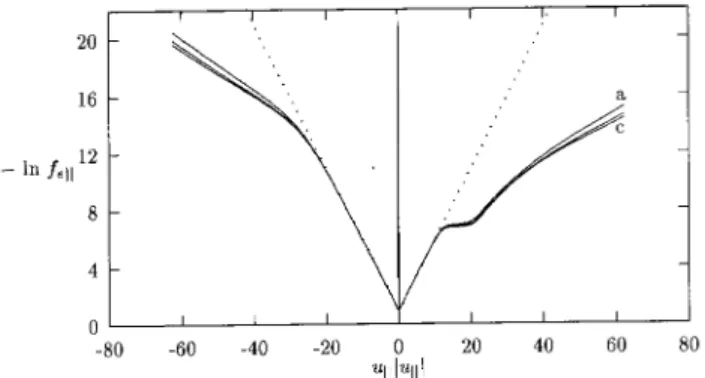
e = 100. For comparison, a Maxwellian distribution appears in this representation, in the shape of the letter V. It is easily seen the assymetry caused by the LH waves toward the side of positiveu
k, although some eect is also seen in the side of negativeu
k, caused by collisional diusion. The perpendicular distribution is also aected by colli-sional diusion, as can be seen is Fig. 2, which shows lnf
e?, as a function of u
2 ?
=2, forW 0= 1
:0, 1:5, and 2:0 MW, also at
e= 100. This excess of perpendicular en-ergy is not equally distributed along the distribution, as demonstrated by the peaks in perpendicular tempera-ture exhibitted in Fig. 3. These featempera-tures of the electron distribution function under the eect of LH waves are well known and are shown here only for the sake of completicity [21, 25, 26].
Still regarding the dynamics of the interaction be-tween LH waves and electrons, in Fig. 4 we show the time evolution of the power dissipated by lower hy-brid waves on the electron distribution function, for the same parameters used in Fig. 1. Instead of plotting the quantity (P
e)
lh, as given by Eq. (17), we present in Fig. 4 the time evolution of the energy dissipated on the electrons by unit of time measured in the time scale of the ions, a quantity which we denote by ^P
e, c ^ P e lh ( e ;x)
Z d 3 u u 2 2 , @ i f e( u jj ;u ? ; e ;x)
lh = e i (P e) lh( e
This quantity has been dened here because it is useful for direct comparison between the energy dissi-pated on the electrons and the energy dissidissi-pated on the ions, measured in the same scale of time.
Figure 1. , lnf ejj, vs.
u k
ju k
j, at x= 0 m and e = 100, for!= 1:5!lh,N
k= 2
:53, and N k= 0
:2. (a)W0= 1:0 MW; (c)W
0 = 2
:0 MW; between these two, the curve for W0 = 1:5 MW. The dotted line represents the Maxwellian distribution. The plasma parameters aren
e(0) = 3 :510
19 m,3,
T e(0) = 5
:0 keV,B
0(0) = 3
:0 T,a= 1.2 m, and R= 5.0 m.
Figure 2. ln f e?, vs.
u 2 ?
=2, at x= 0 m and
e = 100, for ! = 1:5!lh, N
k = 2
:53, and N k = 0
:2. (a)W0 = 1:0 MW; (c)W
0 = 2
:0 MW; between these two, the curve for W0 = 1:5 MW. The dotted line represents the Maxwellian distribution. The plasma parameters are the same as in Fig.1.
We investigate now the time evolution of the ion dis-tribution function. The rst noticeable feature, which has been anticipated in a previous publication [20], is that for the frequency utilized the diusion coecient for LH waves vanishes forW
0= 1
:0 MW, and is barely signicant forW
0 = 1
:5 MW. For larger wave frequen-cies (! =!
lh
2:0), the diusion coecient would be null even forW
0= 2
:0 MW [20].
These results seem to disagree with experimental re-sults which report absorption of LH waves by energetic ions, at frequency ! =!
lh = 3
:7, even for wave power
of 1:0 MW [1]. As discussed on our previous analysis on the threshold condition [20], one possible reason for the dierence is that in the experimental situation a spectrum of waves is present, while the theory utilized assumes a monochromatic LH wave acting on the en-ergetic ions. We intend to continue our investigation on the subject, by considering the eect of the pres-ence of a group or spectrum of waves, but we consider that the simplicity of the slab model and narrow gaus-sian spectra utilized here may provide at least an useful qualitative guide to the phenomena involved.
Figure 3. Te?=Te vs. u k, at
x = 0 m and e = 100, for ! = 1:5 !lh, N
k = 2
:53, and N k = 0
:2. (a)W0 = 1:0 MW; (c)W
0 = 2
:0 MW; between these two, the curve for W
0 = 1
:5 MW. The plasma parameters are the same as in Fig.1.
Figure 4. , ^ P e
lh vs.
e, at
x = 0 m, for ! = 1:5 ! lh, N
k = 2
:53, and N k = 0
:2. (a) W 0 = 1
:0 MW; (b) W0 = 1:5 MW; (c) W0 = 2:0 MW. The plasma parame-ters are the same as in Fig.1.
7 we show respectively the natural logarithm of the perpendicular ion distribution and the perpendicular ion temperature, for W
0 = 1
:0, 1:5, and 2:0 MW, at
i= 100. It is noticeable in both gures the eect due to the LH waves, in the diusion along the perpendic-ular direction. For W
0 = 1
:5 MW the small amount of quasilinear diusion causes a small eect, as com-pared to the modication of the distribution function by the IC waves. For W
0 = 2
:0 MW, however, the diusion due to LH waves is already very signicant, and a sizable additional perpendicular attening of the distribution is obtained.
Figure 5. ,Inf ijj, vs.
u k
ju k
j, atx= 0 m and i = 100, for!= 1:5!
lh, N
k= 2
:53, and N k= 0
:2. (a)W 0 = 1
:0 MW; (b) W0 = 1:5 MW; (c) W0 = 2:0 MW. Dic0 = 0:5, uic = 5:0, and u = 1:0. The dotted line represents the Maxwellian distribution. The plasma parameters are the same as in Fig.1.
Figure 6. In f i?, vs.
u 2 ?
=2, at x= 0 m and
i= 100, for ! = 1:5 !lh, N
k = 2
:53, and N k = 0
:2. (a) W0 = 1:0 MW; (b) W
0 = 1
:5 MW; (c) W 0 = 2
:0 MW. D ic0 = 0
:5, u
ic = 5
:0, and u = 1:0. The dotted line represents the Maxwellian distribution. The plasma parameters are the same as in Fig.1.
Figure 7. T i?
=T e vs.
u k, at
x = 0 m and
i = 100, for ! = 1:5!
lh, N
k = 2
:53, and N k = 0
:2. (a) W 0 = 1
:0 MW; (b)W
0 = 1
:5 MW; (c) W 0 = 2
:0 MW. D ic0 = 0
:5, uic= 5:0, and u= 1:0. The plasma parameters are the same as in Fig.1.
In Fig. 8 it is seen the time evolution of (P i)
lh, for the same parameters used in Fig. 5. The compari-son between the results appearing in Fig. 8 and those of Fig. 4 shows that the power dissipated by the LH waves on the ion population is null forW
0= 1 :0 MW, is less than 10 % of the power dissipated on the elec-tron population for W
0 = 1
:5 MW, and is more than 50 % of
^ P e
lh for W
0 = 2
:0 MW. It is interesting to observe that the increase of LH power dissipation decreases the eciency of IC power deposition, due to the attening of the ion distribution function caused by the LH induced diusion. This behavior is seen in Fig. 9, which shows the power dissipated by the model IC term, (P
i) ic.
This reduction in the eciency of IC power deposi-tion due to high power LH waves is a non trivial behav-ior of the distribution function which evolves according to the quasilinear dynamics. In Fig. 10 we observe the complementary eect, by considering the time evolu-tion of (P
i)
lh, for xed LH power ( W
0= 1
:5 MW) and four values ofD
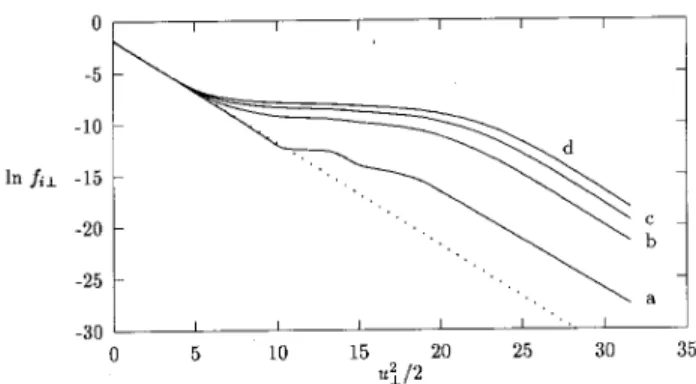
ic0. The other parameters are as in Fig. 5. It is seen that for vanishing IC power the absence of the enhanced population of energetic ions means negli-gible coupling between LH waves and ions. The natu-ral logarithm of the perpendicular ion distribution as a function ofu
2 ?
=2 and the perpendicular temperature as a function ofu
k are shown in Figs. 11 and 12, respec-tively, forW
0 = 1
Figure 8. (Pi) lh vs.
i, at x = 0 m, for ! = 1:5 !lh, N
k = 2
:53, and N k = 0
:2. (a) W0 = 1:0 MW; (b) W0 = 1:5 MW; (c)W0 = 2:0 MW. Dic0 = 0:5, uic = 5:0, and u= 1:0. The plasma parameters are the same as in Fig.1.
Figure 9. (P i)
ic vs.
i, at
x = 0 m, for ! = 1:5 ! lh, N
k = 2
:53, and N k = 0
:2. (a) W0 = 1:0 MW; (b) W
0 = 1
:5 MW; (c)W 0 = 2
:0 MW. D ic0 = 0
:5, u ic = 5
:0, and u= 1:0. The plasma parameters are the same as in Fig.1.
Figure 10. (Pi) lh vs.
i, at x = 0 m, for ! = 1:5 !lh, N
k = 2
:53, N k = 0
:2, W 0 = 1
:5 MW, u ic = 5
:0, and u= 1:0. (a)D
ic0 = 0
:0; (b)D ic0 = 0
:25; (c)D ic0= 0
:5; (d)Dic0= 0:75. The plasma parameters are the same as in Fig.1.
Figure 11. In f i?, vs.
u 2 ?
=2, at x = 0 m and
i = 100, for != 1:5!lh, N
k = 2
:53, N k = 0
:2, W0 = 1:5 MW, u
ic = 5
:0, and u= 1:0. (a)D ic0 = 0
:0; (b)D ic0 = 0
:25; (c)Dic0 = 0:5; (d)Dic0= 0:75. The dotted line represents the Maxwellian distribution. The plasma parameters are the same as in Fig.1.
Figure 12. Ti?=Te vs. u k, at
x = 0 m and i = 100, for != 1:5!lh, N
k = 2
:53, N k = 0
:2, W0 = 1:5 MW, u
ic = 5
:0, and u= 1:0. (a)D ic0 = 0
:0; (b)D ic0 = 0
:25; (c)Dic0= 0:5; (d)Dic0= 0:75. The plasma parameters are the same as in Fig.1.
V. Summary and conclusions
In the present paper we have carried out a quasi-linear analysis of the stochastic diusion of energetic ions in a tokamak, due to the interaction with lower hybrid waves of suciently high intensity. The toka-mak plasma and the lower hybrid wave have been de-scribed by simple models which are intended to con-tribute for the understanding of basic features related to the stochastic diusion and its theoretical descrip-tion.
distribution, and therefore give support to the idea that the presence of energetic ions can contribute for a re-dution of the eciency of lower hybrid current drive, in qualitative agreement with experimental results. On the other hand, the energy dissipated on the ions has been shown to be null for wave powers and frequencies where it has been observed in experiments, indicating that improvements must be introduced in the theoret-ical description of the interaction between LH waves and energetic ions. One possible reason for the quan-titative dierence obtained may be the presence of a spectrum of waves instead of the single monochromatic wave assumed in the present theoretical analysis. We intend to proceed investigating the subject, and report our ndings in a forthcoming publication.
Acknowledgments
This work is partially based on the contents of the dissertation submitted by L. M. Tozawa for a M.Sc. degree from the Universidade Federal do Rio Grande do Sul, and it has been partially supported by the Brazilian agencies Conselho Nacional de Desenvolvi-mento Cientco e Tecnologico (CNPq), Financiadora de Estudos e Projetos (FINEP), and Fundac~ao de Am-paro a Pesquisa do Rio Grande do Sul (FAPERGS). Numerical computations were partially performed at the Supercomputer Center installed at the Universidade Federal do Rio Grande do Sul (CESUP-UFRGS). One of us (L. F. Z.) acknowledges useful discussions with M. C. de Andrade, I. L. Caldas, F. B. Rizzato, and R. S. Schneider.
References
[1] M. C. R. de Andrade, M. Brusati, and the JET team,
Plasma Phys. Contr. Fusion36, 1171 (1994).
[2] M. C. R. de Andrade, PhD thesis, USP, Curso de Pos-Graduac~ao em Fsica, 1994.
[3] E. Barbato and F. Santini, Nucl. Fusion31, 673 (1991). [4] C. F. F. Karney, Phys. Fluids22, 2188 (1979). [5] C. F. F. Karney, Phys. Fluids21, 1584 (1978). [6] N. J. Fisch, Phys. Rev. Lett.41, 873 (1978).
[7] C. F. F. Karney and N. J. Fisch, Phys. Fluids22, 1817 (1979).
[8] N. J. Fisch, Rev. Modern Phys.59, 175 (1987). [9] D. Anderson, V. S. Belikov, Y. I. Kolesnichenko, and
M. Lisak, Phys. Fluids B3, 3125 (1991).
[10] M. Spada, M. Bornatici, and F. Engelmann, Nucl. Fu-sion31, 447 (1991).
[11] N. J. Fisch and J. Rax, Phys. Rev. Lett.69, 612 (1992). [12] N. J. Fisch and J. Rax, Nucl. Fusion32, 549 (1992). [13] J. A. Heikkinen and S. K. Sipila, Nucl. Fusion36, 1345
(1996).
[14] J. A. Heikkinenet al., Plasma Phys. Contr. Fusion38, 2063 (1996).
[15] J. A. Heikkinen and T. P. Kiviniemi, Phys. Lett. A 214, 53 (1996).
[16] A. H. Kritzet al., Nuclear Fusion 18, 835 (1978). [17] K. Ushigusaet al., Nuclear Fusion29, 265 (1989). [18] T. Imaiet al., Nuclear Fusion30, 161 (1990). [19] M. Nemotoet al., Phys. Rev. Lett.67, 70 (1991). [20] L. F. Ziebell and L. M. Tozawa,The threshold condition
for stochastic diusion of energetic ions due to lower hybrid waves, submitted for publication (1998). [21] I. Fidone, G. Giruzzi, G. Granata, and R. L. Meyer,
Phys. Fluids27, 2468 (1984).
[22] T. H. Stix, Nucl. Fusion15, 737 (1975).
[23] J. D. Gaey Jr., J. Plasma Phys.16, 149 (1976). [24] B. Carnahan, H. Luther, and J. Wilkes, Applied
Nu-merical Methods(John Wiley, New York, 1969). [25] I. Fidoneet al., Nucl. Fusion27, 579 (1987).