economic growth regimes
in Brazil: empirical evidence
and policy implications
E
lianE
a
raújo
and
P
aulo
G
ala
Introduction
K
eynesian-oriented literature has developed growth models inwhich aggregate demand determines the income in both nominal and real terms, due to possible insufficient demand and the influence of this variable on the development of productive resources. these models still consider the influence of income distribution on growth rates, i.e., the effects of changes in the share of wages and profits in national income on the different components of aggregate demand, especially consumption and investment. in this regard, special mention should be made of Bhaduri & Marglin (1990); Bowles & Boyer (1995); uemura (2000); stockhammer & onaran (2004); naastepad & storm (2006-2007); Hein & vogel (2008 ); and stockhammer et al. (2009) among others.
the relationship between growth and income distribution enables identi-fying economic growth patterns. thus, if aggregate demand responds positively to a profit share increase in income, it is said that the economy is characterized by a profit-led regime. in situations where aggregate demand responds nega-tively to a profit share increase in income,, the economic growth regime can be characterized as wage-led.
this discussion is now very important for Brazil insofar as the expansion-ary and contractionexpansion-ary effects of currency devaluations are discussed around here. as rightly pointed out by Bresser-Pereira (2009b), one of the pillars of the so-called new developmentalism for catching up in the context of globalization is to maintain the exchange rate at a competitive level. For the exchange rate to produce its beneficial effects on the dynamics of exports and capital accumula-tion, the growth regime observed in the country should follow a profit-led pat-tern. in other words, competitive exchange rates should produce higher profit rates, thus stimulating aggregate investment.
more likely to adopt profit-led growth regimes when compared to closed econ-omies.
this can have important implications for the conventional analysis of the effects of exchange rate depreciation on both output and the trade balance. More specifically, if an economy is wage-led, exchange rate depreciation will probably have contractionary effects on output, although it may be effective in improving the trade balance. on the other hand, in an economy with a prof-it-led growth regime, exchange rate depreciation tends to have expansionary effects on output, but is less effective in improving the trade balance.
in this regard, the objective of this paper is to investigate the growth re-gime of the Brazilian economy and the economic policy implications inherent in this result, inspired by the proposals of Bresser-Pereira (2009b). Besides the introduction, the paper is divided into another four sections: the first addresses the theoretical aspects of the classification of growth regimes; the second an-alyzes the trends of Brazilian macroeconomic variables; the third provides an estimate of the economic growth regime in Brazil; and finally, the last section presents the final considerations of the research and some economic policy im-plications.
Theoretical aspects of the classification of growth regimes
since the publication of the Bhaduri & Marglin (1990) article analyz-ing the effects of a change in functional income distribution on aggregate de-mand, several studies have been devoted to the empirical investigation of the relationship between distribution, accumulation and aggregate demand, among which are studies by Boyer & Bowles (1995); uemura (2000); stockhammer & onaran (2004); naastepad & storm (2006-2007); Hein & vogel (2008); stockhammer et al. (2009.
to analyze the effects of a change in income distribution on aggregate demand from the theoretical standpoint, we begin the discussion of our model by defining the profit rate which, as the driving force of capitalist economies, emerges as a key category in the analysis of the capital accumulation process, and can be defined as: 1
in the previous equations r is the profit rate; ∏ is the real profit; y is the gross domestic product; Yp is potential output; π is the profit share; K is the real
capital stock capital; u is the capacity utilization; σ is the ratio between potential
output and fixed capital stock; py is the prices of output, i.e., the implicit deflator
of output; pk is the price of capital or the deflator of gross capital formation; p is
the ratio between product price and capital price; W is the real wage (and ws=W
/ y is the wage share); w is the nominal average wage; λ is labor productivity,
which is equal to Y / N , where N is the employment level.
the idea that investment decisions are driven by profit expectations is implied in the equation that defines the profit rate. investment spending is what enables profits and therefore there is a macrodynamic interaction between the two, which determines the level of capacity utilization, as suggested by Keynes (2007) and Kalecki (1987, 1983).
Wages, in turn, are at the same time determinants of aggregate demand and production cost, and an important tool in management and discipline strat-egies in capital-labor relations. thus, although indirectly the wage level will influence the level of capacity utilization and the behavior of labor productivity.
the following macroeconomic relationship can be mobilized in order to clarify the links between the dynamics of productivity ( λ ), real average salary (w) and wage share (ws) and w is the average real wage,
(2)
considering that primary income distribution can be formulated as Y= Π
+ W and that W = n.w, where n is the employment level.
among the factors that influence labor productivity (λ), three can be pointed out for the purpose of this analysis: in the short term, capacity utiliza-tion (u) and unemployment rate (µ); in the long term, the accumulation rate
(i / K) has a positive effect on productivity growth, expressing the existence of
increasing dynamic returns on a dynamic scale as indicated by the Kaldor-Ver-doorn law (Kaldor, 1978). the latter represents the effect of cumulative growth,
when higher demand levels pull productivity which, in turn, pulls the demand through the income and the acceleration effects on productive investment.
(3)
as a result, the rate of employment growth can be formulated as:
(4)
investment rate, in turn, can be defined as follows:
(5)
in equation (5): i/K is the accumulation rate, where i is the real invest-ment rate and K is capital stock; r is the gross profit rate, which includes
depre-ciation of capital stock; u is the level of capacity utilization.
thus, the capital accumulation rate (i/K) is influenced by three main
fac-tors: a) the (g0) coefficient that captures the influences of the macroeconomic
environment on investment decisions; b) the sensitivity of the accumulation rate to the gross profit rate (gr) plays an active role and varies with changing
expectations in the capital accumulation process; and c) the response of the cap-ital accumulation rate to the increased use of installed capacity utilization (gu)
may be perceived as an adjustment mechanism to adapt supply to oligopolistic production conditions.
using a saving function based on Kaldor (1978), we have:
(6)
where sw is the rate of savings from wages; W is the wage; sr is the rate of
savings from profits; Π is the amount of profits. Following the Kadorian hypoth-esis, the marginal propensity of capitalists to save is higher than that of workers,
sr >sw.
Given the increasing share of exports in GdP, another important point to consider is the demand share made up by exports, more specifically how exports are related to the profit rate. the export function can be written as:
(7)
Where neXk are net exports normalized by K; e is the exchange rate; π is
a function of excess aggregate demand (ED) is obtained from the
invest-ment and saving functions. When ED is normalized through nominal capital
stock, pkK, we have:
(8)
in equation (8), g is equal to i/K; G is government spending; and T is tax
revenues.
the function of excess aggregate demand (ED) can also be written as a
function of profit share and the level of capacity utilization (u):
(9)
the macroeconomic equilibrium condition can be written so as to match the investment demand with aggregate savings, i.e., ed = 0. in this context, investment determines savings, where the following partial derivatives, which are essential for identifying the patterns of economic growth, can be obtained:
(10)
the effect of changes in profit share on the capacity utilization is deter-mined by the total differentiation of the equilibrium condition in the product market. thus we have:
(11)
Following Boyer & Bowles (1995) and uemura (2000), ed = 0 is the Keynesian stability condition. if ed > 0, the growth regime is considered “prof-it-led” in the sense that an increase in the profit share leads to an increase in the excess of aggregate demand because of the high sensitivity of investment to profit rate. under these conditions, an increase in the profit share in the prod-uct would lead to an increased accumulation rate (i/K). on the other hand, if
share (ws) would cause an increase in excess demand and then in the
accumula-tion rate, due to the high sensitivity of investment to aggregate consumpaccumula-tion. as for the role of the external sector in the classification of growth regimes, Hein and vogel (2008), for example, analyze the relationship between income distribution and economic growth in austria, France, Germany, Holland, usa and uK, from 1960 to 2005. the results found by the authors suggest that in France, Germany, usa and the uK the growth regime is wage-led, while in austria and the netherlands it is profit-led. in the case of austria, domestically speaking the economy has a wage-led growth regime, but when the external sector is included, the growth regime becomes profit-led. the authors con-clude, based on this result, that a wage-led growth regime becomes less likely when the effects of distribution on the external sector are considered.
Blecker (2010) also shows that countries that are highly vulnerable to international competition and whose exports and imports are relatively sensitive to price are less likely to follow strongly wage-led growth regimes and more likely to have profit-led growth regimes when compared to closed economies (or open economies without trade volumes highly insensitive to price).
this can have important implications for the conventional analysis of the effects of exchange rate depreciation on output and trade balance. More spe-cifically, if an economy is wage-led, exchange rate depreciation is likely to have contractionary effects on output, though it may be effective in improving the trade balance. on the other hand, in an economy with a profit-led growth re-gime, exchange rate depreciation tends to have expansionary effects on output, but is less effective in improving the trade balance
Trends of key macroeconomic variables in Brazil
Figure 1 shows the growth rate of the Brazilian economy since the 1960s.
Source: World Bank national accounts data, and oeCd national accounts data files (s. d.).
Figure 1 – trend of GdP growth rate in Brazil after 1960.
Source: iBGe (2011) and Marquetti (2000).
Graph 2 – average profit rate and accumulation rate (1966-2008).
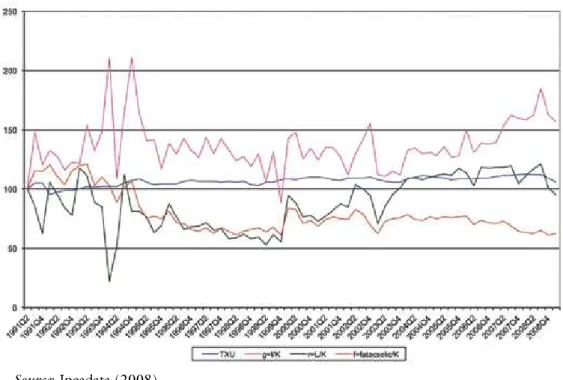
starting from 1994 the evolution pattern becomes very different, high-lighting two other phases: a phase of relative stagnation, when profit rate and ac-cumulation rate disconnect. the first variable maintains itself in a growth path, while the second remains almost stagnant. as a direct macroeconomic result, economic growth became very unstable and at very low rates relative to the his-torical average. the third and last phase reveals that these two variables go back to showing expansion paths, just as the Brazilian economy begins to grow again. But, in fact, it was the capital accumulation rate that grew fast again (average of 7.8% annually between 2004-2008), because the profit rate had been growing since 1999, with an average annual growth of 1.8%.
Source: ipeadata (2008).
Graph 3 – Profit rate and its components (logarithmic scale).
another interesting point is that between 1991 and 2003, corporate profit rates and this proxy go together, in such a way that companies cannot profit in a way that justifies the allocation of productive resources, hence the trend towards a semi-stagnation.
Source: iBGe (2011) and Marquetti (2000).
Graph 4 –Wage share
Figure 5 presents the latest data on the evolution of wage share in Brazil and some other labor market indicators. according to the figure, an increase in wage share is seen from 2006, due mainly to the growth of employment and real wages.
Source: ipeadata (2008) and iBGe (2008). note: value index.
Graph 5 - Macroeconomic determinants of wage share in GdP.
Estimates of growth regime of the Brazilian economy
theo-retical model discussed in section 2 of the article and performed for the period 2002-2008, with quarterly data.2 the construction of the series is described in the appendix.
Previous studies, such as Bruno’s (2003), have already classified the eco-nomic growth regime in Brazil between 1973 and 2000, using the same meth-odology as in this research. the results found by the author suggest that the growth pattern of the Brazilian economy was profit-led between 1973 and 1979, and wage-led in the period 1981-2000.
the classification of growth regimes for the recent period can be done by estimating the savings, investment and net export functions (table 1).
table 1 – estimated equations (2002-2008)
Investment Function:
dependent variable G0 Gr Gu r2
-7.68 0.31 0.31 0.55
(-1.97) (1.96) (1.96)
(0.063) (0.063) (0.063)
Savings Function:
dependent variable sw sr r2
S 0.42 1.46 0.79
Test t 1.77 4.19
Prob. (0.08) (0.00)
Export Function 1:
dependent variable nx 0 nx π nxu nxe r2
NEXk -2.90 1.31 0.48 0.40 0.63
Test t (1.07) (3.62) (0.96) (3.26)
Prob (0.29) (0.00) (0.34) (0.00)
Export Function 2:
dependent variable nx 0 nx π nxu nxe r2
NEX 4.88 1.45 -0.85 0.40 0.46
Test t (3.22) (3.40) (-2.43) (3.26)
Prob (0.00) (0.00) (0.02) (0.00)
note: all series in log, test t in brackets.
if: – (sr – sw – gr) > 0 à profit-led
if: – (sr – sw – gr) < 0 à wage-led
according to the decision rule and without considering the external sector we have:
- (1,46 – 0,31 - 0,42) = - 0,63
Which implies a wage-led internal growth regime.
However, when considering the export function we have: - (1.46 - 0.31 – 0.42) = - 0.63 + 1.31= 0.68 à profit-led
or,
- (1.46 - 0.31 – 0.42) = - 0.63 + 1.45= 0.82 à profit-led
therefore, when including the participation of the external sector, the growth regime of the Brazilian economy can be classified as profit-led, which is consistent with the idea that a wage-led growth regime is less likely when considering the effects of distribution on the external sector. these results were reported by Hein and vogel (2008) and established by Blecker (2010).
according to Bhaduri & Marglin (1990) and Blecker (2002), in the con-text of growth and income distribution models like those presented and dis-cussed in this research, the level of the real exchange rate can affect long-term growth due to the impact it has on functional income distribution. thus, if the accumulation regime is characterized as profit-led, a depreciation of the real exchange rate would lead to an increase in the degree of capacity utilization and the rate of investment, given that the depreciation of the real exchange rate will imply a reduction in real wages, which will increase the profit margin of the companies and have a positive effect on their planned investments.
this reduction in real wages will reduce consumer demand because of the differences between the propensity of workers and capitalists to consume. However, if the sensitivity of investment to profit margin variations is high and the difference between the propensity to consume of capitalists and workers is reduced, the decrease in consumer demand induced by the reduction in real wages will be more than offset by increased investment demand, leading to an increase in the degree of capacity utilization.
Based on the estimates presented, it can be expected, therefore, that a de-preciation of the real exchange rate will have a positive effect on investment in the Brazilian economy, which is in agreement with the arguments favoring the adoption of more competitive exchange rates, as presented in Bresser-Pereira (2009a, 2009b).
Final considerations
the possibility to establish relationships between the macro growth pat-tern and accumulation regimes led this article to investigate which growth re-gime has been observed in the Brazilian economy over the past few years, pro-viding a theoretical model that served as the framework for the presentation of empirical results regarding the Brazilian economy.
the empirical results show, on the one hand, that internally the Brazil-ian economy follows a wage-led growth pattern, in such a way that aggregate demand responds positively to an increase in the share of wages in income. on the other hand, when considering the participation of the external sector, i.e., the determination of net exports, the accumulation regime can be established as profit-led. this result, according to international empirical evidence, is be-coming increasingly characteristic of internationalized economies. thus, when considering investment and exports, aggregate demand responds positively to an increase in the share of profits in income, and it can be said that the economy is characterized by a profit-led accumulation regime.
this conclusion has important implications for the analysis of exchange rate policy and the possible effects of a more depreciated exchange rate on the Brazilian economy. a higher exchange rate has positive effects on investment profitability, given the characterization of the Brazilian economy as profit-led. this would imply greater capital accumulation, savings, exports and a higher lev-el of aggregate demand, as highlighted by Bresser-Pereira (2009b). Moreover, stimulating aggregate demand through exchange rate could lead the Brazilian economy to a macro growth pattern that is more sustainable and less prone to external constraint issues, pulled by more investment and less consumption, which would lead to higher economic growth rates, as is the case in China and other asian countries like Korea, thailand and Malaysia.
notes
1 there are several models that analyze the effects of a change in functional income dis-tribution on demand, but this section is based largely on the works of uemura (2000) and Bowles & Boyer (1990 and 1995). Bruno (2003) also follows these articles as the basis for his analysis of growth regimes in Brazil between 1973 and 2000.
references
BHaduri, a.; MarGLin, s. a. unemployment and the real wage: the economic basis for contesting political ideologies. Cambridge Journal of Economics, v.14, n.4, p.375-93, 1990.
BLeCKer, r. distribution, demand and growth in neo-Kaleckian macro-models. in: setterFieLd, M. (org.) The economics of demand led-growth. aldershot: edward elgar, 2002.
_______. Open economy models of distribution and growth. Working Papers 2010-3. american university, department of economics, 2010.
BoWLes, s.; Boyer, r. a wage-led employment regime: income distribution, labour discipline and aggregate demand in Welfare Capitalism. in: arGLin, s. a.; sCHor, J. (ed.) The golden age of capitalism. oxford: Clarendon Press, 1990.
________. Wages, aggregate demand, and employment in an open economy: an empi-rical investigation. in: ePstein, G.; Gintis, H. (ed.) Macroeconomic policy after the conservative era. Cambridge: Cambridge university Press, 1995. p.143-71.
Bresser-Pereira, L. C. a tendência à sobreapreciação da taxa de câmbio. Econô-mica, v.11, n.1, p.7-30, June 2009a.
________ . Globalização e competição. rio de Janeiro: elsevier-Campus, 2009b.
Bresser-Pereira, L. C.; GaLa, P. Foreign savings, insufficiency of demand, and low growth. Journal of Post Keynesian Economics, v.30, n.3, p.315-34, spring 2008. Bruno, M. regimes de crescimento, mudanças estruturais e distribuição na econo-mia brasileira (1970-2001). in: viii enContro naCionaL de eConoMia PoLÍtiCa. Florianópolis. Anais… Florianópolis, June 2003.
Hein, e.; voGeL, L. distribution and growth reconsidered: empirical results for six oeCd countries. Cambridge Journal of Economics, v.32, n.3, p.479-511, 2008. iBGe. Brazilian institute of Geography and statistics. rio de Janeiro. 2011.
iPeadata – institute of applied economic research. available at: <http://www. ipeadata.gov.br>. access on: sept. 2008.
KaLdor, n. Further Essays on Economic Theory. new york: Holmes & Meier Publi-shers, inc., 1978.
________. alternative theories of distribution. in: . The essential Kaldor. org. F. targetti and a. P. thirlwall. new york: Holmes & Meier Publishers, inc., 1989a. ________. Capital accumulation and growth. in: . The essential Kaldor. org. F. targetti and a. P. thirlwall, a.P. new york: Holmes & Meier Publishers, inc., 1989b. KaLdor, n.; MirrLees, J. a. a new model of economic growth. in: KaLdor, n. Further Essays on Economic Theory. new york: Holmes & Meier Publishers, inc., 1978. KaLeCKi, M. as equações marxistas de reprodução e a economia moderna. in: MiGLioLi, J. (org.) Crescimento e ciclo das economias capitalistas. são Paulo: Hu-citec, 1977a.
KaLeCKi, M. Teoria da dinâmica econômica. são Paulo: abril Cultural, 1983. (Col. os economistas).
______. Crescimento e ciclo das economias capitalistas. 2. ed. são Paulo: Hucitec, 1987. Keynes, J. M. The general theory of employment, interest and money. new york: Pal-grave Macmillan, 2007.
MarQuetti, a. a. estimativa do estoque de riqueza tangível no Brasil, 1950-1998. Nova Economia, v.10, n.2, p.11-37, dec. 2000.
naastePad, C. W. M.; storM, s. oeCd demand regimes, 1960-2000. Journal of Post Keynesian Economics, v.29, n.2, p.213-48, 2006-2007.
stoCKHaMMer, e.; onaran, Ö. accumulation, distribution and employment: a structural var approach to a neo-Kaleckian macro-model. Structural Change and Economic Dynamics, v.15, n.4, p.421-47, 2004.
stoCKHaMMer, e. et al. Functional income distribution and aggregate demand in the euro area. Cambridge Journal of Economics, v.33, n.1, p.139-59, 2009.
ueMura, H. Growth, distribution and structural change in the post-war Japanese in Japanese capitalism in crisis: a regulationist interpretation. edited by r. Boyer and toshio yamada. London: routledge, 2000.
WorLd BanK. World Bank national accounts data, and oeCd national ac-counts data files. n.d.
Appendix
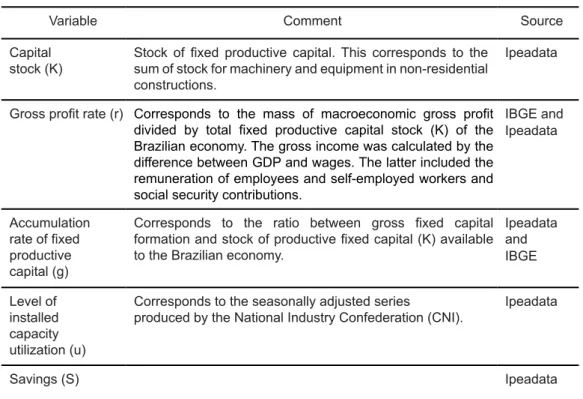
table 1 – research variables
Variable Comment Source
Capital stock (K)
Stock of ixed productive capital. This corresponds to the sum of stock for machinery and equipment in non-residential constructions.
Ipeadata
Gross proit rate (r) Corresponds to the mass of macroeconomic gross proit divided by total ixed productive capital stock (K) of the Brazilian economy. The gross income was calculated by the difference between GDP and wages. The latter included the remuneration of employees and self-employed workers and social security contributions.
IBGE and Ipeadata
Accumulation
rate of ixed productive capital (g)
Corresponds to the ratio between gross ixed capital formation and stock of productive ixed capital (K) available to the Brazilian economy.
Ipeadata and IBGE Level of installed capacity utilization (u)
Corresponds to the seasonally adjusted series
produced by the National Industry Confederation (CNI). Ipeadata
Investment (I) Corresponds to the ratio between gross ixed capital and
GDP Ipeadata
Real effective exchange rate
(e)
Ipeadata
Net exports
(NEX) Trade balance Ipeadata
Total wages
(W)
Corresponds to the sum of income of employees, revenue of autonomous workers plus social contributions. IBGE Total proits
(L)
Corresponds to non-agricultural GDP minus wages (W). IBGE
Proit share (π) Corresponds to proit share (L) in GDP IBGE
abstract – this article investigates the growth regime prevailing in the Brazilian
eco-nomy from 2001 to 2009 by presenting a theoretical model that underpins the empi-rical research concerning the Brazilian economy. the results show that, internally, the growth regime of the Brazilian economy is wage-led, but when considering the external sector it can be characterized as proit-led. this has important implications for a conven-tional analysis of the effects of a depreciation of the exchange rate on domestic produc-tion. More specifically, depreciation in the exchange rate tends to have expansionary effects on domestic production.
KEywords: Growth regimes, Brazilian economy, exchange rate policy.
Eliane Araújo is an assistant-professor at the state university of Maringá (ueM) and has a Phd in economics from the Federal university of rio de Janeiro (uFrJ). @ – [email protected]