Original Article
Artigo Original
Andréia Cristina Muznlinger dos Santos1 Maria Cristina de Menezes Borrego2 Mara Behlau2
Descritores
Voz Treinamento da Voz Fonoaudiologia Acústica da Fala Percepção Auditiva Keywords
Voice Voice Training Speech, Language and Hearing Sciences Speech Acoustics Auditory Perception
Correspondence address:
Andréia Cristina Muznlinger dos Santos Rua Trinta e Três, Qdr. 81, 15, Santa Cruz II, Cuiaba (MT), Brasil, CEP: 78077-015. E-mail: [email protected]
Received: 12/17/2014
Accepted: 03/08/2015
Study carried out at the Department of Speech Language Pathology and Audiology of Centro Universitário de Várzea Grande – UNIVAG – Várzea Grande (MT) and at the Center for Voice Studies – CEV – São Paulo (SP), Brazil.
(1) Centro Universitário de Várzea Grande – UNIVAG – Várzea Grande (MT), Brazil.
(2) Universidade Federal de São Paulo – UNIFESP; Center for Voice Studies – CEV – São Paulo (SP), Brazil.
Conlict of interests: nothing to declare.
Effect of direct and indirect voice training in
Speech-Language Pathology and Audiology students
Efeito de treinamento vocal direto e
indireto em estudantes de Fonoaudiologia
ABSTRACT
Purpose: Toverify the effect of two approaches of vocal training in Speech Language Pathology and Audiology students, a direct and an indirect approach. Methods: Participants were 25 female Speech Language Pathology and Audiology students divided into two groups: direct training with vocal exercises, DTG (n=13); and indirect training with vocal orientations, ITG (n=12). The training sessions were conducted by the same speech language pathologist in six weekly sessions of 30 minutes. Both groups underwent multidimensional voice assessment, pre- and post-training: vocal self-assessment; Vocal Symptoms Scale (VSS); auditory perceptual analysis of sustained vowel and connected speech; acoustic analysis of voice through the Vocal Range Proile (VRP) and Speech Range Proile (SRP); and Group Climate Questionnaire, only at the end of training. Results: The DTG showed changes in auditory perceptual analysis of vowel, which was less diverted after training; and expansion of the voice range in the VRP and SRP, which proves best vocal performance. However, the ITG showed no changes in any of the parameters evaluated. In Group Climate, the ITG obtained the highest conlict score in comparison to the DTG, probably because the indirect approach did not favor exchange in the group and did not allow a better quality interaction. Conclusion: The direct approach provided greater beneits to students than the indirect approach, with signiicant change in voice quality, and can serve as inspiration to Speech Language Pathology and Audiology courses to prevent dysphonia.
RESUMO
INTRODUCTION
The speech language pathologist is a voice professional who works with research, prevention, evaluation, and speech language therapy in the ields of oral and written communi-cation, speech and hearing, as well as improvement of speech and voice patterns(1).
The preferred voice quality of the speech language pathol-ogist is characterized as an adapted voice, with balanced resonance, isochronic vocal attack, stable emission, tended to increase in frequency and intensity, and large use of modulation(2,3).
However, studies showed the presence of complaints and vocal alterations since graduation. Students reported the following symptoms: general fatigue, hoarseness, irritation in the larynx, low pitch, breathiness, straining, frequency breaks, and resonance changes(4,5). The prevalence of voice
disorders was reported by 12% of future speech language pathologists, and such index is greater than in the general population (3–9%)(5).
Aware of the risk and high vocal demand, Speech Language Pathology and Audiology undergraduates have been inserted successfully in voice and speech training programs(6,7). However,
there is a dificulty in comparing the results of the approaches used in the various training programs for future professionals due to the different methods used.
According to the literature(8,9), there are three main approaches
to improving the communication patterns that can prevent voice problems: direct approach, consisting of vocal exercises; indi-rect approach, consisting of vocal hygiene guidelines; and com-bined interventions (direct and indirect approaches).
The direct and indirect approaches have extremely opposite characteristics because the irst acts directly on the voice, and the second, on the learning of vocal self-care(13,14). However, in
Speech Language Pathology and Audiology students, little is known about the comparative effect of these approaches and their contributions to the academic training in the ield of voice.
According to the literature, voice training is usually applied in a group, as it is targeted at people who have a common goal, and its eficacy is scientiically proven and it has reduced costs to society(15-17). However, there are no reports in the literature
on the impacts of direct and indirect approaches on the vocal dynamics developed by vocal training groups.
The group dynamics were initially investigated in psy-chology by Mackenzie(18), which classiied the group
interac-tions in three types of group climate: engagement, conlict, and avoidance. In the ield of Speech Language Pathology and Audiology, group climate was studied in a group of teachers, who were part of a vocal therapy program, and it was noted that positive group interaction with engaged subjects provided signiicant improvements in quality of life, facilitated the adher-ence to the intervention, and assisted in the reduction of vocal symptoms(19). However, when a group is conlictive, there may
be rejection and lack of trust, which can produce a negative result(18). Finally, little is known whether the different types of
voice training approaches can also modify the dynamics devel-oped by the intervention groups.
Thus, this study aimed to evaluate the effect of two vocal approaches in groups of Speech Language Pathology and Audiology students, a direct approach and an indirect approach.
METHODS
This study was approved by the research ethics committee of Universidade Federal de Mato Grosso, Campus Araguaia, under protocol no. 347 753/13, and all participants signed the informed consent.
The study included 25 volunteer Speech Language Pathology and Audiology students, female, randomly divided into two groups: direct approach training group — DTG (n=13), with individuals aged 18–41 years (mean=24.46 years); and indi-rect approach training group — ITG (n=12), with students aged 18–37 years (mean=24.41 years). Both trainings were directed by the same speech language pathologist in six ses-sions, with frequency of a 30-minute session per week, called session 1 (S1), session 2 (S2), session 3 (S3), session 4 (S4), session 5 (S5), and session 6 (S6).
The DTG was subjected only to vocal exercises (Chart 1): • (S1) vocal warm-up;
• (S2) vocal warm-up and cool-down;
• (S3 and S4) vocal warm-up and glottal source exercises; and • (S5 and S6) vocal warm-up, articulation, breathing,
empha-sis, and vocal modulation.
The ITG was subjected only to vocal hygiene guidelines (Chart 2):
• (S1) laryngeal anatomy;
• (S2) vocal physiology and production; • (S3) most common voice disorders;
• (S4) negative attitudes that lead to vocal problems; and • (S5 and S6) positive attitudes aimed at healthy vocal habits.
All subjects underwent a multidimensional voice assess-ment, pre- and post-intervention, held on the irst and last day of training, respectively:
1. vocal self-assessment;
2. Vocal Symptoms Scale (VSS)(20,21);
3. auditory perceptual analysis;
4. acoustic analysis by recording the sustained vowel /ε/ and
counting of numbers from 20 to 30; and
5. Group Climate Questionnaire(18), only on the last day of training.
In the vocal self-assessment, the student should classify their voice quality, through a ive-point Likert scale, for the following responses: “excellent,” “good,” “fair,” “poor,” and “very poor.. The VSS(20,21), the translated and culturally adapted and
is the perception of the overall level of voice alteration regard-ing the limitations in the use of the voice, emotional reactions, and physical symptoms.
In the auditory perceptual analysis, the samples were recorded and edited using VoxMetria software, version 4.4. (CTS Informática). For the analysis of the sustained vowel /ε/,
the irst and the last second of emission were eliminated, as they are marked by natural instability, and only the remaining seconds were analyzed; and, for the number count from 20 to 30, the original recording lengths were kept.
The auditory perceptual analysis was performed by three speech language pathologists who are voice experts, in two sequential listening sessions of the recordings in random order, the irst with the sustained vowels and the second with the con-nected speech. Samples were tested in the ield and simultane-ously to the three evaluators, who could listen to them as often as deemed necessary. There was repetition of 10% of the stimuli to verify the intra-rater reliability.
In the auditory perceptual analysis of the sustained vowel, the judges evaluated the emission of the sustained vowel accord-ing to the GRBASI Scale(22), in which the parameters general
level of dysphonia, roughness, breathiness, asthenia, strain, and instability were analyzed on a scale of 0 to 3 (0 = no deviation and 3 = severe deviation). When analyzing the number count from 20 to 30, judges should listen to each pair of stimuli and note which emission they classiied as the “best emission.” Then they should point out which parameter(s) best justiied their choice: voice quality, articulation and pronunciation, loud-ness, pitch, resonance, speech rate, pneumophonoarticulatory coordination, use of emphasis, and modulation.
In the acoustic analysis, the samples were recorded on the Vocal Grama software, version 4.4 (CTS Informática). The Vocal Range Proile (VRP) and the Speech Range Proile (SRP)(23)
were analyzed on the following parameters: minimum and max-imum fundamental frequency, semitone range, minmax-imum and maximum intensity, and area. For the evaluation of the VRP, the vowel /ε/ was used in ascending and descending glissando
and in strong and weak intensity. For the analysis of the SRP, the number count from 20 to 30 in average, weak, strong, and very strong intensity levels.
The voices were recorded in a room with ambient noise below 50 dB, with participants seated, using the Karsect HT-9 microphone and an Andrea PureAudio™ USB-SA adapter, positioned at an angle of 45° at a distance of 5 cm from the Chart 1. Vocal training program of the direct approach vocal training
group with Speech Language Pathology and Audiology undergraduates
S1. Vocal warm-up
Neck and shoulders relaxation exercise associated with tongue and lips trills in a continuous and modulated tone, five times.
Vocal fry, five times.
Blow and high-pitched sound, five times.
Resonance technique with nasal humming sound, five times.
S2. Vocal warm-up and cool-down
Neck and shoulders relaxation exercise associated with tongue and lips trills in a descending tone, five times.
Yawn and whisper emitting the vowel a, five times.
S3 and S4. Vocal warm-up and glottal source exercises
Loud fricative sound, continuous and alternating, five times. Hands Over Moiuth Technique, five times.
Scales with tongue and lips trills, five times. Messa di Voce technique, five times.
S5 and S6. Vocal warm-up, articulation, breathing, emphasis, and vocal modulation exercises
Overarticulation of the days of the week and months of the year, two times.
Counting from 1 to 30 with a cork between the teeth, one time. Speaking tongue twisters through diadochokinesis and phrases. Breathing in and out five times, observing the lower and the lateral expansion of the ribs.
Breathing in and out emitting a fricative sound for as long as possible, five times, continuously and alternately.
Breathing in and out speaking short, medium, and long sentences, coordinating speech and breathing.
Reading phrases in a modulated form for affirmation, question, and exclamation.
Reading a phrase modifying the emphasis according to the target word, four times.
Reading the text “Meeting at the Company”, using the emphasis and modulation capabilities.
Source: Voz: O Livro do Especialista — Volume II(24) and Muito além do ninho de
mafagafos: um guia de exercícios práticos para aprimorar sua comunicação(25).
Chart 2. Vocal training program of the indirect approach vocal training group with Speech Language Pathology and Audiology undergraduates
S1. Laryngeal anatomy
Components of the larynx — cartilage; laryngeal muscles; ligaments, joints, and laryngeal membranes.
Histological anatomy of the vocal fold.
Main vocal parameters — intensity and frequency.
S2. Vocal physiology and production
Physiology of phonation. Voice and speech production. Vocal psychodynamics.
S3. Most common voice disorders
Classification of dysphonia. Vocal signs and symptoms.
Professionals responsible voice treatment.
S4. Negative attitudes that lead to vocal problems
Inadequate lifestyles — smoking and alcoholism.
Inadequate vocal habits — shouting, speaking too much, speaking for too long, straining while speaking; not articulating words well, speech in competition with noise.
Other inappropriate behaviors — use of tablets/sprays and not hydrating.
S5 and S6. Positive attitudes aimed at healthy vocal habits
Healthy lifestyle — exercise, balanced diet, hydration.
Appropriate vocal habits — dosing speech time, dosing tone of voice (low-high), dosing the volume of voice (strong-weak).
Source: Voz: O Livro do Especialista - Volume I(26); Voz: O Livro do Especialista –
participant’s mouth. The voices were recorded directly onto a Sony Vaio computer, model PCG-31311X.
The Group Climate Questionnaire, also called Group Climate Questionnaire – Short Form (GCQ-S)(18), was translated and
culturally adapted into Brazilian Portuguese by the authors, comparing the group climate of the two vocal training groups (Appendix 1). It was originally created for use in psychotherapy groups to check the effects of group climate in treatment out-comes. It consists of a 12-question questionnaire divided into three scales: engagement (ive questions), conlict (three), and avoidance (four). Each question is scored from 0 (not at all) to 6 (fully), with scores calculated by simply adding the points.
Statistical analysis of variables was performed using the Statistical Package for Social Sciences software, version 17.0. The Test for Equality of Proportions and the Mann-Whitney’s test were applied at a 5% signiicance level for comparison of results for groups.
RESULTS
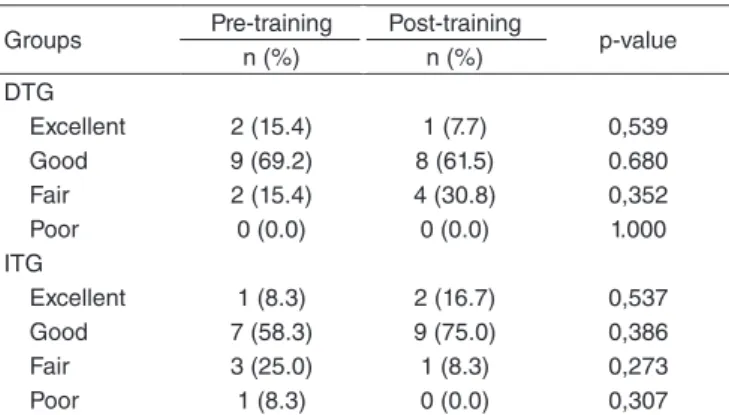
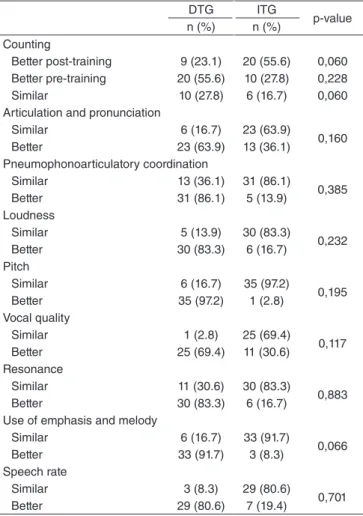
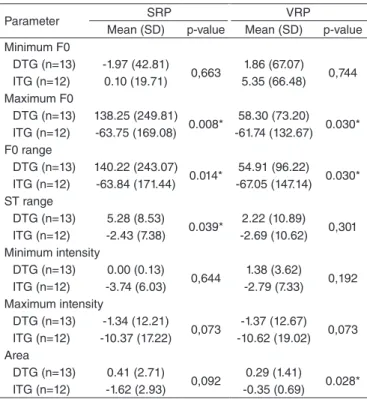
There were no changes in the vocal self-assessment param-eters (Table 1) and in the VSS (Table 2) for any of the two groups. As for the auditory perceptual assessment, signiicant differences were observed only for the DTG for the analysis of the sustained vowel (Table 3) and no change for both groups were observed in the auditory perceptual analysis of speech (Table 4). Signiicant differences were observed only for the DTG for the VRP and SRP (Table 5).
In the auditory perceptual analysis of the sustained vowel (Table 3), the DTG showed a reduction in voice deviations in the overall score and breathiness parameters, which went from moderate to mild.
In the acoustic analysis of the VRP and SRP (Table 5), an increase was observed in the amplitude of maximum frequency and frequency range in the DTG. An increase in semitone range in the SRP was also observed.
The analysis of the Group Climate Questionnaire responses (Figure 1) showed that the ITG had high scores for all the scales evaluated, but the conlict score was signiicant when compared to the DTG.
DISCUSSION
This study examined the effect of two vocal training approaches, a direct approach and an indirect approach, among Speech Language Pathology and Audiology students(24-26).
Different results were found according to the type of approach used for some of the parameters. The direct approach training group presented less voice deviations in the auditory perceptual evaluation of the sustained vowel, maximum frequency range in the VRP and the SRP, and range of the scope of frequencies in the SRP. The indirect approach training group showed no changes in the evaluated parameters.
A literature review(27) on the impacts of vocal training in
voice professionals showed that in 9 of 10 studies investigated, the results showed signiicant changes in vocal quality in this population, with improvement in at least one of the measures related to vocal production when compared to the pre-training assessment data.
No signiicant changes were observed in vocal self-assess-ment for both groups when comparing the pre- and post-training moments (Table 1). However, there was a change for the better (although not signiicant) in the “fair” and “good” classiica-tions in the ITG and “poor” in the DTG, and a change for the worse can also be seen in the “excellent” variable in the DTG group. Thus, the indings suggest that both training approaches caused a change in vocal perception, but not enough to produce
Table 2. Measures of the Vocal Symptoms Scale scores
Mean (SD) Median Min–Max CI p-value
DTG (n=13)
Limitation
Pre-training 6.5 (7.0) 3 1.0–10.0 3,78
0,878 Post-training 6.2 (6.6) 4 2.0–9.0 3,57
Emotional
Pre-training 0.6 (1.9) 0 0.0–0.0 1,05
0,180 Post-training 0.3 (1.1) 0 0.0–0.0 0,6
Physical
Pre-training 4.3 (2.2) 5 3.0–6.0 1,18
0,166 Post-training 5.4 (3.6) 4 2.0–8.0 1,94
Total
Pre-training 11.4 (9.8) 10 3.0–17.0 5,3
0,478 Post-training 11.9 (10.2) 9 4.0–17.0 5,6
ITG (n=12) Limitation
Pre-training 12.6 (7.6) 13,5 5.8–17.5 4,3
0,719 Post-training 13.3 (8.6) 12 7.8–16.5 4,84
Emotional
Pre-training 0.8 (1.4) 0 0.0–1.3 0,79
0,197 Post-training 1.3 (1.7) 0,5 0.0–2.0 0,98
Physical
Pre-training 6.5 (3.9) 7 4.3–9.0 2,23
0,090 Post-training 7.5 (3.0) 8 4.8–9.0 1,71
Total
Pre-training 19.9 (11.6) 20,5 9.8–28.0 6,6
0,284 Post-training 22.1 (11.2) 20,5 14.0–27.3 6,4
*Significant values (p<0.05) – Mann-Whitney’s test
Caption: DTG = direct training group; ITG = indirect training group; SD = standard
deviation; CI = confidence interval
Table 1. Measures of the vocal self-assessment scores
Groups Pre-training Post-training p-value
n (%) n (%)
DTG
Excellent 2 (15.4) 1 (7.7) 0,539
Good 9 (69.2) 8 (61.5) 0.680
Fair 2 (15.4) 4 (30.8) 0,352
Poor 0 (0.0) 0 (0.0) 1.000
ITG
Excellent 1 (8.3) 2 (16.7) 0,537
Good 7 (58.3) 9 (75.0) 0,386
Fair 3 (25.0) 1 (8.3) 0,273
Poor 1 (8.3) 0 (0.0) 0,307
*Significant values (p<0.05) – Test of Equality of Proportions
a differentiation between the approaches used. Students may have had dificulties in understanding their own vocal modi-ications resulting from training through auditory perception. Researchers(28) noted the dificulty faced by Speech Language
Pathology and Audiology students in analyzing vocal param-eters and advised them through an auditory training targeted to undergraduate students.
Table 2 shows that both groups scored high on the VSS com-pared to the indings in the Brazilian population without dys-phonia, which presented as normal scores equal to or less than 3.77 in the limitation score, 0.32 in the emotional score, 3.02 in the physical score, and 7.11 for the total score(21).
In addi-tion, a trend of worsening was noted, even though not statis-tically signiicant, in the vocal symptoms among students in post-training moment. This may be linked to aspects related to vocal use and abuse of a young group of university students, which deserves investigation and future orientation because, after all, they must be prepared to face the professional demand soon. Vocal symptoms were also reported by 29% of the Speech
Language Pathology and Audiology students of the University of Gent(4). These data, among others, lead the researchers to
foster the implementation of voice training to minimize the vocal risks in these future voice professionals(4-7).
Differences were observed in the auditory perceptual anal-ysis of the sustained vowel only for the DTG, which showed less voice deviations in the post-training (Table 3). It is inter-esting to note that in a group of Speech Language Pathology and Audiology students, with voices supposedly considered neutral, 41% of sustained vowel emissions showed some deviation to a moderate degree. The reduction of voice devia-tions from moderate to mild shows the positive effect of direct vocal training in this group. A study with teachers undergo-ing vocal trainundergo-ing with direct approach showed a signiicant reduction in the degree of strain, both in the auditory percep-tual analysis of the vowel /ε/ and in the analysis of
spontane-ous speech of these professionals(29). The ITG remained similar
pre- and post-training, as expected, because it was not submit-ted to vocal training.
No differences were observed in the auditory perceptual analysis of speech in both groups (Table 4). According to the literature, the auditory perceptual assessment of the sustained vowel differs from that of the connected speech, as it seeks to Table 3. Measures of the scores of the auditory perceptive evaluation
of the sustained vowel through the GRBASI Scale
DTG ITG
Pre-training
Post-training p-value Pre-training
Post-training p-value
n (%) n (%) n (%) n (%)
General level of dysphonia
Normal 1 (2.6) 2 (5.1) 0,556 0 (0.0) 0 (0.0) 1.000 Mild 21 (53.8) 31 (79.5) 0.016* 20 (55.6) 21 (58.3) 0,812 Moderate 16 (41.0) 5 (12.8) 0.005* 13 (36.1) 14 (38.9) 0,808 Severe 1 (2.6) 1 (2.6) 1.000 3 (8.3) 1 (2.8) 0,303 Roughness
Normal 18 (46.2) 19 (48.7) 0,821 14 (38.9) 17 (47.2) 0,475 Mild 17 (43.6) 15 (38.5) 0,645 15 (41.7) 12 (33.3) 0,465 Moderate 4 (10.3) 5 (12.8) 0,723 7 (19.4) 7 (19.4) 1.000 Severe 0 (0.0) 0 (0.0) 1.000 0 (0.0) 0 (0.0) 1.000 Breathiness
Normal 13 (33.3) 9 (23.1) 0,314 10 (27.8) 13 (36.1) 0,448 Mild 15 (38.5) 26 (66.7) 0.013* 16 (44.4) 11 (30.6) 0,224 Moderate 11 (28.2) 4 (10.3) 0.044* 8 (22.2) 11 (30.6) 0,422 Severe 0 (0.0) 0 (0.0) 1.000 2 (5.6) 1 (2.8) 0,555 Asthenia
Normal 34 (94.4) 32 (88.9) 0,394 36 (92.3) 36 (92.3) 1.000 Mild 1 (2.8) 3 (8.3) 0,303 3 (7.7) 3 (7.7) 1.000 Moderate 1 (2.8) 1 (2.8) 1.000 0 (0.0) 0 (0.0) 1.000 Severe 0 (0.0) 0 (0.0) 1.000 0 (0.0) 0 (0.0) 1.000 Strain
Normal 24 (61.5) 31 (79.5) 0,082 24 (66.7) 25 (69.4) 0.800 Mild 10 (25.6) 6 (15.4) 0,262 10 (27.8) 10 (27.8) 1.000 Moderate 4 (10.3) 1 (2.6) 0,165 1 (2.8) 1 (2.8) 1.000 Severe 1 (2.6) 1 (2.6) 1.000 1 (2.8) 0 (0.0) 0,314 Instability
Normal 34 (87.2) 31 (79.5) 0,362 24 (66.7) 28 (77.8) 0,293 Mild 5 (12.8) 8 (20.5) 0,362 10 (27.8) 8 (22.2) 0,586 Moderate 0 (0.0) 0 (0.0) 1.000 2 (5.6) 0 (0.0) 0,151 Severe 0 (0.0) 0 (0.0) 1.000 0 (0.0) 0 (0.0) 1.000
*Significant values (p<0.05) – Mann-Whitney’s test
Caption: DTG = direct training group; ITG = indirect training group
Table 4. Measures of the scores of the perceptual evaluation of connected speech
*Significant values (p<0.05) – Test of Equality of Proportions
Caption: DTG = direct training group; ITG = indirect training group
DTG ITG p-value
n (%) n (%)
Counting
Better post-training 9 (23.1) 20 (55.6) 0,060 Better pre-training 20 (55.6) 10 (27.8) 0,228
Similar 10 (27.8) 6 (16.7) 0,060
Articulation and pronunciation
Similar 6 (16.7) 23 (63.9)
0,160
Better 23 (63.9) 13 (36.1)
Pneumophonoarticulatory coordination
Similar 13 (36.1) 31 (86.1)
0,385
Better 31 (86.1) 5 (13.9)
Loudness
Similar 5 (13.9) 30 (83.3)
0,232
Better 30 (83.3) 6 (16.7)
Pitch
Similar 6 (16.7) 35 (97.2)
0,195
Better 35 (97.2) 1 (2.8)
Vocal quality
Similar 1 (2.8) 25 (69.4)
0,117
Better 25 (69.4) 11 (30.6)
Resonance
Similar 11 (30.6) 30 (83.3)
0,883
Better 30 (83.3) 6 (16.7)
Use of emphasis and melody
Similar 6 (16.7) 33 (91.7)
0,066
Better 33 (91.7) 3 (8.3)
Speech rate
Similar 3 (8.3) 29 (80.6)
0,701
show mild changes that are not perceived in connected speech, a type of issue that just masks such changes, as occurred in this study(30).
In the acoustic analysis of the SRP and VRP (Table 5), positive effects were observed only for the DTG, with greater amplitude of maximum frequency, frequency range, and semitone range in the SRP; and greater amplitude of maximum frequency, frequency range, and area in the VRP.
These indings prove a better vocal performance for the direct training group. However, the ITG had reduced results, which shows the low impact of the vocal guidance in spe-ciic parameters evaluated by such acoustic analysis, when used in isolation.
Similar results were observed in a study with Speech Language Pathology and Audiology students(6), in which the
students were submitted to vocal warm-up exercises. Research has shown a better performance of individuals in the post-train-ing moment, measured by the acoustic analysis, with reduction in the intensity and greater amplitude of the vocal frequency. In another study, indirect approach training applied to Speech Language Pathology and Audiology students was important for the modiication of vocal behaviors such as screaming, reduction of general fatigue, and decreased voice complaints(7),
habits that are directly related to the topics addressed in this type of training.
The analysis of the responses of the Group Climate Questionnaire (Figure 1) showed differences between groups only in the conlict score, which was higher for the ITG. This can be explained by the characteristics of the indirect approach training applied to this group, with less chance of interactional exchanges, demanding a more passive stance by the participant, who acts only as a listener of the vocal guid-ance. However, the direct approach led to increased exchange with the practical exercises, showing less conlict at the end of the sessions. Some studies have found that the results and the success of collective interventions may be related to the type of group climate. It was observed that, when there is a negative group interaction, with individuals in conlict or avoidance, there is a signiicant reduction in quality of life, with increased vocal symptoms and low adhesion to the treat-ment(18,19). Thus, the approach used in the DTG led to a more
active attitude and provided a better group climate among the members, with less conlict.
In short, direct approach training, consisting of vocal exer-cises, can provide a change in vocal functioning(8), with reduced
vocal intensity and increased fundamental frequency(6);
expan-sion of frequency range with better range of low and high sounds, and vocal intensity with better range of weak and strong sounds(10); better articulation pattern and luency of speech(11);
and reduced jitter(12). However, the indirect approach can help
the individual to understand vocal use(8) and prevent
worsen-ing of vocal symptoms(12). However, research shows that the
indirect approach may not represent an immediate impact on the vocal tract(13,14).
The limitation of this study was the small sample size due to the low adherence of students to training, justiied by the lack of knowledge on the importance and beneits of voice train-ing. It is suggested that a combined approach should be used to check the effect of the three types of training suggested in the literature: indirect approach, direct approach, and combi-nation approach.
This study may serve as inspiration to Speech Language Pathology and Audiology courses, so that vocal training pro-grams are incorporated in the graduation to promote vocal health and to prevent dysphonia.
14.46 15.58
7.46 9.5
3.69 * 9.5 18
16 14 12 10 8 6 4 2 0
Engagement Avoidance
DTG ITG
Conflict
*Significant value (p-value=0.006) – Mann-Whitney’s test
Caption: DTG = direct training group; ITG = indirect training group
Figure 1. Comparison between the responses of the Group Climate Questionnaire for each group of the vocal training applied to Speech Language Pathology and Audiology undergraduates
Table 5. Comparison between the performances of the groups for Acoustic Analysis Gain in the Speech Range Profile and Vocal Range Profile
*Significant values (p<0.05) – Mann-Whitney’s test
Caption: DTG = direct training group; ITG = indirect training group; SRP = Speech Range Profile; VRP = Vocal Range Profile; SD = standard deviation; ST = semitone
Parameter SRP VRP
Mean (SD) p-value Mean (SD) p-value Minimum F0
DTG (n=13) -1.97 (42.81)
0,663 1.86 (67.07) 0,744 ITG (n=12) 0.10 (19.71) 5.35 (66.48)
Maximum F0
DTG (n=13) 138.25 (249.81)
0.008* 58.30 (73.20) 0.030* ITG (n=12) -63.75 (169.08) -61.74 (132.67) F0 range
DTG (n=13) 140.22 (243.07)
0.014* 54.91 (96.22) 0.030* ITG (n=12) -63.84 (171.44) -67.05 (147.14) ST range
DTG (n=13) 5.28 (8.53)
0.039* 2.22 (10.89) 0,301 ITG (n=12) -2.43 (7.38) -2.69 (10.62) Minimum intensity
DTG (n=13) 0.00 (0.13)
0,644 1.38 (3.62) 0,192 ITG (n=12) -3.74 (6.03) -2.79 (7.33)
Maximum intensity
DTG (n=13) -1.34 (12.21)
0,073 -1.37 (12.67) 0,073 ITG (n=12) -10.37 (17.22) -10.62 (19.02) Area
DTG (n=13) 0.41 (2.71)
CONCLUSION
The participants of voice training subjected to a direct approach, with vocal exercises, beneited from the training offered, which impacted positively on various voice analysis dimensions. However, the indirect approach, only with vocals guidelines, was not suficient to produce signiicant changes in the vocal quality of the students, who took a more passive attitude toward the guidelines.
*MB was the advisor and was responsible for the research design and correction of the manuscript; MCMB was the co-advisor and responsible for the research and correction of the manuscript; ACMS was responsible for research, organization, and analysis of the database, and drafting of the manuscript.
REFERENCES
1. Stival N, Mello JM. O ensino superior e a fonoaudiologia no Brasil. In: Ribas A, Pazini S. (orgs.). Fonoaudiologia e educação: uma parceria necessária. Curitiba: UTP; 2010. p. 82:87.
2. Behlau M, Feijó D, Madazio G, Rehder MI, Azevedo R, Ferreira AE. Voz proissional: Aspectos gerais e atuação Fonoaudiológica. In: Behlau M. Voz o livro do especialista II. São Paulo: Revinter; 2010. p.311-333. 3. Bicalho AD, Behlau M, Oliveira G. Termos descritivos da própria voz:
comparação entre respostas apresentadas por fonoaudiólogos e não-fonoaudiólogos. Rev CEFAC. 2010;12 (4):543-50.
4. Van Lierde K, D’Haeseleer E, Wuyts F, de Ley S, Geldof R, De Vuyst J, et al. The objective vocal quality, vocal risk factors, vocal complaints, and corporal pain in Dutch female students training to be speech-language pathologists during the 4 years of study. J Voice. 2010;24(5):592-8. 5. Gottliebson RO, Lee L, Weinrich B, Sanders JR. Voice problems of future
speech-language pathologists. J Voice. 2007;21(6):699-704.
6. Van Lierde K, D’haeseleer E, Baudonck N, Claeys S, De Bodt M, Behlau M. The impact of vocal warm-up exercises on the objective vocal quality in female students training to be Speech Language Pathologists. J Voice. 2011;25(3):115-21. 7. Van Lierde K, D’haeseleer E, Deley S, Luyten A, Baudonck N, Claeys
S, et al. The impact of a voice counseling procedure to select students with normal vocal characteristics for starting a Master Program in Speech Language Pathology: a pilot study. J Voice. 2012;26(5):623-8. 8. Anhaia TC, Gurgel LG, Vieira RH, Cassol M. Intervenções vocais diretas e
indiretas em professores: revisão sistemática da literatura. ACR. 2013; 18(4):361-6. 9. Rodríguez-Parra MJ, Adria JA, Casado JC. Comparing voice-therapy and
vocal-hygiene treatments in dysphonia using a limited multidimensional evaluation protocol. J Commun Dis. 2011;44:615-30.
10. LeBorgne WD, Weinrich BD. Phonetogram Changes for trained singers over a nine-month period of vocal training. J Voice. 2012;16(1):37-43. 11. Moreira TC, Cassol M, Fávero SR, Oliveira LB, Longaray CS, Soares
MO, et al. Intervenção fonoaudiológica para consultores em um serviço de teleatendimento: bem-estar vocal. Rev CEFAC. 2010;12(6):936-44.
12. Oliveira AG, Gouveia N, Behlau M. The effectiveness of a voice training program for telemarketers. J Voice. 2012;26(6):815e1-8.
13. Nanjundeswaran C, Ii NY, Chan KM, Wong RK, Yiu EM, Verdolini-Abbott K. Preliminary data on prevention and treatment of voice problems in student teachers. J Voice. 2012;26(6):816e1-12.
14. Bovo R, Galceram M, Petrucelli J, Hatzopoulos S. Vocal problems among teachers: evaluation of a preventive voice program. J Voice. 2007;21(6):705-22. 15. Araújo MLB, Freire RMAC. Atendimento fonoaudiológico em grupo.
Rev CEFAC. 2011;13(2):362-38.
16. Camargo AM, Silva APBV, Wolff LDG, Soares VMN, Gonçalves CGO. Abordagens grupais em Saúde Coletiva: a visão de usuários e de profissionais de enfermagem. Rev Bras Ciênc Saúde. 2012;10(31):1-9.
17. Ribeiro VV, Panhoca I, Dassie-Leite AP, Bagarollo MF. Grupo terapêutico em Fonoaudiologia: revisão de literatura. Rev CEFAC. 2012;14(3):544-52.
18. MacKenzie KR. The clinical application of a group climate measure. In: Dies RR, MacKenzie KR. Advances in group Psychotherapy: Inter-grating research and practice. New York: International Universities Press; 1983 p. 159-70. 19. Law T, Lee KY, Ho FN, Vlantis AC, Van Hasselt AC, Tong MC. The. effectiveness
of group voice therapy: a group climate perspective. J Voice. 2012;26(2):41-8. 20. Deary IJ, Wilson JA, Carding PN, MacKenzie K. VoiSS: a patient-derived:
Voice Symptom Scale. J Psychosom Res. 2003;54(5):483-9.
21. Moreti F, Zambon F, Oliveira G, Behlau M. Cross-Cultural adaptation, validation, and cutoff values of the brazilian version of the Voice Symptom Scale — VoiSS. J Voice. In press 2014.
22. Hirano M. Clinical Examination of Voice. New York: Springer Verlag; 1981.
23. Moraes MC, Behlau MS. Peril de extensão de fala e de voz na clínica vocal [Internet]. In: 18º Congresso Brasileiro de Fonoaudiologia; 2010 Set 22-25; Curitiba. Anais. São Paulo: SBFa; 2010. Available from: http:// www.sbfa.org.br/portal/suplementorsbfa
24. Behlau M, Madazio G, Feijo D, Azevedo R, Gielow I, Rehder MI. Aperfeiçoamento vocal e tratamento fonoaudiólogo das disfonias. In: Behlau M. Voz: O Livro do Especialista – Volume II. Rio de Janeiro: Revinter; 2010. p.410-565.
25. Faria DM, Camisa MT, Guimarães MA. Muito além do ninho de mafagafos: um guia de exercícios práticos para aprimorar sua comunicação. São Paulo: J&H Editoração; 2011.
26. Behlau M (org). Voz: O Livro do Especialista – Volume I. Rio de Janeiro: Revinter; 2008.
27. Hazlett DE, Duffy OM, Moorhead SA. Review of the impact of voice training on the vocal quality of professional voice users: implications for vocal health and recommendations for further research. J Voice. 2011;25(2):181-91.
28. Silva RSA, Simões-Zenari M, Nemr NK. Impacto de treinamento auditivo na avaliação perceptivo-auditiva da voz realizada por estudantes de Fonoaudiologia. J Soc Bras Fonoaudiol. 2012;24(1):19-25.
29. Silverio KCA, Gonçalves CGO, Penteado RZ, Vieira TPG, Libardi A, Rossi D. Ações em saúde vocal: proposta de melhoria do peril vocal de professores. Pró-Fono R Atual Cient. 2008;20(3):177-82.
Appendix 1. Group climate questionnaire
QUESTIONÁRIO DE CLIMA DE GRUPO
GROUP CLIMATE QUESTIONNAIRE-SHORT FORM (GCQ-S)
MacKenzie, 1993 – traduzido e adaptado culturalmente para o Português Brasileiro pelos autores
Avalie as afirmações abaixo do questionário e responda de acordo com a escala de 0 (nem um pouco) a 6 (totalmente) em relação ao grupo que você participou.
Escala de respostas de 0 (nem um pouco) a 6 (totalmente)
1. Os membros do grupo se gostavam e sem importavam uns com os outros 0 1 2 3 4 5 6
2. Os membros tentavam entender por que faziam certas coisas, qual a razão de seus
comportamentos 0 1 2 3 4 5 6
3. Os membros evitaram reconhecer alguns problemas entre eles 0 1 2 3 4 5 6
4. Os membros sentiam a importância do que acontecia no grupo e percebiam a colaboração
entre eles 0 1 2 3 4 5 6
5. Os membros dependiam do(s) líder(es), ou professor(es), do grupo para orientação 0 1 2 3 4 5 6
6. Havia certo atrito e raiva entre os membros do grupo 0 1 2 3 4 5 6
7. Os membros se isolavam e mantinham-se distantes uns dos outros 0 1 2 3 4 5 6
8. Os membros se desafiavam positivamente e incentivaram esforços para resolver os
problemas 0 1 2 3 4 5 6
9. Os membros pareciam fazer coisas só para serem aceitos pelo grupo 0 1 2 3 4 5 6
10. Os membros rejeitavam-se e desconfiavam uns dos outros 0 1 2 3 4 5 6
11. Os membros compartilhavam informações pessoais de natureza emocional ou sentimentos 0 1 2 3 4 5 6
12. Os membros pareciam tensos e angustiados 0 1 2 3 4 5 6
Engajamento: questões 1, 2, 4, 8, 11 Evitação: questões 3, 5, 9 Conflito: questões 6, 7, 10, 12