Radiology
Effect of gamma rays on the bone repair
process in rats with estrogen deficiency
Efeito da radiação gama no processo de
reparo ósseo em ratas com deficiência de
estrógeno
Abstract: This study aimed at evaluating the bone repair process in ovariectomized rats submitted to an irradiation procedure. For this purpose, one hundred rats were randomly divided in four experimental groups: control, ovariectomized, irradiated and irradiated/ ovariectomized. A bone defect was made on all animals’ tibias. Three days after surgery, only irradiated and irradiated/ovariectomized rats received 8 Gy of gamma rays on the lower limbs region. The animals were sacriiced 7, 14, 21 and 28 days after surgery in order to assess the repair process. It was possible to observe a delay in the bone repair process in the irradiated/ovariectomized group, in which there was a remarkable associa-tion between estrogen deiciency and ionizing radiaassocia-tion resulting in the reducassocia-tion of newly formed bone production, thus accelerating the resorption process.
Descriptors: Estrogens; Osteoporosis; Ovariectomy; Bone and bones; Fracture healing.
Resumo: O objetivo deste trabalho foi avaliar o processo de reparo ósseo em ratas ova-riectomizadas submetidas ao procedimento de irradiação. Para isto, cem ratas foram alea-toriamente divididas em quatro grupos experimentais: controle, ovariectomizado, irradia-do e ovariectomizairradia-do/irradiairradia-do. Um defeito ósseo foi confeccionairradia-do nas tíbias de toirradia-dos os animais. Três dias após a cirurgia, apenas os animais pertencentes aos grupos irradiado e ovariectomizado/irradiado receberam 8 Gy de radiação gama na região dos membros inferiores. Os animais foram sacriicados 7, 14, 21 e 28 dias após a cirurgia. Foi possível observar um atraso no processo de reparo ósseo nos animais do grupo ovariectomiza-do/irradiado, no qual houve uma marcante associação entre deiciência de estrógeno e radiação ionizante, resultando na redução da produção de osso neoformado, acelerando o processo de reabsorção.
Descritores: Estrogênios; Osteoporose; Ovariectomia; Osso e ossos; Consolidação da fratura.
Mariliani Chicarelli(a)
Flávia Maria de Moraes Ramos(b) Flávio Ricardo Manzi(a)
Pedro Duarte Novaes(c) Frab Norberto Bóscolo(a) Solange Maria de Almeida(a)
(a)PhDs, Oral Radiology; (b)MSc, Oral Radiology; (c)PhD, Histology – School of Dentistry of Piracicaba, State University of Campinas.
Corresponding author: Flávia Maria de Moraes Ramos Universidade de Campinas
Faculdade de Odontologia de Piracicaba - Radiologia Oral
Av. Limeira, 901 - Cx. Postal 52 Piracicaba - SP - Brazil CEP: 13414-018
E-mail: [email protected]
Introduction
The ovary is the major source of estrogen, and ovarian function loss results in the reduction of the endocrine hormones that maintain skeletal mass.12
Estrogen is involved in the bone remodeling process, being responsible for the balance between resorption and bone formation. The rat skeleton is a widely used model in preclinical research on osteoporosis.17
Ovari-ectomy is associated with similar histological changes in rat bones and in human bones, and it can thus pro-vide beneicial information related to human post-menopausal bone loss. However, there are differences between the rodent and human skeletons, so care is necessary in order to prevent misunderstanding.4,8
Malignant lesions are mainly treated by the as-sociation of surgical and radiographic procedures.2
Ionizing radiation is largely used for diagnostic and therapeutic purposes, but its application often re-sults in deleterious effects.1 Thus, trauma healing
may be compromised in irradiated and fragile bones. So, the adverse effect resulting from estrogen dei-ciency, caused by either postmenopausal or surgical procedures, is very concerning. The aim of this study was to evaluate the bone repair process in ovariecto-mized rats submitted to an irradiation procedure.
Material and Methods
One hundred female Wistar adult rats were used and randomly divided in four experimental groups (n = 5): control, comprising sham-operated animals; ovariectomized, on which bilateral ovariectomies were performed; irradiated, where the animals were irradiated and sham operated; irradiated/ovariecto-mized, on which bilateral ovariectomies were per-formed before the irradiation procedure. Ovariecto-my success was evaluated by examining the estrous cycle14 two weeks after the surgical procedure and
observing the marked atrophy of the uterine horns in the ovariectomized rats. Forty-six days after the ovariectomy and sham-ovariectomy, the animals were weighed and anesthetized by an intramuscular injection of ketamin chlorhydrate (0.1 mg/kg) in or-der to create a bone defect on the tibia. For this, a borehole was drilled into the tibia cortical bone using a number-6 carbide bur (KG Sorensen, São Paulo, São Paulo, Brazil). Three days after the bone defect
proce-dure, the animals were anesthetized once more with the same drug, and the rats belonging to the irradi-ated and irradiirradi-ated-ovariectomized groups received, in the lower limbs region, a single acute exposure of 8 Gy (Co60, Alcion CGR II, Siemens, São Paulo, São
Paulo, Brazil) at 80 cm.6 Control and ovariectomized
animals were anesthetized, but not irradiated. The ir-radiation ield corresponded to 31 x 16 cm.
The specimens were obtained 7, 14, 21 and 28 days after the bone defect surgery. The removed tib-ias were placed in 10% formaldehyde buffer for 72 hours. The bone specimens were then dehydrated in 5% EDTA (Titriplex III, ACS, ISO, Merck, Darm-stadt, Germany) embedded in parafin, longitudi-nally sectioned (6 µm thick) and stained with Pic-rosirius for birefringence analysis. A polarized light microscopy (10 X) (Zeiss, Axiolab, Berlin, Germany) and a micro camera (Sony, CCD/RGB Color, Tokyo, Japan) for image digitalization were used. By using an analytical system (KS 400 2.0-Kontron Elektron-ics, Munich, Germany), three measures (cm2) were
made, one of which was in the middle of the bone defect and the others beside it, under the cortical bone. Data were initially evaluated using ANOVA. Signiicant differences were resolved by the Tukey test, with a signiicant p-value < 0.05.
In order to assess the volumetric density, in mm³/
mm³, of the bone surface, two measures were made
in different areas and observed with a light micro-scope (10 X), using a reticulum with 100 points, each of which was equal to 0.065 mm³. Next, bone
volumetric density was calculated by the formula
Vv = P × (0.065)³/100 × (0.065)³ mm³/mm³,
where:
Vv = volumetric density; P = number of impact points.
The results were submitted to ANOVA (p < 0.05) for the groups in the experimental periods.
Results
Quantitative evaluation of the collagen fibers area by Picrosirius staining
presented greater birefringence values which were statistically different from those in the irradiated (III) and ovariectomized/irradiated (IV) groups. The ovariectomized/irradiated group presented the low-est values, differing statistically from the other three groups (Table 1). After 14 days of the repair process, the greatest mean was seen in the control, irradi-ated, ovariectomized and ovariectomized/irradiated groups, respectively (Table 1). At 21 days, the high-est birefringence mean was found in the irradiated group. No signiicant differences were observed be-tween the control and irradiated groups or bebe-tween the ovariectomized and ovariectomized/irradiated groups, but statistical differences were found be-tween the irradiated and ovariectomized/irradiated groups (Table 1). At 28 days of the repair process, the ovariectomized and ovariectomized/irradiated groups presented the lowest values, which were not signiicantly different from each other; however, dif-ferences were found in relation to the control and irradiated groups (Table 1).
Quantitative evaluation of volumetric density
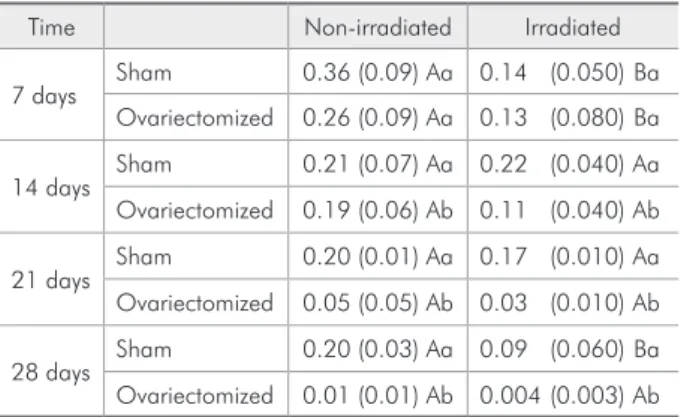
At 7 days, it was possible to observe that the con-trol group presented the highest value, which was followed by that of the ovariectomy (II) group, and no signiicant differences were observed between those groups at that time. The irradiated and
ovari-ectomized/irradiated (IV) groups showed the lowest values, but no statistical difference between them was found. However, comparing the control group with the irradiated group and the ovariectomized group with the ovariectomized/irradiated group, sta-tistical differences were observed (Table 2). After 14 days, the groups presenting the lowest values were the ovariectomized/irradiated and ovariectomized groups, followed by the sham (control) and irradi-ated groups. Statistical differences were found be-tween the sham (control) and ovariectomized groups and between the irradiated and ovariectomized/ir-radiated groups (Table 2). At 21 days, the control group continued presenting the highest volumetric density value, statistically different from that of the ovariectomized group. The ovariectomized/irradi-ated group showed the lowest value, and statistical differences were observed when comparing it with the irradiated and sham group (control) (Table 2). At 28 days of the repair process, the ovariectomized/ir-radiated group presented the lowest volumetric bone density, and such value was not statistically different from that of the ovariectomized group, but statisti-cally different in relation to that of the irradiated group. Additionally, the highest mean was observed in the sham (control) group (Table 2).
The relationship between birefringence and vol-umetric density is directly proportional. A greater value of birefringence means more collagen ibers
Table 1 - Means and standard deviations of the area (cm2) of birefringent bone organic matrix at 7, 14, 21 and 28 days of the repair process.
Time Non-irradiated Irradiated
7 days Sham 66.6 (16.20) Aa 39.5 (8.30) Ba Ovariectomized 65.4 (12.30) Aa 16.4 (6.60) Bb
14 days Sham 23.3 (10.00) Aa 20.5 (4.60) Ba Ovariectomized 17.9 (3.40) Ab 7.5 (2.01) Bb
21 days Sham 15.4 (11.30) Aa 15.9 (5.90) Aa Ovariectomized 9.5 (2.30) Ab 5.7 (2.60) Ab
28 days Sham 15.1 (4.00) Aa 10.7 (5.00) Aa Ovariectomized 1.4 (0.50) Ab 0.9 (0.40) Ab
*Means followed by different lower case letters in the same column and capital letters in the same line, for each time, differ statistically, with a significant p-value of 5%, by the Tukey test.
Table 2 - Means and standard deviations of the volumetric density (mm3/mm3) in the bone tissue at 7, 14, 21 and 28 days of the repair process.
Time Non-irradiated Irradiated
7 days Sham 0.36 (0.09) Aa 0.14 (0.050) Ba Ovariectomized 0.26 (0.09) Aa 0.13 (0.080) Ba
14 days Sham 0.21 (0.07) Aa 0.22 (0.040) Aa Ovariectomized 0.19 (0.06) Ab 0.11 (0.040) Ab
21 days Sham 0.20 (0.01) Aa 0.17 (0.010) Aa Ovariectomized 0.05 (0.05) Ab 0.03 (0.010) Ab
28 days Sham 0.20 (0.03) Aa 0.09 (0.060) Ba Ovariectomized 0.01 (0.01) Ab 0.004 (0.003) Ab
and consequently greater values of bone trabeculae, which is represented by values of volumetric densi-ty. Thus, in all periods of the study, the groups that presented the highest values of birefringence also showed the major values of volumetric density.
Discussion
The bone remodeling function is always in bal-ance and depends on systemic and local factors. Amongst systemic factors, estrogen is probably the most important hormone responsible for the main-tenance of normal bone turnover.18 Bone fracture
and some surgical procedures cause a modiication in tissue integrity; therefore, good healing is nec-essary in order for this tissue to exert its normal activities. In this study, it was possible to observe that some systemic and local factors, such as estro-gen deiciency and ionizing radiation, respectively, negatively inluenced the bone repair process, since the group that received these two variables, pre-sented the most damage. According to Meyer et al.15
(2001), the bone remodeling process can also suffer the inluence from systemic and local factors.
Women are more commonly affected by osteopo-rosis. Severe bone loss is related to the acute effect of estrogen deiciency and aging factors, both contrib-uting to increase bone fragility.7 Lill et al.13 (2002)
are consistent when afirming that there are few available studies on the differences between the bone repair process in healthy individuals and in those presenting osteoporosis as they apparently presented a diminished capacity of repairing and remodeling.
The loss of ovarian function in animals and hu-mans causes dramatic and accelerated bone loss.11
According to Peng et al.17 (1997), ovariectomy
in animals is associated with similar histological changes in rat bones as well as in human bones, and this model of study provides favorable information related to human bone loss.
Ionizing radiation is frequently used for the treatment of primary or metastatic bone malignan-cies. The real mechanism involved with its action in bones is still not fully understood; however, recent studies have demonstrated that radiation modiies the balance between osteoclastic and osteoblastic activity, favoring the destructive process.6,20
Nowa-days, it is not uncommon for people with osteoporo-sis to require diagnostic exams or therapeutic treat-ments using ionizing radiation. According to Gal et al.9 (2000), osteoblast proliferation is inhibited by
radiation since there is an attenuated growth rate in irradiated cells, and osteoblasts show diminished rates of collagen production. Thus, this study aimed at evaluating the bone repair process resulting from the association of two variables: ionizing radiation and estrogen deiciency.
Irradiation delivered three days after a surgery procedure was chosen according to Raveli et al.19
(1990), since the period immediately after surgery is one of the most critical among the repair process phases, and radiation may cause severe alterations in bone and in its capacity to react to trauma.
When bone integrity is breached, a cellular and biochemical sequence of events occurs, inducing inlammatory reactions. In mechanically steady ar-eas, such as that of the bone defects produced in the animals in this study, or in cavities of stable frac-tures, the wound is newly vascularized and osteo-blasts proliferate, thus forming bone. In this study, it was possible to observe that, in the control group, no modiied factors interfered with the bone heal-ing progress, as the defect was a mechanically steady area. In the ovariectomized group, the repair process development was less evident in relation to that in the control group. Volumetric density showed that the bone repair progress in the ovariectomized group was similar in relation to that of the control group at 7 days; therefore, there was no statistically signii-cant difference. This difference was signiisignii-cant at 14, 21 and 28 days, when there was a decline in volu-metric density. In relation to birefringence, it also presented a statistically signiicant difference at 14, 21 and 28 days, showing a decline in collagen ibers conforming to the progress of the repair process.
Tanaka et al.22 (2001) reported that acute
estro-gen deiciency stimulated the supporting bone, hav-ing less inluence on bone formation, which justiies a delay in the repair process. Chow et al.3 (1992)
estro-gen treatment interrupted the endosteal bone re-sorption. Other authors16,21 also reported trabecular
bone loss in animals submitted to a surgical ovariec-tomy procedure.
In the irradiated group, the repair process was incipient, especially in relation to that of the control group. Volumetric density was statistically differ-ent between the control and irradiated groups at 7 and 28 days. The irradiated/ovariectomized group presented fewer bone trabeculae when compared to the irradiated group, a difference which was statis-tically signiicant from the 14th day on. Comparing
with the control group, birefringence showed that the irradiated group presented less birefringence at 7 and 14 days, thus explaining the slighter tissue maturation level. However, in relation to the irradi-ated/ovariectomized group, the birefringence mean of the irradiated group was always greater, and statistically different at all evaluation times in this study. Thus, although the real mechanism of bone damage by ionizing radiation is still not clear, there is a corroboration that the balance between resorp-tion and bone formaresorp-tion is altered, and resorpresorp-tion events prevail. According to Hayashi, Suit10 (1971),
the delayed bone healing process could be related to a minor subgroup of cells that present low repair-ing capacity resultrepair-ing from radiation damage. The decrease of osteocytes and osteoblasts or the ab-sence of osteoblasts on the bone surface leads to a decline in collagen synthesis and alkaline phos-phatasis activity, consequently hindering the min-eralization process and increasing bone resorption, which could result in spontaneous fractures.2,6,20
Dare et al.5 (1997) stated that high radiation doses,
such as 4 Gy, could exert a different effect on cel-lular proliferation and osteoblast dedifferentiation, which explains the results obtained in this study,
since a radiation dose of 8 Gy was used. With the exception of the control group, trabeculae bone for-mation was delayed, and an interesting result was observed: bone resorption occurred before total tis-sue formation, especially in the ovariectomized and irradiated/ovariectomized groups. It is supposed that radiation affects the beginning of bone forma-tion and estrogen deiciency accelerates the bone re-sorption process. Besides, we believe that radiation promotes a more accelerated resorption process in the inal repair phase. Therefore, as the irradiated/ ovariectomized group received an association of the two factors, estrogen deiciency and ionizing radia-tion, there was slight bone trabeculae formation and less tissue maturation at the beginning of the repair process following the application of such two vari-ables, and, from 14 days on, there was accentuated resorption of the fewer and immature bone trabecu-lae present. Wang23 (2000) claimed that the
three-dimensional space orientation of the osteons in the normal repair process was not completely reestab-lished. This effect may be accentuated due to other factors, such as estrogen deiciency and radiation, thus altering the repair process or tissue organiza-tion, which could result in more accentuated bone resorption of the newly formed bone.
Conclusion
Based on the experimental conditions and on the results observed in this study, it is possible to con-clude that, in the irradiated/ovariectomized rats, the morphological and structural analyses of the newly formed bone indicated a delay in the repair process and the association between estrogen deiciency and radiation resulted in a decrease in the production of the newly formed bone, thus accelerating the resorp-tion process.
References
1. Almeida SM, Ferreira RI, Bóscolo FN. Influence of irradiation on collagen content during wound healing in diabetic rats. Pesqui Odontol Bras. 2002;16(4):293-8.
2. Arnold M, Stas P, Kummermehr J, Schultz-Hector S, Trott KR. Radiation-induced impairment of bone healing in the rat femur: effects of radiation dose, sequence and interval between
surgery and irradiation. Radiother Oncol. 1998;48(3):259-65.
4. Danielsen CC, Mosekilde L, Svenstrup B. Cortical bone mass, composition, and mechanical properties in female rats in rela-tion to age, long-term ovariectomy and estrogen substiturela-tion. Calcif Tissue Int. 1993;52(1):26-33.
5. Dare A, Hachisu R, Yamaguchi A, Yokose S, Yoshihi S, Okano T. Effects of ionizing radiation on proliferation and differen-tiation of osteoblast-like cells. J Dent Res. 1997;76(2):658-64.
6. Dudziak ME, Saadeh PB, Mehrara BJ, Steinbrech DS, Greenwald JA, Gittes GK et al. The effects of ionizing ra-diation on osteoblast-like cells in vitro. Plast Reconstr Surg. 2000;106(5):1049-61.
7. Eastell R. Management of osteoporosis due to ovarian failure. Med Pediatr Oncol. 2003;41(3):222-7.
8. Frost HM, Jee WSS. On the rat model of human osteopenias and osteoporoses. Bone Miner. 1992;18(3):227-36.
9. Gal TJ, Munoz-Antonia T, Muro-Cacho CA, Klotch DW. Radiation effects on osteoblasts in vitro. Arch Otolaryngol Head Neck Surg. 2000;126(9):1124-8.
10. Hayashi S, Suit HD. Effect of fractionation of radiation dose on callus formation at site of fracture. Radiology. 1971;101(1):181-6.
11. Jilka RL, Hangoc G, Girasole G, Passeri G, Willians DC, Abrams JS. Increased osteoclast development after estrogen loss: mediation by interleukin-6. Science. 1992;257(3):88-91.
12. Lane NE, Thompson JM, Haupt D, Kimmel DB, Modin G, Kinney JH. Acute changes in trabecular bone connectivity and osteoclast activity in the ovariectomized rat in vivo. J Bone Miner Res. 1998;13(2):229-36.
13. Lill CA, Fluegel AK, Schneider E. Effect of ovariectomy, mal-nutrition and glucocorticoid application on bone properties in sheep: A pilot study. Osteoporos Int. 2002;13(6):480-6.
14. Marcondes FK, Bianchi FJ, Tanno AP. Determination of the estrous cycle phases of rats: Some helpful considerations. Braz J Biol. 2002;62(4):609-14.
15. Meyer RA Jr, Tsahakis PJ, Martin DF, Banks DM, Har-row ME, Kiebzak GM. Age and ovariectomy impair both the normalization of mechanical properties and the accre-tion of mineral by the fracture callus in rats. J Orthop Res. 2001;19(3):428-35.
16. Miller SC, Wronski TJ. Long-term osteopenic changes in cancellous bone structure in ovariectomized rats. Anat Rec. 1993;236(3):433-41.
17. Peng ZQ, Väänänen HK, Zhang HX. Long-term effects of ovariectomy on the mechanical properties and chemical com-position of rat bone. Bone. 1997;20(3):207-12.
18. Raisz LG. Physiology and pathophysiology of bone remodel-ing. Clin Chem. 1999;45(8):1353-8.
19. Raveli D, Ferreira B, Cordeiro R, Okamoto T, Gabrielli M. Influência da radiação X na cronologia do processo de reparo em feridas de extração dental. Estudo histomorfológico em ratos. Rev Odontol Univ São Paulo. 1990;4:119-25.
20. Szymczyk KH, Shapiro IM, Adams CS. Ionizing radiation sensitizes bone cells to apoptosis. Bone. 2004;34(1):148-56. 21. Tanaka M, Toyooka E, Kohno S, Ozawa H, Ejiri S.
Long-term changes in trabecular structure of aged rat alveolar bone after ovariectomy. Oral Surg Oral Med Oral Pathol. 2003;95(4):495-502.
22. Tanaka S, Shimizu M, Debari K, Furuya R, Kawawa T, Sasaki T. Acute effects of ovariectomy on wound healing of alveolar bone after maxillary molar extraction in aged rats. Anat Rec. 2001;262(2):203-12.