Flexural strength and modulus of
elasticity of different types of resin-based
composites
Resistência à flexão e módulo de elasticidade
de diferentes tipos de resina composta
Abstract: The aim of the study was to test whether the iller composition of resin com-posites inluences their lexural strength and modulus of elasticity. Flexural strength and modulus of elasticity were obtained through a three-point bending test. Twelve bar shaped specimens of 5 commercially available composites – Supreme (3M/ESPE), a universal nanoilled composite; Esthet-X (Dentsply), Z-250 (3M/ESPE), Charisma (Heraeus Kulzer), universal hybrid composites; and Helio Fill (Vigodent), a microine composite – were con-fectioned according to the ISO 4049/2000 speciications. The test was performed after a 7-days storage time using a universal test machine with a crosshead speed of 1 mm/min. The iller weight content was determined by the ashing technique. The data obtained on the mechanical properties were submitted to ANOVA and Tukey test (p < 0.05). Pearson’s cor-relation test was used to determine the corcor-relation between the iller content and the me-chanical properties. A weak but signiicant correlation between the meme-chanical properties evaluated and the iller weight content was observed (p < 0.000). The microine composite presented the lowest iller weight and the lowest mechanical properties. Statistically differ-ent lexural strength and modulus of elasticity results were observed among the universal hybrid composites. The nanoilled composite presented intermediary results. Within the limitations of this in vitro study, it could be concluded that the iller content signiicantly interfered in the lexural strength and modulus of elasticity of the composites tested. Descriptors: Composite resins; Physical and chemical properties; Inorganic particles.
Resumo: O objetivo do presente estudo foi avaliar se o conteúdo inorgânico exerce in-luência na resistência à lexão e no módulo de elasticidade de compósitos restauradores. Para determinar a resistência à lexão e o módulo de elasticidade foi realizado o teste de resistência à lexão por três pontos. Doze espécimes em formato de barra de cinco compó-sitos disponíveis comercialmente – Supreme (3M/ESPE), compósito universal nanoparti-culado; Esthet-X (Dentsply), Z-250 (3M/ESPE), Charisma (Heraeus Kulzer), compósitos universais híbridos; e Helio Fill (Vigodent), compósito microparticulado – foram confec-cionados conforme as especiicações da ISO 4049/2000. Após 7 dias de armazenagem em água o teste foi realizado em uma máquina de ensaio universal com velocidade de carga de 1 mm/min. A avaliação do peso do conteúdo inorgânico foi determinada através da in-cineração da fase orgânica. Os dados obtidos referentes às propriedades mecânicas foram então submetidos à Análise de Variância e ao teste Tukey (p < 0,05). Para se determinar a correlação entre o conteúdo inorgânico e as propriedades mecânicas foi realizado o teste de correlação de Pearson. Uma fraca, porém signiicante correlação entre as propriedades mecânicas avaliadas e o peso do conteúdo inorgânico foi observada (p < 0,000). O com-pósito microparticulado apresentou menor conteúdo inorgânico e propriedades mecânicas mais baixas. Também foram observados valores de resistência à lexão e módulo de elas-ticidade estatisticamente diferentes entre os compósitos híbridos. O compósito nanopar-ticulado apresentou valores intermediários. Dentro das limitações deste estudo in vitro, pode-se concluir que o conteúdo inorgânico interfere signiicantemente na resistência à lexão e no módulo de elasticidade dos compósitos testados.
Descritores: Resinas compostas; Propriedades físicas e químicas; Partículas inorgânicas. Sinval Adalberto Rodrigues Junior(a)
Cesar Henrique Zanchi(b) Rodrigo Varella de Carvalho(a) Flávio Fernando Demarco(c)
(a)PhD Students; (b)MSc Student; (c)PhD, Professor – Department of Restorative Dentistry, School of Dentistry, Federal University of Pelotas.
Corresponding author:
Flávio Fernando Demarco Faculdade de Odontologia - UFPel Rua Gonçalves Chaves, 457 Pelotas - RS - Brazil CEP: 96015-560
E-mail: [email protected]
Introduction
Since the introduction of dental resin-based com-posites as posterior restorative materials, their clini-cal behavior has been dictated by their mechaniclini-cal properties. During the ‘70s and ‘80s the main reasons of failure of composite restorations were insuficient wear resistance, loss of anatomic form and proximal contacts, and degradation of the restoration.10 The
improvement in iller technology resulted in more re-sistant composites and changed the reasons of failure and restoration replacement.12 As the composites
im-proved their wear resistance through the incorpora-tion of iller, they also became more brittle materials, increasing the prevalence of bulk fractures.
Resin-based composites mechanical properties are mainly dependent upon their microstructure and composition. The microstructural characteristics in-volve the distribution of iller particles in the bulk, the morphology of these iller particles and the pres-ence of pre-existing cracks and voids. These char-acteristics are directly related to the composition of the composite.
Asmussen, Peutzfeldt2 (1998) observed that the
variation of the BisGMA/TEGDMA/UEDMA ratio affected signiicantly the mechanical properties of the composite, suggesting that speciic combinations should be developed according to the speciic ap-plications of the material. The long-term durability, evaluated by means of water sorption and solubility of the composites, has also been shown as depending on their organic content.17 However, the inorganic
iller content is to be considered the most valuable factor concerning the improvement of the mechani-cal properties of resin-based composites3 and, thus,
it has been largely studied.
Kim et al.9 (2002) observed a signiicant
inlu-ence of the iller rate and morphology on the lex-ural strength and modulus, microhardness and frac-ture toughness of the composites evaluated. Also, Yap, Teoh18 (2003), comparing different categories
of composites, observed that the microine compos-ite, with the lowest iller content (40% in volume), presented the lowest lexural properties (strength and modulus).
Other factors besides the iller content, such as degree of conversion and type of monomer, could
also inluence the mechanical behavior of compos-ites.1,6 In fact, the morphological aspect of the iller
determines its percentage, the silane content and the microstructural characteristics of the composite.15
The incorporation of nanometric sized iller par-ticles in hybrid composites and even the introduction of exclusively nanoilled composites have been con-sidered the most recent advances in iller technology. Characteristically, these iller particles, due to their considerably small size and rounded shape, expose a high surface area and require, as a consequence, a higher amount of silane. Musanje, Ferracane13 (2004)
found that the incorporation of silanized nanoiller particles signiicantly increased abrasion and attrition wear resistance of an experimental hybrid composite.
Flexural strength is a meaningful mechanical property for brittle materials, although the results cannot be extrapolated to the clinical behavior without considering some aspects, namely law dis-tribution11 and structural reliability of the material.5
Nonetheless, the in vitro three-point bending lexur-al test is recommended by the ISO 4049/20008
spec-iication for polymer-based materials and is widely used for comparative purposes.4,14
Another important mechanical parameter pro-vided by the lexural test is the modulus of elasticity, which describes the rigidity of the material. Differ-ent clinical situations demand resin-based restorative materials with different moduli of elasticity. Class V (cervical) cavities, for example, demand a low modu-lus restorative material to lex with the tooth. A rela-tively high modulus, on the other hand, is expected from posterior composites to withstand the occlusal forces and preserve the adhesive interface.
Several authors have reported a signiicant cor-relation between the modulus of elasticity and the percentage of iller by volume (vol%)3,7 or by weight
(wt%).16 Sabbagh et al.16 (2002), evaluating the
The purpose of the present study was to assess the iller composition effect in different commer-cially available resin-based composites, concerning lexural strength and modulus of elasticity.
Material and Methods
Filler weight
To determine the iller weight content, the weight (W0) of an increment of each composite resin was measured in an analytical balance (AG200, Gehaka, São Paulo, SP, Brazil). The increments were heated at 900oC for 30 minutes in an electric furnace to
elimi-nate the organic matrix including all the carbon remnants. After that, they were re-weighed (W1). The weight of the iller fraction was determined us-ing the followus-ing formula:
Wt% = (W1/W0× 100%)
Flexural strength and elasticity modulus
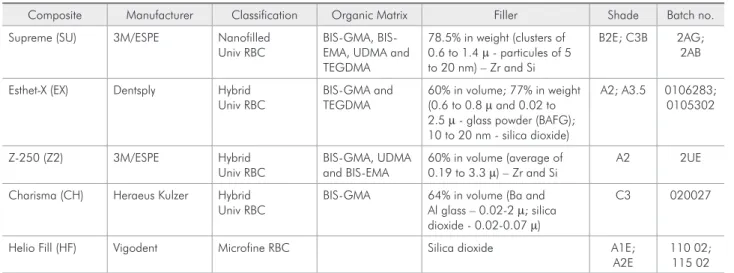
Twelve bar shaped specimens were made of each composite (Table 1), using a metallic mold with the dimensions speciied by the ISO 4049/2000 specii-cation (25 mm x 2 mm x 2 mm).
The mold was positioned over a glass slide and a mylar strip and illed with the composite, which was inserted in a single increment. Another mylar strip was positioned and pressed against it with a glass slide for excess removal before polymerization. A
light-curing unit with 450 mW/cm² (Ultralux, Dabi Atlante, Ribeirão Preto, SP, Brazil) and a 10 mm light guide were used. Its light intensity was meas-ured with a radiometer Model 100 (Demetron Re-search Corp., Danbury, CT, USA) before use. The composite was cured for 40 seconds in three con-secutive points, producing a partial overlapping. The excess of material in the corner was carefully re-moved with a scalpel blade and the specimens were stored in distilled water at room temperature for 7 days. Afterwards, they were submitted to a three-point bend test with a universal testing machine (4411, Instron, Barueri, SP, Brazil) with a crosshead speed of 1 mm/min. The maximum loads were ob-tained and the lexural strength (σ) was calculated in megaPascals (MPa) by using the following formula:
σ = 3FL/(2BH2)
where F is the maximum load (in newtons); L is the distance between the supports (in millimeters); B is the width of the specimen (in millimeters) and H, the height (also in millimeters).
The modulus of elasticity (GPa) was determined as:
E = FL3/4BH3d
where F is the maximum load; L is the distance between the supports; B is the width of the
speci-Table 1 - Information about the composites employed according to the manufacturers.
Composite Manufacturer Classification Organic Matrix Filler Shade Batch no.
Supreme (SU) 3M/ESPE Nanofilled
Univ RBC
GMA, BIS-EMA, UDMA and TEGDMA
78.5% in weight (clusters of 0.6 to 1.4 µ - particules of 5 to 20 nm) – Zr and Si
B2E; C3B 2AG; 2AB
Esthet-X (EX) Dentsply Hybrid
Univ RBC
BIS-GMA and TEGDMA
60% in volume; 77% in weight (0.6 to 0.8 µ and 0.02 to 2.5 µ - glass powder (BAFG); 10 to 20 nm - silica dioxide)
A2; A3.5 0106283; 0105302
Z-250 (Z2) 3M/ESPE Hybrid
Univ RBC
BIS-GMA, UDMA and BIS-EMA
60% in volume (average of 0.19 to 3.3 µ) – Zr and Si
A2 2UE
Charisma (CH) Heraeus Kulzer Hybrid Univ RBC
BIS-GMA 64% in volume (Ba and Al glass – 0.02-2 µ; silica dioxide - 0.02-0.07 µ)
C3 020027
Helio Fill (HF) Vigodent Microfine RBC Silica dioxide A1E;
A2E
110 02; 115 02
men, H is the height of the specimen, and d is the de-lexion (in millimeters) corresponding to the load F.
The fractured specimens were analyzed with a ste-reoscopic lupe (40 X) to observe the fracture pattern.
Statistical analysis
The data obtained from the tests were submitted to ANOVA and Tukey test (p < 0.05). Pearson’s cor-relation test was used to establish if there was any correlation between the iller wt% data and the me-chanical properties.
Results
The statistical analysis pointed out signiicant differences between composites both for the lexural strength and the modulus of elasticity (Table 2).
The highest lexural strength was obtained with Z2 and it was followed by EX. SU and CH had simi-lar behaviors and presented higher lexural strengths than the microine composite HF.
The modulus of elasticity of EX was similar to that of Z2 and signiicantly higher than that of the
other composites. Similar moduli were observed be-tween Z2 and SU and bebe-tween CH and HF.
A signiicant positive correlation (p < 0.000) was found between the iller weight and the mechanical properties lexural strength (r = 0.591) (Graph 1A) and modulus of elasticity (r = 0.423) (Graph 1B).
All the fractures initiated in the traction surface of the specimens, between the inner support points. All the fractured specimens generated two pieces, except for one EX specimen, that generated three.
Discussion
The three-point bending test is based on the In-ternational Organization for Standardization (ISO) speciication n. 4049/20008 for polymer-based
restoratives and is widely employed in dental re-search.4,14,18 The lexural bending test, classiied
as opening mode test or Mode I, is usually recom-mended because the specimen fabrication and the load application are quite simple.11 Although some
studies have suggested alternative lexural test de-signs,4,18 the three-point bending test is still the
Table 2 - Flexural strength, elasticity modulus and weight of filler content for each composite.
Composite Flexural Strength (MPa) Elasticity modulus (GPa) Filler in weight (%)
SU 119.43 (± 18.68) C 5.76 (± 1.49) B 84
EX 145.67 (± 13.96) B 6.93 (± 0.69) A 80
Z2 168.87 (± 15.36) A 6.40 (± 0.96) AB 79
CH 127.39 (± 11.77) C 5.28 (± 0.73) C 74
HF 86.32 (± 8.82) D 4.95 (± 0.70) C 64
Tukey value (5%) 16.34 1.11
Standard deviation is represented in parentheses; Different letters represent significantly different values.
Graph 1 - Association between filler weight and flexural strength (A); Association between filler weight and modulus of elasticity (B).
R2 = 0.3497
60 65 70 75 80 85 90
Flexural Strength (MPa)
60 80 100 120 140 160 180 200
Fille
r
we
ight
%
R2 = 0.1787
60 65 70 75 80 85 90
2 3 4 5 6 7 8 9 10
Modulus of Elasticity (GPa)
Fille
r
we
ight
%
choice for evaluating composites lexural strength due to the lower standard deviation, the lower coef-icient of variation and the less complex crack dis-tribution produced by it when compared to those produced by other test designs, such as the biaxial lexural test.4
Fracture is one of the major reasons for clini-cal failure of dental composite restorations.12 The
fracture of brittle materials, such as composites, oc-curs through the propagation of pre-existing cracks under tensile stress. These cracks may be produced by bubble incorporation during insertion of the ma-terial, polishing or may appear due to microstruc-tural imperfections.5 According to Loughran et al.11
(2005), crack initiation is strongly affected by the microstructural characteristics of the material that may cause stress concentrations, surface scratches, microcracks etc.
The present study associated both the mechanical properties analyzed with the iller content percent-age in weight (wt%). Although studies usually asso-ciate the mechanical behavior of composites to their iller vol%,3,7 this parameter is more complex to
ob-tain, since it involves the previous determination of the iller density, taking into account the variation of the iller morphology and the molecular composi-tion. Furthermore, Ferracane et al.6 (1985) found a
strong correlation between the iller wt% and vol%, having chosen only one of them to correlate with the mechanical properties of the composites studied.
The iller wt% obtained by the ashing technique for some of the composites evaluated (SU and EX) differed from that reported by the manufacturers’ speciications, according to previous studies.9,15 Not
all the manufacturers provided the information about the iller wt% fraction of their composites.
The comparison between the composites from the same category (hybrid universal resin-based composites) showed a statistically signiicant dif-ference in lexural strength and modulus of elastic-ity, even with a low variation of iller wt%. Also, a correlation between the highest iller wt% and the highest mechanical properties evaluated was not ob-served, indicating that other factors than the iller wt% are involved in the mechanical behavior of the composites studied.1
The morphological characteristics of the illers must also be considered, since they have been shown to be determining factors in both the iller loading1,3,9,15
and the material strength.1,9 Smooth spherical shaped
iller particles are related to an increased volume frac-tion of the iller due to the improved packing of the particles and also to higher fracture strength. This could explain the high lexural strength and modu-lus obtained with Z2, which is constituted by small round shaped particles.15 Furthermore, rounded
par-ticles tend to distribute more uniformly the mechani-cal stress than irregular shaped particles that present sharp angles, already known as stress concentration areas from where the cracks may start.15 A
morpho-logical characterization of the iller content of CH and EX showed particles of varying size and shape and greater spaces between particles when compared to that of Z2.15 EX is also constituted by silanized
nanometric iller particles, which have been pointed as capable of increasing the lexural strength and the microhardness of composites.13
As expected, the microine composite present-ed the lowest iller wt% and the lowest mechani-cal properties. Kim et al.9 (2002), who established
a classiication for composites based on the iller morphological characteristics, observed that the presence of pre-polymerized iller particles was as-sociated to low iller content and to low mechanical properties. Microine composite resins (indicated for anterior restorations), such as HF, usually present in their composition these pre-polymerized particles. Indeed, these composites have a silica iller loading (0.04 µm average size) embedded in an organic ma-trix, resulting in 10-50 µm sized blocks of iller.15
The size and the shape of the particles may justify the low iller loading in this composite category.
The nanoilled composite presented intermediate lexural strength and modulus of elasticity results. This composite is constituted exclusively by silanized nanometric sized silica particles (20 nm) and clus-ters of Si/Zr. Small iller particles expose a higher surface area to be coated by silane, making the si-lanization process more critical15 and increasing the
similar values of modulus of elasticity, which may have been inluenced by the organic matrix content. The presence of TEGDMA in the composite matrix composition has been associated to a signiicant de-crease in the lexural strength of the material, while, paradoxically, it has also been associated to an in-crease in the modulus of elasticity.2 The
characteris-tic lexibility of TEGDMA allows the creation of a dense and lexible polymer network17 that increases
the composite elastic deformation. However, in the present study, composites presenting TEGDMA in their composition also showed signiicantly different
lexural strength and modulus of elasticity values indicating that, as already stated, the mechanical properties result from a complex combination of mi-crostructural and compositional factors that vary in the manufacturing process and that cannot be con-sidered in an isolated way.1,2
Conclusions
Within the limitations of this in vitro study, it could be concluded that the iller content signii-cantly interfered in the lexural strength and modu-lus of elasticity of the composites.
References
1. Adabo GL, Cruz CAS, Fonseca RG, Vaz LG. The volumetric fraction of inorganic particles and the flexural strength of composites for posterior teeth. J Dent. 2003;31(5):353-9. 2. Asmussen E, Peutzfeldt A. Influence of UEDMA, BisGMA and
TEGDMA on selected mechanical properties of experimental resin composites. Dent Mater. 1998;14(1):51-6.
3. Braem M, Lambrechts P, Van Doren V, Vanherle G. The im-pact of composite structure on its elastic response. J Dent Res. 1986;65(5):648-53.
4. Chung SM, Yap AUJ, Chandra SP, Lim CT. Flexural strength of dental composite restoratives: comparison of biaxial and three-point bending test. J Biomed Mater Res B Appl Bioma-ter. 2004;71(2):278-83.
5. Della Bona A, Anusavice KJ, DeHoff PH. Weibull analysis and flexural strength of hot-pressed core and veneered ceramic structures. Dent Mater. 2003;19(7):662-9.
6. Ferracane JL, Matsumoto H, Okabe T. Time-dependent defor-mation of composite resins – Compositional considerations. J Dent Res. 1985;64(11):1332-6.
7. Ikejima I, Nomoto R, McCabe JF. Shear punch strength and flexural strength of model composites with varying filler volume fraction, particle size and silanation. Dent Mater. 2003;19(3):206-11.
8. International Organization for Standardization. ISO 4049/2000 – Dentistry – Polymer-based filling, restorative and luting materials. Switzerland: ISO; 2000.
9. Kim KH, Ong JL, Okuno O. The effect of filler loading and morphology on the mechanical properties of contemporary composites. J Prosthet Dent. 2002;87(6):642-9.
10. Leinfelder KF, Sluder TB, Santos JFF, Wall JT. Five-year clinical evaluation of anterior and posterior restorations of composite resins. Oper Dent. 1980;5:57-65.
11. Loughran GM, Versluis A, Douglas WH. Evaluation of sub-critical fatigue crack propagation in a restorative composite. Dent Mater. 2005;21(3):252-61.
12. Manhart J, Chen HY, Hamm G, Hickel R. Review of the clinical survival of direct and indirect restorations in posterior teeth of the permanent dentition. Oper Dent. 2004;29(5):481-508.
13. Musanje L, Ferracane JL. Effects of resin formulation and nanofiller surface treatment on the properties of experimental hybrid resin composite. Biomater. 2004;25(18):4065-71. 14. Palin WM, Fleming GJ, Marquis PM. The reliability of
stan-dardized flexure strength testing procedures for a light-acti-vated resin-based composite. Dent Mater. 2005;21(10):911-9.
15. Sabbagh J, Ryelandt L, Bachérius L, Biebuyck JJ, Vreven J, Lambrechts P, et al. Characterization of the inorganic fraction of resin composites. J Oral Rehabil. 2004;31(11):1090-101. 16. Sabbagh J, Vreven J, Leloup G. Dynamic and static moduli of
elasticity of resin-based materials. Dent Mater. 2002;18(1):64-71.
17. Sideridou I, Tserki V, Papanastasiou G. Study of water sorp-tion, solubility and modulus of elasticity of light-cured di-methacrylate-based dental resins. Biomater. 2003;24(4):655-65.