Oral hygiene frequency and presence of
visible biofilm in the primary dentition
Freqüência de higiene bucal e presença de
biofilme visível na dentição decídua
Abstract: The purpose of this study was to associate oral hygiene frequency and presence of visible bioilm in the primary dentition. The sample consisted of 90 children, aged up to 4 years old, outpatients of the University Hospital of the Rio de Janeiro State University. The examinations were carried out in a dental ofice by a single trained examiner who was aided by an assistant. The parents answered a structured questionnaire about oral hygiene methods and frequency. Two bioilm indices, one simpliied (BF1) and the other conventional (BF2), were used. BF1 classiies bioilm as absent, thin or thick, in anterior and/or posterior teeth, and provides a score for the patient, whereas BF2 classiies bioilm as absent or present, provides scores for three surfaces of each tooth and the inal score is the percentage of tooth surfaces with bioilm. More than half of the parents (51 - 56.7%) reported they cleaned their child’s teeth at least twice a day, while 7 (7.8%) had never cleaned their child’s teeth. BF1 revealed that 12.2% (11) of the children had no visible bioilm, 37.8% (34) had thin bioilm in anterior and/or posterior teeth, 27.8% (25) had thick bioilm in anterior or posterior teeth and 22.2% (20) had thick bioilm in both ante-rior and posteante-rior teeth. BF2 revealed a mean value of 21.8% (s.d. 16.5). No statistically signiicant correlations were found between oral hygiene frequency and the two bioilm indices (p > 0.05), indicating that oral hygiene frequency was not associated to oral hy-giene quality in the evaluated sample.
Descriptors: Oral hygiene; Dental plaque index; Dentition, primary.
Resumo: O objetivo deste estudo foi associar freqüência de higiene bucal e presença de bioilme visível na dentição decídua. A amostra constou de 90 crianças com idade até 4 anos, cadastradas no Hospital Universitário da Universidade do Estado do Rio de Janeiro. Os exames foram realizados em consultório odontológico por um único examinador trei-nado, auxiliado por um anotador. Os pais responderam a um questionário estruturado sobre métodos e freqüência de higiene bucal. Foram utilizados dois índices de bioilme: um simpliicado (BF1) e um convencional (BF2). O BF1 classiica o bioilme como au-sente, ino ou espesso, em dentes anteriores e/ou posteriores, gerando um escore para o paciente, enquanto o BF2 classiica o bioilme como ausente ou presente, fornece escores a três superfícies de cada dente e o escore inal corresponde ao percentual de superfícies com bioilme. Mais da metade dos pais (51 - 56,7%) relataram limpar os dentes dos ilhos pelo menos duas vezes ao dia ao passo que 7 (7,8%) nunca tinham limpado os dentes dos ilhos. O BF1 demonstrou que 12,2% (11) das crianças não apresentavam bioilme visível, 37,8% (34) apresentavam bioilme ino em dentes anteriores e/ou posteriores, 27,8% (25), bioilme espesso em dentes anteriores ou posteriores, e 22,2% (20), bioilme espesso em dentes anteriores e posteriores. O BF2 revelou uma média de 21,8% (d.p. 16,5). Não fo-ram encontradas correlações estatisticamente signiicativas entre a freqüência de higiene bucal e os índices de bioilme (p > 0,05), demonstrando que a freqüência de higiene bucal não esteve associada à qualidade da mesma na amostra estudada.
Descritores: Higiene bucal; Índice de placa dentária; Dentição decídua. Ana Paula Pires dos Santos(a)
Mariana Canano Séllos(b)
Maria Eliza Barbosa Ramos(c)
Vera Mendes Soviero(d)
(a)Master’s degree in Pediatric Dentistry;
(b)DDS; (c)Professor, Department of
Diagnosis and Surgery; (d)Professor, Department of Community and Preventive Dentistry – School of Dentistry, Rio de Janeiro State University.
Corresponding author:
Ana Paula Pires dos Santos Av. Roberto Silveira, 187/201 Centro - Petrópolis - RJ - Brazil CEP: 25685-040
E-mail: [email protected]
Introduction
Several studies have assessed the prevalence of early childhood caries (ECC) throughout the world. Milnes13 (1996), in a comprehensive review, observed a
prevalence rate from 1 to 12% in developed countries and prevalence as high as 70% in developing countries or within disadvantaged populations. In Brazil, a na-tional survey with 12,117 children aged 18-36 months old demonstrated that 26.9% of them had at least one cavitated caries lesion.4 Brazilian studies that have also
registered noncavitated lesions showed prevalence be-tween 35.9 and 55.3%.3,11,20 Surveys including
Afro-American and Hispanic immigrants in the USA also considering noncavitated lesions have found a preva-lence of ECC of 20% and 59%, respectively.15,16
ECC should be considered a multifactorial disease whose etiology involves biological,22 psychosocial
and behavioral factors.17 Individuals from lower
so-cioeconomic strata ind it hard to obtain professional health care and to live in a healthy environment, re-sulting in the development of negative behaviors to-wards their oral health.17 Thus, social class can be
re-garded as a controversial factor in the analysis of oral hygiene habits, such as toothbrushing.21 Studies that
evaluated oral health behaviors in infants and pre-school children have found that 36 to 92% of them had their teeth cleaned at least once a day.6,9,12,19,20,25
Provided cleaning is suficiently thorough and per-formed daily, toothbrushing is considered to be the most reliable means of controlling bioilm.10
Clinical trials have already demonstrated that bioilm accumulation without mechanical distur-bance leads to the development of white spot le-sions.24 Daily toothbrushing associated to luoride
dentifrice has been considered the main reason for the decrease of caries prevalence since the 70’s. In spite of that, the studies fail to show, at the popula-tion level, a clear associapopula-tion between oral hygiene and caries, probably due to the poor quality of bio-ilm removal performed by the patients.14 The
asso-ciation between oral hygiene habits and ECC is also controversial as some studies have found associa-tion between these variables,7,19,23 while others have
not.6,12,25 However, when there is a high quality of
bioilm removal, toothbrushing can be considered eficient to control caries.14
Concerning the quality of oral hygiene in children with primary dentition, it has already been evaluat-ed by means of different bioilm indices.2,3,9,11,20 On
the other hand, the association between frequency and quality of oral hygiene in young children has not been highlighted in the literature.
The aim of this study was to associate oral hy-giene frequency with the presence of visible bioilm in infants and preschool children using a simpliied visible bioilm index as well as a conventional one.
Material and Methods
Subjects and study design
The sample of this cross-sectional study consisted of 90 selected healthy patients, of both sexes, aged up to 4 years old and outpatients of the Pediatric Am-bulatory of the University Hospital, Rio de Janeiro State University. It was a convenience sample and, to be included in the study, children should present, at least, the eight primary incisors erupted. The exami-nations were not previously scheduled. Parents were invited to participate while they were waiting for an ordinary appointment with the pediatrician.
Ethical aspects
Participation in the study was voluntary and written consent forms were obtained from parents. The study was approved by the Ethical Committee of the Biomedical Center, Rio de Janeiro State Uni-versity (967-CEP/HUPE).
Parental interview
Parents were questioned about oral hygiene prac-tices including: 1) how often did they clean their child’s teeth; 2) which product was used to clean their child’s teeth, meaning that they should point out if they used toothbrush with or without luoride dentifrice, gauze, cotton or other. Parents were not asked about any speciic technique or method of toothbrushing. All of them received information on caries prevention.
Biofilm evaluation
chair or in the parent’s lap. Mouth mirrors, explor-atory probes and gauze were used. A simpliied and a conventional bioilm index, both already employed in previous studies, were used. The presence of bio-ilm was evaluated without a disclosing solution. The simpliied index,18 called in this study BF1, gives a
score to the patient according to the amount of vis-ible bioilm accumulated (absent, thin or thick) in anterior and/or posterior teeth, whereas the conven-tional index,1 called in this study BF2, evaluates the
presence of visible bioilm in the mesial, buccal and lingual surfaces of all teeth. The BF118 was chosen
to be used in this study because it is simple and easy to apply, which is an advantage when dealing with young children. However, as it was not used in such young children before, it was decided that a conven-tional index be used as well. The index proposed by Ainamo, Bay1 (1975) (BF2) was selected as previous
studies in the primary dentition have already as-sessed bioilm based on its criteria.2,26
The index proposed by Ribeiro et al.18 (2002)
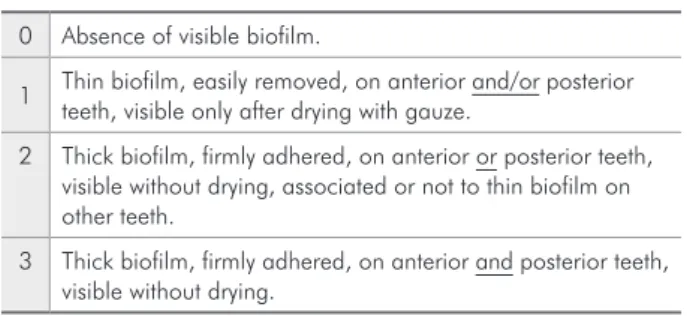
(BF1) was modiied by uniting some scores. Origi-nally, the patient could be assigned a score ranging from 0 to 5. In the modiied index, the scale ranges from 0 to 3, according to Chart 1.
Patients were assigned score 0 when no visible bio-ilm was present, even after the teeth were dried with gauze. Score 1 was given when there was thin bioilm in anterior and/or posterior teeth (visible bioilm that could be seen only after careful drying with gauze). When only one region, anterior or posterior, present-ed thick bioilm, the patient was assignpresent-ed score 2. Fi-nally, when there was thick bioilm in both anterior and posterior teeth (visible bioilm that could be seen without drying), the patient was assigned score 3.
Concerning the index proposed by Ainamo, Bay1
(1975) (BF2), the scores 0, for absent bioilm, and 1, for present bioilm, were recorded for mesial, buccal and lingual surfaces of each tooth in a speciic form. The percentage of tooth surfaces with visible bioilm was calculated.
Statistical analysis
The data were processed by means of the SPSS software, release 8.0 for Windows (SPSS Inc., Chi-cago, IL, USA) for descriptive analyses of oral hy-giene frequency, oral hyhy-giene method and bioilm indices. Spearman’s correlation test was used to determine the association between oral hygiene fre-quency and the bioilm indices. The level of statisti-cal signiicance was set at 5%.
Results
More than half of the parents (51 - 56.7%) re-ported they cleaned their child’s teeth at least twice a day. Twenty-one (23.3%) used to clean their child’s teeth once a day, 11 (12.2%), occasionally, and 7 (7.8%) reported that their child’s teeth had never been cleaned (Table 1).
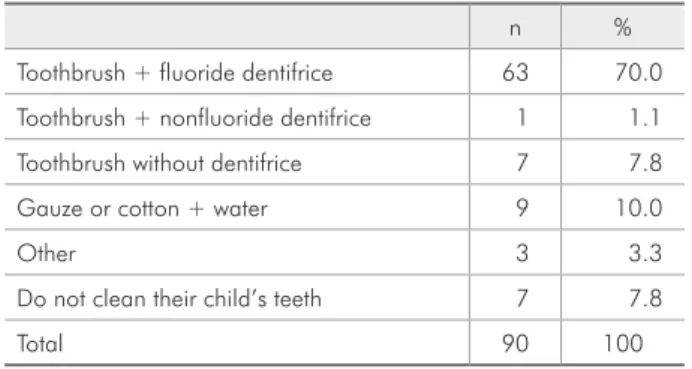
The use of toothbrush associated to luoride den-tifrice was the most common way of cleaning the child’s teeth, which was reported by 70% (63) of the parents (Table 2).
According to BF1, 12.2% (11) of the children had no visible bioilm, 37.8% (34) had thin bio-ilm in anterior and/or posterior teeth, 27.8% (25) had thick bioilm in anterior or posterior teeth and 22.2% (20) had thick bioilm in both anterior and posterior teeth (Table 3).
Table 4 shows that the percentage of BF2 ranged from 0 to 83.3%, with a mean of 21.8% (s.d. 16.5).
No signiicant correlations (p > 0.05) could be found between oral hygiene frequency and pres-ence of visible bioilm expressed by both indices (Table 5).
Among the 51 (56.7%) children who had their teeth cleaned at least twice a day, 27 (52.9%) had scores 0 or 1, and 24 (47.1%) had scores 2 or 3 for BF1. Regarding BF2, despite the decrease from 30.9% among those whose teeth were never cleaned to 19.8% among those whose teeth were cleaned
Chart 1 - Visible dental biofilm index* (BF1).
0 Absence of visible biofilm.
1 Thin biofilm, easily removed, on anterior and/or posterior teeth, visible only after drying with gauze.
2 Thick biofilm, firmly adhered, on anterior or posterior teeth, visible without drying, associated or not to thin biofilm on other teeth.
3 Thick biofilm, firmly adhered, on anterior and posterior teeth, visible without drying.
twice a day or more, this difference was not statisti-cally signiicant.
Discussion
The presence of caries in infants and preschool children has been carefully studied and several risk factors have already been evaluated in order to deter-mine their association with caries occurrence. When it comes to oral hygiene, most of the studies ana-lyze it by means of interviews or questionnaires that ask parents about oral hygiene habits, such as the
method and frequency of tooth cleaning.5-7,12,19,23,25
Some of these studies concluded that there was ei-ther no association or a weak association between oral hygiene and caries.5,6,12,25 However, Wendt et al.26 (1994) observed that if the habit of daily
tooth-brushing is adopted at as early as one year old, it is more likely that children will be caries free by the age of three.
The role of dental bioilm accumulation in car-ies initiation, progression and control is well estab-lished,24 which demonstrates that the sole
evalua-tion of oral hygiene habits may be of limited value. Moreover, the report of toothbrushing habits is sub-ject to response bias17 and gives no indication of the
effectiveness of bioilm removal.21
In the present study, 11 (12.2%) parents reported
Table 5 - Correlation between oral hygiene frequency and the visible biofilm indices using Spearman’s correlation test (n = 90).
Oral hygiene frequency
BF1 BF2
0 1 2 3
n Mean
% s.d.
n % n % n % n %
Never 0 0 3 42.9 3 42.9 1 14.2 7 30.9 18.5
Occasionally 1 9.1 5 45.4 2 18.2 3 27.3 11 25.3 20.5
Once a day 3 14.3 6 28.6 7 33.3 5 23.8 21 21.9 19.4
Twice a day or more 7 13.7 20 39.2 13 25.5 11 21.6 51 19.8 13.8
p value rs = –0.60/p = 0.56 rs = –0.12/p = 0.25
Table 4 - Mean score, standard deviation and range for
BF2, which was expressed as a percentage of tooth surfaces with visible biofilm (n = 90).
BF2 mean % s.d. min % max % n
21.8 16.5 0 83.3 90
Table - Distribution of the sample according to the scores
of the simplified visible biofilm index - BF1 (n = 90).
BF1 n %
0 11 12.2
1 34 37.8
2 25 27.8
3 20 22.2
Total 90 100.0
Note: for the scores definition, see Chart 1.
Table 2 - Products used by parents to clean their child’s
teeth (n = 90).
n %
Toothbrush + fluoride dentifrice 63 70.0
Toothbrush + nonfluoride dentifrice 1 1.1
Toothbrush without dentifrice 7 7.8
Gauze or cotton + water 9 10.0
Other 3 3.3
Do not clean their child’s teeth 7 7.8
Total 90 100
Table 1 - Oral hygiene frequency reported by parents
(n = 90).
n %
Never 7 7.8
Occasionally 11 12.2
Once a day 21 23.3
Twice a day or more 51 56.7
they cleaned their child’s teeth occasionally and 72 (80.0%), at least once a day (Table 1). This frequen-cy is in accordance with that found by Dini et al.6
(2000), who observed that 85.3% of the 245 Brazil-ian children aged 3 to 4 years old had their teeth brushed at least once a day. The frequency of oral hygiene in the present study can be considered high when compared to that of another Brazilian study, which found that just 36% of the sample aged 12 to 36 months had their teeth cleaned.19 The percentage
of oral hygiene frequency tends to be lower when children younger than 12 months old are included in the samples. In Saipan (USA), among 3,750 children aged 6 to 36 months, 54% used to have their teeth cleaned once or twice a day.12 In another Brazilian
study, daily oral cleaning was observed in 76.3% of 80 children under 36 months old.20 In Thailand, in a
group of 387 dentate children aged 6 to 19 months, 64.8% of the parents reported to have the habit of cleaning their child’s teeth.25
Actually, more attention should be directed at assessing not only the oral hygiene habits and fre-quency of toothbrushing but also the quality of oral hygiene. Few studies comprising young children have assessed oral hygiene quality,2,3,9,11,20 though
many bioilm and gingival indices have already been devised as appropriate methods to evaluate oral hygiene quality.
The simpliied visible bioilm index (BF1) used in the present study has been employed in its origi-nal version in a sample of children with primary and mixed dentition.18 In the present study, however, the
index was modiied to reduce the number of scores and facilitate its application in very young children. The other index, the visible plaque index,1 cited in
this study as BF2, was used as it has been employed in a large number of studies since its irst description.
The sole evaluation of bioilm may not be enough as patients tend to improve dental cleanliness when they know they will be examined by a dentist. Therefore, gingival assessment is recommended.8
In this study, however, the parents were not aware that their child would be seen by a dentist. Children were scheduled for a medical appointment and, once in the waiting room, were invited to undergo a den-tal examination. Although the association between
bioilm and gingival indices has not been evaluated in this study, it would be interesting to combine bio-ilm and gingival assessment in a further research involving this age group.
The results of this study showed that the children who had their teeth cleaned twice or more times a day were not necessarily the same that had thin bioilm or no visible bioilm (Table 5). According to BF1, about half of the children who had their teeth cleaned at least twice a day presented thick bioilm. Regarding BF2, despite the decrease in the percent-age of dental surfaces with bioilm among those whose teeth were cleaned twice a day or more, this difference was not statistically signiicant. The lack of association between the reported toothbrushing frequency and the presence of visible bioilm is in agreement with Habibian et al.9 (2001), whose
re-sults also failed to show this association in infants, indicating that a more frequent habit of toothbrush-ing may not relect better oral hygiene quality. This fact places emphasis on the need for more speciic guidance regarding dental cleaning. Although par-ents brushed their child’s teeth, they did not man-age to disturb bioilm properly, probably because they have not been advised how to do that. Gener-ally, when parents brush their child’s teeth they are more worried about removing pieces of food than disorganizing bioilm at the stagnation areas. Suit-able training in toothbrushing should be provided so that parents become able to recognize visible bioilm, therefore increasing the probability of per-forming satisfactory bioilm control.
Conclusion
References
1. Ainamo J, Bay I. Problems and proposals for recording gin-givitis and plaque. Int Dent J. 1975;25(4):229-35.
2. Alaluusua S, Malmivirta R. Early plaque accumulation – a sign for caries risk in young children. Community Dent Oral Epidemiol. 1994;22(5):273-6.
3. Barros SG, Castro Alves A, Pugliese LS, Reis SRA. Contribuição ao estudo da cárie dentária em crianças de 0-30 meses. Pesqui Odontol Bras. 2001;15(3):215-22.
4. Brasil. Projeto SB Brasil 2003: condições de saúde bucal da população brasileira 2002-2003. Resultados principais. Brasília: Ministério da Saúde. Coordenação Nacional de Saúde Bucal; 2004.
5. Cariño KMG, Shinada K, Kawaguchi Y. Early childhood car-ies in northern Philippines. Community Dent Oral Epidemiol. 2003;31(2):81-9.
6. Dini EL, Holt RD, Bedi R. Caries and its association with infant feeding and oral health-related behaviours in 3-4-year-old Brazilian children. Community Dent Oral Epidemiol. 2000;28(4):241-8.
7. Douglass JM, Tinanoff N, Tang JMW, Altman DS. Dental car-ies patterns and oral health behaviors in Arizona infants and toddlers. Community Dent Oral Epidemiol. 2001;29(1):14-22.
8. Ekstrand KR, Bruun G, Bruun M. Plaque and gingival status as indicators for caries progression on approximal surfaces. Caries Res. 1998;32(1):41-5.
9. Habibian M, Roberts G, Lawson M, Stevenson R, Harris S. Dietary habits and dental health over the first 18 months of life. Community Dent Oral Epidemiol. 2001;29(4):239-46. 10. Löe H. Oral hygiene in the prevention of caries and
periodon-tal disease. Int Dent J. 2000;50(3):129-39.
11. Mattos-Graner RO, Zelante F, Line RCSR, Mayer MPA. Asso-ciation between caries prevalence and clinical, microbiological and dietary variables in 1.0 to 2.5-year-old Brazilian children. Caries Res. 1998;32(5):319-23.
12. Milgrom O, Riedy CA, Weinstein P, Tanner ACR, Manibusan L, Bruss J. Dental caries and its relationship to bacterial infection, hypoplasia, diet and oral hygiene in 6- to 36-month-old children. Community Dent Oral Epidemiol. 2000;28(4):295-306. 13. Milnes AR. Description and epidemiology of nursing caries.
J Public Health Dent. 1996;56(1):38-50.
14. Nyvad B. The role of oral hygiene. In: Fejerskov O, Kidd E. Dental caries – The disease and its clinical management. Copenhagen: Blackwell Munksgaard; 2003. p. 171-7. 15. Quiñonez RB, Keels MA, Vann WF Jr, McIver FT, Heller K,
Whitt JK. Early childhood caries: analysis of psychosocial and biological factors in a high-risk population. Caries Res. 2001;35(5):376-83.
16. Ramos-Gomez FJ, Weintraub JA, Gansky SA, Hoover CI, Featherstone JDB. Bacterial, behavioral and environmental factors associated with early childhood caries. J Clin Pediatr Dent. 2002;26(2):165-73.
17. Reisine S, Douglass JM. Psychosocial and behavioral issues in early childhood caries. Community Dent Oral Epidemiol. 1998;26 Suppl 1:32-44.
18. Ribeiro AA, Portela M, Souza, IP. Relation between biofilm, caries activity and gingivitis in HIV+ children. Pesqui Odontol
Bras. 2002;16(2):144-50.
19. Rosenblatt A, Zarzar P. The prevalence of early childhood caries in 12- to 36-month-old children in Recife, Brazil. ASDC J Dent Child. 2002;69(3):319-24.
20. Santos APP, Soviero VM. Caries prevalence and risk factors among children aged 0 to 36 months. Pesqui Odontol Bras. 2002;16(3):203-8.
21. Sayegh A, Dini EL, Holt RD, Bedi R. Oral health, sociode-mographic factors, dietary and oral hygiene practices in Jor-danian children. J Dent. 2005;33(5):379-88.
22. Seow WK. Biological mechanisms of early childhood caries. Community Dent Oral Epidemiol. 1998;26 Suppl 1:8-27. 23. Stecksén-Blicks C, Sunnegårdh K, Borssén E. Caries
expe-rience and background factors in 4-year-old children: time trends 1967-2002. Caries Res. 2004;38(2):149-55.
24. Thylstrup A, Bruun C, Holmen L. In vivo caries models – mechanisms for caries initiation and arrestment. Adv Dent Res. 1994;8(2):144-57.
25. Vachirarojpisan T, Shinada K, Kawaguchi Y, Laungwechakan P, Somkote T, Detsomboonrat P. Early childhood caries in children aged 6-19 months. Community Dent Oral Epidemiol. 2004;32(2):133-42.
26. Wendt LK, Hallonsten AL, Koch G, Birkhed D. Oral hygiene in relation to caries development and immigrant status in in-fants and toddlers. Scand J Dent Res. 1994;102(5):269-73.
the relation between the ocurrence of dental caries and oral hygiene habits should consider not only the frequency of toothbrushing but also the quality of tooth cleanliness by assessing a bioilm index.