127
ABSTRACT: The antimicrobial activity of Grossman’s sealer and its components was evaluated on 13 different strains using the double layer well-diffusion method. Results revealed that Grossman’s sealer presented antimicro-bial activity against all the tested strains. Among the components of the cement, sodium tetraborate presented the greatest antimicrobial activity, both in type and diameter of the halo and ring of inhibition. Sealer powder, rosin, and eugenol presented similar activity, with no effect on P. aeruginosa and C. albicans. Among these, only eugenol had an effect on E. coli. Zinc oxide was only active against S. sobrinus and E. coli. Barium sulfate and bismuth subcarbonate did not show any antimicrobial effect.
DESCRIPTORS: Microbiology; Root canal illing materials.
RESUMO: Os autores estudaram a atividade antimicrobiana do cimento de Grossman e de seus componentes sobre 13 diferentes cepas pelo método de difusão de poço em camada dupla. Os resultados revelaram que o cimento de Grossman apresentou atividade antimicrobiana contra todas as cepas utilizadas. Dos componentes do cimento, o tetraborato de sódio foi o que apresentou maior atividade antimicrobiana, tanto por tipo como por tamanho do halo e aro de inibição. O pó do cimento, o breu e o eugenol apresentaram atividades semelhantes, sendo que eles não tiveram ação sobre P. aeruginosa e C. albicans e, dos três componentes, somente o eugenol teve ação sobre E coli. O óxido de zinco somente teve ação sobre S. sobrinus e E. coli. O sulfato de bário e o subcarbonato de bismuto não tiveram nenhuma ação antimicrobiana.
DESCRITORES: Microbiologia; Materiais restauradores do canal radicular.
INTRODUCTION
The aim of the root canal obturation is to re-place the extirpated pulp with an inert material capable of hermetically closing the canal in order to prevent subsequent infection through the crown or through the bloodstream.
Studies by Okurama11 (1927) and Leonardo7 (2005) had already demonstrated the complexity of the internal anatomy of the root and its ramifica-tions, making it very difficult to clean the canal. According to Peters et al.12 (1995) and Baumgart-ner, Falker1 (1991), instrumentation and irrigation of the root canal with disinfectants do not promote total disinfection of the canal.
The most common reason for failure in root canal therapy is related to problems in the chemo-mechani-cal preparation. However, bacteria resistant to thera-py of good quality may occasionally be involved16.
The disinfection of the root canal system can be accomplished by the mechanical action of en-dodontic instruments aided by irrigant solution and intracanal medication14.
After disinfection, the canal is sealed with a root filling, and one of its main properties is to have antimicrobial activity, with the potential to eliminate residual microorganisms15. Besides that, it should also help prevent recurrent root canal
* PhD, Department of Restorative Dentistry, School of Dentistry of Ribeirão Preto; **Head Professor of Endodontics, Department of Restorative Dentistry, School of Dentistry of Ribeirão Preto; ***DDS, Microbiology Trainee, Department of Toxicologic and Broma-tologic Clinical Analyses, School of Pharmaceutical Sciences; ****Head Professor of Microbiology, Department of Toxicologic and Bromatologic Clinical Analyses, School of Pharmaceutical Sciences – University of São Paulo.
Braz Oral Res
2006;20(2):127-31
Evaluation of the antimicrobial activity of each component in
Grossman’s sealer
Avaliação da atividade antimicrobiana de cada um dos
componentes do cimento de Grossman
Ricardo Novak Savioli* Jesus Djalma Pecora** Henis Mian***
Izabel Yoko Ito****
infection and aid the repair process of the apical and periapical tissues17.
Hence, there is scientific evidence that the an-timicrobial effect of materials used in root canal obturation could compensate for possible imperfec-tions during the phase of cleansing and disinfect-ing of the canal, thus cooperatdisinfect-ing with the success of endodontic treatment8.
Based on those studies, the purpose of the present study was to evaluate the antimicrobial action of Grossman’s sealer and its components.
MATERIALS AND METHODS
The chemical substances used in the present study, as well as their origin, are listed in Table 1.
The sealer powder was mixed according to Grossman4 (1974) in the Laboratory of Endodontic Research, University of São Paulo.
Evaluation of the antimicrobial activity was performed through the method of well diffusion in double layer. For qualitative analyses (antimicro-bial activity), this method is very reliable, swift, simple and well accepted in the literature.
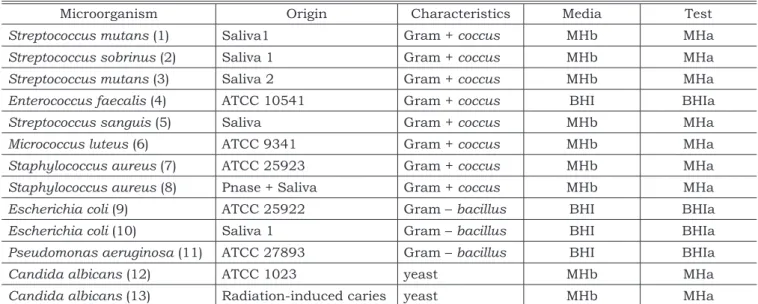
The strains used as indicators for antimicro-bial activity, their origins, morph types, culture media employed for obtaining of cultures and their testing are presented in Table 2.
Most canal infections appear to be multibacte-rial. At the present time a number of investigators have been or are attempting to define the role of specific microorganisms or groups of bacteria in
the pathogenesis of pulpal and periradicular le-sions. Cohen, Burns2 (1994) describe the micro-organisms present in the canal. According to the authors, early studies generally reported a pre-dominance of a facultative organism over obligatory anaerobic species. Streptococcus (alpha and gama) species, gram negative cocci and lactobacilli were most often recovered.
A study on endodontically treated teeth re-quiring re-treatment has shown a prevalence of facultative bacteria, especially Streptococcus fae-calis instead of strict anaerobes5. The choice of
TABLE 1 - Chemical substances utilized.
Material Degree of
pureness Brand Origin PA Zinc
Oxide 99.99% Reagen
SP, Brazil Sodium
Tetraborate 99.50% Vetec
SP, Brazil Bismuth
Subcarbonate 99.90% Reagen
SP, Brazil Barium
Sulfate 99.90% Carlo Erba
SP, Brazil Grade X
Rosin Eucatex
SP, Brazil Sealer
powder
Mix in accord with Grossman4 (1974)
SP, Brazil
Eugenol Dierberger BrazilSP,
TABLE 2 - Microorganisms used as markers of activity, their origin, characteristics and culture media used for inoculation and testing.
Microorganism Origin Characteristics Media Test
Streptococcus mutans (1) Saliva1 Gram + coccus MHb MHa
Streptococcus sobrinus (2) Saliva 1 Gram + coccus MHb MHa
Streptococcus mutans (3) Saliva 2 Gram + coccus MHb MHa
Enterococcus faecalis (4) ATCC 10541 Gram + coccus BHI BHIa
Streptococcus sanguis (5) Saliva Gram + coccus MHb MHa
Micrococcus luteus (6) ATCC 9341 Gram + coccus MHb MHa
Staphylococcus aureus (7) ATCC 25923 Gram + coccus MHb MHa
Staphylococcus aureus (8) Pnase + Saliva Gram + coccus MHb MHa
Escherichia coli (9) ATCC 25922 Gram – bacillus BHI BHIa
Escherichia coli (10) Saliva 1 Gram – bacillus BHI BHIa
Pseudomonas aeruginosa (11) ATCC 27893 Gram – bacillus BHI BHIa
Candida albicans (12) ATCC 1023 yeast MHb MHa
Candida albicans (13) Radiation-induced caries yeast MHb MHa
129 Savioli RN, Pecora JD, Mian H, Ito IY. Evaluation of the antimicrobial activity of each component in Grossman’s sealer. Braz Oral
Res 2006;20(2):127-31.
the microorganisms used for the present testing is based on this report.
Strains were obtained from the American Type Culture Collection (ATCC) or isolated in the Mi-crobiology laboratory, School of Pharmaceutical Sciences, University of São Paulo.
Cultures were obtained through the introduc-tion of marker strains into MHB medium (Mueller Hinton Broth – Difco, SP, Brazil) or BHI medium (Brain Heart Infusion – Difco, SP, Brazil), according to the physiological characteristics of each organ-ism, and incubated at 37ºC for 24 hours.
Testing was performed three times for each sample, using the well-diffusion in double layer method (a base layer and a seed layer composed by adequate media). The base layer consisted of 10 ml of sterile culture medium, cooled to a tem-perature of about 50ºC, and then placed in sterile 20 x 100 mm Petri dishes. The seed layer was ob-tained by plating 106 CFU/ml microorganisms in culture medium cooled to around 50ºC, on top of the base layer.
Following solidification of the seed layer, wells were made by removing small portions of agar, us-ing plastic sticks with a diameter of 4 mm. Wells were placed at approximately 15 mm from the edge of the Petri dishes, at equidistant points.
Grossman’s sealer was manipulated following the manufacturer’s recommendations in the Labo-ratory of Endodontic Research, School of Dentistry, University of São Paulo, and each of its compo-nents was individually tested, by filling each well with a sufficient amount of each component. The powder/liquid ratio was set according to Savioli13 (1992). DMSO (Dimethyl Sulfoxide solvent, Merk, São Paulo, Brazil) was added to the rosin and to the whole cement powder in order to assure better dif-fusion due to the physical characteristics of both. DMSO was tested in order to verify whether its presence could influence the antimicrobial proper-ties of these components.
The sealer was also tested for its activity against the plated microorganisms, 24 hours after manipu-lation. With this purpose, following spatulation, the cement was set into an acrylic mold specially pre-pared for obtaining sample units of the same size as the wells. These samples were then placed into Petri dishes plated with the different microorganisms.
Petri dishes were kept at room temperature for two hours in order to allow pre-diffusion of the ma-terial, and then incubated at 37ºC for 24 hours.
The inhibition area formed around the well was then measured at the point of greatest width using a millimetric ruler.
RESULTS
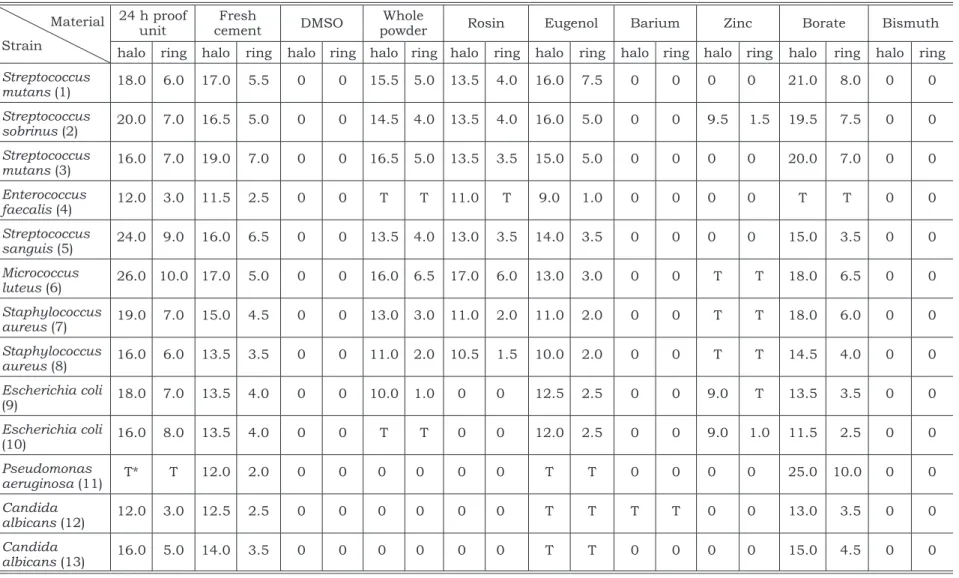
Table 3 shows the average values, in milli-meters, of the inhibition halo and ring diameters obtained through the well-diffusion method. This refers to the antimicrobial activity of each one of the components of Grossman’s sealer, as well as the whole prepared cement, when put in contact with the selected microorganisms.
DISCUSSION
Because of the complexity of root canals, per-fectly cleaning and shaping them with the pres-ently available instruments is almost impossible2. Residual microorganisms left in the root canal sys-tem following cleaning and shaping or microbial contamination of a root canal system between ap-pointments have been a concern. If the root canal treatment is completed in a single appointment, antimicrobial agents in the sealer are recommend-ed for intracanal antisepsis5.
According to Fischer3 (1977), Mickel, Wright10 (1999) and Lai et al.6 (2001), eugenol presents prov-en antimicrobial activity. In the presprov-ent study, it presented excellent bactericide action, since eu-genol, along with sodium tetraborate, promoted inhibition halos on all of the microorganisms tested (Table 3). These results are in agreement with the chemical characteristics of this element: accord-ing to the Merck Index9, sodium tetraborate has antiseptic properties.
Barium sulfate and bismuth subcarbonate, which in the Grossman’s sealer composition act as radiopaque agents, did not present antimicrobial activity.
Rosin showed a slight bactericide activity on some of the microorganisms evaluated, probably due to its slightly acidic pH. Being rosin a plant-derived resinous substance, it was not expected to present any antimicrobial activity.
Zinc oxide presented inhibition halos on some
ele-i R
N
,
P
ecora
J
D
,
M
ia
n
H
,
It
o
IY
.
E
va
lu
a
ti
on
of
t
h
e
a
n
ti
mi
crob
ia
l a
ct
ivi
ty
of
ea
ch
comp
on
en
t
in
G
rossma
n
’s
sea
ler.
B
ra
z
O
ra
l
2
0
0
6
;2
0
(2
):1
2
7
-3
1
.
TABLE 3 - Results of the antimicrobial activity (mm) of sealer and its components, obtained through the well-diffusion method.
Material
Strain
24 h proof unit
Fresh
cement DMSO
Whole
powder Rosin Eugenol Barium Zinc Borate Bismuth
halo ring halo ring halo ring halo ring halo ring halo ring halo ring halo ring halo ring halo ring
Streptococcus
mutans (1) 18.0 6.0 17.0 5.5 0 0 15.5 5.0 13.5 4.0 16.0 7.5 0 0 0 0 21.0 8.0 0 0
Streptococcus
sobrinus (2) 20.0 7.0 16.5 5.0 0 0 14.5 4.0 13.5 4.0 16.0 5.0 0 0 9.5 1.5 19.5 7.5 0 0
Streptococcus
mutans (3) 16.0 7.0 19.0 7.0 0 0 16.5 5.0 13.5 3.5 15.0 5.0 0 0 0 0 20.0 7.0 0 0
Enterococcus
faecalis (4) 12.0 3.0 11.5 2.5 0 0 T T 11.0 T 9.0 1.0 0 0 0 0 T T 0 0
Streptococcus
sanguis (5) 24.0 9.0 16.0 6.5 0 0 13.5 4.0 13.0 3.5 14.0 3.5 0 0 0 0 15.0 3.5 0 0
Micrococcus
luteus (6) 26.0 10.0 17.0 5.0 0 0 16.0 6.5 17.0 6.0 13.0 3.0 0 0 T T 18.0 6.5 0 0
Staphylococcus
aureus (7) 19.0 7.0 15.0 4.5 0 0 13.0 3.0 11.0 2.0 11.0 2.0 0 0 T T 18.0 6.0 0 0
Staphylococcus
aureus (8) 16.0 6.0 13.5 3.5 0 0 11.0 2.0 10.5 1.5 10.0 2.0 0 0 T T 14.5 4.0 0 0
Escherichia coli
(9) 18.0 7.0 13.5 4.0 0 0 10.0 1.0 0 0 12.5 2.5 0 0 9.0 T 13.5 3.5 0 0
Escherichia coli
(10) 16.0 8.0 13.5 4.0 0 0 T T 0 0 12.0 2.5 0 0 9.0 1.0 11.5 2.5 0 0
Pseudomonas
aeruginosa (11) T* T 12.0 2.0 0 0 0 0 0 0 T T 0 0 0 0 25.0 10.0 0 0
Candida
albicans (12) 12.0 3.0 12.5 2.5 0 0 0 0 0 0 T T T T 0 0 13.0 3.5 0 0
Candida
albicans (13) 16.0 5.0 14.0 3.5 0 0 0 0 0 0 T T 0 0 0 0 15.0 4.5 0 0
131 Savioli RN, Pecora JD, Mian H, Ito IY. Evaluation of the antimicrobial activity of each component in Grossman’s sealer. Braz Oral
Res 2006;20(2):127-31.
ment. Zinc oxide is antiseptic, astringent and has protective properties9.
Grossman’s sealer powder presented antimi-crobial activity against almost all the strains used in the present study, except for Pseudomonas ae-ruginosa and Candidaalbicans. The prepared ce-ment, both fresh and already set, also displayed antimicrobial activity against all strains used. This was due to the antimicrobial activity of some of its components, mainly sodium tetraborate and eugenol, which combined, led to positive results. These results are in agreement with those of Mick-el, Wright10 (1999). According to the authors, the zinc oxide-eugenol sealer was found to be more effective in inhibiting the growth of Streptococcus anginosus than three of the calcium hydroxide-containing sealers.
CONCLUSIONS
Based on the methodology applied and on the results obtained, it could be concluded that: 1. Grossman’s sealer displayed antimicrobial
ac-tivity against all strains used.
2. Among the components of the cement, sodium tetraborate presented the greatest antimicro-bial activity, both in type and dimensions of the inhibition halos and rings.
3. Cement powder, rosin, and eugenol presented similar activity, with no effect against P. aerugi-nosa and C. albicans. Among the three of them, only eugenol presented activity against E. coli. 4. Zinc oxide was active only against S. sobrinus
and E. coli.
5. Barium sulfate and bismuth subcarbonate did not present any antimicrobial activity.
REFERENCES
1. Baumgartner J, Falker W. Bacteria in the apical infected root canal. J Endod 1991;17:380-4.
2. Cohen S, Burns RC. Pathways of the pulp. 6rd ed. Missouri:
Mosby; 1994.
3. Fischer FJ. The effect of three proprietary lining materials on microorganisms in carious dentine. An in vitro investiga-tion. Br Dent J 1977;43:231-5.
4. Grossman LI. Endodontic pratice. 8th ed. Philadelphia: Lea
& Febiger; 1974.
5. Ingle JI, Bakland IK. Endodontics. 5th ed. Hamilton: Bc
Decker Inc; 2002.
6. Lai CC, Huang FM, Yang HW, Chan Y, Huang MS, Chou MY, et al. Antimicrobial activity of four root canal sealers against endodontic pathogens. Clin Oral Investig 2001;5:236-9. 7. Leonardo MR. Endodontia - tratamento dos canais
radicu-lares. São Paulo: Artes Médicas; 2005.
8. Lin LM, Skribner JE, Gaengler P. Factors associated with endodontic treatment failures. J Endod 1992;18:625-7. 9. Merck & Co. Inc. Merck Index: an encyclopedia of chemicals,
drugs, and biologicals. 10th ed. Rahway: Merck; 1983.
10. Mickel AK, Wright ER. Growth inhibition of Streptococ-cus anginosus (milleri) by three calcium hydroxide sealers and one zinc oxide-eugenol sealer. J Endod 1999;25:34-7.
11. Okurama T. Anatomy of root canals. J Am Dent Assoc 1927;14:632-7.
12. Peters LB, Wesselink PR, Moorer WR. The fate and the role of bacteria left in root dentinal tubules. Int Endod J 1995;28:95-9.
13. Savioli RN. Efeito da influência de cada componente químico do cimento de Grossman sobre suas propriedades físicas [Dis-sertação de Mestrado]. Ribeirão Preto: Faculdade de Odonto-logia de Ribeirão Preto da Universidade de São Paulo; 1992. 14. Siqueira JF Jr, Batista MM, Fraga RC, de Uzeda M.
Antibacterial effects of endodontic irrigants on black pig-mented gram negative anaerobes and facultative bacteria. J Endod 1998;24:414-6.
15. Siqueira JF, Favieri A, Gahyva SMM, Moraes SR, Lima KC, Lopes HP. Antimicrobial activity and flow rate of newer and established root canal sealers. J Endod 2000;26:274-7. 16. Siren EK, Haapasalo MPP, Ranta K, Salmi P, Kerosuo
ENJ. Microbiological findings and clinical procedures in endodontic cases selected for microbiological investigation. Int Endod J 1997;30:91-5.
17. Tronstad L, Andreasen JO, Hasselgren G, Kriterson L, Riis I. pH changes in dental tissue after root canal filling with calcium hydroxide. J Endod 1988;14:125-7.