www.bjorl.org
Brazilian
Journal
of
OTORHINOLARYNGOLOGY
ORIGINAL
ARTICLE
Morphological
analysis
of
the
vestibular
system
of
guinea
pigs
poisoned
by
organophosphate
夽
,
夽夽
Lícia
Assunc
¸ão
Cogo
a,∗,
Valdete
Alves
Valentins
dos
Santos
Filha
b,c,
Adriana
de
Andrade
Batista
Murashima
d,f,
Miguel
Angelo
Hyppolito
e,f,
Aron
Ferreira
da
Silveira
g,haDepartmentofPhysiotherapy,UniversidadeFederaldoPampa(UNIPAMPA),RioGrandedoSul,RS,Brazil
bDepartmentofMedicine,SciencesofRehabilitationProgram,UniversidadedeSãoPaulo(USP),SãoPaulo,SP,Brazil cUniversidadeFederaldeSantaMaria(UFSM),SantaMaria,RS,Brazil
dDepartmentofBiology,PostgraduatePrograminOphthalmology,Otolaryngology,andHeadandNeck-Shoulder,Universidade
deSãoPaulo(USP),RibeirãoPreto,SP,Brazil
eDepartmentofMedicalSciences,UniversidadedeSãoPaulo(USP),RibeirãoPreto,SP,Brazil
fDepartmentofOphthalmology,Otolaryngology,andHeadandNeck-Shoulder,UniversidadedeSãoPaulo(USP),RibeirãoPreto,
SP,Brazil
gDepartmentofVeterinaryMedicine,UniversidadeFederaldeSantaMaria(UFSM),SantaMaria,RS,Brazil hDepartmentofMorphology,UniversidadeFederaldeSantaMaria(UFSM),SantaMaria,RS,Brazil
Received5May2013;accepted5March2015 Availableonline24October2015
KEYWORDS
Posturalbalance; Vestibulelabyrinth; Insecticides organophosphate; Pesticides; Toxicity
Abstract
Introduction:Thevestibularsystemisresponsibleforbodybalance.Therearesubstancesthat damageit,causingdizziness;thesearetermedvestibulotoxicsubstances.Agrochemicalshave been investigatedfor ototoxicitybecause ofstudies thatidentifieddizzinessas arecurrent symptomamongruralworkers’complaints.
Objective: Tohistopathologicallyevaluatethevestibularsysteminguineapigsexposedtoan organophosphate,andtoidentifythedrug’seffectsonthissystem.
Methods:Experimentalclinicalstudy.Eighteenguineapigswereused;sixofthempoisonedwith theorganophosphatechlorpyrifosatdosesof0.5mg/kg/dayandsevenofthemat1mg/kg/day; andacontrolgroupoffiveguineapigswasexposedtodistilledwater,allfor10consecutive days. Later,ciliarytuftsofsaccule andutricle maculaewerecounted byscanning electron microscopy.
夽
Pleasecitethisarticleas:CogoLA,SantosFilhaVAV,MurashimaAAB,HyppolitoMA,SilveiraAF.Morphologicalanalysisofthevestibular
systemofguineapigspoisonedbyorganophosphate.BrazJOtorhinolaryngol.2016;82:11---6.
夽夽
Institution:UniversidadeFederaldeSantaMaria(UFSM),SantaMaria,RS,Brazil.
∗Correspondingauthor.
E-mail:[email protected](L.A.Cogo).
http://dx.doi.org/10.1016/j.bjorl.2015.10.001
Results:Comparingthegroups,aone-wayANOVAtestforthevariable‘‘saccule’’(p=0.0569) andaKruskal---Wallistestforthevariable‘‘utricle’’(p=0.8958)wereperformed,revealingno differenceamonggroupsinbothvariables.
Conclusion:Thehistopathologicanalysisofthevestibularsystemofguineapigsexposedtoan organophosphateshowed nodifferenceintheamountofciliary tuftsofsaccule andutricle maculaeatthedosestested,althoughtheresultfor thevariable‘‘saccule’’wasconsidered borderline,showingatrendforsignificance.
© 2015Associac¸ãoBrasileira de Otorrinolaringologiae CirurgiaCérvico-Facial. Publishedby ElsevierEditoraLtda.Allrightsreserved.
PALAVRAS-CHAVE
Equilíbriopostural; Vestíbulodo labirinto; Inseticidas organofosforados; Praguicidas; Toxicidade
Análisemorfológicadosistemavestibulardecobaiasintoxicadaspororganofosforado
Resumo
Introduc¸ão:Osistemavestibularéresponsávelpeloequilíbriocorporal.Existemsubstâncias queodanificam,causandotontura;sãochamadasvestibulotóxicas.Agrotóxicostornaram-se objeto deinvestigac¸ãodaototoxicidade apartirdepesquisasqueapontaram tontura como sintomarecorrenteentreasqueixasdetrabalhadoresrurais.
Objetivo:Constitui-seemavaliarahistopatologiadosistemavestibulardecobaiasexpostasa organofosforados,identificandoosefeitosnessesistema.
Método: Éumestudoclínicoexperimental,queutilizou18cobaias,sendoseisintoxicadascom organofosforadoclorpirifósnadose de0,5mg/kg/dia;sete nadosede1mg/kg/dia, egrupo controlecomcincocobaiasexpostasaáguadestilada,durante10diasconsecutivos. Posteri-ormenterealizou-seacontagemdostufosciliaresnasmáculasdossáculoseutrículosatravés microscopiaeletrônicadevarredura.
Resultados: Na comparac¸ão intergrupos, para a variável sáculo realizou-se o teste ANOVA one-way(p=0,0569); paraavariávelutrículo,utilizou-seotesteKruskal-Wallis(p=0,8958), revelandonãohaverdiferenc¸aentreosgruposemambasasvariáveis.
Conclusão:Análisehistopatológicadosistemavestibulardecobaiasexpostasaorganofosforado nãodemonstroudiferenc¸anaquantidadedetufosciliaresnasmáculasdossáculoseutrículosnas dosestestadas,apesardoresultadoparaavariávelsáculoserconsideradolimítrofemostrando umatendênciaasignificância.
©2015Associac¸ãoBrasileira deOtorrinolaringologiaeCirurgiaCérvico-Facial.Publicadopor ElsevierEditoraLtda.Todososdireitosreservados.
Introduction
Thevestibularsystemconsistsofthreemainparts:a periph-eralsensorysystem,acentralprocessor,andamechanism formotorresponses.Theperipheralsensorysystemconsists ofaset ofmotion sensors,which sendinformationtothe central nervoussystem (CNS). The CNS is responsible for processingthesesignalsandforcombiningthemwithother sensoryinformation,toestimatethecephalicorientation.1
Thisperipheralsystemconsistsofabonylabyrinthanda membranouslabyrinth.2 Themembranouscomponent
con-stitutes the functional part of the system, which detects balance sensations. This part contains three semicircular channels,a saccule andan utricle,constitutingthe vesti-bularsensoryorgans.3
Thevestibularreceptorcellsarelocatedinregionsofthe semicircularcanals,called ampullae; whenat thesaccule andutriclelocation,thesecellsarecalledmaculae.These cellsarebiologicalsensors,whichconvertthedisplacement caused by head movements into a neural discharge.1
However, these mechanical properties of the vestibular labyrinthprovideitsreceptorsthesensationofmovement. Thehaircellsoftheutricleandsacculeregisterthelinear movement. Theseorganshaveagelatinouscoatingonthe sensory cells of their maculae, with calcium carbonate crystalsembeddedinthesurfaceofthegelatinousmaterial lyingonthe sensorycells’ stereocilia. This gelatin under-goes a deformation caused by head movements, which divertthestereocilia.3
Bodybalance,forwhichthevestibularsystemisoneof the responsiblefactors,is a complexinteractionbetween sensory and motor systems that prevent the individual fromfalling,allowtheadoptionofdifferentpostures,and facilitateharmoniousbodymovements.4Whenavestibular
change occurs, symptoms of imbalance arise, including dizziness,whichisthemostcommonandcanseverely neg-ativelyimpactthequalityoflife.5
ofvestibularfunctionor celldamageintheinnerear,are calledototoxicorvestibulotoxicsubstances.6Thedegreeto
which these substances influence the patient depends on individualpredisposition,administereddosage,durationof exposure,routeofadministration,age,familysusceptibility, and/orpossiblepriordamagetotheinnerear.7
Severalototoxicsubstanceshavebeenevaluated,among themaminoglycosideantibiotics,aspartame,salicylicacid, oncologicaldrugs,pesticides,andothers.
Pesticides have becomesubject toinvestigation in the fieldofototoxicitybasedonsurveysoffarmers,whopointed to dizzinessand/or vertigo asrecurring symptoms among complaintsofthispopulation.8---12 Studiesreportingan
oto-toxicactionandalsoneurototoxiceffectofpesticideshave been published.The neurototoxic effectderivesfrom the inhibitionofcholinesteraseenzymes;thiseffectcausesan interruptionof propagation ofnerve impulsetothebody, givingrisetovarioussymptomsandclinicalsigns.13
The ototoxicity of pesticides wasreported in a survey involving 59 rural workers, of whom 49.15% had hearing changes.14 In a study conducted in a ruralcommunity on
33employees,54%ofparticipantsreportedsymptomswhen pesticides were applied to plantations near the commu-nity wherethey live;amongthe symptoms,dizzinesswas reportedby12%ofparticipants.15
Thesefindingshighlighttheimportanceofstudiesofthe vestibularsystem,indirectconnectiontotheauditory sys-tem,andalsotakingintoaccountfindingsintheliterature thatrevealclinicalsymptomsassociatedwiththevestibular system,suchasdizziness.
Humanresearchallowsthe identificationof symptoms, but does not allow for assessment of the morphological impacttothevestibularsystemofthosewhopresentswith thesesymptoms.Thus,theaimofthisstudywastoconduct an analysisof thehistopathology of thevestibularsystem ofguineapigsexposedtoorganophosphates,identifyingthe effectsofthesecompoundsonthatsystem.
Methods
This was an experimental study and was submitted to the Comissão de Éticaem Experimentac¸ão Animal (CETEA) of FMRP-USP(Faculdade deMedicina de Ribeirão Preto, Universidade de São Paulo), approved under pro-tocol number 135/2011, and is in accordance with the ethical principles for animal experimentation adopted by the Colégio Brasileiro de Experimentac¸ão Animal (COBEA).
In this study, 18 adult male albino guinea pigs of the species Cavia porcellus weighing between 300 and 500g were selected fromthe central vivariumof Biotério Cen-tralofUniversidadedeSãoPaulo, RibeirãoPreto campus. GuineapigspositiveforPreyerreflex,evaluatedby observ-ingsmallcontractionmovementsoftheearpavilioninthese animals,whentheanimalisstimulatedwithsoundsoflow andmediumintensity,wereincludedinthisstudy.Thisreflex isusedtoevaluateauditoryfunctioninrodents.16Inthe
ini-tialselection,theguineapigswereassessedandsubmitted tomanual otoscopy.Thoseanimals showingsigns of otitis externa and/or otitis media and of tympanic perforation wereexcludedfromthisexperiment.
TheanimalswerekeptintheexperimentalsurgeryUnitat BiotériodoLaboratóriode Cirurgia Experimental, Depart-mentof SurgeryandAnatomyof FMRP-USP(Faculdadede MedicinadeRibeirãoPreto,UniversidadedeSãoPaulo) in separatecollectivecagescontainingwoodshavings, accord-ingtoexperimentalgroup,ina12-hdark/lightcycle,with anauto-feedingsystemandwateradlibitum.
Toconductthestudy,guineapigsweredividedintothree groups,withGroupIascontrol;
--- Group I:Fiveguineapigs,withintraperitoneal adminis-tration of distilled water oncedaily; the same volume correspondingtothatforthepesticidedosewasusedfor 10days,takingintoaccounttheweightoftheanimal. --- GroupII:Sixguineapigswithintraperitoneal
administra-tionofpesticideinasingledailydoseof0.5mg/kg/day for10consecutivedays.
--- GroupIII:Sevenguineapigswithintraperitoneal adminis-trationofpesticideinasingledailydoseof1mg/kg/day for10consecutivedays.
The18guineapigstotaled36ears,with36sacculesand 36utricles.
The number of guinea pigs per group was established inaccordancewiththe standardsof theAgênciaNacional deVigilânciaSanitária17 forconductingtoxicologystudies,
withaminimumoffiveanimalsforeachdosetestedinthe experiment.
Theexperimentalmodelselectedwasthealbinoguinea pig,becauseaccordingtoastudybyAlbuquerqueetal.18this
modelprovedtobethebestanimalinthemicrodissection stage,comparedtorats.Theadvantagesofthismodelare thesize andstrengthof the temporalbone, whichallows greatereaseinremovinganatomicalmaterialforanalysis.
Forguineapig poisoning, the organophosphate Pyrinex 480 CETM (Milenia Agrociências S/A) was administered.
Pyrinex480ECTMisanorganophosphateinsecticidethatacts
bycontactandingestion,recommendedforthecontrolof pestsincotton,potato,coffee, citrus,bean,apple, corn, soybean,andcreepingtomato forindustrialpurposes,and forwheatcrops.TheproductisregisteredattheMinistério daAgricultura, Pecuária e Abastecimento (MAPA)19 under
No.09298.
ThedoseofthepesticidechosenwasbasedonoralLD50
forratswithPyrinex480CETM,foundintheproductpackage
insert,which amountsto300mg/kg; thenorms of ANVISA (nottoexceed80%ofDL50)werefollowed.Guineapigshad
theirweightmonitoreddailyfor propercalculation ofthe doseofthepesticidebeingused.
Forguineapighandlingandadministrationofpesticides, personalprotectiveequipmentwasused,asrecommended intheproductpackageinsert.
After24hofthelastadministrationofthepesticide,all animalswereintraperitoneallyanesthetizedwith thionem-butal(25mg/kg) ata dose6mg/kgbodyweightandwere euthanizedbydecapitation.Immediatelyaftertheanimals were sacrificed, the temporal bones with their tympanic bullae were removed. Tympanic bullae were opened and vestibularorganswereremoved.
Through the round window, a 3% glutaraldehyde solution in 0.1M phosphate buffer, pH 7.4, was injected for fixa-tion,remaining therefor 4h at 4◦C; the specimenswere
washedthreetimesfor 5min withthesamebuffer. Next, theywerefixedwith1%osmiumtetroxidefor2hat4◦Cand
thensubjectedtodehydration.
Dehydrationof thestructureswasperformed with suc-cessiveethanolbathsin increasingconcentrations of50%, 70%,90%, and 95% for 10min each at roomtemperature. Then,100%ethanolwasusedinthree20-min bathseach, leavingthestructuresimmersedinthelastbathfor12hat roomtemperature.Thetaskofdryingthewaterstillpresent inthesamplesafterdehydrationwascarriedoutusingthe equipmentBal-TecCPD030--- CriticalPointDryer(Balzers, Liechtenstein)usingacritical-pointprocess,andthe sam-plesweretransferredtotheapparatuschamberandcovered withfluidcarbondioxide(CO2).
For proper observation under scanning electron microscopy (SEM), the dissected and partially prepared pieces werefixed on a metallic cylindricalsample holder withconductivecarbonpaste,ColloidalGraphite(Electron Microscopy Sciences --- Hatfield, PA, United States). The structureswerecoveredbyathinlayerof24-caratgoldwith theuse ofa vaporizationprocessequipment,Bal-TecSCD 050 --- Sputter Coater (Balzers, Liechtenstein), becoming electricallyconductive.
Morphologicalanalysisofvestibularstructureswas per-formed by scanning electron microscopy in a JEOLTM
JSM-5200ScanningElectron Microscope. The imageswere photographed (3500× magnification). After the photo-graphic register, the pictures were transferred to the ImageJTMsoftware,inordertocarryouttheevaluation.
Amicroscopic evaluationofciliary tuftsof sacculeand utriclemaculaewasconductedbilaterallyforeachanimalin theexperiment.Thisassessmentwasmadebycountingthe numberofciliarytuftsinthestriolaareapresentinthe pho-tographicfield.The3500×magnificationwasstandardized forallphotographs.
Forstatisticalanalysis,theweightedaverageofthe num-berofstereociliatuftspresentineachearwascalculated. Thosevestibularorganswhich,underSEM,showedartifacts that could interfere withciliary tuft count,for instance, structuralinjuryduringdissectionorassemblyofthe speci-men,wereexcluded.
Data obtained were statistically analyzed by Statistica software,version9.0, witha significance levelset at 5%. DatanormalitywastestedbytheLillieforstest.A descrip-tive analysis was performed. According to the result of normalitytest,normaldatawerecomparedbetweengroups byanone-wayANOVA,andnon-normaldatawerecompared throughKruskal---Wallistest.
Results
Attheendoftheanalyses, sixsacculesandthreeutricles werelost,whichwereconsideredin‘‘n’’itemsintables.
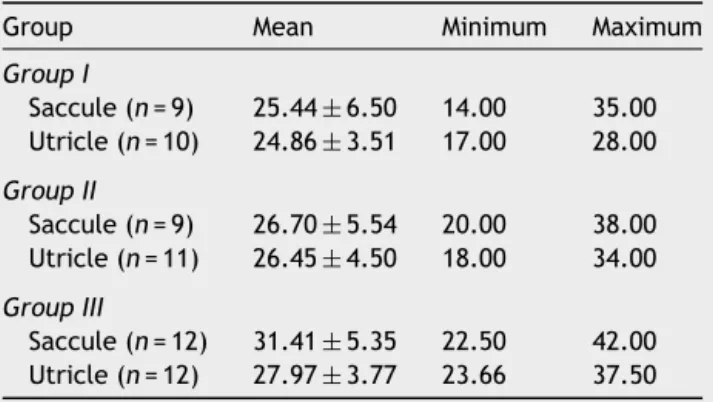
The Lilliefors test showed normality of data for the ‘‘saccule’’ variable and non-normality of data for the ‘‘utricle’’variable.Descriptiveanalysiswasperformedfor thenumberofsacculeandutricleciliarytuftsinGroupsI, II,andIII,asshowninTable1.
Table1 Comparisonofmeanvaluesofthenumberof sac-culeandutricleciliarytuftsamongGroupsI,II,andIII.a
Group Mean Minimum Maximum
GroupI
Saccule(n=9) 25.44±6.50 14.00 35.00 Utricle(n=10) 24.86±3.51 17.00 28.00
GroupII
Saccule(n=9) 26.70±5.54 20.00 38.00 Utricle(n=11) 26.45±4.50 18.00 34.00
GroupIII
Saccule(n=12) 31.41±5.35 22.50 42.00 Utricle(n=12) 27.97±3.77 23.66 37.50
n,numberofsacculesandutricles.
a Datawerepresentedasmean±standarddeviation.
Tocompareintergroupdataforthe‘‘saccule’’variable,a one-wayANOVAtestwascarriedout,resultinginp=0.0569, showingnodifferencebetweenvaluesofGroupsI,II,andIII forthevariabletested.Asfor‘‘utricle’’variable,the com-parisonamonggroupswasanalyzedusingtheKruskal---Wallis test,withp=0.8958,showingnodifferenceamonggroups.
Figure1 Utricle---GroupI.
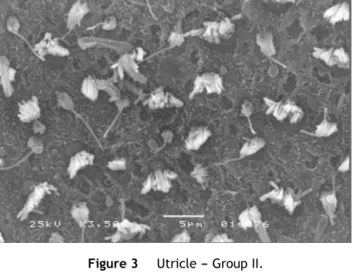
Figure3 Utricle---GroupII.
Figure4 Saccule---GroupII.
Theresultsofcomparativetestsamongthecontrolgroup and the different doses of the organophosphate tested causednohistopathologicaldamagetohaircellsinsaccules andutriclesofguineapigsinvolvedinthisstudyduringthe 10-dayperiod,whenanalyzedbySEM(seeFigs.1---6).
Discussion
The mean for Group I waslower than that for the other groups, but it cannotbe saidthat therewasa significant differenceamonggroups,becausethemeansfor GroupsII andIIIareinlinewithmeanvaluesfoundbyotherauthors, whoutilizedSEMinguineapigs,oneusingdistilledwaterfor 30daysintheircontrolgroups,andanotherusingsalinefluid for10days.20,21Theresultsofthepresentresearchshowed
nostatisticallysignificantdifferencebetweenthenumbers ofciliarytuftsofgroupsofguineapigspoisonedwith differ-entdosesofanorganophosphatepesticide.Thisiscontrary tothefindingsofotherinvestigators,whoassessedthe vesti-bularsystemofguineapigsintoxicatedbyorganophosphates forsevendays,atdosesof0.3and3mg/kg/day,andfound ciliarychangesinsacculesandutricles.22Itisworthnoting
that theirstudy used dosesand an activeagent different fromthoseusedinthepresentinvestigation.
The morphological damage in animals exposed to organophosphateshasbeenwidelyresearched.Astudythat
Figure5 Utricle---GroupIII.
Figure6 Saccule---GroupIII.
acutelyassessedtheeffectsofan organophosphateinthe nervoussystemobservedstructuralchange intheanimals’ cerebellum, characterized by apoptosis of Purkinje cells and structural damage to the cytoskeleton of surviving animals.23InastudythatassessedchronicCNSeffectsin
ani-malsintoxicatedbyanorganophosphate,hypertrophyofthe molecularlayerofthecerebralcortexwasobserved,which couldleadtoalossorthinningofneuralbranches24,25;
how-ever,thiswasnottheobjectiveofthepresentstudy,which evaluatedciliarytuftsinsensorycellsofsacculeandutricle maculae.
Astudyonruralworkerswhocameintocontactwiththe organophosphatechlorpyrifos andlaterweresubmittedto testsfor sensory-motorevaluation showedchanges, espe-ciallyinposturalswaymeasureswithclosedeyesandona softsurface.Thisresultsuggestsasubclinicaleffect involv-ingproprioceptiveandvestibularsystems.10
Afunctionalassessmentbyvectoelectronystagmography ofworkersexposedtoorganophosphatesrevealedthatthe vast majority of the subjects showed irritant peripheral vestibulardysfunction-type changes.9 This finding
Functionalstudieshavedemonstratedthatpesticide poi-soningcausesdizzinessand/or vertigoin workersexposed to these compounds,8,10 but todate it has not been not
possible to elucidate the specific morphological origin of thissymptom,andevenifthereis asinglecauseor ifthis conditionismultifactorial.
Furtherstudiesareneededtodeterminesafedosesand exposuretimesfororganophosphatepesticides.Therefore, itisnoteworthythatatanydoseandwithanycontactwith thesecompounds, the use of suitablepersonal protective equipmentis obligatory.Non-assessmentof the semicircu-lar canalswas a limitation of the present study,and this shouldbeconsideredinotherstudies;thesubtletiesofthe anatomicalstructurewerethefactor thatpreventedtheir evaluation.
Conclusion
Histopathologicalanalysisofthevestibularsystemofguinea pigs exposed acutely to an organophosphate pesticide showednodifferenceintheamountofciliarytuftsinsaccule andutriclemaculaeinthedosestestedinthisexperiment. Itisworthmentioningthattheresultfor‘‘saccule’’variable wasborderline, indicatingthatstudies withalargervalue of‘‘n’’maydemonstratesignificance.
Conflict
of
interests
Theauthorsdeclarenoconflictsofinterest.
Acknowledgements
Theauthorswishtothanktheworkingteamofthesurgical technique and experimental surgery labs of the Depart-ment of Surgery and Anatomy, the Electronic Microscopy Lab of the Department of Cellular andMolecular Biology, andPathogenicBio-agents,oftheFaculdadedeMedicinade RibeirãoPreto,UniversidadedeSãoPaulofortheir collabo-rationonthisstudy;theyalsothankCAPESfortheirfinancial support.
References
1.HerdmanSJ.Reabilitac¸ãoVestibular.2nded.Barueri:Manole; 2002.p.3---24.
2.GuytonAC.TratadodeFisiologiaMédica.8thed.RiodeJaneiro: GuanabaraKoogan;1992.p.583---648.
3.MartinJH.Neuroanatomia:Textoeatlas.2nded.ArtesMédicas: PortoAlegre;1998.
4.Gananc¸aMM,MunhozMSL,CaovillaHH,SilvaMLG.Estratégias Terapêuticas em Otoneurologia, vol. 4. São Paulo: Atheneu; 2000.
5.PopperVM.AReabilitac¸ãoVestibularnaVertigem.Monografia [monografia].Itajaí(SC):CEFAC---AudiologiaClínica;2001. 6.JohnsonAC.Theototoxiceffectoftolueneandtheinfluence
ofnoise,acetylsalicylicacidorgenotype:astudyinratsand mice.ScandAudiol.1993:1---40.
7.Zocoli R, Reichow SL, Zocoli AMF. Emissões otoacústicas x cisplatina: detecc¸ão precoceda ototoxicidade em pacientes oncológicos.RevBrasOtorrinolaringol.2003;69:222---5. 8.DickRB,SteenlandK,KriegEF,HinesCJ.Evaluationofacute
sensory-motor effects and test sensitivity using termiticide
workers exposed to chlorpyrifos. Neurotoxicol Teratol. 2001;23:381---93. Available from: http://www.sciencedirect. com/science[ResumopublicadonoScienceDirect].
9.Araújo AJ, Lima JS, Moreira JC, Jacob SC, Soares MO, Monteiro MCM, et al. Exposic¸ão múltipla a agrotóxicos e efeitosà saúde: estudotransversal em amostra de 102 tra-balhadores rurais, Nova Friburgo, RJ. Cien Saúde Colet. 2007;12:115---30.Availablefrom:http://www.scielo.br/scielo. php?pid=S141381232007000100015&script=sciarttext
10.Hoshino ACH, Pacheco-Ferreira H, Taguchi CK, Tomita S, Miranda MF. Estudo da ototoxicidade em trabalhadores expostos a organofosforados. Rev Bras Otorrinolaringol. 2008;74:912---8. Available from: http://www.scielo.br/scielo. php?script=sciarttext&pid=S003472992008000600015
11.FariaNMX,RosaJAR,Facchini LA.Intoxicac¸õespor agrotóxi-cosentretrabalhadoresruraisdefruticultura,BentoGonc¸alves, RS. Rev Saúde Pública. 2009;43:1---10. Available from: http://www.scielo.br/pdf/rsp/2009nahead/7200.pdf
12.MatiasMI,GhidorsibJ,CanzanC,PertiledE,DiasC,Rodrigues AD,etal.Avaliac¸ãodasaúdeocupacionaleconhecimentosobre autilizac¸ãodeagrotóxicosemagricultoresdaserragaúcha ---RS.In:AnaisdoIICongressodePesquisaeExtensãodaFSG. Cax-iasdoSul:FSG;2014.Availablefrom:http://ojs.fsg.br/index. php/pesquisaextensao/article/viewFile/819-821/1104 13.CantosC,AmaranteZ,LiccoAE.Contribuic¸õesparaagestão
dasembalagensvaziasdeagrotóxicos.RevdeGestãoIntegrada emSaúdedoTrabalhoeMeioAmbiente.2008;3:1---36. 14.LobatoDCB,LacerdaABM,Gonc¸alvesCGO,SilvaLSG,Franc¸a
DMVR.Trabalhadoresrurais:ocorrênciadeperdasauditivas.In: An12◦CongrBrasMedFamComunidade,12:98,Belém,Maio;
2013.
15.BacconBG,Broetto-BiazonAC.Exposic¸ãoaagrotóxicos:perfil dostrabalhadoresdeumacomunidaderuraldeCampoMourão ---PR.SaBios:RevSaúdeBiol.2014;9:13---9.
16.Jero J,Coling DE,Lalwani AK. Theuse ofPreyer’sreflex in evaluation of hearing in mice. Acta Otolaryngol. 2001;121: 585---9.
17.ANVISA---AgênciaNacionaldeVigilânciaSanitária.Metodologias utilizadasparaarealizac¸ãodeestudostoxicológicos,Brasília; 2009.Availablefrom:www.anvisa.gov.br
18.AlbuquerqueAAS,RossatoM,OliveiraJAA,HyppolitoMA. Con-hecimento da anatomia da orelha de cobaias e ratos esua aplicac¸ão na pesquisa otológica básica. Rev Bras Otorrino-laringol.2009;75:43---9.
19.MAPA---Ministério daAgricultura,PecuáriaeAbastecimento. Availablefrom:http://www.agricultura.gov.br.
20.Silveira SCR. Estreptomicina --- ototoxicidadeeautoprotec¸ão [Tese].RibeirãoPreto(SP):USP---CiênciasMédicas;2011. 21.MarqueziniRMS[Dissertac¸ão]Ototoxicidadevestibular
provo-cada pelo uso sistêmico de aminoglicosídeos em cobaias. RibeirãoPreto(SP):USP---CiênciasMédicas;2011.
22.KörbesD,SilveiraAF,HyppolitoMA,MunaroG.Ototoxicidade pororganofosforados: descric¸ãodosaspectosultraestruturais dosistemavestibulococleardecobaias.BrazJ Otorhinolaryn-gol. 2010;76:238---44. Available from: http://www.scielo.br/ scielo.php?script=sciarttext&pid=S1808-86942010000200015 23.Quilodrán J, Miranda JP, Jiménez L. Efectodelagropesticida
Ciper-etrinaendosisúnicaintraperitonealsobreelcerebelo del-ratón.IntJMorphol.2006;24:5---113.
24.PelegrinoJR,CaloreEE, SaldivaPHN,Almeida VF,PeresNM, Vilela-de-Almeida L. Morphometric studies of specific brain regions of ratschronically intoxicatedwith the organophos-phate methamidophos. Ecotoxicol Environ Saf. 2006;64: 251---5.