Erythrocyte phosphoglucomutase
activity of bipolar I patients currently
using lithium or carbamazepine
1Programa de Biologia Molecular e Biotecnologia, Instituto de Bioquímica Médica, 2Laboratório de Pânico e Respiração, Instituto de Psiquiatria,
Universidade Federal do Rio de Janeiro, Rio de Janeiro, RJ, Brasil M. Montero-Lomelí1,
D. Galvão1, B.B. Morais1
and A.E. Nardi2
Abstract
Lithium has been used for the last five decades to treat bipolar disorder, but the molecular basis of its therapeutic effect is unknown. Phosphoglucomutase is a key enzyme in the metabolism of glycogen. In yeast, rabbit and human HEK293 cells, it is inhibited by lithium in the therapeutic concentration range. We measured the phosphogluco-mutase activity in erythrocytes and the inhibitor constant for lithium in a population of healthy subjects and compared them to those of bipolar patients treated with lithium or carbamazepine. The specific activity of phosphoglucomutase measured in vitro in erythrocytes from control subjects presented a normal distribution, with the differ-ence between the lowest and the highest activity being approximately 2-fold (0.53-1.10 nmol mg Hb-1 min-1). Comparison of
phosphogluco-mutase activity in untreated bipolar patients and control subjects showed no significant difference, whereas comparison between bipo-lar patients treated with carbamazepine or lithium revealed signifi-cantly lower mean values in patients treated with carbamazepine (747.3 ± 27.6 vs 879.5 ± 35.9 pmol mg Hb-1 min-1, respectively).
When we studied the concentration of lithium needed to inhibit phosphoglucomutase activity by 50%, a bimodal distribution among the population tested was obtained. The concentration of LiCl needed to inhibit phosphoglucomutase activity by 50% was 0.35 to 1.8 mM in one group of subjects and in the other it was 3 to 4 mM. These results suggest that phosphoglucomutase activity may be significant in pa-tients with bipolar disorder treated with lithium and carbamazepine.
Correspondence
M. Montero-Lomelí Instituto de Bioquímica Médica CCS, UFRJ
Bloco D, Subsolo, Sala 11 21940-590 Rio de Janeiro, RJ Brasil
Fax: +55-21-2561-2936 E-mail: [email protected] Research supported by a FAPERJ grant to M. Montero-Lomelí, and by CNPq grants to M. Montero-Lomelí and A.E. Nardi. D. Galvão was the recipient of an undergraduate fellowship from CNPq.
Received March 9, 2006 Accepted October 9, 2006
Key words
•Phosphoglucomutase •Lithium
•Carbamazepine •Bipolar disorder
Introduction
An important strategy for investigating the molecular basis of bipolar disorder is to study the effects of the different drugs used for treatment on enzyme activity. Lithium has been used extensively for the treatment of bipolar disorder over the last 45 years (1).
and inhibition leads to severe defects in de-velopment in Xenopus laevis embryos and in
Dictyostelium discoideum (2-6). Some of
the enzymesinhibited by lithium share the structural motif Asp-Pro-(Ile/Leu)-Asp-Gly/ Ser)-Thr/Ser that is responsible for lithium binding, such as inositol monophosphatase, inositol polyphosphate 1-phosphatase, fruc-tose 1,6-biphosphate phosphatase, and bi-phosphate nucleotidase (7).
It has been recently shown that phospho-glucomutase is also inhibited by lithium in different species such as yeast (8) rats (9) and human HEK293 cells (8). We believe that the relevance of phosphoglucomutase activity in the manifestation of bipolar disor-der and in the action of lithium deserves study. Phosphoglucomutase is an enzyme that is central to carbohydrate metabolism and protein glycosylation. It is responsible for the reversible interconversion of glucose 1-phosphate (Glu 1-P) to glucose 6-phos-phate (Glu 6-P), both of which are key inter-mediates in the synthesis and breakdown of glycogen and in galactose metabolism. It is also important for the formation of UDP-glucose which is an essential intermediary metabolite in protein glycosylation. Inhibi-tion of phosphoglucomutase by lithium in yeast cells has drastic effects on carbohy-drate metabolism. During glucose metabo-lism lithium reduces the steady-state levels of UDP-glucose, resulting in a defect of glycogen and trehalose biosynthesis, while galactose metabolism is inhibited, leading to galactosemia, accumulation of galactose-1P and Glu 1-P and inhibition of fermentation (8,10). A recent report has shown that lithium treatment up-regulates phosphoglucomutase activity in various tissues of the rat and in bipolar patients, even though lithium inhib-its phosphoglucomutase activity in vitro (11). In the present study, we measured phos-phoglucomutase activity in human erythro-cytes and determined whether this activity is altered in patients with bipolar disorder treated or not with lithium or carbamazepine.
Patients, Material and Methods
Subject selection
Participants were men and women aged 18 to 60 years. Patients with bipolar disorder I (BPI) were classified according to the crite-ria of the Diagnostic and Statistical Manual of Mental Disorders, also known as the DSM-IV-tr (12). BPI is characterized by one or more manic or mixed episodes, usually ac-companied by major depressive episodes (12,13). Patients who met DSM-IV criteria for other mood disorders were excluded. Patients were randomly recruited from a sample of 211 BPI patients currently receiv-ing assistance in the inpatient unit of the Institute of Psychiatry, Federal University of Rio de Janeiro. We selected the BPI pa-tients who had been taking lithium or carba-mazepine for more than one year but had recovered from a recent manic episode and were ready to leave the inpatient clinic. Blood was collected into Vacuette® EDTA tubes which contain 8% liquid EDTA solution, when the patient left the inpatient ward. Women of childbearing potential were in-cluded if they were utilizing an effective method of birth control. The study was ap-proved by the Ethics Review Board of the Institute of Psychiatry and all patients gave written informed consent to participate.
of 0.725 ± 0.159 mEq/L. Carbamazepine-treated patients were on monotherapy. Con-trol subjects were volunteers (N = 22; 6 males and 16 females; mean age: 31.0 ± 11.2 years) who declared that they had never sought psychiatric help. They were also in-terviewed by two psychiatrists using the Structured Clinical Interview (14) for DSM-IV. The age difference between patients and controls was not significant and the phos-phoglucomutase-specific activity did not correlate with the age of the subjects under study (data not shown).
Cell preparation
Blood samples were collected into EDTA-containing tubes and immediately centri-fuged at 3,000 rpm for 10 min. The plasma and leukocyte layers were discarded. Three volumes of 160 mM KCl were added to erythrocytes and the preparation was centri-fuged three times for 10 min each at 2,000 rpm. After the final centrifugation the red cell layer was resuspended in 0.5 mL 160 mM KCl and kept at -70ºC until use.
Biochemical methods
Phosphoglucomutase activity was meas-ured using a coupled system (14). Briefly, lysed erythrocytes (0.050-0.090 mg hemo-globin) were incubated at 37ºC in 250 µL buffer containing 50 mM Tris-HCl, pH 7.5, 0.5 mM NAD+, 0.025 mM glucose 1,6-di-phosphate, 2 units/mL recombinant
Leuco-nostoc mesenteroides glucose-6-phosphate
dehydrogenase, 1.5 mM MgCl2, and 1.0 mM EDTA, unless otherwise stated. The reac-tion was started by the addireac-tion of 4 mM Glu 1-P, and NADH formation was monitored at 340 nm. Phosphoglucomutase activity is re-ported as pmol Glu 6-P mg Hb-1 min-1. He-moglobin concentration was determined by the cyanmethemoglobin method (15). The concentration of lithium that resulted in 50% inhibition of maximal activity (termed the
IC50) was determined by measuring phos-phoglucomutase activity as described above in the presence of increasing concentrations of lithium (0, 0.3, 0.6, 0.9, 1.2, and 3.0 mM). The inhibitor constant or Ki was determined by measuring phosphoglucomutase activity as described above in the presence of 0.1, 1.0 and 10 mM MgCl2 and increasing con-centrations of LiCl. The Ki was determined by plotting the results in a Dixon’s plot. The Ki of Li+ for yeast and human HEK293 cell phosphoglucomutase was determined ear-lier by Masuda et al. (8).
To test whether erythrocyte phosphoglu-comutase is inhibited by carbamazepine, phosphoglucomutase activity was assayed as described above in the presence of vary-ing concentrations of carbamazepine (10 to 500 µM). The therapeutic range for the steady-state plasma concentration of carba-mazepine generally lies between 4 and 10 µg/mL (10-40 µM).
Results
Erythrocyte phosphoglucomutase activity
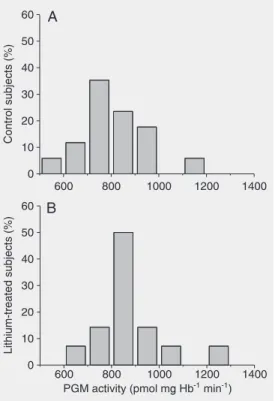
maxi-mal-specific activity in each group (Figure 1). Shapiro-Wilk test performed at P = 0.05 showed evidence that phosphoglucomutase activity values measured for both control and lithium-treated groups are normally dis-tributed. The mean ± SEM activity for con-trol subjects was not significantly different from that of patients receiving lithium (800.6 ± 33.3 and 879.5 ± 35.9 pmol mg Hb-1 min-1, respectively; Table 1).
Phosphoglucomutase activity in lithium- and carbamazepine-treated patients
A recent report showed that, although activity is inhibited in vitro by lithium, leu-kocyte phosphoglucomutase activity from a group of seven patients treated with lithium is increased in relation to healthy individuals (11). In our patients, a larger group, erythro-cyte phosphoglucomutase activity was not significantly different from normal. In both cases it would have been better to analyze subjects before and after treatment. How-ever, it was difficult for us to find a bipolar I patient that had been not medicated. Since we lacked this control we decided to test phosphoglucomutase activity in erythrocytes from patients treated with carbamazepine. We first assayed erythrocyte phosphogluco-mutase activity in vitro in the presence of carbamazepine in order to test if carbamaze-pine modulates the activity of the enzyme. The results showed that carbamazepine does not alter phosphoglucomutase activity (data Figure 1. Frequency distribution
of phosphoglucomutase-specif-ic activity in control subjects and bipolar I patients. Phosphoglu-comutase (PGM) activity was measured in lysed erythrocytes from control healthy volunteers (A; N = 22) and from lithium-treated patients (B; N = 21). Data are the average of three repli-cates for each individual. Values are normally distributed accord-ing to the Shapiro-Wilk test per-formed at P = 0.05 (values ob-tained were: W = 0.95732, P = 0.56969 for control group, and W = 0.89938, P = 0.10989 for lithium-treated groups).
Table 1. Phosphoglucomutase-specific activity (pmol mg Hb-1 min-1) in erythrocytes and inhibition by lithium (IC50, mM).
Phosphoglucomutase activity Lithium (pmol mg Hb-1 min-1) IC50 (mM)
Control (N = 22) 800.6 ± 33.3 1.44 ± 0.34
Lithium-treated subjects (N = 21) 879.5 ± 35.9 1.52 ± 0.36 Carbamazepine-treated subjects (N = 17) 747.3 ± 27.6 ND
Data are reported as means ± SEM. Although the mean phosphoglucomutase-specific activities were significantly different between the three groups (P = 0.02, one-way ANOVA), the post hoc Tukey test indicated that only the difference between lithium-and carbamazepine-treated subjects was significant. ND = not determined.
Figure 2. Inhibition of phospho-glucomutase activity by lithium.
A, The concentration of lithium needed for 50% inhibition of phos-phoglucomutase activity (IC50) was determined in three repli-cates from control (N = 22, open bars) and lithium-treated subjects (N = 21, filled bars). A frequency distribution histogram is shown.
not shown). Next we compared phosphoglu-comutase activity between lithium-treated (N = 21) and carbamazepine-treated sub-jects (N = 17) (Table 1). Carbamazepine-treated patients had a lower erythrocyte phos-phoglucomutase activity (747.3 ± 27.6 pmol mg Hb-1 min-1) than subjects treated with lithium (879.5 ± 35.9 pmol mg Hb-1 min-1). This difference was statistically sig-nificant (P = 0.02, one-way ANOVA). It is possible that there is a difference between erythrocyte and leukocyte phosphogluco-mutase.
Distribution of lithium’s (IC50) on phosphoglucomutase activity
An important characteristic of bipolar I patients is that lithium treatment is not al-ways effective. Thus, we examined the dis-tribution of the concentration of lithium needed to inhibit erythrocyte phosphogluco-mutase activity by 50% (IC50), comparing control subjects (Figure 2A, open bars) with lithium-treated patients (Figure 2A, filled bars; Table 1). In this experiment, phospho-glucomutase activity was measured in the presence of 0.1 mM Mg2+ since it has been shown that the intracellular free Mg2+ level is approximately 0.16 mM (11). The IC50 frequency distribution showed a best fit when the existence of two different populations was assumed. The distribution showed a bimodal curve, with some individuals clus-tered around a low IC50 (0.35 to 1.8 mM) and others around a high IC50 (3 to 4 mM). We also observed that the bimodal distribution was essentially the same for control subjects and for patients treated with lithium. Al-though there was no difference between con-trols and patients, the variation among indi-viduals was significant.
Lithium treatment might lead to the ex-pression of an isoform of phosphoglucomu-tasethat is more resistant to lithium inhibi-tion. However, Figure 2B shows that the IC50 values of lithium-treated patients were
not correlated with lithemia (correlation co-efficient = -0.27). We also analyzed if IC50 values correlated with the rate of phospho-glucomutase activity and found no correla-tion (data not shown). Although the IC50 values represent inhibition in vitro, it is likely that phosphoglucomutase is not affected by lithium in vivo in patients with a high IC50 since lithemia was less than 1.1 mEq/L in all cases.
Discussion
individuals before and after prolonged lithi-um medication.
Phosphoglucomutase, fructose 1,6-bis-phosphatase and glycogen synthase kinase 3 are inhibited by lithium and are all related to glycogen metabolism (Figure 3). However, the role of glycogen in brain metabolism and mood disorders is not well understood. Glial cells play an important role in glycogen metabolism in the brain. Recent findings indicate that glycogen in astrocytes can sup-port axon function under both pathological and physiological conditions, with astrocytes
exporting lactate to neurons by degrading glycogen during an aglycemia insult (16). It has also been found that the number of glial cells is reduced in major depressive disor-ders, and bipolar patients not treated with lithium or valproate had a significant glial reduction (17). Inhibition of phosphogluco-mutase and glycogen synthase kinase 3 en-zymes could impair glycogen turnover. How-ever, prolonged lithium treatment might re-sult in increased glycogen metabolism in the brain.
An important aspect of our results is that phosphoglucomutase inhibition by lithium (IC50) in erythrocytes showed a bimodal be-havior among the subjects studied: in part of the population the IC50 was less than 1 mM, close to the therapeutic range used, while in another part the IC50 was more than 3 mM, far from the range used therapeutically. Both control and lithium-treated subjects showed a bimodal distribution, which suggests that at least two different isoforms of phospho-glucomutase are normally expressed in eryth-rocytes. Expression of the resistant form is not correlated to prolonged lithium treat-ment since the distribution of IC50 in lithium-treated subjects was not related to lithemia (Figure 2B). If phosphoglucomutase is an important target for lithium therapy we might expect subjects with a high lithium IC50 not to be responsive. This issue must be studied further in patients undergoing lithium mono-therapy.
Acknowledgments
We thank Prof. Leila Grivet for assis-tance with blood collection, Sônia C.F. Silva for technical assistance, and Claudio A. Masuda for helpful discussions.
References
1. Coryell W, Solomon D, Leon AC, Akiskal HS, Keller MB, Scheftner WA, et al. Lithium discontinuation and subsequent effectiveness.
Am J Psychiatry 1998; 155: 895-898.
2. Klein PS, Melton DA. A molecular mechanism for the effect of lithium on development. Proc Natl Acad Sci U S A 1996; 93: 8455-8459. 3. Kao KR, Elinson RP. The legacy of lithium effects on development.
Biol Cell 1998; 90: 585-589.
4. Peters DJ, van Lookeren Campagne MM, Van Haastert PJ, Spek W, Schaap P. Lithium ions induce prestalk-associated gene expression and inhibit prespore gene expression in Dictyostelium discoideum. J Cell Sci 1989; 93 (Pt 1): 205-210.
5. Stambolic V, Ruel L, Woodgett JR. Lithium inhibits glycogen syn-thase kinase-3 activity and mimics wingless signalling in intact cells.
Curr Biol 1996; 6: 1664-1668.
6. Hedgepeth CM, Conrad LJ, Zhang J, Huang HC, Lee VM, Klein PS. Activation of the Wnt signaling pathway: a molecular mechanism for lithium action. Dev Biol 1997; 185: 82-91.
7. York JD, Ponder JW, Majerus PW. Definition of a metal-dependent/ Li(+)-inhibited phosphomonoesterase protein family based upon a conserved three-dimensional core structure. Proc Natl Acad Sci U S A 1995; 92: 5149-5153.
8. Masuda CA, Xavier MA, Mattos KA, Galina A, Montero-Lomeli M. Phosphoglucomutase is an in vivo lithium target in yeast. J Biol Chem 2001; 276: 37794-37801.
9. Nordenberg J, Kaplansky M, Beery E, Klein S, Beitner R. Effects of lithium on the activities of phosphofructokinase and phosphogluco-mutase and on glucose-1,6-diphosphate levels in rat muscles, brain
and liver. Biochem Pharmacol 1982; 31: 1025-1031.
10. Bro C, Regenberg B, Lagniel G, Labarre J, Montero-Lomeli M, Nielsen J. Transcriptional, proteomic, and metabolic responses to lithium in galactose-grown yeast cells. J Biol Chem 2003; 278: 32141-32149.
11. Csutora P, Karsai A, Nagy T, Vas B, Kovacs L, Rideg O, et al. Lithium induces phosphoglucomutase activity in various tissues of rats and in bipolar patients. Int J Neuropsychopharmacol 2005; 1-7. 12. American Psychiatric Association. Diagnostic and statistical manual for mental disorders - DSM-IV. 4th edn. Washington: American Psychiatric Press; 1994.
13. First MB, Spitzer RL, Gibbon M, Williams JBM. Structured clinical interview diagnostic (SCID) for DSM-IV axis I disorders-clinician version (SCID-CV). Washington: American Psychiatric Press; 1997. 14. Bergmeyer HU. Methods in enzymatic analysis. 3rd edn. Weinheim:
Verlag Chemie; 1986.
15. Drabkin DL. The molecular weight of haemoglobin, its iron and nitrogen content and optical properties - their relevance in the prob-lem of a reference standard for haemoglobin measurement. Bibl Haematol 1965; 21: 33-42.
16. Brown AM, Baltan TS, Ransom BR. Energy transfer from astrocytes to axons: the role of CNS glycogen. Neurochem Int 2004; 45: 529-536.