Preliminary Analysis of the Genetic Variability of Two
Natural Beds of the Scallop
Euvola ziczac
(Linnaeus, 1758)
in Brazil
Mercedes Gonzalez Wangüemert
1, Paulo Ricardo Pezzuto
2*and Carlos Alberto Borzone
3 1Departamento de Ecología e Hidrología, Facultad de Biología. Universidad de Murcia, Espinardo 30100 Murcia -España. 2Centro de Ciências Tecnológicas, da Terra e do Mar - CTTMar/ /UNIVALI, C.P.360, CEP 88302-202, Itajaí - SC, Brazil. 3Centro de Estudos do Mar, Universidade Federal do Paraná - CEM/UFPR, Av. Beira Mar s/n, Pontal do Sul, CEP 83255-000, Pontal do Paraná - PR, Brazil.ABSTRACT
Euvola ziczac (formerly Pecten ziczac), a simultaneous hermaphroditic scallop was heavily fished in Brazil between
1972 and 1980. The production peaked in 1980 with 8,800 tons and was followed by the total collapse of the resource. In order to investigate the possible loss of genetic variability of the stock associated to overfishing and self-fertilization, the polymorphism of phosphoglucomutase (PGM) and glucose phosphate isomerase (GPI) was analyzed by electrophoresis of the adductor muscle of scallops from São Francisco (26° 20.583’S; 48° 16.507’W) and Bom Abrigo (25° 28.735’S; 47° 37.621’W) beds; the southern and northern extremes of the scallop fishing ground, respectively. Animals from São Francisco showed a strong deficiency of heterozygosity for GPI and PGM. In addition, PGM showed *exclusive alleles for each bed. Such results coupled with other information about the species suggested the following hypothesis: a) the stock was a metapopulation with at least two populations; b) some reproductive isolation might be occurring which might be influenced by conditions of larval transport and by the extremely low densities of scallops; c) presently, the stock seemed to be mostly maintained through self-fertilization; d) São Francisco could constitute a source-area, contributing with larvae and recruits to Bom Abrigo and other areas; e) both beds were suffering a genetic homogenization more evident in São Francisco. Such hypothesis needed to be investigated in order to furnish guidelines for future programs of recovery and management of the resource.
Key words: Genetic variability, Stock depletion, Scallop, Euvolaziczac, Brazil.
*
Author for correspondence
INTRODUCTION
Among the marine invertebrates, scallops can be considered one of the most important fishing resources, owing to the expressive economic yields obtained by commercial exploitation of their natural beds and aquaculture. In Brazil the family Pectinidae is represented by 18 species (Rios, 1994) but only Euvola ziczac (Linnaeus, 1758) (formerly Pecten ziczac) and Nodipecten
nodosus (Linnaeus, 1758) have shown some economic importance. The former species was heavily fished on the southeastern Brazilian shelf during the 1970s and early 1980s. The latter has been cultured but still in a incipient state. Recently, Pezzuto & Borzone (1997a) reviewed
the data on the E. ziczac fishery in Brazil. The exploitation of the species started between 1972 and 1973, as a response to high international prices of scallop meat and decreasing yields of penaeid shrimps, the target species of the double-rig trawler fleet that operated in the region. Between 1972 and 1980, there were two peaks of scallop production, the highest reaching 8,800 tons in 1980. After this peak the stock was completely collapsed and E. ziczac became a minor by-catch item in the shrimp fishery, with current annual landings not exceeding 1-10 t (Pezzuto & Borzone, 1997a; Perez & Pezzuto, 1998).
Borzone (unpubl. data) estimated a reduction of 80% in the area, 89% in the abundance and 99% in the biomass of the scallop beds. The best yields obtained by the authors in the hauls conducted during the 1995-1996 cruises were only 35 individuals per hour, using a heavy 2-m-wide beam-trawl at trawling speeds of 3-4 knots, which corresponded to a trawled area of ca. 14,800 m2 (Borzone & Pezzuto, 1997; Pezzuto & Borzone, 1997b). These figures and the continuous drop in the catches observed since 1981, suggested a critical state of the species that probably had its natural restocking capacity transposed by severe overfishing. In addition, it could also be possible that such extreme depletion might have contributed to a significant decline in the genetic diversity of the species, because many pre-existent alleles could have disappeared with the organisms. This situation seems to be even more likely since
E. ziczac is a functional hermaphroditic (Betancourt et al., 1995). Therefore, while the self-fertilization could be used by the species as a reproductive strategy to overcome or minimize the effects of strong fluctuations in abundance (Betancourt et al., 1995), it could also contribute to the loss of genetic variability of the population, with a consequent increase of homozygosity in the stock that could in turn reduce the chances of success of its recovery.
This article presents some data on genetic variability of E. ziczac collected in two natural beds in Brazil, and addresses some hypotheses about the consequences of the overfishing and the spatial structure of the population.
MATERIAL AND METHODS
Specimens of E. ziczac were collected during the “Scallop Project Cruise XII”, carried out between 18 and 20 of February 1997 (see Pezzuto et al., 1988, for details of the cruise). Ten individuals were obtained in Bom Abrigo (25°28.735’S; 47°37.621’W) and 20 in São Francisco (26°20.583’S; 48°16.507’W) beds (Fig. 1b), corresponding to animals collected in one and two hauls, respectively. Although the number of individuals was low, it could be considered representative of the beds since their densities were extremely low, as discussed above.
-48.80 -48.60 -48.40 -48.20 -48.00 -47.80 -47.60 -47.40 -47.20 -47.00 -26.40
-26.20 -26.00 -25.80 -25.60 -25.40 -25.20 -25.00
São Francisco do Sul Island
100 m Paranaguá
Bay
Bom Abrigo Island Cananéia
a
-48.80 -48.60 -48.40 -48.20 -48.00 -47.80 -47.60 -47.40 -47.20 -47.00 -26.40
-26.20 -26.00 -25.80 -25.60 -25.40 -25.20 -25.00
Cananéia
Bom Abrigo Island
Paranaguá Bay
São Francisco do Sul Island
100 m b
Figure 1 - Distribution and yields of Euvola ziczac in southern Brazil. Values are catches of scallop by hour of trawling using a standard otter trawl. a: catches for 1974-1975; b: catches for 1995-1996.
current font at 3 mA for three hours. The revelation solutions were prepared according to Schaal & Anderson (1974) and Harris & Hopkinson (1976), with minor modifications. In order to prevent overstaining it was used a fixative solution of 10 % acetic acid + 90 % distilled water.
RESULTS AND DISCUSSION
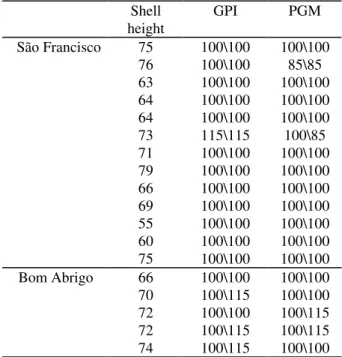
In both beds, GPI was polymorphic and codified only by two alleles. In the active form this enzyme is a dimere and therefore, individuals can show one or three bands whether they are homozygotes or heterozygotes, respectively. Animals from São Francisco showed a strong deficiency of heterozygosity. Except by one individual that was homozygote for the allele 115, all specimens were homozygotes for the allele 100. On the other hand, three of the five specimens from Bom Abrigo were heterozygotes for the GPI (Table 1).
Unlike GPI, PGM was a monomeric enzyme showing one or two bands. The same pattern of excess of homozygosity found for GPI in São Francisco was observed for PGM in this bed with the exception that one individual was heterozygote. The enzyme showed three alleles: 115; 100 and 85. Allele 115 was exclusive of individuals from Bom Abrigo and occurred only in heterozygosity, while allele 85 was found only in São Francisco, either in homozygosity or heterozygosity (Tables 1 and 2).
Despite the scarcity of material used in this study, the electrophoretic analysis of GPI and PGM enzymatic systems showed a clear excess of homozygosity in the São Francisco bed, as found in other natural populations of bivalves (Wilkins & Mathers, 1979; Zouros & Foltz, 1984a, 1984b; Gaffney et al., 1990). Specially for PGM, it was noteworthy the presence of exclusive alleles in both beds, which could indicate the development of characteristic alleles resulting from the partial reproductive isolation of the areas. On the other hand, Table 3 shows that the genetic identity and genetic distance between the beds are very similar for both enzymes. The high genetic identity confirmed the inexistence of specific differences between organisms from Bom Abrigo and São Francisco, and suggested the occurrence of an important genetic flow in the past resulting from
the high abundances and the continuous distribution of the species in this ground in 1974-1975, as showed in Figure 1a. This pattern of distribution and abundance of the species was severely changed after the collapse of the fishery in 1981, when the population was gradually segregated in the actual two low density beds placed in the opposite extremes of the area (Fig. 1b).
Table 1 - Euvola ziczac. Individual phenotypes
observed for phosphogluco-mutase (PGM) and glucose phosphate isomerase (GPI) extracted from adult specimens from São Francisco and Bom Abrigo beds. Shell height in millimeters
.
Shell height
GPI PGM
São Francisco 75 100\100 100\100
76 100\100 85\85
63 100\100 100\100
64 100\100 100\100
64 100\100 100\100
73 115\115 100\85
71 100\100 100\100
79 100\100 100\100
66 100\100 100\100
69 100\100 100\100
55 100\100 100\100
60 100\100 100\100
75 100\100 100\100
Bom Abrigo 66 100\100 100\100
70 100\115 100\100
72 100\100 100\115
72 100\115 100\115
74 100\115 100\100
Thus, assuming a conservative (possibly short)
period of 12 days for the larval development
on the shelf, the interchange of larvae between
São Francisco and Bom Abrigo would be
possible with a latitudinal net transport of only
0.2 knots (
ca.
0.1 m.s
-1), considering the
hypothetical inexistence of physical and
behavioral mechanisms of larval retention in
the vicinity of the beds.
Table 2 - Euvola ziczac. Allelic frequencies and heterozygosity of phosphoglucomutase (PGM) and glucose
phosphate isomerase (GPI) extracted from adult specimens from São Francisco (SF) and Bom Abrigo (BA) beds. N: number of individuals; Ho: observed heterozigosity; He: expected heterozygosity; D: deficiency of heterozygosity.
Bed Enzyme N Allelic frequencies Heterozigosity D
100 115 85 HO HE
BA GPI 5 0.70 0.30 - 0.6 0.42 0.43
SF GPI 13 0.92 0.08 - 0 0.14
-BA PGM 5 0.80 0.20 - 0.4 0.32 0.25
SF PGM 13 0.88 - 0.12 0.08 0.20 -0.60
Table 3 - Euvola ziczac. Genetic identity and genetic distance calculated for specimens from São Francisco (SF) and Bom Abrigo (BA) beds based on electrophoretical analysis of phosphoglucomutase (PGM) and glucose phosphate isomerase (GPI).
Bed Enzyme Genetic
Identity
Genetic distance
BA-SF GPI 0.9482 0.0531
BA-SF PGM 0.9620 0.0387
However, the pattern of currents suggested by Castro-Filho et al. (1987) and Castro-Filho (1990) for the southeastern Brazilian shelf suggested that such mechanisms might occur. According to these authors, during winter the inner continental shelf from the coast to the 50 m isobath remains dominated by Subantarctic waters flowing to the northeast and showing a homogeneous vertical profile of temperature and salinity. This pattern changes during summer when a strong vertical stratification occurs, with high temperature water flowing to the southwest in the surface (Coastal waters) and low temperature water (South Atlantic Central water) flowing to the northeast below the thermocline. Observations on the temporal variation of the gonadosomatic index and the recruitment patterns of E. ziczac (Pezzuto & Borzone, unpubl. data) suggested that the species spawns twice a year in the region, with the first and strongest spawning peak occurring on the summer and the second and weakest on the winter. Hence, the consequences of the circulation and spawning patterns would be the exportation of larvae from both beds to the northeast during the
abundance, though such strategy still have not been confirmed with field data. In the case of E.
ziczac, at least two evidences supported the hypothesis that the self-fertilization could be the main responsible for the maintenance of the existent beds: a) laboratory experiments have showed that contrary to other species (e.g. Pecten
maximus; Beaumont & Budd, 1983), the occurrence of self-fertilization in E. ziczac specimens did not interfere either in the survival or in the growth of their larvae and juveniles, at least in two self-produced generations (Betancourt
et al., 1995); b) densities of the actual beds were so extremely low that the success of cross-fertilization in the water column was expected to be very unlikely, even supposing that the spatial pattern of the individuals in micro-scale was strongly clumped. Like other pectinids (e. g. Caddy, 1989; Orensanz et al., 1991; Ciocco, 1992), the stock of E. ziczac in southern Brazil seems to be another example of self-sustainable metapopulation consisting of a minimum of two populations represented by the São Francisco and Bom Abrigo beds, possibly with different b u
t still not confirmed roles in stock maintenance. As pointed out by Caddy (1975), the dynamic pool axiom, commonly used for finfish management did not apply to sedentary species such as scallops and therefore, in order to implement correct management actions it would be necessary to distinguish their self-sustainable and permanent populations from the edge-populations that could be more dependent and/or that occured in a more transitory form.
The hypotheses raised in this work needs to be investigated in order to furnish guidelines for future programs of recovery and management of the resource in southern Brazil.
ACKNOWLEDGMENTS
Our thanks to Dr. José Domingo Fontana from the Department of Biochemistry of the Universidade Federal do Paraná (UFPR) for his collaboration to the electrophoretic analysis, and to Dr. José Angel Alvarez Perez by the critical revision of the manuscript. This contribution was developed as part of the “Scallop Project” supported by CTTMar/UNIVALI, CEM/UFPR, CEPSUL/ IBAMA (Centro de Pesquisa e Extensão Pesqueira do Sudeste-Sul; Instituto Brasileiro do Meio Ambiente e dos Recursos Naturais Renováveis), IFS (International Foundation for Science) Grant No. A/2197-1 to C.A.B. and a Ph.D. grant of CAPES (Coordenação de Aperfeiçoamento de Pessoal de Nível Superior) to P.R.P. The project is part of the P.R.P. Ph.D. thesis currently in development at the Zoology Department - UFPR.
RESUMO
A vieira hermafrodita simultânea Euvola ziczac (anteriormente Pecten ziczac), foi intensamente explotada no Brasil entre os anos de 1972 e 1980. O máximo de produção foi atingido em 1980, com 8800 toneladas desembarcadas, após o qual ocorreu o total colapso do recurso. Com o objetivo de reconhecer uma possível perda de variabilidade genética do estoque associada à sobrepesca e à autofecundação, analisou-se por técnicas eletroforéticas o polimorfismo da fosfoglicomutase (PGM) e da glicose fosfato isomerase (GPI) do músculo adutor de vieiras do banco de São Francisco (26°20,583’S; 48°16,507’W) e Bom Abrigo (25°28,735’S; 47°37,621’W), nos extremos sul e norte da área de pesca, respectivamente. Os animais de São Francisco mostraram uma forte deficiência de heterozygocidade para a GPI e a PGM. A PGM mostrou também alelos exclusivos deste banco. Estes resultados, junto com outras informações da espécie, levantam às seguintes hipóteses: a) o estoque é uma metapopulação com pelo menos duas populações; b) algum isolamento reprodutivo pode ocorrer influenciado pelas condições de tranporte larval e pelas densidades extremamente baixas dos adultos; c) atualmente o estoque parece manter-se principalmente por autofecundação; d) o banco de São Francisco pode constituir uma área fonte, contribuindo com larvas e recrutas para o banco de Bom Abrigo e outras áreas; e) ambos bancos estariam sofrendo uma homogenização genética, mais evidente em São Francisco. Estas hipóteses necessitam ser investigadas com o objetivo de prover orientação a futuros programas de recuperação e manejo do recurso.
REFERENCES
Beaumont, A. R. & Budd, M. D. (1983), Effects of self-fertilization and other factors on the early development on the scallop Pecten maximus. Mar.
Betancourt, R. J.; Pérez, J. E.; Velez, A.; Freites, L & Segnini, M. I. (1995), Efectos de la consanguinidad en la vieira Euvola ziczac (L). Bol. Inst. Oceanogr.
Venezuela, Univ. Oriente, 34(1 & 2): 69-75.
Borzone, C. A. & Pezzuto, P. R. (1997), Relatório técnico dos cruzeiros do Projeto Vieira. I. Cruzeiro I (4 a 9 de dezembro de 1995). Notas Tec. FACIMAR,
1: 67-79.
Borzone, C. A.; Pezzuto, P. R. & Marone, E. (1999), Oceanographic characteristics of a multi-specific fishing ground of the central south Brazil bight.
Marine Ecology, 20 (2): 131-146.
Caddy, J. F. (1975), Spatial model for an exploited shellfish population, and its application to the Georges Bank scallop fishery. J. Fish. Res. Board
Can. 27: 535-549.
Caddy, J. F. (1989), A perspective on the population dynamics and assessment of scallop fisheries, with special reference to the sea scallop, Placopecten
magellanicus Gmelin. In: Marine Invertebrate
Fisheries - Their Assessment & Management: (Ed.) J. F. Caddy, New York : John Wiley & Sons, Pp. 559-589.
Castro-Filho, B. M. (1990), Estado atual do conhecimento dos procesos fílicos das águas da plataforma continental sudeste do Brasil. In: Anais do
II Simpósio de Ecossistemas da Costa Sul e Sudeste Brasileira: Estrutura, Função e Manejo. Águas de Lindóia, SP, Pp. 1-19.
Castro-Filho, B. M., Miranda, L. B. & Miyao, S. Y. (1987), Condições hidrológicas na plataforma continental ao largo de Ubatuba: variações sazonais e em média escala. Bolm. Inst. oceanogr., São Paulo, 35(2): 135-151.
Ciocco, N. F. (1992), Differences in individual growth rate among scallop (Chlamys tehuelcha [D’Orb.]) populations from the San José Gulf (Argentina): experiments with transplanted individuals. J. Shellfish
Res., 11(1) 27-30.
Gaffney, P., Scott, T. M., Koehn, R. & Diehl, W. (1990), Interrelationships of heterozygosity, growth rate, and heterozygote deficiencies in the coot clam,
Mulinia lateralis. Genetics, Austin, Tex. 124: 687-699.
Harris, H & Hopkinson, D. A. (1976), Handbook of
enzyme electrophoresis in humans genetics.
Amsterdam : Elsevier.
Orensanz, J. M.; Parma, A. M. & Iribarne, O. (1991), Population dynamics and management of natural
stocks. In: Scallops: Biology, Ecology and
Aquaculture: (Ed.) S. E. Shumway,Developments in Aquaculture and Fisheries Science, 21. Amsterdam: Elsevier, Pp. 625-713
Perez, J. A. A. & Pezzuto, P. R. (1998), Valuable shellfish species in the by-catch of shrimp fishery in southern Brazil: spatial and temporal patterns. J.
Shellfish Res., 17(1): 303-309.
Pezzuto, P. R. & Borzone, C. A. (1997a), The scallop
Pecten ziczac (Linnaeus, 1758) fishery in Brazil. J.
Shellfish Res., 16(2): 527-532.
Pezzuto, P. R. & Borzone, C. A. (1977b), Relatório técnico dos cruzeiros do Projeto Vieira. II. Cruzeiros II (15 a 17 de março de 1996) e III (20 a 22 de abril de 1996). Notas Tec. FACIMAR, 1: 81-88.
Pezzuto, P. R.; Borzone, C. A.; Abrahão, R. L. B. E.; Brandini, F. & Machado E. C. (1998), Relatório técnico dos cruzeiros do Projeto Vieira. III. Cruzeiros IV (maio de 1996) a XIV (maio de 1997). Notas Tec. FACIMAR., 2: 109-129.
Rios, E. (1994), Seashells of Brazil. Rio Grande : Editora da FURG, 2nd ed.
Rojas, A. V. & Seijo, C. L. (1990), El cultivo de moluscos en Venezuela. In: Cultivo de Moluscos en
America Latina (Ed.) A. Hernandez, Red Regional de Entidades Y Centros de Acuicultura de América Latina, Pp. 345-369.
Schaal, B. A & Anderson, W. W. (1974), An outline of techniques for starch gel electrophoresis of enzymes from the American oysters, Crassostrea virginica Gmelin. Tech. Rep. Ser. Gamar. Sci. Cent. Savannah
A-74(3): 1-17.
Wilkins, N. P & Mathers, N. F. (1979), Phenotypes of phosphoglucose isomerase in some bivalve molluscs.
Comp. Biochem. Physiol., 988: 599-611.
Zouros, E. & Foltz, D. W. (1984a), Minimal selection requirements for the correlation between heterozygosity and growth, and for the deficiency of heterozygotes in oyster populations. Developmental
Genetics, 4: 393-405.
Zouros, E. & Foltz, D. W. (1984b), Possible explanations of heterozygote deficiency in bivalve molluscs. Malacologia, 25: 583-591.