Rev Bras
Cineantropom
Hum
DOI: http://dx.doi.org/10.5007/1980-0037.2017v19n2p196
original article
Sport classiication for athletes with visual
impairment and its relation with swimming
performance
Classiicação esportiva para atletas com deiciência
visual e sua relação com o desempenho na natação
Elaine Cappellazzo Souto1,2
Leonardo dos Santos Oliveira1
Claudemir da Silva Santos2
Márcia Greguol1
Abstract – he medical classiication (MC) adopted for swimmers with vision visual impairment (VI) does not clearly elucidate the inluence of vision loss on performance. In a documentary research, the inal time in the 50-, 100- and 400-m freestyle events and MC (S11, S12 and S13) of national (n = 40) and international (n = 72) elite swimmers was analyzed. he analysis was performed using the Kruskal-Wallis test and Spearman’s
correlation with 95% conidence (P < 0.05) and Cohen’s d was calculated. here was a
large efect of MC on the inal time in the 50-m (P = 0.034, d = 1.55) for national
ath-letes and in the 50-m (P = 0.001, d = 2.64), 100-m (P = 0.001, d = 3.01) and 400-m (P
= 0.001, d = 2.88) for international athletes. S12 and S13 classes were faster compared
to S11 class for all international events, but only in the 50-m for the national event (P
< 0.05). It was found a strong negative relationship between the inal time and MC for international athletes (Spearman’s Rho ≥ 0.78). here was a signiicant inluence of MC on the performance of swimmers in freestyle races, especially in international swimmers. hus, having a visual residue seems to be suicient for S12 and S13 swimmers to achieve similar performance.
Key words: Athletic performance; Blindness; Low vision; Sports for persons with dis-abilities.
Resumo – A classiicação médica (CM) adotada aos nadadores com deiciência visual (DV) não consegue elucidar claramente a inluência da perda da visão no desempenho. Em uma pesquisa documental, analisou-se o tempo inal de prova dos 50, 100 e 400m livre e a CM (S11, S12 e S13) de nadadores nacionais (n = 40) e internacionais (n = 72) de elite. Utilizou-se o teste de Kruskal-Wallis e a correlação de Spearman, com 95% de coniança (P < 0,05) e o tamanho do efeito d de Cohen foi calculado. Veriicou-se um grande efeito da CM no tempo inal de prova dos 50m (P = 0,034; d = 1,55) para atletas nacionais e dos 50m (P = 0,001; d = 2,64), 100m (P = 0,001; d = 3,01) e 400m (P = 0,001; d = 2,88) para atletas internacionais. As classes S12 e S13 foram mais rápidas comparadas à classe S11 em todas as provas internacionais, mas apenas nos 50m nas provas nacionais (P < 0,05). Foram encontrados fortes relacionamentos negativos entre o tempo inal de prova e a CM para os atletas internacionais (Rho de Spearman ≥ 0,78). Houve uma signiicativa inluência da CM no desempenho de nadadores nas provas do nado livre, especialmente em nadadores internacionais. Assim, ter um resíduo visual parece ser o suiciente para que os nadadores com baixa visão, nas classes S12 e S13, adquiram performance semelhante.
1 State University of Londrina. Post-graduate Program in Physical Education. Londrina, PR. Brazil.
2 Federal University of Paraíba. Department of Physical Education. João Pessoa, PB. Brazil.
Classiication in sports reduces the likelihood that the results in
competi-tions are biased1, being essential in sporting events, especially in
Para-lympics. As in other modalities, swimmers with visual impairment (VI) have the classiication model based on disability, also known as medical
classiication (MC)2,3. However, the International Paralympic Committee
(IPC) is reviewing this classiication system for the evaluation of swimming
functionality based on VI4. hus, investigations in the current system may
support this reformulation.
To date, three classes divide athletes with VI (B1, B2 and B3), with visual acuity less than or equal to the logarithm of the minimum resolution angle (LogMAR) 1.0 or restricted visual ield less than 40 degrees, with
diferent nomenclatures in each modality5. For swimming, these classes
are replaced by preix “S” for freestyle, backstroke and butterly events, “SB” for breaststroke and “SM” for medley events, plus the numbers 11, 12 and 13 for the impairment degree. Number 11 is poorer visual acuity than LogMar 2.6, 12 with visual acuity ranging from LogMar 1.5 to 2.6 and / or visual ield less than 10 degrees and 13 with visual acuity from
LogMar 1.4 to 1 and / or visual ield less than 40 degrees5.
herefore, in a fair competition, the inluence of VI should be sim-ilar at all competitive levels. hus, it is expected that swimmers in the upper classes will outperform those in the lower classes and that similar results will be shown in the same class. However, the formulation of the non-evidence-based classiication system consists of one of the reasons
for revisions in the criteria adopted1, as well as the pressure caused by the
commercialization process of the Paralympic sport, with reduction in the number of events and, consequently, in the number of classes, to attract
greater media attention, spectators, and sponsors6.
Regardless of possible changes in the classiication system for VI by the IPC, investigations in this area are necessary to expand discussions on positive aspects and possible intervening variables in order to contrib-ute to a more efective system. Recent studies with Paralympic coaches, athletes, classiiers and administrators have pointed out that they agreed that additional tests are needed to better control the impact of disability on sport performance, as well as the acuity and visual ield tests used in
MC7. Considering that freestyle event has greater participation of athletes
in competitions at diferent distances, it is relevant to observe the classii-cation applied to swimmers with VI in diferent events and competitions. Few studies have analyzed the relationship between vision loss and
performance at major international swimming events8-11. Souto, Oliveira
and Santos Filho8 veriied that the MC system was related to the inal
time of national and international athletes in the 50-m freestyle event.
Similarly, Malone et al.10 veriied that stroke parameters during
swim-ming were afected by VI at 50- and 100-m freestyle event at the 1996
Visual impairment and swimming performance Souto et al.
that the degree of VI seems not to be the main distinguishing factor of the performance of Paralympic athletes in the 100-m freestyle event at
the 2000 Sydney Paralympic Games, and Makris et al.11 found that MC
was a signiicant determinant only for the breaststroke event in the 2009 European Championship.
In this sense, there seems to be no consensus that diferences in acuity and visual ield established in the classes are proportional in sport. In ad-dition, the literature does not present information on the inal time in all national and / or international freestyle events related to VI. herefore, this study analyzed and compared the inal time of national and international athletes in diferent classes (S11, S12, S13) in the 50-, 100- and 400-m freestyle events. It is speculated that MC, based on the deiciency, inlu-ences the performance in all events, regardless of the competitive level.
METHODOLOGICAL PROCEDURES
Study characterization
his is a documentary research by secondary sources12. Since the
informa-tion is public domain, there was no need for use the informed consent form.
Procedures
Two independent researchers accessed the websites of the Brazilian Paralympic
Committee13 and the International Paralympic Committee14 in order to collect
the inal time of athletes (in seconds) in the 50-, 100- and 400-m freestyle
events of the 3rd National Stage of the “Circuito Loterias da Caixa Brasil de
Atletismo, Natação e Halteroilismo”, held in Fortaleza / CE in December 2013, as well as data from the Paralympic Games in London, in August 2012. he selection of these events occurred because they brought together the best athletes in their respective years of accomplishment. In turn, events were chosen because they are the fastest and with the largest number of swimmers.
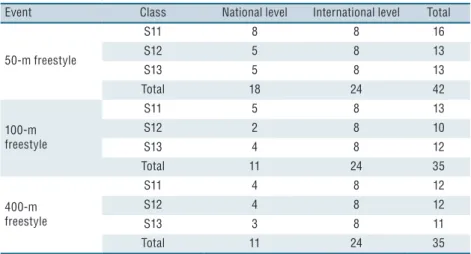
Data from all male inalists of S11, S12 and S13 classes were included in the 50-, 100- and 400-m freestyle events. Results from inalists who, for some reason, were disqualiied or did not complete the race were excluded. hus, the performance of 40 national and 72 international athletes was analyzed. Table 1 summarizes the number of participants per race and competitive level.
Data analysis
Data were reported by median and interquartile range, since they did
not present normal distribution (Shapiro-Wilk test, P < 0.05).
Compari-sons among classes were performed using the Kruskal-Wallis test and, in cases where there was signiicant diference, paired comparisons were
veriied using the Dunn post hoc test. Cohen efect size (d) was calculated
for diferences among classes, using the Psychometrica software15, with d
= 0.2-0.4, d = 0.5-0.7 and ≥ 0.8 being considered as small, medium and
the Spearman correlation (Rho). All analyses were performed with 95%
conidence (P < 0.05).
Table 1. Absolute frequency of participants per event, class based on visual impairment and competitive level.
Event Class National level International level Total
50-m freestyle
S11 8 8 16
S12 5 8 13
S13 5 8 13
Total 18 24 42
100-m freestyle
S11 5 8 13
S12 2 8 10
S13 4 8 12
Total 11 24 35
400-m freestyle
S11 4 8 12
S12 4 8 12
S13 3 8 11
Total 11 24 35
RESULTS
he inal time according to the competitive level, test and classiication based on VI is reported in Table 2. International athletes presented better
performance in all events and classes compared to national athletes (P <
0.05). A large efect of MC was observed in the inal time in the national
50-m event (χ2
(2) = 6.76, P = 0.034, d = 1.55). National swimmers’ time in
the 50-m event was shorter only in the S13 class compared to S11 (P =
0.001). National swimmers’ performance in the 400-m event was similar
among classes (χ2
(2) = 0.053, P = 0.974). he 100-m national event was not
analyzed due to the small number of athletes (n = 2). In addition, a great variability was observed in the national results within classes.
On the other hand, a signiicant efect of MC on performance for all
international events analyzed was observed: 50-m (χ2
(2) = 15.26, P = 0.001,
d = 2.64), 100-m (χ2
(2) = 16.64, P = 0.001, d = 3.01) and 400-m (χ
2
(2) = 15.26,
P = 0.001, d = 2.88). hus, time was shorter for S13 (P = 0.001) and S12
(P = 0.014) compared to S11 for 50-m. In the 100-m event, the inal time
was shorter for S13 (P = 0.001) and S12 (P = 0.014) compared to S11. he
same result was found in the 400-m event, with shorter time for S13 (P
= 0.001) and S12 (P = 0.027) compared to S11. he performance of S12
and S13 classes was similar in all tests and competitive levels (P > 0.05).
Visual impairment and swimming performance Souto et al.
Table 2. Final time of national and international swimmers in the 50-, 100- and 400-m freestyle events of S11, S12 and S13 classes.
Competitive level Event Class
S11 S12 S13
National
50-m 31.7 (2.0) 30.2 (3.4) 29.9 (4.3)*
100-m 71.1 (8.5) 67.8 (-)** 65.7 (12.4)
400-m 340.1 (26.0) 342.3 (42.2) 349.1 (6.3)
International
50-m 26.6 (1.4)† 24.8 (1.4)* † 24.2 (0.6)* †
100-m 61.0 (3.5) † 55.0 (3.1)* † 53.6 (0.7)* †
400-m 291.2 (20.1)† 262.7 (18.1)* † 253.4 (12.7)* †
Values reported by median and interquartile range. * Significant difference for S11 at the same competitive level (P < 0.05). † Significant difference among competitive levels for the same event and MC (P < 0.05). ** S12 in the 100-m at national level shows no dispersion or was compared because it has only two athletes.
Table 3. Relationship between medical classification (S11, S12 and S13) and final time of national and international swimmers in the 50-, 100- and 400-m freestyle events.
Event National level International level
50-m −0.610 [−0.838; −0.201]* −0.781 [−0.900; −0.552]* 100-m −0.446 [−0.825; 0.210]* −0.826 [−0.922; −0.634]*
400-m 0.072 [−0.551; 0.644] −0.826 [−0.922; −0.634]*
Spearman’s Rho coefficient data with 95% confidence interval. * Significant correlation (P < 0.05).
DISCUSSION
his study analyzed and compared the inal time of national and inter-national athletes of diferent classes (S11, S12, S13) in the 50-, 100- and 400-m freestyle events. he main inding is that the greater the degree of VI, the longer the inal time of international swimmers in the 50-, 100- and 400-m freestyle events; however, this phenomenon is only observed in national athletes in the 50-m freestyle event. Nevertheless, it was not possible to clearly observe diferences in S12 and S13 classes, regardless of competitive level, suggesting the integration of these classes from the inal time in events analyzed, especially at international level. hus, our hypothesis was partially conirmed.
During the 1996 Paralympic Games, one of the reasons attributed to the similarity in 57% of adjacent classes among international disabled swimmers was the reduced number of participants in some classes,
lead-ing them directly to the inals17. It is likely that the limited relationship
among classes and the inal time of national disabled swimmers is also related to the reduced number of competitors that may have inluenced the athlete’s commitment to win the race, since only in the 50-m event in S11 class, there were the same number of international swimmers. In this situation, it is not necessary for the athlete to participate in qualifying stages, contributing to a lower average speed than predicted, saving energy for preferential events.
In addition, intraclass variability found at national level may be related to the level of sports maturity and access to more appropriate training
in the 100-, 200- and 400-m freestyle events11. In our investigation, we
did not have access to information about training. However, in view of the evolution of Paralympic sports in the country, it was expected that these athletes had high level of training, because it is the last event of the year and with the best athletes of Brazil.
It is speculated that the current classiication system presents relative
diiculty in diferentiating performance in swimming7,8. Lack of vision
seems to actually impact performance, which is not so evident in low vision swimmers, suggesting that seeing a little seems to be enough for better
performance18. As observed in our study in the inal times in freestyle
events, both in the 2000 Sydney Paralympic Games9 and in 1996 Atlanta
Paralympic Games10, class S11 swimmers were slower, and those in S12
and S13 classes were not distinguishable. herefore, in addition to the cohesion in the intraclass performance veriied for international athletes, these results suggest the integration of these two classes, among low vision swimmers during the Paralympic Games.
he visual residue of classes S12 and S13 seems to be suicient for swimmers to use visual cues such as the bottom lines of the pool to
ac-curately deine their position and orientation9, contributing to the
perfor-mance similarity. However, it is not enough to compete with non-disabled
athletes. Taylor et al.19 observed diferent high-performance events between
2006 and 2012 in the 400-m freestyle, comparing S13 class swimmers with non-disabled athletes. hese authors found that athletes in this class were slower, but as fast as athletes with minimal physical disability (S10), recommending that despite the diference in type of disability, these classes could compete together.
he possible implications for the results found may also be linked to the evaluation method applied to class identiication. Experts consider that the assessment of visual acuity and visual ield is not enough to deine the athlete’s class, being of greater consensus the insertion of tests of contrast
sensitivity, visual dynamics and light sensitivity7. In addition, current
tests are performed in a room, without water interference and in diferent lighting conditions than in swimming pools, which may inluence the assessment of light sensitivity and underwater vision.
Nevertheless, the diferentiation of S11 with S12 and S13 classes seems to be linked to the compulsory use of opaque glasses for S11 class
during competition7, which does not allow the use of visual residue. S11
class athletes collide more frequently in the swimming lane and swing the direction, increasing their inal time. In addition, the total loss of vision implies diiculties with feedback for the construction of a more accurate
technique10, naturally hindering performance. Acquisition time and type
Visual impairment and swimming performance Souto et al.
have better performance20.
It is noteworthy that the swimming turning is an important factor in the inal result. Martens, Einarsson and Daly found a 1.73 second difer-ence between S11 and S12-S13 classes in the turning of a 100-m freestyle
event18. From these ideas, considering that an athlete performs seven turns
in the 400-m, our results corroborate the superiority of athletes with less visual impairment (S12 and S13) compared to those of class S11, as oc-curred in the 50-m test at national and in all events at international level. However, in our study, it is possible that the variability of results (inter-quartile range) and the restricted number of participants have reduced the statistical power of analyses in the national event, and it was not possible to detect these diferences in the 400-m event.
Other limitations of this study are the absence of information about the disability, such as diagnosis and time of acquisition, and aspects related to training, such as time involved with competitive sports, training format and athlete’s preferential event. his information could be analyzed together with information on the inal time to observe possible interferences of these variables. Further studies could include diferent swimming styles and events as well as females.
CONCLUSION
here was a signiicant inluence of MC on the performance of swimmers in freestyle events, especially in international swimmers. hus, having a visual residue seems to be suicient for S12 and S13 swimmers to achieve similar performance. However, it is emphasized that any union or creation of a new class for athletes with VI eligible in the Paralympic sport must follow the path of research based on scientiic evidence (e.g., studies related to functional aspects, learning, competition rules, interviews with coaches and athletes). In addition to performance data, further investigations should be carried out taking into account the evaluation from diferent aspects of function and visual functionality, among others.
REFERENCES
1. Tweedy SM, Vanlandewijck YC. International Paralympic Committee position
stand-background and scientiic principles of classiication in Paralympic sport. Br J Sports Med 2011;45(4):259-69.
2. International Paralympic Committee. Explanatory guide to Paralympic
classiica-tion: Paralympic summer sports. Bonn: International Paralympic Committee; 2015.
3. Marques RFR, Duarte E, Gutierrez GL, Almeida Jd, Miranda TJ. Esporte
olímpico e paraolímpico: coincidências, divergências e especiicidades numa per-spectiva contemporânea. Rev Bras Educ Fís Esporte 2009;23(4):365-77.
4. International Paralympic Committee. Swimming classiication rules and
regu-lations. 2015; Available from: <https://www.paralympic.org/sites/default/iles/ document/150831095438998_2015_September%2BIPC%2BSwimming%2BCl assiication%2BRules%2Band%2BRegulations_1.pdf>[15 jun 2016].
5. International Blind Federation. Classiication - Deinition of Visual Classes. 2016;
CORRESPONDING AUTHOR
Elaine Cappellazzo Souto Universidade Federal da Paraíba, Departamento de Educação Física Cidade Universitária, João Pessoa, Paraíba, Brasil.
CEP: 58051-900
E-mail: [email protected]
7. Ravensbergen HJ, Mann DL, Kamper SJ. Expert consensus statement to guide
the evidence-based classiication of Paralympic athletes with vision impairment: a Delphi study. Br J Sports Med 2016;50(7):386-91.
8. Souto EC, Oliveira LS, Santos Filho CS. Implicação da Deiciência Visual sobre
o Desempenho nos 50 Metros Livre de Nadadores Nacionais e Internacionais. Rev Bras Cienc Saúde 2016;20(1):15-20.
9. Daly D, Malone LA, Burkett B, Gabrys T, Satkunskiene D. Is sight the main
deterrent to race performance in visually impaired competitive swimmers? Facta Univ 2009;7(1):1-15.
10. Malone LA, Sanders RH, Schiltz JH, Steadward RD. Efects of visual
impair-ment on stroke parameters in Paralympic swimmers. Med Sci Sports Exerc 2001;33(12):2098-103.
11. Makris VI, Yee RD, Langefeld CD, Chappell AS, Slemenda CW. Visual loss and
performance in blind athletes. Med Sci Sports Exerc 1993;25(2):265-9.
12. Sá-Silva J, Almeida C, Guindani J. Documentary research: theoretical and
meth-odological clues. Rev Bras Hist Cienc Soc 2009;1(1):1-15.
13. Comitê Paralímpico Brasileiro. Circuito Loterias Caixas Brasil. 2013; Available
from: <http://www.cpb.org.br/circuito_brasil_caixa_loteiras/> [15 fev 2014].
14. Committee IP. IPC Historical Results Database. 2012; Available from: <http://
www.paralympic.org/results/historical> [15 fev 2014].
15. Lenhard W, Lenhard A. Calculation of efect sizes. Dettelbach: Psychometrica.
2016; Available from: <https://www.psychometrica.de/efect_size.html> [15 jun 2016].
16. Cohen J. Statistical power analysis for the behavioral sciences. 2nd ed. New Jersey:
Lawrence Erlbaum; 1988.
17. Wu SK, Williams T. Paralympic swimming performance, impairment, and the
functional classiication system. Adapt Phys Act Q 1999;16(3):251-70.
18. Martens J, Einarsson I, Daly D, editors. Comparison of race parameters for visual
impaired swimmers. VISTA 2013 Scientiic Conference; 2013; Bonn: International Paralympic Committee.
19. Taylor JB, Santi G, Mellalieu SD. Freestyle race pacing strategies (400 m) of
elite able-bodied swimmers and swimmers with disability at major international championships. J Sports Sci 2016;34(20):1913-20.
20. Skaggs S, Hopper C. Individuals with visual impairments: A review of psychomotor