RESEARCH ARTICLE
Individualizing Pharmacotherapy in Patients
with Renal Impairment: The Validity of the
Modification of Diet in Renal Disease
Formula in Specific Patient Populations with
a Glomerular Filtration Rate below 60 Ml/Min.
A Systematic Review
Willemijn L. Eppenga1☯*, Cornelis Kramers2,3‡, Hieronymus J. Derijks4,5, Michel Wensing1‡, Jack F. M. Wetzels6‡, Peter A. G. M. De Smet1,7☯
1Radboud University Medical Center, Radboud Institute for Health Sciences, IQ Healthcare, Nijmegen, The Netherlands,2Radboud University Medical Center, Department of Pharmacology and Toxicology, Nijmegen, The Netherlands,3Department of Clinical Pharmacy, Canisius Wilhelmina Hospital, Nijmegen, The Netherlands,4Hospital Pharmacy‘ZANOB’,‘s-Hertogenbosch, The Netherlands,5Division of Pharmacoepidemiology and Pharmacotherapy, Utrecht Institute for Pharmaceutical Sciences (UIPS), Utrecht University, Utrecht, The Netherlands,6Radboud University Medical Center, Department of Nephrology, Nijmegen, The Netherlands,7Radboud University Medical Center, Department of Pharmacy, Nijmegen, The Netherlands
☯These authors contributed equally to this work.
‡These authors also contributed equally to this work. *[email protected]
Abstract
Background
The Modification of Diet in Renal Disease (MDRD) formula is widely used in clinical practice to assess the correct drug dose. This formula is based on serum creatinine levels which might be influenced by chronic diseases itself or the effects of the chronic diseases. We conducted a systematic review to determine the validity of the MDRD formula in specific pa-tient populations with renal impairment: elderly, hospitalized and obese papa-tients, papa-tients with cardiovascular disease, cancer, chronic respiratory diseases, diabetes mellitus, liver cirrhosis and human immunodeficiency virus.
Methods and Findings
We searched for articles in Pubmed published from January 1999 through January 2014. Selection criteria were (1) patients with a glomerular filtration rate (GFR)<60 ml/min
(/1.73m2), (2) MDRD formula compared with a gold standard and (3) statistical analysis fo-cused on bias, precision and/or accuracy. Data extraction was done by the first author and checked by a second author. A bias of 20% or less, a precision of 30% or less and an accu-racy expressed as P30% of 80% or higher were indicators of the validity of the MDRD
PLOS ONE | DOI:10.1371/journal.pone.0116403 March 5, 2015 1 / 31
OPEN ACCESS
Citation:Eppenga WL, Kramers C, Derijks HJ, Wensing M, Wetzels JFM, De Smet PAGM (2015) Individualizing Pharmacotherapy in Patients with Renal Impairment: The Validity of the Modification of Diet in Renal Disease Formula in Specific Patient Populations with a Glomerular Filtration Rate below 60 Ml/Min. A Systematic Review. PLoS ONE 10(3): e0116403. doi:10.1371/journal.pone.0116403
Academic Editor:Tatsuo Shimosawa, The University of Tokyo, JAPAN
Received:September 8, 2014
Accepted:December 9, 2014
Published:March 5, 2015
Copyright:© 2015 Eppenga et al. This is an open access article distributed under the terms of the Creative Commons Attribution License, which permits unrestricted use, distribution, and reproduction in any medium, provided the original author and source are credited.
Data Availability Statement:All data published in the paper are available from the studies included and the outcomes those papers reported.
Funding:The authors received no specific funding for this work.
formula. In total we included 27 studies. The number of patients included ranged from 8 to 1831. The gold standard and measurement method used varied across the studies. For none of the specific patient populations the studies provided sufficient evidence of validity of the MDRD formula regarding the three parameters. For patients with diabetes mellitus and liver cirrhosis, hospitalized patients and elderly with moderate to severe renal impairment we con-cluded that the MDRD formula is not valid. Limitations of the review are the lack of considering the method of measuring serum creatinine levels and the type of gold standard used.
Conclusion
In several specific patient populations with renal impairment the use of the MDRD formula is not valid or has uncertain validity.
Introduction
Chronic kidney disease (CKD) is a common condition and affects up to 13% of the population. [1] CKD is defined as a glomerular filtration rate (GFR)<60 ml/min/1.73m2or evidence of
kidney damage (proteinuria, haematuria and/or abnormalities of the kidney) for at least 3 months regardless of underlying cause.[2,3] CKD is associated with adverse outcomes, such as kidney failure, cardiovascular diseases and death.[2,4,5] Since laboratories routinely report the estimated GFR (eGFR) if serum creatinine testing is ordered, the awareness of impaired renal function among physicians has increased in recent years.[6,7,8]
The eGFR is not only used to diagnose CKD or to monitor its course in patients with kidney disease, but also to guide decisions in pharmacotherapy. Potential uses of the eGFR in drug therapy are: (1) signal that treatment of CKD is warranted, (2) signal that a drug may be con-traindicated, (3) signal that renal drug toxicity is developing, (4) signal that the risk of an ad-verse drug reaction or drug-drug interaction may be increased or (5) signal that a drug may be less effective. Approximately 20–30% of adverse drug reactions (ADRs) leading to hospital ad-mission of elderly patients are related to impaired renal function.[9,10] This was mainly due to excessive doses of drugs and could have been avoided by close monitoring of renal function and adjustment of pharmacotherapy in terms of the prescribed agent(s) and/or the prescribed dosage(s).[9]
Drug dosing recommendations traditionally have used the Cockcroft and Gault (CG) for-mula to estimate creatinine clearance and therefore the ability of the kidney to excrete drugs. [6,11] This formula was developed in 249 adult men by using the mean 24-h urine creatinine excretion from two urine collections.[12,13]. The adjustment factor for women was based on a theoretical 15% lower muscle mass.[13,14] Approximately 15 years ago a new formula was de-veloped that provided a more accurate estimation of GFR.[15,16] The original six variable Modification of Diet in Renal Disease (MDRD) formula, MDRD-6, was developed in a sample of 1070 ambulatory, predominantly white patients with CKD.[15] The six variables were serum creatinine concentration, age, sex, ethnicity, and serum urea nitrogen and albumin con-centrations.[15] Several years later (in the year 2000), this formula was simplified to 4 variables (serum creatinine concentration, age, sex and ethnicity), MDRD-4.[16] The latter is now rou-tinely used by many clinical laboratories worldwide.[17,18,19,20] Variability in the use of dif-ferent creatinine assays among clinical laboratories led to the introduction of isotope dilution mass spectrometry (IDMS) calibration of the creatinine assays.[17,21,22] This led to a re-ex-pression of the MDRD formulas. The MDRD formulas are presented inBox 1.
Validity of the MDRD Formula in Specific Patient Populations
Although there is an ongoing debate on whether the MDRD formula can safely replace the CG formula in drug dosing [20,23], the MDRD formula is now widely used in clinical practice for drug dosing in various patient populations.[19,24,25] The aim of this article is to review systematically the validity and limitations of the MDRD formula in specific patient populations with a known glomerular filtration rate below 60 ml/min where adjustment of the pharmaco-therapy usually should take place.
Background
The MDRD formula is an estimation of the true GFR. The true GFR is the product of the tion rate in single nephrons and the number of nephrons in both kidneys.[4] The ideal filtra-tion marker to determine the true GFR is freely filtered across capillary walls, unhindered by its size, charge or binding to plasma proteins and neither secreted nor reabsorbed.[4] Inulin fulfils these criteria, but is not widely used for this purpose in clinical practice, because of the necessi-ty for intravenous infusion and the difficult chemical assay required for inulin measurement. [26] The true GFR can also be measured using other markers such as51chromium ethylenedi-aminetetraacetic acid (51Cr-EDTA), technetium-labelled diethylene-triamine-pentacetate (99mTc-DTPA), iohexol and iothalamate.[27] However, these markers are also impractical for routine clinical use due to limited access to necessary diagnostic facilities and high costs.[3,28]
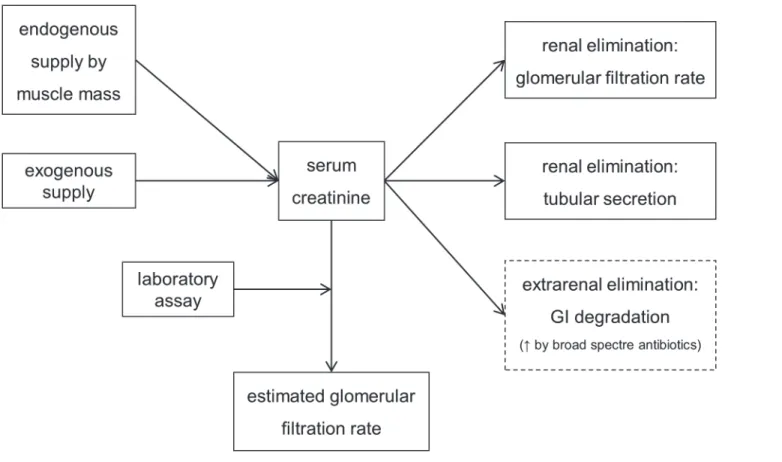
Creatinine is generally considered a good filtration marker to estimate the renal function in routine clinical practice. Serum creatinine level is a function of endogenous creatinine produc-tion, exogenous creatinine supply and renal elimination (glomerular filtration and tubular se-cretion).[29] There is a clear inverse correlation between serum creatinine levels and the true GFR. However there are several factors which may influence serum creatinine levels without affecting GFR itself, which potentially distort the interpretation of values for clinical use (see Fig. 1).[3,4,27,30,31]
Endogenous creatinine production
Creatinine is formed primarily in skeletal muscles from creatine and creatine phosphate.[29] Muscle mass is the most important determinant of total body creatine content and therefore of
Box 1. MDRD equations.
MDRD-6 [15]170 x Scr−0.999x age−0.176x BUN−0.170x albumin+0.318x 1.180 (if black) x 0.762 (if female)
Re-expressed after IDMS calibration [21]
161.5 x Scr−0.999x age−0.176x BUN−0.170x albumin+0.318x 1.180 (if black) x 0.762 (if female)
MDRD-4 [16]
186 x Scr−1.154x age−0.203x 1.212 (if black) x 0.742 (if female)
Re-expressed after IDMS calibration [21]
175 x Scr−1.154x age−0.203x 1.212 (if black) x 0.742 (if female)
Scr= serum creatinine (mg/dL) BUN = blood urea nitrogen (mg/dL) Albumin (g/dL)
Validity of the MDRD Formula in Specific Patient Populations
the creatinine production.[26] Muscle mass is related to age, sex and race. [4,26,32] Although the MDRD formula corrects for age, sex and race, the formula assumes an average muscle mass. However, muscle mass can deviate across individuals in anabolic or catabolic conditions. Thus, muscle-waisting conditions, e.g. due to neuromuscular disease, chronic glucocorticoid therapy, hyperthyroidism, amputation or progressive muscular dystrophy are associated with decreased creatinine production, whereas exercise and body building are associated with in-creased creatinine generation. [4,26,32] In diseases with abnormally low muscle mass, serum creatinine levels will be relatively low, leading to an overestimation of the GFR, whereas the op-posite will occur when the muscle mass is abnormally high.
In addition, the liver plays a major role in the biosynthesis of creatine. The rate of creatine formation and therefore the rate of creatinine production in the muscles is reduced in certain types of hepatic diseases.[33]
Exogenous creatinine supply
Dietary intake of creatinine and creatine can be either unusually high (ingestion of cooked meat, creatine supplementation) or unusually low (vegetarian diet).[4,26] This may lead to un-derestimation and overestimation of the GFR, respectively.
Laboratory assay of serum creatinine
Two assays are now mostly used in clinical practice to measure serum creatinine levels, namely the alkaline picrate assay (Jaffe) and the enzymatic assay. The Jaffe assay is known to have more interfering substances than the enzymatic method, which may result in a deviation of the Fig 1. Determinants of serum creatinine level.
doi:10.1371/journal.pone.0116403.g001
Validity of the MDRD Formula in Specific Patient Populations
true serum creatinine level up to 20%.[3,34] Substances which interfere with the Jaffe assay and may lead to an overestimation of serum creatinine levels include bilirubine, 5-aminolevulic acid, and high dose of lactulose. High doses of furosemide may lead to an underestimation of serum creatinine levels and cephalosporins may lead to both over- and underestimation of serum creatinine levels.[35,36,37,38,39] Substances which interfere with the enzymatic assay include dopamine, dobutamine, glucose and flucytosine.[26,35,36] These interferences may lead to an underestimation of serum creatinine levels and therefore an overestimation of the GFR, except for flucytosine. Flucytosine may overestimate serum creatinine levels with more than 100% and therefore underestimate the GFR.[36]
In addition to interferences of certain drugs in the creatinine assays, there are also differ-ences in creatinine values between clinical laboratories due to differdiffer-ences in the creatinine as-says and their calibration. Therefore a uniform creatinine measurement and a universal known calibration of the serum creatinine assays has led to the introduction of IDMS calibration. [18,40]
Creatinine secretion
Creatinine is not only excreted by glomerular filtration, but also by the renal tubules. In addi-tion, in patients with severe renal impairment a substantial fraction of the daily creatinine pro-duction is eliminated via extrarenal routes.[26] This might lead to relatively low serum creatinine levels, leading to an overestimation of the GFR. The creatinine secretion might also be altered in situations such as trauma, prolonged immobilization and hepatic disease.[26] The etiology of these changes is unknown. Some drugs, such as cimetidine, trimethoprim and fibrates (except gemfibrozil) also alter the secretion of creatinine due to inhibition of the tubu-lar secretion.[4,36,41] As a result serum creatinine levels will increase, independent of the GFR, and the use of serum creatinine based formulas will thus cause an underestimation of GFR. Of note, blocking creatinine secretion ensures a better reflection of the true GFR with creatinine-based formulas.[42,43]
Serum creatinine levels thus provide only a rough guide to the true GFR.[26] While the de-pendence of serum creatinine on muscle mass is partially accounted for in the MDRD formula (age, sex and race), various other factors influencing both production and secretion of creati-nine can be present. Awareness of these limitations of creaticreati-nine-based formulas which esti-mate GFR is therefore necessary. In addition, variability in eGFRs also includes underlying biological intraindividual and interindividual variation of serum creatinine values ranging from 6.3% to 17%.[12,22,44]
Of note, serum creatinine levels and creatinine based formulas should only be used in pa-tients with stable renal function. In cases of rapidly changing GFR, the actual serum creatinine levels will not reflect the GFR, until steady-state has been reached.[45] A diagnosis of a low GFR must therefore rely on multiple measures of serum creatinine levels.[46]
Methods
Search strategy
We performed a systematic search in the Pubmed database for published studies about the va-lidity of the MDRD formula in diverse patient populations. The search focused on publications between January 1999 (the introduction of the MDRD formula [15]) and January 2014. We searched for both the MDRD-4 and MDRD-6 formulas. The terms used for the overall search strategy have been listed inS1 File.
Validity of the MDRD Formula in Specific Patient Populations
Selection criteria
We focused on studies in patients with a measured GFR (mGFR) or estimated GFR (eGFR)<
60 ml/min(/1.73m2). Other selection criteria were (1) MDRD formula compared with a gold standard (defined as:99mTc-DTPA, inulin (including the analogue sinistrin[47]),51Cr-EDTA, 125I-iothalamate and Iohexol) and (2) statistical analysis and reporting focused on bias,
preci-sion and/or accuracy (seeTable 1for definitions).
We excluded case reports, abstracts, and posters. Articles which reproduced data already published elsewhere were carefully reviewed. Only if newer data added information to our re-view, the article was included.
Selection of patient population
In this review we will first discuss three more general patient groups, which were inadequately represented in the development of the MDRD formula, namely 1) elderly patients, 2) hospital-ized patients and 3) obese patients.
The MDRD formula was developed in a relatively young patient population (mean age: 51 + 13 years) with CKD.[15,48] The mean body weight was 79.6 + 16.8 kg and the mean body sur-face area (BSA) was 1.91 + 0.23 m2.[15] The body mass index (BMI) calculated from the mean weight and BSA is approximately 28 kg/m2, so the population was not obese (>30 kg/m2) as a
whole. Creatinine production decreases as muscle mass decreases with age or due to immobili-ty, which is common in hospitalized patients.[49] When this results in low serum creatinine levels creatinine-based formulas may overestimate the GFR.[50] In addition, elderly, malnour-ished, and immobilized patients are at special risk of having depressed GFR but normal serum creatinine levels, so normal serum creatinine concentration cannot exclude significant renal impairment.[51,52,53] Because of these considerations we found elderly patients (>65 years),
hospitalized patients and obese patients (>30 kg/m2) of interest for further evaluation.
Second, we will discuss four common categories of chronic diseases, which are the leading cause of death in the developed world: 4) cardiovascular diseases (e.g. myocardial infarction,
Table 1. Definitions outcome measurements.
Definition bias Formula Ref.
Median difference md eGFR-mGFR [67,120]
Median percentage difference* md ((eGFR-mGFR)/mGFR) x 100% [120]
Mean difference 1/n xΣ(eGFR-mGFR) [135]
Mean percentage difference‡
1/n xΣ((eGFR-mGFR)/mGFR) x 100% [142]
Precision Formula Ref.
Inter quartile range (IQR) difference IQR of (eGFR—mGFR) [67] IQR percentage difference* IQR of ((eGFR-mGFR)/mGFR) x 100% [67] Limits of agreement (LOA) Mean difference±1.96 SD [135,136] Standard deviation difference (SD) σof all the individual differences [67,135]
Accuracy Formula Ref.
Pk§ Percentage of estimates within k% of mGFR [67]
Median absolute percentage error (mAPE) md ((|eGFR—mGFR|)/mGFR) x 100% [142] Mean absolute percentage error (MAPE) 1/n xΣ((|eGFR—mGFR|)/mGFR) x 100% [142]
*Preferred definition because a relative scale provides a more relevant metric.
‡
In some articles the mean percentage difference was called the mean percentage error (MPE).
§Preferred de
finition of accuracy. We limited our search to P10, P20, P30and P50.
doi:10.1371/journal.pone.0116403.t001
Validity of the MDRD Formula in Specific Patient Populations
heart failure and stroke), 5) cancer, 6) chronic respiratory diseases (like chronic obstructed pul-monary disease (COPD) and asthma), and 7) diabetes mellitus.[54] These diseases are associat-ed with the use of multiple drugs of which a substantial part is renally excretassociat-ed.
The chronic diseases itself or the effects of the chronic diseases may alter serum creatinine levels without affecting GFR itself. In patients with chronic heart failure, a cardiovascular dis-ease, the effective circulating volume is reduced, blood pressure is low and therefore renal per-fusion pressure is reduced, leading to reduced filtration rate in viable nephrons and probably also to reduced excretion of creatinine. [55,56] The tubuli, however, are still capable of secret-ing creatinine actively.[55] In addition, the cornerstone in heart failure therapy are renin-an-giotensin-aldosterone-system (RAAS) inhibitors, which also may reduce glomerular filtration pressure and therefore excretion of creatinine.[56] These different mechanisms may influence serum creatinine levels. In addition, patients with heart failure are often immobile and there-fore at risk for having lower serum creatinine levels.
In cancer and COPD unknown mechanisms may influence creatinine levels without affect-ing GFR, but reduced muscle mass and malnourishment may also be present. This latter may result in low serum creatinine levels and therefore in overestimation of the GFR.
In diabetes mellitus, the choice of drugs or dosages is influenced by GFR.[57]
Finally, we searched for articles about 8) other chronic diseases in which reduced muscle mass (mainly due to immobility and malnutrition) can be present, which may render the MDRD formula less valid. Such diseases include neuromuscular diseases, rheumatoid arthritis, cystic fibrosis, human immunodeficiency virus (HIV) and liver diseases.[58,59,60,61,62] In certain liver diseases the production of serum creatinine is also reduced to approximately one half of the rate of patients with normal hepatic function.[58,60,63] Hyperbilirubinemia is also common among patients with liver diseases. Elevated serum bilirubine levels interfere with the Jaffe method to measure creatinine, which might lead to misleadingly low serum creatinine lev-els.[35,58,64]
Extraction of studies
The data and outcomes reported in the selected articles were summarized, specifically focusing on the selection of the study population, age, mean mGFR, type of creatinine assay used, type of gold standard used, mean eGFR and the outcome measures as defined inTable 1. Data ex-traction was done by the first author (WE) and checked by a second author (MW). Description of the findings focused on:
a. number of patients included;
b. outcome measures;
c. method of measuring true GFR.[27,65]
Ad (a) number of patients included: Preferably more than 100 patients should be included. [5,17] Studies with more than 100 patients included were considered of higher value in the in-terpretation than studies with less than 100 patients.
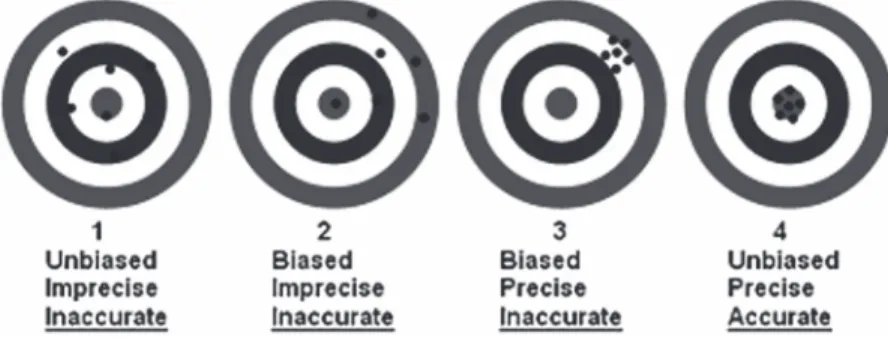
Ad (b) outcome measures: One of our inclusion criteria concerned the presence of outcome measures: bias, precision and accuracy. Bias represents systematic error, precision represents random error and accuracy represents both (seeFig. 2).
In developing a model or formula, bias can to some extent be corrected by means of a cor-rection factor. An example is the corcor-rection factor of 1.212 for Black-Americans in the MDRD formula.[15] Remaining bias refers to confounding factors for which corrections have not been included. It is not possible to completely correct for lack of precision (random error) in a
Validity of the MDRD Formula in Specific Patient Populations
model or formula. Precision is therefore an important indicator for the evaluation of the reli-ability of a clinical measure. Precision has been defined as the variance of the bias. The wider the variance of the bias, the higher the number that represents the precision, or in other words a wide imprecision. Accuracy is an validity indicator, which represents both precision and bias, thus systematic and random error. Accuracy is often expressed as a percentage of estimates within k% of mGFR (Pk%). This outcome measure is probably most easily to interpret from a clinical perspective. For example, if P30is 50%, it means that in half of the cases the eGFR falls within + 30% of the mGFR. Due to intraindividual and interindividual variation of serum cre-atinine levels and analytical variation of the measurement of serum crecre-atinine levels and other influencing factors a P30%of 100% will hardly be achievable.[5,12,22] In line with other authors we considered a bias of 20% or less, a precision of 30% or less and an accuracy expressed as P30%of 80% or higher as indicator of sufficient validity.[14,66,67]
Ad (c) method of measuring true GFR: Several methods for true GFR measurement are available, including urinary clearance, plasma clearance or a combination of both from exoge-nous markers, such as99mTc-DTPA,51Cr-EDTA,125I-iothalamate and Iohexol.[68,69] With urinary clearance, two to four 20 to 30 minutes urine collections are obtained, after administra-tion of the exogenous marker. Urinary clearance is computed as the urine concentraadministra-tion of the exogenous marker multiplied by the volume of the timed urine sample, and divided by the av-erage plasma concentration during the same time period.[27] Plasma clearance is computed from the amount of the exogenous marker administered divided by the area under the curve of plasma concentration over time. The best estimate is a two-compartment model that requires blood sampling two to three time points until 60 minutes and one to three time points from 120 minutes forward.[27]
The clearance of inulin is determined by collecting three sets of 30 minutes urinary clear-ance periods during a continuous intravenous infusion with 1% of inulin. Blood samples should be collected at least three times at the midpoint of the urine collections. Bladder cathe-terization is necessary to assure complete urine collection.[27,70] Tests containing sinistrin, an analogue of inulin and also a fructan, is frequently used as a gold standard for the measurement of GFR and therefore included in our review.[47,71]
Results and Interpretation
We identified 1179 citations with the search terms listed inS1 File. In total we included 27 studies. The flow of study selection is reported inFig. 3.
InTable 2the most important information from the selected studies is summarized. The PRISMA checklist is provided asS1 PRISMAChecklist.
Fig 2. Precision and accuracy.Source:http://www.nrcan.gc.ca/minerals-metals/non-destructive-testing/ application/2914,
doi:10.1371/journal.pone.0116403.g002
Validity of the MDRD Formula in Specific Patient Populations
Elderly patients
Background. CKD is common in elderly and is associated with a high risk of cardiovascu-lar complications.[66,69] Early recognition, intervention and management of patients with CKD by physicians has been shown to slow progression of disease and decrease complications. [72] Accurate estimate of GFR is important to detect elderly patients at risk for progressive CKD, but also in order to guide drug therapy of potentially nephrotoxic drugs, or to adapt Fig 3. Flow of study selection.
doi:10.1371/journal.pone.0116403.g003
Validity of the MDRD Formula in Specific Patient Populations
Table 2. Validity of the MDRD in specific patient populations.
Article Study population Mean(SD) Age (years)
Mean (SD) mGFR
Gold standard Creatinine measurement
Mean (SD) eGFR (MDRD)
Bias Precision Accuracy
Elderly patients Lopes et al., 2013, Brasil [143]
N = 56; subanalysis: mGFR<60 ml/min/ 1.73m2; inclusion
criteria: age>80 years, clinically stable, independent in activities; exclusion criteria: to be institutionalized, unable or willing to give consent, acute infection, moderate or severe cognitive impairment, heart failure, cirrhosis, previously received dialysis, unstable COPD, previous immunosuppressive therapy within 6 months, previous chemotherapy for cancer, known HIV infection, and previously reported allergic reaction to iodine.
-* -* Iohexol; Blood
samples were withdrawn 2, 3, 4 and 5 h after infusion
Jaffe -*
Re-expressed MDRD-4: mean: 5.9 ml/min/ 1.73m2 Re-expressed MDRD-4: SD: 14.1 ml/ min/1.73m2
Re-expressed MDRD-4: P30:
64.3%
Evans et al., 2013, Sweden [80]
N = 1831;
subanalysis: age>65 years; inclusion criteria: Patients with an iohexol
measurement<30 ml/min/1.73m2, a
registered plasma creatinine on the same date, between 1999 and 2010. exclusion criteria: renal transplants, dialysis, patients from the Lund-Malmo region.
-* Median
(IQR): 15 (12– 20) ml/ min/ 1.73m2 Iohexol; Blood samples were withdrawn at baseline and after 6–8h or 48h after injection, for patients with eGFR between 15–30 ml/min/ 1.73m2and<
15 ml/min/ 1.73m2, respectively.
Enzymatic or Jaffe
-* -* -* Re-expressed
MDRD-4: P30:
64.6%
(Continued)
Table 2. (Continued)
Article Study population Mean(SD) Age (years)
Mean (SD) mGFR
Gold standard Creatinine measurement
Mean (SD) eGFR (MDRD)
Bias Precision Accuracy
Koppe et al., 2013, France [71]
N = 53, KDIGO CKD stage 3A, N = 68, KDIGO CKD stage 3B, N = 66, KDIGO CKD stage 4–5; inclusion criteria: age >70 years, white (Caucasion), underwent inulin clearance for suspected or established renal dysfunction.
-* -* Sinistrin;
Loading dose followed by continuous infusion. Urine and plasma collection. (time and numbers not described)
Enzymatic -*
Re-expressed MDRD-46¼ : Stage 3A: median: 2 ml/min/ 1.73m2; Stage 3B: median: 6.7 ml/min/ 1.73m2; Stage 4–5: median: 5.95 ml/min/ 1.73m2 Re-expressed MDRD-46¼ : Stage 3A: SD: 13.53 ml/min/ 1.73m2; Stage 3B: SD: 11.69 ml/min/ 1.73m2; Stage 4–5: SD: 8.6 ml/ min/1.73m2
Re-expressed MDRD-46¼: Stage
3A: P10: 41.51%,
P30: 84.91%; Stage
3B: P10: 28.99%,
P30: 73.91%; Stage
4–5: P10: 19.7%,
P30: 59.09%
Drenth-van Maanen et al., 2013, Netherlands [47]
N = 16; inclusion criteria: Patients with GFR(MDRD)<60 ml/ min/1.73m2, age>70
years, stable medical condition and cognitively able to give informed consent at acute care and outpatient geriatric ward.
82 range: 71–87 39.6 (14.9)$ ml/min/ 1.73m2 Sinistrin; Bolus injection, blood samples were withdrawn at 10, 20, 30, 60, 90, 120, 240 and 480 min after infusion.
Jaffe MDRD-4:
48.6 (13.8)$: ml/
min/1.73m2
MDRD-4: mean (%): 29.1
MDRD-4: LOA: -16– 34 ml/min/ 1.73m2
MDRD-4: P30=
62.5%
Kilbride et al. 2012, United Kingdom [77]
N = 234; subanalysis: mGFR<60 ml/min/ 1.73m2; inclusion:>
74 years; exclusion: iodinated contrast media allergy, active malignancy, life expectancy less than 3 months, cognitive impairment, recent episode (within 3 months) of AKI, dialysis.
-* -* Iohexol; Bolus
injection, blood samples were withdrawn at 120, 180 and 240 minutes.
Enzymatic -*
Re-expressed MDRD-4: median: 2.0 ml/min/ 1.73m2 Re-expressed MDRD-4: IQR: 11.4 ml/min/ 1.73m2 Re-expressed MDRD-4: P30: 78%
Bevc et al., 2011, Slovenia [76]
N = 266; subanalysis: mGFR<60 ml/min/ 1.73m2; inclusion
criteria: age>65 years, Caucasian.
-* -* 51CrEDTA;
After single injection blood samples were withdrawn at 120, 180 and 240 minutes
Jaffe -* MDRD-4:
mean: -20.2 ml/min/ 1.73m2
MDRD-4: SD: 14.9 ml/ min/1.73m2
MDRD-4: 30–59 ml/ min/1.73m2: P30:
77.9%; 15–29 ml/ min/1.73m2: P
30:
56.6%;<15 ml/min/ 1.73m2: P30: 55.2%
(Continued)
Table 2. (Continued)
Article Study population Mean(SD) Age (years)
Mean (SD) mGFR
Gold standard Creatinine measurement
Mean (SD) eGFR (MDRD)
Bias Precision Accuracy
Stevens et al., 2007, United States [79]
N = 580; subanalysis: age>65 years and eGFR<60 ml/min/ 1.73m2; the results
have been compiled from data from different studies.
-* -* Iothalamate;
Drawing of samples was not described
-* -* MDRD-4:
median: -1.2%
-* MDRD-4: P30: 82%
Fontsere et al., 2006, Spain [144]
N = 43; subanalysis: age>65 years; inclusion criteria: Caucasian adult patients with CKD stages 4–5.
-* 22.9 +
6.8 ml/ min/ 1.73m2 51CrEDTA; Drawing of samples was not described
Jaffe -* MDRD-4:
mean: -4.1 ml/min/ 1.73m2
-* -*
Froissart et al., 2005, France [78]
N = -*; subanalysis: age>65 years and mGFR<60 ml/min/ 1.73m2; exclusion
criteria: renal
transplant patients and age<18 years, black patients.
-* -* 51CrEDTA;
Collection of urine 1 hour after injection and then 5 consecutive 30-min clearances. Blood was drawn at midpoint of each clearance period up to 300 min after injection.
Jaffe -* MDRD-4:
male: mean (%): 5.6; female: mean(%): 7.6 MDRD-4: male: SD (%): 31.4; female: SD (%): 34.1 -* Hospitalized patients Frank et al.,
2012, Switzerland [145]
N = 69; inclusion criteria: Caucasian patients, age>70 years, with CKD stage III-IV according to KDOQI guidelines of the internal medicine ward. Stable weight for 4 days; exclusion criteria: unstable renal function in the last two weeks.
Median (IQR): 80 (73–83)
Median (IQR): 30.9 (22.0– 43.3) ml/min Inulin; Blood samples were withdrawn at baseline, 90, 180, 270 and 360 minutes. Jaffe Re-expressed MDRD-4: median: 47.9 ml/min Re-expressed MDRD-4: median: 16.3 ml/min Re-expressed MDRD-4: IQR: 6.4– 27.5 ml/min
-*
(Continued)
Table 2. (Continued)
Article Study population Mean(SD) Age (years)
Mean (SD) mGFR
Gold standard Creatinine measurement
Mean (SD) eGFR (MDRD)
Bias Precision Accuracy
Poggio et al., 2005, California [85]
N = 107; inclusion criteria: patients who had mGFR performed with varying degrees of kidney dysfunction; exclusion criteria: incomplete data, dialysis, serum creatinine level< 0.3mg/dl (<27umol/l), unstable renal function.
65 + 15 17.1 +
17.9 ml/ min/ 1.73m2 Iothalamate; Bolus injection, blood samples were withdrawn at 5, 10, 15, 300, 330 and 360 minutes. In case of expected GFR <30, age>65, or creatinine level>2.5mg. dl, a sample at 24 hours was also collected.
Jaffe MDRD-4:
mean (SD): 23.9 + 16.3 ml/min/ 1.73m2;
MDRD-6: mean (SD): 22.5 + 17.4 ml/min/ 1.73m2
MDRD-4: median(%): 53; MDRD-6: median (%): 46
-* MDRD-4: MAPE: 53%, P30: 31%, P50:
49%;MDRD-6: MAPE: 47%, P30:
36%, P50: 55%
Schuck et al., 2005, Czech Republic [86]
N = 79; Nephrology Department; inclusion criteria: GFR<50 ml/ min/1.73m2; exclusion
criteria: cachexia
Range: 20–65 19.1 + 10.1 ml/ min/ 1.73m2
Inulin; After equilibrium phase (60 min) Urine collection during 60–90 min by spontaneous urination
Jaffe MDRD-6:
22.1 + 8.3 ml/min/ 1.73m2 MDRD-6: mean: 3.26 ml/min/ 1.73m2 MDRD-6: LOA: -5.7– 12.2 ml/min/ 1.73m2 -* Obese patients Bouquegneau., 2013, Belgium [89]
N = 207; subanalysis: mGFR<60 ml/min/ 1.73m2; inclusion
criteria: patients were >18 years and BMI> 30 kg/m2; exclusion
criteria: patients treated with steroids, cimetidine or trimethoprim.
-* 36 + 13
ml/min/ 1.73m2 51 Cr-EDTA; After single injection blood samples were drawn at 120 and 240 min.
Jaffe
Re-expressed MDRD-4: 36 + 17 ml/ min/1.73m2 Re-expressed MDRD-4: mean (%): -0.8 Re-expressed MDRD-4: SD (%): 32
Re-expressed MDRD-4: P30: 80%
Stevens et al., 2007, United States [79]
N = 1039;
subanalysis: BMI>30 kg/m2and eGFR<60
ml/min/1.73m2; the
results have been compiled from data from different studies.
-* -* Iothalamate;
Drawing of samples was not described
-* -* MDRD-4:
median(%): 4.1
-* MDRD-4: P30: 82%
Cardiovascular diseases
(Continued)
Table 2. (Continued)
Article Study population Mean(SD) Age (years)
Mean (SD) mGFR
Gold standard Creatinine measurement
Mean (SD) eGFR (MDRD)
Bias Precision Accuracy
Valente et al., 2014, Netherlands [146]
N = 40; subanalysis: mGFR<60 ml/min/ 1.73m2; inclusion criteria: age>18 years, LVEF<0.45, clinically stable, use of renin angiotensin system inhibitors; exclusion criteria: myocardial infarction within the last 3 months, cardiac surgery or angioplasty within the last 3 months or scheduled, unstable angina pectoris, primary renal disease, prior organ transplantation, chronic use of renal function-compromising medication.
-* -* 125
I-iothalamate; Constant infusion. 2-hour stabilization period.
Jaffe -*
Re-expressed MDRD-4: mean: -2 ml/ min/1.73m2
Re-expressed MDRD-4: SD: 9 ml/ min/1.73m2
-*
Cancer Craig et al., 2012, United Kingdom [147]
N = -*; subanalysis: 30<mGFR<59 ml/ min/1.73m2, mGFR<
30 ml/min/1.73m2; inclusion criteria: patient treated with chemotherapy following their mGFR, serum creatinine measured within 7 days of mGFR, serum creatinine>60 umol/l, age>20 years; exclusion criteria: patients with missing information, serum creatinine<60 umol/l
-* -* 51CrEDTA;
After single injection blood samples were drawn at 120 and 240 minutes.
Jaffe -*
Re-expressed MDRD-4: 30 <mGFR< 59: mean: 15.7 ml/min/ 1.73m2;
mGFR<30: mean: 7.0 ml/min/ 1.73m2
-* -*
Ainsworth et al., 2012, United Kingdom [106]
N = 45; patients who had mGFR<50 ml/ min. at the
Department of Nuclear Medicine.
-* -* 51Cr-EDTA;
Single-sample method until 2005, thereafter three-sample method.
Jaffe -* MDRD-4:
median(%): 17.5
-* MDRD-4: median APE(%): 20.5
(Continued)
Table 2. (Continued)
Article Study population Mean(SD) Age (years)
Mean (SD) mGFR
Gold standard Creatinine measurement
Mean (SD) eGFR (MDRD)
Bias Precision Accuracy
Bolke et al., 2011, Germany [104]
N = 8; subanalysis: mGFR<60 ml/min/ 1.73m2; 8 patients with head and neck cancer presenting for combined
radiochemotherapy and with known chronic renal insufficiency stage 3–5; exclusion: high dose steroid treatment.
-* 46.8 +
7.9$ml/
min/ 1.73m2 51Cr-EDTA; Bolus injection, four blood samples between 120 and 300 minutes after injection. Enzymatic Re-expressed MDRD-4: 55.2 + 13.2$ml/
min/1.73m2 Re-expressed MDRD-4: median(%): 18.4$ Re-expressed MDRD-4: SD(%): 19.1$ Re-expressed MDRD-4: P30: 75%$,
P50: 100%$
Faluyi et al., 2011, United Kingdom [105]
N = 62; patients with mGFR<60 ml/min with stable renal function at a Cancer Centre; exclusion: unstable renal function.
68.3 + 11.2 -* 99mTc-DTPA; Bolus injection, blood samples withdrawn after 2 and 5 hours.
Enzymatic -* -* -* Re-expressed
MDRD-4: P10:
40.3%, P30: 80.6%
Diabetes mellitus Iliadis et al., 2011, Greece [57]
N = 145; consecutive type 2 diabetic outpatients with mGFR between 30–59 ml/min/1.73m2
71 + 9 48.1 +
8.1 ml/ min/ 1.73m2 51Cr-EDTA; Bolus injection, blood samples withdrawn after 2 and 4 hours.
Jaffe
Re-expressed MDRD-4: 56.0 + 13.0 ml/min/ 1.73m2 Re-expressed MDRD-4: mean: 7.5 ml/min/ 1.73m2 Re-expressed MDRD-4: SD: 9.5 ml/ min/1.73m2
Re-expressed MDRD-4: P10:
26.3%, P30: 69.3%
Rognant et al., 2011, France [148]
N = 149; nondialyzed diabetic adult patients with mGFR<60ml/ min/1.73m2
-* 36.4 +
13 ml/ min/ 1.73m2 Inulin; Continuous infusion, both blood and urine samples were withdrawn.
Jaffe -* -* -* MDRD-4: P10:
36.2%, P30: 75.3%
Fontsere et al., 2008, Spain [149]
N = 36; subanalysis: 15<mGFR<59 ml/ min/1.73m2;
Caucasian type 2 diabetic patients.
64 + 8.0 31.2 +
10.8 ml/ min/ 1.73m2 125 I-iothalamate; Drawing of samples was not described
Jaffe -* MDRD-4:
-5.3 ml/min/ 1.73m2
-* -*
Rigalleau, 2007, France [150]
N = 89; inclusion criteria: diabetes and an eGFR<60 ml/min/ 1.73m2; exclusion
criteria: renal replacement therapy
Normoalbuminuric; 68 + 9;
Albuminuric: 64 + 12 45.6 + 29.7 ml/ min/ 1.73m2 51Cr-EDTA; Bolus injection, four blood samples were drawn at 75, 105, 135 and 165 minutes and urine samples were collected at 90, 120, 150 and 180 minutes.
Jaffe 41.3 + 13.1 ml/min/ 1.73m2
-* -* MDRD-?(not
mentioned): Normoalbuminuric: P10:26%, P30: 73%,
P50: 86%;
Albuminuric: P10:24%, P30: 60%,
P50: 79%
(Continued)
Table 2. (Continued)
Article Study population Mean(SD) Age (years)
Mean (SD) mGFR
Gold standard Creatinine measurement
Mean (SD) eGFR (MDRD)
Bias Precision Accuracy
Rigalleau, 2005, France [110]
N = 87; diabetic patients with mGFR< 60 ml/min/1.73m2; exclusion: nephrotic proteinuria (>3g/24h), edema and dialysis.
-* 33.7 +
14.7 ml/ min/ 1.73m2 51Cr-EDTA; Bolus injection, four blood samples were drawn at 75, 105, 135 and 165 minutes and urine samples were collected at 90, 120, 150 and 180 minutes.
Jaffe MDRD-4:
38.4 + 14.0 ml/min/ 1.73m2 MDRD-4: mean: 4.7 ml/min/ 1.73m2 MDRD-4: 2SD: 20.6 ml/min/ 1.73m2 -* Liver cirrhosis Mindikoglu et al., 2014, United States [115]
N = 21; subanalysis: mGFR<60 ml/min/ 1.73m2; inclusion
criteria: cirrhosis, age >18 years; exclusion criteria: pregnancy or breast-feeding, iothalamate or iodine allergy, not treated hepatocellular carcinoma, hyperthyroidism, inability to provide informed consent or to collect or void urine, dialysis or eGFR<15 ml/min/1.73m2,
treatment with NSAIDs, ACE-inhibitors 1 week prior. Onset or change in diuretics 1 week prior. Acute infection, exacerbation of encephalopathy, gastrointestinal bleeding, kidney injury 1 week prior, acute cardiovascular or cerebrovascular event 3 weeks prior, and cognitive impairment.
-* -* Iothalamate;
Blood samples were drawn at baseline, 5, 15, 30, 45, 60, 120, 240 and 360 minutes after iothalamate administration
- -*
Re-expressed MDRD-66¼ : mean: -10.4 ml/min/ 1.73m2 Re-expressed MDRD-66¼ : SD: 13.65 ml/min/ 1.73m2 Re-expressed MDRD-66¼
: P20:
52.38%, P30:
61.90%
(Continued)
Table 2. (Continued)
Article Study population Mean(SD) Age (years)
Mean (SD) mGFR
Gold standard Creatinine measurement
Mean (SD) eGFR (MDRD)
Bias Precision Accuracy
Rognant et al., 2010, France [114]
N = 45; consecutive candidates for liver transplantation with decompensated alcoholic cirrhosis with mGFR<60 ml/min/ 1.73m2.
-* -* Inulin;
Continuous infusion (2 to 2.5 hours), collection of three to four urine samples and a blood sample midway through each collection period.
-
-* MDRD-4:
mean: 19 ml/min/ 1.73m2
MDRD-4: SD: 25 ml/ min/1.73m2
MDRD-4: P10: 11%,
P30: 40%
Human immunodeficiency virus Gagneux et al.,
2013, France [126]
N = 18; subanalysis: mGFR<60 ml/min/ 1.73m2; inclusion
criteria: age>18 years, conformed HIV status; exclusion criteria: pregnancy, history of allergy, thyroid dysfunction, recent acute kidney injury, and treatment by metformin, steroids, trimethoprim, or cimetidine.
- - Iohexol; Bolus
injection, blood samples withdrawn after 120 and 240 minutes.
Enzymatic -
Re-expressed MDRD-4: mean(%): 61 Re-expressed MDRD-4: SD(%): 58 Re-expressed MDRD-4: P30: 22%
Inker et al., 2012, United States [127]
N = 27; subanalysis: eGFR<60 ml/min/ 1.73m2; inclusion: age
>18 years, stable on antiretroviral therapy for at least three months, confirmed HIV status, HIV viral load and CD4 count within 6 months of recruitment; exclusion: pregnancy, allergy or contraindication for iohexol or iodine, recent acute kidney injury, cognitive or physical impairments, use of cimetidine.
-* -* Iohexol; Bolus
injection, blood samples withdrawn after 10, 30, 120 and 240 minutes; for participants with serum
creatinine>1.5 mg/dl, a sample at 360 minutes was drawn.
- -*
Re-expressed MDRD-4: median: -11.9 ml/ min/1.73m2 Re-expressed MDRD-4: IQR: 19.4 ml/min/ 1.73m2 Re-expressed MDRD-4: P30:
66.7%
*Not all parameters were reported in the included articles. Especially when it came to subanalysis of patients with an eGFR<60 ml/min.1.73m2.
$When individual data were available we calculated missing parameters ourselves.
6¼
The MDRD-formula used was not reported. Given the time at which the study was conducted, we assume that the re-expressed MDRD-formula was used.
therapy with renally excreted drugs which is often desirable in elderly patients on polyphar-macy.[73,74,75]
Summary of the selected articles. We included nine studies, four of which were con-ducted in 2013. The definition of elderly or older patients ranged from 65 to 80 years or older. The mean bias reported ranged from an underestimation of 20 ml/min/1.73m2in the study of Bevc et al. to an overestimation of 29% in the study of Drenth-van Maanen et al.[47,76] Inter-pretation of precision is more difficult. The IQR of 11 ml/min/1.73m2reported by Kilbride et al. is reasonable when considering persons with higher ranges of mGFR (around 60 ml/min/ 1.73m2), but would be less acceptable in the lower ranges of the mGFR. The accuracy reported as P30was almost 80% which implies that the variance of the bias, the precision, is too large over the total range from 7 to 60 ml/min/1.73m2.[77] Although, four studies reported a bias within our 20% criteria[71,77,78,79], only two studies reported an accuracy above 80%, namely Stevens et al. and the subanalysis of the KDIGO CKD stage 3A in the study of Koppe et al. [71,79] In five studies (56%) the number of patients included exceeded 100.[71,76,77,79,80] Six out of nine studies described the method for measuring GFR adequately. The gold standards were reasonably performed, but only the studies of Drenth- van Maanen et al. and Froissart et al. met the number of blood samples taken over time as described above.[47,78]
Interpretation and conclusion. The nine included studies were performed reasonably. There was only one study[79] in which the MDRD formula appeared to be valid. Earlier Pottel-bergh et al. conducted a systematic review with broader selection criteria and reported both over- and underestimation of the mGFR.[69] They concluded that there is no accurate creati-nine-based formula to evaluate renal function in elderly patients.[69] With the more recently published studies presented here, we can confirm the conclusion that the creatinine-based MDRD formula is not valid in elderly patients.
Hospitalized patients
Background. Reduced GFR is one of the most important complications in critically ill pa-tients and is associated with increased morbidity and mortality in the intensive care unit (ICU) population.[81,82] In addition, acute renal failure (ARF) is also associated with high mortality. [83] Early detection of renal dysfunction and subsequent adequate treatment is therefore nec-essary in the hospital care setting.[84] Estimation of the GFR is also necnec-essary for appropriate treatment of critically ill and other hospitalized patients with renally excreted drugs.[85]
Summary of the selected articles. InTable 2three studies are presented, which fulfilled our inclusion criteria. All three studies reported an overestimation of the true GFR, ranging from a mean bias of 3.26 ml/min/1.73m2in the study of Schuck et al to a median relative bias of 53% in the study of Poggio et al.[85,86] In the study of Poggio et al. the MDRD-6 formula seemed to perform slightly better than the MDRD-4 formula with a median bias of 46%.[85] Although the bias in the study of Schuck et al. seems low, the precision exceeded our criteria of 30%.[86] Only the study of Poggio et al reported accuracy, which appeared to be inadequate. P30was 36% for the MDRD-6 formula and 31% for the MDRD-4 formula.[85] The measure-ment of the GFR with a gold standard was performed reasonably, although the spontaneous urination instead of catheterization in the study of Schuck et al. is questionable.[86] The num-ber of patients only exceeded 100 in the study of Poggio et al.[85]
Interpretation and conclusion. The MDRD formula is invalid in hospitalized patients on the internal medicine and nephrology ward. In the study of Poggio et al. selection bias was in-troduced, because the selection of patients was based on an individual nephrologist’s percep-tion of laboratory values not reflecting actual GFR.[85] In the other two studies the study was conducted only on the internal medicine and nephrology ward. The study population may
Validity of the MDRD Formula in Specific Patient Populations
therefore not reflect the average hospitalized patient population. In conclusion, the eGFR may largely overestimate true GFR in hospitalized patients, but the impact of this effect in different populations of hospitalized patients is still insufficiently known.
Obese patients
Background. Obesity is a well-recognized global health problem.[87] Obesity is associated with cardiovascular complications, type 2 diabetes mellitus, osteoarthritis, major depression and some cancers.[7,87] Obesity itself and its combination with these chronic diseases predis-pose individuals to develop CKD.[7,88] Considering the increasing number of obese patients the accuracy of the MDRD formula in obesity is of increasing importance.
Summary of the selected articles. Two articles met our selection criteria. Both studies had a study population exceeding 100 patients. One study was compiled with data from different studies, so the measurement of the GFR was not described.[79] In the study of Bouquegneau et al. the measurement of the GFR was not adequately performed.[89] In both studies the true GFR and eGFR were normalized to ml/min/1.73m2. The bias was for both studies within our 20% criteria. The precision reported in the study of Bouquegnea et al. was slightly higher than 30%, but the accuracy was sufficient, P30is 80%.[89] Stevens et al. reported also a sufficient ac-curacy, P30of 82%.[79]
Interpretation and conclusion. We found two studies, which conducted a subanalysis about the validity of the MDRD-4 formula in obese patients (BMI>30 kg/m2). The
perfor-mance of the MDRD-4 formula seemed valid, but the measurement of the gold standard could have been performed better. In conclusion, we were not able to draw conclusions about the va-lidity of the MDRD formula in obese patients.
Cardiovascular diseases
Background. Numerous studies about the prognostic value of the eGFR(MDRD) in car-diovascular diseases for clinical outcomes, such as mortality, have been published.
[56,90,91,92,93,94] In patients with end-stage heart failure, irreversibly impaired renal function precludes eligibility for heart transplantation.[95] In addition, patients with cardiovascular dis-eases are at risk for polypharmacy and the use of drugs that require dosage adjustment in renal impairment.[96,97] Thus an accurate method to estimate GFR is essential.[98]
Summary of the selected articles. One article met our selection criteria. The mean bias of−2 ml/min/1.73m2with a precision of 9 ml/min/1.73m2are within our criteria of 20% and 30%, respectively. However, the number of patients included was low. The measurement of the true GFR was not performed with a common method, a continuous infusion of125 I-iothala-mate instead of a bolus injection.
Interpretation and conclusion. In conclusion, we were not able to draw conclusions about the validity of the MDRD formula in patients with heart failure (or other cardiovascular diseases).
Cancer
Background. Both cancer and its drug therapies can lead to renal impairment.[99] Renal impairment in patients with cancer is highly prevalent and has major clinical implications. [99,100] In the Belgian Renal Insufficiency and Anticancer Medication (BIRMA) study, the prevalence of renal impairment (eGFR<90 ml/min/1.73m2) in patients with a range of cancer
diagnosis was 64%.[101] 80% of the patients treated for cancer received at least one nephrotox-ic drug and/or drugs for whnephrotox-ich dosage had to be adjusted in renal impairment.[101] In our
Validity of the MDRD Formula in Specific Patient Populations
ageing societies oncologists are likely to be faced with increasing numbers of patients with both cancer and renal impairment.[102,103]
Summary of the selected articles. Four studies were selected and are presented inTable 2. None of these studies reported precision. Although the bias reported in the studies of Ains-worth et al. and Bolke et al. were within 20%, only the study of Faluyi et al. reported an accura-cy>80% expressed as P30.[104,105,106] The low accuracy in the other studies implies a wide
imprecision. The number of patients included in all three studies together exceeded 100. The measurement of GFR with a gold standard was not adequately performed in any of the studies. The best performed measurement of the GFR was in the study of Bolke et al. where 4 blood samples were withdrawn over a time period of 5 hours.[104]
Interpretation and conclusion. Precision was not reported, the numbers of patients in the selected separate studies were low and only the measurement of the GFR in the study of Bolke et al. seemed robust. Yet, these studies suggest that the eGFR calculated with the MDRD formula in cancer patients with moderate to severe renal impairment may be substantially dif-ferent from the mGFR for a substantial number of patients. There is no evidence that the use of the MDRD formula in drug dosing in patients with cancer and renal impairment is valid.
Chronic respiratory diseases
Background. The most frequent chronic respiratory disease is chronic obstructive pulmo-nary disease [107], which is associated with several comorbidities, such as hypertension, heart failure and diabetes.[107] Renal impairment is a significant risk factor for cardiovascular dis-eases for which COPD patients are at risk.[108] In addition, polypharmacy is frequent in pa-tients with COPD.[108] An accurate estimation of the GFR seems therefore important.
Summary of the included articles. No articles met our selection criteria.
Interpretation and conclusion. When searching for articles about the validity of the MDRD formula in patients with COPD, we found some recently published articles on the prev-alence of renal impairment in patients with COPD, which discussed the advantages of using creatinine-based formulas for estimating GFR rather than serum creatinine levels.[107,108] The prevalence of undiagnosed renal impairment (eGFR<60 ml/min and normal serum
creat-inine levels) varied between 7 and 22%, and was higher in patients with cachexia and older age (>64 years).[107,108] This implies that the issue of the validity of the MDRD formula in
COPD patients is still far from settled. In conclusion, we were not able to draw conclusions about the validity of the MDRD formula in patients with chronic respiratory diseases and mod-erate to severe renal impairment.
Diabetes mellitus
Background. Diabetes mellitus is the leading cause of CKD.[109] Diabetic nephropathy affects around one-third of patients with diabetes and is the primary cause of end-stage renal disease worldwide.[57,109] Moreover, diabetic patients, especially those with impaired renal function, are at increased risk of cardiovascular events.[57,110] There is strong evidence that early detection of diabetic nephropathy leading to timely intervention improves long-term out-come.[111]
Summary of the selected articles. Several studies have been published about the validity of the MDRD-4 formula in patients with diabetes mellitus. We included five studies. The bias reported in three out of five studies were within 20%. The precision (only reported by Iliadis et al. and Rigalleau et al.) was in the same range, namely a SD of approximately 10 ml/min/ 1.73m2, and within our criterion of 30%.[57,110] Despite the fact that both bias and precision
Validity of the MDRD Formula in Specific Patient Populations
reported met our criteria, the accuracy was not sufficient, which implies a relatively wide im-precision throughout the mGFR range.
In two out of five studies the included number of patients exceeded 100. The findings of two other studies which included nearly 90 patients were in the same range. With respect to the method for measuring GFR, the number of blood samples withdrawn in the study of Iliadis et al. (two blood samples) was probably marginal.[57] In the other four studies the method for GFR measurement was sufficient.
Interpretation and conclusion. In four studies the MDRD-4 formula overestimated the mGFR. The overestimation of the GFR might lead to higher drug doses than necessary or to a late discontinuation of, for example, metformin use and therefore to a greater risk of adverse drug events. Although bias pointed in the same direction in four studies, the precision (= ran-dom error), which was not adequately reported, was probably too wide, which led to low accu-racy. In conclusion, the MDRD formula is not valid in patients with diabetes mellitus and renal impairment.
Other chronic diseases
From various chronic diseases of interest, we decided to present the diseases of which we could include at least two studies. These diseases were liver cirrhosis and HIV-infection.
Liver cirrhosis
Background. Renal dysfunction often accompanies later stages of chronic liver diseases and is strongly associated with increased mortality in both acute liver failure and liver cirrho-sis.[58,112] Pretransplant serum creatinine level is a predictor of posttransplant mortality and posttransplant renal function. [63,113] Other risk factors to develop chronic kidney disease, such as diabetes mellitus, coronary heart disease, and hepatitis C, are common among patient with liver diseases.[113,114] It is therefore important to identify which patients with liver dis-ease truly have renal impairment.[60]
Summary of the selected articles. Two studies were included. The mean bias ranged from −10 ml/min/1.73m2with the MDRD-6 formula in the study of Mindikoglu et al. to 19 ml/min/ 1.73m2with the MDRD-4 formula in the study of Rognant et al..[114,115] The corresponding imprecision expressed as SD were 14 and 25 ml/min/1.73m2, respectively.[113,115] Both bias and imprecision were very wide for patients with a mGFR<60 ml/min/1.73m2. Both
over-and underestimation were reported, which resulted in an accuracy expressed as P30of 40 to 62%.[113,115] The number of patients in the separate studies were below 100, but the measure-ments of the GFR were adequately performed.
Interpretation and conclusion. The imprecision of the MDRD formula in the studies was very wide. Cholongitas et al. already reported that the MDRD overestimates the GFR to a great extent in a review in 2007.[112] The two more recently published articles confirm this conclu-sion. Remarkably, the study in which the MDRD-6 formula was used, reported an underesti-mation of the mGFR.[115] Despite the fact that only two studies met our selection criteria and per study less than 100 patients were included, the degree of over- and underestimation and precision is too large to justify the use of the MDRD formula in patients with liver cirrhosis and moderate to severe renal impairment.
Human immunodeficiency virus (HIV)
Background. Individuals with HIV infection have an increased risk of kidney disease. [116] HIV infection may result in HIV-associated nephropathy, immune complex kidney dis-ease and ARF.[117,118] Moreover, progression to end-stage kidney disdis-ease, which may require
Validity of the MDRD Formula in Specific Patient Populations
hemodialysis, is common.[119,120,121] These conditions are associated with progression to acquired immune deficiency syndrome (AIDS) and death.[118,119] In addition, HIV itself may influence other risk factors for kidney disease, such as lipid levels, insulin resistance and microalbuminuria.[122] Aging, comorbidities and the use of nephrotoxic antiretroviral drugs might lead to a higher risk for developing impaired renal function.[122,123,124] In addition, the use of renally excreted drugs is prevalent, therefore accurate estimation of renal function is an important component of personalized HIV care.[117,125]
Summary of the selected articles. We selected two subanalysis including only 45 patients with HIV and mGFR<60 ml/min/1.73m2. The imprecision reported was very wide, namely
an IQR of 20 ml/min/1.73m2in the study of Inker et al. and mean relative bias of 61% in the study of Gagneux et al..[126,127] This resulted in an accuracy, expressed as P30,of 67% and 22%, respectively.[126,127] The measurement of GFR with the gold standard iohexol was ade-quately performed in the study of Inker et al. and reasonably performed in the study of Gag-neux et al.[126,127]
Interpretation and conclusion. We were not able to draw conclusions about the validity of the MDRD formula in patients with HIV and moderate to severe renal impairment, because of the small number of patients. The wide imprecision reported in the small subanalysis does not support the validity of the MDRD formula.
Of note, in our previously published review about the validity of the MDRD formula in HIV-infected patients we suggested that the MDRD-4 formula is as valid in HIV-positive as in HIV-negative patients.[128] The results in this review do not confirm that hypothesis for pa-tients with moderate to severe renal impairment.
Discussion
To our knowledge this is the first systematic review, which evaluates the validity of the MDRD formula in a range of specific patient populations with moderate to severe renal impairment in a more quantitative way. We focused on studies, which compared the MDRD formula with a gold standard and which provided statistical outcome information about the degree of devia-tion from the true GFR. Our selecdevia-tion criteria were thus more stringent than previously pub-lished reviews.[3,11,129]
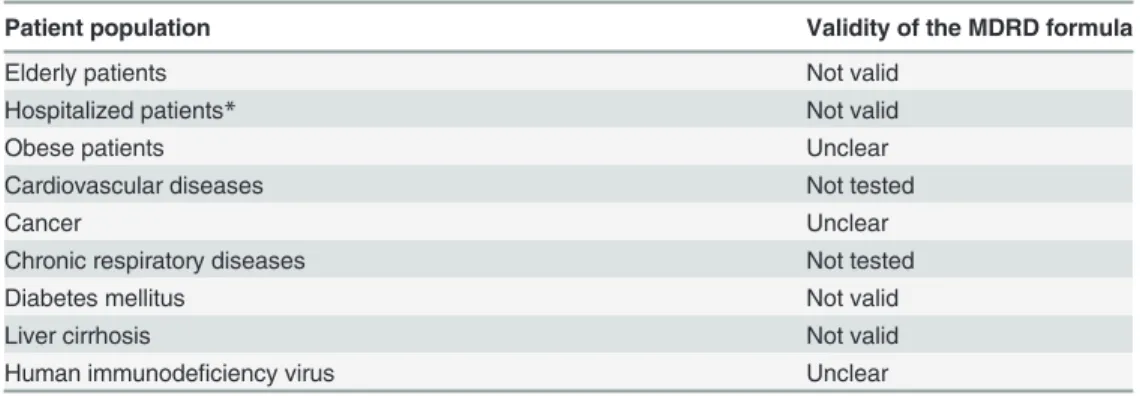
This review showed that the validity of the MDRD formula has not yet been tested properly in patients with cardiovascular diseases and chronic respiratory diseases. In obese patients, pa-tients with cancer and HIV the validity of the MDRD formula has been poorly tested. The number of studies and/or the number of patients included were very low and/or the measure-ment of GFR was not performed adequately. Therefore the validity of the MDRD formula in these patient populations remains unclear. For patients with diabetes mellitus and liver cirrho-sis, hospitalized patients on the internal medicine and nephrology ward and elderly with mod-erate to severe renal impairment we concluded that the MDRD formula is not valid. A summary is given inTable 3.
Overall, we may conclude that the application of the MDRD formula in clinical practice is not supported by available research evidence for a range of specific patient populations. The application of the MDRD formula in drug dosing may become even more difficult with the knowledge that most of these chronic diseases are present in various combinations in the indi-vidual patient, especially in elderly.[130] The variability of the eGFR in daily practice might thus be larger.
At the time this research was conducted the Chronic Kidney Disease Epidemiology Collabo-ration (CKD-EPI) formulas were developed. These formulas are based on serum creatinine value, cystatine value and a combination of both.[131,132] Overall, the CKD-EPI formula
Validity of the MDRD Formula in Specific Patient Populations
performs better than the MDRD-4 formula. However, the differences in the GFR range<
60 ml/min/1.73m2are small and not clinically relevant.[17,133] In Australia, France and a few large laboratories in the United States, the eGFR is already calculated with the CKD-EPI for-mula.[134] Although the CKD-EPI formula may replace the MDRD formula, we still think that our review is of great interest. First, the limitations of the MDRD formula are due to the variable serum creatinine level. This variable still exists in the CKD-EPI formula. Second, this review shows the importance of validating a formula in specific patient populations. Especially, populations who are at risk of having impaired renal function.
This review is not without limitations. First, we excluded studies which did not fulfill our criteria concerning statistical analysis. A frequently used method to compare different formulas to estimate the GFR is the correlation coefficient, which has major limitations when used for this purpose.[117,121] The most informative method to assess diagnostic tests is the Bland Alt-man plot, as this identifies the direction and the magnitude of the bias.[67,135,136] Secondly, the gold standards used in the presented studies were diverse. The gold standard in the devel-opment of the MDRD formula was125I-iothalamate.[15]. Use of other filtration markers may introduce a systematic bias, mostly an overestimation.[4,17,44] We did not consider this vari-able in the interpretation of the included studies. This would have been difficult because the measurement of the GFR was often not well described and/or not adequately performed. An-other limitation is the lack of taking into account the differences between the MDRD en re-ex-pressed MDRD formulas, in other words, between IDMS calibrated creatinine measurements and uncalibrated creatinine measurements. In addition, the use of an enzymatic method or the Jaffe method also introduces variable variations in serum creatinine levels.[2,137] We did not consider such additional variables in the interpretations of the selected studies. Instead, we choose to focus on the variables explained in the method section, which in our opinion have the greatest influence on the eGFR(MDRD). Finally, we did not discuss all different patient populations. Examples of patient characteristics which may also affect the validity of the MDRD formula, but which were not reviewed here, are pregnancy and ethnicity. [138,139,140,141]
Conclusion
In summary, the use of the MDRD formula in different specific patient populations for the fine-tuning of drug therapy management is not without limitations. There is no hard evidence Table 3. Validity of the MDRD formula in different patient populations.
Patient population Validity of the MDRD formula
Elderly patients Not valid
Hospitalized patients* Not valid
Obese patients Unclear
Cardiovascular diseases Not tested
Cancer Unclear
Chronic respiratory diseases Not tested
Diabetes mellitus Not valid
Liver cirrhosis Not valid
Human immunodeficiency virus Unclear
*The MDRD formula is not valid in patients on the internal medicine and nephrology ward. For other hospitalized patients it is not tested.
doi:10.1371/journal.pone.0116403.t003
Validity of the MDRD Formula in Specific Patient Populations
that the MDRD formula is valid in patients with several chronic diseases combined with renal impairment. Clinical judgment remains necessary. Instead of searching for the ideal formula for estimating GFR, we should search for practical approaches to optimize the pharmacothera-py in patients with renal impairment.
Supporting Information
S1 PRISMA Checklist. (PDF)
S1 File. Search terms. (DOCX)
Author Contributions
Conceived and designed the experiments: WLE CK JFMW PAGMDS. Performed the experi-ments: WLE MW PAGMDS. Analyzed the data: WLE CK MW JFMW PAGMDS. Wrote the paper: WLE CK HJD MW JFMW PAGMDS.
References
1. Zhang L, Xu N, Xiao S, Arya V, Zhao P, et al. (2012) Regulatory perspectives on designing pharmaco-kinetic studies and optimizing labeling recommendations for patients with chronic kidney disease. J Clin Pharmacol 52: 79S–90S. doi:10.1177/0091270011415410PMID:22232757
2. Prigent A (2008) Monitoring renal function and limitations of renal function tests. Semin Nucl Med 38: 32–46. PMID:18096462
3. Stevens LA, Coresh J, Greene T, Levey AS (2006) Assessing kidney function—measured and esti-mated glomerular filtration rate. N Engl J Med 354: 2473–2483. PMID:16760447
4. Stevens LA, Levey AS (2005) Measurement of kidney function. Med Clin North Am 89: 457–473. PMID:15755462
5. Anonymous (2002) K/DOQI clinical practice guidelines for chronic kidney disease: evaluation, classifi-cation, and stratification. Am J Kidney Dis 39: S1–S266. PMID:11904577
6. Stevens LA, Nolin TD, Richardson MM, Feldman HI, Lewis JB, et al. (2009) Comparison of drug dos-ing recommendations based on measured GFR and kidney function estimatdos-ing equations. Am J Kid-ney Dis 54: 33–42. doi:10.1053/j.ajkd.2009.03.008PMID:19446939
7. Pai MP (2010) Estimating the glomerular filtration rate in obese adult patients for drug dosing. Adv Chronic Kidney Dis 17: e53–e62. doi:10.1053/j.ackd.2010.05.010PMID:20727504
8. Verhave JC, Wetzels JF, Bakker SJ, Gansevoort RT (2007) Schatting van de nierfunctie met behulp van formules [estimating renal function with formulas]. Ned Tijdschr Geneeskd 151: 1002–1004. PMID:17508682
9. Hellden A, Bergman U, von Euler M, Hentschke M, Odar-Cederlof I, et al. (2009) Adverse drug reac-tions and impaired renal function in elderly patients admitted to the emergency department: a retro-spective study. Drugs Aging 26: 595–606. doi:10.2165/11315790-000000000-00000PMID: 19655826
10. Leendertse AJ, van Dijk EA, De Smet PA, Egberts TC, van den Bemt PM (2012) Contribution of renal impairment to potentially preventable medication-related hospital admissions. Ann Pharmacother 46: 625–633. doi:10.1345/aph.1Q633PMID:22570433
11. Helou R (2010) Should we continue to use the Cockcroft-Gault formula? Nephron Clin Pract 116: c172–c185. doi:10.1159/000317197PMID:20606477
12. Botev R, Mallie JP, Couchoud C, Schuck O, Fauvel JP, et al. (2009) Estimating glomerular filtration rate: Cockcroft-Gault and Modification of Diet in Renal Disease formulas compared to renal inulin clearance. Clin J Am Soc Nephrol 4: 899–906. doi:10.2215/CJN.05371008PMID:19406960
13. Cockcroft DW, Gault MH (1976) Prediction of creatinine clearance from serum creatinine. Nephron 16: 31–41. PMID:1244564
14. Coresh J, Auguste P (2008) Reliability of GFR formulas based on serum creatinine, with special refer-ence to the MDRD Study equation. Scand J Clin Lab Invest Suppl 241: 30–38. doi:10.1080/ 00365510802141140PMID:18569962
Validity of the MDRD Formula in Specific Patient Populations