
112 TEM Journal – Volume 4 / Number 1 / 2015 www.temjournal.com
Virtual Environment of Real Sport Hall
and Analyzing Rendering Quality
Filip Popovski
1, Igor Nedelkovski
1, Svetlana Mijakovska
1, Aleksandar Ackovski
21Faculty of Technical Sciences, SS Kliment Ohridski, Ivo L. Ribar, 7000 Bitola, R. Macedonia 2Artistika, 11 Oktomvri, 24/12, 1000 Skopje, R. Macedonia
Abstract - Here is presented virtual environment of a real sport hall created in Quest3D VR Edition. All analyzes of the rendering quality, techniques of interaction and performance of the system in real time are presented. We made critical analysis on all of these techniques on different machines and have excellent results.
Keywords - Virtual reality, Virtual environments,
Scientific visualization, Computer design, Techniques of interaction.
1. Introduction
”Scientific visualization is the use of computer graphics to create visual images which aid in the understanding of complex, often massive numerical representations of scientific concepts or results (McCormick, 1987).”[1]
Visualization is essential in interpreting data for many scientific problems. It transforms numerical data into a visual representation which is much easier to understand for humans. [2]
The process of data visualization can be described as a sequence of fundamental processing steps:
• Simulation: results of numerical simulations (or data sensing / measurement) are the input of the visualization pipeline.
• Data selection & filtering: relevant regions of the raw data are selected, then filtered and enhanced. Techniques such as for example: enrichment & enhancement, data cropping, down-sizing, noise filtering, segmentation and feature extraction can be used.
• Visualization mapping: the processed data have to be mapped / transformed into graphical primitives such as points, lines, planes / surfaces (triangle meshes), or icons, and their properties such as color, texture or opacity.
• Rendering: finally, the graphical primitives are rendered as images, which are then displayed on the screen.
Virtual reality can be defined in many ways, which all come down to the definition of a
significant relationship between human and
computer. It can be described as a simulation that computer graphics applies for creating a world with realistic view and that synthetic world is not static, but responds in some way to the reaction of the user and modify the environment in real time. Interactivity and its effect contributes to a strong sense of Immersion - including in the environment in which is the user. He can see and manipulate with graphical objects on the screen, but also could touch and feel. Studies go in that direction to make sensors for hearing, taste and smell.[3]
In this paper, we refer to the concept of immersive Virtual Reality, which gives the user the psycho-physical experience of being present in a virtual environment consisting of interactive (virtual) objects. This experience is achieved by a proper integration of VR hardware (3D displays and spatial interaction devices) with a responsive computer-generated 3D environment.
Feeling of space and depth is essential for every VR system. The human visual system interprets the depth in sensed images using both physiological and psychophysical cues. Through the use of artificial depth cues in computer graphics, these spatial sensations can be simulated. In Immersive Virtual Reality, stereo display and head tracking are used to provide the binocular parallax and motion parallax, respectively.[4]
TEM Journal – Volume 4 / Number 1 / 2015. 113 www.temjournal.com
2. Visualization of Sport Hall
For making 3D model it is necesary to collect all information, dimensions, colors, etc. Next step is creating textures for a given model. Each required texture is processed in Adobe Photoshop and then imported into software for virtual reality. For this research we used real model, a sports hall with dimensions 40m x 20 m with capacity for 500 peoples and its environment.
Figure 1. 3D Studio max model
Then we prepeared all of these objects for entry into Quest3D.
Figure 2. Virtual environment of sport hall
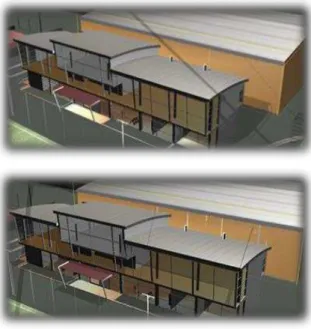
On next figure we made comparison of 3D models in both softwares, 3D Studio Max and Quest3D VR. From it can be seen the difference of graphic quality on the same computer system. The quality of rendering in Quest3D is much better, with stronger colors and tones and much more realistic look. With that feeling, the user has a better sense of comfort and immersion in virtual world.[5]
Figure 3. Comparison in both softwares
114 TEM Journal – Volume 4 / Number 1 / 2015 www.temjournal.com
However, rendering on computer system Toshiba Sattelite A660 has excellent quality and speed. On both computers the whole process was in real time.
Table 1. Specification on different computers
Category Toshiba
Satellite A660
HP Z210 Workstation
CPU Intel Core I5 2.27GHz
Intel Core I7 3.2GHz RAM
memory 4GB 8GB
Graphic cards
NVIDIA GeForce GT
330M, 1GB DDR3 memory
AMD Firepro V5900, 2GB GDDR5
memory Resolution 1366x768,
60Hz
1920х1200, 60Hz Hard Disk
Space 640GB 1TB Operating
System
Windows 7 64 Bit
Windows 7 64 Bit Quest 3D
VR Ver. 4.3.2 Ver. 4.3.2 3D Studio
Max 2013 2013 Photoshop CS5 CS5
3. Interactions in Virtual Environment
Interaction is an essential characteristic of virtual environments. [6] Much has been published about interaction techniques in VR but the quest for truly intuitive and natural interaction techniques is still going on. Interaction between users and virtual environments is complex. Users must be able to navigate through 3D space, manipulate with virtual objects or control parameters of a simulation, and interact with the 3D GUI inside the virtual environment in a user- friendly way. [7]
In our virtual environment interaction between the objects gives a sense of freedom and reality. It relates to the interaction on shadows of the objects and their movement are in real time. With every movement of the sun light, shadows move together with ball under physical laws. Movements are in real time so the user feels comfortable and real in our virtual environment.
Figure 4. Interactions in real time
One important characteristic in virtual reality are interactions with environment.[8] In our case it relates to the falling of sunlight on objects and sport hall and motion of their shadows, depending on the light source. With reducing the intensity of sunlight, decline the strength of a shadows. When sun move from east to west, movements of a shadows are opposite of the light source.
4. Conclusion
TEM Journal – Volume 4 / Number 1 / 2015. 115 www.temjournal.com
Category Toshiba
Satellite A660
HP Z210 Workstation
Rendering
Quality Good Excellent Rendering
Speed excellent excellent Real Time
Rendering
Yes, with 25 frames/sec.
Yes, with 25 frames/sec. Interactions
between objects in Real Time
Yes Yes
Interactions with environment
Yes Yes
Minimum performance of computer system for Real Time rendering
CPU Speed - 1GH System
memory – 1GB Graphic
card with DirectX 9
CPU Speed - 1GH System memory – 1GB
Graphic card with DirectX 9
Table 2. Analysis of the results [6] Ralph Schroeder, Being There Together,
Oxford University, New York, 2011. [7] P. Boudoin, Design of a 3D Navigation
Technique Supporting VR Interaction, Informatics, Integrative Biology and Complex Systems, France, 2008.
[8] Enrico Gobbetti, Virtual reality: Past, Presence and Future, Center for Advanced Studies, Research and Development,Sardinia, Italy, 1998.
Corresponding author: Asst. MSc. Filip Popovski
Institution: Faculty of Technical Sciences, Bitola, Macedonia
E-mail: [email protected]
At our Graphic department in our faculty, we developed a model for interactive scientific visualization that is based on the following principles:
• User friendly interface;
• Using open source libraries;
• Using computer monitor or LED TV;
• Inexpensive accessories needed for
virtual navigation (HMD, virtual stick).
• Will cost under 1000 EUR.
References
[1] Michal Koutek, Scientific visualization in Virtual Reality,Delft University,2003. [2] Maria Lujan Ganuza, Universidad Nacional
del Sur, Buenos Aires, 2009.
[3] Sally J. McMillan, Exploring models of interactivity from multiple research traditions: users, documents and systems, University of Tennessee, 2002.
[4] Ivan K. Y. Li, Enhancing 3D Aplications Using stereoscopic 3D and Motion Parallax, University of Auckland, Australia, 2012. [5] F.Popovski, Scientific visualization in the

![Table 2. Analysis of the results [6] Ralph Schroeder, Being There Together, Oxford University, New York, 2011](https://thumb-eu.123doks.com/thumbv2/123dok_br/18307374.348366/4.894.109.439.130.533/table-analysis-results-ralph-schroeder-oxford-university-york.webp)
