Absorbing-State Critical Phenomena in
Interacting Surface Reaction Models
Hyunggyu Parkand SungchulKwon
Department of Physics, Inha University, Inchon 402-751, Korea Received 15 November 1999
Absorbing-state critical phenomena in various surface reaction models are briey reviewed, focusing on their universal properties. The directed percolation universality class and the directed Ising universality class are identied, associated with absorbing-state phase transitions in these one-dimensional reaction models.
I Introduction
During the last decades, nonequilibrium critical phe-nomena have been extensively studied in various areas such as epidemiology, biology, chemistry, sociology and physics [1-4]. An interesting example of nonequilibrium phase transitions is the absorbing phase transition. In this case, there exist some absorbing (trapped) states in congurational phase space. If the system gets into one of these absorbing states by the evolution dynamics, then the system is trapped: no further dynamics can occur, to escape from the absorbing state. By control-ling an external parameter, the system may undergo a continuous phase transition from an active steady-state phase into an inactive absorbing phase. In the active phase, the system manages to avoid the traps so it has a nite probability to stay alive forever.
Recently, various kinds of nonequilibrium lattice models exhibiting absorbing transitions have been stud-ied extensively [3-6]. These models describe a wide range of phenomena, in particular, epidemic spread-ing, catalytic chemical reactions, and transport in dis-ordered media. Two distinct types of absorbing phase transitions have been identied in one dimension: the directed percolation (DP) and directed Ising (DI) uni-versality class. Most models have been found to belong to the DP class [7-13], which involves typically a single absorbing state or multiple absorbing states with one of them dynamically more prominent than the others (no explicit symmetry). DI type critical behavior ap-pears in models with two equivalent absorbing states or two equivalent classes of absorbing states (Ising type symmetry) [14-21]. The degeneracy of the absorbing states may be obscured by an alternative representa-tion of the models. By assigning kinks (or particles) between dierent absorbing domains, the multiple
ab-sorbing states correspond to a single vacuum cong-uration and their degeneracy translates into particle-number conservation. For example, in the dynamics of branching annihilating random walks (BAW) [22-25], the vacuum (absorbing) state is not degenerate, but the absorbing transition belongs to the DI class if the dy-namics conserve the particle number modulo 2. So the DI class is sometimes called the PC (parity-conserving) universality class.
In this paper, we focus on nonequibirium surface reaction models exhibiting absorbing transitions. In Sec. II, we discuss the universality classes for various noninteracting surface reaction models. In Sec. III, the surface reaction models with lateral interactions are dis-cussed. Finally, we summarize our discussions.
II Noninteracting surface
reac-tion models
{ Monomer-dimer model
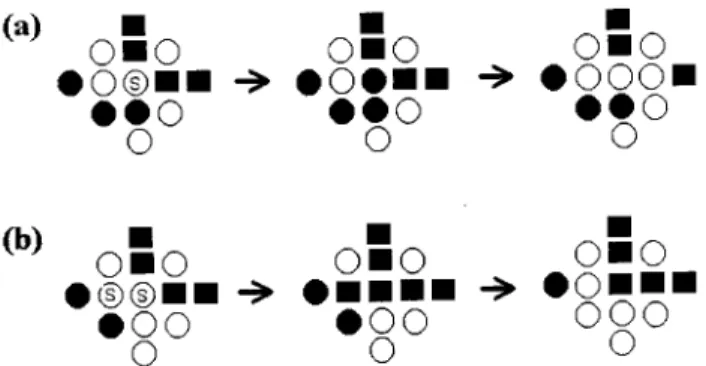
In 1986, Zi, Gulari and Barshad introduced a monomer-dimer(MD) model to describe the oxidation of carbon monoxide on a catalytic surface[26]. In this model, a monomer(CO) adsorbs onto a single vacant site, while a dimer(O
2) adsorbs onto a pair of adjacent vacant sites and then immediately dissociates. A near-est neighbor of adsorbates, composed of anOatom and aCOmolecule, reacts and forms a CO
2 molecule and desorbs from the metal surface (Fig. 1). In two dimen-sions, as the CO gas pressure is lowered, the system undergoes a rst-order transition from aCO-saturated inactive phase into a reactive phase and then a continu-ous transition into anO
2-saturated inactive phase. The O
one dimension, the MD model shows only a rst-order transition between two saturated phases.
Figure 1. Monomer-dimer model: in (a), aCO molecule (lled circle) adsorbs on a selected empty site (open circle withS). The adsorbedCOmolecule reacts with one of the nearest-neighborO atoms (lled squares) and the resultant
CO2 molecule desorbs from the metal surface. In (b), an
O2 molecule adsorbs at a nearest-neighbor pair of vacant
sites. These adsorbed O atoms react with one of nearest-neighbor COmolecule and theCO2 molecule desorbs from
the surface.
{ Monomer-monomer model
Motivated by the MD model, various one-dimensional reaction models have been introduced to understand nonequilibrium dynamic critical behaviors. One simple example is the monomer-monomer(MM) model where particles of two dierent species,AandB, adsorb onto a single vacant site with probabilitiespand 1,p[28-30]. A nearest neighbor A-Bpair of adsorbed particles reacts and desorbs from the lattice (Fig. 2). This model shows a rst-order transition at p = 1=2 from theA-saturated phase into theB-saturated phase. Allowing desorption of one species(B), the MM model exhibits a continuous phase transition from the A -saturated phase into a reactive steady-state phase in one dimension [31, 32]. The A-saturated (absorbing) phase is not degenerate and this transition again be-longs to DP universality class.
Figure 2. Monomer-monomer model: lled circles and lled squares representAandB monomers respectively. A
and B adsorb onto a single vacant site with probabilities
pand 1,p, respectively. A nearest-neighbor A-B pair of
adsorbed particles reacts and immediately desorbs from the surface.
{ Dimer-dimer model
More complicated surface reaction models like the dimer(DD) model [33-35] and the dimer-trimer(DT) model [36, 37] have been also studied.
The DD model describes the oxidation of hydrogen molecules (H
2) on a metal surface. Both oxygen and hydrogen molecules adsorb onto a pair of adjacent va-cant sites and then immediately dissociate. An ad-sorbed H diuses and forms a O H molecule when it meets an O atom. A nearest neighbor O H - H pair reacts and forms an H
2
O molecule and desorbs from the surface immediately. Spontaneous desorptions of a nearest-neighbor HH pair are also allowed. At the low H
2 pressure, the system gets into one of innitely many absorbing states which is a mixture of O, O H, and single vacancies (Fig. 3). The number of absorbing states grows exponentially with system size and there is no clear-cut symmetry among absorbing states. Re-cently, it was argued that models with innitely many absorbing states should belong to the DP class unless they possess any additional symmetry [38, 39]. Nu-merical simulations for the DD model and its variants show that the transition indeed belongs to the DP class. Many other complex models including the DT model possess innitely many absorbing states and belong to the DP class [36, 37, 40].
Figure 3. A typical absorbing conguration of the DD model. V's, O's and H's correspond to vacant sites, oxy-gen atoms, and hydrooxy-gen atoms, respectively.
{ Three species monomer-monomer model
Surface reaction models involving more than two species of particles have been also studied [18, 41, 42, 43]. Again, most of them belong to the DP class with innitely many absorbing states except models with higher symmetry, for example, three species monomer-monomer model (3MM) introduced by Bassler and Browne [18]. In this model, three dierent but equiv-alent monomer species of particles (A, B, C) adsorb on single vacant sites with probabilities p
A, p
B, and p
C, such that p
A+ p
B+ p
C = 1. A nearest neighbor pair of dissimilar adsorbed monomers reacts and des-orbs from the surface. When one species of monomers (e.g.,C) is strongly suppressed with respect to the oth-ers (p
C <<p
A ;p
B), this model becomes similar to the MM model and shows a rst order phase transition be-tween the A-saturated phase andB-saturated phase at p
A = p
B in one dimension. As p
C increases, a re-active phase appears through a continuous transition from the A-saturated (B-saturated) absorbing phase for p
A > p
B ( p
B > p
also belongs to the DP class. However, along the sym-metric line (p
A = p
B), there exist two equivalent ab-sorbing states so the transition to the reactive phase through the bicritical point (the meeting point of two DP-type continuous transition lines) becomes of the DI type. jp
A ,p
B
j plays a role of the symmetry break-ing eld discriminatbreak-ing the two absorbbreak-ing states, which makes the system leave a DI xed point and ow into a DP xed point in the sense of a renormalization-group transformation [17, 44]. Similar bicritical points are found in some interacting reaction models (explained in the next section) and their critical behavior belongs to the DI class [19, 45, 46, 47].
III Interacting surface reaction
models
Lateral interactions between adsorbates in surface re-action models are often important in realistic physical and chemical adsorption problems [48, 49, 50, 51]. Es-pecially nearest-neighbor excluded-volume type inter-actions may be interpreted as the eects of the reactant radius, which may be smaller or larger than the lattice spacing of adsorption sites. When the reactant radius is larger than the lattice spacing, lateral repulsive in-teractions signicantly suppress the attempt to adsorb the particles in the nearest-neighbor vacant sites.
{ Interacting monomer-monomer model
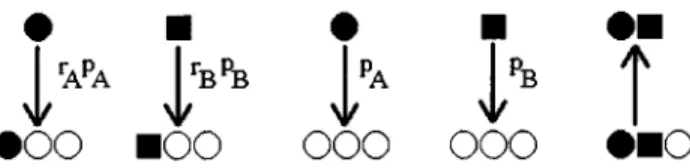
An interacting monomer-monomer model (IMM) has been introduced [46, 47] where monomers of the same species have variable lateral repulsive interactions in one dimension. In the IMM model, an A monomer can adsorb on a vacant site adjacent to an already-adsorbedA(restricted vacancy) with probabilityr
A p
A, where 0 r
A
1. Similarly, B can adsorb on a re-stricted vacant site with probability r
B p
B. An A (B) monomer can adsorb on a free vacant site (no nearest-neighbor adsorbed monomers of the same type) with probability p
A ( p
B). A nearest neighbor
A-B pair of adsorbed particles reacts and desorbs from the lat-tice (Fig. 4). The limiting case r
A = 0 corresponds to the 'dollars and dimes' model [46], while the case r
A = r
B = 1 corresponds to the noninteracting MM model. When the interaction strength (1,r
A, 1 ,r
B) is weak, the IMM model exhibits only a rst-order phase transition between two saturated phases. At the crit-ical value of the interaction strength, a rst-order line terminates at a bicritical point beyond which two con-tinuous DP type transition lines appear. The two sat-urated phases are separated from a reactive phase by these two lines. This feature in the phase diagram is
similarto the 3MM model discussed in the previous sec-tion. The bicritical behavior along the rst-order line has been recently shown to belong to the DI universal-ity class [19], due to equivalence of the two absorbing (saturated) states.
Figure 4. Interacting monomer-monomer model: open circles, lled circles and lled squares correspond to vacant sites,A, andBmonomers respectively. AandBmonomers adsorb onto restricted vacant sites with probabilities rApA
andrBpB, respectively, and onto free vacant sites with pA
andpB, respectively. A nearest-neighbor AB pair
immedi-ately desorbs from the surface.
{ Interacting monomer-dimer model
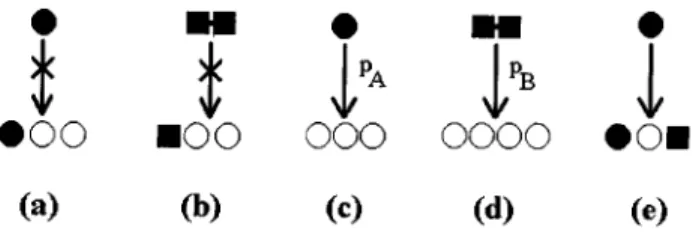
Eects of lateral repulsive interactions in the MD model have been also studied intensively [15, 17, 21, 44, 49, 50, 51, 52]. As in the one-dimensional MM model, the rst-order transition line between the two saturated phases bifurcates into two continuous DP-type transi-tion lines with increasing interactransi-tion strength. Criti-cal behavior at the bicritiCriti-cal point belongs to the DI class [45]. When the repulsive interactions between the same species of particles are innitely strong, an inter-esting thing happens. A monomer (A) cannot adsorb at a restricted vacant site but adsorbs at a free vacant site (no adjacent monomer-occupied site) with proba-bility p
A. Similarly, a dimer ( B
2) cannot adsorb at a pair of restricted vacancies (B in neighboring sites) but adsorbs at a pair of free vacancies with probabil-ityp
B. A nearest neighbor of the adsorbed
This transition has been found to belong to the DI uni-versality class.
Figure 5.Interacting monomer-dimer model: a monomer (lled circle) and dimer (lled square) adsorb at free empty sites with probabilities pA and pB, respectively. Neither
species can adsorb at restricted vacant sites. Whenever there is a monomer-adsorption attempt at a vacant site which neighbors an adsorbed monomer and dimer, the monomer adsorbs and reacts immediately with the neigh-boring dimer.
In order to study the role of symmetry between the two absorbing states, a symmetry breaking eld can be introduced, which favors one absorbing state over the other[17, 44, 52]. When a monomer is chosen to adsorb on an even-numbered free vacant site, the adsorption attempt is rejected with probabilityh. For niteh, the monomers tend to adsorb more on an odd-numbered site rather than an even-numbered one. Therefore, the absorbing state with monomers at odd-numbered sites can be reached more easily than the other absorbing state by the evolution dynamics. In fact, the ratio of the number of ensembles generated by static Monte Carlo simulations, falling into the disfavored absorbing state over that into the favored one, vanishes exponentially with system size at the transition point[17]. It implies that the chance of entering into the disfavored absorb-ing state is negligible in the thermodynamic limit, so the system behaves as if it had a single absorbing state, the favored one. So one can expect that the critical behavior at the absorbing transition should belong to the DP universality class. This has been conrmed in numerical simulations[17, 44].
{ Interacting monomer-trimer model
In analogy to the IMM model, an interacting monomer-trimer model has been studied to investigate an absorbing transition with three equivalent absorbing states[53]. This may be viewed as a natural generaliza-tion in the quest for a new universality class, i.e., the directed version of the equilibrium 3-state Potts model. However, numerical study suggests that this model is always active, without a proper absorbing-state tran-sition. None of the models studied so far with higher symmetries than the Ising symmetry has an absorbing transition[20, 53, 54]. A recent investigation of BAW-type models by Cardy and Tauber [25] may provide an
explanation for the absence of the absorbing phase in models with higher symmetries.
{ Interacting monomer-dimer model with innitely many absorbing states
An interesting variant of the IMD model has been introduced very recently [21]. This model possesses innitely many absorbing (IMA) states with an extra global symmetry (Ising type) among absorbing states. The absorbing states can be divided into two equivalent groups. These two groups are dynamically separated innitely far apart. In other words, an absorbing state in one group cannot be reached from any absorbing state in the other group by a nite number of successive local dynamic changes. This dynamic barrier is simi-lar to the free energy barrier between ground states of equilibrium systems that exhibit spontaneous symme-try breaking in the ordered phase. Furthermore, there is a one-to-one mapping between the absorbing states in the two dierent groups. This ensures the Ising-type global symmetry in the system and the dynamic barrier causes the order-disorder-type absorbing transition.
The dynamic rules of this IMA-IMD model are al-most the same as those of the IMD model with in-nitely strong repulsion between the same species in one dimension. Dierentiation between the IMA-IMD model and the ordinary IMD model comes in when there is a monomer (A) adsorption attempt at a va-cant site between an adsorbed A and and an adsorbed B (Fig. 5(e)). In the IMA-IMD model, this process is disallowed. Then any conguration having neither nearest-neighbor pairs of vacancies nor single vacancies between two adsorbed B's is absorbing, for example, (B0A0BB0A0A). To impose the Ising symme-try, spontaneous desorptions of a nearest-neighbor pair of adsorbed B's are allowed with probability s. For s 6= 0, an absorbing conguration cannot have this BB pair. Hence only those congurations that have particles at alternating sites and no two B's at con-secutive alternating sites become absorbing states, e.g., (A0A0B0A0) and (0A0A0B0A). So the absorb-ing states are divided into two equivalent groups with particles at odd- and even-numbered sites. The num-ber of absorbing states grows exponentially with system size and it is clear that there is an Ising-type symmetry between these two groups. This model shows a contin-uous absorbing phase transition of the DI type.
groups. Therefore there is no dynamic barrier between absorbing states any more and the system behaves like the other systems with innitely many absorbing states without any extra symmetry. Numerical simulations conrm that the absorbing transition at s= 0 belongs to the DP universality class. Also, like in the IMD model with a symmetry breaking eld, the system goes back to the DP class when the dynamic rules favor one group of absorbing states over the other.
IV Summary
In summary, we surveyed various kinds of surface re-action models exhibiting absorbing phase transitions. Absorbing critical behaviors of all models studied thus far can be classied into two universality classes, i.e., the directed percolation (DP) and directed Ising (DI) classes. While the models with the two equivalent ab-sorbing states or two equivalent groups of abab-sorbing states belong to the DI universality class, the mod-els with a single absorbing state or multiple absorbing states with one of them more prominent than the others belong to the DP universality class. These two univer-sality classes are connected by the symmetry-breaking eld which favors one absorbing state or group over the other one. Another scenario to move from the DI to DP class is to remove the dynamic barrier between the two groups of absorbing states.
Most of studies are done by numerical simulations, so a deeper understanding through analytic means is needed. Also various aspects like the dynamics of re-action fronts have to be investigated further in detail [6, 52, 55]. Recently, various multilayer versions of re-action models have been studied and their roughening and preroughening transitions found to be based on the DP-type and DI-type absorbing universality class [56-59]. Generalization of these models in this direction may be interesting. Another line of research should be a quest for a new universality class associated with higher symmetries.
Acknowledgments
We thank WonMuk Hwang, Heungwon Park, Mann Ho Kim, Jae Dong Noh, Marcel den Nijs, Daniel ben-Avraham, Sidney Redner for fruitful collaborations which resulted in many works reviewed in this paper. This work was supported by the research fund through the BK21 project.
References
[1] G. Nicolis and I. Prigogine, Self-organization in Nonequilibrium systems (Wiley-Interscience, New York, 1977).
[2] H. Haken, Synergetics (Springer-Verlag, New York, 1983).
[3] T. M. Liggett,Interacting Particle Systems (Springer-Verlag, New York, 1985).
[4] J. Marro and R. Dickman,Nonequilibrium Phase Tran-sitions in Lattice Models(Cambridge University Press, Cambridge, 1999).
[5] R. Dickman, in Nonequilibrium Statistical Mechanics in One Dimension, edited by V. Privman (Cambridge University Press, Cambridge, 1997).
[6] E. V. Albano, Heterog. Chem. Rev.3, 389 (1996).
[7] W. Kinzel, in Percolation Structures and Processes, edited by G. Deutscher, R. Zallen, and J. Adler (Hilger, Bristol, 1983).
[8] F. Schlogl, Z. Phys.253, 147 (1972).
[9] P. Grassberger and A. de la Torre, Ann. Phys. (N.Y.)
122, 373 (1979).
[10] J. L. Cardy and R. L. Sugar, J. Phys. A 13, L423
(1980).
[11] H. K. Janssen, Z. Phys. B42, 151 (1981).
[12] P. Grasssberger, Z. Phys. B47, 365 (1982).
[13] G. Grinstein, Z.-W. Lai, and D. A. Browne, Phys. Rev. A40, 4820 (1989).
[14] P. Grassberger, F. Krause, and T. von der Twer, J. Phys. A17, L105 (1984); P. Grassberger, J. Phys. A 22, L1103 (1989).
[15] M. H. Kim and H. Park, Phys. Rev. Lett.73, 2579
(1994); H. Park, M. H. Kim, and H. Park, Phys. Rev. E52, 5664 (1995).
[16] N. Menyhard, J. Phys. A27, 6139 (1994); N. Menyhard
and G. Odor, J. Phys. A28, 4505 (1995).
[17] W. Hwang, S. Kwon, H. Park, and H. Park, Phys. Rev. E57, 6438 (1998).
[18] K. E. Bassler and D. A. Browne, Phys. Rev. Lett.77,
4094 (1996); Phys. Rev. E55, 5225 (1997).
[19] K. S. Brown, K. E. Bassler, and D. A. Browne, Phys. Rev. E56, 3953 (1997).
[20] H. Hinrichsen, Phys. Rev. E55, 219 (1997).
[21] W. Hwang and H. Park, Phys. Rev. E59, 4683 (1999).
[22] H. Takayasu and A. Yu. Tretyakov, Phys. Rev. Lett.
68, 3060 (1992).
[23] I. Jensen, Phys. Rev. E50, 3623 (1994).
[24] S. Kwon and H. Park, Phys. Rev. E52, 5955 (1995).
[25] J. L. Cardy and U. C. Tauber, Phys. Rev. Lett.77,
4780 (1996); J. Stat. Phys90, 1 (1998).
[26] R. M. Zi, E. Gulari, and Y. Barshad, Phys. Rev. Lett.
56, 2553 (1986).
[27] G. Grinstein, Z.-W. Lai, and D. A. Browne, Phys. Rev. A40, 4820 (1989).
[28] P. Meankin, and D. J. Scalapino, J. Chem. Phys.87,
[29] R. M. Zi, and K. Fichthorn, Phys. Rev. B , 2038 (1986).
[30] D. ben-Avraham, D. Considine, P. Makein, S. Redner, and H. Takayasu, J. Phys. A23, 4297 (1990).
[31] E. V. Albano, Phys. Rev. Lett.69, 656 (1992).
[32] J. Zhuo, and S. Redner, Phys. Rev. Lett. 70, 2822
(1993).
[33] E. V. Albano, J. Phys. A 25, 2557 (1992); J. Stat.
Phys.69, 643 (1992).
[34] A. Maltz and E. V. Albano, Surf. Sci.277, 414 (1992).
[35] K. Yaldram, K. M. Khan, N. Ahmed, M. A. Khan, J. Phys. A26, 2663 (1993).
[36] J. Kohler and D. ben-Avraham, J. Phys. A24, L621
(1991); D. ben-Avraham and J. Kohler, J. Stat. Phys.
65, 839 (1991).
[37] I. Jensen, Int. J. Mod. Phys. B8, 3299 (1994).
[38] P. Grassberger, J. Stat. Phys.79, 13 (1995).
[39] M. A. Mu~noz, G. Grinstein, R. Dickman, and R. Livi, Phys. Rev. Lett.76, 451 (1996); M. A. Mu~noz, G.
Grin-stein, and R. Dickman, J. Stat. Phys.91, 541 (1998).
[40] I. Jensen, Phys. Rev. Lett.70, 1465 (1993); I. Jensen
and R. Dickman, Phys. Rev. E48, 1710 (1993).
[41] K. Yaldram, K. M. Khan, N. Ahmed, M. A. Khan, J. Phys. A26, L801 (1993).
[42] E. V. Albano, J. Phys. A29, 3317 (1996).
[43] I. Jensen, J. Phys. A27, L61 (1994).
[44] H. Park and H. Park, Physica A221, 97 (1995).
[45] R. A. Monetti, Phys. Rev. E58, 144 (1998).
[46] H. Park, J. Kohler, I.M. Kim, D. ben-Avraham, and S. Redner, J. Phys. A26, 2071 (1993).
[47] J. Zhuo, S. Redner, and H. Park, J. Phys. A26, 4197
(1993).
[48] M. Schick, Prog. Surf. Sci.11, 245 (1982); Physica110,
1811 (1982).
[49] H. P. Kaukonen and R. M. Nieminen, J. Chem. Phys.
91, 4380 (1989).
[50] F. Bagnoli, B. Sente, M. Dumont, and R. Dagonnier, J. Chem. Phys.94, 777 (1991).
[51] J. J. Luque, F. Jimenez-Morales, and M. C. Lemos, J. Chem. Phys.96, 8535 (1992).
[52] S. Kwon, W. Hwang, and H. Park, Phys. Rev. E 59,
4949 (1999).
[53] H. Park (unpublished). [54] J. D. Noh (unpublished).
[55] C.-C. Chen, H. Park, and M. den Nijs, Phys. Rev. E
60, 2496 (1999).
[56] U. Alon, M. R. Evans, H. Hinrichsen, and D. Mukamel, Phys. Rev. Lett. 76, 2746 (1996); Phys. Rev. E 57,
4997 (1998).
[57] H. Hinrichsen and G. Odor, Phys. Rev. Lett.82, 1205
(1999).
[58] J. D. Noh, H. Park, and M. den Nijs, Phys. Rev. E59,
194 (1999).