J. Braz. Chem. Soc., Vol. 18, No. 6, 1242-1246, 2007. Printed in Brazil - ©2007 Sociedade Brasileira de Química 0103 - 5053 $6.00+0.00
ArticleArticleArticleArticleArticle
*e-mail: [email protected]
Identification of Defensive Compounds in Metathoracic Glands of Adults of the
Stink Bug
Dichelops melacanthus
(Hemiptera: Pentatomidae)
Francisco A. Marques,*,a Edison P. Wendler,a Beatriz Helena L. N. Sales Maia,a Maurício U. Venturab and Iara Cintra Arruda-Gattib
a
Departamento de Química, Universidade Federal do Paraná, CP 19081, 81531-990 Curitiba-PR, Brazil
b
Departamento de Agronomia, Centro de Ciências Agrárias, Universidade Estadual de Londrina, CP 6001, 86051-970 Londrina-PR, Brazil
Os conteúdos das glândulas metatorácicas de insetos adultos do percevejo Dichelops
melacanthus (Hemiptera: Pentatomidae) foram analisados. Os compostos de defesa foram
identificados combinando as técnicas de cromatografia gasosa (CG), cromatografia gasosa acoplada à espectrometria de massas (CG-EM) e por comparação de seus índices de retenção com os de compostos padrões. Tridecano foi o componente majoritário, seguido de quantidades menores e aproximadamente iguais de (E)-4-oxo-2-hexenal e (E)-2-octenal. Também foram identificados (E)-2-hexenal, decano, acetato de (E)-2-hexenila, undecano, (E)-4-oxo-2-octenal, dodecano, acetato de (E)-2-octenila, 1-trideceno, tetradecano e pentadecano.
The contents of metathoracic glands of adults of the stink bug Dichelops melacanthus
(Hemiptera: Pentatomidae) were analyzed. Compounds were identified by gas chromatography (GC), coupled GC-mass spectrometry and matching retention indices and mass spectra with those of authentic samples. Tridecane was the major component followed by lesser and approximately equal amounts of (E)-4-oxo-2-hexenal and (E)-2-octenal. Other compounds identified include (E)-2-hexenal, decane, (E)-2-hexenyl acetate, undecane, (E)-4-oxo-2-octenal, dodecane, (E)-2-octenyl acetate, 1-tridecene, tetradecane and pentadecane.
Keywords: Dichelops melacanthus, defensive compounds, short-chain unsaturated aldehydes, unsaturated acetates, tridecane
Introduction
Insects have evolved a multitude of chemical and behavioral defenses against other offensive organisms. Stink bugs, as their name suggests, produce large quantities of strong-smelling and irritating defensive chemicals, which are released when the bugs are disturbed or molested.1 In general, heteropterans produce allomones in dorsal abdominal scent glands as immatures, and in metathoracic scent glands as adults.1-3 Numerous reports attest to the efficacy of the secretions of the metathoracic and abdominal scent glands as effective defenses against predation.1,2,4 They also may have a role as alarm pheromones,5 as has been demonstrated for similar types of compounds produced by bug species in other families.6,7 Stink bug defensive compounds have received considerable study, and it has been shown that the types
of compounds constituting the defensive chemical blends typically consist of alkane hydrocarbons and saturated and unsaturated aldehydes and esters. In adults, the defensive compounds are produced in large, well-defined, and usually colored metathoracic glands, which are not present in the immature stages.
Sex pheromones have been identified from only a few phytophagous stink bug species to date.8,9 In all cases reported, components from metathoracic glands have not been part of the pheromone blend. However, because stink bugs readily release defensive compounds when disturbed, it is difficult if not impossible to collect extracts of sex pheromones uncontaminated by these components.
1243 Marques et al.
Vol. 18, No. 6, 2007
gland was applied on the bug using a glass pipette.7 In Brazil, this bughas for several years been considered a secondary pest of soybean (Glycine max L.) Merril, pods, and has recently become a key pest of corn (Zea mays L.) and wheat (Triticum aestivum L.).11 The no-tillage system and late-season corn, after they were introduced, provided good conditions for the survival and rapid proliferation of this insect. When corn or wheat germinates, the insects suck on the stems of the plants, causing severe damage and significantly reducing yields.12
Experimental
Insects
Dichelops melacanthus was collected at the School Farm of the State University of Londrina, in Londrina County, northern Paraná State (latitude 23 °S and longitude 51 °W). Insects were provided with soybean seeds (Glycine max) and water at 22 ± 2 oC, 70 ± 10% relative humidity and a 14:10 h light-dark cycle.
Analysis of metathoracic gland contents of adult bugs
Metathoracic gland contents were analyzed from 5 adult bugs. To prevent the premature discharge of gland contents, mature bugs were anesthetized with CO2 and then killed by freezing. The legs and wings of freshly killed bugs were clipped off with scissors, and the carcass was pinned through the head, dorsal side up. The outer edges of the abdomen were cut open with a pair of fine iris scissors. Then the dorsal cuticle was flipped open, exposing the contents of the abdomen. The tissues inside the body cavity were carefully removed to expose the paired orange-colored meta-thoracic glands. The gland contents were sampled by piercing the gland with a drawn-out glass micro-capillary tube. Then the tube was broken in 0.2 mL of hexane in a glass vial (2.5 mL) inside a screw-capped vial to release the extracted gland contents. Extracts were concentrated by evaporation under a gentle stream of argon, as required, and analyzed (1 µL) by splitless gas chromatography on a VF-5ms column (30 m × 0.25
mm × 0.25 µm, Varian, Lake Forest, CA), with a
temperature program of 50 °C for 1 min, then 5 °C min-1 to 180 °C and hold for 15 min. Injector and detector temperatures were 250 and 300 °C, respectively, with helium carrier gas (1.0 mL min-1). Extracts were also analyzed (1 µL) by splitless coupled gas
chromato-graphy mass spectrometry (GC-MS) with a Varian 3800
GC fitted with a CP-Sil 8 CB Low Bleed/MS column (30 m × 0.25 mm × 0.25 µm, Varian, Lake Forest, CA)
and interfaced to an Varian Saturn 2000 MS/MS mass selective detector (ion trap, electron impact ionization (70 eV)). The GC was programmed at 50 °C for 3 min, then 5 °C min-1 to 280 °C, with injector and transfer line temperatures of 250 and 280 °C, respectively.
Compounds were tentatively identified by GC/MS, and identifications were confirmed by comparison of the retention time(s) and mass spectra (EI and CI) of the unknowns with those of authentic samples or by comparative analysis of Kovats indeces. In order to determine the Kovats index of the compounds, a mixture of n-alkanes (C8-C20) was injected followed by natural extract in the GC-MS equipment programed at 50-240 °C at 3 °C min-1. Injector and detector temperatures were 250 °C and 300 °C, respectively. The relative amount of each compound was determined from the area under the GC peaks.
Chemical standards
(E)-2-hexenal, (E)-2-octenal, (E)-2-hexenyl acetate, 1-tridecene, 1-dodecene, decane, undecane, dodecane, tridecane, tetradecane, pentadecane, hexadecane, heptadecane, octadecane and eicosane were purchased from Aldrich Chemical Company (Milwaukee, Wisconsin, USA). (E)-2-Octenyl acetate was a gift from Dr. Jocelyn G. Millar, University of California, Riverside, USA. (E)-4-Oxo-2-hexenal and (E )-4-oxo-2-octenal were synthesized as described below.
(E)-2-Hexen-1,4-diol (2a)
A solution of n-BuLi in hexanes (22.9 mL, 27.5 mmol) was added dropwise to a stirred solution of THP-protected 2-propyn-1-ol, 1 (3.50 g, 25 mmol) in anhydrous THF (50 mL) at –30 °C. The solution was warmed to 0 °C, hold at 0 °C for 15 min, then recooled to –30 °C, followed by the addition of propionaldehyde (1.74 g, 30 mmol) in THF (10 mL). After stirring 1 h between –20 and –30 °C and 2 h at room temperature, the mixture was poured into water and the product was extracted with Et2O. The ether extract was washed with brine, dried over Na2SO4 and concentrated.
1244 Identification of Defensive Compounds in Metathoracic Glands of Adults J. Braz. Chem. Soc.
The crude product was taken up in methanol (50 mL), p-toluenesulfonic acid monohydrate (150 mg) was added, and the mixture was stirred 4 h at room temperature. Saturated NaHCO3 solution (2 mL) was then added and the mixture was stirred for 15 min. The MeOH was removed under reduced pressure, and the residue was extracted with ether. The ether extract was dried over Na2SO4, filtered, concentrated and purified by silica gel flash chromatography (hexane-EtOAc 2:1, then EtOAc). The oil obtained was distilled (bp 118-122 °C at 6 mm Hg) giving 1.74 g (60% overall yield) of diol, 2a. 1H NMR (300 MHz, CDCl
3): δ 5.88 (dt, J 15.5, 4.9 Hz, 1 H), 5.76 (br dd, J 16.0, 6.0 Hz, 1 H), 4.19 (d, J 5.1 Hz, 2 H), 4.10 (overlapped dt, J 6.5, 6.1 Hz, 1 H), 1.90 (br s, 2 H), 1.51-1.70 (m, 2 H), 0.95 (t, J 7.4 Hz, 3 H); 13C NMR (75 MHz, CDCl
3): δ 134.1, 129.9, 73.6, 62.9, 30.0, 9.7. MS (70 eV) m/z (relative intensity): 87 (18), 85 (13), 69 (70), 57 (87), 55 (18), 45 (18), 43 (59), 41 (100).
(E)-4-Oxo-2-hexenal (3a)
Pyridinium chlorochromate (388 mg, 1.8 mmol) and neutral activated aluminum oxide (388 mg) were ground together to a fine powder in a mortar and pestle and transferred to a round-bottomed flask containing 5 mL CH2Cl2. A solution of (E)-2-hexen-1,4-diol (32 mg, 0.28 mmol) in CH2Cl2 was added dropwise. The mixture was stirred for 1 h at room temperature and then concentrated under reduced pressure until < 1 mL of liquid remained. The residue was applied to a 5 cm column of silica gel (60-230 Mesh), and the product was eluted with hexane/Et2O (1:1) affording 23 mg (77%) of 3a. 1H NMR (CDCl
3, 300 MHz): δ 9.79 (d, J 7.0 Hz, 1 H), 6.91 (d, J 16.2 Hz, 1 H), 6.79 (dd, J 16.26, 6.9 Hz, 1 H), 2.75 (q, J 7.2 Hz, 2H), 1.17 (t, J 7.2 Hz, 3 H). 13C NMR (CDCl
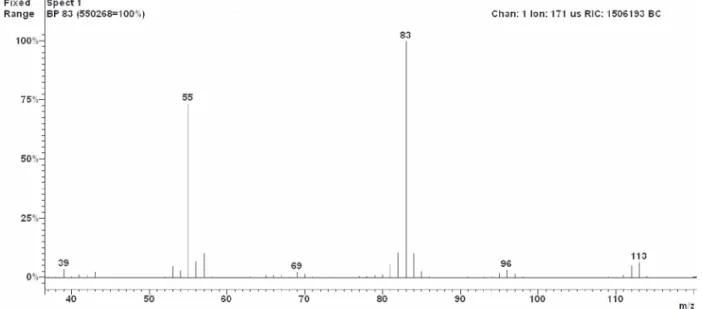
3, 75 MHz): δ 200.3, 193.4, 144.7, 137.3, 34.5, 7.5. MS (70eV) m/z (relative intensity): 112 (M+, 15), 84 (15), 83 (100), 57 (22), 55 (98).
(E)-2-Octen-1,4-diol (2b)
The diol 2b was prepared as described above for preparation of 2a, replacing propionaldehyde with pentanal, giving 2.19 g (61% overall yield) of diol 2b. The oil obtained was distilled (bp ~134-38 °C at 6 mm Hg). 1H NMR (300 MHz, CDCl
3): δ 5.86 (dt, J 15.6, 5.0 Hz, 1 H), 5.76 (dd, J 15.6, 5.8 Hz, 1 H), 4.18 (d, J 5.0Hz, 2 H), 4.15 (overlapped dt, J 6.4, 6.3 Hz, 1 H), 1.69 (br s, 2 H), 1.50-1.62 (m, 2 H), 1.27-1.42 (m, 4 H), 0.92 (t, J 6.8 Hz, 3 H); 13C NMR (75 MHz, CDCl
3): δ 134.5, 129.6, 72.3, 62.7, 36.8, 27.6, 22.6, 14.0. MS (70 eV) m/z (relative intensity): 113 (8), 87 (35), 69 (73), 57 (64), 55 (30), 45 (20), 43 (65), 41 (100).
(E)-4-Oxo-2-octenal (3b)
Diol 2b (40 mg) was oxidized as described above for
2a, giving 30 mg (80%) of (E)-4-oxo-2-octenal, 3b. 1H NMR (300 MHz, CDCl3): δ 9.78 (d, J 7.7 Hz, 1 H), 6.89 (d, J 16.2 Hz, 1 H), 6.77 (dd, J 16.1, 7.7 Hz, 1 H), 2.70 (t, J 7.3 Hz, 2 H), 1.65 (quin, J 7.5 Hz, 2 H), 1.36 (sex, J 7.5 Hz, 2 H), 0.93 (t, J 7.3 Hz, 3 H); 13C NMR (75 MHz, CDCl3): δ 200.3, 193.3, 145.3, 137.5, 40.9, 25.7, 22.2, 13.8. MS (70 eV) m/z (relative intensity): 125 (8), 111 (42), 98 (47), 84 (20), 83 (51), 70 (36), 57 (28), 55 (100), 41 (58).
Results and Discussion
A typical gas chromatogram of the metathoracic gland content of an adult male D. melacanthus is shown in Figure 1.
The volatile gland constituents consisted primarily of saturated hydrocarbons, short-chain unsaturated aldehydes, and two unsaturated esters (Table 1).
1245 Marques et al.
Vol. 18, No. 6, 2007
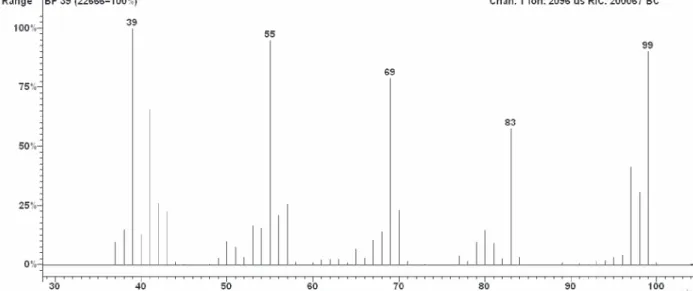
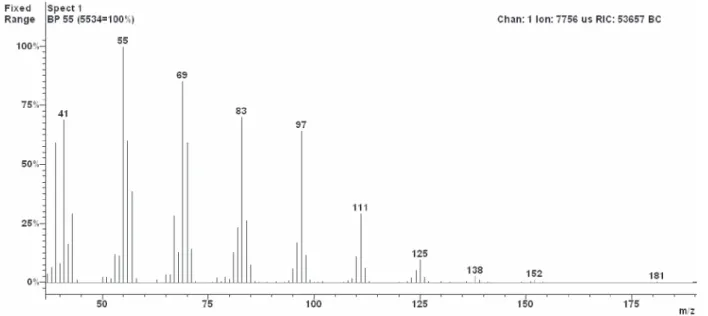
increased the retention times substantially beyond that of the saturated analogs. The geometry of the double bonds was confirmed to be E from the match of the retention times and mass spectra with those of authentic standards (2-octenal: Z: m/z 83 > m/z 70; E: m/z 83 < m/z 70 and 2-hexenal: Z: m/z 83 > m/z 69; E: m/z 83 < m/z 69).
To provide standards for conclusive identification of insect-produced compounds, short syntheses of (E)-4-oxo-2-hexenal and (E)-4-oxo-octenal were performed (Scheme 1).
Because of the instability of these substances, the syntheses were thought to prepare the corresponding diols
2a and 2b, more stable compounds, which could be readily oxidized to the oxo-aldehydes as needed. Attempted distillation of the 4-oxo-2-alkenals resulted in some isomerization, which for our purposes proved to be advantageous because it provided the Z isomers for GC retention-time determinations. The good match of the retention times of the natural products with those of the major synthetic compounds confirmed the stereochemistry of the double bonds of the natural products as E. The retention indices of the oxo-aldehydes, not found in the literature, were calculated, and can be employed in future studies to support the identification of the natural compounds.
The identification of 1-tridecene remained tentative, based on comparison of the mass spectrum with database
searching and retention index value, because the double bond position of this compound was not determined by microchemistry of the extract.
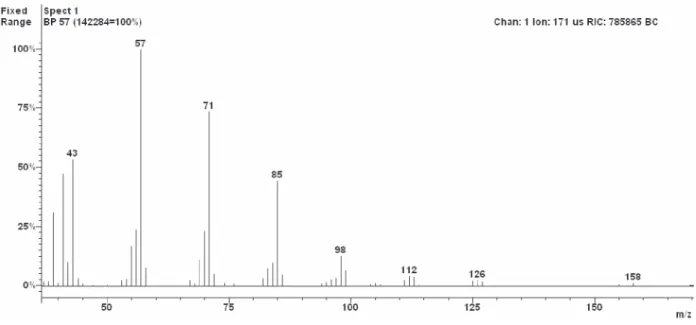
The identification of the structures of the alkanes found in the extracts was based on their mass spectra and good match with the retention indices of authentic standards.
The composition is also typical of what has been reported for several other pentatomid species.1,15 The aldehydes and esters identified are strongly scented and strong irritants, providing both an easily detected warning signal and an effective defense. The function of the hydrocarbons is less clear, but they may serve as solvents and as controlled-release substrates for the more volatile aldehydes.16,17 However it has been reported for pentatomids that other n-alkanes, when combined with (E)-2-hexenal, were not as effective deterrents for other insects as n-tridecane, the major compound found in the extracts analyzed. Hence, n-tridecane appears to be the optimal n-alkane to work synergistically with the other scent compounds.4
Conclusions
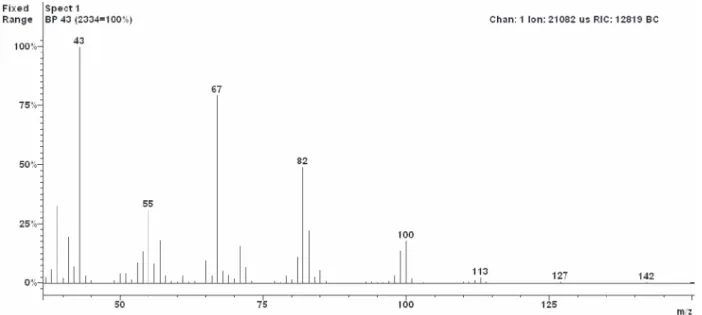
The compounds extracted from the metathoracic scent gland of D. melacanthus were unambiguously identified from their molecular ions and mass spectra and from Table 1. Percentages of compounds found in metathoracic glands of D. melacanthus (mean ± SD) relative to the most abundant compound, tridecane (n = 5)
Entry Compounda Mean ± SD Range Kovats index Kovats index
(found) (literature)12
1 (E)-2-Hexenal 2.58 ± 1.94 0.10 – 6.03 860 854
2 (E)-4-Oxo-2-hexenal 84.1 ± 9.63 65.5 – 92.4 976
3 Decane 0.38 ± 0.24 0.12 – 0.67 1000 999
4 (E)-2-Hexenyl acetate 0.26 ± 0.09 0.09 – 0.33 1028
5 (E)-2-Octenal 87.9 ± 10.3 71.8 – 99.6 1066
6 Undecane 0.21 ± 0.04 0.17 – 0.30 1100 1099
7 (E)-4-Oxo-2-octenal 0.29 ± 0.16 0.15 – 0.59 1162
8 Dodecane 2.16 ± 0.15 1.99 – 2.40 1200 1199
9 (E)-2-Octenyl acetate 1.16 ± 1.09 0.19 – 3.12 1223
10 1-Trideceneb 0.54 ± 0.04 0.46 – 0.57 1292 1292
11 Tridecane 100 1302 1299
12 Tetradecane 0.40 ± 0.11 0.25 – 0.57 1401 1399
13 Pentadecane 0.32 ± 0.10 0.19 – 0.49 1500 1500
aHexadecane, heptadecane, octadecane, eicosane and 1-dodecene were also detected in trace amounts in some extracts. bTentative identification.
Scheme 1. Reaction conditions: (a) THF, n-BuLi; propanal or pentanal; (b) LiAlH4, THF, reflux; (c) MeOH, PTSA (60% for 2a, 61% for 2b); (d) PCC, Al2O3, CH2Cl2 (77% for 3a, 80% for 3b).
OTHP a, b, c R OH
OH
d R
O
H O
1 2aR = Et 3a= (E)-4-oxo-2-hexenal
1246 Identification of Defensive Compounds in Metathoracic Glands of Adults J. Braz. Chem. Soc.
comparison of their retention indices with those of authentic standards. The compounds have all been reported previously from other bug species.1,15 Two of the compounds isolated were synthesized through a short route which allowed the preparation of more stable intermediates that could be converted into the natural compounds as needed.
Acknowledgments
The authors thank CNPq and Fundação Araucária for financial support.
References
1. Aldrich, J.R.; Annu. Rev. Entomol.1988, 33,211. 2. Staddon, B.W.; Adv. Insect Physiol.1979, 14,351. 3. Staddon, B.W.; Ann. Soc. Entomol. Fr.1986, 22, 183. 4. Krall, B.S.; Bartelt, R.J.; Lewis, C.J.; Whitman, D.W.; J. Chem.
Ecol.1999, 25,2477.
5. Kou, R.; Tang, D.S.; Chow, Y.S.; J. Chem. Ecol.1989, 15, 2695. 6. Gunawardena, N.E.; Bandumathie, M.K.; J. Chem. Ecol. 1993,
19,851.
7. Leal, W.S.; Panizzi, A.R.; Niva, C.C.; J. Chem. Ecol. 1994, 20, 1209.
8. McBrien, H.L.; Millar, J.G. In Pheromones of Non-Lepidopteran Insects Associated with Agricultural Plants; Hardie, J.; Minks, A.K., eds.; CAB International:Wallingford, UK, 1999, p. 277.
9. McBrien, H.L.; Millar, J.G.; Rice, R.E.; McElfresh, J. S.; Cullen, E.; Zalom, F. G.; J. Chem. Ecol. 2002, 28, 1797.
10. Arruda-Gatti, I. C.; Ph.D. Thesis, Universidade Estadual de Londrina, Brazil, 2006.
11. Manfredi-Coimbra, S.; Silva, J.J; Chocorosqui, V.V.; Panizzi, A.R..; Cienc. Rural2005, 35, 1243.
12. Chocorosqui, V.R.; Panizzi, A.R.; Neotrop. Entomol. 2004, 33, 487.
13. Millar, J.G.; Rice, R.E.; Wang, Q.; J. Chem. Ecol.1977, 23, 1743.
14. Adams, R.P.; Identification of Essential Oil Components by Gas Chromatography/Mass Spectrometry; Allured Publ.: Illinois, 1995.
15. Aldrich, J.R. In Chemical Ecology of Insects 2; Cardé, R.T.; Bell, W.J., eds.; Chapman and Hall: New York, 1995, p. 318. 16. Remold, H.; Nature1962, 198, 764.
17. Gunawardena, N.E.; Herath, H.M.W.K.; J. Chem. Ecol. 1991,
17, 2449.
J. Braz. Chem. Soc., Vol. 18, No. 6, S1-S12, 2007. Printed in Brazil - ©2007 Sociedade Brasileira de Química 0103 - 5053 $6.00+0.00
Supplementary InformationSupplementary InformationSupplementary InformationSupplementary InformationSupplementary Information
*e-mail: [email protected]
Identification of the Defensive Compounds in Metathoracic Glands of Adults of the
Stink Bug
Dichelops melacanthus
(Hemiptera: Pentatomidae)
Francisco A. Marques,*,a Edison P. Wendler,a Beatriz Helena L. N. Sales Maia,a Maurício U. Venturab and Iara Cintra Arruda-Gattib
a
Departamento de Química, Universidade Federal do Paraná, CP 19081, 81531-990 Curitiba-PR, Brazil
b
Departamento de Agronomia, Centro de Ciências Agrárias, Universidade Estadual de Londrina, CP 6001, 86051-970 Londrina-PR, Brazil
S2 Identification of the Defensive Compounds in Metathoracic Glands of Adults J. Braz. Chem. Soc.
Figure S2. MS spectra of (E)-4-oxo-2-hexenal (3a).
S3 Marques et al.
Vol. 18, No. 6, 2007
Figure S4. MS spectra of (E)-2-hexenyl acetate.
S4 Identification of the Defensive Compounds in Metathoracic Glands of Adults J. Braz. Chem. Soc.
Figure S6. MS spectra of undecane.
S5 Marques et al.
Vol. 18, No. 6, 2007
Figure S8. MS spectra of dodecane.
S6 Identification of the Defensive Compounds in Metathoracic Glands of Adults J. Braz. Chem. Soc.
Figure S10. MS spectra of 1-tridecene.
S7 Marques et al.
Vol. 18, No. 6, 2007
Figure S12. MS spectra of tetradecane.
S8 Identification of the Defensive Compounds in Metathoracic Glands of Adults J. Braz. Chem. Soc.
Figure S14. MS spectra of hexadecane.
S9 Marques et al.
Vol. 18, No. 6, 2007
Figure S16. MS spectra of octadecane.
S10 Identification of the Defensive Compounds in Metathoracic Glands of Adults J. Braz. Chem. Soc.
Figure S18. MS spectra of 1-dodecene.
S11 Marques et al.
Vol. 18, No. 6, 2007
Figure S20. 13C NMR spectra of 1-oxo-2-benzenal.
S12 Identification of the Defensive Compounds in Metathoracic Glands of Adults J. Braz. Chem. Soc.
Figure S22. 13C NMR spectra of 4-oxo-2-octenal (3b)