Article
Alarm Pheromone System of Stink Bug
Piezodorus guildinii
(Heteroptera: Pentatomidae)
Paulo H. G. Zarbina*, Miguel Borgesb, Alcindo A. dos Santosa, Alfredo R. M. de Oliveiraa, Fábio Simonellia and Francisco de A. Marquesa
aUniversidade Federal do Paraná, Departamento de Química, CP 19081, 81531-990, Curitiba - PR, Brazil bEmbrapa, Cenargen, Área de Controle Biológico, CP 02372, 70849-970, Brasília - DF, Brazil
Os compostos utilizados pelo percevejo da soja Piezodorus guildinii como feromônio de alarme foram caracterizados através da análise da composição química das secreções da glândula metatorácica dos insetos adultos. Além dos hidrocarbonetos característicos, (E)-2-hexenal e (E)-4-oxo-2-hexenal foram detectados como constituintes majoritários. Tais compostos já foram previamente descritos como feromônio de alarme em outras espécies de pentatomídeos.
The compounds utilized by the soybean stink bug Piezodorus guildinii as alarm pheromone were characterized by analysis of the chemical composition of the metathoracic scent gland secre-tions from adult bugs. In addition to characteristic hydrocarbons, (E)-2-hexenal and (E)-4-oxo-2-hexenal were detected as major constituents. These compounds were previously described as alarm pheromone in several other pentatomid species.
Keywords: Piezodorus guildinii, alarm pheromone,(E)-2-hexenal, (E)-4-oxo-2-hexenal
*e-mail: [email protected]
Introduction
Piezodorus guildinii is a member of the stinkbug com-plex in soybeans that is economically important pests in Brazil1,2. In our investigation on the chemical ecology re-lated to the Pentatomidae family, we have started to eluci-date the chemical communication system of P. guildinii3 and we have reported previously that methyl 2,6,10-trimethyldodecanoate and methyl 2,6,10-trimethyltride-canoate are male-produced sex pheromones of this spe-cies3,4. Field experiments are now in progress to determine the potential for utilizing these compounds in an integrated pest management program.
An important characteristic of adult heteropterans is the fact that when molested, they usually retaliate by discharg-ing volatiles secretions (defensive chemicals / alarm phero-mones) from their ventral methatoracic glands (MTG)5. This intriguing mechanism has led to the isolation and identifi-cation of several defensive compounds released by a num-ber of heteropteran species5-8.
The P. guildinii metathoracic scent gland complex is similar of that reported by Nezara viridula by Gilby and Waterhouse9. The adult scent gland complex of both males and females consists of a median ventral metathoracic scent
reservoir, which is orange-yellow in color, and paired col-orless lateral glands sometimes called accessory glands. The lateral glands discharge through ducts into the reser-voir, which also receives secretions from the gland cells which form its epithelium. The glands open to the exterior on the ventral surface9.
The main purpose of the present work was to character-ize the chemical composition of the metathoracic glands of P. guildinii and to identify the compounds that elicit dis-persive behavior in other members of the species.
Experimental
Insects
Piezodorus guildinii and Euschistus heros were collected near Brasilia and raised continuously on soybean seeds (Glycine max), green beans (Phaseolus vulgaris), peanuts (Arachis hypogaea), and sunflower seeds (Helianthus annuus) at 26 ± 2 oC, 70% relative humidity, and a 14:10 h light-dark cycle.
Extraction
metathoracic region and under the scutelum. The dorsal abdominal cuticule was pulled back and the viscera were removed. The scent gland complex, located at the ventral abdominal metathoracic region, could be reached and re-moved with the aid of a small surgical scissors. The gland reservoir was removed and immersed in ~100 µL analytical grade hexane distilled from CaH2 and stored at –20 oC. One
sample of dorsal abdominal gland (DAG) secretion of E. heros was prepared by immersing the second-instar nymphs in hexane (~100 µL) for 10 minutes and then transferring the extract directly to a clean conical bottom vial.
Chemical analyses
Samples were analyzed (~ 2 µL of the extract) by gas chromatography (GC) on a HP-5890 Series II (FID detec-tor; 270 oC) in splitless mode (250 oC; 1.5 min). The
HP-1 bonded methyl silicone column (25m x 0.25mm x 0.2µm) was operated at 50 oC for 2 min to 220 oC at 7 oC/min,
using helium as carrier gas (1.0 mL/min). Electron impact mass spectra were obtained at 70 eV using a Shimadzu QP-5000 GC-MS equipped with a DB-5 column (30m x 0.25 mm x 0.25 µm J & W Scientific) in splitless mode (250 oC;
1.5 min) and with an interface temperature of 200 oC. The
temperature program and linear velocity of the carrier gas (He) was the same as described above. The IR refer to films and were measured on a Bomem M-102 spectrometer. The
1H-RMN spectra were recorded at 200 MHz on a Bruker
AC 200 spectrometer (CDCl3). The 13C-NMR spectra were
recorded at 50 MHz on a Bruker AC 200. Column chroma-tography was carried out on columns packed with Merck Kieselgel 60, Art.-Nr 7734. (E)-2-hexenal, (E)-2-octenal, n-undecane, n-dodecane, n-tridec-1-ene, n-tridecane standards, and hexane were obtained from Aldrich Chemical Co.
Synthesis: (E)-4-(Tetrahydro-2’-pyranyloxy)-2-buten-1-ol (9)
A solution of (E)-1,4-butenediol (8) (2.14g; 24.3 mmol), dihydropyran (2.03g; 24.3 mmol), and p-TSA (70 mg) in dry THF (80 mL) was stirred for 6 h at –25 oC. The product
was extracted with ether, washed successively with satu-rated NaHCO3 solution, water and dried under MgSO4. Solvent removal and distillation under reduced pressure gave 9 in 60% yield (1.83 g); b.p. 133-37 oC / 5-7 mm Hg;
IR νmax / cm-1 3410, 2940, 2864, 1453, 1026; 1H-NMR
(200 MHz, CDCl3) δ 1.53-1.88 (m, 6H); 2.02 (s, 1H); 3.48-3.58 (m, 1H); 3.81-3.95 (m, 1H); 4.09-4.33 (m, 4H); 4.69 (d, J 4 Hz, 1H); 5.74 (dt, J 18 Hz ; 6 Hz, 1H); 5.83 (dt, J 18 and 6 Hz, 1 H); 13C-NMR (50 MHz, CDCl
3) δ 19.4; 25.4;
30.6; 58.5; 62.2; 62.8; 97.6; 128.2; 132.3; GC-MS (70 eV) m/z 172 (M+, 29%), 155 (6%), 101 (20%), 85 (100%), 67
(5%), 55 (3%), 39 (12%).
(E)-4-(Tetrahydro-2’-pyranyloxy)-2-butenal (10)
Pyridinium chlorochromate adsorbed in Al2O3 (29.9 g; 24.3 mmol) was suspended in dry CH2Cl2 (180 mL) at 25 oC. Alcohol 9 (1.7 g; 9.9 mmol) in CH2Cl2 (5.0 mL) was added in one lot to the stirred solution. After 2h, the black reaction mixture was filtered through a short pad of SiO2 and active charcoal. The solvent was removed under reduced pressure and the product obtained (1.35 g) was used in the next step without further purification; GC-MS (70 eV) m/z 169 (M-1, 3%), 101 (21%), 85 (100%), 67 (23%), 57 (22%), 41 (57%).
(E)-1-(Tetrahydro-2’-pyranyloxy)-2-hexen-4-ol (11)
To cold ethylmagnesium bromide prepared from mag-nesium (0.16g; 6.5 mmol) and bromoethane (0.73g; 6.5 mmol) in dry THF (30 mL), was added slowly and with constant stirring a soln. of aldehyde 10 (1.1 g; 6.40 mmol) in THF (5.0 mL). The mixture was left overnight at room temperature and quenched with an ice-cold solution of NH4Cl and worked-up in the usual manner. The crude prod-uct was chromatographed over silica gel (ethyl ether: hex-ane / 2:1) and alcohol 11 was obtained in 70 % yield (0.92 g). IR νmax/ cm-1 3422, 2940, 2875, 1453, 1121, 1026;
1H-NMR (200 MHz, CDCl
3) δ 0.93 (t, J 7.4 Hz, 3H);
1.49-1.90 (m, 8H); 3.47-3.53 (m, 1H); 3.81-4.38 (m, 4H); 4.64 (t, J 3Hz, 1H); 5.76-5.80 (m, 2H); 13C-NMR (50 MHz, CDCl
3) δ
9.64; 19.47; 25.4; 29.9; 30.6; 62.2; 67.0; 73.6; 98.0; 127.3; 135.0; GC-MS (70 eV) m/z 182 (M-18, 2%), 169 (1%), 98 (6%), 85 (100%), 67 (10%), 57 (23%), 41 (12%).
(E)- 2-Hexen-1,4-diol (12)
A solution of alcohol 11 (0.80 g; 4.0 mmol), methanol (12 mL) and p-TSA (40 mg) was stirred at room tempera-ture for 4 h. The solvent was removed under reduced pres-sure and the residue was diluted in ether (15.0 mL), washed with saturated NaHCO3 solution and brine, dried over MgSO4 and concentrated in vacuo. The residue obtained (0.40 g) was used in the next step without further purifica-tion. GC-MS (70 eV) m/z 98 (M-18, 33%), 87(16%), 85 (12%), 81 (100%), 69 (44%), 57 (90%), 55 (14%), 43 (46%).
(E)- 4-Oxo-2-hexenal (2)
As described above for the synthesis of aldehyde 10, diol 12 (0.30 g; 2.60 mmol) was converted into compound
2 (77 % yield; 0.22 g) using PCC adsorbed in Al2O3 (12.7 g, 10.4 mmol) and after purification through column chro-matography on silica gel (hexane : ethyl ether / 1:3). IR
νmax / cm-1 2982, 1752, 1699, 1615, 1121, 980; 1H-NMR
2H); 6.71-6.94 (m, 2H); 9.78 (d, J 6 Hz, 1H); 13C-NMR
(50 MHz, CDCl3) δ 7.5; 34.5; 137.2; 144.6; 193.3; 200.3; GC-MS (70 eV) m/z %: 112 (M+ , 16%), 97 (6%), 83 (100%),
69 (4%), 55 (77%), 39 (8% ).
Results and Discussion
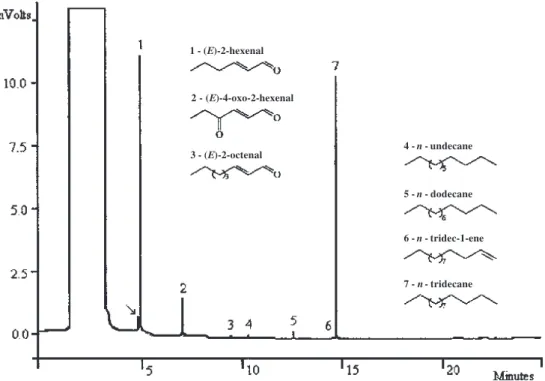
The chromatograms obtained by analyses of the crude hexane extract of the metathoracic glands secretions of P. guildinii showed seven peaks whose structures could be identified, three of those in higher amount than the other ones (Figure 1).
By comparison of these natural products with those on the computerized mass spectra data base, peaks 1, 3-7 were tentatively identified as (E)-2-hexenal, (E)-2-octenal, n -undecane, n-dodecane, n-tridec-1-ene and n-tridecane, re-spectively. The identifications were confirmed by GC co-injection with commercial standards. EI-MS of compound
2 gave a base peak at m/z 83 along with the molecular ion M+. 112 (11%). This structure was tentatively identified
by comparison with spectra from natural products previ-ously identified as pheromones and synthetic standards, as described below.
Defensive secretions from first and second-instar nymphs of stink bugs belonging to the same family as P. guildinii were described by Borges and Aldrich6. In
immature heteropterans (nymphs), defensive secretions are
produced in the dorsal abdominal glands (DAGs) instead of the metathoracic glands and the gland contents usually dif-fer within a species5,6. DAG extracts of second-instar nymphs
of Euschistus heros contained four compounds, and one of these had a MS consistent with the mass spectrum data of component 26. GC-MS co-injection of the MTG extract of P. guildinii with a DAG extract of E. heros showed that com-pound 2 had the same retention time and mass spectrum of the compound identified as (E)-4-oxo-2-hexenal [MS m/z (%): 112 (11), M+; 97 (4), CHOCHCHCOCH
2+; 83 (100),
CHOCHCHCO+; 55 (78), CHOCHCH+].
To confirm this identification, we synthesized (E )-4-oxo-2-hexenal 2 in five steps, following the synthetic route shown in Scheme 1. The monoprotected alcohol 9 was obtained after protection of the diol 8 with DHP in 60 % yield10. Oxidation of 9 with PCC in methylene chloride
afforded the aldehyde 10 in 80% yield11. Coupling of this
compound with ethylmagnesium bromide12 yielded the
alcohol 11 (65 %) which was deprotected to give diol 12
(88%) by treatment with pTSA in methanol10. Oxidation
of this compound with PCC supported on Al2O3 in CH2Cl2 afforded the desired product in 77% yield, which was found by GC-MS co-injection to be indistinguishable from the natural product.
Pinder and Staddon13 described the first synthesis of 2
by employing an acid catalyzed hydrolysis of 2-ethyl-2,5-dimethoxy-2,5-dihydrofuran, which gives a mixture
Figure 1. GC profile of a crude hexane extract sample from metathoracic scent gland of adult males P. guildinii. The peak labeled with an arrow is due to solvent impurity. Peak numbers correspond to compounds identified.
1 - (E)-2-hexenal
2 - (E)-4-oxo-2-hexenal
3 - (E)-2-octenal 4 - n - undecane
5 - n - dodecane
6 - n - tridec-1-ene
of the cis (major) and trans isomers. Later, Ward and Van Dorp14 synthesized the same compound by reaction of
propanal with the Grignard derivative of 1,1-diethoxy-2-propyne, followed by the reduction of the acetylenic bond with Na/NH3(l), oxidation with active manganese dioxide and acid hydrolysis. We now developed a synthesis of 2 in good overall yield by an operationally simple strategy. This synthesis offers a useful alternative to those described in the literature.
Therefore, the chemical composition of the metathoracic scent gland secretions of P. guildinii was identified as a mix-ture of (E)-2-hexenal, (E)-4-oxo-2-hexenal, (E)-2-octenal, n -undecane, n-dodecane, n-tridec-1-ene and n-tridecane (Fig-ure 1). This composition is similar in both sexes indicating that these compounds do not play any role, as sexual attrac-tant, together with the ones previously reported3. Compounds
1, 4, 5, and 7 are known toxins, irritants, or repellents15,16, and are released to the stink bugs in response to disturbance. These facts strongly suggest that they really acts as chemical defenses of the species. Further studies in field will clarify their role in the chemical ecology of P. guildinii.
It is not know how the various secretions components interact. However, it was reported for pentatomid that (E )-2-hexenal and n-tridecane were more effective as repel-lents to insects when combined than when individually tested17. Furthermore, other n-alkanes when combined
with (E)-2-hexenal were not as effective deterrents towards other insects as n-tridecane. Hence, n-tridecane appears to be the optimal n-alkane to work synergistically with (E )-2-hexenal to repel insects16. The other secretions
compo-nents of the multicomponent blend of P. guildinii may likewise function in an additive way.
(E)-2-hexenal 1 has been reported as active component for Dysdercus intermedius18, Cimex lectularius19, Nezara viridula20 and Elasmucha grisea21, while (E
)-4-oxo-2-hexenal 2, which appears to be biosynthesized via oxida-tion of 1 by enzymes secreted into the reservoirs of the glands22, was described for Euschistus heros, Euschistus tristigmus, Thyanta perditor, and Edessa meditabunda6.
We recently reported that the crude aeration extract of P. guildinii has attracted the egg parasitoids Trissolcus teretis, Telenomus podisi, and Trissolcus urichi to the baited traps4. The same phenomenon was observed when the synthetic sex attractant pheromone was employed3,4. Parasitoids have been reported to respond to the host’s body odor; sex, and aggregation pheromones; salivary constituents; excretory products; webbing; honeydew; body scales; and eggs7,23.
It has been reported that the egg parasitoid Trissolcus basa-lis utilizes a defensive substance produced by its host bug as a long-range attractant kairomone24.
Therefore, these simple structures found on the met-athoracic glands of adults P. guildinii could be used as kairomone to synchronize the parasitoid population at the beginning of the host flight season and pave the way for the development of invaluable tools in integrated pest management programs for this important soybean pest.
Acknowledgements
We thank the IFS (International Foundation for Sci-ence – Sweden, grant to P. H. G. Z.), CNPq (Brazilian Con-sul for Scientific and Technological Development), and Plantações E. Michelin for financial support. Helio M. dos Santos and Francisco G. V. Schmidt, from Embrapa Ge-netic Resources and Biotechnology, helped with field col-lecting and laboratory raising of the bugs, for which we are grateful. Prof. Antonio Gilberto Ferreira (DQ-UFSCar) for running 1H NMR and 13C NMR of the synthetic com-pounds and Prof. Jocelyn G. Millar, University of Califor-nia, Riverside, for kindly revising the manuscript.
References
1. Côrrea-Ferreira, B. S.; Moscardi, F. Entomol. Exp. Appl. 1996, 79, 1.
2. Panizzi, A. R.; Slansky, F. Fla. Entomol. 1985, 68, 184. 3. Borges, M.; Zarbin, P. H. G.; Ferreira, J. T. B.; Costa,
M. L. M. J. Chem. Ecol. 1999, 25, 629.
4. Borges, M.; Schmidt, F. G. V.; Sujii, E. R.; Medeiros, M. A.; Mori, K.; Zarbin, P. H. G.; Ferreira, J. T. B. Physiol. Entomol. 1998, 23, 202.
5. Aldrich, J. R. Annu. Rev. Entomol.1988, 33, 211. 6. Borges, M.; Aldrich, J. R. Experientia1992, 48, 893. 7. (a) Leal, W. S.; Higuchi, H.; Mizutani, N.; Nakamori, H.; Kadosawa, T.; Ono, M. J. Chem. Ecol. 1995, 21, 973. (b) Leal, W. S.; Kadosawa, T. Biosci. Biotech. Biochem. 1992, 56, 1004.
8. Kou, R.; Tang, D. S.; Chow, Y. S. J. Chem. Ecol.1989, 15, 2695.
9. Gilby, A. R.; Waterhouse, D. F. Nature 1967, 216, 90. 10. Vig, O. P.; Aggarwal, R. C.; Bari, S. S.; Sharma, S. D.
Indian J. Chem. 1979, 18, 33.
11. Zarbin, P. H. G.; Yonashiro, M.; Perissini Jr., W. J. Braz. Chem. Soc. 1998, 9, 583.
12. Zarbin, P. H. G.; Cruz, W. O.; Ferreira, J. T. B. J. Braz. Chem. Soc. 1998, 9, 511.
13. Pinder, A. R.; Staddon, B. W. J. Chem. Soc. 1965, 2955. 14. Ward, J. P.; Van Dorp, D. A. Recueil1969, 88, 989. 15. Blum, M.S. In Chemical Defenses in Arthropods,
Aca-demic Press, New York, 1981.
16. Krall, B. S.; Bartelt, R. J.; Lewis, C. J.; Whitman, D. W. J. Chem. Ecol. 1999, 25, 2477.
17. Gunawardena, N. E.; Herath, H. M. W. K. J. Chem. Ecol. 1991, 17, 2449.
18. Calam, D. H.; Youdeowei, A. J. Insect Physiol. 1968, 14, 1147.
19. Levinson, H. Z.; Bar Ilan, A. R. Experientia1971, 27, 102.
20. Ishiwatari, T. Appl. Entomol. Zool. 1974, 9, 153. 21. Maschwitz, U.; Gutmann, C. Insect. Soc.1979, 26, 101. 22. Aldrich, J. R.; Blum, M. S.; Hefetz, A.; Fales, H. M.;
Lloyd, H. A.; Roller, P. Science, 1978, 201, 452. 23. Whitmann, D. W. In Novel Aspects of
Insect-Plant-Interations; Barbosa, P.; Letourneau, D., Ed.; John Wiley & Sons, Singapore, 1988, p 11.
24. Mattiacci, L.; Vinson, S. B.; Williams, H. J.; Aldrich, J. R.; Bin, F. J. Chem. Ecol. 1993, 19, 1167.