0103 - 5053 $6.00+0.00
A
r
t
ic
le
A
r
t
ic
le
A
r
t
ic
le
A
r
t
ic
le
A
r
t
ic
le
*e-mail: [email protected]
Electrochemical Behaviour of Iron in Chlorinated Alkaline Media. The Effect of Slurries
from Granite Processing
Carmen M. Abreu, Alba Covelo, Belén Díaz, Lorena Freire, X. Ramón Nóvoa* and M. Consuelo Pérez
Universidade de Vigo, E. T. S. E. I., Rúa Maxwell, 9, Campus Universitário 36310 Vigo, Spain
O Porriño é uma zona bem conhecida de pedreiras do sudoeste de Galiza, Espanha. Nas operações de processamento do granito são geradas 3 × 10⁵ ton ano-1 de pó nesta área, com
consequências graves para o meio ambiente. Este pó resultante comprovou ser um aditivo eficiente do concreto de alta resistência com melhoramento efetivo das suas propriedades mecânicas. Nenhum trabalho foi publicado acerca do efeito desta mistura na passivação de reforços de aço. O objetivo deste trabalho é analisar o comportamento electroquímico dos eletrodos de aço e de ferro em soluções alcalinas resultantes desta lama. O crescimento e evolução das camadas de passivação formadas nos eletrodos testados foram estudados por Voltametria Cíclica e Espectroscopia de Impedância Electroquímica. Foram usadas técnicas de Difração de raios-X e Microscopia de Varrimento por Elétrons para a caracterização morfológica e química dos filmes de passivação gerados. O efeito da presença de íons cloreto também foi considerado.
Porriño is a well known zone of quarry and stone working of the SW of Galicia, Spain. In granite’s working processes 3 × 10⁵ ton year-1 of granite powder are generated in this area,
causing an important environmental problem. This dust has proved to be an efficient addition to high-strength concrete to improve mechanical properties. Nevertheless, no works have been published concerning the effect of this admixture in the passivation of steel reinforcements. The objective of the present work is to analyze the electrochemical behaviour of iron and carbon steel electrodes in alkaline solutions resulting from these slurries. The growth and evolution of the passive layers formed on the tested electrodes are studied by Cyclic Voltammetry and Electrochemical Impedance Spectroscopy. Scanning Electron Microscopy and X-ray powder Diffraction have been used for the morphological and chemical characterisation of the generated passive films. The effect of the presence of Cl– ions is also considered.
Keywords: granite slurry, corrosion inhibitors, CV, EIS
Introduction
Spain is one of the three major ornamental rock producers and the first European granite producer. 60% of the Spanish production is concentrated in the Porriño district (NW of Spain) with 3 × 10⁵ ton year-1. The granite cutting residues are originated from the sawing process of rock blocks into plates. In this process, 20% to 30% (m/m) of mineral is transformed into dust which mixed with water, shot-blasting particles, lubricants, tensio-actives and lime form the so-called granite cutting slurries, GCS. The solid and liquid phases are separated by density difference: the solid fraction remains into a tank while the liquid fraction is recycled at the beginning of process.
The particles present in the solid phase are classified in two sizes: the greater fraction, used as aggregates for concrete, and the finer fraction which nowadays is useless, remains as waste accumulated in landfills. The environmental problem generated urges to find a solution acceptable from the economical and ecological points of view.
aggressive agents.1,2 Preliminary works suggested the possibility of using GCS as an additive in concrete structures, concluding that small additions of these slurries improved the mechanical resistance of
concrete.3 However, the possible effects that granite
slurry’s additions can have in the passive layer of rebars must be studied prior to the use of GCS as cement additives.
The present paper is aimed to analyse the possible use of Granite Cutting Slurries as additive in reinforcing concrete structures, evaluating the GCS addition effect when chloride ions are present. The study is developed in two parts: A first one where the chemical and morphological properties of GCS are analysed, and a second one focused on the electrochemical behaviour of iron in alkaline solution containing GCS powder and chloride ions.
Experimental
Characterization of GCS
Granite Cutting sludge samples were obtained in Porriño (Pontevedra, Spain). The chemical characterization was done by chemical analysis of cations, X-Ray diffraction and titrations with HCl 0.1 mol L-1.
Electrochemical tests
Granite Cutting suspensions were prepared by
adding 0.2 g of slurry to 150 mL of NaOH 0.1 mol L-1
solution. The electrochemical behaviour of iron in this suspension was compared with that of a reference without added GCS. Moreover, alkaline suspensions were used with two chloride concentrations: 0.2 mol L-1 and 0.5 mol L-1.
Electrochemical experiments were performed in a convectional three-electrode cell, where the tested
material was corrugated carbon steel having 0.54 cm2
exposed area. The reference electrode was Hg/HgO
0.1 mol L-1 KOH and the counter electrode, a Pt mesh.
When chloride ions were added to the solutions, a saturated calomel electrode (SCE) was employed as reference electrode. Before each experiment, the working electrode surface was freshly polished and rinsed with distilled water. All electrochemical tests were performed at room temperature and open to the air, using an AUTOLAB 30 Potentiostat (from EcoChemie). Two different electrochemical techniques were employed: Cyclic Voltammetry and Electrochemical Impedance Spectroscopy.
The scanned potential region for Cyclic Voltammetry
tests was from hydrogen evolution (-1.4 V vs. SCE) to
oxygen evolution (+ 0.6 V vs. SCE) reactions at 1 mV s-1 scan rate, which allows relaxation of the redox process that take place in the passive layer.4
EIS tests were conducted at different immersion times (1, 2, 4 and 8 days). They were carried out at the corresponding Open Circuit Potential (OCP). The scanned frequencies interval was from 10 kHz to 1 mHz. Similar experiments were carried out in solutions contaminated with chloride ions.
Results and Discussion
Characterisation of the GCS
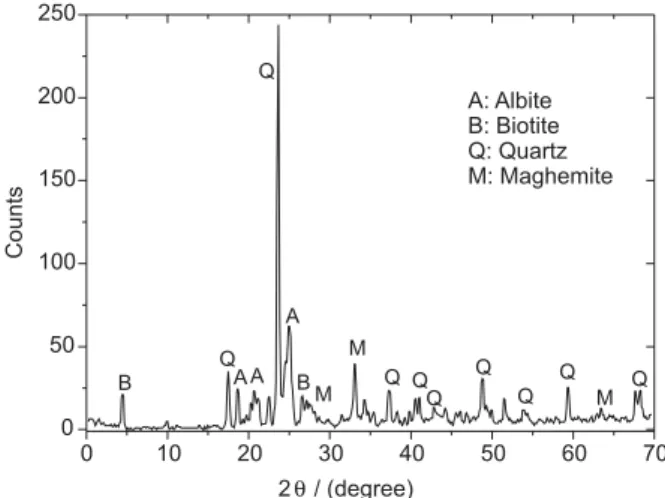
X-ray Diffraction analysis shows the existence of different crystallographic forms. Figure 1 corresponds
to the obtained diffraction spectrum Quartz (SiO2),
Biotite (K+(Mg2+, Fe2+)(Al3+, Fe3+)Si
3O10(OH –, F–)
2), Albite (NaAlSi3O8or CaAl2Si2O8) and an iron oxide,
maghemite (Fe2O3) can be identified. All those
compounds are typical for granite rocks, and are considered to be alkaline in nature; this characteristic, chemical compounds in crystalline form, is typical of chemically stable compounds, therefore having low pozzolanic activity.
The elemental analysis performed on granite slurries allows obtaining the quantitative results that, given as upper oxides, are summarised in Table 1.
It is verified that, from the chemical point of view, the residue is composed mainly of SiO2, Al2O3 and Fe2O3that
corresponds to nearly 86%. The high percentages of SiO2
and Al2O3 obtained are typical of igneous granitic rocks.
Figure 1. X-ray diffraction analysis of Granite Cutting Slurries showing the identified species present. X-axis corresponds to Bragg’s angle 2θ.
0 10 20 30 40 50 60 70
0 50 100 150 200 250
M Q
Q Q Q Q Q Q M A
A Q B
2 / (degree)
Counts
A: Albite B: Biotite Q: Quartz M: Maghemite
B Q
A
The presence of Fe2O3 and CaO is probably related to foreign additions, like the addition of steel shot and lime as abrasive in the process of rock cutting /sawing.
In order to homogenize and mix slurries powder, a planetary ball mill was employed. Before milling, the particles size was 1 to 30 µm and, after milling during
45 min, the size was diminished to 1-5 µm. These
results are coincident with the bibliography where the size of particles was estimated by laser granulometry,
obtaining 3.92 µm average diameter after 80 min
milling.5
In Figure 2 a SEM micrograph of these particles after the milling process is presented. It can be observed that particles are irregular in shape and size, with about 3 µm average size. SEM-EDX analyses of a GCS powder sample show that chemical composition is particle size dependent. The smallest particles (<1µ) are spherical and Si rich. The remaining particle sizes are irregular shape and rich in Fe, Ca and Al.
Figure 3 presents the titration curve in alkaline media
of a GCS suspension (with 2 g L-1 in 100 mL of NaOH
0.1 mol L-1) having as a reference a NaOH 0.1 mol L-1 solution.
The initial pH value (about 13) is similar for both solutions. Nevertheless, it can be seen that the GCS suspension needs 2 mmol HCl more than NaOH solution to neutralise. Thus, GCS show some “buffering power”, similar to that found in red muds.6
Electrochemical behaviour of iron in alkaline solutions containing GCS
Solutions without chloride ions
Carbon steel behaviour in alkaline solutions with GCS was analysed by Cyclic Voltammetry and Electrochemical Impedance Spectroscopy. These data were compared with those obtained for an iron electrode in 0.1 mol L-1 NaOH solution.
Oxide films were grown by cyclic voltammetry (seven cycles) on carbon steel electrodes in the different solutions
(NaOH 0.1 mol L-1 without additives and with 2 g L-1
GCS). The voltammograms corresponding to the last cycle are depicted in Figure 4. Both forward scans show the
activity peak at -0.9 V vs. SCE, typical of magnetite
Table 1. Chemical composition of the granite slurries
Compounds SiO2 Al2O3 Fe2O3 CaO K2O Na2O MgO TiO2 P2O5 SO3 MnO
% (m/m) 65.840 13.0 7.118 5.540 3.470 3.140 0.871 0.332 0.280 0.089 0.089
Compounds Cl BaO SrO ZrO2 Cr2O3 CuO NiO ZnO N C H
% (m/m) 0.070 0.057 0.027 0.021 0.016 0.009 0.008 0.006 0.005 0.73 1.12
Figure 2. SEM micrograph obtained on a sample of GCS after 45 min milling.
Figure 3. Tritation curve corresponding to 100 mL of NaOH 0.1 mol L-1
suspension containing 2 g L-1 of GCS and NaOH 0.1 mol L-1.
0 3 6 9 12 15
0 2 4 6 8 10 12 14
NaOH 0.1 mol L-1
NaOH 0.1 mol L-1+ 0.2 g L-1GCS
pH
HCl added / mmol
Figure 4. Comparison of the seventh cycles of carbon steel in NaOH 0.1 mol L-1, without and with 2 g L-1 GCS added.
-1.4 -1.2 -1.0 -0.8 -0.6 -0.4 -0.2 0.0 0.2 0.4 0.6 0.8 -600
-400 -200 0 200 400 600
7thCycle NaOH 0.1 mol L-1
7thCycle NaOH 0.1 mol L-1 + GCS
C
u
rr
ent
densi
ty
/
(
µ
Ac
m
-2
)
formation, observed for iron electrode in alkaline media.7 Nevertheless, in presence of GCS both the peak current and current in the cathodic domain are lower. Moreover, the potential of oxygen evolution is shifted anodically. Those effects can be attributed to blockage of the carbon steel surface due to GCS.
Electrochemical Impedance Spectroscopy, EIS, was used in order to obtain additional information on the electrode processes involved. Figure 5 depicts the typical Bode impedance spectra obtained at 4 and 8 days immersion. The impedance spectra were recorded at the corresponding OCP values, which vary between –200 mV and –100 mV up to 8 days immersion time.
All plots reveal the presence of two time constants that can be attributed to the double layer capacitance-charge transfer resistance and the redox processes
developing in the passive layer.8 Thus, the impedance
can be modelled using equation 1 where Re represents
the high frequency (electrolyte) resistance; R1 and C1 correspond to the double layer capacitance and charge
transfer resistance; and the R2C2 time constant is
associated to the redox processes developing in the passive layer. Good agreement is found between this model and the experimental data as illustrated in Figure 5A. The best fitting parameters for the data depicted in Figure 5 are given in Table 2.
1 2
1 2
e 2
1 1 2 1 2 2
R R
Z( ) R ; Z ( )
( j R C )α 1/(1 (Z ( ) / R )) 1 (j R C )α
ω = + ω =
ω + + ω + ω (1)
It can be seen in Figure 5 that the overall impedance is higher for the solution containing GCS. Moreover, the high frequency resistance (see Re parameter in Table 2) is also higher for this solution. Variations in Re have been related to changes in the dielectric properties of passive films.9,10 In the present case, GCS could induce either the formation of an adsorbed layer which blocks the electrode surface, or a chemical modification of the passive layer, with similar result.
Table 2 shows also that double layer capacitance is smaller for the solution containing GCS. If the hypothesis of adsorbed layer applies, the result will be C1 decreasing
due to series combination of double layer capacitance and the dielectric capacitance corresponding to this adsorbed layer. Nevertheless, if the double layer capacitance is about
100µF cm-2 and the measured C
1 30 µF cm
-2, the series
capacitance shall be 40 µF cm-2, which gives film
thickness about 10-10 m, value not compatible with any
physical film.
An alternative to explain the observed C1 decreasing is that GCS change the passive film’s zero charge potential (ZCP) by modification of the outermost layer. The OCP shifts cathodically with time in presence of GCS and is globally more cathodic than in the blank solution. According to the literature concerning the electrochemical behaviour of steel in alkaline media, more cathodic potentials means more hydrated passive
Table 2. Best fitting parameters corresponding to data in Figure 5 using equation 1 as equivalent model
Immersion Re / R1/ C1/ R2/ C2/ OCP / mV
time / days (Ω cm2) (kΩ cm2) (µF cm-2) α
1 (kΩ cm
2) (µF cm-2) α
2 (SCE)
NaOH 4 11.5 28 100 0.9 500 188 0.7 -176
0.1 mol L-1 8 14.8 89 87 0.9 8800 55 0.7 -148
NaOH
0.1 mol L-1 4 19.7 260 32 0.9 8500 35 0.6 -168
+ GCS 8 21.5 272 33 0.9 8900 55 0.7 -190
Figure 5. Bode diagrams obtained for carbon steel electrode at (A) 4 and (B) 8 days of immersion time in NaOH 0.1 mol L-1 solution and in the
same solution contaminated with GCS.
10-3
10-2
10-1
100
101
102
103
104
100
101
102
103
104
105
106
107
Frequency / Hz
M
odul
us
/
(ohm
cm
2
2
)
0 10 20 30 40 50 60 70 80 90
Blank solution
Best fitting for blank solution Solution with GCS
Best fitting for solution with GCS
-P
ha
se
Angl
e/
(degr
e
e
)
(A)
10-3
10-2
10-1
100
101
102
103
104
100
101
102
103
104
105
106
107
Frequency / Hz
M
o
dul
us
/
(o
hm
c
m
)
0 10 20 30 40 50 60 70 80 90
Blank solution
Best fitting for blank solution Solution with GCS
Best fitting for solution with GCS
-P
hase
A
ngl
e/
(degre
e)
film, thus having different ZCP and higher resistance to corrosion by chlorides.10
Solutions with chloride ions
Cyclic potentiodynamic curves have also been recorded in the same alkaline solutions adding different chloride concentrations to reach to 0.2 mol L-1 and 0.5 mol L-1, thus nominal [Cl–]/[OH–] of 2 and 5 respectively. These [Cl–]/[OH–] ratios correspond to those necessary for rebar’s depassivation at -200 and -350 mV vs. SCE, respectively.11 In Figures 6 and 7, the obtained potentiodynamic curves are shown.
For carbon steel electrodes in chlorinated alkaline solutions, no matter the chloride concentration, the passive film breakdown occurs in the first forward scan, at about +0.5V, although current transients typical of unstable pitting are observed since about +0.1V. Nevertheless, pitting corrosion was not observed when the electrode is immersed in the suspensions containing GCS, which proves that the sludge protects carbon steel from pitting (at least during ten voltammetric cycles).
Electrochemical Impedance spectra were recorded
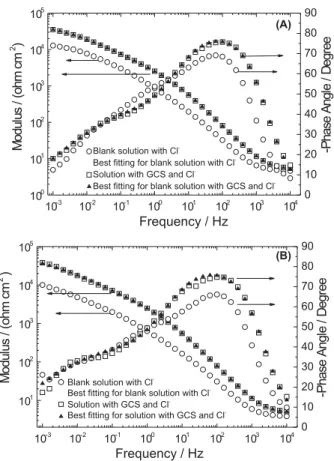
on carbon steel in chlorinated (0.5 mol L-1) alkaline
solution with and without slurries. Measurements were
performed at the corresponding OCP, prior to pitting occurrence. All the obtained spectra present two well differentiated time constants, as shown in Figure 8, for 4 and 8 days immersion time. The experimental data were modelled using again equation 1 as impedance model. The best fitting parameters obtained for the data depicted in Figure 8 are given in Table 3. It can be
seen that Re decreases (compared to values in Table 2)
due to the higher ionic concentration in solutions containing chlorides; however, values for the solution containing GCS remain higher than those for the reference solution.
The R1 values are much lower in Table 3 than in Table 2 which reveals activation of the corrosion process, which leads to thicker oxides layer. This result is consistent with C2 values, in the mF cm-2 range in presence of chlorides andµF cm-2 without them.
The overall activation of the interface corresponds also to the R2 decreasing observed when values in Table
2 are compared with those in Table 3. This R2
decreasing corresponds to a change in the polarisation curve that can explain the potential shift from about -190 mV to -350 mV in presence of GCS; nevertheless the huge decrease from -150 mV to -550 mV observed
Figure 6. Potentiodynamic curve obtained for a carbon steel electrode in NaOH 0.1 mol L-1 + NaCl 0.2 mol L-1 (with and without GCS) at dE/dt =
1mV s-1, from –1.4V to +0.6V.
-1.4 -1.2 -1.0 -0.8 -0.6 -0.4 -0.2 0.0 0.2 0.4 0.6 0.8
10-7
10-6
10-5
10-4
10-3
10-2
10-1
100
101
102
103
104
105
1st Cycle NaOH 0.1 mol L-1+ NaCl 0.2 mol L-1 1st Cycle NaOH 0.1 mol L-1+ NaCl 0.2 mol L-1 + GCS 10th Cycle NaOH 0.1 mol L-1+ NaCl 0.2 mol L-1 + GCS
C
u
rre
nt
de
ns
it
y
/
(
Α
cm
-2
)
Potential /V(vs. SCE )
Table 3. Best fitting parameters corresponding to data in Figure 8 using equation 1 as equivalent model
Immersion Re/ R1/ C1/ R2/ C2/ OCP/ mV
time/ d (Ω cm2) (kΩ cm2) (µF cm-2) α
1 (kΩ cm
2) (mF cm-2) α
2 (SCE)
NaOH
0.1 mol L-1 4 3.7 4.5 43 0.9 17 1.9 0.5 -551
+ NaCl
0.5 mol L-1 8 3.7 12 53 0.9 18 8.8 0.4 -552
NaOH
0.1 mol L-1 4 5.1 16 27 0.9 50 1.4 0.5 -365
+ NaCl
0.5 mol L-1 8 5.9 37 28 0.9 77 4.2 0.4 -350
+GCS
Figure 7. Potentiodynamic curves obtained for a carbon steel lectrode in NaOH 0.1 mol L-1 + NaCl 0.5 mol L-1 (with and without GCS) at dE/dt =
1mV s-1, from –1.4V to +0.6V.
-1.4 -1.2 -1.0 -0.8 -0.6 -0.4 -0.2 0.0 0.2 0.4 0.6 0.8
10-5
10-4
10-3
10-2
10-1
100
101
102
103
104
105
106
1st
Cycle NaOH 0.1 mol L-1
+ NaCl 0.5 mol L-1
1st
Cycle NaOH 0.1 mol L-1
+ NaCl 0.5 mol L-1
+ GCS
10th
Cycle NaOH 0.1 mol L-1
+ NaCl 0.5 mol L-1
+ GCS
C
u
rrent
den
sit
y
/
(
Α
cm
-2
)
in the reference solution can only be attributed to local loss of passivity with alternate cathodic reaction (H+/ H2 instead of O2/OH–). In fact, pitting is visually observable after 10 days immersion in absence of GCS.
Conclusions
Small additions of Granite Cutting Slurries to alkaline solutions modify the natural passive layer formed on carbon steel. The peak current of the magnetite formation peak decreases in presence of GCS, indicating a corrosion rate reduction; moreover, the high frequency capacitance
Figure 8. Bode diagrams obtained for carbon steel electrode at (A) 4 and (B) 8 days of immersion time in NaOH 0.1 mol L-1 + 0.5 mol L-1 NaCl
solution with and without GCS.
10-3 10-2 10-1 100 101 102 103 104
100
101
102
103
104
105
Frequency / Hz
M
odul
u
s
/
(ohm
cm
2 )
0 10 20 30 40 50 60 70 80 90
Blank solution with Cl
-Blank solution with Cl
-Best fitting for blank solution with Cl
-Best fitting for blank solution with Cl
-Solution with GCS and Cl
-Solution with GCS and Cl
-Best fitting for blank solution with GCS and Cl
-Best fitting for solution with GCS and Cl
--P
h
as
e
A
ngl
e
/
D
egr
ee
(A)
10-3
10-2
10-1
100
101
102
103
104
101
102
103
104
105
Frequency / Hz
M
odul
u
s
/
(ohm
cm
2 )
0 10 20 30 40 50 60 70 80 90
-P
hase
A
n
gl
e
/
D
e
gr
e
e
(B)
decreases, which has been attributed to modifications in the outermost level of the passive layer.
GCS are able to inhibit pitting of carbon steel in presence of chlorides. The steel remains passive after at least 10 voltammetric cycles while without GCS pitting occurs at the first cycle.
Acknowledgment
The authors wish to acknowledge the Spanish “Ministerio de Educación y Ciencia” for financial support under contract no. MAT2004-06435-C02-01.
References
1. Neville, A.M.; Properties of Concrete, Longman: Harlow, GB,
1995.
2. Sousa, J.; Cem. Concr. Compos.2003,25, 51.
3. Gonçalves, J.P.; Moura, W.A.; Coitinho Dal Molin, D.C.;
Ambiente Construído2002,2, 53.
4. Andrade, C.; Merino, P.; Nóvoa, X. R.; Pérez, M. C.; Soler, L.;
Mater. Sci. Forum1995,192-194, 891.
5. Moura, W.A.; Gonçalves, J.P.; Da Silva Leite, R.; Sitientibus
2002,26, 49.
6. Díaz, B.; Joiret, S.; Keddam, M.; Nóvoa, X. R.; Pérez, M.C.;
Takenouti, H.; Electrochim. Acta2004,49, 3039.
7. Joiret, S.; Keddam, M.; Nóvoa, X.R.; Pérez, M.C.; Rangel, C.;
Takenouti, H.; Cem. Concr. Compos.2002,24, 7.
8. Andrade, C.; Keddam, M.; Nóvoa, X.R.; Pérez, M.C.; Rangel,
C.M.; Takenouti, H.; Electrochim. Acta2001,46, 3905.
9. Abreu, C.M.; Cristóbal, M.J.; Montemor, M.F.; Nóvoa, X.R.;
Pena, G.; Pérez, M.C.; Electrochim. Acta2002,47, 2271.
10. Collazo, A.; Cristóbal, M.J.; Nóvoa, X.R.; Pena, G.; Pérez,
M.C.;J. ASTM International (JAI)2006,3, 2.
11. Alonso, C.; Castellote, M.; Andrade, C.; Electrochim. Acta
2002,47, 3469.