TISSUE EXPANDER COMPLICATIONS IN PLASTIC SURGERY. A 10-YEAR EXPERIENCE
From the Division of Plastic Surgery, H o s p i t a l d a s C l í n i c a s , F a c u l t y o f Medicine, University of São Paulo.
RHCFAP/3076 Marcelo Sacramento Cunha, Hugo Alberto Nakamoto, Marisa Roma Herson, José Carlos Faes, Rolf Gemperli and Marcus Castro Ferreira
CUNHA MS et al. - Tissue expander complications in plastic surgery. A 10-year experience. Rev. Hosp. Clín. Fac. Med. S. Paulo 57(3): 2002.
INTRODUCTION: Tissue expanders have been of great value in plastic surgery. Tissue expansion was developed for a specific indication; however, within a very short time, the concept of tissue expansion found wide applicability. From 1990 to 1999, 315 expanders in 164 patients were utilized. A retrospective analysis of complications and prognostic factors for complications were done.
METHODS: The indications for tissue expansion were burns (50%), trauma (32%), and sequelae of previous surgery (8.8%). The expanders were inserted most frequently in the scalp, trunk and neck.
RESULTS: There were 22.2% of complications and the most common were expander exposure (50%), infection (24%) and bad function of the expander (12.8%). The present study revealed an increased rate of minor complications in the group of 0 to 10 years of age and an increased rate of major complications for face and neck expansions compared to trunk expansion. There were no increased complication rates for the other age and anatomic site groups, previous expansion, concomitant expansion and type of expander used.
CONCLUSIONS: The outcomes from tissue expansion procedures done in our hospital are similar to those reported in the literature. Tissue expansion is a good and safe technique.
DESCRIPTORS: Tissue expansion. Tissue expander. Expansion complication. Expanded flap.
Tissue expansion has developed as a routine procedure in plastic surgery in the past two decades. In 1956, Neumann was the first to recognize the potential of tissue expansion for recon-structive surgery. He implanted a bal-loon beneath the temporal region for reconstruction of an absent ear. In 1976, Radovan used the tissue expander con-cept for reconstruction of the breast after mastectomy. Subsequently, the use of tissue expansion has been popular-ized among plastic surgeons and has become the treatment method of choice for many congenital and acquired de-fects in children and adults1-3.
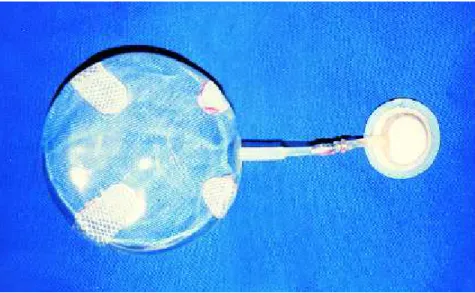
Expanders are silicone envelopes that have self-sealing injection ports (Fig. 1). At weekly intervals, saline is
progressively injected through the port and passes into the expander, which enlarges. As the volume inside the implant increases, tension placed on the overlying and adjacent tissues increases4. The expanded skin
under-goes histological changes that are well documented: the epidermis exhibits increased mitotic activity, there is re-cruitment of adjacent tissue, which is believed to contribute to the addi-tional skin, the dermis thins consid-erably but it is often masked clinically by the thick fibrous capsule that forms around the implant5. Skin expansion
allows the surgeon to generate addi-tional amounts of precious tissue, to thin the flap, and to increase its vas-cularity6.
Tissue expansion was developed for specific indications. It allows sur-geons to cover defects using local skin of appropriate color, texture, and adn-exal structure7. Aesthetic subunits of
the face can be replaced by skin of iden-tical or similar qualities, and distant donor sites can be avoided. Sensate and hair-bearing skin can be expanded and used for specialized areas of facial re-construction; usually, the color and tex-ture match are excellent8.
20 to 40 percent when performing tis-sue expansion in children have been reported8. Patients with high risk of
complication should be identified. The method was introduced in the Division of Plastic Surgery of the Hos-pital das Clinicas in the early 1980s, and the initial indications, anatomic sites,
technique, results, and complications were reviewed in the early 1990s by Gemperli et al.9-11. It seems appropriate
now to review the complications and the prognostic factors for complica-tions of cutaneous expansion, com-pared with the former experience. A ret-rospective review of the experience of the last decade was undertaken, and its presentation is the purpose of this pa-per.
Table 1 - Indications for tissue expansion.
Indications Percent (%)
Burns 157 (50%)
Trauma 101 (32%)
Previous surgery 28 (9%)
Others 29 (9%)
Table 2 - Age and complications.
Age Number (%) Major complications (%) Minor complications (%)
0 to 10 years 67 (21.3%) 10 (14.9%) *+4 (5.9%)
11 to 20 years 112 (35.6%) 20 (17.8%) *1 (0.9%)
21 to 40 years 111 (35.2%) 25(22.5%) 4 (3.6%)
> 40 years 25 (7.9%) 6 (24%) +0
* : P < 0.05
Table 3 - Anatomic site and complications.
Anatomic site Number (%) Major complications (%) Minor complications (%)
Scalp 72 (22.8%) 15 (20.8%) 3 (4.1%)
Trunk 72 (22.8%) *9 (12.5%) 3 (4.1%)
Upper Extremity 35 (11.1%) 5 (14.3%) 2 (5.7%)
Lower Extremity 42 (13.3%) 8 (19%) 1 (2.4%)
Face and Neck 94 (29.9%) *24 (25.5%) 0
* : P < 0.05
Table 4 - Type of expander and complications.
Expander type Number (%) Major complications (%) Minor complications (%)
Croissant 145 (46%) 30 (20.7%) 3 (2%)
Retangular 139 (44.1%) 25 (17.9%) 5 (3.6%)
Round 31 (9.8%) 6 (19.3%) 1 (3.2%)
Figure 1 - Tissue expander.
METHODS
During the time period of January 1990 to December 1999, 164 patients underwent tissue expansion. All pa-tients who had a cutaneous expander for reconstructive purposes were re-viewed retrospectively. Three hundred and fifteen expanders were placed in 164 patients. One hundred and one (61.5%) were females and 63 (38.5%)
were males. The most common indica-tion for tissue expansion was burn se-quelae, trauma, and scars from previ-ous surgery (Table 1).
The ages of patients ranged from 3 to 52 years (average 20.9 years). There were 67 expanders placed in patients of 0 to 10 years (21.3%), 112 in patients of 11 to 20 years (35.6%), 111 in patients of 21 to 40 years (35.2%), and 25 in pa-tients of 40 years or more (7.9%) (Table 2). The anatomic sites of expansion in-cluded the scalp (72 expansions), trunk (72), face and neck (94), lower extremi-ties (42), and upper extremiextremi-ties (35) (Table 3). “Croissant” expanders were used in 145 cases, rectangular expand-ers in 139, and round expandexpand-ers in 31 (Table 4). Expanders were placed in a site of one prior expansion in 78 cases (24.8%) (Table 5). Concomitant expan-sion was done in 145 expanexpan-sions (46%) (Table 6).
The medical records and operative reports of all patients were analyzed. Each patient was studied with respect to indication for the procedure, loca-tion, and shape of expander, previous expansion if any, concomitant expan-sion, and complications. Data such as expander volume and dimensions were not always found in the medical records and could not be used in this study.
cases with no complications were clas-sified as a satisfactory result. Compli-cations were divided into major and minor categories. Major complication was defined as that resulting in a pre-mature loss of expander that required additional surgery, or when the preop-erative plan was not completed, thus yielding a poor result. The minor com-plication was defined as that resulting in only partial satisfaction of the pre-operative plan and thus defined as a fair result12.
The data were analyzed to deter-mine the possible correlation of the complications and those factors stud-ied. The Student t test was used to test for statistic significance, and P < 0.05 was considered statistically significant.
RESULTS
Complications were identified in 70 placed expanders (22.2%). These in-cluded 36 exposures of the implant (51.4% of complications), 17 cases of infections (24.4%), 15 expander failures (21.4%) of which 9 were port failures (12.9%), 4 ex-pander ruptures (5.7%), 2 exex-pander per-forations (2.8%), 1 hematoma (1.4%), and 1 suture dehiscence (1.4%). There were major complications in 61 cases (87% of the complications) and minor complica-tions in 9 expansions ( 13% of the compli-cations).
Patients of 0 to 10 years of age had more minor complications than patients of 11 to 20 years or patients of more
than 40 years of age. Occurrences of minor complications were not signifi-cantly different at any anatomic site (Table 2).
Patients with expanders on the face and neck experienced more major com-plications (25.5%) than those with ex-panders on the trunk (12.5%) (Table 3). The relationship between the minor complications and anatomic sites of expansion was not statistically signifi-cant.
There was no statistic significance between expander type and major or minor complications (Table 4). In the group with previous expansion, there were 15.4% major complications and 1.3% minor complications; whereas, when expansions were placed in a site with no previous expansion, there were 20.6% major complications and 3.3% minor complications. Differences be-tween the two groups were not statisti-cally significant (Table 5).
In the group with concomitant ex-pansion, 20% major complications and 2% minor complications occurred; whereas, in the group with no concomi-tant expansion 18.8% major complica-tions and 3.5% minor complicacomplica-tions occurred. Differences between the two groups were not statistically significant (Table 6 ).
DISCUSSION
Cutaneous expansion is used in-creasingly in reconstructive surgery for
the treatment of a variety of problems in children and adults. The reconstruc-tion of many congenital and acquired defects has been made possible through the use of this technique3.
Advantages of tissue expansion include no new unduly disfiguring de-fects, the avoidance of distant flaps, sensation maintenance, good color and texture match, preservation of hair-bear-ing quality, and increased vascularity and greater length of survival of ran-dom flaps elevated in expanded skin. Disadvantages of tissue expansion are frequent office visits for inflation, dis-comfort, and a period of increased de-formity during the time of inflation. In the pediatric population, emotional dis-turbances may accompany the use of tissue expanders. Formation of a scar tissue capsule may result in reduced skin elasticity, and impeded flap move-ment and expanded skin has a tendency for postoperative retraction13.
The tissue expander was first used in our medical center in 1984. The expe-rience of the Division during the period of 1984 to 1990 was studied by Gemperli at al. in 19919-11. Twenty-five patients
used tissue expanders in the upper limbs, and 12% major complications were re-ported by Gemperli in 199110. The present
study reported similar rates of complica-tions: 14.3% major complications and 57% minor complications in 35 patients with upper limbs expansions. In the pe-riod spanning 1984 to 1990, 33 patients with tissue expanders placed in lower limbs were studied, and 51.9% major complications and 25% minor complica-tions were reported; whereas, in the present study, 19% major complications and 2.4% minor complications in 42 pa-tients occurred9. The lower complication
rates could have resulted from more ex-perience with the technique and better selection of patients. Cases of higher complexity were treated with other tech-niques such as free flaps, since the pre-vious study and the literature showed a higher complication rate for tissue ex-pansion. Tissue expanders were used in the scalp in 32 patients during the pe-riod of 1984 to 1990, and 5 (15.6%) minor complications were reported; the present
Table 5 - Previous expansion and complications.
Previous expansion Number (%) Major complications (%) Minor complications (%) With previous
expansion 78 (24.8%) 12 (15.4%) 1 (1.3%)
Without previous
expansion 237 (75.2%) 49 (20.6%) 8 (3.3%)
Table 6 - Concomitant expansion and complications. Concomitant
expansion Number (%) Major complications (%) Minor complications (%) With concomitant
expansion 145 (46%) 29 (20%) 3 (2%)
Without concomitant
study reported higher rates: 20.8% ma-jor complications and 4.1% minor com-plications in 72 patients11. The number
of patients studied was more than 2 times that of the previous study, and this fact could represent more indications for the technique. Cases of higher complexity were treated, since tissue expanders were considered in the literature to be the best option for scalp reconstruction. Includ-ing cases of higher complexity may have resulted in higher complication rates than in the initial study.
Tissue expanders have been the subject of several reviews3,5,12-14.
Pe-diatric and burned populations have been the most studied patients. A substantial incidence of compli-cations has been well documented. The overall compli cation rates re-ported in the literature are 13% to 40%. Expander complication rates in pediatric burn patients range from 9% to 37%12.
The present study analyzed a young population (average 20.9 years) with a predominance of female patients (61.5%). The most common indication for tissue expansion was burn sequelae, trauma, and scars from previous sur-gery. These epidemiological factors are
similar to those in other series. The overall, minor, and major com-plication rates in this study were 22.2%, 2.8%, and 19.4%, respectively, which are similar to those in other reported series. Complications reported in the literature include primarily infection, exposure of the implant, and implant failure. Other complications are port failure, pain, hematoma, seroma, bone resorption, dog ears, and wide scars13.
Complications reported in this study included 36 exposures of implant (51.4% of the complications), 17 infections (24.4%), 9 port failures (12.9%), 4 ex-pander ruptures (5.7%), 2 exex-pander per-forations (2.8%), 1 hematoma (1.4%), and 1 suture dehiscence (1.4%).
In 1996, Friedman reported a 6-year experience with tissue expanders in chil-dren. The overall complication rate was 18%. The factors associated with a sta-tistically significant increase in compli-cations were burns and soft-tissue loss, patient age under 7 years, use of inter-nal expander ports, and a history of 2 or more prior expansions8. The adult
lit-erature reveals a high complication rate with expansion in lower extremities re-sulting from limitations of vascularity and available tissue. Bauer asserts that
both upper and lower extremity expan-sion have a high complication rate6. In
1998, Pisarski observed an increased complication rate for lower extremity expansion and poor surgeon experi-ence12. Gibstein in 1997 reviewed 105
children in whom 191 tissue expanders were placed. The complications were related to age, being higher in children (aged 1 to 12 years)5.
An increased rate of minor compli-cations was found in the present study in the group of 0 to 10 years of age, and an increased rate of major complications for face and neck expansions compared to trunk expansion. There was no in-creased complication rate for the other age and anatomic site groups, previous expansion, concomitant expansion, and type of expander used. The wide vari-ety of surgeons in the service pre-vented the analysis of the contribution of surgeon experience to the complica-tion rate.
RESUMO RHCFAP/3076
CUNHA MS e col. - Complicações de expansores teciduais em cirurgia plástica. Dez anos de experiência.
Rev. Hosp. Clín. Fac. Med. S. Paulo 57(3): 2002.
INTRODUÇÃO: A utilização de
expansores teciduais tem sido de gran-de importância para a Cirurgia Plásti-ca. Inicialmente descritos para corre-ção de uma deformidade específica, logo tiveram sua utilização ampliada para deformidades congênitas e adqui-ridas. Foram utilizados 315 expansores em 164 pacientes no período de Janei-ro de 1990 a DezembJanei-ro de 1999. Uma análise retrospectiva das complicações
e fatores prognósticos para complica-ções foi realizada.
MÉTODO: As deformidades trata-das mais freqüentes foram seqüelas de queimaduras (50%), seqüelas de trau-mas (32%) e seqüelas de cirurgias pré-vias (8,8%). Os sítios anatômicos em que mais freqüentemente foram utiliza-dos compreenderam face e pescoço, couro cabeludo e tronco.
RESULTADOS: As complicações
ocorreram em 22,2% das expansões e as mais comuns foram extrusão (50%), infecção (24%) e mau funcionamento do expansor (12,8%). No grupo etário de 0 a 10 anos predominaram com-plicações menores e no grupo que
utilizou expansor na face e pescoço as complicações foram maiores comparativamente ao grupo que utili-zou expansores no tronco. Não hou-ve relação causa-efeito entre compli-cações e expansões prévias, uso concomitante de expansores e tipo do expansor.
CONCLUSÃO: Os resultados são
semelhantes aos da Literatura. A utili-zação do expansor tecidual é técnica segura e com bons resultados.
DESCRITORES: Expansores teciduais. Expansão tecidual. Com-plicação expansor. Retalho expan-dido.
REFERENCES
1.BAUER BS, JOHNSON PE & LOVAT O G - Applications of soft tissue expansion in children. Clin Plast Surg , 1987; 14:549. 2.RADOVAN C - Tissue expansion soft-tissue reconstruction. Plast
Reconstr Surg, 1984; 74:482.
3.ICONOMOU TG, MICHELOW BJ & ZUKER RM - Tissue expansion in the pediatric patient. Ann Plast Surg, 1993; 31:134.
4.ARGENTA LC - Tissue expansion. In: AST ON SJ, BEASLEY RW & THORNE CHM - Plastic Surgery. 5th ed. New York,
Lippincott-Raven, 1997. p.91.
5.GIBSTEIN LA, ABRAMSON DL & BARTLETT RA - Tissue expansion in children: a retrospective study of complications. Ann Plast Surg, 1997; 38:358.
6.BAUER BS, VICARI FA & RICHARD ME - The role of tissue expansion in pediatric plastic surgery. Clin Plast Surg, 1990; 17:101.
7.ARGENTA LC, MARKS MW & PASYK KA - Advances in tissue expansion. Clin Plast Surg, 1985; 12:159.
8.FRIEDMAN RM, INGRAM AE & ROHRICH R J - Risk factors for complications in pediatric tissue expansion . Plast Reconstr Surg, 1996; 98:1242.
9.GEMPERLI R - Emprego dos expansores de tecidos na reparação cutânea do membro inferior. São Paulo, 1991. (Tese – Faculdade de Medicina da Universidade de São Paulo).
10.GEMPERLI R, FERREIRA MC, TUMA JR P et al. - The use of tissue expanders in the upper limbs. Rev Soc Bras Cir Plast, 1990; 5:75-80.
11.GEMPERLI R, FERREIRA MC, MANDERS EK et al. - O uso de expansores de tecidos no couro cabeludo. Rev Hosp Clin Fac Med S Paulo, 1991; 46:112-115.
12.PISARSKI GP, MERTENS D & WARDEN GD - Tissue expander complications in the pediatric burn patient. Plast Reconstr Surg, 1998; 102:1008.
13.CHUN JT & ROHRICH RJ - Versatility of tissue expansion in head and neck burn reconstruction. Ann Plast Surg, 1998; 41:11-16.
14.STILL J, CRAFT-COFFMAN B & LAW E - Use of pedicle flaps and tissue expanders to reconstruction burns scars of the anterior abdomen and chest wall. Ann Plast Surg, 1998; 40:226.