Article
Evaluation of the Complexes of Galactomannan of
Leucaena leucocephala
and Co
2+, Mn
2+, Ni
2+and Zn
2+.
Ana Lucia R. Mercê*, Erika Fernandes, Antonio S. Mangrich and Maria Rita Sierakowski
Departamento de Química, Centro Politécnico, Universidade Federal do Paraná, C.P. 19081, 81531-990, Curitiba - PR, Brazil
As constantes de complexação em solução aquosa para soluções de galactomanana da Leucaena
leucocephala e íons metálicos Co2+, Mn2+, Ni2+ e Zn2+ foram obtidas por titulações potenciométricas. Os
valores obtidos mostraram que o íon metálico Ni2+ é o ácido de Lewis que se complexa melhor com os
grupos -OH, bases de Lewis, dos açúcares monoméricos do biopolímero e o Zn2+, o ácido de Lewis que se
complexa mais fracamente. A maior percentagem das espécies complexadas destes equilíbrios se concentraram no pH=7,0, existindo porém quantidades significativas em valores de pH tanto na região ácida quanto básica. Os complexos sólidos isolados das soluções aquosas foram estudados por TG-DSC e espectroscopia de EPR. As curvas de comportamento térmico mostraram que para os complexos ML de menores valores de log K (Zn2+ e Mn2+) as temperaturas de degradação final são maiores quando comparadas à do
biopolímero. Os espectros de EPR confirmaram a complexação entre os íons metálicos e os sítios básicos do polissacarídeo, grupamentos hidroxilas desprotonados -O-, e mostraram a dependência da natureza do
íon metálico na distância em que se encontram complexados dentro da estrutura do biopolímero. A habilidade da galactomanana em complexar íons metálicos variados em sua estrutura entrincada, a resistência que esses complexos exibiram frente a altas temperaturas e a faixa larga de pH em que as espécies complexadas mostraram-se presentes abrem novas perspectivas de utilização destes materiais em processos industriais onde essas propriedades são desejáveis, em bioremediação de rejeitos aquosos e na química de solos, como fertilizantes “slow-release”.
The binding constants for the complexed species formed in aqueous solution between galactomannan of Leucaena leucocephala and the metal ions Co2+, Mn2+, Ni2+ and Zn2+ were
determined by potentiometric titrations. The calculated values showed Ni2+ as the best Lewis acid
towards the Lewis base -OH groups of the sugar monomers, with Zn2+ being the poorest. For all
systems, a higher percentage of the complexed species was present near pH=7.0, although complexed species existed over a wide range of acidic and basic pH values.
The isolated solid complexes were studied by TG-DSC thermal analysis and by EPR spectroscopy. The thermal profiles obtained showed higher thermal resistance to final degradation than the biopolymer alone for the complexed species ML having the smallest log K values. The EPR spectra confirmed the complexation of the metal ions via the Lewis base deprotonated hydroxyl groups (-O) and showed that the distances between metal ions in the complexed biopolymer structure depend on the nature of the metal ion. The ability of galactomannans to complex a variety of metal ions in their web like structure and the resistance to high temperatures and a wide range of pH values of these complexes open new perspectives in possible industrial uses whenever these properties are required, such as in bioremediation of waste waters and in the application of slow-release fertilizers.
Keywords: potentiometric titrations, EPR spectroscopy, TG-DSC, metal complexes
*e-mail: [email protected]
Introduction
Galactomannans are mainly found in the endosperm of seeds from the Leguminosae family. They consist mainly of mannose and galactose in different ratios with the ratio vary-ing with different species, crops, portions or fractions. They are used either in their native states or as derivatives. Their
properties depend on their chemical structure, such as chain length, availability of cis-OH groups, steric hindrance and substituents. Any additional crosslinking via hydrogen bonds or via any other chemical reaction means less solubil-ity, so an increase in substitution in the main chain of the polysaccharide leads to higher solubility. Galactomannans play an important role as improving agents in processes where the aqueous system has to be thickened or where hydro-philic materials need to be coated, depressed or suspended 1.
Galactomannans from seeds of Leguminosae are alter-native sources for other polysaccharides employed in in-dustry such as guar gum2 and locust bean gum3, since they have the same sugar composition. The variation in the degree of substitution and the ability of complexing metal ions may lead to different chemical properties.
Equilibrium studies of some metal ions and mono-saccharides (aldoses e ketoses) and oligomono-saccharides were recently reviewed being the mathematical model used to calculate the binding constants only suitable for simple molecules rather than polysaccharides4.
In this work the complexing ability of a galactomannan (mannose to galactose ratio of 2.6:1) was investigated with respect to the metal ions Co2+, Mn2+, Ni2+ and Zn2+. Also, investigated was the complexed species with the metal ion Cu2+ 5. These metal ions have roles in the environ-ment, in the chemistry of soils and in everyday human life6-11.
The knowledge of the binding constants and their spe-ciation as functions of pH values12 can contribute to the development of applications, such as the use of galactomannan in the elimination of metal ions during the flocculation step of contaminated water treatment, and especially in those cases where those solid complexes can be used as slow-release fertilizers 8-10.
Potentiometric titration was used to evaluate the bind-ing constants of the complexes in aqueous solutions and electron paramagnetic resonance spectroscopy (EPR) and thermal analysis by thermogravimetry - differential scan-ning calorimetry (TG-DSC), were used to investigate some structural aspects of the complexed species between the biopolymer and the metal ions in the solid state.
Experimental
Materials
All chemicals used were of analytical-reagent grade and were used as received. Freshly boiled distilled de-ionised water and grade A glassware were used in preparation of all solutions. The galactomannan used was extracted from seeds of Leucaena leucocephala (Leu),as described elsewhere5. The identity and proportion of monosaccharides were deter-mined by analysis of their alditol acetate derivatives13,14.
The final solution of the polysaccharide used in the potentiometric titrations was 1g L-1. The molecular weight of either one of the two galactomannan monomers was used to provide the number of mols of the solution. Any monomeric sugar portion of the biopolymer is referred as the ligand (L) throughout this work.
The metal ion (referred throughout this work as M)
aqueous solutions were made from the appropriate mass of nitrate salts for Co(II), Ni(II) and Zn(II) (Carlo Erba - Bra-zil) and from a TitrisolTM solution (Merck - Brazil) for Mn(II). All the three nitrate solutions were standardized using methodology from the literature 15.
A carbonate free solution of 0.1 mol L-1 KOH was pre-pared from pellets (Merck - Brazil) and standardized by titration with potassium acid phthalate (Carlo Erba - Bra-zil). KNO3 (Merck - Germany) was used as supporting elec-trolyte to maintain the ionic strength (µ) at 0.100 mol L-1.
Methods
The alditol acetates derived from the biopolymers stud-ied were analyzed by GLC-MS with a model 3300 Varian equipped with an OV-225 capilary column (0.25mm id x 30m) linked to a Finnigan Trap model 419 mass spectrom-eter unit at 70 e.V. Injections were carried out at 50oC and the column was then heated (4.0oC min-1) to 220oC.
All potentiometric titrations were carried out using an Orion (USA) model 420-A research grade pH meter with an Orion (Switzerland) model 91-61 glass electrode and a double junc-tion Ag/AgCl reference electrode Orion (USA) model 90-02, stored in distilled water for short period of times, and in its filling solution (10% KNO3 - Merck - Germany) for longer period of times. The standard procedure to standardize the pH meter followed strictly the procedures described in literature 16, where the slope was set by several trial titrations of standard HCl (Merck - Brazil) 5x10⁻³ mol L-1 [µ = 0.100 mol L-1 (KNO
3)] and KOH 0.1 mol L-1 up to the third pH decimal digit until the experimental values fitted the calculated ones by < 0.005 pH units in buffer and at low pH values, and < 0.015 pH units at high pH values 16. The pH studied range was from 2.000 to 11.000. The standardization at low pH was made with a stan-dard HCl solution, around 5 x 10⁻³ mol L-1 [µ = 0.100mol L-1 (KNO3)] whenever a new experiment was to be performed.
All titrations were made in triplicate under a stream of purified N2 (White-Martins, Brazil) using three aqueous solutions, the first one of pyrogallol (Merck-Germany) in KOH, the second of KOH 1 mol L-1, and the third of KOH 0.1 mol L-1. The temperature was maintained at 25.0 ± 0.1oC (MQBTC 99-20, Microquímica - Brazil).
A Sigma Techware Digitrate manual piston buret was used to deliver the 0.1 mol L-1, 0.02 ± 0.01 mL KOH CO
2 - free solution.
The solid complexes of the biopolymers and the metal ions were obtained as described earlier 5 and were submit-ted to the analytical techniques described below.
tubes at room controlled temperature of 25oC in a Bruker EPR ESP 300 E spectrometer, 9.7 Ghz, 100KHz field modu-lation, Germany.
The simultaneous Thermogravimetry - Differential Scan-ning Calorimetry (TG - DSC) analyses were recorded in a Netzsch simultaneous Thermal Analyzer STA 409 EP, under air, from 21 to 520oC, 2oC min-1, using opened cylindrical aluminum opened sample pans, 4mm diameter, 2mm high.
Computations
The mathematical model that best described the re-sults for the formation of the equilibrium complexes was the one where onehydroxyl group of each complexing sugar unit was depleted of its proton, generating a basic site. The protonation constant for the biopolymer was taken from the literature for the monomer galactose (using UV-Vis spectroscopy20), as in the following equations. -O-L + H+ HO-L log K
a1= 12.6 (1), or L + H HL log Ka1= 12.6 (1’) The hydrolysis constants for the metal ions reported by Baes and Mesmer21 were fully used in the calcula-tions. The dissociation constant of water (pKw) at 25.0oC and µ = 0.100 mol L-1 used was 13.7816 . All these con-stants were kept fixed during refinement of the binding constants of the metal ions and the biopolymer with the aid of the Best7 program 16. This mathematical model was adjusted in Best7 in order to represent the formation of the complexed species as in the equations below:
L-O- + M2+ MOL+ (2), or
L + M ML (2’)
L-O- + MOL+ LOMOL (3), or
L + ML ML2 (3’)
where M=metal ions Co2+, Mn2+, Ni2+ and Zn2+ and L= monomer sugar unit of galactomannan, either mannose or galactose.
The species distribution was calculated with the pro-gram SPE16 that uses as input data the output data of the Best7 program. The species considered in the equi-libria were those which are most likely to be formed and also for which the other analytical techniques employed in this work showed some consistency. These species were ML, ML2, M2L, M2L2, M2L4, ML3 and their pro-tonated counterparts.
All other mathematical aspects of the microcomputer programs employed are described elsewhere 5,16,22 .
Results and Discussion
The potentiometric equilibrium profiles of 0.4 mmole of galactomannan from L. leucocephala (Leu) in the absence of Mn2+ (10 points) and in the presence of 0.4 mmole (15 points) and 0.2 mmole of Mn2+ (11 points) are depicted in Figure 1. The curve of the galactomannan alone starts at pH 4.5, followed by a small break until pH 6.0 and continues until precipitation near pH 9.0. In the alditol acetate assay the presence of galacturonic acid was detected in this galactomannan and it is this acid that imparts the shape of the buffer around pH values of 8.0 and causes the early precipita-tion in the system. The curves with Mn2+ show a displace-ment in the x axis ending in pH values near 7.0 due to forma-tion of insoluble products. As a result of the ability of Mn2+ to form external sphere complexes, mainly with water, the initial pH of those titrations done in the presence of Mn2+ started at slightly higher values than was the case for the profile of the biopolymer alone. The profiles obtained for Co2+ presented almost the same features as for Mn2+.
In Figure 2 the same profile of galactomannan (0.4 mmole, 10 points) alone is depicted along with those ob-tained with Ni2+ (0.4 mmol, 8 points; 0.2 mmol, 15 points). The titration ratio of galactomannan to metal ion of 2:1 was delayed to such a pH value that enabled the formation and detection of ML2 species.
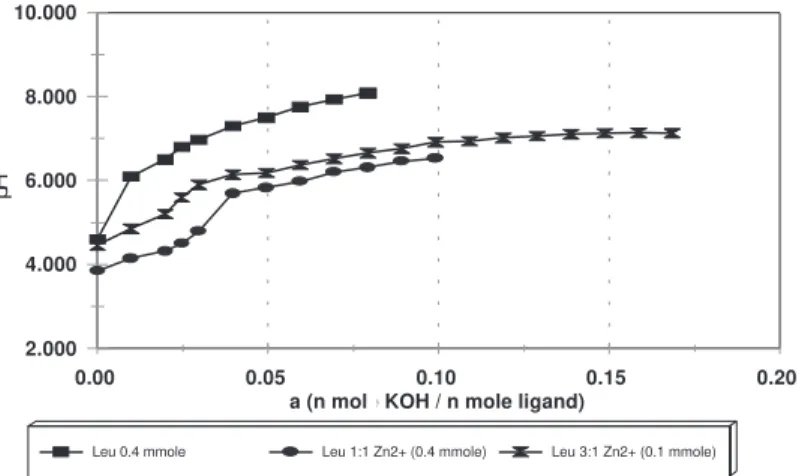
In Figure 3 the biopolymer and Zn2+ (0.4 mmol, 12 points; 0.13 mmol, 19 points) profiles are shown. Those profiles pre-sented small breaks with the metal ion and started at lower pH values than the polysaccharide alone. The metal ion Zn2+ was chosen in the ratio of 1:3 rather than 1:2 with the galactomannan because both the shape of the profile and the calculations with this titration were more elucidative.
Figures 4 and 5 show the distribution species diagram of 0.4 mmol of galactomannan and 0.2 mmol of Ni2+ and 0.13 mmol of Zn2+, the total concentration of metal ion set at 100%. For both metal ions the highest concentration of the complexed species occurs in the pH range of 5.0 to 9.0, unlike the case with Co2+ and Mn2+, for which the only species detected (ML) predominates between pH val-ues of 4.0 and 6.0.
2.000 4.000 6.000 8.000 10.000
p[H]
0.00 0.05 0.10 0.15
a (n mole KOH/ n mole ligand)
Leu 0.4 mmole Leu 1:1 Mn2+(0.4 mmole) Leu 2:1 Mn2+ (0.2 mmole)
Figure 1. Potentiometric pH profile of a solution of 0.4 mmol of galactomannan from L. leucocephala and 0.4 and 0.2 mmol of Mn2+.
T=25oC, µ=0.100mol L-1 (KNO3).
2.000 4.000 6.000 8.000 10.000
p[H]
0.00 0.05 0.10 0.15
a( n mole KOH/ n mole ligand)
Leu 0.4 mmole Leu 1:1 Ni2+ (0.4 mmole) Leu 2:1 Ni2+ (0.2 mmole)
Figure 2. Potentiometric pH profile of a solution of 0.4 mmol of galactomannan from L. leucocephala and 0.4 and 0.2 mmol of Ni2+. T=25oC,
µ=0.100 mol L-1 (KNO 3)
2.000 4.000 6.000 8.000 10.000
p[H]
0.00 0.05 0.10 0.15 0.20
a (n mole KOH / n mole ligand)
Leu 0.4 mmole Leu 1:1 Zn2+ (0.4 mmole) Leu 3:1 Zn2+ (0.1 mmole)
Figure 3. Potentiometric pH profile of a solution of 0.4 mmol of galactomannan from L. leucocephala and 0.4 and 0.13 mmol of Zn2+.
T=25oC, µ=0.100 mol L-1 (KNO 3)
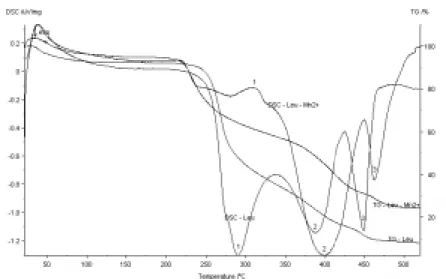
process, indicative of the formation of either a crystalline or a phase change in this temperature range, which con-trasts with the exothermic process presented by the galactomannan alone. The second thermal event (Figure 6
- number 2) remains quite the same for both the complexed and non complexed galactomannan, but the final oxida-tive process happens at a higher temperature for the complexed material (470oC).
pH
pH
Figure 4. Species distributions of 0.4 mmole solution of galactomannan (L) with 0.2 mmol Ni2+ (M) at pH values from 2.0 to 10.0. % is the
percentage of a species present, with the metal concentration set at 100%.
Figure 5. Species distributions of 0.4 mmole solution of galactomannan (L) with 0.13 mmol Zn2+ (M) at pH values from 2.0 to 10.0. % is the
percentage of a species present, with the metal concentration set at 100%.
Figure 6. Thermal profile - TG - DSC -of the solid products extracted from an aqueous solution of pH = 8.0 - 9.0, 10 mol galactomannan to
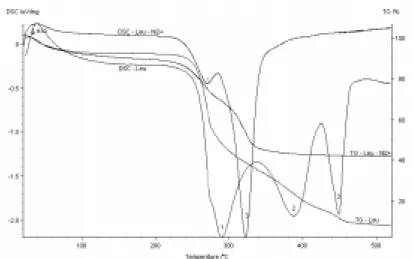
The DSC profile of Leu and Ni2+ (Figure 7 - number 1) showed a smaller break of chains (the TG curve shows a smaller mass loss) and the final oxidative process comes at 325oC, much sooner than for the galactomannan alone (Figures 6 and 7 - number 3).
For the galactomannan - Co2+ complexes all thermal events disappeared but the final oxidative one, which oc-curred around 395oC. For the galactomannan - Zn2+ com-plexes there was a small endothermic process around 300oC and the final oxidative one near 450oC. For Leu and Cu2+ (for other results refer to reference 5) the final oxidative process happened very soon after a break of chains, at 240oC. All the TG curves for the complexes showed a great mass of metallic oxide residues which were not completely vaporized at the end temperature of the assay (520oC).
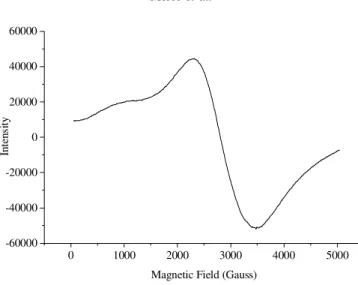
Figures 8 and 9 present the EPR spectra of galactomannan complexes with Co2+ and Mn2+, respectively.
In the EPR spectrum of Leu complexed to Co2+ (Figure 8) g values of 8.10 and 2.006 were found, the latter being due to free radicals of the organic matter. Another g value of 2.49 of axial complexes of Co2+ presented a
∆Hpp = 1200G corresponding to interactions of metal to metal, showing that those metal ions, although complexed inside the galactomannan, are close enough to interact with each other in the web structure of the polysaccharide. In Figure 9 (the EPR spectrum of Leu and Mn2+), am-plifying the range between 300 to 4000G of the spectrum, six sequenced peaks typical of Mn2+ spectra can be seen, with g=2.00 and A=100G, corresponding to Mn2+ exter-nal sphere complexes.
The other EPR spectra showed a g value of 2.24 with Ni2+ (corresponding to some Ni3+) typical of complexes interacting with hard basic sites through O-. To overcome the drawback of Zn2+ being an EPR silent metal ion, taking
a look at the parameters that have changed when the polysac-charide is not complexed5, there is a g = 2.006, indicative of free radical formation, and a ∆Hpp = 23G, indicating that Zn2+ ions are interacting with those free radicals formed.
The solid complexes obtained with Mn2+ and with Zn2+ were more resistant to heat degradation than the biopoly-mer alone, although presenting the lowest binding constants for ML species. This can be attributed to the occluded water molecules in the web structure of the biopolymer, which are not present in great quantities when a strong bond is formed between metal ions and the -OH basic sites. Those water molecules somehow give the biopolymer resistance to heat. It was not the aim of this work to completely purify the galactomannan extracted since it was intended to repro-duce industrial process conditions. The EPR spectroscopy was able to detect some of those impurities originating from other organic matters (other polysaccharides as well from the peels of the seeds) extracted along with the main polysaccharide. Those impurities were in such concentra-tions that they influenced the end of the potentiometric titrations and the presented buffer (in smaller pH values than expected), but it was still possible to quantify the binding constants for the complexed species.
The values of the logarithms of the binding constants followed the ascending order Zn2+, Mn2+, Co2+, Ni2+ and Cu2+5 , showing the progressive affinity of those metal ions and the ligand basic site -OH.
The species diagrams showed that the majority of the complexed species occur at physiological pH values. The existence of a great percentage of those complexed spe-cies in some acidic and some basic aqueous solutions and their resistance to degradation in the solid state may allow their use in industrial processes which may require such resistance of pH values and temperatures.
Figure 7. Thermal profile - TG - DSC -of the solid products extracted from an aqueous solution of pH = 8.0 - 9.0, 10 mol galactomannan to
0 1000 2000 3000 4000 5000 -60000
-40000 -20000 0 20000 40000 60000
In
te
ns
it
y
Magnetic Field (Gauss)
Figure 8. EPR spectrum of the solid products of Leu and Co2+.
0 1000 2000 3000 4000 5000 -200000
-100000 0 100000 200000
In
te
n
si
ty
Magnetic Field (Gauss)
Figure 9. EPR spectrum of the solid products of Leu and Mn2+.
Table 1. Logarithms for the binding constants of the complexes of Leu and Co2+, Mn2+, Ni2+ and Zn2+. T=25oC and µ=0.100 mol L-1 (KNO
3).
log K - Leucaena Co2+ Mn2+ Ni2+ Zn2+
leucocephala
[ML]/[M].[L] 10.4 ± 0.1 9.9 0.4 13.1 ± 0.2 9.0 ± 0.4
[MHL]/[ML].[H] not detected not detected 7.4 ± 0.2 6.2 ± 0.4
[ML2]/[ML].[L] not detected not detected 9.3 ± 0.2 8.7 ± 0.4
Table 2. EPR spectra parameters of metal complexes of Leu (refer to Figures 8 and 9).
EPR parameters g A(G) g ∆H p p gfree
L. leucocephala radical
Co2+complexes 8.10 n.d 2.49 1200 2.006
Mn2+complexes 2.00 100 n.d. n.d. n.d.
Ni2+complexes 2.24 n.d. n.d. n.d. n.d.
Zn2+ complexes
(indirect determination) n.d. n.d. n.d. 2 3 2.006
n.d. not determined
Conclusions
The ability of galactomannans to complex a large variety of metal ions give them potential as alternative materials for
chitosan9-11 for instance in the use of bioremediation of aque-ous wastes.
values of pH at which they are formed and destroyed, shed new light on the possible use of these complexes in the soil as slow-release fertilizers 23-25 providing both macro and micro nutrients as the mineralization of the organic matter happens.
Structural alterations induced by chelation process is said to change the thermal behaviour of the complexes when compared to the native biopolymer 26. The thermal patterns of the complexes with the different metal ions suggest they can be used where one needs some resistance to heat.
Judging by some of the EPR parameters found, the metal ions were not simply trapped by the biopolymer when it precipitated out from the aqueous solutions, as a great interaction between the metal ions and the deprotonated -OH groups of the polysaccharide was found. Further studies involving derivatization and formation of blends of different biopolymers and their complexation with different metal ions are being carried out.
Acknowledgements
We thank the sponsorship of FINEP and UFPR, and CNPq for fellowship, and Dr. David Alexander Mitchell for the most helpful suggestion in the translation of this manuscript.
References
1. Bayerlein, F. In Plant Polymeric Carbohydrates
Meuser, F., Manners, D. J. and W. Seibel eds., pp. The Royal Society of Chemistry, UK 1993, 190.
2. Varma, A. J.; Kokane, S. P.; Pathak, G.; Pradhan, S. D.
Carbohydr. Pol. 1997, 32, 111.
3. Silva, J. A. L.; Gonçalves, M. P. Food Hydrocoll. 1990,
4, 277.
4. Verchère, J. -F.; Chapelle, S.; Xin, F.; Crans, D. C.
Prog. Inorg. Chem. 1998, 47, 837.
5. Mercê, A. L. R.; Lombardi, S. C.; Mangrich, A. S.; Reicher, F.; Szpoganicz, B.; Sierakowski, M. R.
Carbohydr. Pol. 1998, 35, 13.
6. Fraústo da Silva, J. J. R.; Williams, R. J. P. The Bio-logical Chemistry of The Elements. The Inorganic Chemistry of Life, Clarendon Press, Oxford, 1997. 7. Sposito, G. The Chemistry of Soils, Oxford
Univer-sity Press, N.Y, 1989.
8. Masri, M. S.; Reuter, F. W.; Friedman, M. J. Appl. Polym. Sci. 1974, 18, 675.
9. Maruca, R.; Suder, B. J.; Wightman, J. P. J. Appl. Polym. Sci. 1982, 27, 4827.
10. Eiden, C. A.; Jewell, C. A.; Wightman, J. P. J. Appl. Polym. Sci. 1980, 25, 1587.
11. Bryan, N. D.; Hesketh, N.; Livens, F. R.; Tipping, E.; Jones, M. N. J. Chem. Soc., Faraday Trans. 1998,
94, 95.
12. Domard, A. Int. J. Bio. Macromol. 1987, 9, 98. 13. Wolfrom, M. L.; Thompson, A. Methods Carbohydr.
Chem. New York 1963, 2, 211.
14. Blakeney, A. B.; Harris, P. J.; Henry, R. J.; Stone, B. A.
Carbohydr. Res. 1983, 113, 291.
15. Schwarzenbach, G.; Flaschka, H. Complexometric Titrations, Methuen & Co Ltda, UK 1969, 244, 248, 264.
16. Martell, A. E.; Motekaitis, R. J. The Determination and Use of Stability Constants, VCH, New York 1992. 17. Martell, A. E.; Hancock, R. D. Metal Complexes in Aqueous Solutions, Plenum Press, New York 1996, 205.
18. Etcheverry, S. B.; Williams, P. A. M.; Baran, E.
J. Carbohydr. Res. 1997, 302, 131.
19. Ciardelli, F.; Tsuchida, E.; Wöhrle, D. eds., Macro-molecule - Metal Complexes. Springer, Berlin 1995. 20. Martell, A. E.; Smith, R. M. NIST Critical Stability Constants of Metal Complexes, version 4.0, NIST Da-tabase 46, Gaithersburg, MD, USA1997,and references cited therein.
21. Baes Jr., C. F.; Mesmer, R. E. The Hydrolysis of Cat-ions, John-Wiley and Sons, New York 1976. 22. Mercê, A. L. R.; Szpoganicz, B.; Dutra, R. C.; Khan,
M. A.; Than, X. D.; Bouet, G. J. Inorg. Biochem. 1998,
71, 87.
23. Mercê, A. L. R.; Mangrich, A. S.; Szpoganicz, B.; Levy, N. M.; Felcman, J. J. Braz. Chem. Soc. 1996,
7, 239.
24. Mercê, A. L. R.; Mangrich, A. S.; Szpoganicz, B.; Levy, N.M.; Felcman, J. J. Braz. Chem. Soc. 1996,
7, 97.
25. Mercê, A. L. R.; Lombardi, S. C.; Mangrich, A. S.; Levy, N. M.; Szpoganicz, B. J. Braz. Chem. Soc.1998,
9, 231.
26. Sreenivasan, K. Polymer. Degrad. Stab. 1996,
52, 85.