Article
Electrochemical and Positron Annihilation Studies of Semicarbazones
and Thiosemicarbazones Derived from Ferrocene
José Eugênio J. C. Graúdoa, Carlos A. L. Filgueirasb*, Antonio Marques-Nettoc and Alzir A. Batistad
a
Departamento de Química, Universidade Federal de Juiz de Fora, 36036-330, Juiz de Fora - MG, Brazil
b
Departamento de Química Inorgânica, Instituto de Química, Universidade Federal do Rio de Janeiro,CP 68563, 21945-970, Rio de Janeiro - RJ, Brazil
c
Departamento de Química, Universidade Federal de Minas Gerais, 31270-901, Belo Horizonte - MG, Brazil
d
Departamento de Química, Universidade Federal de São Carlos, 13565-905, São Carlos - SP, Brazil
Uma série de seis derivados de ferroceno contendo uma cadeia lateral de semicarbazona ou tiossemicarbazona foi investigada por voltametria cíclica e estudos utilizando medidas de tempo de vida de pósitrons. Ambos os fenômenos, tanto o processo redox como o de captura de elétrons, ocorreram no átomo de ferro. Foram propostas correlações entre os dois métodos, levando em conta os substituintes na cadeia lateral dos compostos, os potenciais redox e as probabilidades de formação de o-positrônio (o-Ps).
A series of six ferrocene derivatives containing a semicarbazone or thiosemicarbazone side chain was investigated by cyclic voltammetry and positron annihilation lifetime measurements. Both the redox and the electron capture processes took place on the Fe atom. Correlations between the two methods were proposed, taking into account the substituents on the side chain of the compounds, their redox potentials and the probabilities of o-positronium (o-Ps).formation.
Keywords: semicarbazone, thiosemicarbazone, ferrocene, cyclic voltammetry, positronium formation
J. Braz. Chem. Soc., Vol. 11, No. 3, 237-240, 2000. Printed in Brazil
c 2000 Soc. Bras. Química 0103 - 5053 $6.00+0.00
Introduction
Positrons can form positronium (Ps) in molecular solids. Interest in the behaviour of the positron-electron (Ps) pair lies in that the probability of its formation (I) and its lifetime (τ) depend upon the physical and chemical properties of the solid 1-3. However, much more attention has been devoted to studies
applied to metals and alloys than to molecular compounds. Two Ps varieties can be formed: p-Ps (singlet) and o-Ps (triplet), depending on the relative spins of the positron and the electron. Therefore, if Ps formation occurs, the lifetime spectra consist of three exponential components standing for p-Ps (τ1 = 120 ps), free and bound positrons (τ2 = 150 - 500 ps)
and o-Ps (τ3 > 900 ps), with the associated formation
prob-abilities, I1, I2 and I3, respectively. Normally one works with
the parameter of the longer lived variety, (o-Ps), τ3 and I3. Work on metal complexes is relatively scarce and has only been performed in recent years. Very few examples exist involving metallocenes, which prompted us to
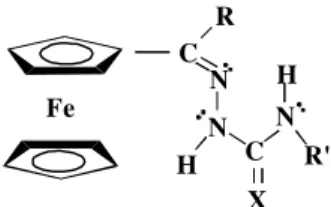
inves-tigate the systems described here. Figure 1 shows the struc-ture of the systems under study.
C R
N N
C X
N R' Fe
H
H
Figure 1. General structure of the compounds studied in this work
Studies concerning complexes of thiosemicarbazones and semicarbazones have been published in the literature 4-7, mostly dealing with their structural and spectroscopic
238 Graúdo et al. J. Braz. Chem. Soc
metallocenes are even scarcer we firmly believe that at-tempts to correlate this with other physical methods are extremely welcome at this stage.
Experimental
Preparation of the complexes
The ferrocene derivatives used in this work were pre-pared by literature methods8-10:
22Na radionuclide immediately after the positron
emis-sion, and the 0.5 MeV annihilation radiation. This can be done using a conventional “fast-fast”coincidence system. Our measurements employed such a system (ORTEC), with a time resolution of 280 ps, given by a 60Co prompt curve.
The 22Na positron source with ca. 4.0 x 10⁵ Bq activity
was sandwiched between two identical 3.5 µm thick Mylar foils. The source correction was approximately 10%. All the experiments were carried out at 294K under atmo-spheric pressure.The experimental apparatus has already been described elsewhere11.
The time resolution of the apparatus (280 ps) makes the data on the shortest-lived component, ascribed to p-Ps, some-what unreliable. In order to reduce the scattering of the other parameters, the value of τ1 was fixed at 120 ps, near the
intrin-sic value of 125 ps of p-Ps in vacuo12. On this basis the
quality of the fit of the spectra (e.g. its reduced chi-square and the corresponding excess of probability) is not significantly altered and the derived parameters are close to those obtained when the analysis is made without any retraints.
The experimental errors for the PAL parameters τ3 and
I3, determined over multiple measurements, were found to
be 50 ps and 1.0%, respectively.
Results and Discussion
A recent work 13 showed that the electronic
configura-tion of the central atom in coordinaconfigura-tion compounds or in metallocenes is of paramount importance in Ps formation. Metal complexes can be divided into 2 classes in this re-spect: class 1, in which Ps formation is observed in appre-ciable amounts and the metal presents completely filled 3d or 4d orbitals; class 2, whose metals have incompletely filled 3d or 4d orbitals, giving very low I3 values. When the e*1g frontier orbital is occupied, as in cobaltocene (19 electrons) or nickelocene (20 electrons), oxidation of the species can occur, leading to cationic species which are strong inhibitors cpFecp C
O R
H2NNH C X NHR'
+ NaOAc (X = O), HOAc (X = S) reflux, EtOH / H2O, 2 h R = H, CH3 R' = H, Ph
cpFecp C R
N NH C X
NHR' + H2O
Six different products were obtained, with yields rang-ing from 51 to 90%. They were characterised satisfactorily by elemental analysis, m.p. and 1H and 13C NMR
spec-troscopy. All the results conformed to the literature. Table 1 lists all six compounds.
Cyclic voltammetry
Cyclic voltammetry experiments were performed us-ing a model 273A EG/PARC potentiostat/galvanostat, con-nected via a GPIB interface with a computer provided with the M270 EG/PARC electrochemical software. Determi-nations were carried out in MeCN, using a Pt working electrode, an Ag/AgCl reference electrode and Bu4NClO4 as the supporting electrolyte.
Positron annihilation lifetime (PAL) measurements
The positron lifetime is measured experimentally as the time delay between the 1.28 MeV γ ray emitted by the
Table 1. Cyclic Voltammetry and o-Ps formation data
Compound R R’ X Epa (V) Epc (V) E1/2 (V) τ3 (ns) I3 (%)
HFFS 1 H H O 0.49 0.42 0.46 1.48 13.6
HAFS 2 Me H O 0.48 0.41 0.45 1.37 25.6
HFFT 3 H H S 0.57 0.50 0.53 1.56 5.9
HAFT 4 Me H S 0.52 0.44 0.48 1.29 16.9
HFFT 5 H P h S 0.57 0.51 0.54 1.64 16.6
HFAT 6 Me P h S 0.50 0.42 0.46 1.63 11.3
1 + HClO4 0.69 0.57 0.63
2 + HClO4 0.71 0.62 0.67
3 + HClO4 0.62 0.54 0.58
4 + HClO4 0.68 0.59 0.64
5 + HClO4 0.63 0.57 0.60
6 + HClO4 0.68 0.58 0.63
Vol. 11 No. 3, 2000 Studies of Semicarbazones and Thiosemicarbazones Derived form Ferrocene 239
of Ps formation. This is the likely reason for the absence of Ps formation in cp2Co and cp2Ni. Ferrocene, on the other hand, forms Ps. We are here presenting evidence of the dependence of Ps formation on factors that alter the electron density on the Fe atom, and that some relationship can be drawn with cyclic voltammetric data. If ferrocene is considered a d6 Fe2+
species, as in the traditional ligand field treatment, with the ligands in the cp- form, and an appreciable ionic character in
its formulation, no Ps formation is to be expected. Consider-ing, however, a molecular orbital treatment in which the iron atom is the centre of an 18 electron system, one can expect Ps formation. The present work shows for the first time evidence of P/s formation in ferrocene derivatives, up to quite an ap-preciable degree, such as in compound 2 (Table 1).
The reversible oxidation processes of the ferrocene deriva-tives always occur on the metal atom. Table 1 shows that the thiosemicarbazone species (compounds 3 to 6) are oxidized at higher potentials than the corresponding semicarbazone com-plexes (compounds 1 and 2). This means that the sulphur-bearing chains cause Fe to be electron poorer, hence its greater difficulty to be oxidized. For each complex the addition of HClO4 increases the oxidation potential, i.e., it produces an
effect similar to that described above, when the S- and O-con-taining chains were compared. In the present case protonation of the side chain contributes to increase its demand for elec-trons, and as a consequence the available electron density on the Fe atom is lowered. The value of the oxidation potential of the Fe2+ ion is sensitive to a variation in the group attached to
the carbon adjacent to the cyclopentadienyl ring. In all cases, when one goes from C-CH3 to C-H the oxidation potential
increases. H is more electronegative than CH3, as shown by the
strengths of formic and acetic acids. The change from C-CH3 to H thus corresponds to a withdrawal of electron density from the side chain, which is reflected in lower electron availability on the Fe2+ ion.
The different groups attached to the amide nitrogens do not play any significant influence on the oxidation potentials of Fe2+. They are far too removed from the metal
and are not capable of causing any detectable change. Thus, comparison between 3 and 5, as well as between 4
and 6 does not show any variation within each pair. Looking at Table 1, one sees that it is easier to oxidize Fe2+ (lower E½ values) when X = O than when X = S. This
means that, when X = O there is less electron density avail-able to the ferrocene moiety from the side chain. The op-posite occurs when the compounds are acidified with HClO4, i.e., E½ is lower when X = S than when X = O.
In the first case, i.e., in the absence of acid, one can draw a resonance structure as shown in Figure 2, in which a negative charge can be ascribed to the oxygen atom and to the carbon atom next to the cyclopentadienyl ring. The oxygen atom,
being more electronegative, will stabilize this structure to a greater extent than sulphur. In addition, the latter will be part of a tautomeric compound, one of whose forms will present an SH group. Of course this tautomeric form will not stabilize the negative charge. Therefore the semicarbazones will be more effective in making more electron density available to the ferrocene moiety than the thiosemicarbazones.
C R N N C O N R' Fe H H C R N N C O N R' Fe H H
-+ +
Figure 2. Resonance structures of a ferrocene semicarbazone.
When HClO4 is added to the compounds all E½ val-ues increase, although the situation regarding the two sets of compounds is inverted, and it becomes relatively easier to oxidize the thiosemicarbazones than the semicarbazones. The latter will protonate better than their sulphur analogues,making electron density less avail-able for the ferrocene moiety.
Table 1 also presents the PAL measurement results. The important data are those given by I3, since τ3 usually does
not show any significant differences.
It is noteworthy that an increase in electron density on the Fe atom leads to an increase in the probability of Ps formation. Indeed, comparing compounds 1 (I3 = 13.6 %)
and 2 (I3 = 25.6 %), the replacement of an H atom by a CH3
group on the carbon closest to the ring increases the inten-sity of Ps formation, and the same is true of the pair 3 (I3 =
5.9 %) and 4 (I3 = 16.9 %). Previous results have shown
that Ps formation is favoured by an increase in electron localization due to an inductive effect. As an example, the hardening of the metal centres on changing their oxida-tion state from 0 in [Pd(PPh3)4] to 2+ in [PdCl2(PPh3)2]
may explain the absence of Ps formation in the latter com-pound12. The behaviour shown by our two pairs above
can be explained in a similar manner.
240 Graúdo et al. J. Braz. Chem. Soc
by the other compounds (with an NH2 end group).
Never-theless, in spite of the difficulties presented by the 5-6 pair, this work showed for the first time that comparative results can be obtained from such different methods as cyclic voltammetry and positron annihilation studies. It is hoped that future work will probe these connections still further.
Acknowledgements
The authors are grateful to CNPq and FAPEMIG for financial support of their work.
References
1. Schrader, D. M.; Jean, Y. C. Studies in Physical and Theoretical Chemistry 57:Positron and Positronium Chemistry; Elsevier; Amsterdam, 1986.
2. Mogensen, C. E. J. Chem. Phys. 1974, 60, 998. 3. Goworek, T. Phys. Stat. Sol., 1987, 9, 511.
4. Beraldo, H. O.; Tosi, L. P. Inorg. Chim. Acta1983,
75, 249.
5. Beraldo, H. O.; Tosi, L. P. Inorg. Chim. Acta 1986,
125, 173.
6. Barbieri, R. S.; Beraldo, H. O.; Filgueiras, C. A. L.; Abras, A.; Nixon, J. F.; Hitchcock P. B. Inorg. Chim. Acta1993, 206, 169.
7. de Sousa, G. F.; Filgueiras, C. A. L.; Abras, A.; Al-Juaid, S. S.; Hitchcock, P. B.; Nixon, J. F. Inorg. Chim. Acta1994, 218, 169.
8. Graham, P. J.; Lindsey, R. V.; Parshall, G. W.; Petersen, M. L.; Whitman, G. M. J.Amer. Chem. Soc. 1957, 79, 3416.
9. Kobayashi, Y. O.; Sugiyama, N. Bull. Chem. Soc. Japan, 1973, 79, 2896.
10. Wiles, D. M.; Suprunchuk, T. Can. J. Chem. 1968, 46, 1865. 11. Machado, J. C.; Carvalho, C. F.; Magalhães, W. F.; Marques-Netto, A.; Duplâtre, G.; Abbé, J.-Ch. Chem. Phys. 1993, 170, 257.
12. Klein, S. I.; Barbieri, R. S.; Marques-Netto, A.; Silva, M. E. S. R.; Machado, J. C. J.Braz. Chem. Soc. 1990, 1, 80. 13. Marques-Netto, A.; Carvalho, R. S.; Magalhães, W. F.; Sinisterra, R. D. Radiochim. Acta,1996, 73, 95.
Received: April 20, 1999