J. Braz. Chem. Soc., Vol. 14, No. 1, 7-10, 2003. Printed in Brazil - ©2003 Sociedade Brasileira de Química 0103 - 5053 $6.00+0.00
C
o
m
m
u
ni
c
a
ti
o
n
* e-mail: [email protected]
Electronic Interactions in [Ru
3(
µ
3-R
2CCC
6
H
4-4-R
1
)(
µ
-dppm)(
µ
-CO)(CO)
7]
(R
1= NO
2
and R
2
= Fc; R
1= NO
2
, CN and R
2
= Ph)
Renato Rosseto, José C. Torres, Edison Stein and Maria D. Vargas*
Instituto de Química, Universidade Estadual de Campinas, CP 6154, 13084-971 Campinas - SP, Brazil
A coordenação de FcCCC6H4-4-NO2 (1) a uma carbonila polinucleada (cluster) de rutênio
resultou na formação de [Ru3(µ3-FcCCC6H4-4-NO2)(µ-dppm)(µ-CO)(CO)7] (2). Os voltamogramas cíclicos destes compostos e dos clusters análogos [Ru3(µ3-η2-C
6H5CCC6H4-4-R)(µ-dppm)(µ
-CO)(CO)7] (R= H, 3; CN, 4; NO2, 5) permitiram avaliar as comunicações eletrônicas entre os diferentes sítios de oxi-redução (grupos ferrocenil e -NO2 e o fragmento Ru3) e analisar as capacidades
relativas doadora-receptora de cada um dos três centros de oxi-redução que compõem 2. Além disto, a inércia de 2, em comparação com os clusters 3-5, os quais sofrem fácil perda de CO, foi atribuída à interação entre o grupo ferrocenil e a base metálica.
The co-ordination of FcCCC6H4-4-NO2 (1) to a ruthenium carbonyl cluster to yield [Ru3(µ3 -FcCCC6H4-4-NO2)(µ-dppm)(µ-CO)(CO)7] (2) is reported. The cyclic voltammograms of these compounds and of the analogous clusters [Ru3(µ3-η2-C
6H5CCC6H4-4-R)(µ-dppm)(µ-CO)(CO)7]
(R= H, 3; CN, 4; NO2, 5) allowed an evaluation of the electronic communications between the different redox sites (ferrocenyl and -NO2 groups, and Ru3 moiety) and an analysis of the relative
electron donor-acceptor capabilities of each of the three redox centres that compose 2. Furthermore, the inertness of 2, compared with clusters 3-5 which loose CO readily was attributed to the interaction between the ferrocenyl group and the metallic frame.
Keywords: ruthenium cluster, ferrocene, alkyne, cyclic voltammetry
Introduction
Studies of electronic interactions in systems containing multiple redox-active centres are of fundamental importance in the development of molecular-based electronic devices.1 Alkynes can be an elegant option in
the search of systems containing multi-redox sites, once they can serve as conjugated bridges between groups of different electronic densities.2 In addition, they are
remarkably versatile in their co-ordinating abilities to different metals (σ or π-fashion), that can result in the generation of novel mono or polynuclear metal complexes with attractive properties.3 Compounds derived from
ferrocene have been extensively investigated for materials science4 due to their low cost, stability and interesting
redox properties, and can be used in molecular ferromagnets, molecular sensors, electrochemical agents, liquid crystals and non-linear optical materials.5
The aim of this work was to combine the electronic properties of alkynes, the ferrocenyl fragment and carbonyl
clusters to build a new supramolecular compound containing various redox sites. Co-ordination of the ferrocenylalkyne FcCCC6H4-4-NO2 (1) to a ruthenium carbonyl cluster to produce [Ru3(µ3-FcCCC6H4-4-NO2)(µ -dppm)(µ-CO)(CO)7] (2) was therefore investigated. In cluster 2, the ferrocenyl fragment can act as an electron donor in charge-transfer processes,6 the -NO
2 group as an
electron acceptor7 and the ruthenium moiety as a reservoir
of electrons, depending on the co-ordinated ligands.8 The
analogous clusters [Ru3(µ3-η2-C
6H5CCC6H4-4-R)(µ
-dppm)(µ-CO)(CO)7] (R= H, 3; CN, 4; NO2, 5) were also synthesized for the sake of comparison of their electronic and chemical properties.
Results and Discussion
Co-ordination of 19 and of the alkynes PhCCC 6H4-4-R
(R = NO2 and CN)10 to [Ru
3(CO)12] to produce [Ru3(µ3-η 2
8 Rosseto et al. J. Braz. Chem. Soc.
and 4-5 were formulated on the basis of elemental analysis, IR and 1H and 31P{1H} NMR spectroscopy.13 In the 31P NMR
spectra of the unsymmetrical derivatives 2 and 4-5 the dppm phosphorus nuclei appear as two doublets (JP-P ~130Hz) whose chemical shift difference decreases with the decreasing electronic asymmetry of the co-ordinated alkyne (2>5>4). This suggests that these compounds are isostructural with the symmetrical derivative 311 whose
dppm phosphorus atoms are equivalent and whose structure is proposed here to contain a CO and a dppm ligands bridging the same edge which is also parallel to the µ3-η2-alkyne14 (see Scheme), although the X-ray
molecular structure of the closely related cluster [Ru3(µ3 -η2-PhC
2CCPh)(µ-dppm)(µ-CO)(CO)7] has been reported to
be slightly different15 with the bridging CO bonded to a
different metal edge. Contrary to the analogous clusters 3, 4 and 5 and other clusters of the series containing a dppm instead of two CO ligands,11,16 it was impossible to
decarbonylate 2 to yield the unsaturated cluster [Ru3(µ3 -η2-FcCCC
6H4-4-NO2)(µ-dppm)(CO)7] with the alkyne
bonded in the perpendicular mode. Compound 2 was stable when heated in toluene, at 80 °C, for 4 h, but upon increasing the temperature it underwent decomposition. Stabilisation of the alkyne bonded in this mode has been ascribed to the presence of the dppm that induces metal back donation to the alkyne.17 The electron donating
ferrocenyl group seems therefore to counteract the effect of the dppm, possibly by increasing the back donation from the metals to the CO ligands, which then become more strongly bonded to the metal base.
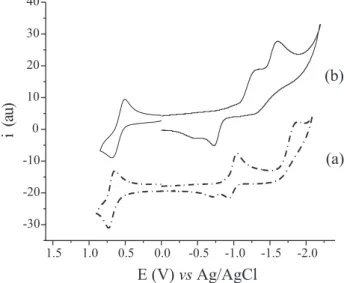
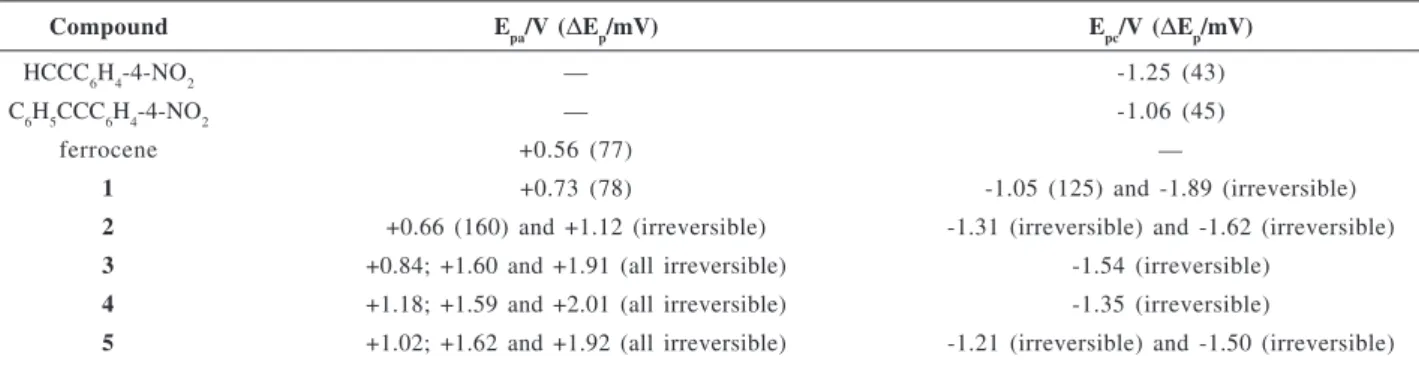
The relevant electrochemical data for compounds 1-5, HCCC6H4-4-NO2, PhCCC6H4-4-NO2, and ferrocene are given in Table 1. Full cyclic voltammograms of 1 and 2 are shown in Figure 1, and (reduction) cyclic voltammograms of clusters 2-5, in Figure 2.
The redox behaviour of 1 indicates that the ferrocenyl and -NO2 groups are strongly coupled, since the oxidation
and reduction potentials differ from those of the starting materials (ferrocene and HCCC6H4-4-NO2). The cyclic voltammogram of 1 (Figure 1a) reveals in the anodic scan one chemically reversible one electron process at 0.73 V vs Ag/AgCl (∆Ep= 78 mV) ascribed to the ferrocenyl group. The Epa of the ferrocenyl group in 1 (+0.73 V) is more anodic compared to that of ferrocene (+0.56 V) because of the ability of the -NO2 to accept electronic density thus hindering oxidation of the ferrocenyl group. In the cathodic scan two one electron peaks were observed, both attributed to the -NO2 group, the first of which is quasi-reversible, at
Figure 1. Cyclic voltammograms (CH2Cl2, 1x10⁻³ mol L-1, 200 mV s-1,
RT): (a) alkyne 1; (b) cluster 2. The number of electrons involved in the redox processes was evaluated through normal pulse voltammetric experiments (npv) using ferrocene as standard, and comparing the intensity of the reduction potentials.
Figure 2. Cyclic voltammogram (reduction) of clusters 2-5 (CH2Cl2, 1x10⁻³ mol L-1, 200 mV s-1, RT).
9 Electronic Interactions in [Ru3(µ3-R2CCC
6H4-4-R
1)(µ-dppm)(µ-CO)(CO) 7]
Vol. 14, No. 1, 2003
–1.05 V vs Ag/AgCl (∆Ep= 125 mV), and the second, irreversible, at –1.89 V vs Ag/AgCl.
The cyclic voltammogram of cluster 2 (Figure1b) revealed in the anodic scan a one electron quasi-reversible process at +0.66 V vs Ag/AgCl (∆E =165 mV) ascribed to the ferrocenyl group and an irreversible process at +1.12 V corresponding to the oxidation of the Ru3 moiety. In the cathodic scan, two irreversible reduction processes most probably involving the transfer of two electrons as observed for other analogous Ru3 systems17 were identified: the one
at -1.62 V vs Ag/AgCl, was ascribed to the reduction of the -NO2 group and the other at –1.31 V vs Ag/AgCl was assigned to the reduction of the ‘[Ru3dppm(CO)8]’ fragment. This assignment was confirmed by the observation of the corresponding process in the voltamograms of clusters 3-5, which contain R1 = H, -CN
and -NO2 respectively on the co-ordinated PhCCC6H4 -4-R1 (see Scheme). Compound 3 exhibited only one
reduction wave at -1.54 V in the cathodic scan, attributed to the reduction of the Ru3 moiety. Replacement of R1 = H
for the electron withdrawing groups -CN (compound 4) and -NO2 (compound 5) led to the expected anodic shifts in the reduction of the Ru3 moiety (Epc 4= -1.35 V and Epc 5= -1.21 V). The ∆Ep of the irreversible reduction process decreased slightly from 335 mV (3) to 310 mV (4), however the presence of the -NO2 group in compound 5 turned the process quasi-reversible (∆Ep= 200 mV). Furthermore, as expected the NO2 reduction potential (Epc 5 = -1.50 V) was more cathodic than that of free PhCCC6H4-4-NO2 (Epc= -1.06 V). The fact that the reduction process of the Ru3 fragment in cluster 2 (Epc 2= -1.31 V) occurs at an inter-mediate potential between those observed for 4 (-1.35 V) and 5 (-1.21 V), and that the reduction potential of the – NO2 group in 2 (-1.62 V) is even more cathodic than in 5 (-1.50 V) indicate that the ferrocenyl interacts both with
the metallic frame and the -NO2 group. Peaks around -0.7 V were observed in the voltammograms of clusters 2-5 and were ascribed to the oxidation of unidentified fragmen-tation products formed after the “irreversible” reductions. In conclusion, in compound 2, µ3-η2-// co-ordination
of the C≡C bond of alkyne 1 to the ‘[Ru3dppm(CO)8]’
fragment has led to a decrease in the interaction between the ferrocenyl and –NO2 groups, most probably as the result of loss of linearity of the alkyne and lengthening of the C-C bond: from the molecular structure of the related species [Ru3(µ3-η2-PhC
2CCPh)(µ-dppm)(µ-CO)(CO)7], 15
average C-C-C angles (123°) and C=C bond [1.383(8)Å] are typical of sp2 hybridization. However, the
electro-chemical data suggest that the three redox sites are not kept isolated in 2 and therefore that this cluster is a push-pull type molecule. Further evidence for the communi-cation between the ferrocenyl group and the metallic frame comes from the peculiar inertness of cluster 2, compared to clusters 3-5, which readily undergo CO dissociation.
Acknowledgements
The authors thank CAPES and FAPESP (Brazil) for financial support.
References
1. Joachim, C.; Gimzewski, J. K.; Avioram, A.; Nature2000, 408, 541.
2. Arnold, D. P.; Manno, D.; Micocci, G.; Serra, A.; Tepore, A.; Valli, L.; Langmuir1997, 13, 5951. Coat, F.; Thominot, P.; Lapinte, C.; J. Organomet. Chem.2001, 629, 39.
3. Sappa, E.; Tiripicchio, A.; Braunstein, P.; Chem. Rev.1983, 83, 203; Raithby, P. R.; Rosales, M. J.; Adv. Inorg. Chem. Radiochem.1985, 29, 169.
Table 1. Electrochemical data
Compound Epa/V (∆Ep/mV) Epc/V (∆Ep/mV)
HCCC6H4-4-NO2 — -1.25 (43)
C6H5CCC6H4-4-NO2 — -1.06 (45)
ferrocene +0.56 (77) —
1 +0.73 (78) -1.05 (125) and -1.89 (irreversible)
2 +0.66 (160) and +1.12 (irreversible) -1.31 (irreversible) and -1.62 (irreversible)
3 +0.84; +1.60 and +1.91 (all irreversible) -1.54 (irreversible)
4 +1.18; +1.59 and +2.01 (all irreversible) -1.35 (irreversible)
5 +1.02; +1.62 and +1.92 (all irreversible) -1.21 (irreversible) and -1.50 (irreversible)
Epa = anodic potential; Epc = cathodic potential; ∆Ep = (Epa-Epc)/n, where n = number of electron involved. Scan rate: 200 mVs-1 at room
temperature. Solutions in CH2Cl2 were ca 1x10⁻³ mol L-1 with respect to the compounds and ca 1x10⁻¹ mol L-1 with respect to the supporting
10 Rosseto et al. J. Braz. Chem. Soc.
4. Adams, R. D.; J. Organomet. Chem.2001, 637, 1.
5. Rettig, S. J.; Storr, A.; Summers, D. A.; Thompson, R. C.; Trotter, J.; J. Am. Chem. Soc.1997, 119, 8675; Norrild, J. C.; Sotofte, I.; J. Chem. Soc., Perkin Trans.2002, 2, 303; Seo, J. S.; Yoo, Y. S.; Choi, M. G.; J. Mater. Chem.2001, 11, 1332; Heck, J.; Dabek, S.; Meyer-Friedrichsen, T.; Wong, H.; Coord. Chem. Rev.1999, 192, 1217.
6. Cianciosi, S. J.; Ragunathan, N.; Freedman, T. B.; Nafie, L. A.; Baldwin, J. E.; J. Am. Chem. Soc.1990, 112, 8204; Hendrickx, E.; Persoons, A.; Samson, S.; Stephenson, G. R.; J. Organomet. Chem.1997, 542, 295.
7. Exner, O.; Krygowski, T. M.; Chem. Soc. Rev.1996, 25, 71; Kalninsh, K. K.; Kutsenko, A. D.; Archegova, A. S.; J. Struct. Chem.1998, 39, 520.
8. Lemoine, P.; Coord. Chem. Rev.1982, 47, 56; Lemoine, P.;
Coord. Chem. Rev.1988, 83, 169; Drake, S. R.; Polyhedron
1990, 9, 455.
9. Torres, J. C.; Pilli, R. A.; Vargas, M. D.; Violante, F. A.; Garden, S. J.; Pinto, A. C.; Tetrahedron2002, 58, 4487.
10. Polin, J.; Schottenberger, H.; Org. Synth.1996, 73, 262. 11. Rivomanana, S.; Lavigne, G.; Lugan,N.; Bonnet, J. J.; Inorg.
Chem.1991, 30, 4110.
12. Rivomonana, S.; Lavigne, G.; Lugan, N.; Bonnet, J. J.; Orga-nometallics1991, 10, 2285.
13. Cluster 2 (yield: 30%): Anal. Calcd. for C51H33NO10P2Ru3Fe: C 49.24, H 2.68, N 1.13. Found: C 49.42, H 2.65, N 1.27 %. IR (CH2Cl2, νCO/cm-1): 2055s, 2000vs, 1973m, 1826vw. 1H
NMR (CDCl3): δ 7.10-8.40(m, 4H, C6H4), 4.30(s, 5H, Cp), 4.20(m, 4H, C5H4), 3.70(m, 1H, CH2), 3.10(m, 1H, CH2).
31P{H} NMR (CDCl
3): δ 35.7 (d, JP-P 136Hz), 33.6 (d).
[Ru3(µ3-η2-C
6H4CCC6H4-4-R)(µ-dppm)(µ-CO)(CO)7] (R=
H,123; CN, 4; NO
2, 5): IR spectra in the νCO region similar to
that of 2. Compound 4 (yield: 56%), Anal. Calcd. for C48H21NO8P2Ru3: C 51.71, H 2.80, N 1.26; Found: C 51.12, H 2.74, N 1.22. 5 (yield: 65%), Anal. Calcd. for C47H21NO10P2Ru3: C 49.74, H 2.75, N 1.23; Found: C 50.53, H 2.87, N 1.17%. 31P{H} NMR (CDCl
3): 3: δ 35.5 (s); 124: δ
36.2 (d, JP-P132Hz), 34.9; 5δ 36.5 (d, JP-P 135Hz), 35.1 (d). 14. Rosseto, R.; Stein, E.; Vargas, M. D.; manuscript in
prepara-tion.
15. Bruce, M. I.; Skelton, B. W.; White, A. H.; Zaitseva, N. N.; J. Organomet. Chem.2002, 650, 188; Bruce, M. I.; Zaitvesa, N. N.; Skelton, B. W.; White, A. H.; J. Organomet. Chem.1997, 536-537, 93.
16. Rivomanana, S.; Mongin, C.; Lavigne, G.; Organometallics
1996, 15, 1195.
17. Osella, D.; Pospisil, L.; Fiedler, J.; Organometallics1993, 12, 3140 and references therein.
Received: November 21, 2002
Published on the web: February 12, 2003