1 Stress, Memory and Behavior Laboratory, Universidade Federal do Pampa (UNIPAMPA), Uruguaiana, RS, Brazil 2 Laboratory of Applied neuromechanical, Universidade Federal do Pampa (UNIPAMPA), Uruguaiana, RS, Brazil
Received: 07/19/2013 Revised: 10/07/2013 Accepted: 10/15/2013
a r t i c l e
Influence of mental practice and movement observation
on motor memory, cognitive function and motor
performance in the elderly
Caroline D. C. Altermann¹, Alexandre S. Martins¹, Felipe P. Carpes², Pâmela B. Mello-Carpes¹
ABSTRACT | Background: With aging, it is important to maintain cognitive and motor functions to ensure autonomy and quality of life. During the acquisition of motor skills, it is necessary for the elderly to understand the purpose of the proposed activities. Physical and mental practice, as well as demonstrations, are strategies used to learn movements. Objectives: To investigate the inluence of mental practice and the observation of movement on motor memory and to
understand the relationship between cognitive function and motor performance in the execution of a sequence of digital movements in the elderly. Method: This was a cross-sectional study conducted with 45 young and 45 aged subjects. The instruments used were Mini-Mental State Examination (MMSE), Manual Preference Inventory and a Digital Motor Task (composed of a training of a sequence of movements, an interval and a test phase). The subjects were divided into three subgroups: control, mental practice and observation of movement. Results: The elderly depend more strongly on mental practice for the acquisition of a motor memory. In comparing the performances of people in different age groups, we found that in the elderly, there was a negative correlation between the MMSE score and the execution time as well as the number of errors in the motor task. Conclusions: For the elderly, mental practice can advantage motor performance. Also, there is a signiicant relationship between cognitive function, learning and the execution of new motor skills.
Keywords: cognition; motor memory; movement; aging; rehabilitation. HOW TO CITE THIS ARTICLE
Altermann CDC, Martins AS, Carpes FP, Mello-Carpes PB. Inluence of mental practice and movement observation on motor memory, cognitive function and motor performance in the elderly. Braz J Phys Ther. 2014 Mar-Apr; 18(2):201-209. http://dx.doi. org/10.1590/S1413-35552012005000150
Introduction
Given an increase in life expectancy, the elderly
population has grown dramatically worldwide in
recent decades. This increase must be associated
with the development of new strategies and clinical
research. An increasing number of studies have focused on public health issues related to aging, showing an increase in the number of elderly people
in society and the search for an improved quality of life of these individuals1,2.
Human aging is accompanied by structural and
neurophysiological changes in the central nervous system and varying degrees of cognitive decline3.
Studies suggest that the elderly exhibit a decrease in learning, memory, attention, executive functions and sensorimotor performance, even when not aflicted
with diseases4-6. The most widely studied cognitive
function in the aging process is memory7-10. Several processes need to occur for memory formation, including the acquisition, consolidation, retention and retrieval of information11.
Motor memory is a procedural memory, and the learning of a motor skill represents the acquisition and
consolidation of a sequence of complex movements,
such as those involved in learning to weave or ride
a bicycle. In addition, learning new motor skills is a
fundamental adaptation mechanism in humans and animals12. The elderly become slower at learning
new motor skills than young adults because they
differ from young individuals in terms of cognitive
processing speed, not in the ability to learn new motor
skills13. In motor skill acquisition, demonstration of
physical and mental practice, seem to act together and in a complementary manner to facilitate learning14,15.
Demonstration is useful in learning a skill because it reduces uncertainty about how the motor activity should be performed16. Moreover, demonstration is an important source of information in the learning process, and it consists of providing a representative
image of the task to be performed17. The practice
can be divided into two different types, physical and mental, with the physical practice being characterized by motor execution of a given task/movement so that, after a period of practice, the task can be performed more easily. Thus, physical practice can contribute
to the improvement or maintenance of the level of motor coordination and delay the effects of aging on the performance of the skill18. In turn, mental practice,
or movement planning, is deined as a cognitive rehearsal of a physical skill in the absence of explicit
physical movements19. Mental practice can be used
to facilitate the learning and improvement of skills or sequences of skills15 because approximately the same neural network in the sensory-motor system is activated when an individual imagines or performs an motor action20.
In the elderly, the maintenance of cognitive
and motor functions is one of the main challenges in maintaining quality of life. Thus, for multiple
strategies for the treatment/training of motor functions to be effective, there is a need for good cognitive function. The elderly should be able to
understand the purpose of the proposed activities, as well as the instructions received. Thus, understanding
the learning abilities of the elderly allows the determination of the best intervention method for
motor tasks21. There is still controversy regarding
the decline of the learning ability throughout aging,
as well as the impact of interventions during this process. Therefore, the present study aimed to investigate the influence of mental practice and
movement observation on motor memory, as well as the relationship between cognitive function and motor performance in the execution of a sequence
of digital movements in the elderly.
Method
Participants
Young adults and elderly individuals were selected to participate in the study. The elderly individuals were recruited from a social group, and they were autonomous, socially active and involved in physical, social and cognitive activities at least three times per
week. These activities included walking, stretching,
outdoor gym exercises, Tai Chi Chuan, memory
games, chess, card games and group reading. Young
adults ranged from 18 to 30 years of age. Self-classiied as healthy and active regarding the practice of daily activities. Neither group included subjects who practiced physical exercise regularly. To be
included in the study, the participants could not have
orthopedic diseases or injuries of the upper limbs
or, in the case of the elderly, cognitive impairment consistent with dementia.
The study group consisted of 45 young adults
and 45 elderly individuals of both genders. The educational level was considered for the inal analysis
of the results related to the evaluation of cognitive
function using the Mini-Mental State Examination (MMSE)22. The characteristics of the participants
are shown in Table 1. All procedures developed in this study were approved by the Research Ethics
Committee of the Universidade Federal do Pampa
(UNIPAMPA), Uruguaiana, RS, Brazil, under
protocol nº 101.557, from 2012. Each participant
was informed of the objectives and procedures of the
study and signed an informed consent form.
Procedures
The study procedures involved the application of
the following instruments, in order of presentation: • Socio-demographic form: This form was used to
collect data for deining the participants proile,
including gender, age, marital status, education level and the presence of chronic diseases;
• Mini-Mental State Examination (MMSE): This test was used to determine the general cognitive function and to identify any undiagnosed
cognitive deicit. The MMSE is divided into ive sections (orientation, immediate memory,
attention and calculation, recall and language22) and provides evidence for presence of dementia.
The participants who obtained scores below
the minimum value for their level of education,
according to the classification proposed by
Brucki et al.23, were excluded from the analysis
of the results;
• Edinburgh Handedness Inventory (EHI): This tool was used to determine the handedness of
subjects24, which served as a parameter to select
the hand to be used in the subsequent task; • Motor task - execution of a sequence of digital
training, which was followed by an interval and subsequent testing of a sequence of ive digital movements with the non-dominant hand (adapted
from Ungerleider et al.25). The sequence involved
the movement of the following ingers: 4, 1, 3, 2, 4, according to the numbering shown in Figure 1. The thumb was not used to perform the sequence.
This task involved a training phase in which the participants practiced the sequence of movements
ten times with the non-dominant hand (left/right). This phase was followed by an interval phase of approximately 2 minutes, during which, depending on the subgroup, the subjects did not perform any task-related activity (control subgroup), observed the execution of the sequence of movements by one of the trained researchers (observation subgroup) or
mentally practiced the movements learned during
the training phase (movement planning subgroup). Finally, there was a test phase in which the subjects
repeated the sequence of movements ten times, as
fast and as accurately as possible25,26. The execution of the motor task was videotaped for later analysis.
The time required for the execution of the movements
during the training and testing phases as well as the
number of execution errors were recorded.
Statistical analysis
To assess the normality of the data, the Shapiro-Wilk test was used. To compare the performances
of each of the six subgroups during the training and test phases of the motor task, the Wilcoxon test for dependent samples (variable execution time) and
Student’s t-test for dependent samples (variable number of errors) were used. The Kruskall-Wallis test followed by Dunn’s post hoc test(variable execution time) and one-way ANOVA followed by a Bonferroni post-hoc test (variable number of errors)
were used to compare the performances of different
groups/subgroups in the motor task test. The Mann-Whitney (variable execution time, difference between
training and test time and MMSE) and Student’s t-test
for independent samples (variable number of errors)
were used to compare the performances on the motor
task test and the cognitive functions between young adults and the elderly. The Spearman test (MMSE score x execution time; MMSE score x execution error) was used to verify the correlation between
cognitive function and motor performance in the
execution of movements. In all analyses, results were considered signiicant when P≤0.05.
Results
The overall mean MMSE score in the young adult group was 28.26±2.64, while that in the elderly group
was 25.64±3.08, resulting in a signiicant difference
in the cognitive function of individuals of different
ages (P<0.0001 by the Mann-Whitney test). There were no differences between the scores of the subgroups of each age group.
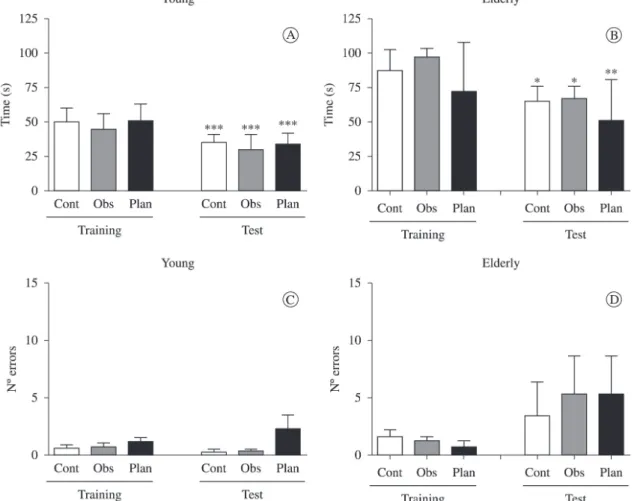
When comparing the times required to perform the motor task during training and testing, young
adults showed improvement in the execution time in all subgroups evaluated (Figure 2A, P<0.001). For
Table 1. Age, gender and education levels of the subjects.
Characteristic Young n=45
Elderly n=45
Age in years
(mean and standard deviation) (±2.97)22.28
73.04 (±6.82) Gender (M/F) 14/31 9/36 Education (illiterate/literate) 0/45 1/44
Education in years
(mean and standard deviation)
13.22 (±1.24)
7.32
(±4.75) Figure 1. Identiication of the ingers used to perform the sequence
the elderly, there was improvement in all subgroups; however, the subgroup that conducted movement
planning showed a more significant difference
between the execution times in the training and
test phases (P<0.01) than the other elderly groups
(Figure 2B; P<0.05), with this group showing a signiicantly greater reduction in the execution time of the task than all the other groups (Figure 3A, difference in training and test times, P<0.05). No signiicant differences were observed in the numbers
of errors when comparing the training and test phases
(Figure 2C and 2D) between subgroups.
We observed no differences in the execution times (Figures 2A and 2B, test) or the numbers of execution errors (Figures 2C and 2D, test) among the different subgroups of each age group.
When comparing the performances of the
subgroups (control, observation and movement planning - young adults x elderly), a difference in the variation of the time required for task execution between the training and test phases was observed (Figure 3A). In the observation (P<0.05) and
planning (P<0.01) groups, the execution time decreased signiicantly more for the elderly than for the young adults. There was also a difference between the age groups in the execution time of the motor task (Figure 3B; P<0.01 for the control and observation
groups, P<0.01 for the planning group) but not in the number of errors (Figure 3C).
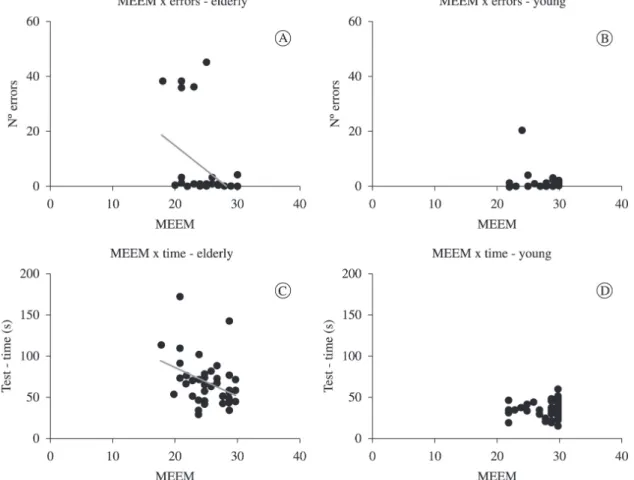
Among the elderly, there was a negative correlation
between the MMSE score (cognitive performance) and the number of errors in the motor task execution during the test phase (Figure 4A; r= –0.470;
P=0.001) as well as between the MMSE score and the execution time (Figure 4C; r= –0.354; P=0.016). In
the young adults, the MMSE results did not correlate
with the number of errors (Figure 4B, r= –0.106;
P=0.485) or execution time (Figure 4D; r= –0.015;
P=0.917).
Discussion
The present study assessed the inluence of mental practice and movement observation on the motor
learning and memory in young adults and elderly, as
well as the relationship between cognitive function and motor performance in the execution of a sequence
of digital movements.
Our results demonstrate that cognitive performance, as assessed by the MMSE and following the cutoff points proposed by Brucki et al.23, although different
when comparing the groups, is within the expected values for both the young adults and the elderly.
Thus, the sample exhibits a good overall cognitive
level even among the elderly, in spite of aging
commonly being associated with a reduction in
cognitive functions related to information processing.
The processes of executive function, attention and
memory are especially affected with age, as well as learning aspects, the process of selection and the programming of motor response27-29. Most likely, the
fact that these functions are preserved is related to the practice of physical, social and cognitive activities
by the elderly.
When analyzing the performance during training
and testing, especially in relation to the execution time of the motor task, a difference between the two phases was observed. With repetition during training,
a shorter time was required for the task in all groups.
During training, it is essential to make the observer
realize the important aspects of the action to form a reference for later reproducing the movements
accurately. In the review by Tani et al.17, the authors reported that one way to ensure learning is through demonstrating a task multiple times, which favors an increase in the selectivity of information for movement production and error correction.
The amount of time required to perform the motor task was greater for the elderly than for the young
adults, both during the training and test phases. This result may be related to the fact that aging
involves a variety of factors that result in functional
loss, such as decreased cerebral blood low, gray matter and brain volume30. It also involves a longer
reaction time and slower movement31. All these
non-pathological changes can affect the cognitive and
motor performance of the elderly because executive functions play an important role in learning ability
and motor performance32. This result corroborates
the study of Toledo and Barela33, who observed
differences in sensory and motor performance
between young and elderly individuals in learning/
performing a new task, with the elderly showing poorer performance.
Diniz et al.34 studied children, adults and elderly
individuals during the learning of a serial task, which
consisted of touching sensors with the index inger of the dominant hand, six times in response to light stimuli. The authors observed that adults had better
responses than children and elderly, and only adults
were able to learn the full sequence of the serial pattern. The elderly group showed better performance than the children at the beginning of the practice, which could be explained by the motor experience
acquired throughout their lifetimes; however,
that the elderly maintain their ability to learn but in
a slower manner, i.e., the performance of the elderly decreases compared with young individuals due to aging. Diniz et al.34 also concluded that the more
complex the task, the more dificult it is to perform.
The elderly seem to rely more on movement
planning than on observation for the acquisition of a
motor memory. Elderly individuals who performed
motion planning (mental practice) during the training-test interval exhibited a signiicantly greater
decrease in the time required to perform the task
when compared with the other elderly groups (control and observation). Our indings support the notion of
Tani et al.17 that when teaching a new task to older individuals, techniques different from those that are
effective in young individuals can be effective for
participants with a preserved cognitive and motor state. Taken together, our results suggest that for the
elderly, the mental practice of a movement before its execution may favor performance.
Gomes et al.35 studied the effects of mental
practice on the acquisition of motor skills in young
individuals and observed a better performance in the groups performing physical practice combined
with mental practice. That is, in this case, mental
practice depends on physical practice to be effective during the learning of a motor skill. In our study, this
association was not assessed; however, contrary to
what was observed for the elderly, mental practice alone did not modify the learning ability of young subjects. Saimpont et al.36 emphasized that mental
practice, in addition to being used to optimize motor function in sports and rehabilitation settings, can also beneit healthy elderly individuals facing age-related
impairments in motor function. The use of mental
practice is a safe and easy way to help preserve/
improve motor function in the elderly.
Figure 2. Comparison between time (igures A and B, median ± interquartile range, Wilcoxon test) and the number of runtime errors
Movement observation did not have the same
effect as mental practice on the learning of motor
skills by the elderly. The main reason for this difference may be the fact that mental planning involves more attention to the task than observation
and recruits neural pathways similar to those needed for the movement itself20. These results are extremely important when considering the choice of physical therapy techniques for intervention in elderly
individuals. Mental stimulation has been shown to Figure 3. Comparison of the performances of young adults and the elderly on the motor task test showing the difference in the time
required for the execution of the motor task in testing and training (igure A; median ± standard error of the Mann-Whitney test; # P<0.05, # # P<0.01 compared with the same young subgroup, * P < 0.05 compared to the control elderly subgroup); execution time (Figure B, median ± interquartile range test; Mann-Whitney test, ** P<0.01 compared to the youth of the same subgroup; *** P<0.001 compared to the same young subgroup) and the number of errors (Figure C, mean ± standard deviation, t-test of independent samples) (n=15/group).
be an important tool when the goal is to promote
learning or perfect a skill37, and thus, it can optimize
the recovery process of elderly patients.
Results from other studies have also indicated the
need to consider the differences in the motor learning of young individuals and elderly. Boyd et al.38 sought
to identify motor, spatial and temporal characteristics that could affect the motor learning process and to determine whether age directly interferes with motor learning. Their results suggest that a decline in motor learning occurs due to old age, which should
be considered in motor rehabilitation of the elderly. Teixeira39 compared the performances of different
age groups, from young adults to the elderly, on motor tasks requiring distinct sensorimotor functions and concluded that there was no single pattern of performance decline. Moreover, the author found that
the performance proile for each motor task seems to
have particular characteristics throughout the aging process, with a moderate increase in reaction time from 20 to 60 years old and poorer performance in tasks that require speed from 20 to 40 years old. The author also emphasizes that elderly individuals showed improved performance on tasks practiced regularly, while young individuals usually have an advantage in non-routine tasks.
The present study showed that for elderly
individuals, there is a relationship between cognitive function and motor performance in the execution
of a sequence of digital movements. Despite the
preservation of cognitive function in the subjects, ensuring the absence of dementia, the better the cognitive function, the better the motor learning. In young adults, the impact of cognition on motor learning was not signiicant because these individuals did not show any age-related cognitive deicits, with scores close to the maximum value in the evaluation
of this function.
It is important to consider that diseases associated
with aging are present in much of the elderly
population and that these diseases may exacerbate
the sensory and motor deterioration resulting from
the natural aging process. Dementias are examples of these diseases, and they are characterized by a decline in cognitive function that leads to a signiicant
impairment in performing daily activities. Dementias
affect approximately 5% of the population more than 65 years old, and this frequency can reach 20% to 25% of the population more than 80 years old26.
Therefore, because motor memory correlates with
cognitive function, it is important that cognitive
deicits are identiied early in the elderly to ensure that
the individuals maintain their autonomy, self-care and independence during the aging process.
Our results suggest that mental practice can positively inluence motor learning and memory in the elderly, allowing better motor performance in individuals of this age group. A correlation between
cognitive function and motor performance of the
elderly was also observed.
The results in the present study may contribute to
clinical practice in treating the elderly, allowing the
identiication of strategies that can facilitate motor learning and rehabilitation in this population. Given that aging leads to changes that may contribute to
psychomotor limitations and reduced autonomy and skills, it is important that healthcare professionals, including physical therapists, study and assess, in the
context of clinical practice, not only musculoskeletal capacity but also the cognitive functions of the elderly.
When working with healthy elderly individuals
or elderly with different levels of deicits, either cognitive or motor, these considerations should be taken into account when planning the rehabilitation program. Every activity must be learned with slow
and controlled movements and easy to understand instructions, and healthcare professionals must
respect the time needed by the elderly to learn and adjust their movement. Thus, the intervention will enable the most effective treatment for the patient.
References
1. Karuka AH, Silva JAMG, Navega MT. Analysis of agreement of assessment tools of body balance in the elderly. Rev Bras Fisioter. 2011;15(6):460-6. PMid:22218711. http://dx.doi.org/10.1590/S1413-35552011000600006
2. Lunenfeld B, Stratton P. The clinical consequences of an
ageing world and preventive strategies. Best Pract Res Clin Obstet Gynaecol. 2013;27(5):643-59. PMid:23541823. http://dx.doi.org/10.1016/j.bpobgyn.2013.02.005 3. Bishop NA, Lu T, Yankner BA. Neural mechanisms of
ageing and cognitive decline. Nature. 2010;464:529-535. PMid:20336135 PMCid:PMC2927852. http://dx.doi. org/10.1038/nature08983
4. Seidler RD. Differential effects of age on sequence
learning and sensorimotor adaptation. Differential effects of age on sequence learning and sensorimotor adaptation.
Brain Res Bull. 2006;70:337-46. PMid:17027769. http:// dx.doi.org/10.1016/j.brainresbull.2006.06.008
5. Degardin A, Devos D, Cassim F, Bourriez J-L, Defebvre L, Derambure P, et al. Deicit of sensorimotor integration in normal aging. Neurosci Lett. 2011;498:208-12. PMid:21600958. http://dx.doi.org/10.1016/j.
neulet.2011.05.010
6. Zibetti MR, Gindri G, Pawlowski J, Salles JF, Parente MAMP, Bandeira DR, et al. Estudo comparativo de
funções neuropsicológicas entre grupos etários de 21
7. Engvig A, Fjell AM, Westlye LT, Moberget T, Sundseth O, Larsen VA, et al. Effects of memory training on cortical thickness in the elderly. NeuroImage. 2010;52:1667-1676. PMid:20580844. http://dx.doi.org/10.1016/j.
neuroimage.2010.05.041
8. Chen KHM, Chuah LYM, Sim SKY, Chee MWL. Hippocampal region-speciic contributions to memory performance in normal elderly. Brain Cogn. 2010;72:400-7. PMid:20044193. http://dx.doi.org/10.1016/j. bandc.2009.11.007
9. Paulo DLV, Yassuda MS. Queixas de memória de
idosos e sua relação com escolaridade, desempenho
cognitivo e sintomas de depressão e ansiedade. Rev Psiq Clín. 2010;37(1):23-6. http://dx.doi.org/10.1590/ S0101-60832010000100005
10. Carvalho FCR, Neri AL, Yassuda MS. Treino de
Memória Episódica com Ênfase em Categorização
para Idosos sem Demência e Depressão. Psicol. Relex. Crit. 2010;23(2):317-23. http://dx.doi.org/10.1590/ S0102-79722010000200014
11. Abel T, Lattal KM. Molecular mechanisms of memory acquisition, consolidation and retrieval. Curr Opin Neurobiol. 2001;11:180-7. http://dx.doi.org/10.1016/ S0959-4388(00)00194-X
12. Bureau G, Carrier M, Lebel M, Cyr M. Intrastriatal inhibition of extracellular signal-regulated kinases
impaired the consolidation phase of motor skill learning.
Neurobiol Learn Mem. 2010;9:107-15. PMid:20447478. http://dx.doi.org/10.1016/j.nlm.2010.04.008
13. Verwey WB. Diminished motor skill development in elderly: indications for limited motor chunk use. Acta Psychol. 2010;134:206-14. PMid:20189547. http://dx.doi. org/10.1016/j.actpsy.2010.02.001
14. Meaney K, Griffin K, Hart M. The effect of model
similarity on girls’ motor performance. J Teaching Phys
Ed. 2005;24:165-78.
15. Ugrinowitsch H, Benda RN. Contribuições da Aprendizagem Motora: A prática na intervenção em Educação Física. Rev Bras Educ Fís Esporte. 2011;25:25-35. http://dx.doi.org/10.1590/S1807-55092011000500004
16. Tonello MGM, Pellegrini AM. A utilização da
demonstração para a aprendizagem de habilidades motoras em aulas de Educação Física. Rev Paul Educ Fís. 1998;12(2):107-14.
17. Tani G, Bruzi AT, Bastos FH, Chiviacowsky S. O estudo da demonstração em aprendizagem motora: estado da arte, desaios e perspectivas. Rev Bras Cineantropom Desempenho Hum. 2011;13(5):392-403. http://dx.doi. org/10.5007/1980-0037.2011v13n5p392
18. Dias VK, Duarte PSF. Idoso: níveis de coordenação motora sob a prática de atividade física generalizada. Efdeportes. 2005;89(10):23-33.
19. Fonseca FS, Siqueira MB, Bruzi AT, Fialho JV, Ugrinowitsch H, Benda RN. Demonstração e prática mental na aquisição de habilidades motoras. Rev Motricidade. 2008;4(2):62-67.
20. Skoura X, Papaxanthis C, Vinter A, Pozzo T. Mentally represented motor actions in normal aging I. Age
effects on the temporal features of overt and covert
execution of actions. Behav Brain Res. 2005;165(2):229-39. PMid:16165229. http://dx.doi.org/10.1016/j. bbr.2005.07.023
21. Rossi ALS, Pereira VS, Driusso P, Rebelatto JR, Ricci NA. Proile of the elderly in physical therapy and its relation to functional disability. Braz J Phys Ther. 2013;17(1):77-85. PMid:23175439. http://dx.doi. org/10.1590/S1413-35552012005000060
22. Folstein MF, Folstein SE, McHugh PR. “Mini-Mental State”: a pratical method for grading the cognitive state of patients for the cliniciam. J Psychiatr Res. 1975;12(3):189-98. http://dx.doi.org/10.1016/0022-3956(75)90026-6 23. Brucki SMD, Nitrini R, Caramelli P, Bertolucci PHF,
Okamoto IH. Sugestões para o uso do mini-exame do estado mental no Brasil. Arq Neuropsiquiatr 2003;61(3-B):777-781. PMid:14595482. http://dx.doi.org/10.1590/ S0004-282X2003000500014
24. Oldield RC. The assessment and analysis of handedness: the edinburgh inventory. Neuropsychologia. 1971;9(1):97-113. http://dx.doi.org/10.1016/0028-3932(71)90067-4
25. Ungerleider LG, Doyon J, Karni A. Imaging brain plasticity during motor skill learning. Neurobiol Learn Mem. 2002;78(3):553-64. PMid:12559834. http://dx.doi. org/10.1006/nlme.2002.4091
26. Albouy G, Sterpenich V, Vandewalle G, Darsaud A, Gais S, Rauchs G, et al. Neural correlates of performance variability during motor sequence acquisition. NeuroImage. 2012;60(1):324-331. PMid:22227134. http:// dx.doi.org/10.1016/j.neuroimage.2011.12.049
27. Macêdo AML, Cerchiari EAN, Alvarenga MRM, Faccenda O, Oliveira MAC. Avaliação funcional de idosos com déicit cognitivo. Acta Paul Enferm. 2012;25(3):358-63. http://dx.doi.org/10.1590/S0103-21002012000300007
28. Zeamer A, Decamp E, Clark K, Schneider JS. Attention, executive functioning and memory in normal aged rhesus monkeys. Behav Brain Res. 2011;219(1)23-30. PMid:21168445 PMCid:PMC3062645. http://dx.doi. org/10.1016/j.bbr.2010.12.021
29. Costarella M, Monteleone L, Steindler R, Zuccaro SM.
Decline of physical and cognitive conditions in the elderly measured through the functional reach test and
themini-mental state examination. Arch Gerontol Geriatr. 2010;50(3):332-37. PMid:19545918. http://dx.doi. org/10.1016/j.archger.2009.05.013
30. Mozolic JL, Hayasaka S, Laurienti PJ. A cognitive
training intervention increases resting cerebral blood
flow in healthy older adults. Front Hum Neurosci.
2010;4(16):1-10.
31. Martins AB, Dascal JB, Bruzi AT, Caldeira MD, Turetta
C. Interferência de tarefas motoras com diferentes demandas de processamento sobre o tempo de reação de idosos e adultos jovens. Rev Bras Ciênc Esporte. 2010;1(2):127-34.
32. Fraser SA, Li KZ, Penhune VB. Dual-task performance reveals increased involvement of executive control in ine
motor sequencing in healthy aging. J Gerontol B Psychol
Sci Soc Sci. 2010;65(5):526-35. PMid:20478900. http:// dx.doi.org/10.1093/geronb/gbq036
33. Toledo DR, Barela JA. Sensory and motor differences between young and older adults: somatosensory contribution to postural control. Rev Bras Fisioter. 2010;14(3):267-75. http://dx.doi.org/10.1590/ S1413-35552010000300004
34. Diniz AB, Basso L, Hashiguchi D, Beltrão NB, Correia
motora seriada em diferentes estágios de desenvolvimento.
Rev Bras Educ Fís Esporte. 2012;26(1):119-28. http:// dx.doi.org/10.1590/S1807-55092012000100012 35. Gomes TVB, Ugrinowitsch H, Marinho NFS, Benda RN.
Efeitos da prática mental na aquisição de habilidades motoras em sujeitos novatos. Rev Bras Educ Fís Esporte. 2012;26(3):511-21. http://dx.doi.org/10.1590/ S1807-55092012000300016
36. Saimpont A, Malouin F, Tousignant B, Jackson PL.
Motor imagery and aging. J Mot Behav. 2013;45(1):21-28. PMid:23394362. http://dx.doi.org/10.1080/0022289 5.2012.740098
37. Barato G, Fernandes T, Pacheco M, Bastos VH, Machado
S, Mello MP, et al. Plasticidade cortical e técnicas de
isioterapia neurológica na ótica da neuroimagem. Rev Neurocienc. 2009;17(4):342-8.
38. Boyd LA, Vidoni ED, Siengsukon CF. Multidimensional motor sequence learning is impaired in older but not younger
or middle-aged adults. Phys Ther. 2008;88(3):351-62. PMid:18096651. http://dx.doi.org/10.2522/ptj.20070131 39. Teixeira LA. Declínio de desempenho motor no
envelhecimento é especíico à tarefa. Rev Bras Med Esporte. 2006;12(6):351-5. http://dx.doi.org/10.1590/ S1517-86922006000600010
Correspondence Pâmela B. Mello-Carpes Universidade Federal do Pampa
Laboratório de Estresse, Memória e Comportamento BR 472, km 592