Considerations on Undistorted-Progressive X-Waves and
Davydov Solitons, Fr¨ohlich-Bose-Einstein Condensation,
and Cherenkov-like effect in Biosystems
Marcus V. Mesquita,
1Aurea R. Vasconcellos,
´
2and Roberto Luzzi
21. Instituto de F´ısica, Universidade Federal do Cear´a, 60455-760, Fortaleza, CE, Brazil
2. Instituto de F´ısica ‘Gleb Wataghin’, Universidade Estadual de Campinas, Unicamp, 13083-970 Campinas, SP, Brazil
Received on 3 June, 2003
Research in ultrasonography has evidenced the propagation of a peculiar kind of excitation in fluids. Such excitation, dubbed a X-wave, has characteristics resembling that of a solitary-wave type. We reconsider the problem in a medium consisting of a biological material of the like ofα-helix proteins. It can be shown that in this case is expected an excitation of the Davydov’s solitary wave type, however strongly damped in normal conditions. The case of acetanilide, an organic polymer which resembles biopolymers, is considered, and the infrared spectrum analyzed. Davydov’s soliton is evidenced as a coherent state of polar vibrations. The case of acoustic (sound) vibrations is also considered, where, also, a damped Davydov-like solitary wave may be excited. However, it is shown that when traveling in conditions sufficiently away from equilibrium, more precisely, when the soliton is embeded in the resulting Fr ¨ohlich-Bose-Einstein condensate, the lifetime of the solitary wave is largely enhanced. Moreover, a soliton moving in bulk with a velocity larger than that of the group velocity of the normal vibrational waves would produce a Cherenkov-like emission of phonons giving rise to the observed X-wave-like pattern. This paper is a modified and extended version of an earlier publication on the subject.
1
Introduction
Experiments in ultrasonography have evidenced a particular kind of wave propagation, dubbed as X-waves [1, 2]. They have the characteristic of propagating without dispersion, and may result of relevance for ultrasound medical imag-ing. Later on, they were ascribed to some kind of the so-called undistorted propagating waves [3]. They are waves traveling in a material media, and the reported characteris-tics point to the possibility of they belonging to the category of solitary waves. Soliton is the name coined to describe a pulse-like nonlinear wave (the solitary wave referred to above) which emerges from a collision with a similar pulse having unchanged shape or speed. Its relevance in applied sciences has been described in a 1973 review paper by A. C. Scottet al.[4] Because of the above mentioned technologi-cal/medical relevance we reanalyze the question in the case of propagation in biological materials.
The original category of solitary waves consists in the one observed by the Scottish engineer Scott-Russell in Au-gust 1834 in an English water channel, and reported in a 1844 meeting of the British Society for the Advancement of Science [5, 6]. During the second half of this century many other types of solitary waves have been associated to a num-ber of physical situations in condensed matter physics. Sev-eral, seemingly, have a fundamental role in important tech-nological areas of large relevance for contemporary society. Among them we may highlight the case of doped organic
polymers with very large conductivity for, e. g., use in very light, almost two-dimensional (sheets) batteries [7, 8, 9], and the case of propagation of light in optical fibers [10]. An-other example is that of the so-called Davydov’s solitons [11, 12], which may have a quite relevant role in bioener-getics.
which describes the evolution of the system at the macro-scopic level in arbitrary nonequilibrium situations [20,23-25], a formalism to be used in what follows. We notice that the method has been applied with particular success to the study of optical and transport properties in solids [26] and also to modelled biopolymers [27, 28], of the kind we consider here, and to techno-industrial processes [29]. Con-sequently, we do not go over the details of the formalism, just adapting those earlier results for the present discussion, giving in each case the reference where they are reported. We separate the presentation into two parts: After a general derivation of the equations of evolution, a first analysis is concentrated on the case of polar vibrations (with frequen-cies in the infrared region of the spectrum), for which are available experimental results, particularly the case of ac-etanilide, which we analyze, comparing theory and experi-ment. This is done in subsection 2.1, while in subsection 2.2 we deal with the case of longitudinal acoustic vibrations.
As stated, we first consider a system where modes of po-lar vibrations are excited by a continuous supply of energy. These polar modes are coupled through a nonlinear kinet-ics with a bath consisting of a continuous medium modelled by a system of acoustic-like vibrations. The equations of evolution for the population of the vibrational modes are de-rived resorting to the nonlinear quantum kinetic theory that the NESOM provides. This corresponds to the description of polar vibrations of theCO-stretching type (Amide-I) in, for example,α-helix proteins [11-13]. Experiments, of the class of Raman or neutron scattering or radiation absorp-tion, in active biological systems are particularly difficult. For that reason, the comparison of the theory of next sec-tion with experiment is done in the case of the organic poly-mer acetanilide, which constitutes a good mimic of biopoly-mers [30]. The infrared spectrum in the frequency region corresponding to the CO-stretching oscillation is derived, and compare very well with the experimental measurements, confirming the presence ofDavydov’s soliton. Finally, we comment on the possibly very large increase of the lifetime of Davydov’s soliton when propagating in an open medium sufficiently far from equilibrium.
In subsection 2.2, we consider a system of longitudinal acoustic vibrations in interaction with the above said ther-mal bath. We find a behavior of the acoustic modes quite similar to the one evidenced for the optical modes, namely, existence of the solitary-wave excitation, damped near equi-librium conditions but whose lifetime is greatly enhanced when propagating in a highly excited background.
Finally, it is demonstrated the possible emergence of a particular phenomenon, which we callFr¨ohlich-Cherenkov effect, consisting in that when the soliton is propagating with a velocity larger than the group velocity of the normal modes of vibration in the medium, a large number of phonons are emitted at a certain angle with the direction of propagation of the soliton.
2
The Solitary Wave
Let us consider a model biosystem which can sustain longi-tudinal vibrations and in interactions with a thermal bath of
acoustic-like vibrations, which is described by the so-called Fr¨ohlich-Davydov Hamiltonian given in [11] and [27]: This Hamiltonian is given in the so-called Random Wave Ap-proximation, while the full Hamiltonian — to be used in what follows — is given by
H =H0+HI =H0S+H0B+HI , (1)
where
H0S =
X
~ q
~ω~q
µ
a†~qa~q+
1 2
¶
, (2a)
H0B =
X
~ q
~Ω~q(b†
~ qb~q+
1
2), (2b)
HI =
X
~ q
Z~qϕ~qa†~q+
X
~ q1~q2
V~q(1)1~q2a~q1b~q2b
† ~ q1+~q2
+X
~ q1~q2
V~q(1)1~q2a~q1b
† ~
q2b−~q1+~q2+
X
~ q1~q2
V~q(1)1~q2a~q1b~q2b−~q1−~q2
+X
~ q1~q2
V~q(1)1~q2a~q1b
† ~ q2b
† ~ q1−~q2+
X
~ q1~q2
V~q(2)1~q2a~q1a~q2b
† ~ q1+~q2
+X
~ q1~q2
V~q(2)1~q2a~q1a~q2b−~q1−~q2+
X
~ q1~q2
V~q(2)1~q2a†~q1a~q2b~q1−~q2
+X
~ q1~q2
V~q(2)1~q2a~q1a
† ~ q2b
† ~
q1−~q2+H.c. (2c)
Figure 1 in [27] describes a particular biological system and the mechanical analog we are using. The Hamiltonian consists of the energy of the free subsystems, namely, that of the free vibrations, withωq~being their frequency
disper-sion relation (~qis a wave-vector running over the reciprocal-space Brillouin zone), and that of the thermal bath composed by oscillations with frequency dispersion relationΩq~, with
a Debye cut-off frequencyΩD. The interaction Hamiltonian
HIcontains the interaction of the system of polar vibrations
with an external source [which pumps energy on the system and is the first term on the right side of Eq. (2c)], and, finally, the anharmonic interactions between both subsystems. The latter are composed of several contribution, namely, those associated with three quasi-particle (phonons) collisions in-volving one of the system and two of the thermal bath (we callV(1)
~
q ~q′ the corresponding matrix element), and two of the system and one of the bath (we callV~q ~(2)q′ the corresponding matrix element). Finally,a~q(a†~q),b~q(b†~q), are, as usual,
✂✁☎✄✝✆ ✞✁✟✁✠✆ ✂✁☛✡☞✆ ✂✁✟✌✠✆ ✆✎✍✆
✆✎✍✏ ✆✎✍✌ ✆✎✍✁ ✆✎✍✑ ☞✍✆ ☞✍✏
✒✔✓✖✕✞✗✞✘
✙
✚ ✛✜✢✛
✣✞✤✦✥
✓ ✣☞✧★✪✩✖✫✗✭✬✯✮✱✰✳✲✂✴
✵
✓ ✣☞✧✕ ✩✖✫✗✞✶✷✮✱✰✹✸✺✲✻✴
✼
✲✻✴✽✓ ✫✷✾✸
✿❁❀❃❂✯❄✳❅☛❆❈❇❉❄✯❊●❋
❍❏■❑❄●▲▼❅✻◆
❖P
◗❘❙
P
❖❚
❯❱
❲❨❳❩ ❬▼❭
❪
❫
❴❵❛
❭
❜
❝✢❞✔✿✪❡❣❢❤✿❥✐❧❦❃♠♦♥✻♣q❇sr ✂t
Figure 1. Optical vibrations: The IRabsorption spectrum in ac-etanilide at 80 K. Points are from the experimental data reported in [38], and the full line the calculation after Eq. (23).
Next step consists in the choice, within the tenets ofNE -SOM, of the basic set of dynamical variables relevant for the present problem. Since we are dealing with excitation of vibrations in modes~q(with energy~ω~q), we need to in-troduce the number of excitations in each mode,νˆ~q =a†~qa~q.
Moreover, once the formation of a coherent state is expected (Davydov’s soliton), we must introduce the field amplitudes
aq~ anda†~q. Finally, since the thermal bath is taken as re-maining constantly in a stationary state at a temperatureT0,
via an efficient homeostatic mechanism, we introduce its Hamiltonian,HB. The average of these quantities over the
NESOMnonequilibrium ensemble constitute the basic set of macrovariables, which we designate as
n
ν~q(t),ha † ~
q|ti,ha~q|ti, EB
o
, (3)
that is, they define Gibbs’s space of nonequilibrium thermo-dynamic states. This is the thermothermo-dynamic state space in Informational Statistical Thermodynamics (IST for short). IST is the thermodynamic theory for irreversible processes based on the nonequilibrium ensemble formalism NESOM [20, 21, 22]. The basic thermodynamic macrovariables of Eq. (3) are then given by
ν~q(t) = Tr{ˆν~q̺(t)} ; (4a)
haq~|ti= Tr{a~q̺(t)}; (4b)
ha†~q|ti=ha~q|ti∗= Tr
n
a†~q̺(t)o; (4c)
EB= Tr
n
ˆ
HB̺B
o
(4d)
where̺(t)is the nonequilibrium statistical operator of the system, and̺Bthe canonical distribution of the thermal bath
at temperatureT0. The statistical operator̺(t)is taken in
Zubarev’s approach [20,21], in this case given by
̺(t) = e−ˆSε(t) (5)
where
⌋
ˆ
Sε(t) = ˆS(t,0)−
Z t
−∞
dt′eε(t′−t) d
dt′ˆS(t
′,t′−t), (6a)
with
ˆ
S(t,0) =φ(t) +X
~ q
£
F~q(t)ˆν~q+f~q(t)a~q+f~q∗(t)a†~q
¤
(6b)
being the so-called informational-statistical-entropy operator [31],
ˆ
S(t′, t′−t) = exp©
−1
i~(t
′−t)Hªˆ
S(t,0) exp©1
i~(t
′−t)Hª
, (6c)
⌈
andεis a positive infinitesimal that goes to zero after the calculation of averages has been performed [20, 21]. More-over,φ(t)— playing the role of a nonequilibrium partition function — ensures the normalization of the statistical oper-ator.
In Eq. (6b) are present the Lagrange multipliers that the method introduces, namely those we have called
©
F~q(t), f~q(t), f~q∗(t), β0
ª
, (7)
whereβ0 = (kBT0)−1, since the thermal bath remains in
a stationary state at fixed temperatureT0, and the total
sta-tistical operator is the direct product of̺(t)and̺B;kB is
Boltzmann universal constant.
are simply left to calculate the equations of evolution for the population of the vibrational modes,ν~q(t), and of the amplitude ha~q|ti and its complex conjugate. As noticed,
these equations are derived resorting to the nonlinear quan-tum generalized transport theory that theNESOMprovides. We introduce an approximated treatment, however appro-priate for the present case since the anharmonic interactions are weak, consisting of the so-called second order approx-imation in relaxation theory, SOART for short [24]. It is usually referred to as the quasi-linear theory of relaxation [32], which is a Markovian approximation involving only the second order in the interaction strengths [24], in the present case involving contributions proportional to|V~q~(1)q′|2 and|V~q~(2)q′|
2.
The calculation shows that, because of the symmetry properties of the system and the selected choice of basic variables, several contributions inNESOM-SOARTvanish in this case: The surviving one corresponds to the Golden Rule of quantum mechanics averaged over the nonequilibrium
en-semble [27]. In compact form, the one for the population is d
dtν~q(t) =I~q+
5
X
j=1
J~q(j)(t) +ζq~(t), (8)
where the first term on the right hand side is the one as-sociated to the pumping source, whereI~q is then the rate
of population increase that it generates, and the remaining five collisions operatorsJ~q(i)(t)are those arising out of the
anharmonic interactions. The first two correspond to col-lisional events involving a single vibration and two of the bath, and gives rise to a pure dissipative term which takes the form
J~q(1)(t) +J~q(2)(t) =−
1
τ~q
h
ν~q(t)−ν
(0)
~ q
i
, (9)
whereν~q(0) is the population in equilibrium at temperature T0, andτplays the role of a relaxation time given by
⌋
τ−1
~
q =
4π
~2
1
ν~q(0)
X
~ q′
|V~q~(1)q′|
2νB ~ q′ν~q−~Bq′
£
δ(Ω~q′+ Ω~q−~q′ −ω~q) + 2eβ ~Ω
˜ q′δ(Ω
˜
q′−Ω˜q−q˜′+ω˜q)¤, (10)
whereνB ~
q is the population of the phonons in the bath, namely, the Planck distribution
νB~q = [exp(β0~Ω~q)−1]−1, (11)
and the delta functions account for conservation of energy in the scattering events. The other terms,J~q(i)(t)withi= 3,4,5,
are
J~q(3)(t) =
8π
~2
X
~ q′
|V~q~(2)q′|
2£
νB~q−~q′(ν~q′ −ν~q)−ν~q(1 +ν~q′)¤δ(Ω~q−~q′ +ω~q′−ω~q), (12a)
J~q(4)(t) =
8π
~2
X
~ q′
|V~q~(2)q′|
2£
νB ~
q−~q′(ν~q′ −ν~q) +ν~q′(1 +νq~)¤δ(Ω~q−~q′ −ω~q′+ω~q), (12b)
J~q(5)(t) =
8π
~2
X
~ q′
|V~q~(2)q′|
2£
ν~qB+~q′(1 +ν~q′)−(ν~q′−ν~qB+~q′)ν~q
¤
δ(Ω~q+~q′−ω~q′−ω~q), (12c)
and, finally, the termζ~q(t)is the one which couples the populations with the amplitudes, namely
ζ~q(t) = 4π
~2
X
~ q′
|V~q~(1)q′|
2|haq|ti|2©
(1 +ν~qB′ +ν
B ~
q−~q′)δ(Ω~q−~q′+ Ω~q′ −ω~q′)
+2(ν~qB′−ν
B ~
q−~q′)δ(Ω~q−~q′−Ω~q′−ω~q′)
ª
+8π ~2
X
~ q′
|V~q~(2)q′|
2©
|haq|ti|2(1 +νq~′+ν~q−~Bq′)− |haq′|ti|2(ν~q−ν~q−~Bq′)
ª
δ(Ω~q−~q′+ω~q′−ω~q)
−8π
~2
X
~ q′
|V~q~(2)q′|
2©
|haq|ti|2(νq~′−ν~q−~Bq′)− |haq′|ti|2(1 +ν~q+ν~q−~Bq′)
ª
δ(Ω~q−~q′−ω~q′+ω~q)
+8π ~2
X
~ q′
|V~q~(2)q′|
2©
|haq|ti|2(ν~q′−ν~qB+~q′)− |haq′|ti|2(νq~−ν~qB+~q′)
ª
The collision operator J~q(5) is also a relaxation term
(containing contributions nonlinear in the mode popula-tions); and the first two terms are those responsible for the so-called Fr¨ohlich effect, as a result that they account for,
through the nonlinear terms, of the transfer of energy to the polar modes lowest in frequency. In fact, they contain non-linear contributions proportional to
⌋
X
~ q′
|V~q~(2)q′|
2ν
~
q(t)ν~q′(t)
£
δ(Ω~q−~q′−ω~q′+ωq~)−δ(Ω~q−~q′+ω~q′−ω~q)
¤
, (13)
⌈
and we may notice that for modes ~q′ such that ω ~ q′ > ω~q
the energy conservation as required by the first delta func-tion is satisfied, while this is not possible for the second: hence this nonlinear contribution tends to increase the pop-ulation in mode~qat the expenses of the other modes higher in frequency. Reciprocally, forω~q′ < ω~q, the mode~q
trans-fers energy to the modes lower in frequency. Moreover, in
Eq. (12d) the termζ~q(t)acts as a source coupling the
pop-ulations of the vibrational modes with the amplitudes of the expected coherent excitation (Davydov’s soliton as shown a posteriori).
On the other hand, the equations of evolution for the field amplitudes are
⌋
∂
∂tha~q|ti=−i ˜ω˜qha˜q|ti −Γq˜ha˜q|ti+ Γ˜qhaq˜|ti
∗−iW
˜
qha˜q|ti∗+
+X
~ q1~q2
R~q1~q2ha~q1|tiha
† ~ q2|ti
³
ha~q−~q1+~q2|ti+ha
†
−~q+~q1−~q2|ti
´
, (14a)
∂ ∂tha
† ~
q|ti=the c.c. of the r.h.s. of Eq. (14a), (14b)
whereω˜~q =ω~q+W~q, withW~q being a term of renormalization of frequency which will not be of interest in the following
analysis, and the lengthy expression forR~q1~q2 is given elsewhere [28]; its detailed expression is unnecessary for the analysis here. Finally,Γ~q(t), which has a quite relevant role in what follows, is given by
Γ~q(t) =
1 2τ
−1
~ q (t) +
4π
~2
X
~ q′
|V~q~(2)q′|
2£
1 +ν~q′+ν~q−~Bq′
¤
δ(Ω~q−~q′+ω~q′−ω~q) +
−4π
~2
X
~ q′
|V~q~(2)q′|
2£
ν~q′−ν~q−~Bq′
¤
δ(Ω~q−~q′ −ω~q′+ω~q) +
4π
~2
X
~ q′
|V~q~(2)q′|
2£
ν~q′−ν~qB+~q′
¤
δ(Ω~q+~q′ −ω~q′−ω~q). (15)
⌈
The coupled equations (14) contain linear and tri-linear terms. Ignoring the latter, the resulting linearized equation has as solutions the normal damped wave motion, proceed-ing with a renormalized frequency and lifetime Γ−1
~ q . The
complete equations, i.e. including the nonlinear terms, are of the Davydov’s soliton type, but with damping, or more precisely, are nonlinear damped Schr¨odinger-like equations [4, 33]. We introduce a representation in direct space, defin-ing the averaged (over the nonequilibrium ensemble) field
operator
ψ(x, t) =X
~ q
ha~q|tieiqx. (16)
for linear propagation along the, say,xdirection on bulk or along the one-dimensional polymer.
2.1
Polar (Optical) Vibrational Modes
lon-gitudinal polar-modes (optical modes with frequencies in the infrared), as in Davydov’s and Fr¨ohlich’s works [11, 12, 34, 35]. Their frequency dispersion relation is approxi-mated (to a good degree of accuracy) by the parabolic-law ω~q =ω0−αq2, whereω0andαare constants, standing for
the frequency at the zone centre (the maximum one) and the
curvature at this centre, respectively. Next, using Eqs. (14), after neglecting the coupling terms with the conjugated am-plitude (what can be shown to be the case when we introduce from the outset a truncated Hamiltonian in the so-called Ro-tating Wave Approximation [36]), it follows that the average field amplitude satisfies the equation
⌋
i~∂
∂tψ(x,t) = (~ω0+~α
∂2
∂x2)ψ(x,t)−i~
Z L
0
dx′
L Γ(x−x
′)ψ(x′,t)+
+
Z L
0
dx′
L
Z L
0
dx′′
L R(x−x
′, x−x′′)ψ(x′, t)ψ(x′′, t)ψ∗(x, t), (17)
⌈
whereΓandRare the back-transforms to direct space of
Γ~q in Eq. (15) andR~q1~q2 in Eq. (14a), andLis the length
of the sample. Moreover, we have taken a time-independent populationν~q, that is, according to Eq. (8) it is either the equilibrium distribution at temperatureT0when no external
pumping source is present (i. e. I~q(ω~q) = 0), or when in
the presence of a constant pumping source leading, after a short transient has elapsed, to a steady state and, moreover, the termζ~q is weakly dependent on time (a condition to be
characterizeda posteriori).
Equation (17) is a nonlinear Schr¨odinger-type equation with damping [33]. Introducing a local approximation, that is, neglecting space correlations, after using the expressions
R(x−x′, x−x′′) =~Gδ(x−x′)δ(x−x′′), (18a)
Γ(x−x′) =γ
sδ(x−x′), (18b)
we obtain that Eq. (17) becomes
⌋
i∂ψ(x,t)
∂t −(ω0−iγs)ψ(x,t)−α
∂2
∂x2ψ(x,t)−G|ψ(x,t)| 2
ψ(x,t) = 0, (19)
⌈
Equations (14) and (19) are of the form of the equa-tions derived by Davydov in an alternative way, but, with the present thermodynamic treatment clearly showing the damping effects. In equilibrium conditions at temperature 300 K, the damping constants have values corresponding to
lifetimes in the order of a few picoseconds. For the case of a Gaussian signal impinged at the beginning of the polymer chain, which can be approximated to a good degree of accu-racy by a hyperbolic secant shape, and next using the Inverse Scattering Method [37] we obtain the solution
⌋
ψ(x, t) =Aexp
½
i
· υ
2αx−(ωs−iγs) t− θ
2
¸¾
sech
"
A
µ|G|
2α
¶1/2
(x−υt)
#
, (20)
⌈
whereγsis, evidently, the reciprocal lifetime of the
excita-tion (takingγs = 0andω0 = 0, Eq. (20) is the expression
for Davydov’s soliton in its original version [11, 12]), and we usedG=|G|eiθ. Moreover,
ωs=ω0−
υ2
4α+
|G| A2
2 , (21)
is the reciprocal period of the solitary wave andAandυare an amplitude and a velocity of propagation fixed by the ini-tial condition of excitation imposed by the external source.
the Amide-I oscillation and prevents its dispersion in a self-trapping.
Let us consider the experimental observation of this ex-citation. As already noticed, experimental observation is difficult in active biological materials. A way around this difficulty consists into the experimental study of polymers whose vibronic characteristics resemble those of biopoly-mers, and a quite favorable one is acetanilide. Experiments of infrared absorption in acetanilide showed an “anomalous” band in theIRspectrum, which was ascribed to a Davydov’s soliton [38], and later on reproduced in other experiments, and also observed in Raman scattering experiments [39-43]. We analyze the experiment of Careri et. al [38], re-sorting to a response function theory consistently derived in the framework of NESOM [20, 44, 45]. Without going into details (see [46]), the absorbance in the region of the CO-stretching mode has the expression
α(ω) =αn(ω) +αs(ω), (22)
which describes two bands: one centered aroundω~q, the
fre-quency of the normal mode, (~qbeing equal to theIR-photon wave-vector) and with intensity proportional to the popula-tion in equilibriumν~q at temperatureT0, since no external
pump is present,I~q = 0in Eq. (8); and the other is centered
aroundωs, the frequency of the soliton. The band widths are
γn=τ0−1andγs=τ0−1+A(|G|/2α)1/2, whereτ0−1is the
one of Eq. (10), for~qnear the zone center. Let us consider the experiments of reference [38], and take, for example, the case ofT0 = 80K; on the basis of the red shift of the band
due to the soliton in relation to the normal CO-stretching band, that is, ω0−ωs ≈ 16 cm−1, and thatγs−γn ≈
3.6cm−1, we find thatA(|G|/2α)1/2 ≈ 2.3×106cm−1
andυ≈3×104cm s−1. The calculated spectra is shown as
a full line in Fig. 1, while the dots are experimental points, evidencing a satisfactory agreement.
In Fig. 2 it is shown the propagation of the energy ac-companying the soliton (proportional to|ψ(x, t)|2) along a few picoseconds after the application of the initial Gaussian-like excitation. It is clearly evidenced the conservation of the shape characteristic of the soliton, but accompanied, as already described, with a decay in amplitude in the picosec-ond range. Hence, a pulse signal impinged on the system would be carried a few micrometers, since the velocity of propagation is≈3×104cm s−1.
However, the situation may be substantially modified if the excitation propagates in a nonequilibrium background, namely the one provided by the presence of a constant pumping source [I~q 6= 0in Eq. (8)] leading the system to
a steady state, with populations, say,ν¯~q, constant in time but
much larger than the population in equilibrium. At a suf-ficient distance from equilibrium, as proposed by Fr¨ohlich near thirty years ago [34, 35], and later on verified by sev-eral authors (in the framework ofISTin [27]), is expected to arise a particular complex behavior in the system, namely a phenomenon akin to a Bose-Einstein condensation, consist-ing in that [because of the presence of the terms of Eq. (9)], and as already noticed, the energy stored in the polar vibra-tional modes is preferentially channeled to the modes lowest in frequency. The latter greatly increase in population, while
✁ ✂ ✄ ☎ ✆✝
✟✞✠ ✟✞✡✁ ✟✞✂ ✟✞✠✄ ✟✞☛☎ ✆☞✞✠
✌
✍
✎✑✏✒✌ ✓✕✔
✍ ✖✘✗✚✙
✓✜✛
✍ ✖✣✢✕✤✥✗✚✙
✓✕✦
✍ ✖✣✢★✧✩✗✚✙
✓✕✪
✍ ✖✣✢✬✫✘✗✚✙
✓✕✭
✍ ✖✣✢✕✮✯✗✚✙
✓✱✰ ✲
✢✬✖✘✗✚✙
✎✴✳ ✎✶✵✷✌ ✎✑✸✹✌ ✎✑✺✻✌ ✎✽✼✾✌
✿❀
✿❁
❂ ❃
❄✡❅❆ ❇❉❈
❊
❋
●❍■
❏
❑▼▲❖◆◗P✹❘❚❙❱❯❳❲ ✎✬❨❩✌
Figure 2. Optical vibrations: Profile of the soliton energy (propor-tional to|ψ(x, t)|2
) along a few picoseconds after application of the initial Gaussian-like perturbation (in the experimental condi-tions of Fig. 1 forT = 80K).
the modes at intermediate and high frequencies remain nearly constant on further increase of the intensity of the pump. As expressed above, this is similar to a Bose-Einstein condensation, but, it must be stressed, not in equilibrium but in nonequilibrium conditions, and then the phenomenon —
Fr¨ohlich effect— may be considered a kind of emergence of a dissipative structure in Prigogine’s sense [47, 48, 49]. This is illustrated in Fig. 3, where the steady state populations in terms of the intensity of the pumping source are shown. We have used numerical parameters characteristic of a poly-mer of theα-helix protein type [27]. The figure evidences the large increase (after an intensity threshold has been at-tained) of a mode lowest in frequency (the one labelled 1), at the expenses of other modes higher in frequency. In Fig. 4 it is evidenced the Fr¨ohlich-Bose-Einstein-like condensate at the lowest frequencies in the vibrational spectrum.
The relevant point to be stressed is thatFr¨ohlich effect
intensity Iincreases [28]. This implies that it may be ex-pected that an excitation composed by a coherent interplay of the low-lying-in frequency excited polar (optical) modes in biopolymers, may propagate in the form of aDavydov solitary wave traveling undeformed and nearly undamped while Fr¨ohlich condensate state is maintained.
✂✁☎✄ ✆✁✞✝ ✂✁✠✟ ✂✁✞✡ ✆✁✠☛ ✂✁✠☞
✂✁✍✌ ✂✁☎✄ ✂✁
✝
✂✁✠✟ ✂✁✡ ✂✁✠☛
✂✁☎✄ ✆✁✞✝ ✂✁✠✟ ✂✁✞✡ ✆✁✠☛
✂✁✠☞ ✂✁✍✌ ✂✁☎✄ ✂✁
✝
✂✁✠✟ ✂✁✡ ✂✁✠☛
✎✑✏ ✎✓✒
✎✕✔ ✎✗✖
✎✙✘ ✎✛✚ ✜✣✢✥✤
✦
✢★✧✪✩✫✩✗✬
✭
✮
✭✯
✰✱
✲
✳✴
✵
✶
✮
✵
✷
✮
✶
✮
✵
✸
✹✻✺✽✼✿✾❀✺❂❁❃✹✼✽❄
Figure 3. Optical vibrations: The steady-state populations vs. the intensity of the pumping source, for a selected set of modes: After an intensityS = 103
is reached, there follows a large increase in the populationν6 of the mode lowest in frequency in the said set (After Ref. [27]).
✂✁✄ ☎✆✁✝ ☎✂✁✄ ✞✟✝✂✁✝
✝
✠✡✝✆✝ ☛✝✆✝ ☞✌✝✆✝ ✡✝✆✝ ✞✟✝✌✝✆✝
✂✁✄ ☎✆✁✝ ☎✂✁✄ ✞✟✝✂✁✝
✝
✠✡✝✌✝ ☛✝✌✝ ☞✌✝✌✝ ✡✝✌✝ ✞✟✝✌✝✆✝
✍✏✎✒✑✔✓✖✕✗✑✙✘✛✚✢✜✤✣✟✥✙✦✢✧✩★✫✪
✬
✭ ✮
✯✰
✭
✰
✱✲
✳✴✵
✭ ✶
Figure 4. Optical vibrations: The steady-state populations for S = 104
, showing a “two fluid” separation consisting in the “condensate” at low frequencies and the “normal” contributions at higher frequencies (After Ref. [27]).
✂✁☎✄ ✂✁☎✆ ✂✁✞✝ ✂✁✠✟ ✂✁✞✡
✂✁✞☛ ✂✁✠☞ ✂✁✞✄ ✂✁☎✆ ✂✁✌✝ ✂✁✍✟
✂✁☎✄ ✂✁☎✆ ✂✁✞✝ ✂✁✠✟ ✂✁✞✡
✂✁✞☛ ✂✁✠☞ ✂✁✞✄ ✂✁☎✆ ✂✁✌✝ ✂✁✍✟
✎
✎
✎
✎
✎
✎
✏✞✑ ✏✌✒
✏☎✓ ✏✕✔
✏✗✖
✏✞✘ ✙✛✚✢✜
✣ ✚✥✤✧✦★✦✪✩
✫✬
✭ ✮
✯
✫
✰
✭ ✱
✲
✲✮✳
✬
✴✮
✵✬
✶
✷
✸✺✹✼✻✾✽✿✹❁❀❂✸✻❄❃
❅
Figure 5. Optical vibrations: The lifetime of the same modes as in Fig. 3, in terms of the intensity of the pumping source.
2.2
Acoustical Vibrational Modes
So far we have considered propagation of vibronic waves in biological media, via Eq. (16), but restricted to the case of polar modes. We briefly consider next the case of longitudi-nal acoustic modes. For that purpose we return to Eqs. (14), where now we take into account that the dispersion relation ωq~is, for acoustic-like vibrations,sq, wheresis the
veloc-ity of sound in the media, this meaning that we are using a Debye model. Using this dispersion relation, and theAnsatz
that the excitation is expected to be a closed-packet solitary wave, we arrive at the equivalent of Eq. (19), in this case acquiring the expression
i∂
∂tψ(x, t) +
~
2Ms
∂2
∂x2ψ(x, t)
+iγsψ(x, t)−Gs|ψ(x, t)|2ψ(x, t) = 0 (23)
as shown in Appendix A.
Evidently, this Eq. (23) is formally identical with Eq. (19) if in the latter we takeω0 = 0and, of course with
the coefficients being those corresponding to this case ofLA (longitudinal acoustic) vibrations. However, a remarkable difference may be noticed, namely, while in Eq. (19) the coefficient in front of the second derivative in space is deter-mined, throughα, by the bandwidth of theLO(longitudinal optical) vibrations dispersion relation, in this case, as shown in Appendix A, it depends through the pseudo-massMson
⌋
ψ(x, t) =Aexpni£Msv
~ x−(ωs−iγs)t−
θ
2
¤o
sechnA£|Gs|Ms
~
¤1/2
(x−vt)o, (24)
⌈
where
ωs= |Gs|A2
2 −
Msv2
4~ , (25)
As in the case ofLOvibrations, the “acoustic” solitary wave is damped, and one may wonder if, as in the case of the “op-tical” solitary wave, this lifetime may be largely extended by the action of nonlinear kinetic terms enhanced by the pump-ing of energy on the system. We reconsider Eqs. (11), now specialized for the LAvibrations, and look for the station-ary states when a constant exciting source is continuously applied.
To perform numerical calculations we choose a set of parameters in a typical order of mag-nitude approximation. We take for the Bril-louin zone-end wavenumber qB = 3.14×107cm−1,
ω~q=sq with s= 1.8×105cm s−1, Ω~q =sBq with
sB = 1.4×105cm s−1. Moreover, the matrix elements
V(1) and V(2) are proportional to the square roots of the
wavenumbers [50], sayV~q~(1q′,2)=K
(1,2)[|~q
1||~q2||~q1−~q2|]
1 2,
andK(1)is determined from a typical value of 10 ps for the
lifetime of Eq. (10) (for any system it can be determined from the linewidth in Raman scattering experiments). An open parameter λ=|K(2)/K(1)|2 is introduced, and we take λ = 1 to draw Fig. 6. Finally,L, the length of the sample in the direction of propagation is taken as 10 cm. Therefore, the permitted wavenumbers for propagation of vibrations are contained in the intervalπ/L≤q≤qB. For
these characteristic values it follows that, because of en-ergy and momentum conservation in the scattering events, the set of equations of evolution, Eqs. (8), which in prin-ciple couple all modes among themselves, can be sepa-rated into independent sets each one having nine modes. For example, taking the mode with the lowest wavenum-ber π/L, the set to which it belongs contains the modes κn−1π/L, whereκ= (s+s
B)/(s−sB) = 8in this case,
andn= 2,3, . . . ,9. Let us callν1, . . . , ν9the
correspond-ing populations, havcorrespond-ing frequencies ω1 = 5.6 ×10⁴ Hz,
ω2= 4.5×10⁵Hz.ω3= 3.6×10⁶Hz,ω4= 2.9×10⁷Hz,
ω5= 2.3×10⁸Hz,ω6= 1.8×10⁹Hz,ω7= 1.5×10¹⁰Hz,
ω8 = 1.2×10¹¹Hz,ω9 = 9.5×10¹¹ Hz. Moreover, for
illustration, the open parameterλis taken equal to1, and we consider that only the modes 2and3 (in the ultrasonic re-gion) are pumped with the same constant intensityS =I¯τ, whereI2 = I3 = I, and I1 andIn withn = 4, . . . ,9are
null, andτ¯is a characteristic time used for scaling purposes (as in [27]) here equal to0.17s. The results are shown in Fig. 6, where it is evident the large enhancement of the pop-ulation in the mode lowest in frequency (ν1), forS0≃1019,
at the expenses of the two pumped modesν2andν3, while
the modesν4toν9(higher in frequency) are practically
unal-tered. The emergence of Fr¨ohlich effect is clearly evidenced
for this case of acoustical vibrations: In fact, pumping of the modes in a restricted ultrasonic band (in the present case in the interval4.5×105Hz≤ω≤2.8×10⁷Hz), leads at
sufficiently high intensity of excitation to the transmission of the pumped energy in these modes to those with lower frequencies (ω < ω2), while those with larger frequencies
(ω >2.8×10⁷Hz) remain in near equilibrium, as shown
in Fig. 7. It may be noticed that for the given value of
¯
τ, forS = 1023, the flux power provided by the external
source, in the given interval of ultrasound frequencies being excited, is of the order of milliwatts. Modes in the interval
5.6×10⁴ ≤ ω
~
q ≤ 4.5×10⁵, those lowest in frequency,
have large populations in comparison with those higher in frequency. As already noticed, because of these charac-teristics of Fr¨ohlich’s effect, it is sometimes referred-to as a Bose-Einstein-like condensation. However, it must be stressed that not in equilibrium, but in nonequilibrium con-ditions, then being a kind of nonequilibrium phase transition or better to say, a kind of emergence of a dissipative struc-ture in Prigogine’s sense [47-49]. Moreover, we may say, in a descriptive way, that it is present a kind of a “two fluid system”, the normal one and the Fr¨ohlich condensate.
Another relevant result is that, also as in the case of the optical vibrations, the modes in the condensate largely increase their lifetimes; this is shown in Fig. 8. There-fore, the soliton, composed by the coherent interplay of low-frequency acoustical modes, travels nearly undamped in the Fr¨ohlich condensate.
We proceed now to consider another possible novel phe-nomenon in this kind of systems.
2.3
The accompanying Cherenkov-like
emis-sion
✂✁☎✄✆ ✝✁✞✄✟ ✝✁✡✠☞☛ ✂✁✡✠✌✄ ✂✁✡✠✍✠ ✝✁✎✠✍✏ ✝✁✡✑
✝✁✓✒ ✝✁✎✆ ✝✁✎✟ ✂✁☎✄☛ ✂✁✄✍✄ ✂✁☎✄✠ ✂✁☎✄✔✏ ✂✁✄✕ ✂✁✄✔✖ ✂✁☎✄✑
✂✁☎✄✆ ✝✁✞✄✟ ✝✁✡✠☞☛ ✂✁✡✠✌✄ ✂✁✡✠✍✠ ✝✁✎✠✍✏
✝✁
✑
✝✁✓✒ ✝✁✎✆ ✝✁✟ ✝✁
✄☛ ✝✁✞✄☞✄ ✝✁✞✄✠ ✝✁✞✄✏ ✝✁✞✄✕ ✝✁✞✄✖ ✝✁✞✄✑
✗✘
✙
✚✜✛✣✢✥✤✧✦★✦✪✩
✫
✢ ✬
✭✜✮ ✭✰✯ ✭✲✱
✳
✴
✳✵
✶✷
✸✹
✴ ✺
✻
✼✾✽❀✿❂❁❄❃❆❅❈❇❊❉●❋❍❅✾❉❍✼■❇❋✲❏▲❑▼✼❖◆
Figure 6. Acoustic vibrations: The steady state populations of the three relevant modes in the set — as described in the main text —, with increasing values of the intensity of the external source pumping modes labeled 2 and 3 in the ultrasonic region. (After Ref. [46]).
105
106
107
108
104
105
106
107
108
109
1010
1011
1012
1013
1014
1015
1016
104
105
106
107
108
109
1010
1011
1012
1013
1014
1015
1016
_
FRÖHLICH CONDENSATE
(ν)
S=1023
T0=300 K
λ=1
STEADY STATE MODE POPULATIONS
FREQUENCY (Hz)
Figure 7. Acoustic vibrations: The population in the steady state for a pumping intensityS= 1023
, of the modes along the spectrum of frequencies of the acoustic modes. Dots indicate the modes in the first set (the remaining part of the spectrum up to the highest Brillouin frequencyωB= 9.5×10
11
Hz has been omitted). (After Ref. [46]).
1018
1019
1020
1021
1022
1023
1024
1025
102
104
106
108
1010 1012 1014
1016
1018 1018
1019 1020
1021 1022
1023 1024
1025
102 104 106 108
1010
1012
1014
1016
1018
_
_
_
_
Γ2
(Γ)
RECIPROCAL LIFETIMES
SOURCE INTENSITY (S) T0=300 K
λ=1
Γ3
Γ1
Figure 8. Acoustic vibrations: The lifetime of the same modes as in Fig. 7, in terms of the intensity of the pumping source (After Ref. [46]).
When the soliton velocity of propagation, sayv, is larger than the group velocity of the normal vibrations, (the ve-locity of soundswhen the acoustic modes are involved), it may follow aCherenkov-like effect. We recall that originally it was observed in electromagnetic radiation (e.g. [51]) by Cherenkov in 1934. It is a result that in a material media with an index of refraction n, the velocity of propagation of light isc/n, smaller than the velocitycin vacuum (since n >1), and if an electron with velocityu > c/n(but with the relativistic limitation of u < c) travels in this medium then, along a cone defined by the angle cosθ = c/n uis emitted the so-called Cherenkov radiation: that is, along such direction photons are strongly emitted. This is the so-called superluminal radiation [52, 53].
Something similar is present in the case of phonons in the photoinjected plasma in semiconductors in the presence of an electric field: when the drift velocity of the carriers ex-ceeds the group velocity of the~q-mode optical phonon, then along a cone whose axis is along the electric field, and with an aperture with angleθ~qdefined by
cosθ=ω~q/vq, (26)
there follows a large emission of ~q-mode optical phonons [54].
This is also the case when the soliton, either optical or acoustical, travels in bulk with a velocityv larger than the group velocity of the normal vibronic waves. This is de-scribed elsewhere [46], and next we briefly outline the re-sults. Inspection of Eq. (8) tells us that the presence of the direct coupling to the external source viaI~q, and indirectly
soli-ton, tends to increase the population of phonons. But, as al-ready noticed, because of Fr¨ohlich effect, such pumped en-ergy tends to concentrate in the modes lowest in frequency, those at the Brillouin zone boundary in the case of optical vibrations and around the zone center in the case of acoustic vibrations.
Take the case of acoustic phonons, when there should be a large increase in the population of the modes with very small wavenumber. A straightforward calculation of
Eq. (4a) leads to the result that
ν~q(t) = [eF˜q(t)−1]−1+
¯ ¯
fq˜(t)
F˜q
¯ ¯
2
· (27)
Evidently, in the absence of the perturbation, that is, I~q = 0 andha~qi = 0 and then f~q = 0, it follows that
F~q(t) = ~sq/kBT0, and we recover the usual Planck
dis-tribution in equilibrium. In the presence of the perturbation we need to obtain bothF~q(t)andf~q(t). On the one hand, a
direct calculation tell us that
⌋
|f~q(t)/F~q(t)|2=|ha~q|ti|2≈
Z L
0
dx
L|ψ(x, t)|
2≈(A2w2/L2)e−γst, (28)
⌈
1018 1019 1020 1021 1022 1023
0.0 0.2 0.4 0.6 0.8 1.0 1.2
1018 1019 1020 1021 1022 1023
0.0 0.2 0.4 0.6 0.8 1.0 1.2
µ 3/ℏω3 µ
2/ℏω2 µ
1/ℏω1
(µ
q
/ℏω
q
)
T0=300 K
λ=1
QUASI-CHEMICAL POTENTIAL
SOURCE INTENSITY (S)
Figure 9. The quasi-chemical potential of the modes labeled 1 to 3 in Fig 6, with mode 1 corresponding to the one with the lowest frequency in the given set: it is evident the emergence of a “Bose-Einstein-like condensation” forS approaching a critical value of the order of1019
.
where we have used Eqs. (16) and (20), and, we recall, under a sufficiently intense excitationγsis small and then|haq|ti|2
becomes near time independent; we have calledwthe width of the solitary wave packet.
On the other hand,F~qin steady state conditions after
ap-plication of the constant external excitation, depends on the intensity of the pumping source. This Lagrange multiplier may be rewritten in either of two alternative forms, which resemble well known results in equilibrium theory. One is
F~q(t) = [~sq−µ~q]/kBT0, (29)
whereµ~q plays the role of a quasi-chemical potential (this
kind of choice was done by Fr¨ohlich [35] and Landsberg [55]). In Fig. 9 is shown the dependence of the quasi-chemical potential, corresponding to the modes in Fig. 6, with the pumping intensity. Another is
F~q =~sq/kBT~q∗ (30)
introducing a quasitemperatureT∗, as it is done in
semicon-ductor physics [26]. In Fig. 10 is shown the dependence of the dependence of the quasitemperature, corresponding to the modes in Fig. 6, with the pumping intensity.
1018 1019
1020 1021
1022 1023 10-1
100 101 102 103 104 105 106 107
1018 1019
1020 1021
1022 1023
10-1 100 101 102 103 104 105 106 107
T
2ÍT0
T
3ÍT0
(T
⋆/T
0
)
T0=300 K
λ=1
T
1ÍT0
QUASITEMPERATURE
SOURCE INTENSITY (S)
Figure 10. The quasi-temperature, defined in Eq. (30) for the modes in Fig. 6.
Let us take the choice of Eq. (30), then the quasitemper-atureT∗is given by
kBT~q∗=~sqln
·
1 + 1
ν~q− |ha~qi|2
¸
and we recall that
|ha~qi|2≈ A2w2/L2, (32)
(for γs → 0, with ν~q determined in each case solving
Eq. (8)). Using Eqs. (29) to (32) we have that [46]
µ~q =~vqcosη~q (33)
where
⌋
cosη~q =
s v
£
1−kBT0
~sq ln[1 + (ν~q− |ha~qi|
2)−1]¤
= s
v[1− T0
T∗ ~ q
]. (34)
⌈
These results imply in this case in a phenomenon of a pe-culiar character which we callFrhlich-Cherenkov-effect. In fact, we note, first, that there follows a large enhancement of phonons in mode~qforµ~q approaching~sq, and second, the
linear motion of the soliton defines a particular direction, the one given by its velocity of propagation~v. Therefore, there is a preferential direction of production of vibrational waves given by
~sq ≈~vqcosη~q =µ~q (35) or
cosη~q ≈s/v. (36)
Equation (35) defines the direction of propagation ~qof the longitudinal vibration and its modulus. Sinceη~qdepends
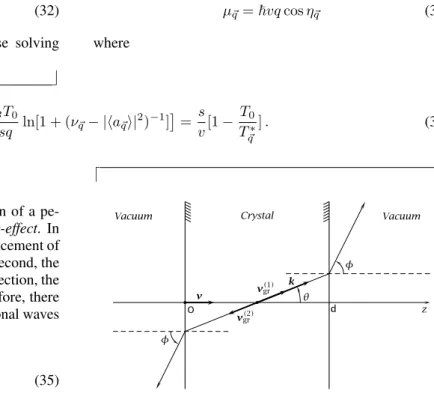
only on the modulus of~q, there follows two Cherenkov-like privileged directions of emission of~q-mode phonons, one forward and one backwards, like the normal and anomalous Cherenkov cones in radiation theory as illustrated in Fig. 9 adapted from [53]. In the present case both directions are symmetrical on both sides of the centre defined at each time by the position occupied by the soliton. This may account for the observed so-called X-waves [1, 56, 3]. In Fig. 12 is illustrated the cases of propagation of the normal sound wave (upper figure) and of the, presumably, solitary wave-packet selectively excited by the transducer (lower figure) with velocity larger than the sound velocity in the medium. The figure has appeared in [3]. Given the angleη~q(called the
axicon angle in [1]), thenvis larger thansin the percentage
[(v/cosη~q)−s]/v. Same arguments are valid for the case
of the optical soliton, when∇~qω~q (the group velocity of the
normal mode) enters in place ofs. In the case of Fig. 12, a rough estimate givesη ∼ 13◦andv
s/s ∼ 1.02, that is,
the velocity of propagation of the soliton,v, is roughly 2% larger than the velocity of sound in the medium.
3
Concluding remarks
We have considered the propagation of vibronic excitations in nonlinear condensed matter media, like biological mate-rial. Because of the nonlinearities in the kinetic equations that describe the evolution of the macroscopic collective modes (nonlinearities having their origin in the microscopic
z v
Vacuum Crystal Vacuum
O d
φ
φ
θ
k vgr(1)
vgr(2)
Figure 11. The direction of propagation of the waves of Cherenkov radiation, when spatial dispersion is taken into account, for the or-dinary wave (subscript 1) and the anomalous wave (subscript 2) (Adapted from Ref. [53]).
Figure 12. Normal sound propagation (upper figure), and the exci-tation interpreted as a supersonic soliton (lower figure); from ref-erence [3] (We thank W. A. Rodrigues and J. E. Maiorino for pro-viding us with a postscript file of this picture).
anharmonic interactions between the system and the sur-roundings) it is expected that complex behavior shall arise.
amplitude, velocity, and frequency of the solitary wave are determined by the initial and boundary conditions. Another phenomenon, arising out of the same nonlinearities that al-lows for the creation of the soliton, consists in that, under conditions of excitation which lead the system sufficiently away from equilibrium, there follows a large increase of the population of the modes lowest in frequency. This effect has a reminiscence of a Bose-Einstein condensation but here in nonequilibrium conditions, and we have termed itFr¨ohlich effect.
A third phenomenon consists in that, and again because of the nonlinearities which are responsible for both, Fr¨ohlich effect and formation of a Schr¨odinger-Davydov soliton, the latter acquires a very long lifetime, that is, the soliton be-comes nearly undamped, when travelling in the Fr¨ohlich-Bose-Einstein-like condensate.
Finally, the fourth phenomenon refers to a situation when, because of appropriate initial and boundary condi-tions, the soliton travels with a speed larger than that of the normal vibronic modes. In this case, as shown, there follows what can be termed asFr¨ohlich-Cherenkov effect: along two symmetrical privileged directions centered on the position of the soliton, is produced a large number of long wavelengths phonons. This could be the origin of the so-called X-waves observed in experiments of ultrasonography, as noticed in previous sections.
We conclude with the remark that solitary waves appear to be ubiquitous, and having large relevance in a number of important situations. Some at the technological level, like propagation in optical fibers (e.g., in a projected trans-Atlantic cable), in conducting polymers (for electric-car bat-teries; microcircuits; etc.), and the case of biological sys-tems (long range propagation of nervous signals; the here mentioned case of medical imaging; etc.).
Acknowledgments
We gratefully acknowledge financial support to our Group, provided in different opportunities by the S˜ao Paulo State Research Foundation (FAPESP), the National Research Council (CNPq), the Ministry of Planning (Finep), Unicamp Foundation (FAEP), IBM Brasil, the John Simon Guggen-heim Memorial Foundation (New York, USA).
Appendix A
The Acoustic Solitary
Wave
In direct space, after the terms that couple the amplitude
ha~qiwith its conjugate are neglected, what, as noticed in
the main text is accomplished using the rotating wave ap-proximation, Eq. (14) takes the form:
⌋
i~∂
∂tψ(x, t) =−i
X
q
~ω~q
Z dx′
L e
iq(x−x′)
ψ(x′, t)−i~X
~ q
Γ~q
Z dx′
L e
iq(x−x′) ψ(x′, t)
+X
q1q2
R~q1~q2
Z dx′
L
Z dx′′
L e
iq1(x−x′)eiq2(x−x′′)ψ(x′, t)ψ(x′′, t)ψ∗(x, t), (A.1)
⌈
where, we recall,ω~q =sq. Considering that it is expected
the formation of a highly localized packet (the soliton), cen-tered in point x and with a Gaussian-like profile with a width, say, w(fixed by the initial condition of excitation) extending along a certain large number of lattice parameter a(i.e.w≫a), in Eq. (A.1) we make the expansion
ψ(x′, t)≈ψ(x, t)−ξ ∂
∂xψ(x, t), (A.2) whereξ = x−x′ is roughly restricted to be smaller or
at most of the order of w. The first term on the right of Eq. (A.1) is
⌋
iX
q
s|q|
Z dx′
L e
iq(x−x′) ψ(x′, t)
=−Ls
2π ∂ ∂x
Z πa
0
dq
Z L
0
dx′
L
h
eiq(x−x′)
−eiq(x−x′)i ψ(x′, t)
≈ −is
π ∂ ∂x
Z πa
0
dq
Z x+w/2
x−w/2
dξ sin(qξ)
·
ψ(x, t)−ξ ∂ ∂xψ(x, t)
¸
= is
π ∂ ∂x
£ Z x+12w
x−1 2w
(1−cosπ
aξ) dξ
ξ
¤
+is
π
£ Z x+12w
x−1 2w
(1−cosπ
aξ) dξ
ξ
¤ ∂
∂xψ(x, t)
−is
π
" Z x+12w
x−1 2w
(1−cosπ
aξ)dξ
#
∂ ∂xψ(x, t)
−is
π
" Z x+12w
x−1 2w
(1−cosπ
aξ)dξ
#
∂2
∂x2ψ(x, t). (A.3)
⌈
But, of the four terms after the last equal sign in this Eq. (A.3), the second and third are null, because of the
Ansatzthat a soliton would follow, since the derivative at the center of the packet is null. Consider now the last term, which after the integrations are performed becomes
−isw
π
£
1− 2a
πwsin π a
w
2 cos
π ax
¤ ∂
2
∂x2ψ(x, t). (A.4)
But, we notice that the width of the packet isw≫a, and the cosine in Eq. (A.4) has a period2a, and then it oscillates very many times inw, and with amplitude(2a/πw) ≪ 1, and can be neglected. Similarly, the first term becomes pro-portional to
⌋
is
π
ψ(x)
x2−(w/2)2
n
wh1−cos³πx
a
´
cos³πw 2a
´i
−2xsin³πx
a
´
sin³πw 2a
´o
, (A.5)
⌈
where, on the one hand, the oscillatory terms cancel on av-erage, and, on the other hand, the term decays asx−2.
Con-sequently, using these results in Eq. (A.1), after introducing the notation(~sw/π)≡~2/(2Ms), and the local approxi-mation in the second and third term on the right of Eq. (A.1), we find Eq. 23.
References
[1] J. Lu and J. F. Greenleaf, Nondiffracting X-waves, IEEE Trans. Ultrason. Ferroelect. Freq. Contr.39, 19 (1992).
[2] J. Lu and J. F. Greeleaf, Experimental Verification of Non-diffracting X-waves, IEEE Trans. Ultrason. Ferroelect. Freq. Contr.39, 441 (1992).
[3] W. A. Rodrigues and J. Lu, On the Existence of Undistorted Progressive Waves, Found. Phys.27, 435 (1997).
[4] A. Scott, F. Chu, and S. McLaughlin, The Soliton: A New Concept in Applied Science, Proc. IEEE61, 1443 (1973).
[5] J. Scott-Russel, Report on Waves, Proc. Roy. Soc. Edin-burgh, 319 (1844).
[6] A. C. Scott, The Solitary Wave, The Sciences (NYAS)30(2), 28 (1990).
[7] T. Beardsley, Plastic Power, Scientific American276(4), 39 (1997).
[8] A. J. Heger, S. Kivelson, J. R. Schrieffer, and W. P. Su, Solitons in Conducting Polymers, Rev. Mod. Phys.60, 781 (1988).
[9] T. Anderson and S. Roth, Conducting Polymers: Electrical Transport and Current Applications, Braz. J. Phys.24(3), 746 (1994).
[10] H. A. Haus, Molding light into solitons, IEEE Spectrum, 48 (March 1993).
[11] A. S. Davydov,Biology and Quantum Mechanics, Pergamon, Oxford, 1982.
[12] A. S. Davydov, Solitons in Biology, inSolitons, edited by S. E. Trullinger, V. E. Zakharov, and V. L. Prokovsky, chap-ter 1, pages 1–51, Elsevier, New York, 1986.
[13] A. C. Scott, Davydov’s Soliton, Phys. Rep217, 1 (1992).
[14] L. S. Garcia-Colin, A. R. Vasconcellos, and R. Luzzi, On Informational Statistical Thermodynamics, J. Non-Equilib. Thermodyn.19, 24 (1994).
[15] A. R. Vasconcellos, R. Luzzi, and L. S. Garcia-Colin, A Microscopic Approach to IrreversibleThermodynamics (I): General Theory, Phys. Rev. A43, 6622 (1991).
[16] A. R. Vasconcellos, R. Luzzi, and L. S. Garcia-Colin, A Microscopic Approach to Irreversible Thermodynamics (II): An Example from Semiconductor Physics, Phys. Rev. A43, 6633 (1991).
[17] M. A. Tenan, A. R. Vasconcellos, and R. Luzzi, Mechano-statistical Foundations for Generalized Nonequilibrium Ther-modynamics, Fortschr. Phys./Prog. Phys.47, 1 (1996).
[19] R. Luzzi, A. R. Vasconcellos, and J. G. Ramos, Statisti-cal Foundations of Irreversible Thermodynamics, Teubner Bertelsmann-Springer, Berlin, 2000.
[20] R. Luzzi, A. R. Vasconcellos, and J. G. Ramos, Predictive Statistical Mechanics: A Nonequilibrium Ensemble Formal-ism, Kluwer Academic, Dordrecht, 2002.
[21] D. N. Zubarev, Nonequilibrium Statistical Thermodynam-ics, Consultants Bureau, New York, 1974, [Neravnoves-naia Statisticheskaia Termodinamika (Izd. Nauka, Moscow, 1971)].
[22] R. Luzzi and A. R. Vasconcellos, On the Nonequilibrium Sta-tistical Operator Method, Fortschr. Phys./Prog. Phys.38, 887 (1990).
[23] J. G. Ramos, A. R. Vasconcellos, and R. Luzzi, A Classical Approach in Predictive Statistical Mechanics: A Generalized Boltzmann Formalism, Fortschr. Phys./Prog. Phys.43, 265 (1995).
[24] L. Lauck, A. R. Vasconcellos, and R. Luzzi, A Nonlinear Quantum Transport Theory, Physica A168, 789 (1990).
[25] A. I. Akhiezer and S. V. Peletminskii, Methods of Statistical Physics, Pergamon, Oxford, 1981.
[26] A. C. Algarte, A. R. Vasconcellos, and R. Luzzi, Kinetic of Hot Elementary Excitations in Photoexcited Polar Semicon-ductors, Phys. Stat. Sol. (b)173, 487 (1992).
[27] M. V. Mesquita, A. R. Vasconcellos, and R. Luzzi, Selective Amplification of Coherent Polar Vibrations in Biopolymers, Phys. Rev. E48, 4049 (1993).
[28] M. V. Mesquita, A. R. Vasconcellos, and R. Luzzi, Near-dissipationless Coherent Excitations in Biosystems, Int. J. Quantum Chem60, 689 (1996).
[29] R. Luzzi, M. A. Scarparo, J. G. Ramos, A. R. Vasconcellos, M. L. Barros, Z. Zhiayo, and A. Kiel, Informational Statis-tical Thermodynamics and Thermal Laser Stereolithography, J. Non-Equilib. Thermodyn.22, 197 (1997).
[30] A. R. Vasconcellos, M. V. Mesquita, and R. Luzzi, Solitary Wave Excitation in Acetanilide, Phys. Rev. Lett. 80, 2008 (1998).
[31] S. A. Hassan, A. R. Vasconcellos, and R. Luzzi, The informational-statistical-entropy operator in a nonequilib-rium ensemble formalism, Physica A262, 359 (1999).
[32] V. P. Kalashnikov, Equations of Motion, Green’s Functions, and Thermodynamic Relations in Theories of Linear Relax-ation, Theor. Math. Phys.35, 362 (1978).
[33] K. Walyazek, D. N. Zubarev, and A. Z. Kuzemskii, Schr¨odinger-type equation with damping for a dynamical system in a thermal bath, Theor. Math. Phys.5, 1150 (1971). [34] H. Fr¨ohlich, Long Range Coherence and the Action of
En-zymes, Nature228, 1093 (1970).
[35] H. Fr¨ohlich, The Biological Effects of Microwaves and Re-lated Questions, in Advances in Electronics and Electron Physics, volume 17, pages 85–152, Academic Press, New York, 1980.
[36] H. Haken, Handbuch der Physik XXV/2C, Springer, Berlin, 1970.
[37] V. E. Zakharov, The Inverse Scattering Method, inSolitons, edited by R. K. Bullough and P. J. Caudrey, chapter 7, pages 243–285, Springer, Berlin, 1980.
[38] G. Careri, U. Buotempo, R. Carta, E. Gratton, and A. C. Scott, Infrared Absorption in Acetanilide by Solitons, Phys. Rev. Lett.51(4), 304 (1983).
[39] J. L. Sauvajol, R. Almaraic, J. Moret, M. Barthes, and J. L. Ribet, Temperature Dependence of the Raman spectrum of fully deuterated acetanilide, J. Raman Spectrosc. 20, 517 (1989).
[40] G. Careri and E. Gratton, Fine Structure of the Amide I Band in Acetanilide, Phys. Rev. A37(10), 4048 (1988).
[41] M. Sakai, N. Kuroda, and Y. Nishima, High-pressure Raman Study of Vibrational Spectra in Crystalline Acetanilide, Phys. Rev. B47(1), 150 (1993).
[42] M. Barthes, R. Almaraic, J. L. Sauvajol, , R. Currat, J. Moret, and J. L. Ribet, Neutron scattering investigation of deuterated crystalline acetanilide, Europhys. Lett.7, 55 (1988).
[43] M. Barthes, J. Eckert, S. W. Johnson, J. Moret, B. I. Swan-son, and C. J. Unjeker, Anomalous Vibrational Modes in acetanilide as studied by inelastic neutron scattering, J. Phys. I France2, 1929 (1992).
[44] R. Luzzi and A. R. Vasconcellos, Response Function The-ory for Far-from-Equilibrium Systems, J. Stat. Phys.23, 539 (1980).
[45] V. P. Kalashnikov, Response to a Mechanical Perturbation and the Green’s Functions for Nonequilibrium Systems, So-viet Phys.-Usp.9, 94 (1971).
[46] M. V. Mesquita, A. R. Vasconcellos, and R. Luzzi, Solitons in highly excited matter: Dissipative thermodynamics and su-personic effects, Phys. Rev. E58(6), 7913 (1998).
[47] I. Prigogine, Structure, Dissipation, and Life, inFrom The-oretical Physics to Biology, edited by M. Marois, North Hol-land, Amsterdam, 1969.
[48] G. Nicolis and I. Prigogine,Self-organization in Nonequilib-rium Systems, Wiley-Interscience, New York, 1977.
[49] R. Luzzi and A. R. Vasconcellos, Dissipation and Order in Complex Systems: An overview, Ciˆencia e Cultura43, 423 (1992), A publication of the Brazilian Society for the Ad-vancement of Science.
[50] J. M. Ziman, Electrons and Phonons, Clarendon, Oxford, l960.
[51] L. D. Landau and E. M. Lifshitz,Electrodynamics of Contin-uous Media, Pergamon, Oxford, 1960.
[52] V. L. Ginsburg, Certain Theoretical Aspects of Radiation due to Superluminal Motion in a Medium, Physics-Uspekhi 2, 874 (1960).
[53] V. M. Agranovich and V. L. Ginsburg, Spatial Disper-sion in Crystal Optics and the Theory of Excitons, Wiley-Interscience, London, 1966.
[54] P. Kocevar, Hot phonon dynamics, Physica B34, 155 (1985).
[55] P. T. Landsberg, Photons at non-zero chemical potential, J. Phys. C: Solid State Phys.14, L1025 (1981).
![Figure 1. Optical vibrations: The IR absorption spectrum in ac- ac-etanilide at 80 K. Points are from the experimental data reported in [38], and the full line the calculation after Eq](https://thumb-eu.123doks.com/thumbv2/123dok_br/18980839.456966/3.892.142.371.131.436/optical-vibrations-absorption-spectrum-etanilide-experimental-reported-calculation.webp)