0103 - 5053 $6.00+0.00
Article
* e-mail: [email protected]
2-Mercaptobenzoxazole Pentacyanoferrate(II/III) Complexes: UV-Visible, Mössbauer,
Electron Paramagnetic Resonance, Electrochemistry and Molecular Modeling
Juciane B. Luiza, Fabiano M. de Andradea, Eduardo L. de Sáa, Geraldo R. Friedermanna, Antonio S. Mangricha, J. Elaine Barclayb, David J. Evansb, Tai Hasegawac and Fábio S. Nunes*,a
a
Departamento de Química, Universidade Federal do Paraná, Centro Politécnico, CP 19081, 81531-990 Curitiba - PR, Brazil
b
Department of Biological Chemistry, John Innes Centre, Norwich Research Park, Norwich NR4 7UH, UK
c
Henry Taube Institute, 897 Embarcadero Road, Palo Alto, CA 94303, USA
Os complexos 2-mercaptobenzoxazol pentacianoferrato(II/III), [FeII/III(CN) 5(bzoxs)]
3-/2-, foram
preparados em solução (mistura MeOH/H2O 75:25%) e caracterizados por técnicas espectroscópicas UV-Vis, Mössbauer, ressonância paramagnérica eletrônica (epr) e eletroquímica-voltametria cíclica. Os espectros de absorção no UV-Vis e de epr, juntamente com o comportamento eletroquímico sugeriram a coordenação do ligante polifuncional N,S,O-doador, bzoxs, através do átomo de enxofre ao íon de ferro(III). Os parâmetros de campo cristalino (DqL e Dt) calculados para o complexo de ferro(II) e a reversibilidade do processo redox: FeIII-bzoxs + e-→ FeII-bzoxs, também apontaram
para a coordenação de bzoxs via átomo de enxofre. Os resultados foram complementados pelo estudo comparativo das propriedades de complexos pentacianoferrato contendo outros ligantes monodentados N-, S- eO-doadores. Cálculos em nível ab initio fornecem a composição dos orbitais de fronteira do ligante bzoxs e estão de acordo com o modo de ligação proposto a partir dos resultados experimentais.
2-Mercaptobenzoxazole pentacyanoferrate(II/III) complexes, [FeII/III(CN) 5(bzoxs)]
3-/2-, were
prepared in MeOH/H2O 75:25% solutions and characterized by spectroscopic UV-Vis, Mössbauer, electron paramagnetic resonance (epr) and electrochemical-cyclic voltammetry- techniques. UV-Vis and epr spectra along with the electrochemical behavior suggested the coordination of the multi-functional N,S,O- donor ligand, bzoxs, to iron(III) through the sulfur atom. The crystal field parameters, DqL and Dt, calculated for the iron(II) complex, in addition to the reversible redox process FeIII-bzoxs
+ e-→ FeII-bzoxs also pointed to coordination via the sulfur atom. The results were compared with
the chemical properties of pentacyanoferrate complexes containing other monodentate N-, S- and
O-donor ligands. Ab initio calculations revealed the composition of the frontier orbitals of bzoxs and are in agreement with the mode of coordination proposed from the experimental data.
Keywords:2-mercaptobenzoxazole, pentacyanoferrate, spectroscopy, crystal field parameters,
ab initio calculations, electrochemistry
Introduction
Substituted pentacyanoferrate(II/III) complexes, [Fe(CN)5L]n-, have been studied extensively over the past
decades.1 These low-spin complexes are useful synthetic
models for biological systems and have been used to probe specific binding sites in amino acids,2 multi-functional
ligands3 and redox metalloproteins.4
The coordination of 2-mercaptobenzoxazole (bzoxs)
to transition-metal ions is of special interest because of the efficiency of this ligand as a corrosion inhibitor,an important regulator of plant growth, showing a marked bacteriostatic and fungicidal activity.5 Proteins containing
thiol groups that undergo nitrosation may modulate cellular functions and thiolate-complexes such as the [Fe(CN)5N(O)SR]3- (SR = mercaptosuccinate) have been
investigated for possible in situ generation of biologically important NO species.6 Bzoxs is structurally related to
biological important bases, having more than one donor atom to bind transition-metal ions (Scheme 1).7 Both in
tautomer with the protonated N-atom.7,8 Most of the
electron density of the oxygen is in resonance with the aromatic ring making it a poor donor atom. Although S↔N linkage isomerism in bzoxs complexes is possible, no evidence has ever been published. Previous reports focused on the iron(II) form of the pentacyanoferrate ion, [FeII(CN)
5L]
n-, with little effort devoted to the
characterization of the oxidised form.9,10 We have now
observed that bzoxs reacts with [FeII(CN) 5(H2O)]
3- and
[FeIII(CN) 5(H2O)]
2- giving solutions which are yellow and
green, respectively. The complexes were characterized in detail by UV-Vis, epr, Mössbauer, cyclic voltammetry and theoretical calculations.
Experimental
Materials
Na3[Fe(CN)5(NH3)]·3H2O (20 g) was prepared from sodium nitroprusside by a standard procedure.11 It was
recrystallized three times by saturating an aqueous solution containing 3 mol L-1 NH
3, at room temperature,
and cooling overnight at –15 oC. The pure solid was
collected on a filter, washed many times with 90% ethanol and dried under vacuum. The yellow product was stored in the dark at –15 oC. Anal. Calcd. for Na
3[Fe(CN)5
(NH3)]·3H2O: C, 18.4; H, 2.8; N, 25.8 %. Found C, 18.0; H, 2.1; N, 24.6 %.
The high purity of bzoxs (Aldrich) was confirmed by elemental analysis. Calcd. for C7H5NOS: C, 55.6; H, 3.3; N, 9.3 %. Found C, 56.1; H, 3.3; N, 8.9 %. 2-merpatopyri-dine N-oxide (shpyNO) and benzoxazole (bzox) both Aldrich grade reagents were used as supplied.
Solutions of the aquopentacyanoferrate(II) complex were always freshly prepared, using Schlenk techniques, by dissolving Na3[Fe(CN)5(NH3)]·3H2O in nitrogen-saturated water. The mixture with a methanolic solution of bzoxs yielded final MeOH/H2O (75:25%) solutions with total iron concentration usually smaller than 10-4 mol L-1,
except for the cyclic voltammetry measurements (see below) and a ligand to iron ratio of ca. 20-40 times.
Solutions of the aquopentacyanoferrate(III) complex were freshly prepared by oxidizing [FeII(CN)
5(H2O)]
3-(obtained from the aquation of [FeII(CN) 5(NH3)]
2-) with
PbO2 in nitrogen-saturated water. After removal of the excess of PbO2, it was mixed with a methanolic solution of bzoxs affording a clear deep-green solution.
Measurements
Electronic spectrain the UV-Vis range (190-820 nm) were obtained on a Hewlett-Packard Model 8452A diode-array or on a Shimadzu 2401-PC spectrophotometer in MeOH/H2O (75:25%) solutions.
Infrared spectra were obtained with a Bomen Hartmann & Braun MB series spectrophotometer in the region 4000-400 cm-1 as nujol mulls spread on KBr windows.
Determination of pKa values of 2-mercaptobenzoxazole were done by spectrophotometry with an acid-base titration of an aqueous solution of the ligand (1x10⁻⁵ mol L-1 ) at
0.10 mol L-1 KCl. The experimental results for a single
titration was expressed by the classical Henderson-Hasselbach equation: pH = pKa – log([HL+]/[L]), where
[HL+] and [L] are the equilibrium concentrations of the
protonated and deprotonated species, respectively. A plot of pH vs log([HL+]/[L]) gives a straight line with slope
close to unity. The pH values of the solutions were measured using a VWR Scientific pH meter Model 34100-632 with a combined glass electrode.
X-band electron paramagnetic resonance (epr) spectra were recorded on a Bruker ESP300-E instrument from frozen MeOH/H2O (75:25%) solutions (1x10⁻² mol L-1) at
77 K.
Mössbauer data were recorded from frozen MeOH/H2O (75:25%) solutions at 77 K using an ES-Technology MS105 spectrometer with a 25 mCi 57Co source in a
rhodium matrix. Spectra were referenced against iron foil at 298 K.
Cyclic voltammetry was carried out with a Princeton Applied Research Potentiostat model 273A. A platinum disc electrode was employed for the measurements at I =
0.5 mol L-1 kept constant with TBABF
4
(tetrabutylammonium tetrafluoroborate). A Ag/AgNO3 ([Ag+] = 0.01 mol L-1 in an MeCN solution of TBABF
4 0.1
mol L-1) along with a platinum wire were used as reference
and auxiliary electrodes, respectively. Typical experiments were conducted with a 2.5x10⁻³ mol L-1 complex
concentration in MeOH/H2O (75:25%) solutions at ambient temperature.
Molecular modeling were carried out for 2-mercaptobenzoxazole in both the thione and thiol tautomers. Ab initio calculations using Hartree-Fock method and bases 6-311(d,f) were done using the Gaussian 94 program running under the UNIX FreeBSD 2.1.5 operational system in a personal computer.
Results and Discussion
Molecular modeling of bzoxs
The calculated energy for the thione tautomer is -2.09x10⁶ kJ mol-1, 28.3 kJ mol-1 more stable than the thiol
form. This is in accordance with the large N-H stretching band at 3257 cm-1 and the absence of the band at ca.
2500 cm-1 typical of S-H stretching. The dominance of the
thione in polar solvents such as methanol, as proved by
15N and 13C experiments,8 agrees with the dipole moment
of 6.47 D calculated for bzoxs in this work against 0.79 D found for the thiol form.
The composition of HOMO showed a major contribution of sulfur and nitrogen (S, 0.60; N, 0.50; and O, 0.31 for thione and S, 0.38; N, 0.40; and O, 0.0 for thiol). The smaller difference gap between the energies of the HOMO and LUMO (0.39892 eV for thione versus
0.42349 eV for thiol) shows that the thione is expected to behave as a softer base. The HOMO of thione has a greater contribution from the sulfur atom, suggesting the ability to stabilize soft ions while the LUMO orbital has the necessary π-symmetry to undergo backbonding
interactions with iron(II).
The high negative Mülliken charges of the nitrogen atom in both tautomers (N, -0.52; S, -0.25 for thione and N, -0.44; S, 0.066 for thiol) indicate a harder character when compared with those values for sulfur. This is consistent with the pKa values of 10.50 and5.1 determined for the -NH and –SH groups, respectively, and should stabilize a coordination of nitrogen to the hard iron(III) Lewis acid.
Electronic spectra
The lowest energy band at 706 nm (ε = 2x10³ mol-1 L
cm-1) in the spectrum of [FeIII(CN)
5(bzoxs)]
2- is assigned to
a pπ(S)→dπ(Fe
III) charge transfer transition, which is
responsible for the deep-green color of the complex (Figure 1). Bands of this sort are not observed in the spectra of the NH312 nor in the benzoxazole (bzox) complexes. However
they are prominent in the spectra of pentacyanoferrate(III) complexes containing S-donor ligands such as, thiourea, (595 nm)13 2-mercaptopyridine (670 nm),14
3-mercapto-1,2,4-triazol (693 nm),15 mercaptosuccinate (700 nm),
diethyldithiocarbamate (785 nm)6 and
2-mercaptopyridine-N-oxide (shpyNO) at 736 nm, as seen in Figure 1. The
bands in the 432-362 nm region for the iron(III) spectra of bzoxs, shpyNO and bzox complexes were assigned to a pπ(CN
-)→d
π(Fe
III) charge-transfer as in the
aquopenta-cyanoferrate(III) complex.16 Strong absorptions observed
below 300 nm are due to intra-ligand transitions π→π*.
In [FeII(CN) 5L]
n- (d6) complexes of C
4v symmetry, two
transitions are expected. The first (1A 1 →
1A
2) is orbitally
forbidden with very small extinction coefficient and only has been seen for the nitroprusside (NO+) complex at 330
nm (30.3 kK, ε = 40 L mol- cm-1).17 The second transition
has higher intensity than the first and has been assigned as
1A 1→
1E (1).
18 In contrast to the first transition (which is d xy
→ dx2-y2), the 1A 1→
1E
(1) (dxz, dyz → dz2) transition is
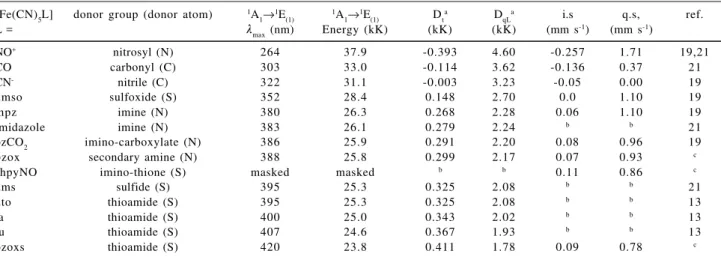
sensitive to the nature of the ligand L and has been reported for a large number of pentacyanoferrate(II) complexes between 264 to 444 nm (Table 1).
Solutions of [FeII(CN) 5(L)]
3- (L = bzoxs and bzox)are
yellow with absorption bands at 356 and 348 nm, respectively, and these are assigned as a dπ(Fe
II)→p
π(L)
transition (Figure 1). A d-d 1A 1→
1E
(1) transition was
tentatively assigned around 420 nm (for bzoxs) and 396 nm (for bzox). The very close proximity of this band with the more intense MLCT band, makes a more accurate attribution difficult. A strong absorption is seen at 230 nm due to a dπ(Fe
II)→p
π(CN
-) charge transfer transition and
overlaps with the π→π* transitions of the ligands L (present
in excess) at 210, 260 and 300 nm. In [FeII(CN)
5(shpyNO)] 3-,
all d-d bands are completely masked by the MLCT band at 434 nm.
Determining the mode of coordination of bzoxs to FeII
is not so simple as for the FeIII-bzoxs system, as revealed by
the electronic spectra. To solve this problem, we determined Dt and DqL based on a standard crystal field analysis.19 The
energies of the d-d transitions are directly proportional to the ligand field strength and the values found suggest a sulfur coordination of bzoxs to iron(II) and are in accordance with other thioamide S-bonded ligands like thioacetamide (ta) and thiourea (tu) 13 (Table 1).
Figure 1. UV-visible spectra of [FeIII/II(CN)
Moving down in Table 1, DqL values decrease as the
σ+π donorcapacities increase. This tendency shows the
smaller ability of the ligands (from top to the bottom) to stabilize the π symmetry orbitals (d
xz and dyz) relative to
that of σ symmetry (d
z2), while Dt>0 indicates that bzoxs
gives axial elongation. The fact that bzoxs is a weak ligand as indicated by the low DqL does not mean the corres-ponding [FeIII/II (CN)
5(bzoxs)]
n- complexes lack stability.
On the contrary, formation constants for both oxidation states have proven that bzoxs is indeed a fair π-acceptor
and an even better σ+π donor.9
Cyclic voltammetry
Cyclic voltammograms of [Fe(CN)5(L)]n- (bzoxs and
bzox) show typical quasi-reversible behavior, consistent with the existence of monomeric species in solution, with formal reduction potentials Ef = 0.190 and 0.284 V versus
SHE, respectively, and assigned to the FeIII→ FeII redox
reaction (Figure 2). Considering the strong resemblance between the structures of the ligands bzoxs and bzox, the small but real difference between the reduction potentials suggests, again, different modes of coordination.
Compared to the high Ef
dmso = 0.85 V vs SHE found for
[FeIII/II(CN)
5(dmso)]
2-/3-,20 (dmso = dimethylsulfoxide) other
thioamide S-bonded ligands (tu = thiourea: Ef = 0.300 V and ta = thioacetamide: 0.405 V vs SHE) also showed low values of reduction potentials.13 Bzoxs behaves as a
moderate π-acceptor as well as a strong σ+π donor ligand,
as it stabilizes both oxidation states of the pentacyanoferrate complexes (KfII
bzoxs = 7.8x10 5 vs K
f III
bzoxs
= 8.6x10⁸ L mol-1).9 The quasi-reversible electrochemical
behavior observed for the redox couple [FeIII/II(CN)
5(bzoxs)]
3-/2- indicates no linkage isomerization
coupled to the redox reaction and is consistent with the iron-sulfur bonding for both FeIII and FeII.
Mössbauer data
The Mössbauer spectra of the [FeII(CN) 5L]
3- complexes
are quadrupole split doublets as already seen in similiar studies.19,21 Table 1 presents isomer shifts (i.s.) and
quadrupole splitting (q.s.) parameters calculated from the spectra, the data are in accordance with low-spin iron(II).19,21
The quadrupole splitting measures the asymmetry of the electric field at the nucleus, the extent of which is closely related to the σ and π metal-ligand bonding and
therefore is sensitive to the nature of the ligand L. According to the data in Table 1, for those complexes which Table 1. Crystal field and Mössbauer parameters of pentacyanoferrate(II) complexes
[Fe(CN)5L] donor group (donor atom) 1A
1→1E(1) 1A1→1E(1) Dta DqLa i.s q.s, ref.
L = λ
max (nm) Energy (kK) (kK) (kK) (mm s-1) (mm s-1)
NO+ nitrosyl (N) 264 37.9 -0.393 4.60 -0.257 1.71 19,21
CO carbonyl (C) 303 33.0 -0.114 3.62 -0.136 0.37 21
CN- nitrile (C) 322 31.1 -0.003 3.23 -0.05 0.00 19
dmso sulfoxide (S) 352 28.4 0.148 2.70 0.0 1.10 19
mpz imine (N) 380 26.3 0.268 2.28 0.06 1.10 19
imidazole imine (N) 383 26.1 0.279 2.24 b b 21
pzCO2 imino-carboxylate (N) 386 25.9 0.291 2.20 0.08 0.96 19
bzox secondary amine (N) 388 25.8 0.299 2.17 0.07 0.93 c
shpyNO imino-thione (S) masked masked b b 0.11 0.86 c
dms sulfide (S) 395 25.3 0.325 2.08 b b 21
dto thioamide (S) 395 25.3 0.325 2.08 b b 13
ta thioamide (S) 400 25.0 0.343 2.02 b b 13
tu thioamide (S) 407 24.6 0.367 1.93 b b 13
bzoxs thioamide (S) 420 23.8 0.411 1.78 0.09 0.78 c
dmso = dimethylsulfoxide; mpz = methylpyrazinium; pzCO2 = pyrazine carboxilate; bzox = benzoxazole; shpyNO = 2-mercaptopyridine N-oxide; dms = dimethylsufide; dto = dithiooxamide; ta = thioacetamide; tu = thiourea; bzoxs = 2-mercaptobenzoxazole; a Calculated according to ref. 19; b Not determined; c This work.
Figure 2. Cyclic voltammograms of [FeIII/II(CN)
5(L)]2-/3- complexes (L = bzoxs and bzox). Conditions: [Fen+]≈2 x10⁻³ mol L-1; excess of L (20 x) in MeOH/H2O (75/25% v/v). I=0.5 mol L-1 (TBABF
show axial elongation (Dt > 0), asymmetry decreases slightly in the order: L = dmso = mpz > pzCO2 > bzox > shpyNO > bzoxs. This is consistent with the ligand spectrochemical series with bzoxs being a better donor than an acceptor.
The isomer shift is also sensitive to the ligand (L)
σ-donor and π-acceptor ability as it changes the electronic
density at the iron nucleus. There is a clear tendency for i.s. values to increase from the top (NO+) to the bottom (bzoxs)
of Table 1, although the data are slightly scattered. This can be easily rationalized when we consider that ligands with
π-acceptor ability remove π-3d electron density from the
iron through a back-bonding mechanism, reducing the shielding of the nucleus and causing an increase of the s
electron density at the metal. This causes a decrease in the isomer shift. The σ ligand-metal bonding, which is more prominent for those ligands at the bottom of Table 1, also has the same effect on i.s. as it increases the 4s population. On the other hand, the increase in i.s. from NO+ to bzoxs
suggests that i.s. depends more on the relative abilities of the ligands to accept π-electrons rather than by their σ-donor properties.
Electron paramagnetic spectra (epr)
The epr spectrum of the benzoxazole complex, [FeIII(CN)
5(bzox)]
2-, at 77 K (Figure 3) shows broad lines
with strong overlapping. A similar behavior was observed for NH3. When L = MeOH/H2O, a typical spectrum of iron in rhombic symmetry is obtained, with g1 = 2.36, g2 = 2.18 and g3 = 1.92. In contrast, the spectra of [FeIII(CN)
5(bzoxs)]
2-and of [FeIII(CN)
5(shpyNO)]
2- are typically axial with
identical g// = 1.96 and g⊥= 2.20 values (Figure 3). These results strengthen our previous conclusion of bzoxs being
coordinated to iron(III) through the sulfur atom, as suggested by the UV-Vis data.
Conclusions
Although the theoretical calculations for bzoxs have indicated some nucleophilic character for the nitrogen atom, the steric relief provided by the sulfur coordination probably provides the driving force responsible for the thermodynamic stability of both the FeII and FeIII
pentacyanoferrate-bzox complexes. Moreover, spectros-copic, electrochemical as well as thermodynamic and kinetic9 data altogether have given strong support for
preferential sulfur coordination.
The following spectrochemical order was obtained: benzoxazole > 2-mercaptopyridine N-oxide >
dimethylsulfide > dithioxamide > thioacetamide > thiourea > 2-mercaptobenzoxazole, consistent with the presence of the thioamide group in bzoxs and also showing that it provides a weak ligand field.
Acknowledgements
This work was supported by Brazilian PRONEX Program (Contract Number 41.96.0884.00), whose help we gratefully acknowledge. We thank Prof. Henrique Eisi Toma (Institute of Chemistry – USP, Brasil) and Prof. Carlos J. da Cunha (DQ-UFPR, Brasil) for the valuable suggestions. J.E.B and D.J.E thank the Biotechnology and Biological Sciences Research Council, UK for funding. J.B.L thanks UFPR and Brazilian Research Council (CAPES) for a research fellowship.
References
1. Baraldo, L. M.; Forlano, P. F.; Parise, A. R.; Slep, L. D.; Olabe,
J. A.; Coord. Chem. Rev.2001, 219-221, 881; Sieklucka, B.;
Proc. React. Kinet. Mec. 1999, 24, 165; Burguess, J. In
Mecha-nisms of Inorganic and Organometallic Reaction; Twigg, M.V.,
ed., Plenum: New York, 1994, p. 155.
2. Toma, H. E.; Batista, A. A.; Gray, H. B.; J. Am. Chem. Soc.
1982, 104, 7509.
3. Toma, H. E.; Giesbrecht, E.; Espinoza Rojas, R. L.; Can. J.
Chem.1983, 61, 2520; Toma, H. E.; Martins, J. M.; J. Chem.
Soc., Dalton Trans. 1978, 1610; Toma, H. E.; Takayasu, M.;
An. Acad. Bras. Cienc. 1989, 61, 131;
4. Toma, H. E.; Batista, A. A.; J. Inorg. Biochem.1984, 20, 53.
5. Yan, C. W.; Lin, H. C.; Cao, C. N.; Electrochimica Acta2000,
45, 2815; Preti, C.; Tosi, G.; J. Inorg. Nucl. Chem. 1976, 38, 1125; Khanova, L. A.; Merenkova, M. V.; Efremov, B. N.;
Tarashevich, M. R.; Russian J. Electrochem. 1993, 89, 952.
6. Szachowski, K.; Oszajca, J.; Stochel, G.; Stasicka, Z.; J. Chem. Soc., Dalton Trans.1999, 2353.
7. Preti, C.; Tosi, G.; Can. J. Chem. 1976, 54, 85; Preti, C.; Tosi, G.; J. Coord. Chem. 1978, 8, 15; Preti, C.; Tosi, G.; Spectrochim. Acta 1979, 35A, 577; Vicente, J.; Chicote, M. T.;
Herrero, P. G.; Jones, P. G.; J.Chem. Soc., Dalton Trans.
1994, 3183; Vicente, J.; Chicote, M. T.; Rubio, D.; Chem. Ber.
1996, 129, 327; Bandbury, F. A.; Davidson, M. G.; Rai They,
P. R.; Stalke, D.; Snaith, R. J.; J. Chem. Soc., Dalton Trans.
1995, 3139; Preti, C.; Tosi, G.; Can. J. Chem.1977, 55, 1409.
8. Balestero, R. S.; Forkey, D. M.; Russel, J. G.; Magnetic Reson.
Chem.1986, 24, 651
9. Luiz, J. B.; Leigh; G. J.; Nunes, F. S.; Polyhedron2002, 21,
2137.
10. Maciejowska, I.; Stasicka, Z.; Stochel, G.; van Eldik, R.; J.
Chem. Soc., Dalton Trans. 1999, 3643; Stochel, G.; van Eldik, R.; Inorg. Chim. Acta1991, 190, 55; Alshehri, S.; Burguess,
J.; van Eldik, R.; Hubbard, C. D.; Inorg. Chim. Acta 1995,
240, 305; Lin, C. L.; Hung, K.; Yeh, A.; Inorg. Chem.1999,
38, 411; Chen, C. N.; Wu, M. C.; Yeh, A.; Tsai, T. Y. R.; Inorg.
Chim. Acta1998, 267, 81; Toma, H. E.; Chavez-Gil, T. E.;
Spectroscopy Letters1999, 32, 963; Norris, P. R.; Harper, P.
L. S.; Pratt,J. M.; J. Chem. Soc., Dalton. Trans. 1997, 2505;
Almaraz, A. E.; Gentil, L. A.; Baraldo, L. M.; Olabe, J. A.; Inorg. Chem.1996, 35, 7718.
11. Brauer, G.; Handbook of Preparative Inorganic Chemistry,
Academic Press: New York, 2nd ed., 1965, vol. 2, p. 1511.
12. Gale, R.; McCaffery, A. J.; J. Chem. Soc., Dalton Trans. 1973,
1344.
13. Toma, H. E.; Takasugi, M. S.; Polyhedron1982, 1, 429.
14. Toma, H. E.; Nunes, F. S.; Anais do VI Simpósio Brasileiro de
Eletroquímica e Eletroanalítica, Ribeirão Preto-SP,1988.
15. Baran, Y.; Ülgen, A.; Intern. J. Chem. Kinet.1998, 30, 415.
16. Batista, A. A.; PhD Thesis, Universidade de São Paulo, Brazil,
1982.
17. Manoharan, P. T.; Gray, H. B.; J. Am. Chem. Soc. 1965, 87,
3340.
18. Gray, H. B.; Ballhausen, C. J.; J. Chem. Phys.1962, 36, 1151.
19. Toma, H. E.; Giesbrecht, E.; Malin, J. M.; Fluck, E.; Inorg.
Chim. Acta1975, 14, 11.
20. Toma, H. E.; Martins, J. M.; Giesbrecht, E.; Inorg. Chem.
1973, 12, 2084.
21. Borges, S. S. S.; Coelho, A. L.; Moreira, I. S.; Araújo, M. A. B.; Polyhedron1994, 13, 1015.
Received: November 11, 2002
![Figure 1 . UV-visible spectra of [Fe III/II (CN) 5 (L)] 2-/3- complexes, where L = mercaptobenzoxazole (bzoxs), benzoxazole (bzox) and 2-mercaptopyridine-N-oxide (shpyNO).](https://thumb-eu.123doks.com/thumbv2/123dok_br/18990081.460318/3.892.469.813.108.386/figure-visible-spectra-complexes-mercaptobenzoxazole-benzoxazole-mercaptopyridine-shpyno.webp)