Image
Mailing Address: Acácio Fernandes Cardoso •
Serviço de Cardiologia do Hospital Aroldo Tourinho - Av. João XXIII, 1207 - Edgar Pereira -39400-162 - Montes Claros, MG - Brazil E-mail: [email protected]
Manuscript received August 17, 2007; revised manuscript received August 29, 2007; accepted August 29, 2007.
Key words
Chagas cardiomyopathy; desfibrillators implantable; electrodes implanted/adverse effects; Twiddler syndrome.
References
1. Fahraeus T, Hoijer CJ. Early pacemaker twiddler syndrome. Europace. 2003; 5 (3):279-81.
Twiddler Syndrome
Acácio Fernandes Cardoso e Gyovanny Mendes Almeida
Hospital Aroldo Tourinho, Montes Claros, MG - Brazil
A male 32 year old patient with Chagas’s cardiopathy was admitted presenting with ventricular fibrillation reverted after successive electrical defibrillation maneuvers. He was submitted to dual chamber cardioverter defibrillator implantation, and returned asymptomatic thirty days after hospital discharge. The threshold test showed absence of atrioventricular capture with maximum pulse energy.
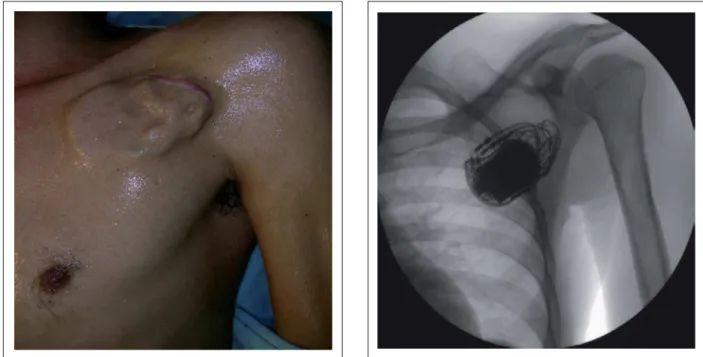
Physical examination revealed irregularities over the generator suggesting displacement of the electrodes (fig. 1). Chest fluoroscopy showed dislodgement of the leads, both grouped around the generator (fig. 2). Rotation of the generator, whether inadvertent or deliberate, resulting in the dislodgement of the electrodes, loss of capture or diaphragmatic stimulation is known as Twiddler Syndrome.
Fig. 1 -Ectoscopy of the chest showing ICD generator implanted in the subcutaneous layer, with an irregular surface suggesting a “ball of yarn” formed by the electrodes enveloping the pulse generator.
Fig. 2 (Fluoroscopy) -Electrode cables (atrial and ventricular) wrapped around the pulse generator (Twiddler Syndrome), completely withdrawn from the heart and venous system.