Unsupported Valvuloplasty for Degenerative Mitral Regurgitation:
Long-Term Results
Alexsandra L. Balbinot1, Renato A. K. Kalil1,2, Paulo R. Prates1, João Ricardo M. Sant’Anna1, Orlando C. Wender1, Guaracy Fernandes Teixeira Filho1, Rogério S. Abrahão1, Ivo A. Nesralla1
Instituto de Cardiologia do Rio Grande do Sul, Fundação Universitária de Cardiologia1, Universidade Federal de Ciências da Saúde de Porto Alegre,
(UFCSPA)2, Porto Alegre, RS - Brazil
Mailing address: Renato A. K. Kalil •
Av. Princesa Isabel, 370 - Santana - 90620-001, Porto Alegre, RS - Brazil E-mail: [email protected]
Manuscript received July 05, 2007; revised manuscript received October 17, 2007; accepted December 3, 2007.
Summary
Background: The advantages of valve repair for treatment of degenerative mitral regurgitation are well established. The procedure is associated with low mortality and morbidity rates, and low indices of reoperation, thromboembolic events and endocarditis have been reported. In most series, annuloplasty rings are implanted, but some institutions give preference to unsupported valvuloplasty.
Objective: To assess the clinical outcome of patients submitted to unsupported valvuloplasty for degenerative mitral regurgitation.
Methods: Between January 1980 and January 2003, 116 patients were submitted to the procedure. A total of 62 (53.4%) were men, and mean age was 47.2 ± 16.5 years. The procedures included: Wooler annuloplasty (65.5%), unilateral annuloplasty (15.5%), quadrangular resection of the posterior leaflet (35.3%), anterior chordal shortening (20.7%), posterior chordal shortening (6.9%), and calcium debridement (0.9%). Mean follow-up was 6.5 ± 5.1 years, and the longest follow-up was 24 years.
Results: Mortality was 0.86% (1 pt) early and 6.03% (7 pt) late. Actuarial survival was 85.3% in 20 years. Most patients (55.2%) presented preoperative NYHA functional class III, whereas class I was more frequent in the postoperative period (66.4%). Thromboembolic complications were observed in 4 patients (3.4%), and no correlation was seen with atrial fibrillation. Freedom from thromboembolic events was 94.8%, and similar results were observed for bacterial endocarditis. Survival free from reoperation was 79%, and 53% at 5 and 10 years, respectively.
Conclusion: Unsupported valvuloplasty is effective and safe for treatment of degenerative mitral regurgitation, representing an adequate therapeutic alternative for selected cases. (Arq Bras Cardiol 2008; 90(6): 363-369)
Key words: Mitral valve; mitral valve/surgery; evaluation studies.
has resulted in better outcomes. Most studies, however, use annuloplasty rings to provide stability and reproducibility to the repair process8-11.
Since 1974, we have been performing unsupported valvuloplasty for mitral regurgitation, initially only in cases of rheumatic disease6 but, during the last decades, also in cases
of degenerative valve disease. Long-term evaluation of patients treated for degenerative mitral disease with unsupported valvuloplasty may provide useful information about the results of this therapeutic approach.
Methods
Patients
This retrospective study included consecutive, non-random cases of degenerative mitral disease treated with unsupported valvuloplasty, between January 1980 and January 2003,
at Instituto de Cardiologia do Rio Grande do Sul/Fundação
Universitária de Cardiologia. In all cases, technical preference was given to valve repair and small residual defects were tolerated, in the sense that the natural valve, even with some
Introduction
Valve repair has become the procedure of choice for mitral disease over the past decades. With the development of technical improvements, around 90% of degenerative mitral valves can be repaired1,2.
Many reports have shown that mitral valve repair is preferable to valve replacement1-4. Lower operative mortality,
better maintenance of left ventricular function and improved survival are reported. Although the procedure may result in a higher frequency of reoperation, the frequency of thromboembolic events and hemorrhages related to the use of anticoagulants and episodes of infectious endocarditis is lower after valve repair than after valve replacement3,5-7.
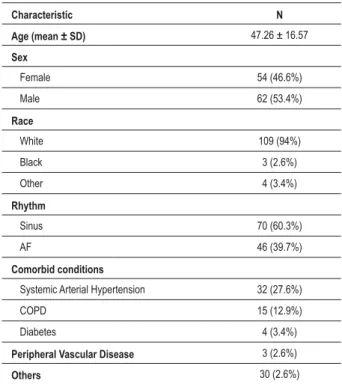
imperfections, is better than mitral prostheses. Patients whose follow-up had been lost, or were treated for mitral disease of other etiologies (rheumatic and congenital), as well as for mitral stenosis, were excluded. The series included 116 patients (mean age, 47.26 ± 16.57 years; 53.4% men). Other patient characteristics are presented in Table 1.
Most of the patients were in New York Heart Association (NYHA) functional class III (Table 2). Annulus dilatation was the most common finding, present in 78.4% of the patients (Table 3). Other types of mitral valve lesions were observed, as shown in Table 3. Procedures used for mitral valve repair included Wooler type annuloplasty12, unilateral annuloplasty,
quadrangular resection of the posterior leaflet, anterior or posterior chordal shortening and calcium debridement (Table 4).
Concomitant procedures included aortic prosthesis in 6 patients (5.1%), Cox-maze procedure13 for atrial fibrillation in
4 (3.4%), tricuspid valve repair in 2 (1.72%), surgical isolation
of pulmonary veins to treat atrial fibrillation14 in 1 (0.86%) and
aortic valve repair in 2 patients (1.72%).
Seventy patients (60.3%) presented sinus rhythm, and the remaining 46 patients (39.7%) presented atrial fibrillation preoperatively. Six patients (5.2%) presented some intraventricular conduction block.
Mean follow-up was 6.5 ± 5.1 years, and the longest follow-up extended to 24 years.
Surgical technique
All patients were operated on through a median sternotomy. Extracorporeal circulation was established by cannulation of the ascending aorta and venae cavae. After establishment of extracorporeal circulation with moderate hypothermia (30 to 32°C), the aorta was clamped and the left atrium was opened for inspection of the cavity and mitral valve. Myocardial protection was provided with cold, crystalloid potassium-induced cardioplegia.
The repair technique more appropriate to each case was selected after identification of the causes of regurgitation. The following isolated or associated abnormalities were observed: prolapse of the anterior and posterior leaflets, rupture of the anterior and posterior chordae, elongated chordae to the anterior and posterior leaflets, calcified mitral annulus and dilated mitral annulus. The techniques employed are described below. After testing for valve competence with saline, the left atrium was closed while body temperature was normalized by
Table 2 -Preoperative NYHA functional classPreoperative NYHA functional class
Functional Class (NYHA) N %
I 7 6.0
II 31 26.7
III 64 55.2
IV 14 12.1
Total 116 100.0
Table 1 -Demographic characteristicsDemographic characteristics
Characteristic N
Age (mean ± SD) 47.26 ± 16.57
Sex
Female 54 (46.6%)
Male 62 (53.4%)
Race
White 109 (94%)
Black 3 (2.6%)
Other 4 (3.4%)
Rhythm
Sinus 70 (60.3%)
AF 46 (39.7%)
Comorbid conditions
Systemic Arterial Hypertension 32 (27.6%)
COPD 15 (12.9%)
Diabetes 4 (3.4%)
Peripheral Vascular Disease 3 (2.6%)
Others 30 (2.6%)
$)DWULDO¿EULOODWLRQ&23'FKURQLFREVWUXFWLYHSXOPRQDU\GLVHDVHRWKHUV VPRNLQJUHQDOIDLOXUH
Table 3 - Mitral valve lesionMitral valve lesion
Mitral Lesion n %
Dilated Annulus 91 78.4
PL Prolapse 40 34.5
AL Prolapse 39 33.6
Rupture of the Posterior Chordae 31 26.7 Rupture of the Anterior Chordae 10 8.6 Elongated Chordae to the AL 18 15.5 Elongated Chordae to the PL 10 8.6
&DOFL¿HG$QQXOXV 6 5.2
3/SRVWHULRUOHDÀHW$/DQWHULRUOHDÀHW
Table 4 -Surgical techniques used for mitral valve repairSurgical techniques used for mitral valve repair
Surgical Technique n (*) % (*)
Wooler Type Annuloplasty 76 65.5 Unilateral Annuloplasty 18 15.5 Quadrangular Resection of the PL 41 35.3 Anterior Chordal Shortening 24 20.7 Posterior Chordal Shortening 8 6.9 Calcium Debridement 1 0.9
extracorporeal circulation. When the aortic clamp was released, allowing coronary reperfusion, the heart beat recovered either spontaneously or by internal cardioversion. Mechanical circulatory assistance was interrupted when nasopharyngeal temperature reached 37oC. The cannulae were then removed, hemostasia was
revised, the mediastinum was drained, pacemaker wires applied on the right ventricular wall and the chest was closed.
Reconstructive procedures
a) Wooler type annuloplasty12
This technique involves plication and suspension of the distended mural leaflet, with stitches close to the commissures. It is based in the fact that annulus dilation is due to widening of the mural leaflet, which has a diffuse and fibromuscular insertion. Insertion of the septal leaflet, on the other hand, is of dense, fibrous tissue, difficult to distend. There is no interference with the width of the septal leaflet. The final diameter of the valve orifice is a function of the size of this leaflet. A suture of 2-0 polyester is used with Teflon felt pledgets, passed through the fibrous annulus and the external region of the mural leaflet.
b) Quadrangular resection
Performed on the prolapsed middle scallop of the posterior leaflet. This technique is usually employed in cases of rupture of the posterior chordae. The affected region is corrected by quadrangular resection, the annulus is plicated and the leaflet edges sewn to one another. In consequence, orifice size is reduced, increasing leaflet free-edge coaptation and restoring valve competence15.
c) Correction of elongated chordae
The defect is corrected by direct suture of the chord, or their cluster, at the tendinous portion of the papillary muscle that is closest to the free margin of the desired leaflet. This is more easily done before annuloplasty, when the region is more exposed6.
Postoperative management
After surgery the patients were taken to the recovery room, receiving intensive care for at least 24 hours. They were discharged from hospital after the fifth postoperative day, and no oral anticoagulant therapy was routinely prescribed except in cases of atrial fibrillation.
Statistical analysis
The results were analyzed in contingency tables and submitted to statistical analysis by the actuarial method for global survival and the actual method for event-free survival curves16
with SPSS (Statistical Package for Social Sciences).Quantitative results were expressed as mean ± standard deviation (SD). The significance level was established at alpha 5% (P < 0.05).
Results
One patient died of pulmonary embolism on the fourth postoperative day, so that immediate mortality was 0.86%. Late
mortality was 10.4 %, with nine deaths in the late postoperative period. Causes of death were ventricular tachyarrhythmia (2 patients), car accident (1 patient), respiratory dysfunction (1 patient), and sudden death of undetermined cause (5 patients). The actuarial survival curve at 10 and 20 years was 92 % and 86.4%, respectively (Figure 1). Since only three of the patients had complete follow-up for 20 years, and nine patients for 15 years, the remaining actuarial and actual curves were estimated for 12 years after surgery.
Clinical outcome
Most of the patients (77, 66.4%) were in functional class I at the last postoperative examination. Fourteen patients (12.1%) were in functional class II, 14 (12.1%) in class III and only one patient (0.9%) was in functional class IV. These results represented significant improvement (P = 0.0001) of functional class (Figure 2).
Figure 1 -/DWHVXUYLYDOFXUYHE\WKHDFWXDULDOPHWKRG.DSODQ0HLHU
n
Thromboembolic complications and heart rhythm
Three patients (2.7%) presented thromboembolic complications in the late postoperative period. Two of them had cerebrovascular and one had pulmonary embolism. One patient presented phlebothrombosis of the left lower extremity. The thromboembolic-free survival rate was 94.8% ± 0.3 at 12 years follow-up. (Figure 3A).
Analysis of postoperative heart rhythm showed atrial fibrillation in 41 patients (35.3%). Only one of them
(2.4%) developed a thromboembolic episode. The three remaining cases of thromboembolism occurred in patients with sinus rhythm. Heart rhythm could not be correlated to the occurrence of thromboembolic events during the late postoperative period in the present study.
Bacterial endocarditis
Four patients (3.4%) had valve bacterial endocarditis in the late postoperative period. Endocarditis-free survival according
to the Kaplan-Meier method was 92.9 ± 0.04 % at 12 years (Figure 3B).
Reoperation
Over 23 years of follow-up, forty of the patients (34.5%) were reoperated, after periods ranging from 21 days to 20.6 years (mean 4.1 ± 4.2 years) from the original procedure. Reoperation included cases of new valve repair or mitral valve replacement. Reoperation-free survival was 79 ± 4% at 5 years and 53 ± 6% at 10 years (Figure 4A), as estimated by the Kaplan-Meier actuarial method (Figure 4B).
When patients were considered separately according to decade (from 1980 to 2000), no differences were observed for reoperation-free survival periods, and more recent series were similar to earlier ones (Figure 4-ABC). During the 1980’s, 29 patients (25.2%) where treated whereas 68 patients (59.1%) had mitral repair in the decade from 1990 to 2000.
Discussion
Mitral valvuloplasty is a safe and effective alternative to valve replacement for management of mitral valve regurgitation. It has been increasingly used, with the development of different techniques, and series with follow-up longer than 20 years are available for analysis17.
Maintaining the normal architecture of the mitral valve is the main objective of valve repair. Preservation of ventricular geometry and of subvalvar structure, decreased need for anticoagulant therapy, optimal long-term function and reduced incidence of endocarditis1,17. The procedure is also
associated to low operative mortality and excellent early and late survival rates18. One study, for instance, showed 71 ±
3% survival at 15 years among 113 patients, treated between 1972 and 19793. In the present study, the number of deaths
was significantly decreased in the immediate (1 case) and late (7 cases) postoperative periods. Although our results included only 9 cases with follow-up longer than 15 years, and 3 longer than 20 years, they show a late survival rate of 85.34% at 20 years.
Although most studies include considerable numbers of patients with atrial fibrillation and receiving anticoagulant therapy, very low prevalence of thromboembolic events after mitral valve repair has been reported9. Advantages
of valve repair without ring support include the absence of prosthetic material, maintaining good hemodynamic improvement. Deloche et al3 observed a
thromboembolism-free rate of 94% ± 2% at 15 years. Galloway et al4 reported
thromboembolism-free rate of 95.2% at 5 years. Four cases (3.5%) of thromboembolic events were observed in the present study, stressing the low prevalence of this complication in association with mitral valve repair. Our results showed a thromboembolism-free rate of 94.84% at 12 years. Despite the high number of patients with atrial fibrillation (46 cases, 39.7%), no correlation between heart rhythm and thromboembolism was observed.
Only 4 cases (3.4%) of infectious endocarditis were observed in the present study, and the endocarditis-free survival rate was 92.9% at 12 years, supporting previous
Figure 4 - $5HRSHUDWLRQIUHHVXUYLYDOUDWHDFFRUGLQJWRWKH.DSODQ0HLHU
PHWKRG%$FFRUGLQJWRWKHDFWXDOPHWKRG&5HRSHUDWLRQIUHHVXUYLYDOUDWH DFFRUGLQJWRWKHGHFDGHLQZKLFKUHSDLUZDVSHUIRUPHGQQXPEHURISDWLHQWV DWULVNLQHDFKLQWHUYDO
reports showing very low risks of infectious endocarditis after valve repair3, 4, 9, 10, 19, 20.
References
1. Enriquez-Sarano M, Schaff HV, Orszulak TA, Tajik AJ, Bailey KR, Frye RL. Valve repair improves the outcome of surgery for mitral regurgitation: a multivariate analysis. Circulation. 1995; 91 (4): 1022-8.
2. Gillinov A, Cosgrove DMI. Mitral valve repair. In: Cohn LH, Edmunds LH Jr. eds. Cardiac surgery in the adult. New York: McGraw-Hill, 2003. p. 933-50.
3. Deloche A, Jebara VA, Relland JY, Chauvaud S, Fabiani JN, Perier P, et al. Valve repair with Carpentier techniques: the second decade. J Thorac Cardiovasc Surg. 1990; 99 (6): 990-1001.
4. Galloway AC, Colvin SB, Baumann FG, Esposito R, Vohra R, Harty S, et al. Long-term results of mitral valve reconstruction with Carpentier techniques in 148 patients with mitral insufficiency. Circulation. 1988; 78: I-97-I105.
5. David TE, Omran A, Armstrong S, Sun Z, Ivanov J. Long-term results of mitral valve repair for myxomatous disease with and without chordal replacement with expanded polytetrafluoroethylene sutures. J Thorac Cardiovasc Surg. 1998; 115 (6):1279-85.
6. Kalil RA, Lucchese FA, Prates PR, Sant’Anna JR, Faes FC, Pereira E, et al. Late outcome of unsupported annuloplasty for rheumatic mitral regurgitation. J Am Coll Cardiol. 1993; 22 (7): 1915-20.
7. Pomerantzeff PMA, Brandão CMA, Faber CN, Fonseca MH, Puig LB, Grinberg M, et al. Plástica da valva mitral: resultados aos 17 anos de experiência. Rev Bras Cir Cardiovasc. 1999; 14 (3): 185-90.
8. Machado VH, Gregory Jr F. Late heart evaluation of children with rheumatic mitral regurgitation submitted to reconstructive surgery with implantation of
Gregori’s ring. Arq Bras Cardiol. 2005; 85 (6): 403-11.
9. Cohn LH, Couper GS, Aranki SF, Rizzo RJ, Kinchla NM, Collins JJ Jr. Long-term results of mitral valve reconstruction for regurgitation of the myxomatous mitral valve. J Thorac Cardiovasc Surg. 1994; 107 (1): 143-50.
10. David TE, Armstrong S, Sun Z, Daniel L. Late results of mitral valve repair for mitral regurgitation due to degenerative disease. Ann Thorac Surg. 1993; 56 (1): 7-12.
11. Fernandez J, Joyce DH, Hirschfeld K, Chen C, Laub GW, Adkins MS, et al. Factors affecting mitral valve reoperation in 317 survivors after mitral valve reconstruction. Ann Thorac Surg. 1992; 54 (3): 440-7.
12. Wooler GH, Nixon PGF, Grinslaw VA, Watson DA. Experience with the repair of the mitral valve in mitral incompetence. Thorax. 1962; 17: 49-57.
13. Cox JL, Jaquiss RD, Schuessler RB, Boineau JP. Modification of the maze procedure for atrial flutter and atrial fibrillation. II. Surgical technique of the maze III procedure. J Thorac Cardiovasc Surg. 1995; 110 (2): 485-95.
14. de Lima GG, Kalil RA, Leiria TL, Hatem DM, Kruse CL, Abrahão R, et al. Randomized study of surgery for patients with permanent atrial fibrillation as a result of mitral valve disease. Ann Thorac Surg. 2004; 77 (6): 2089-94.
15. Nunley DL, Starr A. The evolution of reparative techniques for the mitral valve. Ann Thorac Surg. 1984; 37 (5): 393-7.
16. Grunkemeier GL, Jamieson WRE, Miller DC, Starr A. Actuarial versus actual risk of porcine structural valve deterioration. J Thorac Cardiovasc Surg. 1994; 108: 709-18.
by evaluation with the actual method showed 82% and 50% reoperation-free survival at 5 and 15 years, respectively. When reoperation-free survival rates were compared according to the period in which the surgery was performed, no differences were found for reoperation free survival.
Improvement of functional class is the rule in the postoperative period, and 95% of patients in functional class I and II have been reported during follow-up10. Similar results
were observed in the present study. Most of the patients moved to functional class I and II (66.4% and 12.1%, respectively). In the preoperative period, 55.2% of the patients were in functional class III.
Wooler annuloplasty was the most frequently used technique for valve repair (65.5%). One of the most important technical characteristics of this method is the avoidance of annuloplasty rings. Disadvantages of the insertion of the rings supporting the valve annulus include reduced movement of the ring in systole and diastole, particularly with rigid rings; time spent in insertion, lengthening the time of aortic clamping and duration of myocardial ischemia; increased risk of infection and hemolysis21. Although it has been suggested that annuloplastic
rings help avoid progressive dilation of the valvar annulus and repair failure, the technique of unsupported annuloplasty used for valve repair has been shown to be adequate in avoiding dilation in the postoperative period6,11,21. Annuloplasty rings
have been shown to reduce the area of the mitral valve, and convert an anatomic and functionally bicuspid valve into a functionally monocuspid one, since movement of the posterior leaflet is reduced. Small rings should be avoided, to prevent the development of stenosis10.
In conclusion, these results show that unsupported mitral
valvuloplasty is an accessible and safe method for treatment of degenerative mitral disease. Symptomatic improvement and low levels of thromboembolic and infectious complications validate its use. Reoperations, more frequently needed than with valve replacement, do not affect late survival rates or quality of life of the patients. Avoidance of ring implantation may minimize impairment of annular movement during cardiac cycle. Preference should be given to this method of repair as compared to mechanical prostheses, particularly in younger patients.
Acknowledgements
The authors acknowledge the precious and thorough work of Angelo de Souza and the staff of the Research Unit at the Instituto de Cardiologia do Rio Grande do Sul/Fundação Universitária de Cardiologia.
Potential Conflict of Interest
No potential conflict of interest relevant to this article was reported.
Sources of Funding
There were no external funding sources for this study.
Study Association
17. Savage EB, Ferguson TB Jr., DiSesa VJ. Use of mitral valve repair: analysis of contemporary United States experience reported to the Society of Thoracic Surgeons National Cardiac Database. Ann Thorac Surg. 2003; 75 (3): 820-5.
18. Carpentier A. Cardiac valve surgery - the “French correction”. J Thorac Cardiovasc Surg. 1983; 86 (3): 323-37.
19. Cosgrove DM, Stewart WJ. Mitral valvuloplasty. Curr Probl Cardiol. 1989; 14
(7): 359-415.
20. Kay GL, Aoki A, Zubiate P, Prejean CA Jr., Ruggio JM, Kay JH. Probability of valve repair for pure mitral regurgitation. J Thorac Cardiovasc Surg. 1994; 108 (5): 871-9.