U
SE OF MATERNAL
AND CHILD HEALTH SERVICES AND
IMMUNIZKTION
COVERAGE IN PANAMA
AND GUATEMALA1
Ricburd S. Montez>l~,~ Cbardes K Wan-en,3 Egberto StartzioZa,4 Ricardo Llpex Urxzca,s and Murk It? OberZd
I
NTRODUCTIONNational leaders and health professionals have endorsed the goal of
“health for all by the year 2000" (1). This objective was defined by the Thirti- eth World Health Assembly in 1977 and adopted by the World Health Organiza- tion at the International Conference on Primary Health Care at Alma Ata in 1978. Two of the eight basic components of primary health care identified at the Alma Ata conference that were consid- ered to need worldwide attention were provision of maternal and child health (MCH) services and childhood immuniza- tion against major infectious diseases (2, 3). As a measure of progress toward “health for all by the year 2000” in two
’ This article will also be published in Spanish in the
Boletin de la Oj?cina San&ah Panamericana, Vol.
103, 1987.
2 Program Analyst, Program Evaluation Branch, Divi- sion of Reproductive Health, Center for Health Promo- tion and Education, Centers for Disease Control, At- lanta, Georgia 30333, USA.
3 Demographer, Program Evaluation Branch, Division of Reproductive Health, Center for Health Promotion and Education.
4 Director, Maternal-Child Health, Ministry of Health of Panama.
s Formerly Chief, Division of Maternal and Child Health, Ministry of Health of Guatemala.
G Medical Epidemiologist, Program Evaluation Branch, Division of Reproductive Health, Center for Health Promotion and Education.
Latin American countries, this article dis- cusses the utilization of MCH services and the immunization status of children in Panama and Guatemala.
The rate of progress toward “health for all by the year 2000” will of course vary from country to country. Fac- tors affecting the rate for a given country include the existing health infrastructure and the extent of its coverage, the avail- ability and cost of medications, and how people view the importance of preven- tive care such as MCH services and immu- nization. The rate will also be affected by where each country begins working to- ward the goal, as measured by major health indicators.
For example, a 1984 report (41 indicated that infant mortality was 66 deaths per 1,000 live births in Guate- mala as compared to 25 deaths per 1,000 live births in Panama. The same report stated that life expectancy at birth was 11 years longer in Panama than in Guate-
mala (70 versus 59 years). Also, as of
1983 the total fertility rate in Guatemala
was 5.8 per hundred, with 25 % of the $ currently married women 15 to 44 years
2 2
old using contraception; while in 1984 the total fertility rate in Panama was 3.7 per hundred, with 60% of the currently married women 15 to 44 years old using contraception (‘,6). These differences provide a basis for comparison in discus- sing the use of MCH services and immuni- zation coverage in these two countries.
M
ETHODOLOGYThe analysis presented here is based on two family planning and ma- ternal and child health surveys that were initiated in Guatemala and Panama in
1983 and 1984, respectively (3, 6). These surveys were conducted mainly to esti- mate the extent of contraceptive use and to provide population-based data on the use of MCH services and immunization levels, in order to measure the impact of these in each country. Both surveys were multistage area probability surveys with two-stage selection. The Guatemala sur- vey was conducted by the Asociacidn Pro-Bienestar de 1a.s Familias (APROFAM) and the Panamanian survey by the Min- istry of Health of Panama; in both cases technical assistance was provided by the Division of Reproductive Health, U.S. Centers for Disease Control, Atlanta, Georgia.
In Guatemala, two areas were considered separately-these being the 2
2 Department of Guatemala, which is largely urban, and all of the country’s i
CL other departments, which are collectively 2 referred to in this article as “the interior.” .j$ In the interior, respondents were classi-
u
% 3 fied into two ethnic groups, Ladinos and 2
Indians. Ethnic membership was defined
3
specifically by the language spoken in the home and the type of clothing worn, especially by women. Thus, the respon- dents in Guatemala were divided into 2 three groups-those residing in the De-
partment of Guatemala, Ladino resi- dents of the interior, and Indian resi- dents of the interior. Fieldwork was conducted from September 1983 through January 1984. Completed inter- views were obtained from 3,670 women
15 to 44 years of age of all marital sta- tuses, representing 95% of the selected households that had eligible respon- dents. Individual completion rates ranged from 88% in the Department of Guatemala to 98% in the interior.
Separate consideration was also given to urban and rural areas in the Panama survey, with ethnic membership being defined in a similar fashion to the way it was defined in Guatemala. Thus, the respondents in Panama were also di- vided into three groups-urban dwell- ers, rural Ladinos, and rural Indians. Fieldwork was initiated in July 1984, but numerous administrative delays kept it from being completed until April 1985, five months after the scheduled comple- tion date. Completed interviews were obtained from a total of 8,240 women 15 to 49 years old of all marital statuses, rep- resenting 91% of the selected house- holds that had eligible respondents. The individual completion rate was slightly higher in the rural area than in the urban area (94% versus 88%).
In order to minimize respon- dent recall problems and obtain a cross- section of women’s recent MCH experi- ences, only currently married women 15 to 44 years of age who had delivered their last live baby within five years of the date of interview are included in our analysis of each country. Since the Guatemala survey, unlike the Panama survey, did not include women 45-49 years of age, the 45-49-year age group was excluded from the Panama data for the purpose of this analysis. Both surveys also obtained data on the immunization status of chil- dren less than five years of age. In both countries questions were asked about the number of doses of vaccine received against poliomyelitis, diptheria-pertus- sis-tetanus (DPT), and measles by each child living in the sampled households. However, questions about the number of BCG doses each child had received were asked only in Guatemala.
Panama’s immunization pro- gram functions as a routine service, with no mass campaigns. In general, the Min- istry of Health and the Social Security In- stitute recommend that children have complete primary immunization against tuberculosis shortly after birth, against poliomyelitis, diptheria-tetanus-pertus- sis (DPT) by six months of age, and against measles by 15 months.
The Ministry of Health of Guatemala pursues two activities de- signed to provide complete primary im- munization. One functions as a routine service through clinics, while the second functions through periodic mass cam- paigns. Children vaccinated by the rou- tine service should receive complete pri- mary immunization against polio, DPT, and measles by nine months of age. In
the case of those immunized through the periodic mass campaigns, it is recom- mended that these immunizations be completed by the age of 15 months. Un- der both schemes, the Ministry of Health recommends complete primary immuni- zation against tuberculosis during the first year of life.
RE
SULTSMaternal and Child Health Services
As indicated in Table 1, the percentages of women using MCH ser- vices in Panama and Guatemala were found to differ quite markedly, with a higher percentage of women using them in Panama as compared to a moderate to low percentage of women using them in Guatemala. Nearly two-thirds of the Guatemalan women surveyed reported receiving prenatal care, but only 42 % re- ported taking their last live-born child for a well-baby checkup, and only 26% said they received a postpartum checkup following their last birth. In contrast, be- tween 8 1% and 94 % of the women sur- veyed in Panama were found to be using each of these services.
The data also show consider- able variation among the three groups in each country. In Panama the urban women, followed closely by the rural La- dine women, had the highest percentage of users of MCH services. A similar pat- tern was found in Guatemala, except that lower percentages of interior Ladino women used the services. In both coun- tries the rural (or interior) Indians had the poorest record of MCH service use.
Prenatal cafe. In both countries, use
TABLE 1. Use of MCH services in Panama and Guatemala by survey subjects (currently married women 15 through 44 years old who had delivered their last baby within five years of the intetview- 1984-1985 in Panama and 1983-1984 in Guatemala) grouped according to place of residence, ethnic background, education, employment status, and facifii at which the last baby was deliiered.
% of survey women 15-44 years old using the following services:
Prenatal care Postpartum checkup Well-baby care
Panama Guatemala Panama Guatemala Panama Guatemala
Total 89.4 62.3 81.3 26.1 93.8 42.5
Residence/ethnic’hy:
Urban (Guatemala Department) Rural (Interior): Ladino
Indian
94.7 75.1 88.1 52.3 96.7 74.3 89.1 68.3 78.8 22.6 94.8 43.4 56.4 48.3 52.3 17.8 69.1 25.8
Education: None
Primary incomplete Primary complete
> Primary complete
Employment status: Not working Working at home Working outside home
Place of delivery of last live birth:
Ministry of Heaith facility Social Security facility Integrated hospitala Private hospital Midwife Other
49.5 49.7 48.6 16.5 64.2 29.0 80.1 66.7 67.5 24.8 89.6 43.8 89.6 80.4 81.5 38.1 95.0 61.9 95.9 89.6 88.5 64.0 97.2 82.5
88.9 61.9 80.4 23.8 93.8 40.9 86.3 58.7 78.6 30.8 94.0 42.0 93.5 71.0 87.5 37.8 93.8 55.4
93.6 74.0 87.9 33.8 96.7 97.0 91.2 89.9 72.1 96.4
92.5 - 84.0 - 96.4
100.0 95.0 88.2 82.5 98.7 60.6 53.8 42.7 15.3 78.8 47.5 48.7 35.9 15.3 64.2
58.8 90.6
- 89.0 27.3 41.7
a Only in Panama, a joint Ministry of Health and Social Secunty hospital.
greater among women who were em- ployed outside of the household than among unemployed women or women working out of their homes. The place the last baby was delivered also appeared to be associated with use of prenatal care. Especially in Guatemala, women who had delivered their last babies in a pri- vate or Social Security hospital (indicat- ing higher socioeconomic status) were more likely to seek prenatal care than women who had delivered their last ba- bies elsewhere.
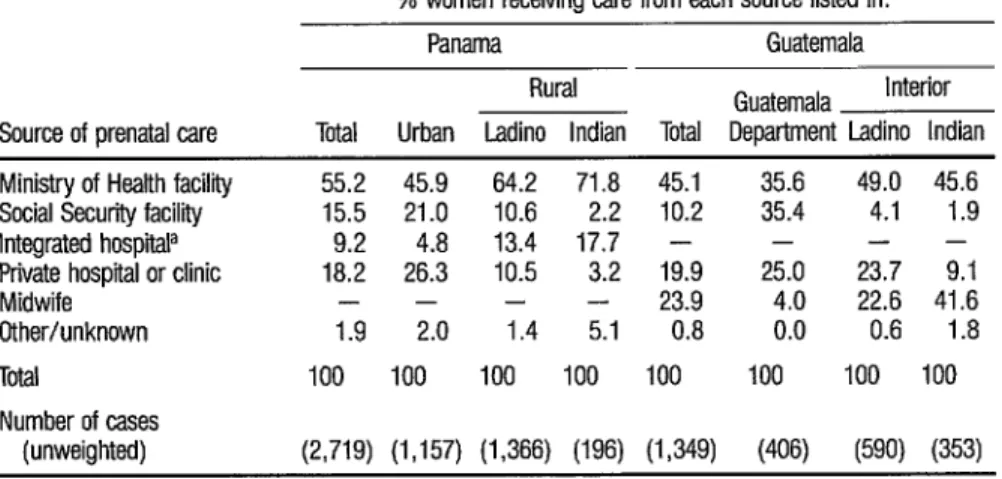
As shown in Table 2, in both countries the Ministry of Health was the
TABLE 2. Sources of the prenatal care used by survey subjects (currentfy married women 15 through 44 years old who had delivered their last baby within five years of the interview).
% women receiving care from each source listed in:
Panama Guatemala
Source of prenatal care
Rural Guatemala Interior
Total Urban Ladino Indian Total Department Ladino Indian
Ministry of Heath facility 55.2 45.9 64.2 71.8 45.1 Social Security facility 15.5 21.0 10.6 2.2 10.2 Integrated hospiiP 9.2 4.8 13.4 17.7 - Private hospital or clinic 18.2 26.3 10.5 3.2 19.9
Midwife _ - - - 23.9
Other/unknown 1.9 2.0 1.4 5.1 0.8
Total 100 100 100 100 100
Number of cases
(unweighted) (2,719) (1,157) (1,366) (196) (1,349)
a Only in Panama, a joint Ministry of Health and Scclal Security hospital.
However, for lack of equipment and training they do not check blood pres- sure or do a urinalysis.) No women in the Panama survey reported receiving prena- tal care from midwives. In the rural areas of Panama and the interior of Guate- mala, the Ministry of Health was the most important provider of prenatal care services. In the urban areas of Panama and in the Department of Guatemala, private facilities and Social Security health facilities were important sources of prenatal care.
Compared to their Guatema- Ian counterparts, women in Panama re- ported receiving their first prenatal checkup relatively soon after conception (Table 3). Table 3 also shows that in both countries women who obtained prenatal care from a private physician or Social Se- curity facility were more likely to seek care during the first three months of pregnancy than were women who ob- tained care elsewhere.
In addition, an analysis of the ages of the women who received prenatal care indicates that young mothers in both countries were more likely to seek
prenatal care for their earlier pregnancies than were older women who had already experienced several pregnancies. It is un- clear whether this represents a tendency to forego prenatal care in later pregnan- cies, or whether it points to an increasing tendency for new mothers to seek prena- tal care.
Well-baby care. As was shown in E-
ble 1,940~ and 43 % of the Panamanian and Guatemalan women, respectively, reported taking their last live-born child for a well-baby checkup. In Guatemala, women living in the Department of Guatemala were 1.7 times more likely to
use well-baby care than interior Ladino women and three times more likely to do so than interior Indian women. In Pan- ama, similar percentages of urban dwell-
35.6 49.0 45.6 35.4 4.1 1.9
- - -
25.0 23.7 9.1 4.0 22.6 41.6 0.0 0.6 1.8
100 100 100
ers and rural Ladinos utilized well-baby care, while a substantially lower percent- age of Indian women did so. In general, education, employment status, and place of the last live birth were important factors in the use of prenatal care and use of well-baby care in both countries.
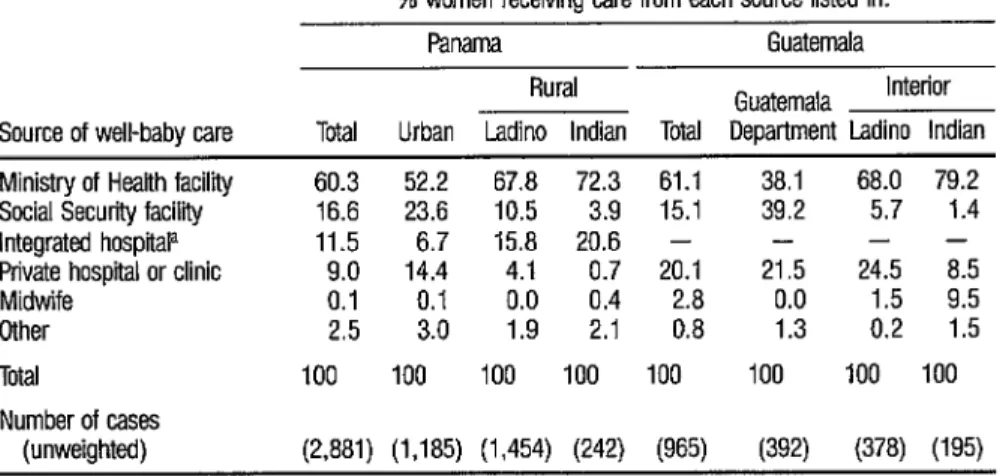
The source of well-baby care also generally corresponded with the source of prenatal care, though as Tables 2 and 4 show, a higher percentage of women in both countries utilized Minis- try of Health facilities for well-baby care than they did for prenatal care. In ad- dition, only 3% of the Guatemalan women who received well-baby care used midwives as the source of that care, even though 24% of those receiving prenatal care obtained it from midwives. Simi- larly, only half as many Panamanian women said they used private hospitals or clinics for their well-baby care com- pared with women who reported using such facilities for their prenatal care.
Postpartum care. In both countries, postpartum care was the least utilized of the three MCH services under discussion. Use of postpartum care varied by resi- dence and ethnic group, with urban (or Department of Guatemala) women hav- ing the highest proportion of users and rural Indians having the lowest (see Table 1). The characteristics of women receiv- ing postpartum care were similar to those of women receiving prenatal care. For ex- ample, use of postpartum care was posi- tively associated with education. Also, in Guatemala the place of the last live birth (a surrogate measure of socioeconomic status) was associated with the use of postpartum care, in that those women who paid and those who were covered by health insurance were more likely than others to use postpartum care.
TABLE 4. Sources of well-baby care used by survey subjects (currently married women 15 through 44 years old who had delivered their last baby within five years of the interview).
% women receiving care from each source listed in:
Source of well-babv care
Panama Guatemala
Rural Guatemala Interior
Total Urban Ladino Indian Tda Department Ladino Indian
Ministry of Health facility 60.3 52.2 67.8 72.3 61.1 38.1 68.0 79.2 Social Security facility 16.6 23.6 10.5 3.9 15.1 39.2 5.7 1.4
Integrated hospitala 11.5 6.7 15.8 20.6 - - - -
Private hospital or clinic 9.0 14.4 4.1 0.7 20.1 21.5 24.5 8.5
Midwife 0.1
$I
0 0 1:9
04
Other 2.5 2:l
2.8 0.0 1.5 9.5 0.8 1.3 0.2 1.5
Total 100 100 100 100 100 100 100 100
Number of cases
(unweighted) (2,881) (1,185) (1,454) (242) (965) (392) (378) (195)
a Only in Panama. a joint Ministry oi Health and Social Security hospital.
high utilization of prenatal services, sug- gests that they viewed prenatal services as being more important. Similarly, the data suggest that although well-baby care may have been considered more im- portant to women in both countries than postpartum care, it was considered less important than prenatal care by the women in Guatemala. Much of the dif- ference between the percentages of women using postpartum and well-baby care in both countries may be due to the fact that health providers in both coun- tries do not always integrate these two services. Our analysis suggests that some women would rather not be bothered with two trips to a health facility, and that well-baby care is more important to them than postpartum care.
AU MCH services. Table 5 shows the percentages of women in both countries using either all three types of MCH ser-
vices or none of them. Over three- fourths of the Panamanian women uti- lized all three services, compared to less than one-fifth of the Guatemalan women. Conversely, 28% of the Guate- malan women said they used no MCH ser- vices, as compared to only 3% of the
Panamanian women. As might have been expected, higher percentages of women living in urban Panama (84 % ) and the Department of Guatemala (44%) reported using all three services, as compared to those living in rural or interior areas. Rural Indians in Pan- ama and interior Indians in Guatemala were the least likely to have used all three services and the most likely to have used none.
TABLE 5. Use of all three MCH services or no MCH services in Panama and Guatemala
by survey subjects (currently married women 15 through 44 years old who had delivered their last baby within ffve years of the interview-1984-1985 in Panama and 1983-1984 in Guatemala)-grouped according to place of residence, ethnic background, education, employment status, and facility at which the last baby was delivered.
% of survey women using:
All three MCH
services No Mcti services
Panama Guatemala Panama Guatemala
Total 76.2 18.5 2.9 28.2
Residence/ethnic’ky:
Urban (Guatemala Department) Rural (interior): Ladino
Indian
84.1 44.0 0.7 10.2
74.0 16.4 1.9 23.6 38.8 8.6 22.8 43.0
Education: None
Primary, incomplete Primary complete > Primary complete
Employment status: Not working Working at home Working outside home
Place of delivery of last live birth:
Ministry of Health facilii Social Security facility Integrated hospiiaP Private hospital Home (midwife) Other
35.1 8.5 29.1 40.4 61 .O 17.6 5.5 23.6
75.2 29.1 1.5 8.6
85.3 57.8 0.4 5.5
74.8 16.7 2.9 28.9 75.8 19.4 3.1 31.5 84.6 30.4 2.8 18.6
83.1 24.2 86.0 64.9 79.2 - 87.6 75.3 33.0 8.1 26.0 9.4
0.1 0.0
ii:: 15.1 26.6
a Only in Panama, a joint Ministry oi Health and Social Security hospital.
midwife during their last delivery (pri- marily rural women) were the least likely to have used all three MCH services.
Figure 1 shows that mothers with relatively few living children in both countries were more likely than higher parity women to have used all three MCH services. In rural Guatemala, however, parity appears to have had little influ- ence on the use of MCH services, as inte- rior Indian mothers were not likely to use these services regardless of their number of living children.
FIGURE 1. The influence of parity upon use of MCH services. The charts show the percentages of survey subjects with one, two, three, four, and five or more living children in Panama (A) and Guatemala (B) who reported using all three kinds of MCH setvlces.
90 90
80 80 t- 70 70 I-
t TOTAL=
60 60 l- & 50
s s !! 2 40
30 20 10
DEPT. OF GUATEMALA
‘. I-
\- -\
-\ -, INDIANS l-
l \
‘N.0 .(
,- 50 40 30 20 10
~-+*---I_._.-
INDIANS -
1 2 3 4 ?5
No. of living children B
1 2 3 4 ?5
TABLE 6. Current use of contraception by survey subjjcts using no MCH services, one or two setvices, or all
three services. (The data shown are for cummtiy married women 15-44 years old who delivered their last baby within tive years of the interview.)
% using contraception in:
Types of MCH services used
Panama Guatemala
Rural
Guatemala Interior Total Urban Ladino Indian Total Department Ladino Indian
None
One or two types All three types Number of ca.ses
(unweighted)
12.6 -a 4.6 12.9 7.9 20.0 14.0 2.2 34.8 43.1 32.6 21.8 19.1 35.8 23.5 4.4 61.8 68.0 57.0 30.1 49.6 65.5 48.8 11.2
(3,110) (1,232) (1,537) (341) (2,145) (538) (855) (752)
use of MCH services and contraceptive use varied by place of residence and ethnic background, but the pattern was similar in both countries. As expected, urban residents in Panama and women living in the Department of Guatemala who used all three MCH services were the most likely to be using contraception. Contra- ceptive use by rural Ladinos in Panama and interior Ladinos in Guatemala was only slightly lower than that of their ur- ban counterparts. In contrast, 30% of the rural Indians in Panama and only
11% of the interior Indians in Guate- mala who used all three services were us- ing contraception.
Place and Type of Last Live Birth
Table 7 shows the place of the last live delivery. The extensive use of midwives in Guatemala relative to Pan- ama (for 58% versus 6% of the deliv- eries) is the most striking difference be- tween the two countries in this regard. In Panama, only rural Indians made fairly extensive use of midwives (for 27 % of
the deliveries), while in Guatemala over half the interior Ladinos and over 80 % of the interior Indians used a midwife for their last delivery.
Women whose last delivery was in a hospital were asked if their most recent delivery was vaginal or cesarean (Table 8). In both Panama and Guate- mala, 16-17 % of these women reported
that their last delivery was cesarean. In both countries, the percentage of women whose last delivery was cesarean was highest for urban (or Department of Guatemala) women, for women who had at least a primary school education, for low-parity women, and for women who delivered in a private hospital. Simi- lar relationships have been found in Bra- zil (7). It is also noteworthy that of the women who had a cesarean, 44 % in Pan- ama and 25 % in Guatemala had a tubal sterilization at the time of delivery.
TABLE 7. The place or type of facilii at which the survey subject’s last baby was delivered. (The data shown are fur currently married women 15-44 years old who delivered their last baby within five years of the infervfaw.)
% using indicated place of delivery in:
Panama Guatemala
Place of last live birth
Rural Guatemala Interior
Total Urban Ladino Indian Total Department Ladino Indian
Ministry of Health facilii Social Securii facility Integrated hospitala Private hospital Home (midwife) DtheP
Total
Number of cases (unweiahted)
38.7 48.9 30.6 20.6 24.2 40.5 30.2 a.5 12.9 20.7 6.5 1.0 6.3 30.2 2.0 0.0
33.2 22.9 45.9 23.7 - - - -
t:
5:3 0’7 5 5
1:3 2.2
8.6 27.3 0.8 57.7 4.1 10.6 15.8 53.2 4.5 84.2 0.3
6.2 26.6 7.7 2.9 10.1 7.0
100 100 100 100 100 100 100 100
(3,110) (1,232) (1,537) (341) (2,145) (548) (855) (752)
TABLE 8. Cesaman deliveries among the survey subjects 15-44 years old whose last deliv- eries occurred in a hospital-by place of residence, ethnic background, education, parity, and the facility where the last lie delivery occurred.
Cesarean deliveries in:
Panama Guatemala
No. of cases No. of cases % (unweighted) % (unweighted)
Total 16.2 w44) 17.1
Residence/ethnic&y:
Urban (Guatemala Department) 18.4 (1,180) la.8 Rural (interior): Ladino 13.5 (1,151) 15.7
Indian 11.4 (113) 16.8
Education:
None 6.5 630) 15.4
Primary, incomplete
Primary complete 129.64
19:7
;;:A{
12.5 20.3
> Primary complete (1,311) 22.6
parity:
1 17.8 W) 22.0
2 22.4 (649) 21.7
3 18.6 (434) 18.8
4-5 6.5 (429) 9.7
6+ 6.9 (287) 8.9
Place of delivery of last iiie birth:
Ministry of Health facilii 15.4
g:;
15.2
Social Security facifii 17.9 18.2
Integrated hospitala 14.5 (1,167) -
Private hospital 31.2 (101) 27.7
a Only in Panama, a joint Ministry of Health and Social Sewity hospital.
(889)
(473) (340) (76)
(173)
[%j
(212)
(207)
(228)
(152) (176)
UN
WJl) VW
(104)
Immunization Coverage
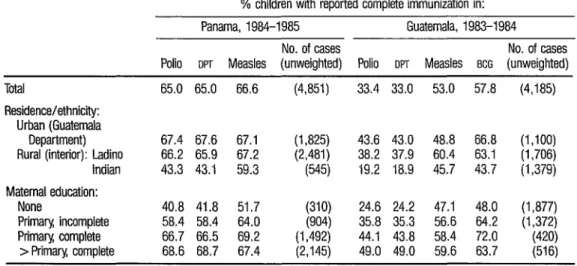
The results shown in Table 9 indicate the immunization coverage of children less than five years old in Pan- ama and Guatemala. In Panama, some two-thirds of the children were reported to have completed immunization for po- lio, DPT, and measles. This relatively high coverage was found in both the ur- ban and the rural Ladino groups; how- ever, coverage of rural Indians was rela- tively low. The percentage of children
with completed immunizations was posi- tively associated with their mother’s edu- cational level, as less than half the chil- dren of mothers with no education were reported to have been covered, while about two-thirds of those whose mothers had at least completed primary school were said to have been covered.
TABLE 9. Percentages of children of the survey mothers who were under five years of age at the time of the interview and who had reportedly received complete immunization against the indicated diseases-by country, maternal residence and ethnic background, and maternal educatton.
% children with reported complete immunization in:
Panama, 1984-1985 Guatemala, 1983-1984
No. of cases No. of cases
Polio om Measles (unweighted) Polio OPT Measles BCG (unweighted) Total
Residencekthnicity: Urban (Guatemala
Department) Rural (interior): Ladino
Indian
Maternal education: None
Primary incomplete Primary complete
> Primary complete
65.0 65.0 66.6 ww 33.4 33.0 53.0 57.8 ww
67.4 67.6 67.1 (1,825) 43.6 43.0 48.8 66.8 (1,100) 66.2 65.9 67.2 (2,481) 38.2 37.9 60.4 63.1 (1,706) 43.3 43.1 59.3 (545) 19.2 18.9 45.7 43.7 (1,379)
40.8 41.8 51.7 (310) 24.6 24.2 47.1 48.0 (1,877) 58.4 58.4 64.0 (904) 35.8 35.3 56.6 64.2 (1,372) 66.7 66.5 69.2 (1,492) 44.1 43.8 58.4 72.0 (420) 68.6 68.7 67.4 (2,145) 49.0 49.0 59.6 63.7 (516)
mala and interior Ladino children. As in Panama, immunization coverage for all the diseases covered by the survey was positively associated with maternal edu- cation.
As indicated in Figure 2, the data show that in both Panama and Gua- temala immunization coverage was strongly related to the child’s age. That is, the largest percentage increase in chil- dren with complete immunization oc- curred from those less than one year old to those one year of age. This was to be expected, since both countries were rec- ommending complete immunization of children by nine months of age.
4 CL s
.,g
D
ISCUSSION ANDP)
* 3 CONCLUSIONS
: In general, the survey results 3
reported here can be compared to fmd- ings from earlier surveys in Panama in 1979 and Guatemala in 1978 (8-10). In Panama, the use of all three MCH services
12 increased by 16 percentage points be-
tween 1979 and 1984, reaching 76% in 1984. Conversely, the percentage of women in Panama who reported not us- ing any MCH service decreased from ap- proximately 7% in 1979 to 3% in 1984. However, immunization coverage in- creased only slightly between the sur- veys. Available data suggest that use of
MCH services and childhood immuniza- tion coverage did not change signifi- cantly in Guatemala during the five years between surveys (5).
This information provides a
useful basis for orienting programs, as- signing resources, and defining goals in each of these countries in pursuing the goal of “health for all by the year 2000.”
For example, the relatively low use of
FIGURE 2. Percentages of survey children less than five years old who reportedty received complete poliomyeliifs, OPT, measles, and (in the case of Guatemala) BCG immunizations, by age of child in (A) Panama and (B) Guatemala.
A ao- 70 - 60 - g - z 50
z 2 p” 40 -
30 - 20 - 10
t
1 I I I I I Cl 1 2 3 4
other hand, the data show that the rate at which MCH services are used is rela- tively high, but that rural Indians do not enjoy the same level of health protection as rural Ladinos, indicating a need to strengthen the preventive health services provided to the Indians.
In general, the Indian popu- lations in both Panama and Guatemala made relatively little use of MCH and im-
munization services. The problem is more severe in Guatemala since over 40% of the population is Indian, whereas less than 10 % of Panama’s pop- ulation is Indian. Why Indians tend not to use MCH services in Guatemala is un- clear, especially since 50 % of all Ministry of Health centers and posts are located in the altiplano where most of the Indian population lives. Chen et al. (11) have
80-
60 -
Age (in years)
MEASLES
suggested that the Indians’ tendency not to use contraceptive services was due in part to their isolation within Guatema- lan society and their cultural resistance to change. It is likely that these factors also influence their acceptance of MCH ser- vices. Clearly, priority should be given in both countries to better serving the MCH
needs of the Indian population.
she will be vaccinated at all. This sug- gests that all MCH services need to stress
the importance of timely immunization before one year of age. Also, in view of the extensive use of midwives in Guate- mala, consideration should be given to training them so that they stress the im- portance of child immunization to the mothers they attend.
Overall, in order to reach the goal of “health for all by the year 2000” it appears that a great deal of work re- mains to be done in Guatemala. Our findings suggest that Guatemala needs to stress both the importance of MCH ser- vices and child immunization. One pos- sible program that might prove useful is an educational program directed toward midwives, since midwives attend over half of all births in Guatemala and the current utilization of MCH services is rela- tively low by women who are attended by midwives. In Panama, the general levels of MCH service use and child im- munization are quite high. For this rea- son the program needs to focus more sharply on specific groups making rela- tively slight use of these services-most notably Indians and rural women of low socioeconomic status.
S
UMMARYTwo surveys designed to assess rA
8 Y the extent to which maternal and child health services were being used in Guate- i
2 mala and Panama were conducted in 2 1983-1984 and 1984-1985, respectively. .g The Panama survey obtained complete
u
a 3 interviews from 8,240 women 15 2
2 3
through 49 years of age, while the Gua- temala survey obtained complete inter- views from 3,670 women 15 through 44 years of age. These surveys were con- ducted principally to estimate the preva- lence of the use of contraception and to provide population-based data on the use of maternal and child health services, including immunization levels, in order to measure program impact in each country. For purposes of this analysis, only women 15 through 44 years of age who were married at the time of the in- terview and who had given birth to a live infant within the preceding five years are included.
A considerably higher per- centage of married women aged 15-44 reported using maternal and child health
(MCH) services in Panama than in Guate-
mala. In both countries a relatively high percentage of women residing in the ur- ban areas said they made use of these ser- vices, while Indian women in both coun- tries reported making relatively little use of them. In addition, associations were found between use of MCH services and maternal education, maternal employ- ment, parity, and the type of facility at which the last baby was delivered. Also, women who used all three types of MCH services were found far more likely to be using contraception than were women who reported using only some or none of these services.
Regarding immunization cov- erage of young children in Panama and Guatemala, the survey data indicated that completed immunization levels were relatively higher in Panama than in Guatemala, and that the degree of cover- age was associated with the mother’s ed- ucation and ethnic background and with the age of the child involved.
need to promote these services and make them universally available, while the ru- ral Panamanian Indians’ relatively low use of these services suggests a need to strengthen the preventive health services available to them.
RE
FERENCESMahler, H. Health for all by the year 2000. K%da’Hea/h, pp. 3-5, February-March, 1981.
Rinehart, W., A. Kols, and S. H. Moore. Healthier mothers and children through fam- ily planning. Poj&ation Reports, Series J (27):65Y-696. The Johns Hopkins University, Baltimore, Maryland, 1984.
Kols, A. J., M. J. Wawer, W. Quillin, and J. Kinsey. Community-based health and family planning. Pop&a&on RepotiJ, Series L (3):77- 111. The Johns Honkins Universitv. Bahi- more, Ma&nd, 1985.
Population Reference Bureau. 1984 Erld Population Data Sheet. Washington, D.C., April 1984.
Monteith, R. S., J. E. Anderson, M. A. Pineda, R. Santiso, and M. Oberle. Contra- ceptive use and fertility in Guatemala. Stlca Fam P/an 16(5):27Y-288, 1985.
6 Warren, C. W., I?. Guerra, M. W. Oberle, R. Bat&a, E. Stanziola., and L. Morris. Changes in contraceptive use m Panama: 1976 to 1984. (Unpublished manuscript, 1986).
7 Janowitt, B., W. Rodrigues, D. L. Covington, J. M. Arruda, and L. Morris. Cesarean Delivery in the Northeast of Brazil. Women in Interna- tional Development Publication Series! Work- ing Paper No. 66. Michigan State Umversity; East Lansing, Michigan, 1984.
8 Monteith, R. S., J. E. Anderson, E Mascarin, and L. Morris. Contraceptive use and fertility in the Republic of Panama. St& Fam Plan 12(10):331-340, 1981.
Y Huezo, C. M., R. S. Monte& H. Naar, and L. Morris. Use of maternal and child health services and immunization coverage in Pan- ama. Bufl Pan Am Heahh Organ 16(4):329- 340, 1982.
10 Asociaci6n Pro-Bienestar de la Familia. En- cuesta nacionaL de fecundida& p/an;fca&n famiL+z~ y comunicaci& de Guatemala, 1978: Primera parte-fecmzu%kd y p/am@z&n fa- m&x Guatemala City, Guatemala, 1980. s