ORIGIN
AL RESEAR
CH
Corresponding author: Raciele Ivandra Guarda Korelo – Universidade Federal do Pará – Department of Physical Therapy Prevention and Rehabilitation – Avenida Coronel Francisco Heráclito dos Santos, 210 – Curitiba (PR), Brazil – CEP 81531-980 – Phone: +41 3361-1799 – E-mail: [email protected] – Financing source: Nothing to declare – Conlict of interest: Nothing to declare – Presentation: Feb. 2016 – Accepted for publication: July 2016. Approved by the Research Ethics Committee of the Federal University of Paraná: Statement 335,941.
1Universidade Federal do Pará (UFPR) Litoral Campus – Matinhos (PR), Brazil.
2Graduate Program in Physical Education, Biological Sciences Campus, Federal Universidade Federal do Paraná (UFPR) – Curitiba (PR),
Brazil.
3Graduate Program in Physical Education, Biological Sciences Campus – Centro de Performance Física – Cepeis, Universidade Federal
do Paraná (UFPR) – Curitiba (PR), Brazil.
4Department of Physical Therapy Prevention and Rehabilitation, Biological Sciences Campus, Universidade Federal do Paraná (UFPR)
– Curitiba (PR), Brazil.
ABSTRACT | Although suring can contribute to chronic low back pain, the relationship between functional/kinetic changes and low back pain are still not fully understood. The association between low back pain and functional/ kinetic aspects was investigated in people who had surfed for diferent numbers of years, in a cross-sectional study involving 66 surfers from the coast of Paraná. The participants were allocated into three groups considering how long they had surfed: G1 (up to 4.9 years), G2 (from 5 to 9.9 years) and G3 (more than 10 years). The following items were evaluated: body mass index; level of physical activity; low back pain; intensity and frequency of low back pain, low back disability, low back function, low back lexibility, low back range of motion, low back and thoracic angles. To analyze the association between functional/ kinetic aspects and low back pain, Pearson’s Qui-Square test was used for categorical data, while for nominal data ANOVA with Bonferroni’s post-hoc test (p<0.05) was used. The group which had surfed the longest (G3) showed an association with the occurrence of low back pain (p=0.05) and its highest intensity (p=0.01). The group with 5 to 9.9 years of suring (G2) showed the largest low back angle (p=0.04). We conclude that the surfer’s chronic low back 394
pain is associated with greater pain intensity, the angle of the lumbar curvature and how long the person has surfed.
Keywords | Sports; Low Back Pain; Spinal Curvatures; Athletic Injuries; Lordosis.
RESUMO | Embora a prática do surf possa contribuir para o aparecimento de dor lombar crônica, ainda não está totalmente esclarecido se a lombalgia está associada a alterações cinético-funcionais. Assim, investigou-se a associação entre a presença de dor lombar com aspectos cinético-funcionais em suristas com diferentes tempos de prática. Participaram deste estudo observacional de corte transversal 66 suristas do litoral do Paraná. Os participantes foram alocados em três grupos, conforme o tempo de prática esportiva em anos: G1 (até 4,9 anos), G2 (de 5 a 9,9 anos) e G3 (acima de 10 anos de prática). Foram avaliados: índice de massa corporal, nível de atividade física, presença de dor lombar, intensidade e periodicidade da dor, incapacidade lombar, funcionalidade lombar, lexibilidade lombar, amplitude de movimento lombar, e ângulo torácico e lombar. Para a análise da associação entre os aspectos cinético-funcionais e a dor lombar foram utilizados o teste qui-quadrado de Pearson para dados
Association between low back pain and functional/
kinetic aspects of surfers: disability, function,
flexibility, range of motion and angle of the thoracic
and lumbar spine
Associação entre dor lombar e aspectos cinético-funcionais em suristas: incapacidade,
funcionalidade, lexibilidade, amplitude de movimento e ângulo da coluna torácica e lombar
La asociación entre dolor lumbar y aspectos cinético y funcionales en suristas: incapacidad,
funcionalidad, lexibilidad, amplitud del movimiento y ángulo de la columna torácica y lumbar
categóricos e ANOVA com post hoc de Bonferroni (p<0,05) para dados nominais. O maior tempo de prática esportiva (G3) revelou associação com a presença (p=0,05) e maior intensidade da dor lombar (p=0,01). O grupo que praticava o esporte entre 5 a 9,9 anos (G2) apresentou maior ângulo lombar (p=0,04). Conclui-se que a presença da dor lombar crônica em suristas apresentou associação com a intensidade da dor, o ângulo da coluna lombar e o tempo de prática de surf.
Descritores | Esportes; Dor Lombar; Curvaturas da Coluna Vertebral; Traumatismos em Atletas; Lordose.
RESUMEN | La práctica del surf puede ocasionar dolor lumbar crónica. Pero todavía no se sabe si la lumbalgia está asociada con los aspectos cinéticos y funcionales. En este trabajo se asoció la presencia del dolor lumbar con los aspectos cinético y funcional en suristas con distintos tiempos de práctica. Del estudio de corte transversal participaron 66 suristas del litoral de Paraná, Brasil. Se dividieron a los participantes en tres grupos según su tiempo,
en años, de práctica deportiva: G1 (hasta 4,9 años), G2 (de 5 a 9,9 años) y G3 (más de 10 años). Se evaluaron: el índice de masa corporal, el nivel de actividad física, la presencia de dolor lumbar, la intensidad y periodicidad del dolor, la incapacidad lumbar, la funcionalidad lumbar, la lexibilidad lumbar, la amplitud del movimiento lumbar, el ángulo torácico y lumbar. Para analizar la asociación de los aspectos cinético y funcional con el dolor lumbar se empleó la prueba de chi-cuadrado de Pearson para los datos categóricos y para los datos nominales la prueba ANOVA con
post-hoc, de Bonferroni (p<0,05). El mayor tiempo de práctica deportiva (G3) fue asociado con la presencia (p=0,05) y mayor intensidad del dolor lumbar (p=0,01). El grupo que practicaba de 5 a 9,9 años (G2) este deporte presentó mayor ángulo lumbar (p=0,04). Se concluye que la presencia de dolor lumbar crónica en suristas estuvo asociada con la intensidad del dolor, el ángulo de la columna lumbar y el tiempo de práctica del surf.
Palabras clave | Deportes; Dolor Lumbar; Curvaturas de la Columna Vertebral; Traumatismos en Atletas; Lordosis.
INTRODUCTION
Surf is an intermittent type of sport that requires the person to alternate between high, moderate and low intensity activities1. It is performed by people of diferent
ages and requires long periods of practice. Moreover, it requires a high level of neuromuscular ability and balance, with movements from higher and lower limbs and the spine2. hus, pains and discomforts associated
with the muscle demands of these movements from the sport may arise over time3,4.
Of the chronic muscle dysfunctions, lower back pain stands out among surfers from diferent countries3,5,6, at times making them ind the sport
intolerable or giving it up. In Brazil, chronic low back pain afects three of every 10 athletes who surf7.
he higher incidence of low back pain in surfers in comparison with a group of sedentary people8 reveals
the need of specialized professional attention in the search for the kinetic/functional factors demanded by the sport.
Professional surfers who train most of their time present better control of their posture, especially in unstable surfaces9. Similarly, recreational suring may
cause beneicial adaptations to the neuromuscular function on the long term, with lower rates of posture
oscillation in the standing position, with closed eyes and in a smooth surface2. However, when we compare
amateur surfers with active individuals who perform diferent sports, there is no diferent in their balance control10. hus, we conclude that lower back pain
in surfers is not caused by posture instability, since higher rates of oscillation may be related to low back pain11.
However, isometric hyperextension while paddling7
and doing the pop-up (quick movement to change from the position of paddling to standing up on the surfboard)12 were mentioned as probable causes for
lower back pain. As a result, our hypothesis is that kinetic and functional changes in the thorax and lower back could be related to pain in the area.
METHODOLOGY
he participants of this cross-sectional study were professional, amateur or recreational surfers from the coast of Paraná who had been suring for at least 6 months. hey were from both sexes, and their age ranged between 18 and 42. We excluded individuals with peripheral neurological and vascular comorbidities, who had had back surgery less than a year before or who had a herniated disk and/or spine fractures.
For the sample calculation, we considered the percentage of surfers was 1.47%13,14 (2,803,770) of
the total of the population in Brazil (190.732.694), according to data from the last Census/IBGE 2010. When adopting these parameters, based on the equation of a previous study14, the result was 62 surfers, and 66
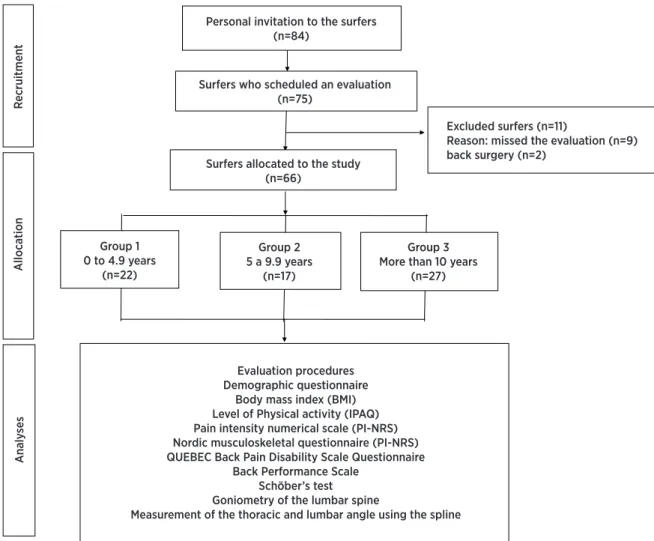
were selected (igure 1). he participants were allocated into three diferent experimental groups according to how long they had been suring: group 1 (G1, up to 4.9 years of suring, n=22), group 2 (G2, between 5 and 9.9 years of suring, n =17) and group 3 (G3, more than 10 years of suring, n=27). Table 1 shows the characteristics of the participants. All procedures carried out in this study were approved by the Research Ethics Committee (Statement 335,941).
he procedures of this study were carried out individually by a single inter-rater.
To characterize the participants, we used a demographic questionnaire which assessed: age, gender, suring category, years of suring, number of hours per day and weekly frequency of the suring training.
he Body Mass Index (BMI) was obtained by dividing the mass of the individual by the square of their height (kg/m²) and the participants were classiied as underweight, eutrophic, overweight or obese15.
he level of physical activity was investigated by the IPAQ (International Physical Activity Questionnaire – long version)16 and the participants were classiied as
sedentary, insuiciently active, active and very active. Acute lower back pain was analyzed by asking if an episode of acute lower back pain had occurred in the previous four weeks, with its intensity being assessed with the 11-point pain intensity numerical rating scale (PI-NRS)17, which consists in 11 numbers, from 0 (no
pain) to 10 (worst pain), over a horizontal 10-cm line. Chronic lower back pain was evaluated using the Nordic Musculoskeletal Questionnaire (NMQ)18,
which asked if chronic lower back pain had occurred for longer than 4 weeks in the previous 12 months. he
participant also answered if the pain was associated with suring.
Lumbar disability was investigated with the QUEBEC Back Pain Disability Scale Questionnaire19,
and the participant evaluated how hard it is to perform 20 daily activities. he scores of the items were added up, to a total score within the range of 10 and 100, with higher numbers representing greater levels of disability.
Lumbar function was evaluated with the Back Performance Scale (BPS)20, which consists in
conducting 5 tests to evaluate the physical performance of the lower back region in diferent daily life activities. he score was obtained by adding up the individual scores of each tests, with the higher scores indicating the worst performance.
Lower back lexibility was measured by Schober’s test21, with a variation equal or greater than 5 cm being
considered normal.
he range of motion of the lumbar spine was evaluated with goniometry21. he maximal active range
of motion of the lexion and extension of the lumbar spine was requested, in degrees. A freedom of movement between 0 and 95 o was considered normal for lumbar
lexion, and between 0 and 35 o for lumbar extension21.
he thoracic and lumbar angles were measured in degrees with a spline. Previous evidences22 indicate
that the method is strongly correlated with the gold standard test performed in radiography. he method22
consists in the palpation and marking of the spinous processes, molding the lexible ruler of 80 cm (spline) from the seventh cervical vertebrae (C7) to the irst sacral vertebrae (S1) and then drawing the form in graph paper. he angle is determined by an algorithm developed in the Matlab software with a third-degree polynomial. he measurement was done in three repetitions by a single inter-rater which presented an intra-class correlation coeicient of: ICC lumbar=0.83, p=0.003; ICC thoracic=0.82, p=0.004. Values between 20 and 60o for the thoracic curvature and 22 and 54 o for the lumbar curvature were considered normal.
Values below the reference values were considered rectiications of the curvature, and those above it, thoracic hyperkyphosis or lumbar hyperlordosis.
frequency and in percentage, while numerical variables were described in average and standard deviation.
To analyze the categorical dada, we used Pearson’s chi-square test. For the numerical variables, ANOVA was used among the groups with Bonferroni’s post-hoc
test. For all the analyses, the level of signiicance was ixed at p<0.05. he size of the efect was determined through the calculation of the omega, with ω =0.01 being considered a small efect, ω =0.06 a moderate efect and values above 0.14 a large efect23.
Table 1. Characteristics of the surfers from the three diferent experimental groups
Characteristics
Experimental groups Group 1
0 to 4.9 years (n=22)
Group 2 5 to 9.9 years
(n=17)
Group 3 More than 10 years
(n=27)
Age (years, average ± SD) 23.6 (4.2) 23.6 (5.5) 29.9 (5.8)
Gender Female (n, %) Male (n, %)
8 14
6 11
2 25
BMI (kg/m2, average ± SD) 22.8 (3.6) 22.9 (3.1) 23.8 (2.6)
Classiication according to the BMI Underweight (n, %)
Eutrophic (n, %) Overweight (n, %) Obese (n, %)
3 (13.6) 16 (72.7) 2 (15.4) 1 (4.5)
1 (5.9) 13 (76.5) 3 (17.1) 0 (0.0)
0 (0) 19 (70.4) 8 (29.6) 0 (0.0)
Personal invitation to the surfers (n=84)
Figure 1. Experimental design
R
ecruitmen
t
Analy
ses
Alloca
tion
Surfers who scheduled an evaluation (n=75)
Surfers allocated to the study (n=66)
Group 1 0 to 4.9 years
(n=22)
Group 2 5 a 9.9 years
(n=17)
Group 3 More than 10 years
(n=27)
Evaluation procedures Demographic questionnaire
Body mass index (BMI) Level of Physical activity (IPAQ) Pain intensity numerical scale (PI-NRS) Nordic musculoskeletal questionnaire (PI-NRS) QUEBEC Back Pain Disability Scale Questionnaire
Back Performance Scale Schöber’s test Goniometry of the lumbar spine
Measurement of the thoracic and lumbar angle using the spline
Excluded surfers (n=11)
Reason: missed the evaluation (n=9) back surgery (n=2)
RESULTS
Presence of lower back pain, periodicity and association with surfing
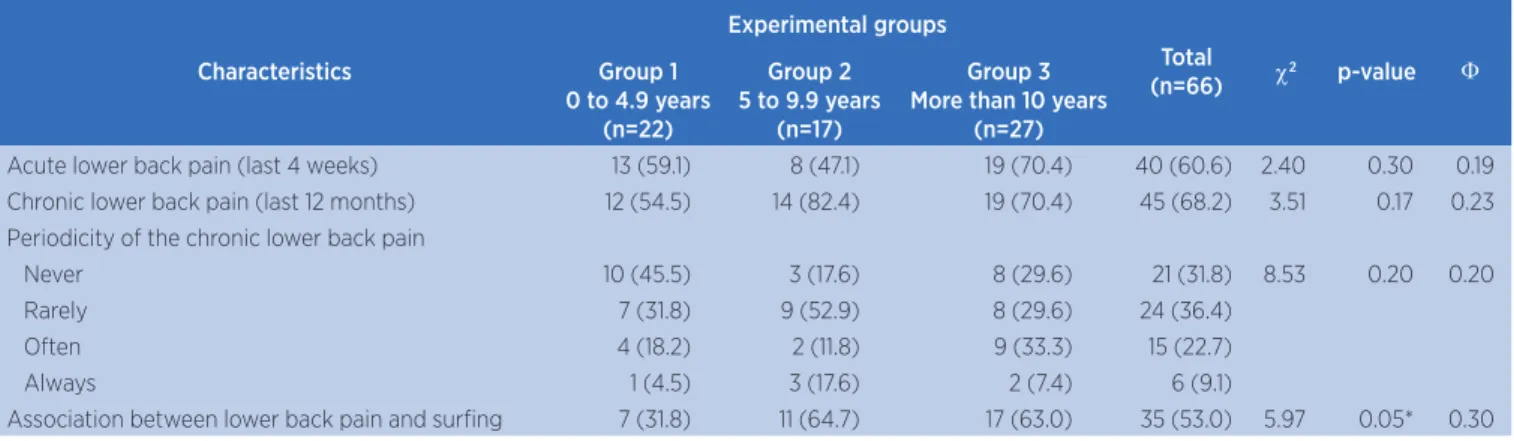
Table 2 shows there was a signiicant association between the presence of chronic low back pain and suring, χ2 (1) = 5.97 (p=0.05). However, there was no
statistically signiicant diference between the three groups of the study for the occurrence of lower back pain (acute or chronic) or for its periodicity.
Kinetic and functional aspects (intensity of the lumbar pain, disability, function, flexibility, range of motion and angle of the thoracic and lumbar spine)
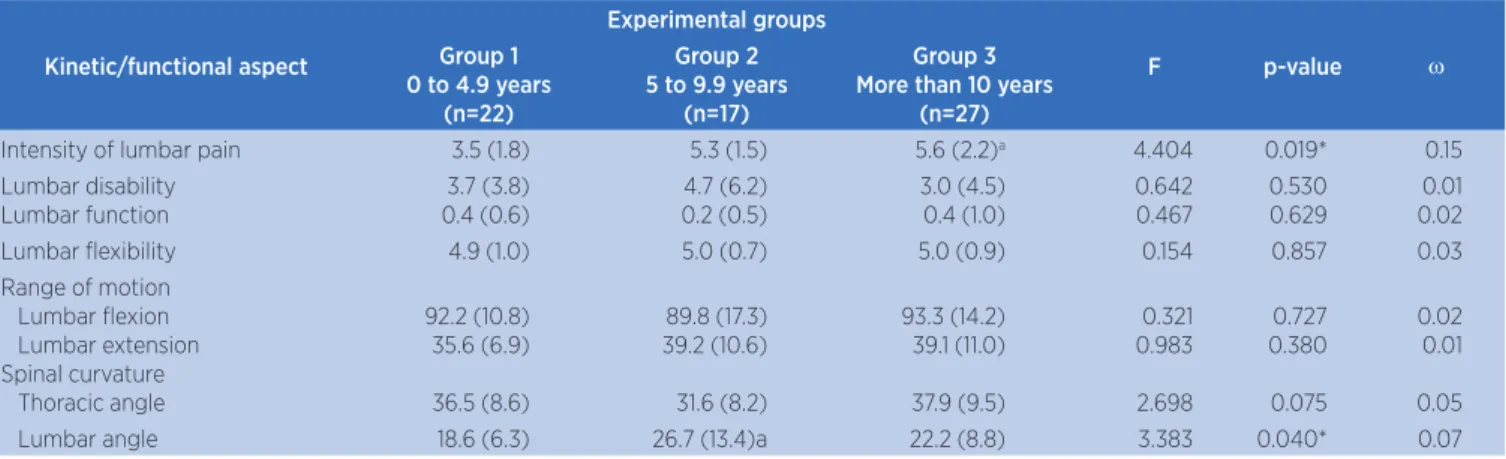
Table 3 presents the kinetic and functional aspects of the three diferent experimental groups. he efect
of the number of years suring was signiicant for pain intensity, F (2, 39) = 4.40, p = 0.01, ω = 0.15 (large efect size).
he analyses also revealed that the lumbar angle was greater for those who had been suring for a period between 5 and 9.9 years, in comparison with those who had surfed for less time (up to 4.9 years), F (2, 65) = 3.38, p = 0.04, ω = 0.07 (moderate efect size). However, this diference was not conirmed in Group 3, which had the longest suring period (p > 0.05).
As a result, to eliminate the efect of the changes caused by age, we conducted statistical analyses using age as a covariate. he results showed that age had no signiicant relationship with pain intensity nor with the lumbar angle, F (2, 39) = 2.49, p = 0.12, r= 0.37 (large efect size).
Characteristics
Experimental groups Group 1
0 to 4.9 years (n=22)
Group 2 5 to 9.9 years
(n=17)
Group 3 More than 10 years
(n=27)
Sports category Recreational (n, %) Amateur (n, %) Professional (n, %)
19 (86.4) 3 (13.6) 0 (0)
12 (70.6) 4 (23.5) 1 (5.9)
12 (44.4) 8 (29.6) 7 (25.9) Daily hours of training (average ± SD) 2.1 ± 1.0 2.5 ± 1.1 2.6 ± 1.3 Number of training days per week (average ± SD) 3.3 ± 1.6 3.8 ± 1.8 3.4 ± 1.5 Level of physical activity
Very active (n, %) Active (n, %)
Suiciently active (n, %)
8 (36.4) 14 (63.6) 0 (0.0)
12 (70.6) 4 (16.7) 1 (5.9)
21 (77.8) 6 (22.2) 0 (0.0)
Table 2. Occurrence of acute or chronic lower back pain, periodicity of the pain and its association with suring, for the three diferent experimental groups
Characteristics
Experimental groups
Total
(n=66) χ2 p-value Φ
Group 1 0 to 4.9 years
(n=22)
Group 2 5 to 9.9 years
(n=17)
Group 3 More than 10 years
(n=27)
Acute lower back pain (last 4 weeks) 13 (59.1) 8 (47.1) 19 (70.4) 40 (60.6) 2.40 0.30 0.19 Chronic lower back pain (last 12 months) 12 (54.5) 14 (82.4) 19 (70.4) 45 (68.2) 3.51 0.17 0.23 Periodicity of the chronic lower back pain
Never 10 (45.5) 3 (17.6) 8 (29.6) 21 (31.8) 8.53 0.20 0.20
Rarely 7 (31.8) 9 (52.9) 8 (29.6) 24 (36.4)
Often 4 (18.2) 2 (11.8) 9 (33.3) 15 (22.7)
Always 1 (4.5) 3 (17.6) 2 (7.4) 6 (9.1)
Association between lower back pain and suring 7 (31.8) 11 (64.7) 17 (63.0) 35 (53.0) 5.97 0.05* 0.30
DISCUSSION
In this study, most young men who were eutrophic, active, who surfed recreationally three times a week, with a larger angle of the lumbar curvature and who had surfed the longest presented more intense lower back pain.
In the present study, more than half of the interviewees (60.6%) reported that at least one episode of lumbar pain had occurred in the previous 4 weeks. Similarly, 68.2% of surfers reported having lumbar pain in the previous 12 months.
Steinman et al.7 revealed the high prevalence of
recurring lower back pain (28.4%) in recreational surfers from Brazil who had surfed for more than 5 years. he authors suggest that after years of suring, due to the repetitive movements of compressing and rotating the spine, the dehydration of intervertebral disks may occur, leading to pain and even disk degeneration. Moreover, the cervical and thoracic spines may sufer injuries, causing muscle imbalance due to the isometric hyperextension during paddling and predisposing surfers to musculoligamentous injuries caused by trauma.
here is also evidence12 that accelerating the
pop-up (quick movement to change from paddling to standing up on the surfboard) is a probable cause for the occurrence of lower back pain and injury. his is based on the physical relationship between the acceleration and the forces of tension at work during the movement, since it is an intense and explosive movement of rotating and compressing the lumbar spine.
With the goal of identifying the prevalence of lower back pain in surfers from Rio de Janeiro, Souza et al.8
observed that lower back pain was more common in
surfers than in non-surfers. hese indings corroborate the results of the present study, where we found a signiicant association between the presence of chronic lower back pain and suring.
With respect to the presence of lower back pain and the years of suring, Daniels et al.24 state that lower
back pain is a common complaint among athletes, with traumas and infections being the most frequent causes in teenagers, while for adults they are mechanical or a consequence of osteoarthritis. De Luigi25 states that the
high incidence of structural injuries and lower back pain is associated with young athletes. Contrarily, Nathanson et al.3 airm that older surfers (age higher than 40) and
more experienced surfers (more than 20 years of suring) have higher relative risks of injuries, with the 35-55 age bracket being the most afected by lower back pain26.
hese statements partially contradict the indings of our study, in which no signiicant diferences were found between the three studied groups, which were subdivided according to years of suring for acute pain, occurrence of chronic lumbar pain or its periodicity. As for pain intensity, those who had surfed the longest (Group 3) had more intense lower back pain. However, when we eliminated the efect of the changes which could be related to age, the results indicated that age does not have a signiicant relationship with pain intensity.
Posture changes may occur due to factors such as muscle hypertrophy, imbalance between agonist/ antagonist muscles, the decrease of lexibility due to repetitive movements and intense training for athletes27.
Moreover, the increase of lumbar lordosis may directly cause lumbar pain, which was previously demonstrated by wrestling athletes who had chronic lumbar pain – the angle of their lumbar curvature was greater than that of
Table 3. Kinetic and functional aspects of surfers from the three experimental groups
Kinetic/functional aspect
Experimental groups
F p-value ω
Group 1 0 to 4.9 years
(n=22)
Group 2 5 to 9.9 years
(n=17)
Group 3 More than 10 years
(n=27)
Intensity of lumbar pain 3.5 (1.8) 5.3 (1.5) 5.6 (2.2)a 4.404 0.019* 0.15
Lumbar disability Lumbar function
3.7 (3.8) 0.4 (0.6)
4.7 (6.2) 0.2 (0.5)
3.0 (4.5) 0.4 (1.0)
0.642 0.467
0.530 0.629
0.01 0.02
Lumbar lexibility 4.9 (1.0) 5.0 (0.7) 5.0 (0.9) 0.154 0.857 0.03
Range of motion Lumbar lexion Lumbar extension Spinal curvature
Thoracic angle
92.2 (10.8) 35.6 (6.9) 36.5 (8.6)
89.8 (17.3) 39.2 (10.6) 31.6 (8.2)
93.3 (14.2) 39.1 (11.0) 37.9 (9.5)
0.321 0.983 2.698
0.727 0.380 0.075
0.02 0.01 0.05 Lumbar angle 18.6 (6.3) 26.7 (13.4)a 22.2 (8.8) 3.383 0.040* 0.07
asymptomatic individuals28, but this association has not
been investigated for surfers up to the present moment. Surfers spend about 45-50% of their time on the surfboard paddling, which favors spine hyperextension7,
which strengthens the posterior chain isometrically, possibly leading to muscle imbalance29. hese results are
compatible with the indings of the present study, in which the lumbar angle was greater for those who had surfed the longest when compared with those who had surfed less, suggesting that suring may contribute to the increase of the lumbar curvature. However, the increase was not conirmed in Group 3, which had surfed the longest. Moreover, when we eliminate statistically the efect of changes brought by age, the results indicate that age did not have a signiicant relationship with the lumbar curvature and/or pain intensity.
In addition to the increase of the lumbar curvature, there are evidences that low back pain can be related to the loss of lexibility in the region30. Considering these
indications, in our study we did not ind an association between low back pain and lexibility and/or the range of motion of the lower back. Most participants (53%) presented values of normality for lexibility, but 57.5% showed loss of motion for lumbar lexion, and 36.3% showed restrictions for lumbar extension. hus, in this study it was not possible to state that a restricted motion of the lower back leads to pain in the area.
here was also no association between lower back pain and lumbar disability, which was evaluated with the QUEBEC questionnaire, and no surfer presented a score greater than 30. his suggests that low back pain in surfers is not disabling. his inding is compatible with the evaluation of lumbar function, for which 95.5% of surfers presented a performance with no limitation (level 0) or minimally limited (level 1). In addition, the same occurred with the assessment of the thoracic curvature, for which 95.5% of the surfers presented angles considered normal. hus, due to the indices of normality obtained in the sample of this study, the results of these variables should be interpreted with caution. Hence, future studies should analyze the relationship between lumbar disability and the loss of thoracic and lumbar curvature, and the lexibility of surfers with low back pain.
Although the present study explored the association between low back pain and kinetic and functional aspects, such as disability, function, lexibility, range of motion and the curvature of the thoracic and lumbar spines of surfers, some limitations can be mentioned
so that they are studied by future researches, such as the aspect of practicing other sports in addition to suring and speciic training. Moreover, other methods can be used to collect data on low back pain instead of questionnaires and interviews.
We highlight that the clinical contribution of this work is relevant, since it shows the importance of evaluating the angle of the lumbar curvature for the choice of therapies aimed at preventing and reducing the intensity of low back pain in surfers. he data presented in this study showed some factors that cause low back pain in surfers, in particular the increase of the lumbar curvature. Hence, we single out the importance of postural re-education to correct the angle of the lumbar curvature in the prophylaxis of low back pain, as well as to control this type of pain in surfers.
CONCLUSION
here is a signiicant association between the occurrence of low back pain and suring. A higher number of years of suring seems to be associated with more intense low back pain and a larger angle of the lumbar curvature. However, for surfers low back pain is not associated with lumbar disability, function, lexibility, range of motion of the lumbar spine and the angle of the thoracic spine.
REFERENCES
1. Méndez-Villanueva A, Perez-Landaluce J, Bishop D, Fernandez-García B, Ortolano R, Leibar X, et al. Upper body aerobic itness comparison between two groups of competitive surfboard riders. J Sci Med Sport. 2005;8(1):43-51. 2. Frank M, Zhou S, Bezerra P, Crowley Z. Efects of long-term recreational suring on control of force and posture in older surfers: a preliminary investigation. J Exerc Sci Fit. 2009;7(1):31-8.
3. Nathanson A, Haynes P, Galanis D. Suring injuries. Am J Emerg Med. 2002;20(3):155-60.
4. Finch CF, Owen N. Injury prevention and the promotion of physical activity: what is the nexus? J Sci Med Sport. 2001;4(1):77-87.
5. Taylor DM, Bennett D, Carter M, Garewal D, Finch CF. Acute injury and chronic disability resulting from surfboard riding. J Sci Med Sport. 2004;7(4):429-37.
7. Steinman J, Vasconcellos EH, Ramos RM, Botelho JL, Nahas MV. Epidemiologia dos acidentes no surfe no Brasil. Rev Bras Med Esporte. 2000;6(1):9-15. doi: http://dx.doi.org/10.1590/ S1517-86922000000100004.
8. Souza MCMG, Fonseca VS, Sá VWB. Prevalência de lombalgia em suristas amadores. Rev Bras Fisioter. 2006;10(2):1054-5.
9. Paillard T, Margnes E, Portet M, Breucq A. Postural ability relects the athletic skill level of surfers. Eur J Appl Physiol. 2011;111(8):1619-23. doi: 10.1007/s00421-010-1782-2.
10. Alcantara CPA, Prado JM, Duarte M. Análise do controle do equilíbrio em suristas durante a postura ereta. Rev Bras Med Esporte. 2012;18(5):318-21. doi: http://dx.doi.org/10.1590/ S1517-86922012000500007.
11. Kiers H, van Dieën J, Dekkers H, Wittink H, Vanhees L. A systematic review of the relationship between physical activities in sports or daily life and postural sway in upright stance. Sports Med. 2013;43(11):1171-89. doi: 10.1007/s40279-013-0082-5. 12. Hammer RL, Loubert PV. Alternative pop-up for surfers with
low back pain. N Am J Sports Phys Ther. 2010;5(1):15-8. 13. Base LH, Alves MAF, Martins EO, Costa RF. Lesões em suristas
proissionais. Rev Bras Med Esporte. 2007;13(4):251-3. 14. Moraes GC, Guimarães ATB, Gomes ARS. Análise da
prevalência de lesões em suristas do litoral paranaense. Acta Ortop Bras. 2013;21(4):213-8. doi: http://dx.doi.org/10.1590/ S1413-78522013000400006.
15. Brasil. Ministério da Saúde. Biblioteca Virtual em Saúde do Ministério da Saúde. Obesidade. Brasília: Ministério da Saúde; 2009. [acesso em 25 maio 2015]. Disponível em: http:// bvsms.saude.gov.br/bvs/dicas/215_obesidade.html.
16. Matsudo S, Araújo T, Matsudo V, Andrade D, Andrade E, Oliveira LC, et al. Questionário Internacional de Atividade Física (IPAQ): estudo de validade e reprodutibilidade no Brasil. Rev Bras Ativ Fís Saúde. 2001;2(6):5-18.
17. Farrar JT, Young JP Jr, LaMoreaux L, Werth JL, Poole RM. Clinical importance of changes in chronic pain intensity measured on an 11-point numerical pain rating scale. Pain. 2001;94(2):149-58.
18. Pinheiro FA, Troccoli BT, Carvalho CV. Validação do Questionário Nórdico de Sintomas Osteomusculares como
medida de morbidade. Rev Saúde Pública. 2002;36(3):307-12. doi: http://dx.doi.org/10.1590/S0034-89102002000300008. 19. Rodrigues MF, Michel-Crosato E, Cardoso JR, Traebert J.
Psychometric properties and cross-cultural adaptation of the Brazilian Quebec Back Pain Disability Scale Questionnaire. Spine (Phila Pa 1976). 2009;34(13):E459-64. doi: 10.1097/ BRS.0b013e3181a5605a.
20. Magnussen L, Strand LI, Lygren H. Reliability and validity of the back performance scale: observing activity limitation in patients with back pain. Spine (Phila PA 1976). 2004;29(8):903-7.
21. Magee DJ. Avaliação musculoesquelética. 5. ed. São Paulo: Manole; 2010.
22. Oliveira TS, Candotti CT, La Torre M, Pelinson PP, Furlanetto TS, Kutchak FM, et al. Validity and reproducibility of the measurements obtained using the lexicurve instrument to evaluate the angles of thoracic and lumbar curvatures of the spine in the sagittal plane. Rehabil Res Pract. 2012;ID186156. doi:10.1155/2012/186156.
23. Field A. Discovering Statistics Using IBM SPSS Statistics. 4. ed. London: SAGE; 2013.
24. Daniels JM, Pontius G, El-Amin S, Gabriel K. Evaluation of low back pain in athletes. Sports Health. 2011;3(4):336-45. doi: 10.1177/1941738111410861.
25. De Luigi AJ. Low back pain in the adolescent athlete. Phys Med Rehabil Clin N Am. 2014;25(4):763-88.
26. Baker RJ, Patel D. Lower back pain in the athlete: common conditions and treatment. Prim Care. 2005;32(1):201-29. 27. Peirão R, Tirloni AS, Reis DC. Avaliação postural de suristas
proissionais utilizando o método Portland State University (PSU). Fit Perf J. 2008;7(6):370-4.
28. Dezan VH, Sarraf TA, Rodacki ALF. Alterações posturais, desequilíbrios musculares e lombalgias em atletas de luta olímpica. Rev Bras Ciênc Mov. 2004;12(1):35-8.
29. Prati SRA, Prati ARC. Níveis de aptidão física e análise de tendências posturais em bailarinas clássicas. Rev Bras Cineantropom Desempenho Hum. 2006;8(1):80-7.