Localized Renal Cell Carcinoma Management: An Update
Flavio L. Heldwein, T. Casey McCullough, Carlos A. V. Souto, Marc Galiano, Eric Barret
Department of Urology, Institut Montsouris, Paris, France
ABSTRACT
Objective:To review the current modalities of treatment for localized renal cell carcinoma.
Materials and Methods: A literature search for keywords: renal cell carcinoma, radical nephrectomy, nephron sparing surgery, minimally invasive surgery, and cryoablation was performed for the years 2000 through 2008. The most relevant publications were examined.
Results:New epidemiologic data and current treatment of renal cancer were covered. Concerning the treatment of clini-cally localized disease, the literature supports the standardization of partial nephrectomy and laparoscopic approaches as therapeutic options with better functional results and oncologic success comparable to standard radical resection. Promising initial results are now available for minimally invasive therapies, such as cryotherapy and radiofrequency ablation. Active surveillance has been reported with acceptable results, including for those who are poor surgical candidates.
Conclusions:This review covers current advances in radical and conservative treatments of localized kidney cancer. The current status of nephron-sparing surgery, ablative therapies, and active surveillance based on natural history has resulted in great progress in the management of localized renal cell carcinoma.
Key words: renal cell carcinoma; treatment; nephrectomy; surgical procedures; minimally invasive
Int Braz J Urol. 2008; 34: 676-90
INTRODUCTION
Renal cell carcinoma (RCC) is the third most frequent urologic cancer and represents 2-3% of all adult malignancies. Adenocarcinoma is the most preva-lent histologic subtype, responsible for approximately 85% of renal tumors (1). Historically, RCC was known as the tumor of multiple presentations due to the several signs and symptoms that could be present at the time of diagnosis. Currently, up to 40% of kidney neoplasms are detected incidentally because of the widespread use of imaging technologies (2). This has led to an apparent increase in the incidence of RCC (3).
For decades, radical nephrectomy was con-sidered the gold standard treatment for localized RCC, representing the only curative option. Several open or
laparoscopic approaches are now available. However, despite a small improvement in overall survival and good oncologic outcomes, radical surgery has a relapse rate that can reach 30% (4). Likewise, renal function outcomes can be poor, even in patients with a normal contralateral kidney. More recently, renal parenchyma preservation and nephron-sparing procedures are beginning to demonstrate satisfactory results, point-ing toward a possible role of new minimally invasive energy-based ablation techniques in renal tumor therapy.
EPIDEMIOLOGY
There is a geographical prevalence variation. The smallest incidence rates have been observed in Africa, 3DFL¿F&RDVWDQG$VLDH[FHSWIRU-DSDQHVHPHQ,Q some countries, such as Denmark and Sweden the incidence has been decreasing for the last 20 years (5).
,Q/DWLQ$PHULFDWKHKLJKHVWLQFLGHQFHLV
observed in Uruguay and in the south of Brazil (Porto Alegre 10.2 per 100.000 men) (6), contrasting with low rates in the north of Brazil and in the middle-west area, Goiania for instance (7,8).
According to the American Cancer Society, more than 54,390 new cases and 13,010 deaths are expected in 2008 in the United States. Since 1950, the annual incidence has grown by 130%, at a rate of 3.7% (9).
Data from the U.S. Surveillance, Epidemiol-ogy and End-Results (SEER) study shows that 54% RIUHQDOWXPRUVDUHRUJDQFRQ¿QHGDWGLDJQRVLV are locally advanced and 25% of the patients already have disseminated disease. Approximately 50% of these patients will develop metastases. The 2-year survival rate for patients with untreated metastases LVRQO\,QJHQHUDOJOREDOVXUYLYDOUDWHV at 5 and 10 years are 65% and 56%, respectively.
TREATMENT
The Trial Search Strategy
The computerized database of the US Nation-al Library of Medicine of the search engine PubMed (http://www.pubmed.gov), and the Latin American and Caribbean Health Sciences /,/$&6 GDWDEDVH were primarily searched for articles on localized UHQDOFHOOFDUFLQRPDIURPWR,QDQHIIRUW to identify the records, the search descriptors: “renal cell carcinoma”, “kidney neoplasm”, were combined with the following terms: “radical nephrectomy”, “nephron sparing surgery”, “minimally invasive surgery”, “radio frequency”, “active surveillance” and “cryoablation”. The databases search was con-ducted from March to April 2008. These terms were crossed, resulting in vast number of papers. Among WKHDEVWUDFWVZHLGHQWL¿HGSDSHUVZHUHVHOHFWHGRQ the basis of their clinical relevance with respect to the aim of the review.
The introduction of radical nephrectomy as the standard of care, together with earlier diagnosis provided by an increased frequency of radiological imaging, has made some progress in RCC manage-PHQW7KLVKDVWUDQVODWHGLQWRDVPDOOEXWVLJQL¿FDQW better global survival (7). (Figure-1)
Radical Nephrectomy
Open Radical Nephrectomy
,Q&]HUQ\SHUIRUPHGWKH¿UVWUDGLFDO
nephrectomy. However, high sepsis and mortality UDWHVGHOD\HGWKHSRSXODULW\RIQHSKUHFWRP\,Q Robson et al., published one of the most recognized and cited articles concerning the standardization of radical nephrectomy (11).
The choice of surgical access for radical nephrectomy is determined by the size and location of the tumor, patients’ anatomy, and the surgeon’s preferences. Whatever the choice of incision, the radical treatment should follow accepted oncologic principles. Contemporary series of open radical ne-phrectomies (ORN) report acceptable complication rates between 2-7%. The most common immediate complication is secondary hemorrhage (12).
Radical nephrectomy remains the most gener-DOO\SHUIRUPHGWUHDWPHQWIRUORFDOL]HGUHQDOWXPRUV,Q clinical stage T3b tumors, radical nephrectomy with thrombectomy offers curative potential particularly in patients not exhibiting evidence of metastatic disease (13).
Laparoscopic Radical Nephrectomy
,Q &OD\PDQ DFFRPSOLVKHG WKH ILUVW laparoscopic radical nephrectomy (LRN) for a kidney tumor (14). After high initial costs and conquering the learning curve, Meraney and Gill concluded that this approach was 12% cheaper than open surgery (15). 7KHZHOONQRZQEHQH¿WVRIODSDURVFRS\KDYHPDGH this approach very attractive. Burgess et al. compared short outcomes of LRN and ORN and demonstrated less postoperative pain and an earlier return to normal activities (16).
tech-nique-with “en bloc” resection both feasible and desir-able. Although it is possible to remove the specimen by morcellation, it impairs pathologic analysis and risks perforating the extractor bag. However, port site recurrences have been only rarely reported. Morcella-tion has been found to be a safe procedure, although contraindicated in patients with ascites (17).
Regarding long-term oncologic outcomes, several prospective cohorts compared laparoscopic versus open radical nephrectomy. Oncologic control after 3, 5, and 10 years of follow-up seems equivalent to open surgery (18-20).
LRN is an established standardized pro-cedure for treatment of T1, T2 and some T3aN0 tumors. Nevertheless, despite some success of laparoscopy for more locally advanced tumors such as T3, open radical nephrectomy remains the gold-standard for these lesions (20). Today nephron sparing surgery is emerging as the new standard of care for small renal lesions (T1a and probably some T1b) (Table-1).
Adrenalectomy
Although ipsilateral adrenalectomy is feasible during radical nephrectomy, the real risk of adrenal invasion is low. Moreover, adrenal involvement can be detected preoperatively by computerized tomography or magnetic resonance image with a high sensitivity (21). However, false negative adrenal metastasis rate can be meaningful, particularly in upper pole masses and in the context of large renal masses. Direct tumor extension or metastatic involvement of the ipsilateral adrenal gland occurs in only 1.2-10% of surgical speci-PHQV,QDUHFHQWVWXG\WKHDGUHQDOLQYROYHPHQWZDV found in 3.1% of 866 radical specimens (21). There are no reported prospective randomized studies examining the role of adrenalectomy in kidney cancer surgery. The low incidence of adrenal involvement and current imaging technology makes such a study unlikely.
Lymphadenectomy
Based on numerous published reports, such as: the UCLA experience and the EORTC 30881
randomized study, lymph node dissection is desirable only if preoperative imaging demonstrates enlarged lymph nodes. Lymph node involvement is associated with a poor prognosis although resection can increase survival when these patients are selected for adjuvant LPPXQRWKHUDS\%HFDXVHWKHUHLVQREHQH¿WLQ prospective oncologic outcomes, lymphadenectomy is considered unnecessary in unsuspected lymph node metastases as assessed by pre-operative imaging.
Partial Nephrectomy
Open Partial Nephrectomy (Nephron-Sparing Surgery - NSS)
7KH¿UVWSDUWLDOQHSKUHFWRP\ZDVSHUIRUPHG in 1870, by Simon, in a patient with hydronephrosis. 7KH¿UVWRQFRORJLFSDUWLDOQHSKUHFWRP\ZDVDFFRP -plished by Vizenz Czerny, successor of Simon in Heidelberg.
Today there is a debate about the accepted tumor size for partial nephrectomy. Patients with tumors of 4-7 cm with favorable anatomical char-acteristics are now treated conservatively (24). The complete removal of the tumor should be extended to have a negative margin. As regards the size of the normal parenchyma rim, some authors have reported that a macroscopic surgical margin of 0.5 cm is desir-DEOHQRQHWKHOHVVWKHVFLHQWL¿FOLWHUDWXUHVXSSRUWVWKDW negative margin irrespective of size is adequate and safe (25). The survival data are excellent and 5-year FDQFHUVSHFL¿FVXUYLYDOLV$UHWURVSHFWLYH analysis demonstrated a local recurrence rate of 7.5% (0-12%) (27). The partial nephrectomy is criticized for its higher complication rate, chance of local recur-rence due to incomplete resection, and because some of these tumors can be multifocal. However, recent series report low rates of local recurrence, even in patients with positive surgical margins (27).
,QSDWLHQWVZLWKDVROLWDU\NLGQH\ELODWHUDOWX -mors, inadequate renal function or Von Hippel-Lindau
disease (VHL), partial nephrectomy has mandatory indications to avoid dialysis and possible renal trans-SODQWDWLRQ,Q9+/GLVHDVHSDWLHQWVIUHTXHQWO\KDYH multifocal tumors and multiple premalignant cysts. ,QWKHVHFDVHVQHSKURQVSDULQJVXUJHU\LVSRVWSRQHG with the intention of delaying the onset of renal insuf-¿FLHQF\7KHVHOHVLRQVDUHUHVHFWHGZKHQWKHWXPRU reaches a determined size (28).
,Q +XDQJ HW DO GHPRQVWUDWHG WKDW
radical nephrectomy is a risk factor for development RIFKURQLFUHQDOGLVHDVHJORPHUXODU¿OWUDWLRQUDWH GFR < 60 mL/min for 1.73m2) when compared to patients undergoing partial nephrectomy (29). Study-ing a cohort of 662 patients, 171 had some degree of preoperative renal dysfunction, 50/287 and 142/204 patients developed CRD after partial and radical ne-phrectomy, respectively. The probability of not hav-ing chronic renal disease in 3 and 5 years was 80% and 67% in nephron-sparing surgery, respectively; and 35% and 23% in the radical surgery group (p < 0.0001). This functional result questions the role of radical nephrectomy, as the previous gold standard, in terms of best preserving long-term renal function for small cortical tumors (29,30).
There are no prospective clinical trials that demonstrate the long-term oncological results of nephron-sparing surgery. However, the first ran-GRPL]HGSURVSHFWLYHSKDVH,,,WULDOZDVOHGE\WKH Genito-urinary Group of the European Organization for Research and Treatment of Cancer (EORTC) in collaboration with groups in North America (EORTC 30904). Van Poppel et al., randomized 541 patients with tumors less than 5 cm and a normal contralateral kidney (partial nephrectomy PN = 268 and Radical nephrectomy RN = 273). They concluded that the complication rate with partial surgery is slightly greater than in the radical procedure. The oncological results are not yet available (31) (Table-2).
Therefore, based on functional long-term outcomes and similar retrospective oncologic end-points compared to radical procedure, elective NSS an
Table 1 – Indications for laparoscopic radical nephrectomy.
acceptable option for treat small RCC regardless of a higher complication rate. Nevertheless, the choice of invasiveness of the (laparoscopic or open) approach should not be considered the most important issue to select patients to radical or NSS procedures.
Laparoscopic Nephron-Sparing Nephrectomy ,Q VRPH WHUWLDU\ FHQWHUV WKH ODSDURVFRSLF partial nephrectomy (LPN) is the standard technique for small cortical tumors (< 4 cm). Concerning the surgical technique, the vascular anatomy is very im-portant (32). The polar nephrectomy is indicated in polar tumors as the wedge resection is indicated for central tumors (33). With this approach, the artery and the vein can be clamped when convenient even without cooling the kidney. Maintaining the kidney in warm ischemia enables a resection of up to 30 minutes (34). When complicated resections are anticipated, the hilum clamping is advised in conjunction with previous mannitol (12.5g) 20% administration and furosemide (10 mg) 5 to 10 minutes before clamping. Cooling the kidney with ice (for about 25 minutes lowering the temperature to 5-19º C) (35,36), helps prevent irreversible ischemic damage, thus making it possible longer resections up to 3 hours (37).
The most common complications of partial ne-SKUHFWRP\DUHKHPRUUKDJHXULQDU\¿VWXOD DQGUHLQWHUYHQWLRQ,Q the majority of cases, such complications can be man-aged conservatively, through endoluminal vascular or endourological techniques. The use of intraoperative ultrasound is a useful tool to evaluate depth and the presence of other tumors. Except in few centers, warm ischemia time is longer than in open surgery.
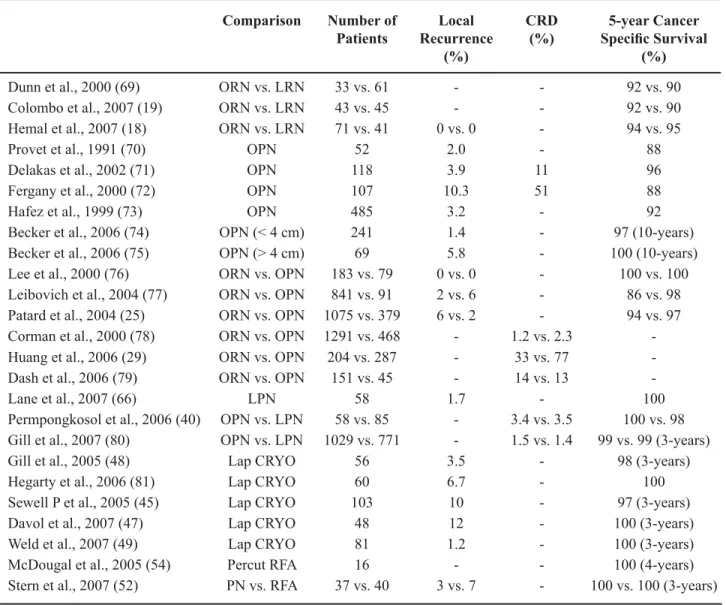
Permpongkosol et al. demonstrated that LPN has 5-year oncologic outcomes similar to open partial nephrectomy (40) (Table-3).
Even in modern series, there are heteroge-neous populations between LPN and OPN, suggesting different indications. T1b tumors are more common in OPN than in LPN cohorts (41). Few studies report good initial results with hand-assisted technique and tele-robotic surgery (42).
Minimally Invasive Techniques
The minimally invasive techniques give new perspectives to the treatment of localized RCC, of-fering alternatives to conventional surgery. Currently,
Table 2 – Indications for nephron-sparing nephrectomy.
Formal Indications
Benign disease suspicion Bilateral tumors
Cystic nephroma Solitary kidney Complex cyst
Von Hippel-Lindau disease
Bourneville syndrome Angiomyolipoma Familial RCC Oncocytoma Graft kidney
Relative Indications
(probable future chronic renal disease or threatened contralateral kidney) Lithiasis
Arterial stenosis
Borderline renal function
9HVLFRXUHWHUDOUHÀX[ Chronic pyelonephritis Hypertension/diabetes
Elective Indication
Tumor with a normal contra-lateral kidney
Controversial Indication
great interest exists in renal ablations by radio-fre-quency and cryotherapy. Frequently, those therapies are reserved for patients with serious co-morbidities. However, their low morbidity and ability to preserve renal parenchyma make them promising techniques.
Cryoablation
Hypothermic ablation therapy (-40° C) is performed through the introduction of a probe, whose
Table 3 – Published long-term outcomes for treatment of localized RCC regarding local recurrence, chronic renal disease &5'DQGFDQFHUVSHFL¿FVXUYLYDO
Comparison Number of Patients
Local Recurrence
(%)
CRD (%)
5-year Cancer 6SHFL¿F6XUYLYDO
(%)
Dunn et al., 2000 (69) ORN vs. LRN 33 vs. 61 - - 92 vs. 90 Colombo et al., 2007 (19) ORN vs. LRN 43 vs. 45 - - 92 vs. 90 Hemal et al., 2007 (18) ORN vs. LRN 71 vs. 41 0 vs. 0 - 94 vs. 95
Provet et al., 1991 (70) OPN 52 2.0 - 88
Delakas et al., 2002 (71) OPN 118 3.9 11 96
Fergany et al., 2000 (72) OPN 107 10.3 51 88
Hafez et al., 1999 (73) OPN 485 3.2 - 92
Becker et al., 2006 (74) OPN (< 4 cm) 241 1.4 - 97 (10-years) Becker et al., 2006 (75) OPN (> 4 cm) 69 5.8 - 100 (10-years) Lee et al., 2000 (76) ORN vs. OPN 183 vs. 79 0 vs. 0 - 100 vs. 100 Leibovich et al., 2004 (77) ORN vs. OPN 841 vs. 91 2 vs. 6 - 86 vs. 98 Patard et al., 2004 (25) ORN vs. OPN 1075 vs. 379 6 vs. 2 - 94 vs. 97 Corman et al., 2000 (78) ORN vs. OPN 1291 vs. 468 - 1.2 vs. 2.3 -Huang et al., 2006 (29) ORN vs. OPN 204 vs. 287 - 33 vs. 77 -Dash et al., 2006 (79) ORN vs. OPN 151 vs. 45 - 14 vs. 13
-Lane et al., 2007 (66) LPN 58 1.7 - 100
Permpongkosol et al., 2006 (40) OPN vs. LPN 58 vs. 85 - 3.4 vs. 3.5 100 vs. 98 Gill et al., 2007 (80) OPN vs. LPN 1029 vs. 771 - 1.5 vs. 1.4 99 vs. 99 (3-years) Gill et al., 2005 (48) Lap CRYO 56 3.5 - 98 (3-years) Hegarty et al., 2006 (81) Lap CRYO 60 6.7 - 100 Sewell P et al., 2005 (45) Lap CRYO 103 10 - 97 (3-years) Davol et al., 2007 (47) Lap CRYO 48 12 - 100 (3-years) Weld et al., 2007 (49) Lap CRYO 81 1.2 - 100 (3-years) McDougal et al., 2005 (54) Percut RFA 16 - - 100 (4-years) Stern et al., 2007 (52) PN vs. RFA 37 vs. 40 3 vs. 7 - 100 vs. 100 (3-years) OPN = open partial nephrectomy; ORN = open radical nephrectomy; LPN = laparoscopic partial nephrectomy; LRN = laparoscopic radical nephrectomy; Lap CRYO = laparoscopic cryoablation; Percut RFA = percutaneous radio frequency ablation.
function is to destroy the tissue by cellular damage from freezing, apoptosis, coagulation necrosis, and immunological action (43). The available devices use argon gas. Nonetheless, it is advisable that these procedures be properly guided by accurate imaging techniques. Some series have reported the safety of the technique, usually accomplished by laparoscopic or percutaneous means (Figure-2).
patients had a 6 year follow-up, with general and can-FHUVSHFL¿FVXUYLYDOVRIDQGUHVSHFWLYHO\ The local recurrence rate was 1.8% (44). There are no trials comparing long-term results of laparoscopic partial nephrectomy and laparoscopic cryoablation.
The percutaneous approach is even less in-vasive than laparoscopy and is able to be performed under local anesthesia and sedation. Sewell et al., studied 120 tumors treated by cryotherapy via per-FXWDQHRXVDFFHVVZLWKDFDQFHUVSHFL¿FVXUYLYDORI 97% and global survival of 90.2%. With 35.5 months of follow-up, the local recurrence rate was 10% and approximately one-third of patients needed more than one session (45).
,QDUHFHQWUHYLHZDFRPSOLFDWLRQUDWHRI
14% was observed in 139 procedures (4 laparoscopic and 16 percutaneous). The most frequent complica-tions were perinephric hematomas requiring blood transfusion, hematuria, paresthesias and abscesses. Renal dysfunction occurred in only 1 of 139 patients (46).
Three year oncological results have reported DFDQFHUIUHHVXUYLYDOXSWR,WFDQEH concluded that cryoablation, using two freeze/thaw cycles, is a safe therapy in small tumors in patients with comorbidities (47).
Long-term results comparing conventional open partial nephrectomy to cryotherapy are ex-pected.
Radio Frequency Ablation
Hyperthermic ablation therapy by radio fre-quency elevates the temperature of the tissues above 100o&E\UHDFKLQJDQLPSHGDQFHRIȍFUHDWHGE\ DQHOHFWULFDOFXUUHQW,WLVDOVRSHUIRUPHGE\LQWURGXF -tion of a probe, causing coagula-tion necrosis.
Short and intermediate-term results have demonstrated the safety and effectiveness of this method in small renal tumors. Follow-up of 27 months H[LVWVDQGJOREDODQGFDQFHUVSHFL¿FVXUYLYDOUDWHVRI 92.3% and 98.5% respectively were observed (50).
Stern et al., published their results in 37 ASA 1-2 patients. Only one patient had a local recurrence in a period over 2 years and he was treated by radical nephrectomy without recurrence after 1 year follow-up (51). The same author compared intermediate-term
results of partial nephrectomy and radiofrequency ablation and concluded that 3-year oncological out-comes were similar (52).
Gervais and colleagues published a series of 85 patients with the treatment of 100 tumors percuta-neously. One local recurrence was seen and there were HOHYHQFRPSOLFDWLRQVVXFKDVEORRGWUDQVIXVLRQV,Q -deed, 100% of the tumors smaller than 3 cm achieved complete ablation while only 25% of tumors greater WKDQFPZHUHWUHDWHGFRPSOHWHO\,QDQRWKHU paper of the same group, a cohort of 16 patients was reported with the longest term follow-up available (4.6 years). Five patients died of unrelated causes and the \HDUFDQFHUVSHFL¿FVXUYLYDOZDV
Zagoria et al., obtained complete ablation (absence of contrast enhancement in the tumors on &7RU05,LQRIWXPRUVDOWKRXJK residual tumors were observed in 30% of those larger than 3.7 cm in a follow-up of 13.8 months (55).
Centrally located tumors and those greater than 3 cm have been implicated as negative predic-tive factors for success. The observed complications are usually ureteral stenosis and urinomas. Residual tumors have been observed in nephrectomy specimens previously treated with radio-frequency ablation. There are concerns about viable tumor cells remain-ing after thermal ablation. However, such histological analyses were made in specimens previously treated with radiofrequency ablation just before the excision, therefore before complete coagulation necrosis had a chance to occur (56).
in future, molecular markers will also be considered IRUWKLVSXUSRVH,GHDOO\VXUYHLOODQFHDIWHUDEODWLRQV as well as reporting of outcomes, technique and KLVWRORJLFDOFRQ¿UPDWLRQVKRXOGEHVWDQGDUGL]HGWR make possible comparisons of these ablative series with surgery.
Figure 2 – Renal cell carcinoma cryoablation. A) and B) Preoperative and six months post cryoablation CT images demonstrating ab-sence of enhancement in the ablation site equivalent to the peripherical antero-lateral tumor in the right kidney. C) and D) Laparoscopic FU\RDEODWLRQRIDUHQDOWXPRUZLWKFU\RFDUH®GHYLFHFRXUWHV\RI'U6FKZDUW]6RXWKHUQ,OOLQRLV8QLYHUVLW\(DQG),QWUDRSHUDWLYH XOWUDVRXQGFRQ¿UPLQJWKHFRUUHFWSRVLWLRQRIFU\RVHQVRUVDQGFU\RSUREHVDQGPRQLWRULQJWKHIUHH]LQJSURFHGXUHLFHEDOO3KRWRPL-FURJUDSKLHVLOOXVWUDWLQJWKHUHQDOFHOOFDUFLQRPD*DQLQIDUFWLRQDUHDDIWHUFU\RWKHUDS\+DQG¿EURVLVLQDIROORZXSELRSV\,
A
B
C
D
E
F
G H I
Neo Adjuvant Therapy for Localized Renal Cancer
were allocated alternately to 2 groups: perioperative LPPXQRPRGXODWLRQZLWKVXEFXWDQHRXV,QWHUOHXNLQ in the week before surgery and control (57). The two groups had similar characteristics. Median follow-up was 40 months. The results revealed a difference in WKHWXPRUVSHFL¿F\HDUDQG\HDUVXUYLYDOUDWHVRI 98% vs. 81% and 86% vs. 73% (p = 0.04) in treated vs. control groups. Despite this paper’s non-random-ized design, it signals a possible new approach in localized renal cell carcinoma. Future research in this ¿HOGFRXOGEHOHDGWRWKHXVHRIPXOWLWDUJHWHGWKHUDS\ as an option in selected patients with a high risk for recurrence.
Adjuvant Therapy for Localized RCC
Renal cell carcinoma expresses tumor anti-JHQVFDUERQLFDQK\GUDVH,;DQGWHORPHUDVH8VXDOO\ these antigens promote an immune system response and eventually tumor destruction. These tumor anti-gens are available as potential targets for vaccination. Different mechanisms can make the tumor cells es-cape from immune surveillance. The cornerstone of WXPRUYDFFLQDWLRQLVWRLQGXFHDWXPRUVSHFL¿F7FHOO response.
Adjuvant tumor vaccination was reported in a randomized trial. A total of 553 patients were en-rolled, comparing an autologous cancer cell vaccine. -RFKDPDQGFROOHDJXHVKDYHVKRZQLPSURYHPHQWLQ the 5-year progression-free survival for T2-3N0-3 tumors (58).
Randomized trials have shown no improve-ment in overall or disease-free survival with the adjuvant treatments radiotherapy, interferon, in-terleukin or BCG (58,59). The new targeted thera-pies are fast becoming the standard treatment for metastatic RCC. Nonetheless, it is not yet known whether adjuvant angiogenesis inhibitors are more effective than observation in treating locally ad-vanced renal cell carcinoma. Several adjuvant trials for high risk localized RCC are recruiting patients to evaluate the role of adjuvant G250Ab, sunitinib and sorafenib versus observation after complete excision of unfavorable RCC (ASSURE, SORCE and S-TRAC trials) (60-62). Preliminary results concerning patient-reported outcomes and safety are not expected before 2010.
Active Surveillance
,QVSLWHRIDGYDQFHVGXULQJWKHODVWGHFDGH including a better understanding of tumor molecular biology, improved imaging, and minimally invasive procedures, approximately 30% of localized RCC will recur and progress. The current treatment framework considers that a better oncological outcome can be assured with early intervention. Hollingsworth et al., analyzing the SEER database that enrolled more than 34,500 tumors, concluded that the incidence of small tumors has increased (< 4 cm) and represents the larg-est increase in annual incidence of RCC. Similarly, surgical treatment has increased (63). Nevertheless, even with preclinical tumor detection and the treat-ment of incidental tumors, the overall mortality of RCC has not been impacted. Hence, current as-sumptions of treatment are being reviewed and new concepts of management have been created. Active surveillance is being proposed to treat some of these indolent tumors, but there are doubts regarding this indolence (64).
The tenets of surveillance propose that small renal masses (< 3.5 cm) with a slow annual growth rate (< 0.28 cm/year) can be observed and should not be promptly treated (63). Unfortunately, tumor stage and growth kinetics are not reliable factors to predict a tumor’s natural history; in part because of the het-erogeneous range of tumors considered here (65). ,QYHVWLJDWLRQVIURPWKH0D\R&OLQLFVKRZHG that 46% of tumors less than 1 cm were benign (66). Also, Gill reported a cohort where the median tumor size was 3 cm and 32% of these lesions were benign, the great majority was cancerous (67).
5HFHQWO\DPHWDDQDO\VLVFRQ¿UPHGWKDWWKH JURZWKUDWHZDVQRWVLJQL¿FDQWO\GLIIHUHQWEHWZHHQ oncocytomas and RCC variants. Although rare, meta-static disease was observed in 3 patients (1%). Two of these patients became metastatic after the primary tumor reached 8 cm (54 and 111 months). Another pa-tient had metastasis after a follow-up of 134 months. The pathological evaluation was provided in 131/286 OHVLRQVDQGFRQ¿UPHGDPDOLJQDQWSDWWHUQ (64). Although renal biopsy should not be performed in the majority of patients, more recent studies have reported less complications and better accuracy.
refuse surgery. Thus, histological factors and molecu-lar markers of progression are needed to improve the selection of patients for active surveillance.
Regardless of the approach, surgery remains the preferred standard of care for treating localized RCC. Complication rates of partial nephrectomies are not insignificant and ablative technologies are assuming a more prominent role. Recently, a meta-analysis compared oncological outcomes of these three strategies. Kunkle et al. analyzed 6,471 small renal masses described in 99 studies: 5,037 tumors were treated with nephron sparing surgery, 496 with cryoablation, 607 with radio frequency ablation and 331 were observed. The authors con-cluded that different groups have been treated by these strategies. This selection bias is clear when analyzing differences in tumor size, patient age, follow-up, and pathologic results. Although local control with ablation techniques has been inferior to nephron sparing surgery (radio-frequency 18-fold DQGFU\RWKHUDS\IROGQRVLJQL¿FDQWGLIIHUHQFHV were found concerning metastatic progression, even with surveillance (68).
CONCLUSIONS
Surgery has been mostly responsible for the improvement in survival in localized renal cell carci-noma. Unfortunately, surgery for advanced localized disease (T3 and T4) remains unsatisfactory with high recurrence rates (20 to 30%). With a better understand-ing of the molecular basis of RCC the natural history can be predicted with improved accuracy, helping to identify high-risk tumors and establish targeted WKHUDS\IRUVSHFL¿FWXPRUV
Laparoscopic radical nephrectomy is the pre-ferred treatment for localized renal masses (T1 and T2) deemed not amenable to partial nephrectomy (open or laparoscopic). The quality of life and preservation of renal function have now become important clinical issues. Therefore, attempts to achieve these goals have resulted in better clinical results and similar 10-year oncological outcomes for T1a lesions managed by partial nephrectomy, as well as T1b lesions (<7 cm) in favorable locations amenable to a partial nephrec-tomy..
Complete tumor resection must be advocated. Thus, all minimally invasive procedures should be compared to open surgery. Minimally invasive therapies, including cryosurgery and radio frequency ablation, by open, laparoscopic or percutaneous ap-proaches are safe in patients with co-morbidities. The results obtained with minimally invasive therapies are promising. They are associated with a faster recovery, less pain, and decreased costs. However, long term RQFRORJLFHI¿FDF\UHPDLQVWREHGHPRQVWUDWHGEXWLV expected in the near future.
The role of other minimally invasive tech-QLTXHVVXFKDV+,)8KLJKLQWHQVLW\IRFXVHGXOWUD -sound), microwave thermotherapy, laser ablation, hypertonic solution instillation, and radio-surgery are uncertain and should at this time be considered experimental.
CONFLICT OF INTEREST
None declared.
REFERENCES
3DUNLQ'0:KHODQ6/)HUOD\-5D\PRQG/<RXQJ - HG &DQFHU LQFLGHQFH LQ ¿YH FRQWLQHQWV Y /\RQ,QWHUQDWLRQDO$JHQF\IRU5HVHDUFKRQ&DQFHU 6FLHQWL¿F3XEOLFDWLRQ
2. Ries LAG, Harkins D, Krapcho M, Mariotto A, 0LOOHU %$ )HXHU (- HW DO HG 6((5 &DQFHU 6WDWLVWLFV5HYLHZ1DWLRQDO&DQFHU,QVWL -tute. Bethesda, MD. Available at: http://seer.cancer. JRYFVUBLQGH[KWPO$FFHVVHG -XQH 2007.
0F/DXJKOLQ-./LSZRUWK/7DURQH5((SLGHPLR -logic aspects of renal cell carcinoma.Semin Oncol. 2006; 33: 527-33.
6WHSKHQVRQ$-&KHWQHU035RXUNH.*OHDYH0( Signaevsky M, Palmer B, et al.: Guidelines for the surveillance of localized renal cell carcinoma based RQWKHSDWWHUQVRIUHODSVHDIWHUQHSKUHFWRP\-8URO 2004; 172: 58-62.
:XQVFK)LOKR9,QVLJKWVRQGLDJQRVLVSURJQRVLVDQG VFUHHQLQJRIUHQDOFHOOFDUFLQRPD6DR3DXOR0HG-2002; 120: 163-4
7. Dall’Oglio MF, Srougi M, Gonçalves PD, Leite K, 1HVUDOODK/+HULQJ),QFLGHQWDODQGV\PSWRPDWLF renal tumors: impact on patient survival. São Paulo
0HG-8. Latorre MRDO: Cancer in Goiania: incidence and mortality from 1988 to 1997. Sao Paulo; 2001. Tese de livre docência - Faculdade de saúde pública da Universidade de São Paulo. Available at: http://www. teses.usp.br/teses/disponiveis/livredocencia/6/tde-27042006-094006
-HPDO$6LHJHO5:DUG(+DR<;X-0XUUD\7HW DO&DQFHUVWDWLVWLFV&$&DQFHU-&OLQ 58: 71-96.
.OHLQ)$*DVK-5:DWHUV%'LDJQRVLV$QG6WDJLQJ RI5HQDO&HOO&DUFLQRPD,Q5LFKLH-3'$PLFR$9 (eds.), Urologic Oncology. Philadelphia, Elsevier Sanders. 2005; pp. 173-94.
5REVRQ&-&KXUFKLOO%0$QGHUVRQ:7KHUHVXOWV RI UDGLFDO QHSKUHFWRP\ IRU UHQDO FHOO FDUFLQRPD -Urol. 1969; 101: 297-301.
&RUPDQ-03HQVRQ')+XU..KXUL6)'DOH\ -+HQGHUVRQ:HWDO&RPSDULVRQRIFRPSOLFD -tions after radical and partial nephrectomy: results from the National Veterans Administration Surgical 4XDOLW\,PSURYHPHQW3URJUDP%-8,QW 782-9.
3RUWLV$-&OD\PDQ596KRXOGODSDURVFRS\EHWKH standard approach used for radical nephrectomy? Curr Urol Rep. 2001; 2: 165-70.
&OD\PDQ59.DYRXVVL/56RSHU1-'LHUNV60 Merety KS, Darcy MD, et al.: Laparoscopic nephrec-WRP\1(QJO-0HG
0HUDQH\$0 *LOO ,6 )LQDQFLDO DQDO\VLV RI RSHQ versus laparoscopic radical nephrectomy and nephro-XUHWHUHFWRP\-8URO
16. Burgess NA, Koo BC, Calvert RC, Hindmarsh A, 'RQDOGVRQ3-5KRGHV05DQGRPL]HGWULDORIODSD -URVFRSLFYRSHQQHSKUHFWRP\-(QGRXURO 610-3.
/DQGPDQ-&OD\PDQ595H3RUWVLWHWXPRUUHFXU -rences of renal cell carcinoma after videolaparoscopic UDGLFDOQHSKUHFWRP\-8URO 18. Hemal AK, Kumar A, Kumar R, Wadhwa P, Seth A,
Gupta NP: Laparoscopic versus open radical nephrec-tomy for large renal tumors: a long-term prospective FRPSDULVRQ-8URO
&RORPER-5-U+DEHU*3$URQ0&RFX]]D0&R -ORPER5.DRXN-HWDO2QFRORJLFDORXWFRPHVRI
laparoscopic radical nephrectomy for renal cancer. Clinics. 2007; 62: 251-6.
20. Mattar K, Finelli A: Expanding the indications for laparoscopic radical nephrectomy. Curr Opin Urol. 2007; 17: 88-92.
3DXO50RUGKRUVW-%XVFK5/H\K++DUWXQJ5 Adrenal sparing surgery during radical nephrectomy LQSDWLHQWVZLWKUHQDOFHOOFDQFHUDQHZDOJRULWKP-Urol. 2001; 166: 59-62.
3DQWXFN$-=LVPDQ$'RUH\)&KDR'++DQ.5 6DLG-HWDO5HQDOFHOOFDUFLQRPDZLWKUHWURSHULWR - QHDOO\PSKQRGHVUROHRIO\PSKQRGHGLVVHFWLRQ-Urol. 2003; 169: 2076-83.
%ORP-+YDQ3RSSHO+0DUHFKDO-0-DFTPLQ' Sylvester R, Schröder FH, et al.: Radical nephrec-tomy with and without lymph node dissection: pre-OLPLQDU\UHVXOWVRIWKH(257&UDQGRPL]HGSKDVH,,, protocol 30881. EORTC Genitourinary Group. Eur Urol. 1999; 36: 570-5.
0LOOHU'&+ROOLQJVZRUWK-0+DIH].6'DLJQDXOW S, Hollenbeck BK: Partial nephrectomy for small renal masses: an emerging quality of care concern? -8UROGLVFXVVLRQ
3DWDUG--6KYDUWV2/DP-63DQWXFN$-.LP+/ )LFDUUD9HWDO6DIHW\DQGHI¿FDF\RISDUWLDOQH -phrectomy for all T1 tumors based on an international PXOWLFHQWHUH[SHULHQFH-8URO 26. Morgan WR, Zincke H: Progression and survival
af-ter renal-conserving surgery for renal cell carcinoma: H[SHULHQFHLQSDWLHQWVDQGH[WHQGHGIROORZXS-Urol. 1990; 144: 852-7; discussion 857-8.
5RWK7- /HLERYLFK %& &KHYLOOH -& /RKVH &0 &KHYLOOH-&%OXWH0/5RFKHVWHU01)HDWXUHVSUH -dictive of local recurrence following nephron-sparing VXUJHU\IRUUHQDOFHOOFDUFLQRPD-8URO 241. (abstract no. 742).
28. Steinbach F, Novick AC, Zincke H, Miller DP, Wil-liams RD, Lund G, et al.: Treatment of renal cell car-cinoma in von Hippel-Lindau disease: a multicenter VWXG\-8URO
29. Huang WC, Levey AS, Serio AM, Snyder M, Vick-HUV$-5DM*9HWDO&KURQLFNLGQH\GLVHDVHDIWHU nephrectomy in patients with renal cortical tumours: a retrospective cohort study. Lancet Oncol. 2006; 7: 735-40.
0F.LHUQDQ-6LPPRQV5.DW]-5XVVR31DWXUDO KLVWRU\RIFKURQLFUHQDOLQVXI¿FLHQF\DIWHUSDUWLDODQG radical nephrectomy. Urology. 2002; 59: 816-20. 31. Van Poppel H, Da Pozzo L, Albrecht W, Matveev V,
complications of elective nephron-sparing surgery and radical nephrectomy for low-stage renal cell carcinoma. Eur Urol. 2007; 51: 1606-15.
6DPSDLR )-$QDWRPLFDO EDFNJURXQG IRU QHSKURQ VSDULQJVXUJHU\LQUHQDOFHOOFDUFLQRPD-8URO 147: 999-1005.
)UDQN , &RORPER -5 -U 5XELQVWHLQ 0 'HVDL 0 .DRXN-*LOO,6/DSDURVFRSLFSDUWLDOQHSKUHFWRP\ IRUFHQWUDOO\ORFDWHGUHQDOWXPRUV-8URO 849-52.
'HUZHHVK ,+ 1RYLFN$& 0HFKDQLVPV RI UHQDO LVFKDHPLFLQMXU\DQGWKHLUFOLQLFDOLPSDFW%-8,QW 2005; 95: 948-50.
35. Uzzo RG, Novick AC: Nephron sparing surgery for renal tumors: indications, techniques and outcomes. -8URO
36. Novick AC: Nephron-sparing surgery for renal cell carcinoma. Annu Rev Med. 2002; 53: 393-407. 0DUEHUJHU 0 ,Q VLWX FRROLQJ RI WKH NLGQH\ ,Q
Marberger M, Dreikorn K (ed.), Renal preservation. Baltimoree, Williams & Wilkins; 1983. pp. 38-63. 38. Herr HW: Partial nephrectomy for unilateral renal
carcinoma and a normal contralateral kidney: 10-year IROORZXS-8UROGLVFXVVLRQ 39. Becker F, Siemer S, Humke U, Hack M, Ziegler M,
Stöckle M: Elective nephron sparing surgery should become standard treatment for small unilateral renal cell carcinoma: Long-term survival data of 216 pa-tients. Eur Urol. 2006; 49: 308-13.
40. Permpongkosol S, Bagga HS, Romero FR, Sroka M, -DUUHWW7:.DYRXVVL/5/DSDURVFRSLFYHUVXVRSHQ partial nephrectomy for the treatment of pathological T1N0M0 renal cell carcinoma: a 5-year survival rate. -8UROGLVFXVVLRQ 41. Guillonneau B, Bermúdez H, Gholami S, El Fettouh
+ *XSWD 5$GRUQR 5RVD - HW DO /DSDURVFRSLF partial nephrectomy for renal tumor: single center experience comparing clamping and no clamping WHFKQLTXHV RI WKH UHQDO YDVFXODWXUH - 8URO 169: 483-6.
.DZDXFKL$<RQHGD.)XMLWR$2NLKDUD.6RK-Naitoh Y, et al.: Oncologic outcome of hand-assisted laparoscopic radical nephrectomy. Urology. 2007; 69: 53-6.
&KRV\6*1DNDGD6</HH)7-U:DUQHU7)0RQL -toring renal cryosurgery: predictors of tissue necrosis LQVZLQH-8URO
+HJDUW\1-*LOO,6'HVDL005HPHU(02¶0DOOH\ &0.DRXN-+3UREHDEODWLYHQHSKURQVSDULQJVXU -gery: cryoablation versus radiofrequency ablation. Urology. 2006; 68(Suppl 1): 7-13.
45. Sewell P, Shingleton W: Five-year treatment success and survival of patients treated with percutaneous ,05, JXLGHG DQG PRQLWRUHG UHQDO FHOO FDUFLQRPD FU\RDEODWLRQ%-8,QWDEVWUDFW03 1609).
-RKQVRQ'%6RORPRQ6%6X/00DWVXPRWR(' .DYRXVVL/51DNDGD6<HWDO'H¿QLQJWKHFRPSOL -cations of cryoablation and radio frequency ablation RIVPDOOUHQDOWXPRUVDPXOWLLQVWLWXWLRQDOUHYLHZ-Urol. 2004; 172: 874-7.
47. Davol PE, Fulmer BR, Rukstalis DB: Long-term results of cryoablation for renal cancer and complex renal masses. Urology. 2006; 68(Suppl 1): 2-6. *LOO,65HPHU(0+DVDQ:$6WU]HPSNRZVNL%
Spaliviero M, Steinberg AP, et al.: Renal cryoabla-WLRQRXWFRPHDW\HDUV-8URO 7.
:HOG.-)LJHQVKDX569HQNDWHVK5%KD\DQL6% Ames CD, Clayman RV, et al.: Laparoscopic cryoab-lation for small renal masses: three-year follow-up. Urology. 2007; 69: 448-51.
9DUNDUDNLV ,0$OODI 0( ,QDJDNL7 %KD\DQL 6% Chan DY, Su LM, et al.: Percutaneous radio fre-quency ablation of renal masses: results at a 2-year PHDQIROORZXS-8UROGLVFXVVLRQ 460.
6WHUQ-03DUN6$QGHUVRQ-..LGQH\WXPRUUDGLR -IUHTXHQF\DEDOWLRQH[SHULHQFHLQ$6$,DQG$6$,, SDWLHQWV-8URODEVWUDFWQR 6WHUQ-06YDWHN53DUN6+HUPDQQ0/RWDQ<
6DJDORZVN\$,HWDO,QWHUPHGLDWHFRPSDULVRQRI partial nephrectomy and radiofrequency ablation IRUFOLQLFDO7DUHQDOWXPRXUV%-8,QW 287-90.
*HUYDLV'$0F*RYHUQ)-$UHOODQR560F'RXJDO WS, Mueller PR: Radiofrequency ablation of renal FHOOFDUFLQRPDSDUW,QGLFDWLRQVUHVXOWVDQGUROH in patient management over a 6-year period and ab-ODWLRQRIWXPRUV$-5$P-5RHQWJHQRO 185: 64-71.
0F'RXJDO:6*HUYDLV'$0F*RYHUQ)-0XHOOHU PR: Long-term followup of patients with renal cell carcinoma treated with radio frequency ablation with FXUDWLYHLQWHQW-8URO
=DJRULD5-7UDYHU0$:HUOH'03HULQL0+D\D -VDND6&ODUN3(2QFRORJLFHI¿FDF\RI&7JXLGHG percutaneous radiofrequency ablation of renal cell FDUFLQRPDV$-5$P-5RHQWJHQRO 36.
radio frequency treatment of renal cell carcinoma: ¿QGLQJVDWLPPHGLDWHDQGGHOD\HGQHSKUHFWRP\-Urol. 2002; 167: 1587-92.
.ODWWH7,WWHQVRQ$5|KO):(FNH0$OOKRII(3 Böhm M: Perioperative immunomodulation with interleukin-2 in patients with renal cell carcinoma: UHVXOWV RI D FRQWUROOHG SKDVH ,, WULDO %U - &DQFHU 2006; 95: 1167-73.
-RFKDP'5LFKWHU$+RIIPDQQ/,ZLJ.)DKOHQ -kamp D, Zakrzewski G, et al.: Adjuvant autologous renal tumour cell vaccine and risk of tumour progres-sion in patients with renal-cell carcinoma after radical QHSKUHFWRP\SKDVH,,,UDQGRPLVHGFRQWUROOHGWULDO Lancet. 2004; 363: 594-9.
59. Galligioni E, Quaia M, Merlo A, Carbone A, Spada A, Favaro D, et al.: Adjuvant immunotherapy treatment of renal carcinoma patients with autologous tumor FHOOVDQGEDFLOOXV&DOPHWWH*XqULQ¿YH\HDUUHVXOWV of a prospective randomized study. Cancer. 1996; 77: 2560-6.
60. ASSURE: Adjuvant sorafenib or sunitinib for unfa-vorable renal carcinoma. Available at: http://clinical-trials.gov/ct2/show/NCT00326898.
625&($ 3KDVH ,,, 5DQGRPL]HG GRXEOHEOLQG study comparing sorafenib with placebo in patients with resected primary renal cell carcinoma at high or intermediate risk of relapse. Available at: http:// clinicaltrials.gov/ct2/show/NCT00492258.
62. Sunitinib Treatment of Renal Adjuvant Cancer (S-TRAC): A Randomized Double Blind Phase 3 Study of Adjuvant Sunitinib VS. Placebo in Subjects At High Risk of Recurrent RCC. Available at: http:// clinicaltrials.gov/ct2/show/record/NCT00375674. +ROOLQJVZRUWK-00LOOHU'&'DLJQDXOW6+ROOHQ
-beck BK: Rising incidence of small renal masses: a QHHGWRUHDVVHVVWUHDWPHQWHIIHFW-1DWO&DQFHU,QVW 2006; 981: 1331-4.
64. Chawla SN, Crispen PL, Hanlon AL, Greenberg RE, Chen DY, Uzzo RG: The natural history of observed enhancing renal masses: meta-analysis and review of WKHZRUOGOLWHUDWXUH-8URO 65. Lane BR, Samplaski MK, Herts BR, Zhou M, Novick
AC, Campbell SC: Renal mass biopsy--a renaissance? -8URO
66. Lerner SE, Hawkins CA, Blute ML, Grabner A, :ROODQ3&(LFNKROW-7HWDO'LVHDVHRXWFRPHLQ patients with low stage renal cell carcinoma treated ZLWKQHSKURQVSDULQJRUUDGLFDOVXUJHU\-8URO 2002; 167: 884-9.
*LOO,6'HVDL00.DRXN-+0HUDQH\$00XUSK\ DP, Sung GT, et al.: Laparoscopic partial
nephrec-tomy for renal tumor: duplicating open surgical tech-QLTXHV-8UROGLVFXVVLRQ 68. Kunkle DA, Egleston BL, Uzzo RG: Excise, ablate
or observe: the small renal mass dilemma--a meta-DQDO\VLV DQG UHYLHZ - 8URO discussion 1233-4.
'XQQ0'3RUWLV$-6KDOKDY$/(OEDKQDV\$0 Heidorn C, McDougall EM, et al.: Laparoscopic ver-sus open radical nephrectomy: a 9-year experience. -8URO
3URYHW-7HVVOHU$%URZQ-*ROLPEX0%RVQLDN M, Morales P: Partial nephrectomy for renal cell FDUFLQRPD LQGLFDWLRQV UHVXOWV DQG LPSOLFDWLRQV -Urol. 1991; 145: 472-6.
'HODNDV ' .DU\RWLV , 'DVNDORSRXORV *7HUKRUVW B, Lymberopoulos S, Cranidis A: Nephron-sparing surgery for localized renal cell carcinoma with a normal contralateral kidney: a European three-center experience. Urology. 2002; 60: 998-1002.
72. Fergany AF, Hafez KS, Novick AC: Long-term re-sults of nephron sparing surgery for localized renal FHOOFDUFLQRPD\HDUIROORZXS-8URO 442-5.
73. Hafez KS, Fergany AF, Novick AC: Nephron sparing surgery for localized renal cell carcinoma: impact of tumor size on patient survival, tumor recurrence and 710VWDJLQJ-8URO
74. Becker F, Siemer S, Humke U, Hack M, Ziegler M, Stöckle M: Elective nephron sparing surgery should become standard treatment for small unilateral renal cell carcinoma: Long-term survival data of 216 pa-tients. Eur Urol. 2006; 49: 308-13.
75. Becker F, Siemer S, Hack M, Humke U, Ziegler M, Stöckle M: Excellent long-term cancer control with elective nephron-sparing surgery for selected renal cell carcinomas measuring more than 4 cm. Eur Urol. 2006; 49: 1058-63; discussion 1063-4.
/HH&7.DW]-6KL:7KDOHU+75HXWHU9(5XVVR P: Surgical management of renal tumors 4 cm. or OHVV LQ D FRQWHPSRUDU\ FRKRUW - 8URO 730-6.
/HLERYLFK%&%OXWH0/&KHYLOOH-&/RKVH&0 Weaver AL, Zincke H: Nephron sparing surgery for appropriately selected renal cell carcinoma between 4 and 7 cm results in outcome similar to radical ne-SKUHFWRP\-8URO
'DVK$9LFNHUV$-6FKDFKWHU/5%DFK$06Q\GHU ME, Russo P: Comparison of outcomes in elective partial vs radical nephrectomy for clear cell renal cell FDUFLQRPDRIFP%-8,QW *LOO,6.DYRXVVL/5/DQH%5%OXWH0/%DELQHDX
'&RORPER-5-UHWDO&RPSDULVRQRIODSD
-roscopic and open partial nephrectomies for single UHQDOWXPRUV-8URO
+HJDUW\1-.DRXN-+6SDOLYLHUR0'HVDL00 Novick AC, Remer EM: Renal cryoablation: 5 year RXWFRPHV-8URO$EVW
Accepted after revision: 6HSWHPEHU
Correspondence address:
Dr. Flavio Heldwein
Rua Altamiro Guimaraes, 360 / 504 Florianópolis, SC, 88015-510, Brazil Fax: + 55 48 3223-0816
(PDLOÀDYLRORER#JPDLOFRP
EDITORIAL COMMENT
,QWKLVUHYLHZWKHDXWKRUVSURYLGHDFRP -SUHKHQVLYHUHYLHZRIWKHFXUUHQWVFLHQWL¿FOLWHUDWXUH on the management of localized renal tumors. The authors have adequately depicted that the manage-ment of small renal masses is no longer a simplistic discussion with patients that “the kidney needs to be removed” but rather that a spectrum of treatment choices are currently available from minimally inva-sive treatment modalities such as percutaneous radio-frequency ablation or cryotherapy, to nephron sparing surgery (laparoscopic, robotic assisted, open partial nephrectomy), extirpative surgery (laparoscopic or open radical nephrectomy), and active surveillance (for well-selected patients committed to a rigorous surveillance strategy and accepting of the potential risk of local, regional, and systemic progression). 2QHSRLQWWKDW,ZRXOGOLNHWRHPSKDVL]HLV that partial nephrectomy remains the “gold standard” approach for the management of localized renal masses deemed amenable to partial excision with QHJDWLYH VXUJLFDO PDUJLQV7KH EHQH¿WV RI SDUWLDO nephrectomy are increasingly being shown in terms of long-term renal function. The surgical approach used in performing a partial nephrectomy (i.e. open,
pure laparoscopic, or robotic assisted laparoscopic) VKRXOG GHSHQG RQ SDWLHQW UHODWHG WXPRU VSHFL¿F surgeon skill, and available hospital resources. The issue that is clear is that patient and case selection is of primordial importance.
Non-surgical, minimally invasive approaches to renal masses i.e. percutaneous cryotherapy or ra-diofrequency ablation are appealing to patients not ideally suited for aggressive surgical management and presenting with small renal masses amenable to this modality. Patients considering such minimally invasive approaches must be informed and accept-ing that long-term data on the effectiveness of these approaches are currently lacking and furthermore, patients must be committed to frequent radiologic imaging studies following the ablative procedure par-WLFXODUO\ZLWKLQWKH¿UVW\HDUDQGPRQWKV Patients must also be informed that a residual enhanc-ing renal mass post-ablation may require repeated therapy (with either the same modality or another form of therapy).
treatment for a suspected localized renal mass. Patients must be educated and guided along this spectrum of currently available treatment armamentarium. With this knowledge at hand, patients are able to decide for themselves which modality is best suited for them.
Furthermore, our knowledge is evolving and future discoveries and technological advances will impact our treatment options for a localized renal mass, our role will be to keep abreast of these advances and make them readily available to our patients.
Dr. Philippe E. Spiess Department of Interdisciplinary Oncology
0RI¿WW&DQFHU&HQWHU
University of South Florida Tampa, Florida, USA