Laparoscopic Renal Surgery in Infants and Children: Is it a
Feasible and Safe Procedure for all Pediatric Age Groups?
Francisco T. Denes, Alessandro Tavares, Edison D. S. Monteiro, Jose de Bessa Jr., Amilcar M.
Giron, Frederico A. Queiroz Filho, Miguel Srougi
Uropediatric Unit (FTD, EDM, JBJr, AMG FAQF, MS), Division of Urology University of Sao Paulo
Medical School, Sao Paulo, Brazil and Section of Urology (AT), ABC Medical School, Santo Andre,
SP, Brazil
ABSTRACT
Purpose: Although laparoscopy is considered the mainstay for most renal procedures in adults, its role in the pediatric population is still controversial, especially for smaller children. We reviewed our experience in pediatric renal laparoscopic surgery in three pediatric age groups in an attempt to identify if age has an impact on feasibility and surgical outcomes.
Materials and Methods: From November 1995 to May 2006, 144 pediatric laparoscopic renal procedures were performed at our institution. The charts of these patients were reviewed for demographic data, urologic pathology and surgical pro-cedure, as well as perioperative complications and post-operative outcomes. The indings were stratiied into 3 groups, according to patient age (A: < 1 year, B: 1 to 5 years and C: 6-18 years).
Results: Median age of the patients was 4.2 years (42 days - 18 years). We performed 54 nephrectomies, 33 nephroure -terectomies, 19 upper pole nephrectomies, 11 radical nephrectomies, 22 pyeloplasties and 4 miscellaneous procedures. The 3 age groups were comparable in terms of the procedures performed. Conversion rates were 0%, 1.4% and 1.9% for groups A, B and C, respectively (p = 0.72). Incidence of perioperative complications was 5%, 8.2% and 7.8% for age groups A to C, respectively (p = 0.88).
Conclusions: Most renal procedures can be performed safely by laparoscopy in the pediatric population, with excellent aesthetic and functional outcomes. The morbidity related to the procedure was minimal irrespective of the age group.
Key words: pediatrics; laparoscopy; renal surgery; complications; results
Int Braz J Urol. 2008; 34: 739-48
INTRODUCTION
Although laparoscopy is considered the main-stay for most renal procedures in adults, its role in the pediatric population is still controversial, especially
for smaller children (1-3).
In pediatrics, traditional open renal proce-dures have enjoyed high success rates. Moreover, infants and smaller children tend to experience less postoperative morbidity than adults (4,5). To date,
there are very few reported series comparing open and laparoscopic renal procedures (6-9).
(10-12). The primary objective of this study was to
review indications, feasibility and safety in 3 pediatric
age groups, in order to determine if younger (hence smaller) children are at an increased risk for conver-sion or complications when undergoing a laparoscopic renal procedure. As a secondary objective, we have also reviewed the outcomes of these procedures dur-ing follow-up.
MATERIALS AND METHODS
From November/1995 to May/2006, a total of 141 children underwent 144 laparoscopic
proce-dures involving the kidney; 3 of these patients had
asynchronous bilateral procedures. The age of the pa-tients ranged from 42 days to 18 years (median of 4.2 years). For analysis of feasibility and safety, patients
were subdivided into 3 groups: A: (1-11 months), B:
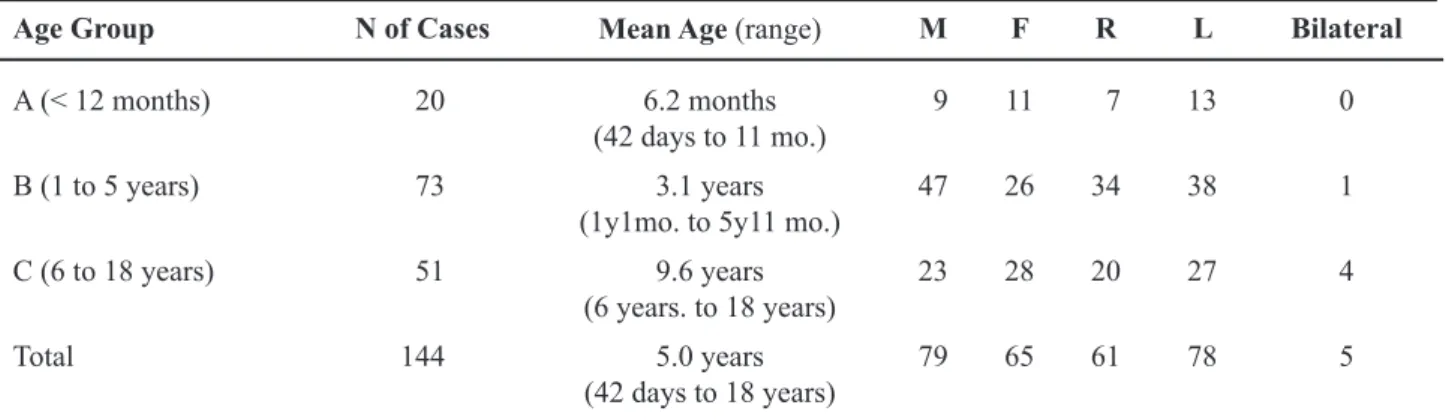
(1-5 years) and C: (6-18 years). Table-1 shows the
demographics of these 3 age groups.
The most common indications for each kind of laparoscopic procedure were as follows. Simple nephrectomy: non-functioning kidneys due to ure-teropelvic junction (UPJ) obstruction, stenosis of the renal artery or multicystic kidney; three cases had a nephrological indication for nephrectomy, for reduc-tion of proteinuria in cases of nephrotic syndrome. Nephroureterectomy: functional exclusion due to
vesicoureteric relux (VUR), ureterocele, ectopic
ureter or primary obstructive megaureter. Upper
pole nephrectomy (UPN): functional exclusion of
the upper pole in ureteropelvic duplication. Radical
nephrectomy: renal tumors (1 renal cell carcinoma, 1 cystic nephroma, 1 mass that was shown later to be a xantogranulomatous pyelonephritis, 8 cases of
post-chemotherapy Wilms’ tumors) (13-15). Pyelo -plasty: UPJ obstruction with functioning kidney. Two of these patients presented with associated pelvic and calyceal stones and underwent a laparoscopic pyelolithotomy during the same procedure.
The procedures described as miscellaneous include 2 resection of large compressive renal cysts and 2 bilateral nephrectomies in which the kidneys and ureters were mobilized downwards, exposed through a Pfannenstiel incision, detubularized and sutured to the bladder as a means of augmentation.
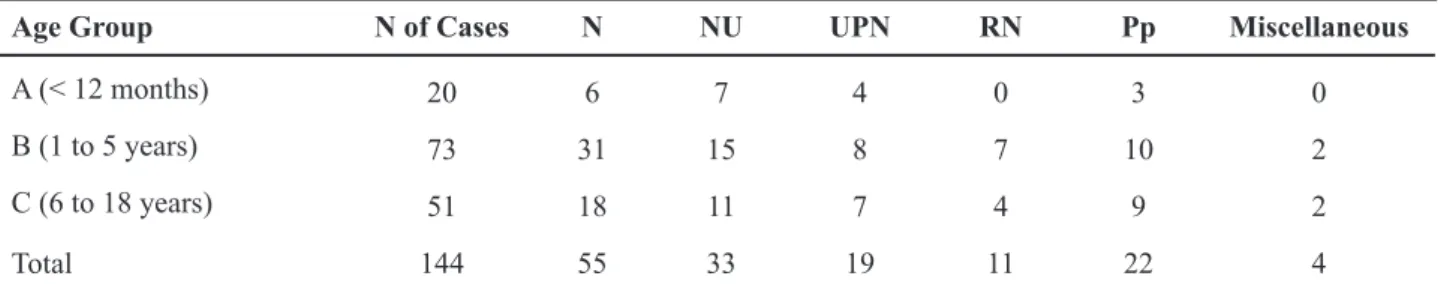
The laparoscopic renal procedures included in this study and their distribution in each age group is shown in Table-2.
Surgical Technique
The surgeries were carried out under general anesthesia, and continuous monitoring, including cap-nography. The patients received bladder and gastric catheterization, were kept warm by a thermal blanket and hydrated with warmed crystalloid solution..
The transperitoneal access was employed in the majority of cases (n = 140). The initial access was
made with a Veress needle, except in the few cases
with previous abdominal surgery or marked obesity, in which a Hasson (open) technique was used. In 4 cases,
Table 1 – Demographic data and side of the pathology in the population and in the 3 age groups.
Age Group N of Cases Mean Age (range) M F R L Bilateral
A (< 12 months) 20 6.2 months (42 days to 11 mo.)
9 11 7 13 0
B (1 to 5 years) 73 3.1 years (1y1mo. to 5y11 mo.)
47 26 34 38 1
C (6 to 18 years) 51 9.6 years (6 years. to 18 years)
23 28 20 27 4
Total 144 5.0 years
(42 days to 18 years)
79 65 61 78 5
a lateral retroperitoneoscopic access was employed (2 pyeloplasties and 2 nephrectomies).
The pressure of CO2 insuflation ranged from 8 to 14 mmHg, according to the patient weight.
Details of the surgical technique have been previously described, but some technical points should be stressed (9-11,15-17). In the UPN, after exposing the hilum, the diseased ureter is divided distally, almost always at the level of the iliac vessels, preserving the normal ureter. The distal stump is aspirated in cases of ureteroceles. It is then transposed cranially under-neath the hilum and used as a handle to identify and manipulate the diseased upper pole. This maneuver facilitates the visualization of the upper pole vessels and the transection of the parenchyma between the poles. Pyeloplasties were performed after a retrocolic exposure of the UPJ. A transabdominal hitch stitch was used to stabilize the pelvis. In 19 cases, the An-derson-Hynes dismembered technique was performed.
A technically simpler alternative was employed in 3
cases, in which there was a high insertion of the ureter in the pelvis, allowing a latero-lateral ureteropelvic anastomosis without section of the UPJ.
In all pyeloplasties except one, a double J catheter was inserted antegrade before completion of the anastomosis, which consisted of a running
suture with 5 or 6-0 Vicryl thread. In the cases that
presented with associated calyceal and pelvic stones,
luoroscopy, stone graspers and a lexible nephroscope
were used for lithotripsy.
Patients remained hospitalized until stabiliza-tion of pain and gastrointestinal symptoms.
Patients undergoing pyeloplasty had an
in-dwelling bladder catheter for 2-3 days. The double J
catheter was removed by endoscopy after 4-6 weeks. All patients were medicated with an analgesic and antibiotics in the postoperative period.
Study Design
The medical records were reviewed; periop-erative and follow-up outcomes, as well as occasional late complications related to the technique were re-corded.
The statistical analysis was performed using “chi-square” test or the likelihood ratio test for differ-ences between proportions, and the Student-t-test for differences between means, p < 0.05 being considered
statistically signiicant.
RESULTS
Group A (1 to 11 months of age; n = 20). All procedures were completed successfully. There was no need for conversion to open surgery in any cases, and there were no major complications.
Intraoperative bleeding was minimum in all
cases. Only one (5%) intraoperative incident was
observed, in an 11 month-old baby boy with left renal
exclusion due to VUR and ureteral quadruplication,
who underwent a laparoscopic nephroureterectomy. This patient had an atretic left vas deferens, which adhered to the dilated distal ureter, and was sectioned during the procedure.
All patients began feeding in the immediate postoperative period, and there were no postoperative incidents.
Table 2 – Number of procedures performed in each age group.
Age Group N of Cases N NU UPN RN Pp Miscellaneous
A (< 12 months) 20 6 7 4 0 3 0
B (1 to 5 years) 73 31 15 8 7 10 2
C (6 to 18 years) 51 18 11 7 4 9 2
Total 144 55 33 19 11 22 4
The late follow-up of these patients showed no important incidents related to the procedure. Dur-ing the follow-up, all patients who underwent upper pole polar nephrectomies presented good function in the remaining inferior unit in the renal scintigraphy and all three patients who underwent pyeloplasties presented clinical and radiological signs of suc-cess.
Group B (1 to 5 years of age; n = 73). Seven
-ty-two cases (98.6%) could be completed laparoscopi -cally, while only one case needed conversion to open surgery: in the 4th case of our series, a 2 year-old girl
undergoing a left nephrectomy due to non-functioning hydronephrosis was found intraoperatively to have a
horseshoe kidney with a leshy isthmus. As this was
still at the beginning of our laparoscopic experience, and fully adequate equipment was not yet available, we decided for the division of the isthmus and removal of the specimen through a small laparotomy.
There were no major complications, and six
cases (8.1%) presented with minor complications, in -cluding 4 hemorrhagic complications and 2 prolonged postoperative ileum.
In 2 radical nephrectomies for Wilms´ tumors, in one nephrectomy and in 1 UPN there was bleed-ing durbleed-ing or after the surgery that required blood transfusion (10-15 mL/kg). In the remainder of cases, bleeding was negligible.
Except for 2 cases (2.7%) that presented an
adynamic ileus until the 4th post-operative day, the patients had normal oral intake within the irst two
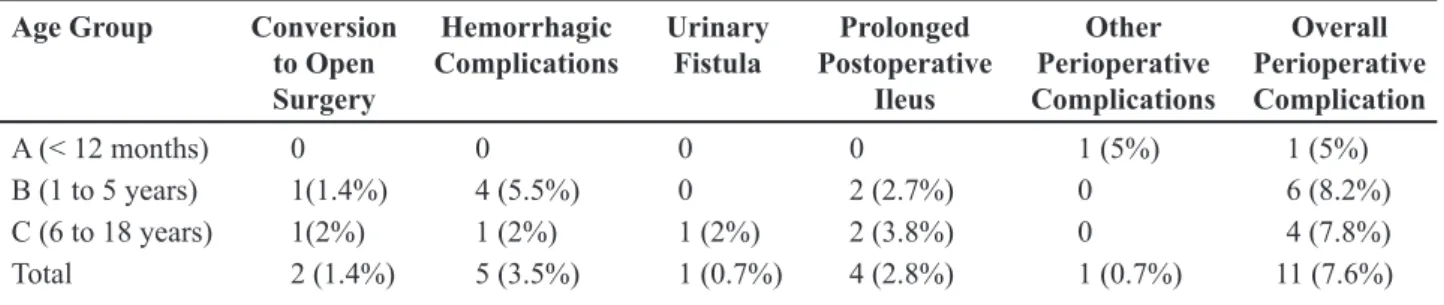
postoperative days. A summary of all postoperative
incidents is depicted in Table-3.
In the late follow-up, 3 events were noted, all
in patients with duplication anomalies. A young boy
who had undergone an UPN at the age of 13 months persisted with urinary tract infections and VUR to the
lower pole and needed an open ureteral reimplanta-tion. A girl who underwent UPN at the age of 5 years developed a distal ureteral empyema and needed a laparoscopic distal ureterectomy. A young boy who underwent UPN at the age of 16 months developed an asymptomatic functional loss of the ipsilateral inferior renal unit, probably due to accidental injury of the main renal artery during surgery.
Regarding the late follow-up of pyeloplasties,
all patients showed clinical and radiological evidence of success. The 2 patients who underwent a laparo-scopic pyelolithotomy became stone free.
The seven radical nephrectomies were per-formed in patients with Wilms´ tumor, after good response to neoadjuvant chemotherapy (12). No tumor rupture occurred in any of the cases, and neither local nor systemic recurrences were observed, after a mean
follow-up of 33 months.
Group C (> 5 years of age; n = 51). Fifty
(98%) procedures were completed laparoscopi -cally. A single case needed a tactical conversion to
open surgery (2%). A 9 year-old girl undergoing a
radical nephrectomy for a renal cell carcinoma had an extensive adherence between the mass and the diaphragm, resulting in diaphragm laceration dur-ing dissection. A subcostal incision was made to remove the specimen and facilitate the closure of the diaphragm. The postoperative course of this patient was uneventful.
Table 3 – Frequency of perioperative complications in each age group.
Age Group Conversion to Open Surgery
Hemorrhagic Complications
Urinary Fistula
Prolonged Postoperative
Ileus
Other Perioperative Complications
Overall Perioperative Complication
A (< 12 months) 0 0 0 0 1 (5%) 1 (5%)
B (1 to 5 years) 1(1.4%) 4 (5.5%) 0 2 (2.7%) 0 6 (8.2%) C (6 to 18 years) 1(2%) 1 (2%) 1 (2%) 2 (3.8%) 0 4 (7.8%) Total 2 (1.4%) 5 (3.5%) 1 (0.7%) 4 (2.8%) 1 (0.7%) 11 (7.6%)
There were no major complications. Minor
complications occurred in 4 (7.8%) cases: one signii -cant intraoperative bleeding, two cases of prolonged
postoperative ileum and one case of urinary istula
in a patient who underwent a pyeloplasty, in whom the intraoperative antegrade insertion of a double J catheter was not possible. Despite being kept with the bladder catheter, the patient developed an anastomotic urinary leakage, and required a retrograde insertion of a double J catheter in the 8th post-operative day
(POD). After that, the follow-up was excellent with discharge by the 10th POD.
All patients had normal oral intake within
the irst two postoperative days, except for two cases
that presented with prolonged ileus, which subsided spontaneously in the 5th POD. Regarding the late fol
-low-up of these patients, only 2 events were observed. A boy who had undergone a nephroureterectomy when he was 11 years-old persisted with an obstruc-tive ureterocele and needed an endoscopic puncture.
A girl who underwent a UPN at the age of 13 years
developed a distal ureteral empyema and needed a laparoscopic distal ureterectomy.
The late results of all pyeloplasties in this group of patients were favorable as well, without other complications.
In the four radical nephrectomies of this group, the pathological studies disclosed one xanto-granulomatous pyelonephritis, one cystic nephroma, one clear cell carcinoma and one Wilms´ tumor. The patients with neoplasms had no signs of local or sys-temic tumor recurrence after an average follow-up of
33 months.
Comparative Analysis
Although the irst group is smaller, the de -mographics of the groups are comparable (Table-1). The procedures are evenly distributed in all groups, p = 0.69 (Table-2).
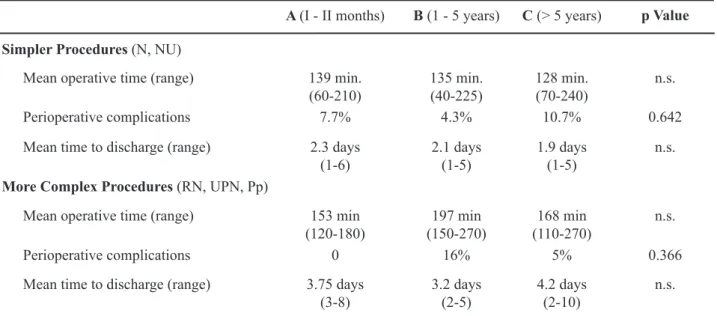
Table-4 illustrates the main operative and
postoperative data in the 3 age groups.
There were no differences among the groups regarding conversion (p = 0.72) or perioperative
complications (p = 0.88) (Table-3). Also, when com -paring the incidence of complications between the simpler (nephrectomies and nephroureterectomies)
and more complex (Radical Nephrectomies, Upper
Pole Nephrectomies and Pyeloplasties) procedures,
no difference was found (p = 0.66, 0.39, 0.46 and
0.47 for Groups A, B, C and the whole popula-tion).
Table 4 – Operative and postoperative data for simpler and more complex procedures in each age group.
A (I - II months) B (1 - 5 years) C (> 5 years) p Value
Mean operative time (range) 139 min. (60-210)
135 min. (40-225)
128 min. (70-240)
n.s.
Perioperative complications 7.7% 4.3% 10.7% 0.642
Mean time to discharge (range) 2.3 days (1-6)
2.1 days (1-5)
1.9 days (1-5)
n.s.
More Complex Procedures (RN, UPN, Pp)
Mean operative time (range) 153 min (120-180)
197 min (150-270)
168 min (110-270)
n.s.
Perioperative complications 0 16% 5% 0.366
Mean time to discharge (range) 3.75 days
(3-8) 3.2 days(2-5)
4.2 days (2-10)
n.s.
N = nephrectomy; NU = nephroureterectomy; UPN = upper pole nephrectomy; RN = radical nephrectomy; Pp = pyeloplasty; n.s. =
COMMENTS
Adequate training and availability of new technologies have allowed the progressive increase in the indications of laparoscopic procedures in pediatric
urology. Reconstructive and ablative renal procedures
have been reported with increasing frequency, with safety and success (9-12,17). The presence of malignant pathology was one of the few limitations yet to be trans-posed in pediatric renal laparoscopy. We have recently described the successful treatment of Wilms´ tumor in children by laparoscopic nephrectomy (14,15). More-over, we included in this sampling the laparoscopic treatment of a patient with clear cell carcinoma and other with cystic nephroma, with therapeutic success after a follow-up longer than 19 months.
The frequently described advantages of lapa-roscopic surgery are not always observed in simple nephrectomies, since incisions of open surgery can be small and recovery of children, particularly the younger ones, tends to be fast. Nevertheless, it must be stressed that very small incisions do not always allow a safe exposure of the renal pedicle and neighboring structures, favoring occasional accidents (4).
Despite being a parameter dificult to evalu -ate objectively, the parental satisfaction is prone to be
more signiicant in laparoscopic procedures, due to
the excellent cosmetic results as well as the smaller
number of necessary dressing exchanges. Regarding
nephroureterectomies, the laparoscopic choice pres-ents clear advantages, considering that the open access may imply an additional lower incision to remove the distal ureter.
The polar nephrectomy is one of the new procedures in which laparoscopy seems more ap-pealing, since it allows excellent visualization of the vascular pedicles and the renal units, with minimum mobilization of the lower moiety and excellent results concerning the preservation of this unit (18).
Pyeloplasty is still considered a technically demanding procedure, but has been reported with increasing frequency, with results that match open surgery, and clearly surpass those of endopyelotomies, whose late results are poor (19,20). The insertion of double J catheter was preferably antegrade during the laparoscopic pyeloplasty, facilitating the section of the UPJ and the anastomosis, as well as saving time
by skipping cystoscopy and patient repositioning. Insertion of a double J catheter was not possible in only one patient. Postoperative results were excellent in all cases.
Despite an increased technical difficulty in smaller children, all procedures were feasible, independent of age and body size. In fact, we have observed that the access to the renal vessels or to the UPJ was very fast in many of the patients in Group A, due to the scarcity of peri-renal fat in young infants,
which facilitated the surgery signiicantly. In smaller
patients, we have routinely chosen to perform pyelo-plasties transperitoneally, due to the larger working space, that allows a comfortable pieloureteral anas-tomosis. This has been the choice of the majority of authors (10,11,17).
The operative times shown at this study must be analyzed with some restrictions, due to the het-erogeneity of the surgeries, the effect of the learning curve and the participation of different residents in training. Despite these remarks, we can observe that most procedures could be accomplished at reasonable operative times, even in the smaller children.
Moreover, the hospitalization times shown here are slightly longer than those usually reported for laparoscopic procedures elsewhere. This can be explained by the some particularities of our Institu-tion, where many patients come from other regions of the country and may require longer hospitalization
due to dificult return for early follow-up.
Regarding the safety of the laparoscopic ac
-cess in the 3 age groups during this study, no major
complications or accidents occurred in any of the cases. There were only two tactical conversions to open surgery, none in emergency scenario. Incidents during the procedures and on the immediate postop-erative period (bleeding and adynamic ileus) were rare in all age groups. Of note, our rate of complication was small and not clearly dependent on the complexity of the procedure. This may have been observed at this series because many patients undergoing nephrectomy
had associated conditions, such as inlammation, ne -phrological pathology or previous adhesions, which rendered an otherwise simple operation into a more
dificult one.
laparoscopic access itself, but rather to lower urinary
tract pathology (distal stump empyema, VUR and
persistence of an obstructive ureterocele). The other event (loss of the lower pole after UPN) is also well described in open procedures (5).
CONCLUSIONS
Most ablative and reconstructive renal pro-cedures can be performed safely by laparoscopy in the pediatric age group, with excellent functional and aesthetic outcomes. The feasibility was excellent and the morbidity of the procedures was minimal irrespec-tive of the age of the patients.
Ideally, a prospective randomized study is needed to assess in which age groups, if in any, lapa-roscopy is superior to the open procedure. However, our study suggests that laparoscopy is a feasible and safe alternative that can be offered in the cases when renal surgery is required.
CONFLICT OF INTEREST
None declared.
REFERENCES
1. Abdelmaksoud A, Biyani CS, Bagheri F, Janetschek G: Laparoscopic approaches in urology. BJU Int. 2005; 95: 244-9.
2. Jurczok A, Hamza A, Nill A, Gerbershagen HP, Fornara P: The value of laparoscopic kidney surgery in urology. Urologe A. 2006; 45: 1111-2, 1114-7.
3. Teber D, Subotic S, Schulze M, Stock C, Eskicorapci S, Rassweiler J: The position of laparoscopic surgery in pediatric urology. Urologe A. 2006; 45: 1145-6, 1148-54.
4. Elder JS, Hladky D, Selzman AA: Outpatient nephrec-tomy for nonfunctioning kidneys. J Urol. 1995; 154: 712-4; discussion 714-5.
5. Gundeti MS, Ransley PG, Duffy PG, Cuckow PM, Wilcox DT: Renal outcome following heminephrec -tomy for duplex kidney. J Urol. 2005; 173: 1743-4. 6. Robinson BC, Snow BW, Cartwright PC, De Vries CR,
Hamilton BD, Anderson JB: Comparison of
laparo-scopic versus open partial nephrectomy in a pediatric series. J Urol. 2003; 169: 638-40.
7. El-Ghoneimi A, Farhat W, Bolduc S, Bagli D, McLorie G, Khoury A: Retroperitoneal laparoscopic vs open partial nephroureterectomy in children. BJU Int. 2003; 91: 532-5.
8. Bonnard A, Fouquet V, Carricaburu E, Aigrain Y, El-Ghoneimi A: Retroperitoneal laparoscopic versus open pyeloplasty in children. J Urol. 2005; 173: 1710-3; discussion 1713.
9. Piaggio L, Franc-Guimond J, Figueroa TE, Barthold JS, González R: Comparison of laparoscopic and open partial nephrectomy for duplication anomalies in children. J Urol. 2006; 175: 2269-73.
10. Metzelder ML, Schier F, Petersen C, Truss M, Ure BM: Laparoscopic transabdominal pyeloplasty in children is feasible irrespective of age. J Urol. 2006; 175: 688-91.
11. Cascio S, Tien A, Chee W, Tan HL: Laparoscopic dismembered pyeloplasty in children younger than 2 years. J Urol. 2007; 177: 335-8.
12. Jesch NK, Metzelder ML, Kuebler JF, Ure BM: Lapa-roscopic transperitoneal nephrectomy is feasible in the irst year of life and is not affected by kidney size. J Urol. 2006; 176: 1177-9.
13. Graf N, Tournade MF, de Kraker J: The role of preop -erative chemotherapy in the management of Wilms’ tumor. The SIOP studies. International Society of Pediatric Oncology. Urol Clin North Am. 2000; 27: 443-54.
14. Duarte RJ, Dénes FT, Cristofani LM, Giron AM, Filho VO, Arap S: Laparoscopic nephrectomy for wilms tumor after chemotherapy: initial experience. J Urol. 2004; 172: 1438-40.
15. Duarte RJ, Dénes FT, Cristofani LM, Odone-Filho V, Srougi M: Further experience with laparoscopic nephrectomy for Wilms’ tumour after chemotherapy. BJU Int. 2006; 98: 155-9.
16. Steyaert H, Valla JS: Minimally invasive urologic surgery in children: an overview of what can be done. Eur J Pediatr Surg. 2005; 15: 307-13.
17. Moon DA, El-Shazly MA, Chang CM, Gianduzzo TR, Eden CG: Laparoscopic pyeloplasty: evolution of a new gold standard. Urology. 2006; 67: 932-6.
18. Dénes FT, Danilovic A, Srougi M: Outcome of laparo -scopic upper-pole nephrectomy in children with duplex systems. J Endourol. 2007; 21: 162-8.
EDITORIAL COMMENT
Minimally invasive surgery is evolving fast
in the ield of pediatric urology. The advantages for
some indications like ablative procedures as nephro-ureterectomy (including for donation) and partial nephrectomy for duplicated systems are real and here to stay (1,2). As in the present study, several authors showed that both transperitoneal laparoscopic or ret-roperitoneoscopic procedures were performed safely in all pediatric age groups with minimal morbidity
and excellent short-term results (1-3).
On the other hand, reconstructive procedures
are dificult to perform and dependent on special
skills. With increasing improvement of the suture techniques, laparoscopic pyeloplasty represents, in experienced hands, an alternative method with suc-cess rates comparable to the open technique in sucsuc-cess rates (4,5).
Comparative studies indicate that laparoscop-ic surgery achieves minimal morbidity such as pain and a quick return to normal activities. The hospital
stay is signiicantly reduced, although the operative
times are long compared with open pyeloplasty (5).
Additionally, a recent report of morbidity and inlam -matory response comparing open and laparoscopic pyeloplasty in the pediatric population show that
an enlarged renal pelvis and crossing vessels. Eur Urol. 2002; 42: 268-75.
20. Desai MM, Desai MR, Gill IS: Endopyeloplasty versus endopyelotomy versus laparoscopic pyeloplasty for
primary ureteropelvic junction obstruction. Urology. 2004; 64: 16-21; discussion 21.
Accepted after revision: August 25, 2008
Correspondence address:
Dr. Alessandro Tavares Rua Dr. Paulo Dias, 75
São Paulo, SP, 04109-060, Brazil Fax: + 55 11 3213-9742
E-mail: [email protected]
shorter hospital stay and decreased cytokine response
following laparoscopic indicates potential beneits
over traditional invasive procedures (6).
However, at present time, experience with reconstructive procedures in children remains limited. Concerning pediatric laparoscopic pyeloplasty it is not clear if children younger than 1 year, where the open
incision can be small, will beneit from this procedure. In this present series only 3 children in this age group
underwent pyeloplasty but promising results seem to be reported.
Some alternatives reported to simplify the repair, which reduce operative time and achieve better results include laparoscopic dissection with extracorporeal reconstruction and robotic assisted surgery (7,8).
Sukumar et al. report 13 children who under -went laparoscopic assisted dismembered pyeloplasty.
Using 5 mm camera and 3 mm working ports, the
ureteropelvic junction (UPJ) was mobilized by a transperitoneal laparoscopic technique. The UPJ was
cm and the average postoperative hospital stay was
3.2 days. That authors believe that this technique has
results comparable to that of open pyeloplasty and hence, maybe considered a good option for surgeons making the transition to pure laparoscopic pyeloplasty (7).
Robotic pediatric urologic procedures such
as pyeloplasty, ureteral reimplantation, partial or total nephrectomy with or without ureteral stump removal are now done on a regular basis at select centers offer-ing robotic expertise. The minimally invasive surgery
using robotic da Vinci surgical system provides deli -cate manipulation, coalesced with three-dimensional
visualization and a superior magniication. This has
been considered the bridge between laparoscopy and open surgery. Some authors believe that in small children robotic surgery achieve a better quality of ureteral anastomosis than regular laparoscopic pro-cedure (8).
We congratulate the pioneer work of these au-thors in Brazil to consistently show that laparoscopic surgery must be incorporated in the pediatric urologic armamentarium.
REFERENCES
1. Chertin B, Ben-Chaim J, Landau EH, Koulikov D, Nadu A, Reissman P, et al.: Pediatric transperitoneal laparoscopic partial nephrectomy: comparison with an age-matched group undergoing open surgery. Pediatr Surg Int. 2007; 23: 1233-6.
2. Basiri A, Simforoosh N, Heidari M, Moghaddam SM, Otookesh H: Laparoscopic v open donor nephrectomy for pediatric kidney recipients: preliminary report of
a randomized controlled trial. J Endourol. 2007; 21: 1033-6.
3. Machado M, Cartum J, Santos-Machado TM, Gaspar HA, Simoes AS, Cruz R, et al.: Retroperitoneoscopic adrenalectomy in an infant with adrenocortical viril-izing tumor. Sao Paulo Med J. 2002; 120: 87-9. 4. Lam PN, Wong C, Mulholland TL, Campbell JB,
Kropp BP: Pediatric laparoscopic pyeloplasty: 4-year experience. J Endourol. 2007; 21: 1467-71.
5. Piaggio LA, Franc-Guimond J, Noh PH, Wehry M, Figueroa TE, Barthold J, et al.: Transperitoneal laparo-scopic pyeloplasty for primary repair of ureteropelvic junction obstruction in infants and children: compari-son with open surgery. J Urol. 2007; 178: 1579-83. 6. Wang L, Qin W, Tian F, Zhang G, Yuan J, Wang H:
Cytokine responses following laparoscopic or open pyeloplasty in children. Surg Endosc. 2008; 4. [Epub ahead of print]
7. Sukumar S, Nair B, Sanjeevan KV, Mathew G, Bhat HS: Laparoscopic assisted dismembered pyeloplasty in children: intermediate results. Pediatr Surg Int. 2008; 24: 403-6.
8. Patel RP, Casale P: Robotic pediatric urology. Minerva Urol Nefrol. 2007; 59: 425-30.
Dr. Marcos Tobias-Machado
Urologic Oncology and Laparoscopy Section of Urology, ABC Medical School Sao Paulo, SP, Brazil E-mail: [email protected]
Dr. Marco Tulio Coelho Lasmar
Department of Urology Felicio Rocho Hospital Belo Horizonte, MG, Brazil
EDITORIAL COMMENT
The laparoscopic technique, which is pres-ently one of the highlights among the urological thera-pies and is still on the rise, especially due to its recent association with robot-assisted surgery, began, in the
ield of Urology, with uropediatrics. The irst and most signiicant studies written about laparoscopy in Urol
authors who are now presenting a respectable number of cases of renal surgeries in children, have already
shown signiicant results in Wilms’ tumor surgery. In this study, the authors presented a signii -cant number of cases of renal procedures in children, most of which were ablative, with outstanding results. In fact, the results are so good that presently their
department uses laparoscopic surgery as the irst in -dication for renal surgery in children, whereas open surgery is the exception.
It is worth mentioning the authors’ preference for the transperitoneal approach, which was used in
140 out of 144 cases. Personally, I believe that the retroperitoneal or transperitoneal approach could have been randomly indicated in most of these cases, depending only on the surgeon’s personal preference. There is no evidence that one approach is better that the other for most cases of renal and adrenal sur-gery.
I would like to challenge the authors of this excellent study to repeat their experience with the retroperitoneal approach.