r e v b r a s o r t o p .2 0 1 4;4 9(3):267–270
w w w . r b o . o r g . b r
Original Article
Association between trochanteric bursitis, osteoarthrosis
and total hip arthroplasty
夽
,
夽夽
Carlos Roberto Schwartsmann
a,∗, Felipe Loss
a, Leandro de Freitas Spinelli
a,
Roque Furian
a, Marcelo Faria Silva
b, Júlia Mazzuchello Zanatta
c,
Leonardo Carbonera Boschin
c, Ramiro Zilles Gonc¸alves
c, Anthony Kerbes Yépez
c aServic¸o de Ortopedia e Traumatologia do Complexo Hospitalar da Santa Casa de Porto Alegre, Porto Alegre, RS, BrazilbDepartamento de Fisioterapia da Universidade Federal de Ciências da Saúde de Porto Alegre, Porto Alegre, RS, Brazil
cIrmandade Santa Casa de Misericórdia de Porto Alegre, Porto Alegre, RS, Brazil
a r t i c l e
i n f o
Article history:
Received 2 April 2013 Accepted 23 July 2013 Available online 25 April 2014
Keywords:
Hip arthroplasty Osteoarthritis Bursitis Epidemiology
a b s t r a c t
Objective:this was an epidemiological study on trochanteric bursitis at the time of perform-ing total hip arthroplasty.
Methods:sixty-two sequential patients who underwent total hip arthroplasty due to osteoarthrosis, without any previous history of trochanteric bursitis, were evaluated. The bursas were collected and evaluated histologically.
Results:there were 35 female patients (56.5%) and 27 male patients (43.5%), with a mean age of 65 years (±11). Trochanteric bursitis was conformed histologically in nine patients (14.5%), of whom six were female (66.7%) and three were male (33.3%).
Conclusions: 14.5% of the bursas analyzed presented inflammation at the time that the pri-mary total hip arthroplasty due to osteoarthrosis was performed, and the majority of the cases of bursitis were detected in female patients.
© 2014 Sociedade Brasileira de Ortopedia e Traumatologia. Published by Elsevier Editora Ltda. All rights reserved.
Associac¸ão entre bursite trocantérica, osteoartrose e artroplastia total do
quadril
Palavras-chave:
Artroplastia de quadril Osteoartrite
Bursite Epidemiolgia
r e s u m o
Objetivo:fazer um estudo epidemiológico da bursite trocantérica no momento da feitura da artroplastia total do quadril (ATQ).
Métodos:foram avaliados 62 pacientes, sequenciais, submetidos à ATQ por osteoartrose, sem história prévia de bursite trocantérica. As bursas foram coletadas e avaliadas histologica-mente.
夽
Please cite this article as: Schwartsmann CR, Loss F, de Freitas Spinelli L, Furian R, Silva MF, Zanatta JM, et al. Associac¸ão entre bursite trocantérica, osteoartrose e artroplastia total do quadril. Rev Bras Ortop. 2014;49:267–270.
夽夽
Work performed in the Santa Casa de Porto Alegre Hospital Complex, Porto Alegre, RS, Brazil.
∗ Corresponding author.
E-mail: [email protected] (C.R. Schwartsmann).
268
r e v b r a s o r t o p .2 0 1 4;4 9(3):267–270Resultados: foram observados 35 pacientes do sexo feminino (56,5%) e 27 do masculino (43,5%), com média de 65 anos (+/−11). A bursite trocantérica foi confirmada histologica-mente em nove (14,5%), seis do sexo feminino (66,7%) e três (33,3%) do masculino.
Conclusões: das bursas analisadas, 14,5% apresentaram inflamac¸ão no momento da feitura da ATQ primária por osteoartrose. A maioria das bursites foi detectada nas pacientes femi-ninas.
© 2014 Sociedade Brasileira de Ortopedia e Traumatologia. Publicado por Elsevier Editora Ltda. Todos os direitos reservados.
Introduction
Trochanteric bursitis is the term used to describe intermit-tent chronic pain accompanied by discomfort on palpation of the lateral region of the hip caused by an inflamma-tory process in the bursas.1 The bursas are pouches coated
with synovial membranes, with fluids inside them, which are responsible for diminishing the friction of tendons and mus-cles over bone prominences.2Among all the bursas of the hip
that have been described, the trochanteric bursa is the one most frequently affected by inflammation. The most frequent cause of trochanteric bursitis is repetitive microtrauma due to active use of the muscles that are inserted into the greater trochanter, thereby resulting in degenerative changes to the tendons, muscles or fibrous tissues.3
Hip arthrosis is one of the musculoskeletal diseases that may be associated with trochanteric bursitis. Both in young and in old patients, the indications for total hip arthro-plasty (THA) involve progressive worsening of pain with loss of function and worsening of quality of life consequent to osteoarthrosis.4 THA is the elective orthopedic procedure
most performed worldwide, with the highest success rate.5
Nonetheless, there are no relevant data in the current litera-ture regarding the incidence of trochanteric bursitis among patients undergoing THA. Silva et al.6 presented the only
study on preoperative bursitis, but with few bursas col-lected and with patients presenting rheumatoid arthritis and osteoarthrosis.6 However, the incidence of trochanteric
bursitis following THA procedures is approximately 4.6%.7
The gold-standard diagnosis for defining trochanteric bursi-tis is made through anatomopathological assessment of the bursa. Ferrala et al.8 and Nikolajsen et al.9 reported that,
12–18 months after the THA procedure, around 12% of their patients still presented chronic pain in performing their daily activities.8,9
The present study aimed to evaluate the association between trochanteric bursitis and osteoarthrosis at the time of performing primary THA.
Materials and methods
This was a prospective study on 62 sequential patients who presented primary hip osteoarthrosis and underwent a THA procedure. Bursectomy is a routine procedure performed with THA at our service.
The bursas were collected during the surgery and were sent to the institution’s pathology laboratory. An experi-enced pathologist analyzed the bursas and identified whether
bursitis was present. Slides were prepared at section thick-nesses of 2.0–3.0m and were stained using the
hematoxylin-eosin technique. An Olympus optical microscope (model BX40) was used. The criterion used for diagnosing bursitis was the presence of capsule thickening, with fibroblastic proliferation and lymphocytic, histiocytic or neutrocytic inflammatory infil-trate, and with synovial hyperplasia.
Patients with rheumatoid arthritis, proximal epiphysiol-ysis of the femur, local tumors, developmental dysplasia of the hip, Legg–Calvé–Perthes disease, previous hip fractures, hemophilia, osteonecrosis, sequelae from septic arthritis and tuberculosis and previous procedures or radiotherapy on the hip that was to be operated. All the information was gath-ered from the medical files and also included demographic, epidemiological and clinical data such as age, sex and clinical presentations.
The statistical analysis on the data was performed using the Excel for Windows software, and it consisted of descriptive statistics and frequency distributions.
Results
There were 35 female patients (56.5%) and 27 male patients (43.5%). The mean age was 65 years (standard deviation±11), with a range from 41 to 85.
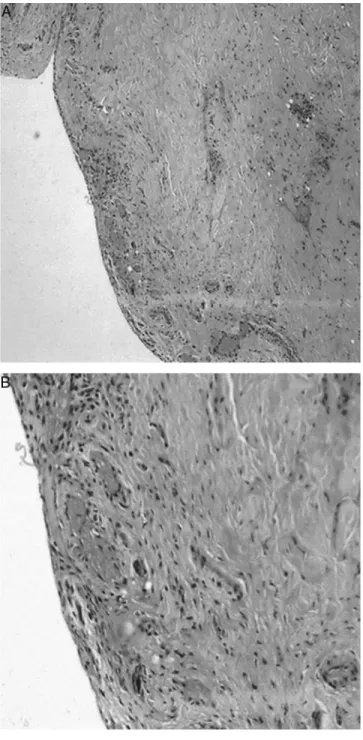
The diagnosis of trochanteric bursitis was confirmed in nine of the patients analyzed (14.5%). Among these, six (66.7%) were female and three (33.3%) were male. Fig. 1 presents the histology of a normal bursa, at magnifications of 100× (A) and 200×(B). A thin fibrous membrane coated with synovial cells can be seen. Fig. 2 presents the histology of a bursa with an inflammatory process (chronic bursitis), at magnifications of 100×(A) and 200×(B), respectively. Fibrous thickening of the capsule can be seen, with a predominantly lymphocytic inflammatory infiltrate and synovial hyperplasia.
Discussion
The treatment for trochanteric bursitis is generally conser-vative and includes non-steroidal anti-inflammatory medica-tions for up to six to eight weeks, along with ice. Infiltramedica-tions, thermal contrasts (ice and heat), rest and physiotherapy can also be used, with ultrasound at the level of the greater trochanter and femoral triangle, in association with muscle stretching for the iliotibial band and the iliopsoas tendon.3,10
r e v b r a s o r t o p .2 0 1 4;4 9(3):267–270
269
Fig. 1 – Normal trochanteric bursa stained using the hematoxylin-eosin technique: (A) magnification of 100×
and (B) magnification of 200×.
epidemiology of the trochanteric bursitis at the time of per-forming the hip surgery.
Trochanteric bursitis may be a manifestation of a sec-ondary disease such as hip osteoarthrosis. In the cases of the present study, we found that nine patients (14.5%) presented silent trochanteric bursitis at the time of their hip arthroplasty procedures, and that most of these patients were female (six; 66.7%). Thus, the great majority of the patients did not present trochanteric bursitis at the time of performing the primary THA.
Some hip surgeons do not perform resection of the bursa during the THA procedure. This might be reflected in
Fig. 2 – Chronic bursitis stained using the
hematoxylin-eosin technique: (A) magnification of 100×
and (B) magnification of 200×.
the postoperative bursitis rates observed in the literature. Farmer et al. evaluated bursitis treatment consisting of use of injectable corticosteroids, after performing arthroplasty. They analyzed 689 primary arthroplasty procedures during the postoperative period and observed that the incidence was 4.6%.7
270
r e v b r a s o r t o p .2 0 1 4;4 9(3):267–270epiphysiolysis of the femur, dysplasia, osteonecrosis, etc.), the data found in this study justify resection of the bursas during the arthroplasty procedure.
Conclusions
Among the patients who underwent THA due to osteoarthro-sis (9/62), 14.5% presented silent trochanteric bursitis at the time of the hip surgery. Two thirds were female (66.7%).
Conflicts of interest
The authors declare no conflicts of interest.
r e f e r e n c e s
1. Alvarez-Nemegyei J, Canoso JJ. Evidence-based soft tissue rheumatology: III: Trochanteric bursitis. J Clin Rheumatol. 2004;10(3):123–4.
2. Stedman TL, editor. Stedman: Dicionário médico. Traduc¸ão de Cláudia Lúcia Caetano de Araújo. 25th ed. Rio de Janeiro: Guanabara Koogan; 1996.
3. Dani WS, Azevedo E. Bursite trocantérica. Rev Bras Med. 2006;7(1):2–5.
4. Shrader MW. Total hip arthroplasty and hip resurfacing arthroplasty in the very young patient. Orthop Clin North Am. 2012;43(3):359–67.
5. Pivec R, Johnson AJ, Mears SC, Mont MA. Hip arthroplasty. Lancet. 2012;380(9855):1768–77.
6. Silva F, Adams T, Feinstein J, Arroyo RA. Trochanteric bursitis: refuting the myth of inflammation. J Clin Rheumatol. 2008;14(2):82–6.
7. Farmer KW, Jones LC, Brownson KE, Khanuja HS, Hungerford MW. Trochanteric bursitis after total hip arthroplasty: incidence and evaluation of response to treatment. J Arthroplasty. 2010;25(2):208–12.
8. Ferrala P, Carla S, Fortina M, Scipio D, Riva A, Di Giacinlo S. Painful hip arthroplasty: definition. Clin Cases Miner Bone Metab. 2011;8(2):19–22.
9. Nikolajsen L, Brandsborg B, Lucht U, Jensen TS, Kehlet H. Chronic pain following total hip arthroplasty: a nationwide questionnaire study. Acta Anaesthesiol Scand.
2006;50(4):495–500.