© 2013 Elsevier Editora Ltda. All rights reserved.
REV ASSOC MED BRAS. 2013;59(2):104-105
ASSOCIAÇÃO MÉDICA BRASILEIRA REVISTA DA
Volume 58 • Número 6 • Novembro/Dezembro 2012 • ISSN 0104-4230 • ISSN 1806-9282 (On-line)
www.ramb.org.br
ARTIGOS
ARTIGOS ORIGINAIS _____________Qualidade da informação da internet disponível para pacientes em páginas em português ___________________________________________________________645 Acesso a informações de saúde na internet: uma questão de saúde pública? ______650 Maus-tratos contra a criança e o adolescente no Estado de São Paulo, 2009_______659 Obesidade e hipertensão arterial em escolares de Santa Cruz do Sul – RS, Brasil ___666 Bone mineral density in postmenopausal women with and without breast cancer ___673 Prevalence and factors associated with thoracic alterations in infants born prematurely __________________________________________________679 Análise espacial de óbitos por acidentes de trânsito, antes e após a Lei Seca, nas microrregiões do estado de São Paulo ___________________________________685 Sobrevida e complicações em idosos com doenças neurológicas em nutrição enteral ______________________________________________________691 Infliximab reduces cardiac output in rheumatoid arthritis patients without heart failure ______________________________________________________698 Análise dos resultados maternos e fetais dos procedimentos invasivos genéticos fetais: um estudo exploratório em Hospital Universitário _______________703 Frequência dos tipos de cefaleia no centro de atendimento terciário do Hospital das Clínicas da Universidade Federal de Minas Gerais __________________709
ARTIGO DE REVISÃO ______________Influência das variáveis nutricionais e da obesidade sobre a saúde e o metabolismo __714
EDITORIAL
Conclusão: como exibir a cereja do bolo 633
PONTO DE VISTA
Os paradoxos da medicina contemporânea 634
IMAGEM EM MEDICINAObstrução duodenal maligna: tratamento endoscópico paliativo utilizando prótese metálica autoexpansível 636 Gossypiboma 638
DIRETRIZES EM FOCO
Hérnia de disco cervical no adulto: tratamento cirúrgico 639
ACREDITAÇÃOAtualização em perda auditiva: diagnóstico radiológico 644
SEÇÕES ____________________________
•
•
•
30/11/12 11:24
www.ramb.org.br
Revista da
ASSOCIAÇÃO MÉDICA BRASILEIRA
Image in Medicine
Epiphrenic esophageal diverticulum
Divertículo epifrênico de esôfago
Elias Jirjoss Ilias
a, Paulo Kassab
baColégio Brasileiro de Cirurgiões, São Paulo, SP, Brazil
bFaculdade de Ciências Médicas da Santa Casa Misericórdia de São Paulo, São Paulo, SP, Brazil
* Corresponding author at: Rua Prof. Enéas de Siqueira Neto, 340, Jardim Imbuías, Sta. Cecília, São Paulo, SP, 04829‑900, Brazil
E‑mail: [email protected] (E.J. Ilias)
Case presentation
Female patient, 40 years of age, presented to the surgical outpatient clinic complaining of dysphagia and halitosis. She had a medical history of HIV‑positive asymptomatic disease. She was submitted to an upper endoscopy procedure that showed protrusion of a sac in the distal esophagus, compatible with epiphrenic esophageal diverticulum.
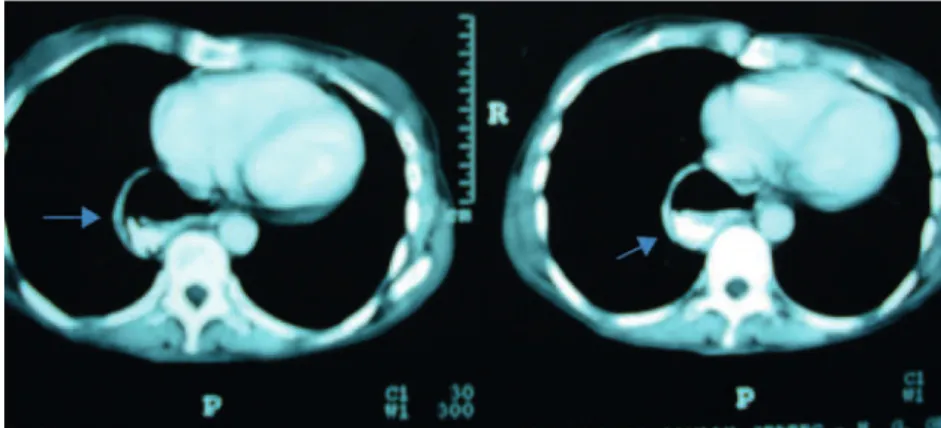
A contrast X‑ray was performed, which showed a large diverticulum in the distal esophagus, protruding from the right side of the thorax (Figure 1); the computed tomography assessment showed a distal esophageal diverticulum with air‑fluid level in the right hemithorax (Figure 2).
The patient underwent a right thoracotomy with diver‑ ticulum resection and simple suture of its base, with good postoperative outcome. The patient showed resolution of dysphagia symptoms, and has remained asymptomatic during the follow‑up.
Discussion
Esophageal diverticula are epithelialized mucosal sacs that protrude from the esophageal lumen. They can be classified based on the place of occurrence; the epiphrenic type emerges from 10 cm distal to the esophagus (supradiaphragmatic). The epiphrenic diverticulum occurs more commonly on the right side. The most common symptoms are dysphagia, vomiting, regurgitation, chest and/or epigastric pain, coughing, and halitosis.
REV ASSOC MED BRAS. 2013;59(2):104-105
105
Fig. 2 – Chest computed tomography showing diverticulum with air‑fluid level in posterolateral right side (arrows).
The diagnosis method that best defines the diverticulum is contrast X‑ray of the esophagus, which also demonstrates the motility disorder. In some cases, the presence of distal esophagus tumors may lead to increased pressure in the organ, which leads to the appearance of the diverticulum. These diverticula are usually acquired and rarely congenital or caused by trauma.
The treatment of these diverticula, when asymptomatic or mildly symptomatic, should be clinical, as the surgical approach
has significant morbimortality. In cases of large diverticula
(> 3 cm) and very symptomatic patients, surgical resection is