(1) Pontifícia Universidade Católica de São Paulo(PEPG-PUCSP), São Paulo, SP, Brazil.
Research support source: National Postdoctoral Program/ Coordination for the Improvement of Higher Education Personnel (PNPD/CAPES).
Conlict of interest: Nonexistent
Effects of orofacial myofunctional therapy on
the symptoms and physiological parameters of
sleep breathing disorders in adults:
a systematic review
Fabiane Kayamori(1)
Esther Mandelbaum Gonçalves Bianchini(1)
Received on: August 29, 2017 Accepted on: October 17, 2017
Mailing address:
ABSTRACT
Recently, the orofacial myofunctional therapy (OMT) has appeared as a possible alter-native treatment for obstructive sleep apnea (OSA). Systematic reviews are required to achieve scientiic evidence, seeking to direct the decision on therapeutic issues. The aim of this study was to systematically review the literature about the OMT proposals in adults with OSA related to symptoms and physiological parameters. Data sources were Lilacs, MEDLINE, Pubmed, Cochrane and Scielo using the descriptors: obstruc-tive sleep apnea; myofunctional therapy; oropharyngeal exercises; breathing exercises; upper airway exercises; speech therapy. Studies published from 2000 to 2017 that evaluated the treatment with isolated OMT in subjects with OSA were included, obli-gatorily with polysomnographic data, pre and post therapy. Eight studies, out of 124 articles, were eligible according to the criteria adopted. Two systematic reviews, one clinical trial, three randomized clinical trials, and two case reports were included. Six studies showed a decrease in the Apnea and Hypopnea Index (AHI), ive studies sho -wed improvement in the minimum SpO2, decrease in the Epworth Sleepiness Scale (ESS) and in snoring. OMT proposals refer to a three-month program changing the parameters related to partial reduction of AHI, ESS index, snoring, and partial increase of SpO2. There are few randomized studies.
Keywords: Obstructive Sleep Apnea; Snoring; Myofunctional Therapy; Speech,
INTRODUCTION
Orofacial myofunctional therapy (OMT) is a set of techniques and procedures intended to change orofacial muscular and functional patterns using isotonic and isometric exercises for orofacial and oropharyngeal muscles targeting the functions of breathing, mastication, swallowing and speech1.
For the past 10 years, Speech, Language and Hearing Sciences intervention using OMT have been
presented in this ield as one of the possible treatments
for snoring and obstructive sleep apnea (OSA), with evidence found specially in studies on Sleep Breathing DIsorders in adults1-4.
Every new ield of study with its speciic techniques needs researches that provide evidence of the beneits of each therapy. The irst publications on OMT for
obstructive sleep apnea date from 19995, but the irst
randomized clinical trial (RCT) to use the therapy as alternative treatment for patients with moderate OSA was published in 20091. The study reported a decrease
of approximately 40% in the Apnea and hypopnea index (AHI), a reduction in cervical circumference, reduction in snoring intensity and frequency, reduction of daytime sleepiness and better sleep quality after the OMT
program. Right after this irst international publication,
the same journal published an editorial questioning
the beneits and objectives of OMT procedures for
improving OSA6.
Physiologically, the pharynx is a highly collapsible area in the entirety of its extension. The activity of dilating pharynx muscles, especially the genioglossus and tensor palatini muscles oppose to the tendency of the pharynx to collapse as a protective mechanism. Changes in such mechanism are associated with the syndrome of obstructive sleep apnea disorder7.
In that sense, OMT applied to OSA has the objective of strengthening the nasopharynx and oropharynx musculature contributing to reduce collapse of the airway during sleep1-4. However, the exact mechanisms
by which OMT helps with Sleep Breathing Disorders are still not clear to this day.
Contemporary studies show OMT eficient results
in improving the quality of life2, in the reduction of
intensity and frequency of snoring3 and in the better
adherence of CPAP (Continuous Positive Airway Pressure)4. Such studies endorse the Speech, Language Therapist interest in this ield and validate
the presence of that professional in the interdisciplinary realm of Sleep Breathing Disorders, especially in Brazil
with the existence of a speciic certiication for Speech,
Language and Hearing Sciences in the ield of sleep
disorders8.
At the present stage, systematic reviews are
necessary to attest the level of scientiic evidence of
OMT effects in OSA and in snoring, as well as to set methodological parameters for the decision-making in therapy matters. However, such parameters are not
always clear or coincident, making dificult a consistent veriication of OMT effects for individuals with Sleep
Breathing Disorders.
The objective of this study is to systematically
analyze the scientiic literature available on OMT
programs for adults with Sleep Breathing Disorders, their effects on symptoms and physiological param-eters, trying to argue for the relevance of the practice-based evidence (PBE).
METHODS
Research strategies
The fundamental questions that guide this literature review are:
“What are the methodological parameters in orofacial myofunctional therapy programs for Sleep Breathing Disorders?”
“What are the effects of the isolated orofacial myofunctional therapy in adults considering symptoms and physiological parameters of Sleep Breathing Disorders?”.
Our search was performed in the following online databases: “Literatura Latino-Americana e do Caribe
em Ciências da Saúde” (Lilacs); ‘‘Medical Literature
Analysis and Retrieval System Online’’ (MEDLINE),
‘‘US National Library of Medicine National Institutes
Health’’ (Pubmed), ‘‘Cochrane Library’’ (Cochrane)
and ‘‘Scientiic Electronic Library’’ (Scielo) and we have selected the studies published between the year 2000 and April 2017.
The descriptors in Health Sciences (DeCs) used for retrieving the articles, language limiters considered for Portuguese and English languages, were: apneia obstrutiva do sono (obstructive sleep
apnea) [All ields]; terapia miofuncional (myofunctional
therapy) [All ields]; exercícios (exercises) [All ields];
exercícios orofaríngeos (oropharyngeal exercises)
[All ields]; exercícios respiratórios/ /exercícios da via
aérea (breathing exercises / upper airway exercises
[All ields]; Fonoaudiologia (Speech, Language and
search was performed with associated descriptors (e/and).
Selection criteria
The selection of studies published followed the steps described below:
The search for materials according to the associate descriptors and that had been published between the year 2000 to 2017 (April) in the referred databases with full version available online; the selection of studies whose titles and abstracts were related to the proposed subject; observation of inclusion and exclusion criteria; reading and analysis of the full text articles.
The considered articles should published in Portuguese or English and approach the method-ological parameters for the OMT programs related to Sleep Breathing Disorders or present studies describing the procedures and effects of isolated OMT in adults considering the symptoms and physiological parameters of Sleep Breathing Disorders (snoring and/or OSA) necessarily reporting polysomnographic data (pre and post therapy), at least for the Apnea and Hypopnea Index (AHI).
Repeated articles recovered from different databases were not considered. An initial selection was made after reading of titles and abstracts and exclusion of those that did not match the criteria. The full text articles were downloaded and the studies were read and analyzed in their entirety. The references were
evaluated, the studies were identiied and listed.
Data analysis
The following topics were tabulated for the articles’ analysis: name of authors, year of publication, infor-mation on the type of study, study risk of bias (consid-ering selection, performance, detection, friction and publishing biases), number of subjects, demographic characteristics (gender, age), type of Sleep Breathing Disorder, level of OSA severity, methodological
parameters with respect to therapeutic procedures and description of results post OMT.
A speciic protocol was developed for the present
research based on the selected articles and trying to answer the question on the methodological param-eters that guide OMT proposals for Sleep Breathing Disorders.
The speciic research protocol based on method -ological parameters included:
Therapeutic parameters: procedures, frequency and period of therapy, therapy follow up;
Parameters for evaluation and reevaluation:
Physiologic parameters: anthropometric measure-ments such as body mass index (BMI) and cervical circumference (cc) pre and post OMT, polysomno-graphic data such as Apnea and Hypopnea Index (AHI) for each hour of sleep and minimum blood oxygen saturation (SpO2) and period with SpO2 under 90% pre and post OTM;
Symptomatology: data on daytime sleepiness (Epworth Sleepiness Scale)9 and snoring reported by
complaint or part of Berlin questionnaire (referring to intensity and frequency)10.
LITERATURE REVIEW
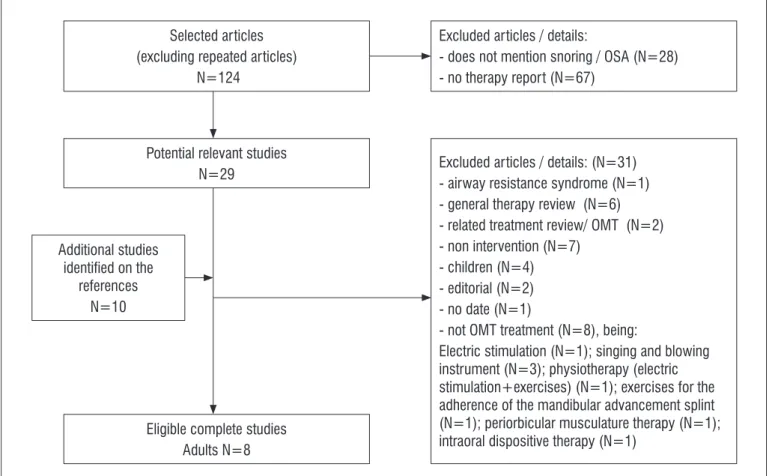
One hundred and twenty four articles were screened considering the methodology for this literature review, initially excluding the studies that did not involve snoring and/or OSA (N=28) and that did not provide some form of therapy (N=67). 29 potentially relevant studies were set apart and their references checked for other studies not present in our initial search. 10 more studies were included. After verifying the total of 39 articles, 31 of them were eliminated and 8 articles were kept for detailed analysis.
The luxogram (Figure 1) illustrates the trajectory
of the present study. It is interesting to point out that 4
studies involve speciically the applicability and results
of OMT for children11-14, two case-control reports13,14 and
with systematic literature review15,16, three RCT1-4, one
clinical study17 and two case reports18,19. A description
of the studies can be found in Tables 1 and 2. Considering the focus of the present systematic
liter-ature review on the effects of isolated OMT for adults with OSA, 8 studies were considered, two of them
Figure 1. Systematic literature review information luxogram: studies selection stage Selected articles
(excluding repeated articles)
N=124
Potential relevant studies N=29
Eligible complete studies Adults N=8 Additional studies
identiied on the
references N=10
Excluded articles / details:
- does not mention snoring / OSA (N=28) - no therapy report (N=67)
Excluded articles / details: (N=31)
- airway resistance syndrome (N=1) - general therapy review (N=6) - related treatment review/ OMT (N=2) - non intervention (N=7)
- children (N=4) - editorial (N=2) - no date (N=1)
- not OMT treatment (N=8), being:
Electric stimulation (N=1); singing and blowing
instrument (N=3); physiotherapy (electric stimulation+exercises) (N=1); exercises for the
adherence of the mandibular advancement splint (N=1); periorbicular musculature therapy (N=1); intraoral dispositive therapy (N=1)
Table 1. Eligible literature review articles description
Author, year Objective Meta-analysis Number of listed
articles Conclusion
Camacho et al, 2015(16)
Systematic literature review considering OMT for the treatment of OSA in children and adults performing meta-analysis of polysomnography, snoring and
sleepiness
Yes 9
Data on the adults:
myofunctional therapy reduces AHI
in approximately 50%, improves
SpO2 and snoring.
Valbuza et al, 2010(15)
Literature review on methods of treatment for OSA improving musculature tonus as revealed in
the AHI.
The three RCT were analyzed reported on Table 2 observing, when possible, the possibility of bias according to the Cochrane Collaboration criteria for the development of systematic reviews of interventions20.
Little information on this item could be recovered in the complete version of the published articles or even in the respective thesis, which were secondarily checked. To give an example, only one of the studies3 mentions
the intention of treating, which is recommended in the cases of dropout or loss of subjects in the RCT and this being a better model for this type of study. The RCT also presented performance bias in the blinding of the professionals performing the clinical evaluations pre and post OMT. That is something important to be taken into account in future studies.
The last three studies: the clinical study17 and the
case reports18,19 do not provide data related to possible
biases. For the present literature review all types of studies were analyzed despite possible biases.
Data related to the establishment the studies’ sample, type of Sleep Breathing Disorder, level of severity of the OSA and therapeutic parameters can be found in Table 3.
The two systematic literature reviews listed in our search differ in relation to the objectives and criteria of analysis (Table 1). Data from the literature review16
performed through meta-analysis attest for the positive effects of OMT in adults based in parameters from polysomnography, indicating approximately 50% decrease in AIH, improvement in minimum blood oxygen saturation and snoring. However, the systematic literature review previously published15, with
focus in the increase of muscle tonus with exercises did not present favorable effects for AIH reduction under
ive15. We should reinforce that given the criteria of the
described literature review potential results above this level were not considered as they would be later16, understanding that the AIH criteria under ive events
per hour indicates remission of the disorder.
Considering two of the RCTs2,4, they originally
correspond to the same study and although they bring additional information, the data are from the same subjects and so were counted only once in our systematic literature review.
Table 2. Eligible clinical studies description considering type of study and biases
Author, year Type of study
Selection bias
Selection bias
Performance
bias Detection bias Attrite bias Report bias Random
sequence generator
Omitted allocation
Participants and professional
blinding
Final reviewers blinding
Incomplete results
Selective results report
Diaféria G
et al, 2013(2) and 2016(4)
RCT unknown unknown
yes (participants) no(professional speech therapist)
yes
(polysomnography) unknown unknown
Verma et al,
2016(17) CR NR NR NR NR NR NR
Ieto et al,
2015(3) RCT unknown unknown
yes (participants) no(professional speech therapist)
yes
(polysomnography) unknown
Treatment recommendation,
low risk of bias
Guimarães
et al, 2009(1) RCT unknown unknown
yes (participants) no(professional speech therapist)
yes
(polysomnography) unknown unknown
Silva et al,
2007(18) CR NR NR NR NR NR NR
Pitta et al, 2007(19)
CR2
cases NR NR NR NR NR NR
The three RCT1-4 counted on a control group
as intended for this type of study. The subjects did not undergo OMT, only receiving orientations and/ or nasal wash as placebo effect in order to minimize performance bias. Trying to analyze the effects of OMT associated to other forms of therapy, other studies2,4
have considered four groups, one control group (N=24), one OMT group (N=27), CPAP (N=27) and a mixed group (CPAP e OTM) (N=22). This literature review considered only the results referring to OMT alone, following the methodological criteria.
The analysis section of the studies1-4,17 did not
include sample calculation, which we consider to be a relevant matter. The challenge of gathering a relevant number of participants in the groups, especially for this kind of studies is a known fact, mainly in the search for homogeneity in the sample. However, observing the number of subjects in the clinical studies’ OMT group, we notice a gradual increase in that aspect through the years, which we consider to be a positive factor.
The Sleep Breathing Disorders and their level of severity have also changed through the years. Starting
Table 3. Description of data from the studies considering subjects characterization, type of disorder and level of OSA severity and therapeutic parameters
Author, year
Subjects characterization in the
studies Type and
severity of the OSA
Therapeutic procedures (OMT)
Frequency/
Period of OMT Follow up
N Gender Age
(years)
Diaféria et al,
2013(2)
and 2016(4) 27 male 45.2±13.0
mild, moderate and severe
OSA
Exercise program:Tongue,
soft palate, pharynx
musculature, facial musculature.Functional: breathing, swallowing and
mastication
12 sessions
3 daily
practices, 20 minutes each
After 3
weeks wash out: decrease
in AHI
Verma et al,
2016(17) 20 female (25%)male (75%) 41.1±10.6
mild and moderate
OSA
3 stages exercise
program:Tongue, soft palate, facial musculature and mandible musculature.
12 sessions 10 repetitions
5 series per day
NR
Ieto et al,
2015(3) 19 female (42.1%)male (57.9%) 48±14
snoring, mild and moderate
OSA
Nasal washShort exercise
programTongue, soft palate, facial musculature.
Functional: mastication
12 sessions Daily practice
3 times a day,
8 minutes each
NR
Guimarães
et al, 2009(1) 16 male 63
Moderate OSA
Nasal washExercise
program:Tongue, soft palate, facial musculature and mandible musculature.
Functional: speech, breathing, swallowing and
mastication
12 sessions Daily practice
30 minutes
each
NR
Silva et al,
2007(18) 1 female 60 Severe OSA
Nasal washExercises
forTongue, soft palate, facial musculature.Functional: Breathing and mastication
12 sessions
Note.:1st PSG 10 months previous to therapy)
NR
Pitta et al, 2007(19)
1 male 37 Severe OSA Exercises forTongue, soft
palate, pharynx musculature,
facial musculature and mandible musculature.
16 sessions NR
1 female 55 Severe OSA 16 sessions NR
with clinical case reports of severe OSA19,20, going to
RCT with moderate OSA1, to mild or moderate OSA 3,17
to RCT2,4 with all three levels of OSA severity. We were
able to notice that the search for data on OMT effects has grown for all levels of OSA.
Regarding the methodological therapeutic param-eters applied to each of the studies1-4,17,19,the approach
and procedures in OMT were the same considering the period of therapy, being prescribed 12 sessions, one time per week. They differ nevertheless in the selection of exercises, number of repetitions, frequency and period of daily practice and also in the type of functional
approach. The speciicities of the practices were not properly justiied regarding the choices made in each
of the studies.
The analysis section of the case reports are clearly
more speciic and direct considering the case matter.
On those studies, the selected exercises are not described, nor is the amount of exercises. On the RCTs those descriptions are found. On one of the case reports17 the amount of exercises changes along three stages of practice: 13 exercises for the two irst
stages and seven for the third one. The other three RCTs1-4 seem to suggest the following up of exercises
and functional practice progress without considering stages. Two of the studies indicate programs with a higher amount of exercises1,2,4 and another3 shows
a great reduction of such number, maybe trying to facilitate the technique for the patient or because of the main focus of the study, which was primary snoring.
It is important to indicate that mostly because of
the type of study, techniques were previously deined
and equally applied for the entire study group in each of researches regardless of the myofunctional changes that each of the participants could present. For RCT studies that is a required procedure in order to observe the effects of a certain technique. However, studies with
consistent justiication for the exercise selection and
its functional approach seem to be necessary to better fund the therapeutic practice targeted to those cases.
The description of therapeutic parameters only similar among the studies is probably due to the variety of aspects and matters that involve a orofacial myofunc-tional therapeutic approach, besides the recent
presence of such therapy in the ield of sleep disorders.
Other relevant data refer to the follow up of the studies in relation to the effects obtained with OMT. Only one of the studies in the present systematic review brought this important concern2,4, revealing a downsize
of the results previously obtained. Considering that the follow up was only after a few weeks, it was possible to attest the necessity of maintaining the therapy program to solidify the results previously obtained. New studies, with medium and long term follow ups seem to be necessary.
The data regarding the methodological param-eters for evaluation and reevaluation post OMT are found in Tables 4 and 5. Considering this aspect, the randomized trials follow similar parameters for evaluation and reevaluation and they are based on
symptomatology data, speciic anthropometric data
Table 4. Description of data considering the results with orofacial myofunctional therapy (OMYT) based on physiological parameters
Author, year
Anthropometric measurements Polysomnography
BMI (kg/m2) CC (cm) AHI (events/hour) Minimum SpO2 (%)
pre post pre post pre post Pre post
Diaféria G
et al, 2013(2) and 2016(4)
25.0±7.4 26.7±2.9 41.6±3.7 41.5±2.3 28±22.7 13.9±18.5* 83.7 ±7.7 84.9±8.8
Verma et al,
2016(17) 25.6±3.1 25.4±3.2 38.4±1.3 37.8±1.6* 20.1±9.1 19.7±9.4 87.6 ±1.1 88.5 ±1.6*
Ieto et al,
2015(3) 28.1±2.7 28.2±2.8 37.9±2.5 37.5±2.4**
25.4 (22.1-28.7)
#
18.1 (15.4-24.1)
# *** 85.5±7.5 83.8±8.9
Guimarães
et al, 2009(1) 29.6±3.8 29.5±4.3 39.6±3.6 38.5±4.0* 22.4±4.8 13.7±8.5* 83±6 85±7*
Silva et al.
2007(18) 23.3 NC NC NC 44 3 83 92
Pitta et al. 2007(19)
26.3 27.7 NC NC 48.5 8.6 79 87
22.2 22.2 NC NC 40.4 3.3 77 83
Subtitles: Data presenting mean and standard deviation. except for #. which presents the results in median. minimum and maximum; BMI= body mass index; CC= cervical circumference; AHI= Apnea and Hypopnea Index per hour of sleep; SpO2 = blood minimum saturation; * P signiicant (<0.05) test T; ** P signiicant considering test with variation according to period and group; *** P relevant only for the group with moderate OSA; NR= no record.
Table 5. Description of data considering the results with orofacial myofunctional therapy (OMT) based on symptomatological parameters
Author. Year
Symptomatology Life quality
Sleep quality ESS Intensity of snoring Frequency of snoring
pre post pre post pre post pre post
Diaféria G
et al. 2013(2) and 2016(4)
FOSQ
WHOQoL-Bref SF-36(2)
FOSQ
WHOQoL-Bref * SF-36*
13.7±3.2(2) 7.5±3.7* 8.5±2.3(4) 4.9±3.2* 7.7±2.3(4) 4.3±2.8*
Verma et al.
2016(17) NC NC 15.4±2.3 13.6±3.1* 2.8±0.5 1.7±0.6 * NC NC
Ieto et al. 2015(3)
Pittsburgh
6±3.2
Pittsburgh
4±2.6* 7 (3-11)# 7 (4-10) #
2(2-3) S
4(2.5-4) C #
2(1-2) S
1(1-2)C*
#
3(2-4) S 4(3-4) C
#
2(1-4) S
2(1.5-3)C*
# Guimarães
et al. 2009(1)
Pittsburgh
10.2±3.7
Pittsburgh
6.9± 2.5* 14±5 8±6* 3(3-4)#
1(1-2)*
#
4(4-4) #
3(1.5-3.5)*
# Silva et al.
2007(18) NR NR NR NR NR NR NR NR
Pitta et al. 2007(19)
NR NR 12 10 Disturbs the
partner mild NR NR
NR NR 13 7 Disturbs the
partner mild NR NR
Subtitles: Data presenting mean and standard deviation. except for #. which presents the results in median. minimum and maximum; ESS=Epworth Sleepiness Scale;
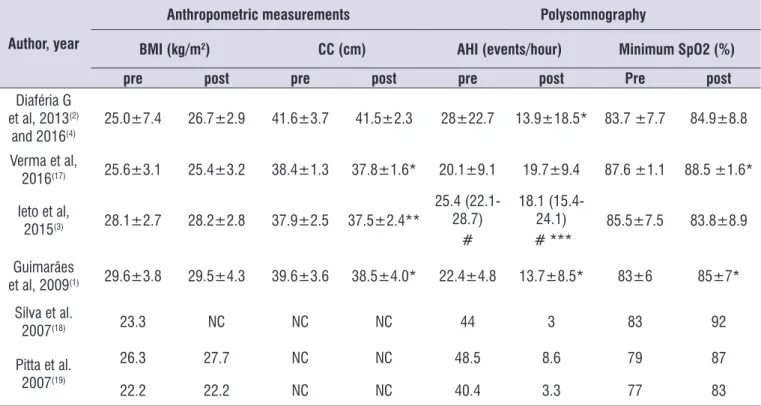
Table 4 shows the data of the results obtained with OMT based in physiologic parameters and they show
signiicant differences in relation to anthropometric
measurements considering the reduction in cervical circumference without BMI reduction in three clinical studies1,3,17. The authors indicate that the improvement
in oropharynx musculature may have determined such reduction since the subjects did not lose weight and their BMI was not altered.
Considering physiologic data obtained with polysomnography, all three RCT1-4 revealed signiicant
differences in OMT showing decrease in AIH. It is worth to point out that in one of the studies3, which also
considered subjects with primary snoring and mild OSA, the relevant statistic difference was only for the
subjects with moderate OSA. The author justiies that
the AIH for mild OSA is already close to the minimum
limit and thus not provide signiicant reduction.
The two articles with case reports18,19 are the ones
presenting a better improvement in the level of apnea with great differences in AIH, maybe because they had an individual focus. Those studies also present improvement in the minimum SpO2, as well as in one of the ECR1 and the clinical essay17, indicating one other relevant beneicial effect of OMT.
In order to analyze the effects of OMT on snoring in an instrumental way, a RCT3 measured snoring
recording it with a microphone and then presented a total snoring index considering sound intensity divided by the total period of sleep. The analysis of such data pre and post OMT, comparing the results in both groups
(therapy and control) showed signiicant reduction of
snoring considering the snoring index and also consid-ering the total snoring index in the OMT group 3.
The results in the studies referring to the symptom-atology pre and post OMT are found in table 5, which brings the data in quality of life, quality of sleep, excessive daytime sleepiness, intensity and frequency
of snoring, reported and analyzed with speciic
questionnaires.
Only one of the RCT2 brought data on quality of
life using three different questionnaires (FOSQ21,
WHOQoL-Bref22 and SF-3623). Comparing the results of the group pre and post OMT. Signiicant differences
were found in: physical domain of the instrument WHOQoL-Bref and functional quality of the SF-36, revealing the effects of OMT in those aspects.
post OMT, although not indicating in which
compo-nents speciically.
The data on the symptom of daytime sleepiness were based on the Epworth Sleepiness Scale (ESS)9 in
four of the clinical essays1-4,17 and in one of the case
reports19. Excluding the results in one of the RCT3, the studies indicate a signiicant reduction of the symptom
after a OMT program.
Considering the data related to snoring, the clinical studies analyzed the intensity and frequency of the snoring according to the Berlin questionnaire1,3,17 or
the analogic subjective visual scale4. They indicate a
reduction in intensity1,3,4,17 and frequency of snoring1,3,4.
One of the RCT3 separates the Berlin questionnaire
answers when applied to the subject himself or his
roommate, showing signiicant improvement in the
answers of the roommate when comparing pre and post data for the OMT and the control group. In general terms, the report on snoring by the patient himself is uncommon and when it happens is due to information previously given by the roommate. He is the one that listens to the subject snoring and is able to report on changes and is thus the most relevant information for that variable.
In relation to the case reports, one of them19 analyzed
excessive daytime sleepiness and snoring data in two cases. The data followed the Epworth Sleepiness Scale (ESS) and show a relief of the symptom. The data on snoring, on its turn, followed a scale of 0 to 4 (0 = absence of snoring, 1= resonate; 2 = light snore, 3 = snoring disturbing partner, 4 = snoring disturbing family). In both cases there was a reduction in the symptom post OMT. The other case report18 only brings
information on high intensity snoring and the report of sleepiness previous to OMT, going to moderate snoring after OMT with evidence on polysomnographic data. The lack of data uniformity does not allow us to infer how those characteristics related to the effects of OMT in the study.
Considering the data in general, it is worth noticing that the clinical study17 and one of the RCTs3,4, statistical
analysis were presented in terms of mean and standard deviation. However, two of the RCTs1,3,4 included
median, minimum and maximum, probably because of the number of subjects in the sample. Methodological
differences were also identiied between the RCTs1-4
statistical analysis considering the changes in study group post OMT compared with data from previous evaluation. Regardless of those methodological
differ-ences, which can dificult the comparison of results, the studies conirm the positive effects of OMT for patients
with OSA.
Systematic literature reviews are a growing
tendency in the ield of health sciences as to gather
evidence on the practice of a certain line of action, trying to base changes in the works of prevention, diagnosis, treatment and rehabilitation. The privilege of a systematic literature review is the possibility of a detailed approach focused on answering precise
questions. In the ield of Speech, Language and
Hearing Sciences, that is already a challenge, given the
variety of the aspects involved in each of the ields of
competence25,26.However, sleep studies in that context are a recent and interdisciplinary ield of work and the
search for literature reviews that recover the effects of therapies is necessary to guide upcoming studies as well as the clinical practice.
The present systematic literature review found that there are few controlled randomized trials with adults
and they are necessary to provide scientiic evidence
to guide the eligibility criteria for undergoing OMT and also determine the applicable therapy procedures.
CONCLUSION
The present systematic literature review shows that the methodological parameters guiding orofacial myofunctional therapy programs for Sleep Breathing Disorders mostly compare data pre and post therapy based on the analysis of: symptomatology related to quality of life, quality of sleep, daytime sleepiness, intensity and frequency of snoring; anthropometric data related to body mass index and cervical circumference; physiological parameters measured with polysomnog-raphy related to Apnea and Hypopnea Index and blood minimum saturation.
The parameters for therapy are related to the practice of exercises for the orofacial and oropharynx musculature daily, reinforced by functional practice for the period of 3 months, with individual therapy one time per week.
The most relevant effects of the isolated orofacial myofunctional therapy in adults include: reduction of daytime sleepiness and snoring, better quality of sleep, partial decrease in the Apnea and Hypopnea Index and partial increase in the blood minimum saturation.
There have been few controlled randomized blind trials and they are important to attest the effects of the technique based on evidences and guiding the thera-peutic decisions considering evaluation and diagnosis and the phenotype of the patient for an accurate prognosis.
ACKNOWLEDGEMENTS
Coordination for the Improvement of Higher Education Personnel (CAPES) National postdoctoral program in the Program of Graduate Studies in Speech Language Pathology and Audiology (PEPG/PUC-SP) at
the Pontiicate Catholic University of São Paulo.
REFERENCES
1. Guimarães KC, Drager LF, Genta PR, Marcondes
BF, Lorenzi-Filho G. Effects of oropharyngeal exercises on patients with moderate obstructive sleep apnea syndrome. Am J Respir Crit Care Med. 2009;179(10):962-6.
2. Diaferia G, Badke L, Santos-Silva R, Bommarito
S, Tuik S, Bittencourt L. Effect of speech therapy
as adjunct treatment to continuous positive airway pressure on the quality of life of patients with obstructive sleep apnea. Sleep Med. 2013;14(7):628-35.
3. Ieto V, Kayamori F, Montes MI, Hirata RP, Gregório MG, Alencar AM et al. Effects of oropharyngeal exercises on snoring: a randomized trial. Chest. 2015;148(3):683-91.
4. Diaféria G, Santos-Silva R, Truksinas E, Haddad FLM, Santos R, Bommarito S et al. Myofunctional therapy improves adherence to continuous positive airway pressure treatment. Sleep Breath. 2016;21(2):387-95.
5. Guimarães KC. Alterações no tecido mole de
orofaringe em portadores de apneia do sono obstrutiva. J Bras Fonoaudiol.1999;1(1):69-75. 6. Steele CM. On the plausibility of upper airway
remodeling as an outcome of orofacial exercise. Am J Respir Crit Care Med. 2009;179(10):858-9. 7. Dempsey JA, Veasey SC, Morgan BJOC.
Pathophysiology of sleep apnea. Physiol Rev. 2010;90(1):47-112.
9. Johns M. A new method for measuring daytime sleepiness: the Epworth sleepiness scale. Sleep. 1991;14(6):540-5.
10. Netzer N, Stoohs R, Netzer C, Clark K, Strohl K. Using the Berlin Questionnaire to identify patients at risk for the sleep apnea syndrome. Ann Intern Med. 1999;131(137):485-91.
11. Guilleminault C, Huang YS, Monteyrol PJ, Sato R, Quo S, Lin CH. Critical role of myofascial reeducation in pediatric sleep-disordered breathing. Sleep Med. 2013;14(6):518-25.
12. Lee SY, Guilleminault C, Chiu HY, Sullivan SS. Mouth breathing, “nasal disuse,” and pediatric sleep-disordered breathing. Sleep Breath. 2015;19(4):1257-64.
13. Villa MP, Brasili L, Ferretti A, Vitelli O, Rabasco J, Mazzotta AR et al. Oropharyngeal exercises to reduce symptoms of OSA after AT. Sleep Breath. 2015;19(1):281-9.
14. Villa MP, Evangelisti M, Martella S, Barreto M, Del Pozzo M. Can myofunctional therapy increase tongue tone and reduce symptoms in children with sleep-disordered breathing? Sleep Breath. 2017.
Mar 18. [Epub ahead of print]
15. Valbuza JS, De Oliveira MM, Conti CF, Prado LBF, De Carvalho LBC, Do Prado GF. Methods for increasing upper airway muscle tonus in treating obstructive sleep apnea: Systematic review. Sleep Breath. 2010;14(4):299-305.
16. Camacho M, Certal V, Abdullatif J, Zaghi S, Ruoff CM, Capasso R et al. Myofunctional therapy to treat obstructive sleep apnea: a systematic review and meta-analysis. Sleep. 2015;38(5):669-75.
17. Verma RK, Johnson-J JR, Goyal M, Banumathy N, Goswami U, Panda NK. Oropharyngeal exercises in the treatment of obstructive sleep apnoea: our experience. Sleep Breath. 2016;20(4):1193-201. 18. Silva LM de P, Aureliano FT dos S, Motta AR.
Atuação fonoaudiológica na síndrome da apnéia e
hipopnéia obstrutiva do sono: relato de caso. Rev. CEFAC. 2007;9(4):490-6.
19. Pitta DB e S, Pessoa AF, Sampaio ALL, Rodrigues RN, Tavares MG, Tavares P. Terapia miofuncional
oral aplicada a dois casos de síndrome da apnéia
obstrutiva do sono grave. Arq Int Otorrinolaringol. 2007;11(3):350-4.
20. Carvalho APV, Silva VGA. Avaliação do risco
21. Weaver T, Laizner A, Evans L, Maislin G, Chugh D, Lyon K et al. An instrument to measure functional status outcomes for disorders of excessive sleepiness. Sleep. 1997;20(10):835-43.
22. Skevington SM, Lotfy M, O’connell KA. The World Health Organizations WHOQOL-BREF quality of life assessment : Psychometric properties
and results of the international ield trial A Report
from the WHOQOL Group. Qual Life Res. 2004;13(2):299-310.
23. Ciconelli RM, Ferraz MB, Santos W, Meinão I, Quaresma MR. Tradução para a língua portuguesa e validação do questionário genérico de avaliação
de qualidade de vida SF-36 (Brasil SF-36). Rev Bras Reumatol. 1999;39(3):143-50.
24. Buysse D, Reynolds C, Monk T, Berman S, Kupfer D. The Pittsburgh Sleep Quality Index: a new instrument for psychiatric practice and research. Psychiatry Res. 1989;28(2):193-213.
25. De-la-Torre-Ugarte-Guanilo MC, Takahashi RF, Bertolozzi MR. Systematic review: general notions. Rev Esc Enferm USP. 2011;45(5):1260-6.