(1) Universidade Federal do Paraná, Curitiba, PR, Brasil; Universidade Tuiuti do Paraná, Curitiba, PR, Brazil. (2) Universidade Tuiuti do Paraná, Curitiba,
PR, Brazil.
Conlict of interest: Nonexistent
Quality of life, perception and knowledge of
dentists on noise
Sonia Regina Lazarotto Schettini(1)
Cláudia Giglio de Oliveira Gonçalves(2)
Received on: April 21, 2017 Accepted on: September 14, 2017
Mailing address:
Cláudia Giglio de Oliveira Gonçalves Rua Felisberto Fiore Dorazio, 146 CEP 82410-460 - Curitiba, Paraná, Brasil E-mail: [email protected] or [email protected]
ABSTRACT
Purpose: to analyze the perception and knowledge of dentists on occupational noise, its prevention, and effects on their health and quality of life.
Methods: a cross-sectional study carried out with 54 dentists of both genders. Two questionnaires were applied: one addressing issues of perception and knowledge on noise and its effects, and another on Quality of Life (SF 36).
Results: the workplace noise was considered within medium intensity, and a health risk. Some professionals (59.2%) reported knowing noise prevention methods, although they do not use them. Complaints and the most frequently reported symp-toms were irritability, dificulty in understanding speech and tinnitus. The perception of the Quality of Life was worse among men. There was association between pain and perception of noise intensity.
Conclusion: noise was considered, regardless of gender, harmful to health and asso-ciated with perception of musculoskeletal pain. Symptoms and complaints caused by noise have been reported to negatively impact the professional activity of dentists, however, most of them do not adopt preventive measures.
INTRODUCTION
Dentistry activity uses different types of equipment
with diversiied functions, not only in general clinical
procedures, but also in the surgical ones, and many of them generate loud noise.
In dentists’ ofices, loud noise is present in the
clinical equipment used, such as dental pens, dental suction machines, amalgamators, air compressors, dental vacuum pumps, autoclave, air conditioners or
fans, and external sources, such as vehicular trafic and
other kinds of urban noise1,2. Study in four public dental
ofices and four private ones assessed the instanta
-neous level of sound pressure, inding levels from 56.4
to 83.1 dBA2. Another study at three dentist’s clinics in
the interior of São Paulo State, Brazil, measured the instantaneous sound pressure level with a total of 80
measurements collected ive times a week for 20 days; and found mean values from 71.8 to 94.1 dBA3. Study
in China assessed instantaneous noise levels in a dental clinic at the University Hospital of Taiwan during
tooth extractions in 40 patients, and evidenced levels
varying from 68.5 to 87.2 dBA4. Thus, those environ-ments can be favorable to the development of hearing loss and other health outcomes considering the time of exposure.
Study5 carried out with 115 dentists evidenced
sensorineural hearing loss in 24.3% of them, prevalent in males (33.3%). The authors concluded that tonal
thresholds would get worse according to dentists’ age and work time. They still observed that after 21 years performing their job, the percentage of hearing dysfunctions was higher among male dentists. Another study held in Paraná State assessed 80 dentists’
hearing, mixed genders, and found 15% of sensori -neural hearing loss6.
Besides its effects on hearing, loud noise may also impair other organic systems, such as: behavioral, neurological, vestibular, digestive, cardiovascular disorders, among others7. Excessive noise increases
stress levels, which increases blood pressure and hormone release, such as adrenaline and cortisol8.
Noise effects on hearing (Noise-Induced Hearing
including physical health, psychological status, the level of Independence, social relations, beliefs and environ-mental relationship. Thus, the concept of Quality of Life is a subjective one, including the negative aspects of life, such as pain, use of medication, among others; and positive ones, for example: to feel healthy and the degree of social participation 10,11. Therefore,
commu-nication is a signiicant factor to be considered in the
Quality of Life, as it enables social integration12.
Loud noise may also directly interfere in dentists’ activity by reducing their potential for focus, attention,
speed and precision of movements7; besides the
reduction of speech clarity, hindering professional and patient’s communication, irritability and decrease in work productivity, among others 7,8. Dentistry is an
occupation which demands knowledge, skill and focus on the part of professionals.
Thus, the objective of this study is to analyze dentists’ perception and knowledge about occupa-tional noise, its prevention and outcomes on health and quality of life.
METHODS
The research began after approval by the Ethics Board on Research of the Sociedade Evangélica
Beneicente under number 739.215, and by having
all the subjects involved signed the Free Informed Consent Form.
It is a crosscut, quantitative study. It was carried out with dentists from the city of Curitiba, Paraná State, Brazil, who accepted to participate in the research
study, totaling 54 participants. From those, 32 (59.2%) were female, and 22 (40.7%) were male, most of them working at private ofices (39 – 72.2%), and 26 (48.1%)
at public outpatient clinics. The invitation was held by means of visits to professionals at their workplace. As an inclusion criterion, dentists should be graduated, clinically working and having signed the Free Informed Consent Form.
occupa-functional capacity, physical aspects, pain, general health status, vitality, social aspects, emotional aspects, mental health, and one more question for comparative evaluation of current health conditions and the ones in the previous year. Percentual scoring varies from 0 to 100, being zero the worst general health status, and
100% the best one. According to the authors’ own criterion, scoring in the domains inferior to 50% was
considered negative perception of quality of life, while
scoring superior to 50% would be positive perception. The cut point deinition of 50 percentiles, deining
scoring for high (positive perception) and low (negative perception) quality of life for the domains, was based on some studies which used similar questionnaires. However, in the original instrument, there are not any references to any score dicotomy13.
Data were analyzed regarding age and working hours until 8 hours per day and over 8 hours per day between the genders. For the analysis of noise knowledge and perception (questionnaire 1), Chi-Square Statistical Test was used. For the score analysis of the SF-36 questionnaire by gender, Student’s T-Test was used.
Spearman’s correlation coeficient was used to analyze
the association between perception of noise levels by the dentists and scoring in the SF-36 questionnaire. In
all the analyses, signiicance level of 5% or p< 0.05 was
considered.
RESULTS
Among all the studied dentists, age ranged from 20 to 65 years, with prevalent age range between 20 and
40 years old (66.7%) for the females, and over 40 years old (66.7%) of age prevalence for the males. There were signiicant gender differences regarding age
(Chi-square Test, p=0.0166), being males older than females.
Regarding job length as a dentist, it varied from 5
months to 40 years, with prevalence among males (61.9%) of job length longer than 20 years, and among females (66.7%), job length was inferior to 20 years.
There were gender differences in relation to job length
(Chi-square Test, p=0.0394), with males featuring
longer professional time than females. Regarding daily
working hours, 53.7% of the dentists worked over 8 hours a day, being 14 (66.7%) males and 15 (45.5%)
females, although there were no gender differences (Chi-square Test, p=0.1275).
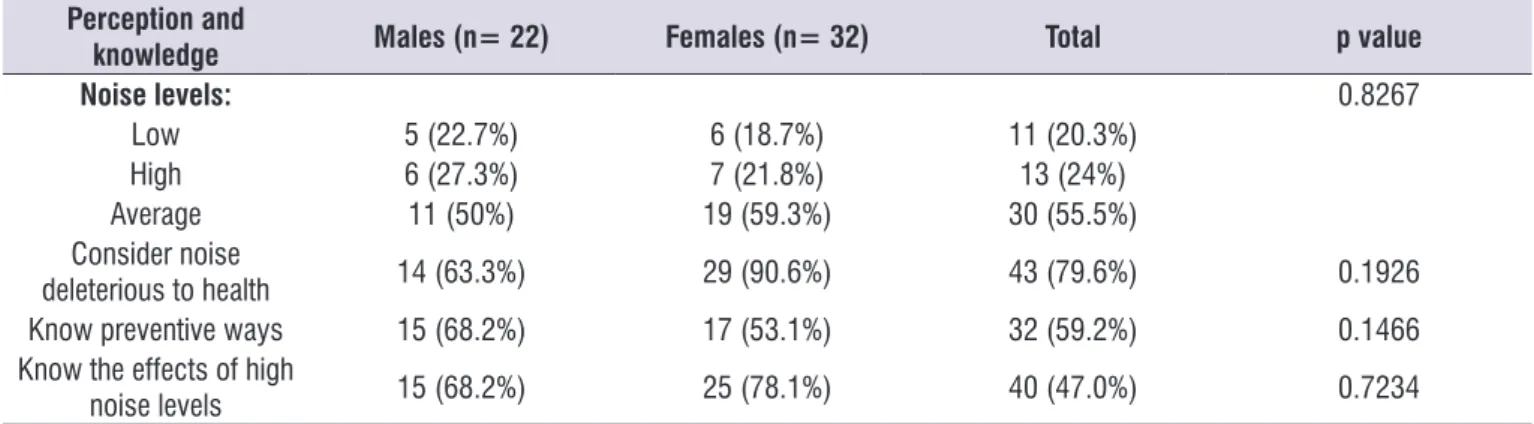
In Table 1, we found the results about noise
perception at dental ofices and knowledge on the
prevention of auditory disorders among dentists, considering that all stated to be noise-exposed.
Table 1. Perception of noise at workplace and knowledge on prevention from hearing disorders by dentists (N=54)
Perception and
knowledge Males (n= 22) Females (n= 32) Total p value
Noise levels: 0.8267
Low 5 (22.7%) 6 (18.7%) 11 (20.3%)
High 6 (27.3%) 7 (21.8%) 13 (24%)
Average 11 (50%) 19 (59.3%) 30 (55.5%)
Consider noise
deleterious to health 14 (63.3%) 29 (90.6%) 43 (79.6%) 0.1926
Know preventive ways 15 (68.2%) 17 (53.1%) 32 (59.2%) 0.1466
Know the effects of high
noise levels 15 (68.2%) 25 (78.1%) 40 (47.0%) 0.7234
use of hearing protectors (51.8%). Other ways for noise control (14.8% - 8) were reported, such as: the need of lubricating the hand pieces (1.8% - 1), reduction in the use of the high-speed pen (1.8% - 1), location of
the compressor and air vacuum pump distant from the
ofice (1.8% - 1), equipment maintenance (1.8%- 1), acoustic protection for the equipment (3.7% - 2), and less noisy equipment (3.7% - 2).
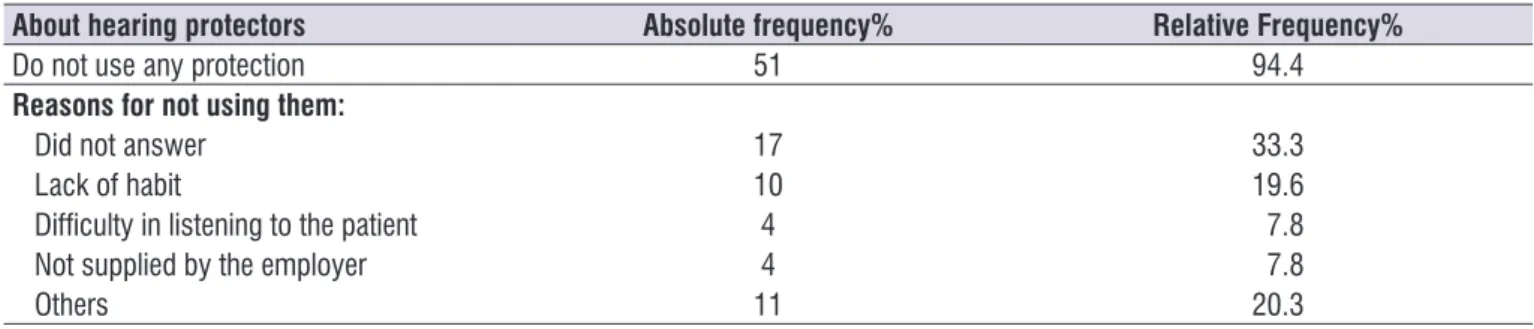
Table 2 shows the accounts on the use of hearing protectors.
By means of the Chi-square Test, signiicance level of 0.05, no difference was veriied between genders
and the answers about perception and knowledge on noise and prevention.
It was observed that 55.5% of the dentists considered noise of medium-level, and 79.6% said that
noise was deleterious to health.
It was evidenced that 59.2% of the dentists somehow
knew how to prevent themselves from loud noise. Among these preventive ways, it was mentioned the
Table 2. Use of hearing protectors by dentists (N=54)
About hearing protectors Absolute frequency% Relative Frequency%
Do not use any protection 51 94.4
Reasons for not using them:
Did not answer 17 33.3
Lack of habit 10 19.6
Dificulty in listening to the patient 4 7.8
Not supplied by the employer 4 7.8
Others 11 20.3
Most professionals do not use hearing protectors
(94.4% - 51). It was veriied that 33.3% - 18 participants
did not answer the reason why they did not use hearing
protectors. Among those who justiied why they did not
use hearing protectors (51 subjects), it can be pointed out lack of habit (19.6 – 10). In the item grouped as “other” reasons for not using hearing protectors,
were reported: “I don’t consider it necessary, silent environment, inconvenient, I’ve never thought of that, carelessness, I don’t know, I work with radiology, laze,
dificulty in setting them, and I wasn’t taught about.”
Complaints and symptoms possibly related to exposure to high sound levels are described in Table 3.
Table 3. Complaints and symptoms possibly related to noise exposure reported by dentists (N=54)
Reported complaints Absolute frequency Relative frequency %
Irritability 25 46.3
Dificulty in speech understanding 22 40.7
Tinnitus 19 35.1
Dificulty in focusing 15 27.7
Headache 11 20.3
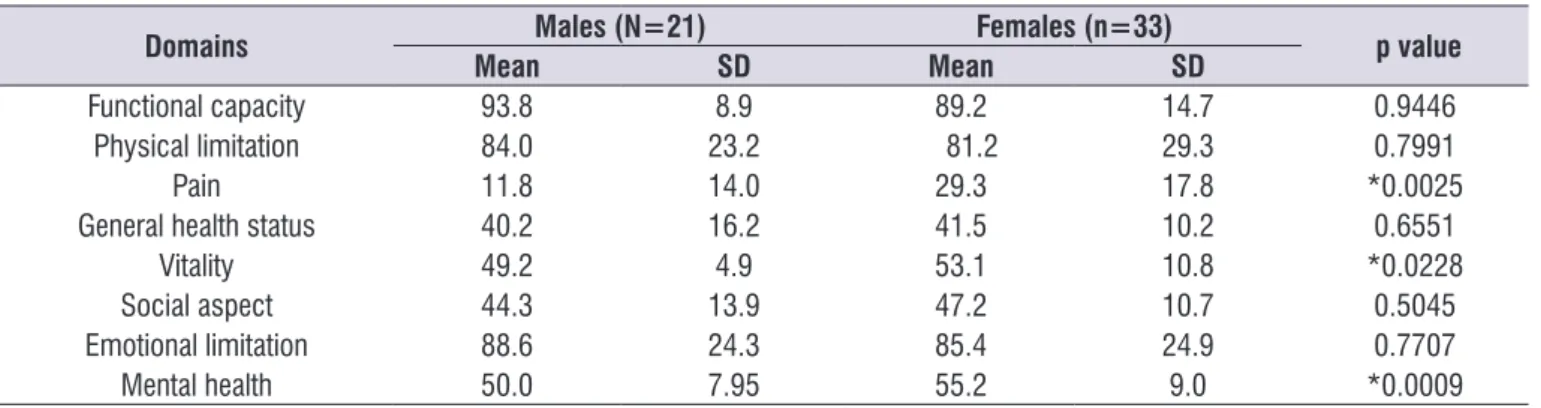
Among females, there is scoring equal to or lower than 50 (considered a negative perception on the quality of life) for the domains: pain, general health status and social aspects. As for the males, in addition to those three domains, there is mean score equal to or lower than 50 for the vitality and mental health domains.
However, signiicant differences were observed
between the genders for the mean values in the following domains: pain (p=0.0025), vitality (p=0.0228) and mental health (p=0.0009), featuring worse among the males.
Table 4 shows the results for the perception of
Quality of Life per domain, comparing the genders. The most reported complaints were noise-related
irritability, reported by 46.3% of the dentists, followed by dificulty in understanding speeches (40.7%).
Regarding Quality of Life, it was observed that the Functional Capacity, which refers to the performance of daily activities, such as the capacity to take care of yourself, to get dressed, bathing, and climbing stairs, scored the mean value for both genders. Therefore, it was positively assessed, considering the criterion that a
score of over 50% would mean a positive assessment.
As for Pain (referring to the level of pain and the impact on the performance of daily or professional activities), it scored less than the mean value for both genders, being negatively assessed by the dentists.
Table 4. Mean scores for quality of life per domains and gender among dentists (N=54)
Domains Males (N=21) Females (n=33) p value
Mean SD Mean SD
Functional capacity 93.8 8.9 89.2 14.7 0.9446
Physical limitation 84.0 23.2 81.2 29.3 0.7991
Pain 11.8 14.0 29.3 17.8 *0.0025
General health status 40.2 16.2 41.5 10.2 0.6551
Vitality 49.2 4.9 53.1 10.8 *0.0228
Social aspect 44.3 13.9 47.2 10.7 0.5045
Emotional limitation 88.6 24.3 85.4 24.9 0.7707
Mental health 50.0 7.95 55.2 9.0 *0.0009
*Statistically signiicant values (p< 0.05) – Student’s T-Test
Table 5 shows the relation between the scoring of the Quality of Life questionnaire, per domain, to age, educational level and dentists’ noise perception.
By using the Spearman’s Correlation Coeficient, it was evidenced the signiicant correlation only between
DISCUSSION
In this study, it was observed that most dentistry professionals are females and worked predominantly in the general practice. The prevalence of female profes-sionals was also observed in a study carried out in the interior of São Paulo State, which evidenced women’s increasing participation in this professional category, concluding that education, entertainment and health
ields have been attracting a higher number of women14.
Regarding age range and graduation time, it was
reported signiicant differences between the genders.
Males are older and graduated longer than females. However, in spite of a higher percentage of males
working over 8 hours a day, no signiicant differences
were observed between the genders in the questions about the perception and knowledge on noise and its prevention (Table 1). Similar results were found in other studies. In a study with dental surgeons, it was evidenced that in the activities carried out by dentists, males worked an average of longer working hours than those recorded by females15. It is known that noise
effects are more deleterious depending on the sound levels and the daily hours of exposure to them, thus, literature considers that the hazards to noise exposure are higher among males due to their longer working hours if compared to females’ working hours16,17.
As for noise perception at workplace (Table 1),
Brazilian labor legislation considers unhealthy environment if sound levels are equal to or higher than 85 dBA for 8 daily working hours. Literature reports sound pressure levels for dental equipment between
56 and 94 dBA2-4, which would make some activities
and situations at a dental clinic as hearing hazards.
However, not only sound levels deine hearing hazards,
but also the exposure time is fundamental6. In this
study, it was observed that 53.7% of the dentists work
over 8 hours, which may increase the risk for hearing loss. However, assuming that dentists are not exposed to the risk of hearing loss, as they are exposed to lower sound pressure levels or the exposure is for shorter periods of time, other consequences may evolve from the presence of noise18. The exercise of dentistry
requires a high degree of concentration, thus the sound
pressure level should not be higher than 30 to 40 dBA,
as above such levels, noise causes professionals irritation and loss of focus; and yet, if it is above 65 dB, it may cause hypertension, among other non-auditory outcomes7,8.
Regarding knowledge on prevention from loud noise-exposure risks, the greatest part of the profes-sionals reported to know some types of prevention, being the use of hearing protectors the most mentioned one. Reports of other preventive devices occurred, such as intervention measures for the equipment or its use. Apart from that evidence, a high proportion of
profes-Table 5. Correlation between quality of life domains and age, graduation time and noise perception (N=54)
DOMAINS Age Graduation Time Noise Perception
R p R p R p
Functional capacity -0.2181 0.1131 -0.1712 0.2159 0.0567 0.6839
Physical limitation -0.0014 0.9918 -0.0170 0.9027 -0.1471 0.2886
Pain -0.2093 0.1288 -0.1130 0.4158 0.2994 0.0279*
General health status -0.0479 0.7309 0.0562 0.6864 -0.0425 0.7601
Vitality -0.0705 0.6125 0.0205 0.8828 -0.0221 0.8739
Social aspect -0.0642 0.6445 0.0142 0.9191 -0.0193 0.8899
Emotional limitation 0.0946 0.4965 0.0785 0.5725 -0.1374 0.3219
Functional capacity -0.2454 0.0737 -0.2146 0.1191 -0.2610 0.0566
related to noise and its outcomes in dentistry hinders its control and prevention. Addressing this subject in dentists’ education is important, from Dentistry schools to post-graduation courses, considering information on NIHL, making the use of hearing protectors routine in clinical practice, besides implementing other aspects regarding the Hearing Conservation Program, such as changes at workplace and adoption of less noisy equipment5,15.
Some studies point out that although dentists are exposed to several hazards in their professional activity, such as ergonomic ones (excessive working hours), chemical ones (mercury), and physical ones (high sound levels, among others), there is still neglect on the part of those professionals toward hearing prevention, and its consequences can only be observed over time15,19,20.
Investigating complaints and symptoms possibly associated with exposure to loud noise reported by
dentists (Table 3), irritability and dificulty in speech
understanding were the most reported ones, followed by tinnitus. Another study from Southern Brazil with
158 dentists found as the main complaints: dificulty in understanding speech (64.55%), stress (10.12%), tinnitus (8.22%) and irritability (7.59%)16. In addition, in
the Northeastern Brazil, a study with 50 dentists found
tinnitus (40%), dizziness (32%), intolerance to high sound levels (20%)18. That shows how the effects of
noise exposure can hinder the activity and relationship
to patients at a dental ofice. Quality of Life at Workplace
is related to the improvement of physical conditions, lifestyle, facilities, meeting workers’ needs and the
expansion of a set of beneits for the satisfactory
exercise of their activities, therefore, those conditions are negatively affected by the presence of noise16,20,21.
By relating the perception on the Quality of Life to
gender (Table 4), it was observed that males reported
worse perception than females, with average scoring
equal to or lower than 50. There are signiicant differ -ences between the averages for the following domains: pain, vitality and mental health, mainly affecting males. Other studies observed pain and discomfort among dentists, without specifying the gender19,21. Another
study on dentists’ quality of life using SF-36 question-naire was not found in literature. Study on that theme,
but using the WHOQOL 100 assessment instrument of
quality of life, found negative factors in dentists’ activity related to lack of work organization, and unhealthy
workplace with thermal and sound discomfort (70%) and pain (64%) as the main reported complaints19.
In the current study, maybe for the fact that males are older, and exercising their profession longer than females, that may have impacted on their quality of life19,22,23. Another study with male and female dentists
concluded that males were older, working longer and featured higher prevalence of hearing loss and tinnitus15,23.
When the Quality of Life per domains was analyzed,
relating it to age, graduation time and noise perception, only the Pain domain was observed to be related to the perception of noise levels (Table 5). Literature reports that exposure to loud noise at workplace is one of the risk factors that can be related to musculoskeletal pain24. Study with 115 workers observed that the
prevalence of Work-Related Musculoskeletal Disorders (WRMSD) was related, among other factors, to the presence of noise at the workplace (OR=7.9; CI 95%
1.6-38.2). The authors explain that association once noise is perceived as a factor of stress or by the associ-ation of noise with the vibrassoci-ation in the manipulassoci-ation of certain types of equipment25. As musculoskeletal pain
is a common complaint among dentists due to their stiff
posture and the ine repetitive movements of the upper
limbs21,22, and the hint that noise exposure may be
associated with the increase in pain24,25, further studies
about that theme are suggested, including other profes-sional categories.
As in the current study hearing was not assessed, it was not possible to relate quality of life to the auditory
proile. Further studies are suggested, with a larger
sample, in order to analyze it.
The indings in this research enable to formulate
suggestions to include the noise theme in Dentistry education, warning future professionals about its health outcomes, and addressing preventive ways, thus encouraging their use.
CONCLUSION
In the current study, it could be observed that most professionals, disregarding the gender, considered noise levels as of medium range, deleterious to health and noise effects are known.
Symptoms and complaints associated with noise
Regarding Quality of Life, males featured worse perception than females in some domains. Noise levels at workplace were related to pain among dentists.
REFERENCES
1. Ribas A, Scmidt A, Ronconi E. Conforto ambiental e o ruído urbano como risco ambiental: a percepção de moradores dos setores especiais estruturais da cidade de Curitiba. Desenvolvimento e Meio Ambiente. 2010;21(1):183-99.
2. Lourenço EA, Berto JMR, Duarte SB, Greco JPM. Can noise in dental clinic produce hearing loss? Int
Arch Otorhinolaryngol. 2011;15(1):84-8.
3. Osmarin N, Calza J. Damage risk assessment hearing through the noise measurement produced in a dental clinic. J Oral Invest. 2017;5(2):9-15.
4. Chang HH, Lee MS, Hsu YC, Tsai SJ, Lin
CP. Comparison of clinical parameters and environmental noise levels between regular surgery and piezosurgery for extraction of impacted third
molars. JFMA. 2015;114(10):929-35.
5. Gonçalves CGO, Marques JM, Ribas A, Lacerda ABM, Lobato DCB, Costa GL et al. Caracterization from hearing thresholds from dentists in a poulation from Curitiba city / PR, Brazil. Int Arch Otorhinolaryngol. 2012;16(1):32-8.
6. Gonçalves CGO, Santos L, Lobato D, Ribas A, Lacerda ABM, Marques J. Characterization of hearing thresholds from 500 to 16,000 hz in dentists: a comparative study. Int. Arch. Otorhinolaryngol. 2015;19(02):156-60.
7. Fernandes JC, Santos LN, Carvalho HJM. Avaliação de desempenho acústico de um consultório odontológico. Produção. 2011;21(3):7-20.
8. Fernandes M, Morata TC. Estudo dos efeitos auditivos e extra auditivos da exposição ocupacional a ruído e vibração. Rev Bras Otorrinolaringol. 2002;68(5):705-13.
9. Hinze H, Deleon C, Michel WC. Dentists at high hisk for hearing loss: protection with custom earplugs.
General Dentistry. 1999;47(6):600-3.
10. Minayo MCS, Hartz ZMA, Buss PM. Qualidade de
patients from an outpatient clinic of speech-language pathology and audiology. Rev soc bras de fonoaudiol. 2012;17(2):119-27.
13. Ciconelli RM. Tradução para o português do questionário de avaliação de qualidade de vida “Medical out comes study 36 – item short-form health survey (SF-36)” [tese]. São Paulo (SP): Universidade Federal de São Paulo; 1997.
14. Saliba NA, Moimaz SAS, Vilela RM, Blanco MB.
Women in dentistry: a quantitative analysis. Rev Bras Odontol. 2002;59(6):400-2.
15. Gonçalves, CGO, Lacerda ABM, Ribas A, Oliva FC, Almeida SB, Marques JM. Exposição ocupacional ao ruído em odontólogos do Paraná: percepções e efeitos auditivos. Rev de Odontologia da UNESP.
2009;38(4):235-43.
16. Bruschini MCA. Trabalho e gênero no Brasil nos últimos dez anos. Cad Pesquisa. 2007;37(132):537-72.
17. Ayers KM, Thomson WM, Rich AM, Newton JT. Gender differences in dentists’ working practices
and job satisfaction. J Dent. 2008;36(5):343-50.
18. Cavalcanti TLO, Andrade WTL. Efeitos auditivos e extra-auditivos decorrentes do ruído na saúde do dentista. RBCS. 2012;16(2):161-6.
19. Moimaz SAS, Costa ACO, Saliba NA, Bordin D, Rovida TAS, Garbin CAS. Condições de trabalho e qualidade de vida de cirurgiões-dentistas no Sistema Único de Saúde. Rev Ciênc Plural. 2015;1(2):68-78
20. França ACL. Qualidade de vida no trabalho – QVT: conceitos e práticas nas empresas da sociedade
pós-industrial. São Paulo: Atlas; 2004.
21. Nogueira SA, Bastos LF, Costa IDCC. Riscos ocupacionais em odontologia: revisão da literatura. UNOPAR Cient Ciênc Biol Saúde. 2010;12(3):11-20.
22. Michel-Crosato E. Peril da força de trabalho representada pelo cirurgião-dentista: análise
epidemiológica dos proissionais que exerciam
APPENDIX 1 - QUESTIONNAIRE APPLIED TO DENTISTS
Professional Field:
( ) General Practice ( ) Cosmetic dentistry ( ) Periodontics ( ) prostheses/braces ( ) others: __________________________________________________________ Workplace:
( ) clinic/private ofice ( ) public service ( ) university
( ) others: __________________________________________________________ Graduation time: _______ years Daily working hours: __________ hours age: ______
Do you work at a noisy environment so that you have to shout for your workmate to hear you at 1 meter distance from you? ( ) yes, always. ( ) yes, sometimes ( ) no, never
During your Dentistry under-graduation course, were noise outcomes addressed as a curricular content? ( ) yes ( ) no ( ) don’t remember
Do you know the deleterious effects of loud noise to your health? ( ) no ( ) yes. Which ones?________
___________________________________________________________________
Do you know any preventive ways from the deleterious effects of exposure to high noise levels at your workplace? ( ) no ( ) yes. Which ones? _____________________________________________
Do you use any ways to reduce exposure to high noise levels at your workplace?
( ) no. Why? ___________________________________________________________ ( ) yes. Which one? ______________________________________________________
How do you rate noise levels at your workplace:
( ) there is no noise ( ) low noise ( ) medium-level noise ( ) loud noise
If there is noise at your work facility, what places/equipment below does it occur: ( ) turbine/high speed ( ) micro-motor? Low speed
( ) air compressor ( ) Light
( ) air conditioner ( ) neighborhood trafic ( ) others: __________________
What symptoms/complaints below can you report: ( ) hearing impairment ( ) recurring headache
( ) tinnitus ( ) irritability at the end of the day
( ) dificulties in focusing ( ) dificulties in speech understanding in some situations