Determining Factors of the Level of Disclosure of Information on
Business Combinations with the Entry into Force of the Accounting
Standard CPC 15
Wilson Kazumi Nakayama
Master of Arts, Department of Accounting and Actuary, School of Economics, Business, and Accounting, University of São Paulo Email: [email protected]
Bruno Meirelles Salotti
Ph.D Professor, Department of Accounting and Actuary, School of Economics, Business, and Accounting, University of São Paulo Email: [email protected]
Received on 05.11.2013 – Desk acceptance on 05.23.2013 – 4th version approved on 08.21.2014.
ABSTRACT
This paper aimed to investigate information disclosure on business combination transactions that took place in Brazil in 2010, when the Accounting Standard CPC 15 entered into force, and evaluate which were the determining factors of the level of disclosure of information related to it. To evaluate the disclosure level, a disclosure index of business combinations (INDCOMB) was prepared, having the disclosure index developed by Shalev (2009) as a basis. We evaluated, in the light of the literature on disclosure and business combinations, whether the following factors influenced on the disclosure level: acquiring company size, recognized percentage of overprice for expected future profitability in relation to the transaction value, dispersion of capital of the acquiring company, audit firm size, and participation of the acquiring company in American Depositary Receipts (ADRs) programs. The control variables used were listing of the acquiring company in the various segments of BM&FBOVESPA, operation sector, origin (state, private company with national capital or private company with foreign capital), and relative acquired company size in relation to the acquiring company. We analyzed business combination transactions that took place in 2010, reported by 40 open capital companies involved in 76 transactions. We conclude that the audit firm size and the relative acquired company size were factors that influenced on the level of disclosure of information regarding business combinations in 2010. The other factors showed no conclusive results.
Keywords: Accounting in business associations, Financial statement, Accounting information.
1 INTRODUCTION
fied the situation that may occur in the economy consi-dering half of the business ideas as “good” and the other half as “bad”. Investors and entrepreneurs act rationally and evaluate an investment having the information they hold as a basis. If investors cannot distinguish betwe-en “good” and “bad” business ideas, thbetwe-en, betwe-entreprbetwe-eneurs with “bad” business ideas might argue that their busi-ness ideas are “good”. Therefore, investors might evalu-ate investments at a medium level. As a result, if the in-formation asymmetry problem is not solved, the capital market may underestimate the value of good ideas and overestimate the value of some bad ideas. To tackle such a problem, Healy and Palepu (2001) point out some so-lutions. The first could be optimizing contracts betwe-en betwe-entreprbetwe-eneurs and investors, creating incbetwe-entives for a full disclosure of private information, thus mitigating the issue of investment measurement errors. Another might be regulation, which could require a full disclosu-re of private information from professional administra-tors. And, also, a third way might be getting information from intermediaries, such as market analysts and rating agencies, which seek to unravel the information held by administrators.
In Brazil, the disclosure of information on incorpo-ration, merger, or demerger is required by Instruction 319, from the Brazilian Securities Commission (CVM), enacted on December 1999. Alternatively, Instruction CVM 358, enacted in 2002, provides for the disclosure of information on any relevant act or fact concerning open capital companies, among which stands out the trans-fer of control. It also establishes the obligation to inform the names of the acquiring and acquired companies, a brief summary of the acquiring company’s qualification, its business sectors and its activities. It also requires the disclosure of price and other conditions regarding the deal, such as the acquisition purpose and the expected effects on the acquiring company’s businesses. It was, however, with the entry into force of the Accounting Standard 15, from the Brazilian Accounting Pronoun-cements Committee (CPC), which established a robust set of information subject to compulsory disclosure on the part of open capital companies involved in business combination transactions.
Information disclosure plays a signiicant role by re-ducing the information asymmetry between the company and its shareholders, but there are costs to the company associated with the production and dissemination of such information. A component of this expense is ownership cost, related to the company’s expenditure due to strategic information disclosure. Such information may be used by competitors, for instance, at the company’s expense. hus, companies assess the costs and beneits of information disclosure, even those related to mandatory disclosure information (Dye, 2001; Robinson, Xue, & Yu, 2011; Ver-recchia, 2001).
Business combination is a transaction where a com-pany acquires control over one or more businesses, regar-dless of the legal form of the transaction, which may be by means of merger or acquisition of control. It arouses great interest in business circles, because, in addition to the large igures involved, there is an impact on decisions taken by customers, suppliers, and employees associa-ted with these companies. It also raises expectations in the stock market and interest in the academy. In order to think of the magnitude of this kind of transaction, the sale of control over State enterprises earned the Brazilian go-vernment the igure of US$ 105.298 billion, out of which US$ 78,614 billion only during the Fernando Henrique Cardoso administration.
here is not, yet, a irmly established theory suppor-ting the motivations for the occurrence of business com-bination. However, there are a number of explanations for the occurrence of these transactions, especially tho-se derived from the heory of the Firm (Camargos & Coutinho, 2008), which has in its theoretical framework a logical explanation for the emergence of the irm, its evolution, its growth, and, from this growth perspective, business combination activities are shaped. In the early development stage of the irm, the businessman had full power to decide on business issues. he businessman was both the business owner and administrator. As the com-pany grew, manager-owners started playing a wider range of activities, they were forced to share or even delegate powers so that a professional administrator with more specialized knowledge and managerial ability, could take management positions and make decisions. Besides the administrative complexity that required hiring profes-sional administrators to control the irm, inancial cons-traints due to growing demands have forced companies to go public, dividing their property among a large number of shareholders. his resulted in the separation of com-pany ownership and control.
exempli-Although CVM requires the disclosure of information on transactions regarding merger and demerger since Ins-truction CVM 319 was enacted in 1999, and despite the requirement of information disclosure concerning the transfer of control since Instruction CVM 358 was enac-ted, in 2002, there is no data conirming the existence of an index demonstrating the information disclosure level required from then on. hus, this study aims to evaluate, by constructing a disclosure index (INDCOMB), based on the information required by the Accounting Standard CPC 15, the level of disclosure of information related to business combinations that took place in 2010. By using the index INDCOMB, this study seeks to answer the following rese-arch question: “Since the entry into force of the Accounting Standard CPC 15 - Business Combinations -, containing compulsory rules for disclosure of information on business combinations, which factors do inluence the information disclosure level in transactions?”.
his study aims to ind evidence of the factors inluen-cing on the company’s decision to disclose a greater or les-ser amount of information on business combination tran-sactions.
It is hoped that this study can contribute so that users, regulators, and preparers of inancial statements apprehend the mechanisms associated with the level of disclosure of information on these signiicant business combinations.
In addition to this brief introduction, which sought to contextualize the problem, this paper is divided into the following sections: section 2 reviews the surveys relating the disclosure level to the company’s characteristics, whi-ch are used to ground the researwhi-ch hypotheses. Section 3 describes the methodology employed, the empirical model, the way how the disclosure index INDCOMB was constructed, and the information sources. Section 4 pre-sents the results and, inally, our conclusions are drawn.
2 THEORETICAL FRAMEWORK AND CONSTRUCTION OF HYPOTHESES
2.1 Disclosure and business combination
Merger and acquisition transactions constitute the fastest way to grow a company, enter into markets whe-re it is not operating, yet, fight against unwanted acqui-sitions, take advantage of investment opportunities or, even, to lead some participants in these processes to pro-fit at the expense of others (Camargos & Barbosa, 2003).
As it is an transaction that signiicantly afects the inte-rests of shareholders, the disclosure of information related to these transactions plays an important role in reducing information asymmetry between the company’s adminis-tration and its shareholders.
According to Shalev (2009), the administrators tend to disclose more information on acquisitions that are expec-ted to create value for the acquiring company (good news) and disclose less information on acquisitions that are less likely to be proitable (bad news).
According to Healy and Palepu (2001), the problem of information asymmetry causes the phenomenon of adver-se adver-selection, i.e. as it is not possible to distinguish good vestments from bad investments, the market evaluates in-vestments by an average level, hindering the development of this market.
To tackle this problem, Healy and Palepu (2001) point out two solutions. The first might be optimizing contracts between entrepreneurs and investors, leading them to promote full disclosure of private information, thus mitigating the issue of error in investment evalua-tion. The second is regulation, which might require full disclosure of private information from professional ad-ministrators.
On the other hand, the company may judge that the disclosure of information related to business combination may entail high costs to owners, something which could
lead them to restrict or even reduce the disclosure level. In such a situation, the disclosure of information on business transactions should be compulsory.
According to Dye (2001), there is not yet an establi-shed theory on mandatory disclosure, in part because few analytical investigations were conducted to address accounting standards in the previous two decades. Schi-pper (2007) confirms this, and also argues that theorists cannot agree on what should be optimized in terms of disclosure requirements. Furthermore, the theoretical models also face difficulties in distinguishing between items recognized in the financial statements and those disclosed only in the notes.
In economic terms, the underlying idea to disclo-sure regulation is that companies do not voluntarily open the information when the cost is greater than the effects produced by it on firm value (Verrecchia, 2001). Thus, the regulation could make compulsory the dis-closure of information that would not be disclosed on a voluntary basis, although it is noticed that mandatory disclosure does not necessarily indicate that all infor-mation is disclosed, as documented by other surveys indicating a low level of disclosure of mandatory in-formation (Ayers, Schwab, & Utke, no prelo; Devalle & Rizzato, 2012).
manipulation of accounting figures, but it might also be biased. According to Martins and Iudicibus (2011, p. 72):
[...] regardless of how good the regulators’ purposes are, there are always political aspects involved favoring some groups and damaging others.
It is known that, on the other hand, absolute Accounting neutrality is unattainable, because choices are always made.
2.2 Disclosure and the company’s characteristics
According to Ahmed and Courtis (1999), the typical methodology employed in surveys relating the disclosu-re level to the company’s characteristics is that involving the construction of an index and the ratio between the amount of informational items disclosed and the selected corporate characteristics. In this study, we sought to de-termine whether the acquiring company’s characteristics (size, control structure, and listing on foreign stock ex-changes), as well as the percentage of recognition of goo-dwill in relation to the value of transferred consideration and the audit irm size inluenced the level of disclosure on the business combination transaction.
In the meta-analysis of surveys on disclosure car-ried out by Ahmed and Courtis (1999), the most fre-quent variable when relating the disclosure level to the company’s characteristics was its size. According to Ahmed and Courtis (1999), several studies (Singhvi & Desai, 1971; Cooke, 1989) found out a positive relation between disclosure and firm size. According to the au-thors, the results suggest that larger firms had better dis-closure level. There are several hypotheses that explain the positive relation between disclosure and size, among which those raised by Singhvi and Desai (1971), arguing that the larger the firm size, measured by total assets, the higher the disclosure, due to the fact that the cost to generate information is relatively lower for larger com-panies. In addition, Wallace and Naser (1995) also argue that larger companies typically attract more customers, suppliers, and analysts, and, therefore, a greater demand for more information on their activities. In a survey with a sample of 130 companies from Hong Kong within the period from 1988 to 1992, these authors also found a positive relation between size and the level of disclosure of mandatory information.
However, Street and Bryant (2000), Glaum and Street (2003), and Street and Gray (2002) found no evidence that irm size has a positive relation to the level of compliance with the requirements of international standards.
In Brazil, Murcia and Santos (2009) analyzed the vo-luntary information disclosure contained in the Brazilian Standardized Financial Statements (DFP) for the fiscal year 2007 of the 100 largest Brazilian non-financial open capital companies. These authors found that company size is positively related to the information disclosure level and the results corroborate the idea that larger fir-ms, due to their greater visibility in society, have a wider
group of interested people following up its performance. Thus, being more transparent, they increase their repu-tation with this audience and suffer less pressure.
Based on the evidence found in the surveys cited, it is possible to formulate the following hypothesis:
H1: he disclosure level of business combinations has a positive correlation to the acquiring company size.
certain conditions1, something which may encourage
administrators to recognize a substantial portion of the transaction value as goodwill. Taking into account, therefore, that it would not be interesting for managers to reveal overpricing or distorted recognition of the goodwill value, considered as “bad news”, the hypothe-sis posed is:
H2: he disclosure level of a business combination has a negative correlation to the ratio between the recog-nized goodwill and the transferred consideration value.
According to the agency theory, the separation of ow-nership and control has led to the emergence of agency conlict. his is also derived from the separation of irm ownership and control and due to the fact that agents are engaged in its operation, they have more information than investors, resulting in information asymmetry among stakeholders. Shleifer and Vishny (1986) found that the interests of the controlling shareholders do not necessari-ly coincide with those of other investors in the company. he presence of big shareholders may end up generating conlict between controlling and non-controlling sha-reholders, there is a possibility that the latter are expro-priated by the former. his possibility may be due, for instance, to the ineiciency resulting from the pursuit of personal objectives that do not optimize the company’s value. he expropriation of non-controlling shareholders by the controlling shareholders may take place, according to Lanzana (2004), by the appointment of individuals con-nected to the controller to manage the company, the va-luation of investments based on the controller’s personal interest, among others reasons. As the fact that the con-trolling shareholder has privileged access to information would not require information disclosure (Leuz & Ver-recchia, 2000), it is expected that companies with more dispersed ownership capital disclose more information than those controlled by major shareholders (Rafournier, 1995; Wallace & Naser, 1995). he hypothesis formulated having theory as a basis is:
H3: he disclosure level of a business combination has a positive correlation to the dispersion of capital.
Audit services are demanded as monitoring tools against the potential conlict of interest between com-pany owners and administrators, as well as between the various classes of shareholders, according to Deangelo (1981). Audited inancial statements could be the chea-pest solution to agency conlicts. Audit quality is related to auditor’s independence from its client. According to Deangelo (1981), the higher the audit irm in relation to the current number of customers and the smaller the irm in relation to its revenue, less incentive the auditor might have to act on a timely basis and the greater might be the perceived audit quality. Large audit irms, the so-called “Big Four” (KPMG, PricewaterhouseCoopers, Deloitte Touche Tohmatsu, and Ernest & Young), tend not to asso-ciate with companies having low disclosure level (Ahmad,
Hassan, & Mohammad, 2003). Dumontier and Rafour-nier (1998) also argue that auditors from the largest com-panies have an interest of their own in seeing clients in accordance with complex accounting standards, because they can enhance their reputation and take competitive advantage in the application of international accounting standards. Murcia and Santos (2009), in a survey on the determinants of voluntary disclosure level in the inancial statements for the years 2006, 2007, and 2008 of Brazilian open capital companies, found evidence that companies audited by the “Big Four” had higher disclosure of eco-nomic information. On the other hand, Wallace and Na-ser (1995) found no relation between the mandatory dis-closure level and this variable in their research with 130 companies from Hong Kong. It is assumed that the largest audit irms, by having international experience in the use of these rules on disclosure of business combination tran-sactions, are more prepared than their local counterparts to certify disclosure. hus, the following research hypo-thesis is formulated:
H4: he disclosure level of a business combination has a positive correlation to the audit irm size.
An alternative to raise funds for Brazilian open ca-pital companies is resorting to international markets. By means of the American Depositary Receipts (ADRs), Brazilian companies have the possibility to trade their securities in the United States, the largest capital market in the world. According to Lanzana (2004), the possi-bility that Brazilian companies issue ADRs, or debt se-curities in the U.S. market, has required a greater infor-mation disclosure level from these companies than that required by the Brazilian law. According to Leuz and Wysocki (2008), the U.S. securities legislation protects the rights of foreigner investors more than in their own countries of origin, and these rights are more strictly re-quired both by the Securities and Exchange Commission (SEC) and the U.S. courts on security litigation. When listing their securities on U.S. stock exchanges, foreign companies are subject to their laws and their respective enforcement. The disclosure policy of a company tends to be influenced by the disclosure policy of the capital market where its securities are traded, according to Ar-chambault and ArAr-chambault (2003). Murcia and Santos (2009) analyzed the determining factors of the voluntary disclosure level of the 100 largest non-financial Brazilian open capital companies traded on the basis of financial statement analysis for the fiscal year 2007. The authors found a positive correlation between the disclosure and participation level of the company in an ADR program levels II and III. Based on theory and evidence of the cited studies, it is possible to formulate the following hy-pothesis:
H5: he disclosure level of a business combination transaction has a positive correlation to the company’s participation in ADR programs.
1 The amortization of goodwill for future proitability has no effects on the calculation of income tax, as provided for by Article 25 of Decree-Law 1,598. However, Article 7 of Law 9,532, enacted on December 10,
2.3 Disclosure index
Financial information disclosure is an important means of communication between the company administration and investors and the other market participants. he de-mand for disclosure derives from the issue of information asymmetry and agency conlicts between administrators and investors (Healy & Palepu, 2001). An indirect way to measure disclosure is by constructing an index based on observable variables related to disclosure. Observable as-pects may be both objective, having a numerical quantiica-tion, and subjective, related to information quality. So, this index shows the disclosure level of a group of companies, which may be used to show the compliance with standards if the items making up the index are required or it can de-monstrate the voluntary disclosure level. When the resear-cher uses a disclosure index his research, he may choose to use an index that already exists or construct his own index. By using already existing disclosure indexes, the researcher has the advantage of making direct comparisons of his re-search to previous studies (Marston & Shrives, 1991) and he also has the beneit of saving survey time, but restricts himself to pre-deined items, without having the lexibility to add or remove items as he deems needed in his survey. he current indexes may be the ranking of the Center for International Financial Analysis and Research (CIFAR), the Association for Investiment and Management Re-port (AIMR), and the transparency indicator of Standard & Poors. In Brazil, there are the transparency rankings of the Brazilian Association of Open Capital Companies (ABRASCA) and the award of the National Association of Finance Executives (ANEFAC).
With the option to construct an index of his own, the researcher deems more appropriate to choose items suita-ble to the context of his survey. hen, items making up the index are chosen among those that the researcher consi-ders as related to disclosure. Although they may be sub-ject to criticism and disagreement, like any other research tool in social sciences, disclosure rates have been used since the 1960s by many researchers. he disclosure index provides the answers to researchers’ hypotheses in many situations, conirming its usefulness, since a research tool would not be used by providing poor results (Marston & Shrives, 1991).
he Brazilian literature has many studies addressing information disclosure, such as Costa Jr. (2003), Malacri-da and Yamamoto (2006), Salotti and Yamamoto (2008) and Lima (2009). Regarding the disclosure index, we may cite Lopes and Rodrigues (2007), who used a disclosure index based on the information required by the interna-tional accounting standards to analyze the determining
factors of disclosure for companies listed on the Portu-guese stock exchange. Mapurunga, Rocha, Ponte, Coelho and Meneses (2011) used a disclosure index based on CPC 14, which deals with inancial instruments, to che-ck the disclosure level of Brazilian companies. Malaquias, Lemes, Carvalho and Tavares (2012) investigated the cor-relation between the capital cost of Brazilian companies and the level of disclosure of information on inancial instruments that these companies report on the form 20F and the inancial statements prepared and disclosed in ac-cordance with the accounting practices adopted in Brazil.
2.3.1 Disclosure Index of Business Combination (INDCOMB)
his study aims to analyze the mandatory disclosure of information on business combination in accordance with CPC 15. he existing rankings and indicators on disclosure in Brazil have a general nature, they do not focus on the disclosure of a speciic information type. Although CVM requires disclosure on incorporation, merger, and demer-ger transactions since Instruction CVM 319 was enacted, in 1996, and despite the requirement of disclosure in the transfer of control since the enactment of Instruction CVM 358, in 2002, there is no knowledge of an index demonstra-ting the level of information disclosure speciically regar-ding these transactions. hus, we chose to prepare a disclo-sure index addressing business combination (INDCOMB) transactions, adapted from disclosure index developed by Shalev (2009), which was based on business combination information required by the U.S. accounting standards2.
When preparing INDCOMB, we used the information re-quired by the Accounting Standard CPC 15.
We chose the content analysis technique to analyze the information contained in the DFPs submitted by compa-nies to CVM. In order to ensure a rather objective and systematic analysis of information and reduce subjectivi-ty, the information required by CPC 15 were classiied and grouped according to theme addressed into 10 categories and 65 subcategories: General Information (12) Informa-tion on the allocaInforma-tion of purchase price (7), InformaInforma-tion on contingent consideration agreement (4), information on contingent liabilities (5), Information on goodwill (13), Information on transactions recognized separately from combination (7), Information on business combination achieved in stages (3), Financial information on the acqui-red company included in the consolidated statements (4), Information on business combinations whose acquisition date was ater the end of the reporting period (3), Informa-tion on changes that took place in the acquired assets, and liabilities taken within the reporting period (7).
2 The items required by SFAS 141, reviewed in December 2007, are similar to IFRS-3 (r), from 2009. The information required by SFAS 141, from 2001, are not the same as SFAS 141, reviewed in 2007.
3 METHODOLOGICAL ASPECTS
3.1 Definition of information categories and
subcategories
In this article, we chose to assign binary values to each information item required, assigning the value “1” if the
there are surveys where values are set according to the spe-ciicity degree of each information item (see, for instance, Lanzana, 2004; Wiseman, 1982), it is believed that this way of assigning value establishes a certain subjectivity degree not desirable to the survey.
When the notes had no mention to a certain informa-tional item, it was assumed that the item did not apply to the case. However, if after reading the whole financial statement it was concluded that the item was significant but it was not disclosed, “0” is assigned to that infor-mational item. This procedure introduces a subjectivi-ty element, but it was understood that this procedure introduced a smaller bias than simply considering the dichotomous condition “disclosed/did not disclose” in-formation. That was the way of assigning value used by Cooke (1989).
he disclosure index may be understood as the com-pliance level, because these items are of compulsory dis-closure. Just as found by Hodgdon, Tondkar, Harless and Adhikari (2008), even companies that have claimed to adopt the International Financial Reporting Standards (IFRS) in 1999 and 2000 did not do that adequately. In addition, Chatham (2008) analyzed the level of complian-ce with IFRS by French, Swedish, and Swiss companies which claimed to follow the international accounting standards, reaching insights regarding what might moti-vate companies to meet or not the requirements of those standards. So, it is understood that the fact that there is a mismatch between what the standard establishes and what is observed by irms is perfectly “natural” at the in-ception of a new standard.
he index is based on Tsalavoutas, Evans and Smith (2010) and calculated according to the formula:
INDCOMB = 1
di
dj
in
j m1
1
∑
∑
=
=
Where di is the total number of items disclosed by the company (which was assigned the value “1”) and dj is the total number of items the company should have disclosed.
3.2 Information sources
he identiication of a business combination transac-tion may be achieved by referring to the notes to the i-nancial statements published by companies listed on the stock exchange. As this procedure might require a long time, we sought an alternative to obtain the list of busi-ness combinations that took place in 2010. Studies and analyses on merger and acquisition transactions conduc-ted by entities such as the National Association of Invest-ment Banks (ANBID) and PricewaterhouseCoopers and event reports from the Bloomberg database constitute sources of information on merger and acquisition tran-sactions occurred in Brazil.
The information available in the ranking of mergers and acquisitions of ANBID was crossed with
informa-tion from the Bloomberg database and the reports on mergers and acquisitions from PricewaterhouseCoopers, in order to obtain a list of companies involved in merger and acquisition transactions. In order to achieve confir-mation that all business combination transactions had been listed, searches were performed in the documents filed by the companies in CVM the fiscal year 2010, on the documents entitled “Relevant Fact”, “Shareholders Meeting”, and “Notice to the Market”, by means of the system for Submission of Periodical and Occasional Information (IPE), which is a repository of documents that open capital companies are required to file in CVM. The search was performed by checking the period from January 1, 2010, to December 31, 2010. Document cate-gories were those previously reported and the keywor-ds adopted were “acquisition”, “combination”, “merger”, and “reorganization”. Transactions not considered as business combination were excluded. In the final list, 40 companies involved in 76 mergers and acquisitions remained. Information regarding the disclosure of bu-siness combination transactions were obtained from the financial statements of companies filed in CVM or those published in newspapers or on each company’s website. We also analyzed the reports of the independent audi-tors, in order to check the existence of any reservation or emphasis involving the subject “business combinations” and there was no specific mention to this theme in the 40 companies under analysis.
3.3 Empirical model
To test the research hypotheses, we used multiple linear regression, in its cross-sectional type, by means of the or-dinary least squares (OLS) method, having as dependent variable the disclosure index INDCOMB and explanatory variables related to the hypotheses described in items 3.4 and 3.5, according to the general model:
INDCOMBi = α + β1 * SIZE + β2 *GOODWILL + β3 * DISPERSION + β4 *AUDIT + β5 * ADR_
LISTING +
j k
1
∑
=
CVji +εi
2
Where i represents the i-th company, SIZE,
GOO-DWILL, DISPERSION, AUDIT, and ADR_LISTING are proxies for variables related to the research hypotheses, CV are control variables, and εi represents the term unsystema-tic error in the model.
Based on the reviewed literature and the research hy-potheses, we expect to identify a statistically signiicant relation between the dependent variable INDCOMB and the explanatory variables in the model that contribute to answer the following questions:
- Are large companies more concerned with the disclo-sure of information on business combination tran-sactions?
- When companies recognize goodwill as a signiicant
- Do companies with dispersed capital tend to disclose more information on business combination transactions?
- Does audit firm size influence on the decision to
disclose more information on business combination transactions?
- Do companies participating in the U.S. stock market exchages represent greater concern with disclosure on business combinations?
3.4 Operational definition of variables
- SIZE represents the acquiring company size. In this stu-dy, the proxy for irm size was the natural logarithm of total assets in the end of the reporting period.
- GOODWILL is the ratio between the value recogni-zed as goodwill (overprice for expected future proi-tability) and the value of transferred consideration. he value regarded as transferred consideration was the amount delivered to assume control (which may have been in cash, capital instruments, or assumption of liabilities).
- DISPERSION is the variable to characterize capital dispersion. In this study, the variable DISPERSION was deined as the percentage of shares with voting rights held by non-controlling shareholders. he va-lues were obtained from the reference form iled by the company in CVM.
- AUDIT is the dummy variable indicating whether the audit service was provided by one of the big audit irms, the so-called Big Four (KPMG, Pricewaterhou-seCoopers, Deloitte Touche Tohmatsu, and Ernest & Young). his is a dichotomous variable to which the value “1” has been assigned if the audit service was provided by one of the “Big Four” or “0” if the audit service was provided by other companies.
- ADR_LISTAGEM is the dummy variable indicating whether the acquiring company issues ADRs levels II and III, if it has issued the value “1” was assigned and “0” if it has not issued. Information was obtained from the website of CVM and the situation took into ac-count in the end of the reporting period, i.e. for being regarded as ADR issuer the company should have its registration approved by CVM until 12/31/2010.
3.5 Control variables
Control variables were selected based on previous surveys and the possible inluence on the dependent (INDCOMB) and independent (SIZE, GOODWILL, DISPERSION, AU-DIT, and ADR_LISTING) disclosure variables. Control varia-bles (which are independent variavaria-bles) are inserted into the model to remove their efects on the study results. he selected
control variables and their proxies are described below. - Relative_size: Málaga (2007) reports several researches
that point out the use of the acquired company’s relative size as a control variable in regressions. he results of these studies suggest, according to Málaga (2007), that the acquired company’s relative size, among other fac-tors, inluenced on the acquirers’ short and long term return. However the results were not conclusive. In this study, relative size is deined as the ratio between the transaction value and the acquirer’s total assets (obtai-ned from the consolidated inancial statements) in the end of the reporting period.
- Listing status (listing): Kent and Stewart (2008) ar-gue that a better corporate governance structure leads to better disclosure levels and they obtained empiri-cal evidence with Australian companies that confirm this relation. Murcia and Santos (2009) found that companies from different sectors in the Brazilian Mercantile and Futures Exchange and the São Paulo Stock Exchange (BM&FBOVESPA) tend to have hi-gher disclosure level. Companies listed in the New Market of BM&FBOVESPA indicate that they have the best corporate governance practices and, therefo-re, should provide fuller financial data and annual re-ports on internationally accepted standards. We used a dichotomous variable to indicate whether the ac-quiring company was listed in the various segments of BM&FBOVESPA (New Market and Level II) up to 12/31/2010.
- Operation sector (sector): In addition to the ac-counting regulation issued by CVM some open ca-pital companies are also subject to standards issued by government regulatory agencies, such as the National Electric Energy Agency (ANEEL) and the Central Bank of Brazil (BACEN). Murcia and Santos (2009) found that companies from the electric sec-tor, subject to the standards of ANEEL, have higher disclosure level than the other companies. We used the dummy variable to indicate whether the company acted in sectors subject to the standards issued by ANEEL and BACEN.
- Origin of the acquiring company (origin): According to Lanzana (2004), State companies may be motivated by having higher disclosure level on the market than their private counterparts in view of their “social role”. he researcher classiied companies into three groups, according to their origin: state-owned, national priva-te, and foreign private company. In this research, we used dummies indicating the origin of the acquiring company under analysis in Lanzana (2004).
4 RESULTS
4.1 Descriptive statistics
In addition to the disclosure index INDCOMB, calcu-lated having equation (1) as a basis, we calcucalcu-lated the
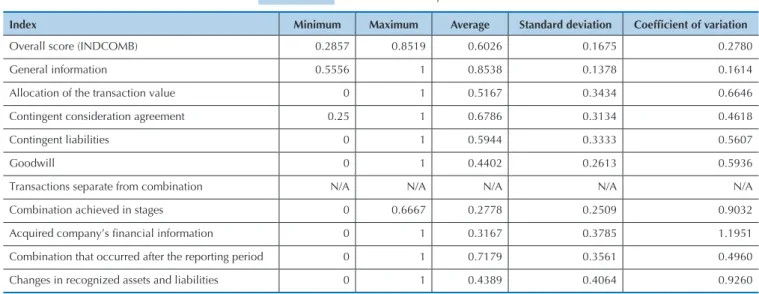
- Overall score: he average disclosure rate was 0.6026. We emphasize that this result was obtained through information that “theoretically” might be mandatorily disclosed, indicating that a signiicant part of the infor-mation required by CPC 15 have not been disclosed. However, this result is not a matter of surprise, since it is consistent with other studies that also documented non-disclosure of mandatory information (see, for ins-tance, Ayers et al., no prelo; Devalle & Rizzato, 2012). - Overall information score: he average rate 0.8538 in
this category indicates that companies have disclosed overall information related to transactions in an ade-quate way, this has been the highest individual score. It is observed that in this information category the disclo-sure of owner information has not been required, some-thing which may justify its high level.
- Score of information on allocation of transaction value for the assets: he information in this category refer to the book values and fair values of recognized assets acquired and liabilities assumed. he average rate 0.5167, with a coeicient of variation of 0.6646 indicate low disclosure levels, with very big diferences between the information provided by companies.
- Score of information on contingent consideration agreements: Few companies have reported the existen-ce of a contingent consideration agreement. he doubt is whether the small amount of companies reporting the existence of this agreement type is due to the fact that, actually, there are no agreements between buyer and seller or because of the former Brazilian accounting practices, which did not prescribe the disclose of this information.
- Score of information on recognition of contingent liabilities: his is one of the exceptions to CPC 25 – Provisions, Contingent Liabilities and Contingent As-sets – in recognizing contingent asAs-sets and liabilities deriving from business combination. Few companies have recognized the existence of contingent liabilities deriving from combination. he rate 0.5944, with a co-eicient of variation of 0.5607, indicate low disclosure
level and a big diference between the companies that reported information in this category.
- Score of information on goodwill: Information on goodwill recognized in a business combination was very poor, as it may be evidenced by the low rate 0.4402. In addition, there are major diferences between infor-mation provided by companies, because the coeicient of variation was 0.5936. It is observed that there is still some conceptual confusion regarding overprice and goodwill at some companies. he most common is na-ming goodwill as the diference between the value of transferred consideration and the net value of assets and liabilities. Concerning the qualitative factors that make up goodwill, generally companies just declared that the overprice for future expectation was grounded in a report prepared by a specialized company.
- Score of information on transaction separate from combination: We did not identify any company that has reported a transaction separate from combination. - Score of information on business combination
achie-ved in stages: Few companies reported that they held prior participation in acquired companies before acqui-ring control.
- Score of inancial information of the acquired company: he average rate 0.3167 indicates that companies had few required information. Additionally, there is a big diference between companies; some did not disclose any information and others disclosed all required information.
- Score of information on combination of operations occurring ater the reporting period: Only 13 compa-nies reported conducting a business combination tran-saction ater the reporting period. he information is contained in the item named subsequent events and, generally, does not meet the information requirements of CPC 15. he information disclosed was quite suc-cinct.
- Score of information on changes in recognized values:
Few companies have identiied changes in values recog-nized in the initial accounting.
N/A – not available
Index Minimum Maximum Average Standard deviation Coeficient of variation
Overall score (INDCOMB) 0.2857 0.8519 0.6026 0.1675 0.2780
General information 0.5556 1 0.8538 0.1378 0.1614
Allocation of the transaction value 0 1 0.5167 0.3434 0.6646
Contingent consideration agreement 0.25 1 0.6786 0.3134 0.4618
Contingent liabilities 0 1 0.5944 0.3333 0.5607
Goodwill 0 1 0.4402 0.2613 0.5936
Transactions separate from combination N/A N/A N/A N/A N/A
Combination achieved in stages 0 0.6667 0.2778 0.2509 0.9032
Acquired company’s inancial information 0 1 0.3167 0.3785 1.1951
Combination that occurred after the reporting period 0 1 0.7179 0.3561 0.4960
Changes in recognized assets and liabilities 0 1 0.4389 0.4064 0.9260
4.2 Results of the empirical model
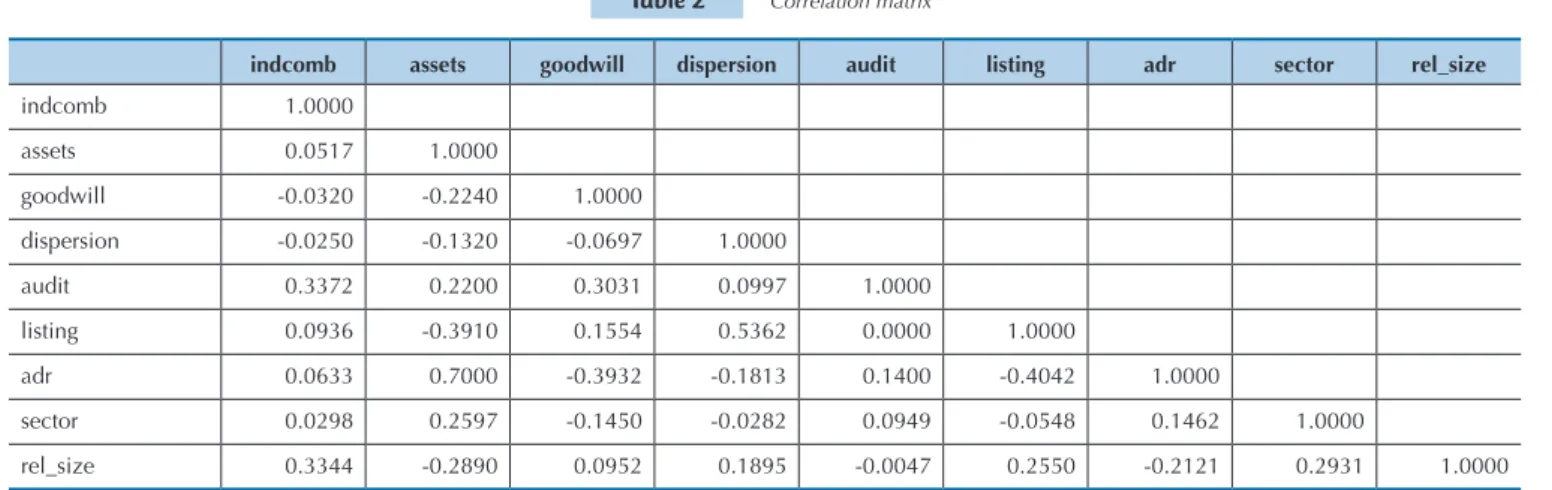
Preliminarily, we conducted a survey of the correlation
between variables of the model, obtaining the results dis-played in Table 2.
We notice a signiicant positive correlation between the disclosure index and the independent variables relative size and audit irm, enabling evidence that the acquired com-pany size and the audit irm inluence on the disclosure of information on the business combination.
he variable goodwill (percentage of goodwill in relation to the value of transferred consideration) expresses a negative correlation to the disclosure rate of INDCOMB, it seems to in-dicate that a greater recognition of goodwill in relation to the transaction value leads companies to disclose a lower level of information, in line with what was observed by Shalev (2009).
he correlation between the variable percentage of goodwill in relation to the transaction value and the total assets sho-ws a negative sign, suggesting that smaller companies tend to recognize greater goodwill in the transaction. According to the observation of a negative correlation between the variable indicating participation in ADR programs and the percenta-ge of goodwill identiied in relation to the transaction value, companies that list their shares on American stock exchanges recognize lower goodwill in transactions.
We used the statistical sotware Stata and the results are shown in Table 3.
indcomb assets goodwill dispersion audit listing adr sector rel_size
indcomb 1.0000
assets 0.0517 1.0000
goodwill -0.0320 -0.2240 1.0000
dispersion -0.0250 -0.1320 -0.0697 1.0000
audit 0.3372 0.2200 0.3031 0.0997 1.0000
listing 0.0936 -0.3910 0.1554 0.5362 0.0000 1.0000
adr 0.0633 0.7000 -0.3932 -0.1813 0.1400 -0.4042 1.0000
sector 0.0298 0.2597 -0.1450 -0.0282 0.0949 -0.0548 0.1462 1.0000
rel_size 0.3344 -0.2890 0.0952 0.1895 -0.0047 0.2550 -0.2121 0.2931 1.0000
legend:
indcomb = index of business combination INDCOMB assets = natural logarithm of total assets
goodwill = ratio between recognized goodwill and the value of transferred consideration dispersion = percentage of common shares held by non-controlling shareholders audit = dummy indicating that the audit irm is one of the Big Four
listing = dummy indicating that the company is listed on the new Market or on BM&FBovespa level 2 adr = dummy indicating that the company issues ADRs
sector = dummy indicating that the company operates in the inancial or electric sector rel_size = ratio between the transaction value and the the acquiring company’s total assets
Table 2 Correlation matrix
Coef. Std. Err t P> |t| [95% conf. interval]
assets .0152439 .0201705 0.76 0.456 -.0258942 .0563819
goodwill -.1084677 .0695888 -1.56 0.129 -.2503951 .0334597
dispersion -.1967892 .1290954 -1.52 0.138 -.460081 .0665026
audit .245981 .0921305 2.67 0.012 .0580797 .4338824
listing .0740528 .0732194 1.01 0.320 -.0752791 .2233848
adr -.0331007 .1049792 -0.32 0.755 -.2472071 .1810058
sector -.1391803 .1058138 -1.32 0.198 -.3549889 .0766283
rel_size .4922631 .1800548 2.73 0.010 .1250388 .8594874
_cons .0865779 .4391994 0.20 0.845 -.8091751 .9823309
Number of observations 40
F statistics 1.98
P value 0.0827
R squared 0.3383
Adjusted R squared 0.1675
We can notice that the model with all independent va-riables included has no statistical signiicance at 95% con-idence level, according to F test, and there are even proble-ms of multicollinearity between some variables, such as, for instance, adr and assets. However, as the variables audit and
relative size have proved to be signiicant, then, the stepwise procedure was executed to remove from the model statisti-cally non-signiicant variables and check if they result in a model that demonstrates explanatory power. hus, executing the procedure, we obtained the results displayed in Table 4.
he resulting model is signiicant (F statistics = 0.0086), therefore, if rejecting the null hypothesis that all covariates have coeicients equal to zero. he inal model shows as sta-tistically signiicant variables the audit irm size, the relative company size, and the intercept, at the conidence interval of 95%. Based on multicollinearity test by using the variation in-lation factor (VIF) test, it was found that the VIFs found are below 3 According to Gujarati (2006), multicollinearity pro-blems are considered when VIF above 10 are observed. he-refore, in the inal model, based on the VIF test, there are no multicollinearity problems among the explanatory variables.
The model has indicated a heteroscedasticity pro-blem of waste in the Breush-Pagan/Cook-Weisberg test. However, according to Wooldridge (2006), heteroce-dasticity does not cause bias or inconsistency in the re-gression coefficients or in R², revealing problems only in t statistics. Wooldridge (2006) suggests as a correcti-ve procedure for this problem using a robust t statistics concerning heteroscedasticity. Running up a robust re-gression in Stata, with only the audit explanatory varia-bles and relative size, we obtained the results displayed in Table 5.
In fact it is observed that the model remains statistically signiicant with no change in its explanatory power. he
co-eicient values were not changed, only on the t statistics for each regressor.
5 CONCLUSIONS
his paper sought to analyze the level of disclosure of information on business combinations and the factors that inluenced on the company’s decision to disclose informa-tion on these transacinforma-tions, in the year that CPC 15 entered into force.
To test the hypotheses, independent variables cited in the meta-analysis by Ahmed and Courtis (1999) and control variables reported in the literature were used. It is noticed that the disclosure index was low. This may be attributed to the fact that 2010 was the first year of
Coef. Std. Err t P> |t| [95% conf. interval]
audit .1867982 .0797242 2.34 0.025 .0252616 .3483348
rel_size .3547538 .1526599 2.32 0.026 .0454355 .6640721
_cons .3995629 .077173 5.18 0.000 .2431956 .5559302
Number of observations 40
F statistics 5.42
P value 0.0086
R squared 0.2266
Adjusted R squared 0.1848
Table 4 Results regression by using the stepwise procedure
Coef. Std. Err t P> |t| [95% conf. interval]
audit .1867982 .0536262 3.48 0.001 .0781413 .2954551 rel_size .3547538 .1171841 3.03 0.004 .1173163 .5921913
_cons .3995629 .0478862 8.34 0.000 .3025362 .4965896 Number of observations 40
F statistics 13.08
P value 0.0001
R squared 0.2266
the Accounting Standard CPC 15 – and, thus, preparers and auditors were not, yet, well prepared to apply the standard.
Regarding the acquiring company’s size, it was not con-cluded that larger companies disclose more information on business combinations, a result that is diferent from that found in most international surveys on disclosure, but in line with what was found by Glaum and Street (2003), Street and Bryant (2000), and Street and Gray (2002). It is emphasized that this study refers to a speciic dimension of disclosure related to information on business combina-tions, therefore, with diferent characteristics when compa-red to other studies cited on disclosure. Nevertheless, this is information disclosure and, thus, we compared the results to other surveys regarding disclosure.
On the other hand, corroborating what was observed in the analysis of the correlation between variables, it was confirmed that the control variable relative size sho-wed statistical significance with a positive coefficient, as observed by Málaga (2007), indicating that acquiring firms are concerned about disclosing more information on business combinations the higher the value of the transaction in relation to the total of their own assets, i.e. when investment is significant. This seems to be due to the concern of acquiring companies with the influence of the acquired company on its results.
he variable recognized goodwill in relation to trans-ferred consideration value had no statistical signiicant, unlike what was found by Shalev (2007). A possible ex-planation for the rejection of this hypothesis is that the calculation of goodwill is usually done with a high dose of arbitrariness or even inluenced by tax legislation. We can also notice that, in a large part of transactions, goodwill was computed as the diference between the amount paid and its book value and this diference was entirely justi-ied as expected future proitability.
he hypothesis that irms with greater capital disper-sion disclose more information on business combinations was not conirmed, contrary to what was reported by Leuz and Verrecchia (2000) and Rafournier (1995). A hy-pothesis for the result is that even with capital dispersion, shareholder agreements ensure control of these compa-nies by a controller or a control group, according to a stu-dy conducted by Gorga (2008), and, in the presence of control concentration, disclosure would not be required.
The results indicate that audit firm size influences on the level of disclosure of information on business combination, as observed by Ahmad et al. (2003). Large international audit companies, familiar with the requi-rements of IFRS 3 at the international level, apply this knowledge to Brazil, influencing on the disclosure of information on a business combination undertaken by audited companies.
Finally, we did not conirm the hypothesis that the le-vel of disclosure on business combinations is inluenced by acquiring company’s participation in ADR programs. Murcia and Santos (2009) found diferent results. A justi-ication for the diferent result is that the companies used
for analysis were diferent. Murcia and Santos (2009) used the 100 largest companies listed on BOVESPA, which pu-blished inancial statements for the iscal year 2007 and this study analyzed all companies having shares traded on the BM&FBOVESPA in 2010 that reported to acquired the stock control of other companies. Furthermore, the metrics used by Murcia and Santos (2009) to calculate the disclosure level was based on voluntarily disclosed infor-mation, whereas this study used the compulsory disclo-sure items deined by CPC 15. herefore, although both analyze the inluence of issuing ADRs on disclosure, they are not similar surveys.
The results obtained by this survey provide a contri-bution to the studies that have been recently conducted in Brazil, related to the evaluation of the accounting in-formation disclosure levels after the adoption of IFRS and CPCs. Furthermore, it provides evidence for the specific analysis of companies that undertook business combinations. These transactions, as discussed in the introduction, moved large volumes of resources and users of accounting information are directly affected by the outcomes of such transactions. It also contributes to international studies related to accounting information disclosure, insofar as it provides empirical evidence on impacts deriving from the adoption of IFRS in Brazil. The findings also contribute to the literature in the field by providing new evidence on the phenomenon of dis-closure, studied both internationally and in Brazil and from a very specific perspective, the disclosure of infor-mation on business combinations.
hus, in terms of practical consequences for such users, through the positive relation obtained between the infor-mation disclosure level and the audit irm size, it is expec-ted that companies audiexpec-ted by the Big Four provide a rather transparent information to the market. On the other hand, the positive relation between the disclosure level and the acquiring company’s relative size draws attention to the as-pect of transaction relevance.
and the standards’ estability could provide the disclosure level with robustness and knowledge on the evolution. This could help regulators to evaluate the need for en-forcement. On the other hand, this does not invalidate this survey, because it portrays the situation observed when CPC 15 entered into force. Another analysis that could be suggested might be a comparison between the situation before and after CPC 15. However, taking into account that the requirement to disclose this kind of in-formation prior to the adoption of CPC 15 was much lower, so, such a comparison could not be feasible.
he second limitation is related to the construction of the disclosure index INDCOMB. Although such a
cons-truction has been based on Shalev (2009) and on the re-quirements of CPC 15, this involves the creation of a not directly observable construct. In addition, there is the fact that, in the content analysis of inancial statements to pre-pare the disclosure index INDCOMB, the researcher used a considerable amount of opinion. Finally, it is worth hi-ghlighting the limitations of the econometric model em-ployed, since it is restricted to a few independent variables that the researcher considered as relevant to explain the level of disclosure of information on business combina-tion. he choice of variables was based on previous stu-dies and on the need to construct proxies to analyze the hypotheses.
Ahmad, Z., Hassan S., & Mohammad, J. (2003). Determinants of environmental reporting in Malaysia. International Journal of Business Studies, 11, 69-90.
Ahmed, K., & Courtis, J. K. (1999). Associations between corporarte characteristics and disclosure levels in annual reports: a meta-analysis.
British Accounting Review, 31, 35-61.
Archambault, J. J., & Archambault, M. E. (2003). A multinational test of determinants of corporate disclosure. International Journal of Accounting, 38, 173-194.
Ayers, B. C., Schwab, C. M., & Utke, S. (no prelo). Noncompliance with mandatory disclosure requirements: the magnitude and determinants of undisclosed permanently reinvested earnings. he Accounting Review.
Botosan, C. A. (1997). Disclosure level and the cost of equity capital. he Accounting Review, 72(3), 323-349.
Camargos, M. A., & Barbosa, F. V. (2003). Fusões, aquisições e takeovers: um levantamento teórico dos motivos, hipóteses testáveis e evidências empíricas. Caderno de Pesquisa em Administração, 10(2), 17-38. Camargos, M. A., & Coutinho, E. S. A. (2008). Teoria da irma e a
fundamentação teórica para fusões e aquisições: uma análise de suas interfaces. RAC-Eletrônica, 2(2), 273-295.
Chatham, M. D. (2008). Assessing the extent of compliance with international accounting standards. Journal of International Business Research,7(1), 61-90.
Cooke, T. E. (1989). Disclosure in the corporate annual reports of swedish companies. Accounting and Business Research, 19(74), 113-124. Costa Jr., J. V. (2003). Uma avaliação do nível de evidenciação das
companhias abertas, no Brasil, no tocante aos instrumentos inanceiros. Revista Contabilidade e Finanças, 14(32), 23-39. Deangelo, L. E. (1981). Auditor size and audit quality. Journal of
Accounting and Economics.3, 183-199.
Devalle, A., & Rizzato, F. (2012). he quality of mandatory disclosure: the impairment of goodwill. An empirical analysis of european listed companies. Procedia Economics and Finance, 2, 101-108.
Dumontier, P., & Rafournier, B. (1998). Why irms comply voluntarily with IAS: an empirical analysis with Swiss data.Journal of International Financial Management and Accounting. 9(3), 216-245. Dye, R. A. (2001). An evaluation of “essays on disclosure” and the
disclosure literature in accounting. Jounal of Accountung an Economics, 32, 181-235.
Glaum, M., & Street, D. L. (2003). Compliance with the disclosure requirements of Germany’s new market: IAS versus US GAAP. Journal of International Financial Management and Accounting. 14, 64-100. Gorga, E. (2008). Changing the paradigm of stock ownership from concentrated
towards dispersed ownership? Evidence from Brazil and consequences for emerging countries (working paper). Recuperado em 1º de março de 2001, de http://scholarship.law.cornell.edu/clsops_papers/42
Gujarati, D. N. (2006). Econometria Básica (4a ed.). Rio de Janeiro: Elsevier.
Healy, P. M., & Palepu, K. G (2001). Information asymmetry, corporate disclosure, and the capital markets: a review of empirical disclosure literature. Journal of Accounting and Economics, 31, 405-440. Hodgdon, C., Tondkar, R. H., Harless, D. W., & Adhikari, A. (2008).
Compliance with IFRS disclosure requirements and individual analysts’ forecast errors. Journal of International Accounting and Taxation, 17, 1-13.
Kent, P., & Stewart, J. (2008). Corporate governance and disclosures on the transition to international inancial reporting standards. Accounting and Finance, 48, 649-671.
Lanzana, A. P. (2004). Relação entre disclosure e governança corporativa das empresas brasileiras. Dissertação de Mestrado, Faculdade de Economia, Administração e Contabilidade, Universidade de São Paulo, São Paulo.
Letwich, R. (1980). Market failure fallacies and accounting information.
Journal of Accounting and Economics, 2, 193-211.
Leuz, C., & Verrecchia, R. (2000). he economic consequences of increased disclosure. Journal of Accounting Research, 38, 91-124. Leuz, C., & Wysocki, P. (2008). Economic consequences of inancial
reporting and disclosure regulation: a review and suggestions for future research (working paper). Recuperado em 1º de março de 2011, de http://ssrn.com/abstract=1105398
Lima, G. A. S. F. (2009). Nível de evidenciação × custo da dívida das empresas brasileiras. Revista Contabilidade e Finanças, 20(49), 95-108. Lopes, A. B., & Rodrigues, L. L. (2007). Accounting for inancial
instruments: an analysis of the determinants of disclosure in the Portuguese stock exchange. he Journal of Accounting, 42(1), 25-56. Malacrida, M. J. C., & Yamamoto, M. M. (2006). Governança corporativa:
nível de evidenciação das informações e sua relação com a volatilidade das ações do Ibovespa. Revista Contabilidade e Finanças, 17, 65-79. Málaga, F. K. (2007). Estudo do risco sistêmico das empresas resultantes
de fusões e aquisições e as expectativas dos investidores e dos gestores. Tese de Doutorado, Faculdade de Economia, Administração e Contabilidade, Universidade de São Paulo, São Paulo. Malaquias, R. F., Lemes, S., Carvalho, L. F., & Tavares, M. (2012).
Disclosure of inancial instruments and capital cost of Brazilian companies. Asian Journalof Business and Management Sciences, 1(9), 16-27.
Mapurunga, P. V. R., Ponte, V. M. R., Coelho, A. C. D., & Meneses, A. F. (2011). Determinantes do nível de disclosure de instrumentos inanceiros derivativos em irmas brasileiras. Revista Contabilidade & Finanças, 22(57), 263-278.
Marston, C. L., & Shrives, P. J. (1991). he use of disclosure indices in accounting research: a review article. Britsh Accounting Review, 25, 195-210.
Martins, E., & Iudicibus, S. (2011). Intangível: sua relação contabilidade/direito – teoria, estruturas conceituais e normas – problemas iscais de hoje. In A. B. Lopes, & R. Q. Mosquera (Coord), Controvérsias jurídico-contábeis (aproximações e distanciamentos) (Vol. 2). São Paulo: Dialética. Murcia, F. D., & Santos, A. (2009). Fatores determinantes do nível de
disclosure voluntário das companhias abertas no Brasil. Revista de Educação e Pesquisa em Contabilidade, 3(2), 72-95.
Rafournier, B. (1995). he determinants of voluntary disclosure by Swiss listed companies. European Accounting Review, 4, 261-280. Robinson, J. R., Xue, Y., & Yu, Y. (2011). Determinants of disclosure
noncompliance and the efect of the SEC review: evidence from the 2006 mandated compensation disclosure regulations. he Accounting Review, 86(4), 1415-1444.
Salotti, B. M., & Yamamoto, M. M. (2008). Divulgação voluntária da demonstração dos luxos de caixa no mercado de capitais brasileiro.
Revista Contabilidade e Finanças, 19(48), 37-49.
Schipper, K. (2007). Required disclosures in inancial reports. he Accounting Review, 82(2), 301-326.
Shalev, R. (2007). Managerial discretion in business combinations reporting under SFAS 141. Tese de doutorado, Graduate School of Arts and Science, Columbia University, Ann Arbor, Ml.
Shalev, R. (2009). he information content of business combination disclosure level. he Accounting Review, 84(1), 239-270. Shleifer, A., & Vishny, R. (1986). Large shareholders and corporate
control. Journal of Political Economy, 94, 461-488.
Singhvi, S. S., & Desai, H. B. (1971). An empirical analysis of the quality of corporate inancial disclosure. he Accounting Review, 46, 120-138. Street, D. L., & Bryant, S. M. (2000). Disclosure level and compliance with
IASs: a comparison of companies with and without US listings and illings. International Journal of Accounting, 35(3), 305-329. Street, D. L., & Gray, S. J. (2002). Factors inluencing the extent of
corporate compliance with International Accounting Standards: summary of a research monograph. Journal of International Accounting, Auditing & Taxation, 11, 51-76.
Tsalavoutas, I., Evans, L.; & Smith, M. (2010). Comparison of two methods for measuring compliance with IFRS mandatory disclosure requirements. Journal of Applied Accounting Research,11(3), 213-228. Verrecchia, R. (2001). Essays on disclosure. Journal of Accounting and
Economics, 32, 97-180.
Wallace, R. S. O., & Naser, K. (1995). Firm-speciic determinants of the comprehensiveness of mandatory disclosure in the corporate annual reports of irms listed on the stock exchange of Hong Kong. Journal of Accounting and Public Policy, 13, 311-368.
Wiseman, J. (1982). An evaluation of environmental disclosures made in corporate annual reports. Accounting Organization and Society, 7(1), 53-63. Wooldridge, J. M. (2006). Introdução à econometria: uma abordagem
moderna. São Paulo: Pioneira homson Learnig.
Yeoh, J. (2005). Compliance with mandatory disclosure requirements by New Zealand listed companies. Advances in International Accounting,