DOI: 10.1590/1808-057x201703240
Value Relevance vis-à-vis Disclosure on Business Combinations
and Goodwill Recognized by Publicly Traded Brazilian
Companies*
Maíra Melo de Souza
Universidade Federal de Santa Catarina, Departamento de Ciências Contábeis, Florianópolis, SC, Brazil
José Alonso Borba
Universidade Federal de Santa Catarina, Departamento de Ciências Contábeis, Florianópolis, SC, Brazil
Received on 02.20.2016 – Desk acceptance on 03.12.2016 – 3rd version approved on 09.30.2016
ABSTRACT
he objective of this study is to examine the value relevance of the level of disclosure on business combinations and goodwill recognized by publicly traded Brazilian companies. he research sample is composed of publicly traded Brazilian companies that carried out any type of business combination, as the acquiring entity, between 2010 and 2013, yielding a total sample of 202 observations. To measure the disclosure level of each, a metric was created based on CPC-15 R1 (2011) to examine certain disclosure items in order to render a greater level of detail. Data collection was carried out using the footnotes to the annual consolidated standardized inancial statements (DFPs) available from the São Paulo Stock Exchange (BM&FBOVESPA) website. he results revealed that disclosure levels for business combinations are positively and signiicantly associated with the stock price of the companies analyzed. As to the recognition of goodwill during business combinations, despite the fact that it represents a signiicant share of the value of the transactions, no statistical signiicance explaining stock price behavior was found. It also bears mentioning that the average level of disclosure identiied in the explanatory notes in the sample was very low, indicating that companies need to improve when it comes to transparency of information.
Keywords: business combinations, goodwill, disclosure, value relevance.
1 INTRODUCTION
In an economically vulnerable environment, one of the alternatives that companies use in order to become stronger are business combinations (Mortensen, 1994; Chi & Tang, 2007). Examples of business combinations (corporate reorganizations) include incorporations, mergers, and acquisitions.
The International Accounting Standards Board (IASB) uses the IFRS 3 rule, which addresses business combination transactions and determines how companies should proceed with regards to accounting treatment and disclosure requirements in explanatory notes. Brazil has also adopted this standard via CPC 15 R1 (which correlates with IFRS 3 of the IASB).
However, because it recommends intense use of fair value for accounting and disclosure on business combinations, IFRS 3 is considered to be one of the IASB’s most complex standards (Baboukardos & Rimmel, 2014). Despite the organization’s eff orts, implementing IFRS 3 is still a big challenge in countries that have adopted its rules (Mario, Baboukardos, Cunningham & Hassel, 2011). In Brazil, in light of the challenge presented by the rule addressing business combinations, and in the context of convergence with the IASB standards, studies addressing the mandatory disclosure involved in IFRS 3 thus become relevant. Moreover, Brazil is the perfect environment for comprehensive studies covering the transparency of information contained in published DFPs, considering that it is a developing country which is experiencing various crises involving corruption and lack of transparency.
In this context, disclosure of information on business combinations plays an important role in the sense that it provides users with details regarding the accounting policies adopted and the values related with the transactions carried out (Shalev, 2009).
h e importance of mandatory disclosure can also be explained by the agency theory. Laid down by Jensen and Meckling (1976), it shows that earnings management can be used as a result of conl icts of interest in which those who control a company (agent) can manage their decisions with the aim of demonstrating a situation that is compatible with their aims and ambitions, to the detriment of other parties interested in the company’s returns. h e underlying idea is that those who control company decisions can use this situation to obtain individual benei ts to the detriment of other interested parties who do not take part in the decision making process, but who have an interest in the returns that a company can off er.
h us, regulatory bodies still face diffi culties when dei ning the standards to be followed, as well as researchers, in the sense of providing empirical evidence with regards to mandatory disclosure involved in the accounting rules (Schipper, 2007).
Perhaps because there is no broad theory involving mandatory disclosure, various questions still need to be studied with regards to how to disclose mandatory information and how users view the disclosure carried out (Schipper, 2007).
Moreover, most papers on disclosure originate from countries with the Anglo-Saxon accounting model and address voluntary disclosure; there are still few studies addressing mandatory disclosure in less developed markets (Schipper, 2007; Hassan, Romilly, Giorgioni & Power, 2009; Baboukardos & Rimmel, 2014).
Accounting disclosure plays a crucial role in reducing information asymmetry in the context of agency theory (Klann, Beuren & Hein, 2015). In this sense, companies that carry out better levels of disclosure in their i nancial statements and explanatory notes are contributing to transparency before the market.
Moreover, another point highlighted by Schipper (2007) is the way users of i nancial statements view the disclosure carried out by companies. h is line of studies includes papers on value relevance.
Studies on value relevance aim to evaluate the relevance of accounting information via how it is rel ected in stock prices (Barth, Beaver & Landsman, 2001; Beaver, 2002; Baboukardos & Rimmel, 2014; Tsalavoutas & Dionysiou, 2014).
In Brazil, the expression value relevance is understood as the extent of the impact that particular accounting information causes on company share prices (Ramos & Lustosa, 2013). h us, the primary question in studies on value relevance is to know whether the content of accounting statements is relevant for investors (Barth et al., 2001; Beaver, 2002; Lopes, 2002a; Baboukardos & Rimmel, 2014; Tsalavoutas & Dionysiou, 2014).
and Tsalavoutas and Dionysiou (2014). h e study from Hassan et al. (2009) covers both mandatory and voluntary disclosure. h e results from the aforementioned papers diff er, depending on the country in which the research was carried out.
Considering the gap that exists with regards to studies involving mandatory disclosure (Schipper, 2007), the complexity related with IFRS 3, which addresses business combinations (Mario et al., 2011; Baboukardos & Rimmel, 2014), and the importance of disclosure in reducing information asymmetry (Leuz & Verrecchia, 2000; Verrecchia, 2001; Patel, Balic & Bwakndoira, 2002; Klann et al., 2015), this study intends to contribute to the topic by addressing the value relevance of levels of disclosure on business combinations in the Brazilian emerging market.
Moreover, when addressing business combinations, another important topic that arises is the goodwill recognized in these transactions (Nakayama & Salotti, 2014).
Goodwill is an asset for which the accounting treatment attributed by the IFRS rules is considered to be complex, with it being the subject of various questions concerning the subjectivity involved in recognizing it in business combinations and subsequent impairment tests (Baboukardos & Rimmel, 2014).
As the IFRS rules determine the use of fair value in the recording and subsequent accounting treatment of goodwill, researchers criticisms focus on the subjectivity that exists, which paves the way for manager accounting choice, and consequently, earnings management (Hayn & Hughes, 2006; Petersen & Plenborg, 2010; Detzen & Zülch, 2012; Baboukardos & Rimmel, 2014).
In Brazil, Nakayama (2012) verii ed that, in 2010, the average percentage of goodwill acquired in business combinations represented 53.16% of transaction values.
In a survey carried out in 2012 by American Appraisal (a company specialized in evaluating assets and businesses) related to 2010 and 2011 and presented in a paper titled “Global M&A Valuation Outlook”, it was disclosed that in some sectors goodwill values can reach more than 40% of the values paid in business combinations. h e results
from the survey reveal that the portions attributed to goodwill are signii cant.
Some studies have explored the relevance of goodwill created in business combinations, such as Jennings, Robinson, h ompson and Duvall(1996), Henning, Lewis, and Shaw (2000), and Baboukardos and Rimmel (2014). Other studies have investigated the value relevance of total goodwill (accumulated over various years) presented in balance sheets, with the authors of these papers addressing the relevance of intangible assets and covering goodwill with the aim of evaluating its relevance. Examples include the articles from Godfrey and Koh (2001), Dahmash, Durand and Watson (2009), and Olivandira, Rodriguands and Craig (2010). h e results from these papers revealed a positive relationship between goodwill values and stock prices.
With the aim of analyzing business combinations and recognized goodwill in the Brazilian setting, the intention behind this study is to provide evidence regarding the way that publicly traded companies are disclosing information on their business combinations, as well as revealing whether the level of disclosure carried out and the goodwill recognized are statistically signii cant for explaining stock prices.
In light of the above, the following research question was formulated: What is the value relevance of levels of disclosure on business combinations and goodwill recognized in publicly traded Brazilian companies? h e research question reveals the aim of this study. h is is the i rst paper in Brazil to address the value relevance of levels of disclosure in business combinations. With the aim of answering the research question, the two hypotheses below were formulated:
H1: h ere is a positive relationship between levels of disclosure on business combinations in Brazilian companies and their share prices.
2 THEORETICAL FRAMEWORK
2.1 Disclosure on Business Combinations and Acquired Goodwill
Healy, Palepu, and Ruback (1992) analyzed the performance of companies resulting from business combinations in 50 major mergers and incorporations carried out in the United States between 1979 and 1984. h e authors demonstrated that the companies obtained improvements in performance post business combination and the results revealed better productivity indices and increases in returns on operating cash l ow.
Baboukardos and Rimmel (2014) explain that business combinations are transactions in which an acquirer obtains control of one or more businesses, independent of any compensation involved. In cases in which there is some compensation in exchange for control, this can occur via payment or the promise of payment in money or shares. On the other hand, in situations in which there is no compensation agreement to be honored by the acquirer, the transaction is concluded by solely contractual means. Examples of business combinations include mergers, incorporations, and acquisitions carried out between companies.
h e reasons for carrying out business combinations vary from company to company, but authors such as Godoy and Santos (2006) emphasize the search for synergies between companies participating in these transactions, also mentioning the alterations that occur in internal and external market environments, as well as the speed with which new markets to be explored arise. h ese market factors ot en make company mergers and acquisitions the fastest and most effi cient way to reach more developed markets.
In this economic environment in which companies seek to gain strength by carrying out business combinations, Shalev (2009) highlights the importance of adequate disclosure of information on these transactions in the accounting reports released for external users.
Shalev (2009) argues that the size of the repercussions and economic impact that business combinations can cause in a country makes the importance of adequate disclosure evident, considering that, in many cases, these transactions involve signii cant amounts of money and important social repercussions, aff ecting collaborators and society.
In Brazil, accounting pronouncement CPC-15 (R1, 2011), agreeing with the international rule IFRS 3,
determines the disclosure requirements for business combinations carried out in the country. However, as Baboukardos and Rimmel (2014) highlight, IFRS 3 is considered to be one of the most complex of the set of international standards.
h e complexity of IFRS 3 begins with the method for acquisitions, which requires the use of fair value in measuring an acquired company’s assets and liabilities (Dorata & Zaldivar, 2010; Mario et al., 2011; Baboukardos & Rimmel, 2014), also determining that identii able intangibles, acquired liabilities, goodwill or gain from advantageous purchase, should be recognized on the date of acquisition.
h us, in a business combination the acquirer should carry out a fair value evaluation of the acquired company’s net assets (assets and liabilities at fair value, including contingent liabilities) and should also recognize the identii able intangibles that did not feature before on the acquired company’s balance sheet. h e diff erence between the value of compensation transferred for acquiring control, the value of the acquired company’s net assets evaluated at fair value, and the value of recognized identii able intangibles, constitutes the goodwill (Samkin & Deegan, 2010; Giuliani & Brännström, 2011; Detzen & Zülch, 2012; Martins, Gelbcke, Santos & Iudícibus, 2013). It is possible to deduce that, in environments in which business combinations are carried out, intangible assets, among which goodwill features, are ever more important
acquired economic resources and represent signifi cant
portions in many of these transactions (Chen, Kohlbeck & Wari eld, 2008; Detzen & Zülch, 2012).
Using the IASB rule IFRS 3, the accounting treatment of goodwill is highly inl uenced by fair value, both in initial recognition as well as in subsequent impairment tests, and is the subject of many criticisms regarding its complexity, subjectivity (Baboukardos & Rimmel, 2014), and the possibility of earnings management (Beatty & Weber, 2006; Hayn & Hughes, 2006; Carlin & Finch, 2010; Jahmani, Dowling & Torres, 2010; Li, Shroff , Venkataraman & Zhang, 2011; Detzen & Zülch, 2012; Ramanna & Watts, 2012).
IFRS 3. h e next topic considers some of the previous studies on value relevance, highlighting that no previous study was found that addressed the relevance of disclosure with regards to the IFRS 3 rule in particular.
2.2 Some Previous Studies regarding Value Relevance
Lopes (2002b) investigated the value relevance of accounting variables (net equity per share and earnings per share) in Brazil. h e period analyzed was from 1998 to 1999. h e results revealed that the explanatory power of net equity per share was greater than the explanatory power of earnings per share. h e author interpreted the low explanatory power of i nancial period results, arguing that the high ownership concentration in Brazilian companies means that this information is not crucial for reducing information asymmetry, given that the big controlling shareholders already have privileged access to it.
In Brazil, Rezende (2005) verii ed the value relevance of net income, net equity, and deferred assets in telecommunications sector companies (new economy) and, comparatively, in companies from the steel/metals and banks/insurers sector (representing the old economy), between 1995 and 2003. h e author verii ed that the accounting variables (earnings per share and net equity per share) are relevant for explaining stock prices in the three sectors analyzed; however, the value of deferred assets did not present statistical signii cance in any of the sectors.
Kang and Pang (2005) investigated whether the diff erences in disclosure levels between developed and emerging countries rel ects greater value relevance in developed countries. h e authors found that the value relevance of accounting information in the United States (a developed country) is greater than the value relevance of information in emerging countries, suggesting that the higher disclosure level in developed countries has an inl uence on the value relevance of the information provided in accounting reports.
Regarding the relevance of mandatory disclosure levels in an emerging country, the study carried out by Hassan and Mohd-Saleh (2010), in companies in Malaysia, investigated the value relevance of disclosure on i nancial instruments based on rule MASB 24. h e authors report a positive connection between the level of disclosure on i nancial instruments and stock prices, suggesting that a better level of disclosure regarding i nancial instruments improves the value relevance of these assets before the market.
Alfaraih and Alanezi (2011) analyzed whether mandatory disclosure levels aff ect the value relevance of accounting information from the view of investors, in companies listed on the Kuwait Stock Exchange in 2007. h ey verii ed that earnings per share are strongly signii cant for investors in Kuwait, at a 1% level of signii cance; and yet, the level of mandatory disclosure variable did not present statistical relevance. h e researchers interpreted this result as being due to the inability of many investors to price, in their share price evaluations, better levels of voluntary disclosure.
Tsalavoutas and Dionysiou (2014) analyzed the value relevance of levels of compliance with the IFRS rule and whether there was any diff erence between companies with high and low levels of compliance in relation to the disclosure requirements of the rule. h e study was carried out in Greece, and consisted of a sample of 150 companies. h e authors found that compliance with the disclosure requirements is positively and signii cantly related with stock prices, concluding that information of a mandatory nature is relevant for investors in that they tend to value more transparent companies.
It is possible to note in previous studies that research regarding value relevance tends to i nd the relevance of net income and net equity, both accounting variables which explain only a small part of a stock’s price. In addition, by inserting variables regarding disclosure, some studies have concluded that levels of disclosure are relevant in explaining part of a stock’s price. h ese results in relation to disclosure encourage research in this area aiming to provide more evidence with regards to this fact.
3 METHODOLOGY
h is study is exploratory-descriptive in nature and in terms of its approach to the problem it covers evaluations of a quantitative and qualitative nature, considering that statistical tools were used to answer the research problem, but a qualitative analysis was also carried out of the disclosure in companies’ explanatory notes.
notes published by the companies, in each case related to the year in which each business combinations occurred. h us, if the business combination was carried out on October 15, 2010, the disclosure level analysis was verii ed in the explanatory notes included in the standardized i nancial statements (DFPs) related to the i nancial period ending in 2010. All of the data related to this combination also respected this criterion. In all cases the consolidated
DFPs were analyzed.
3.1 Constructing the Metric and Obtaining Level of Disclosure
With the aim of measuring the level of disclosure for each business combination in the sample, a disclosure index was calculated based on the information published by the companies in their explanatory notes related to the year in which the business combination occurred.
To obtain each disclosure index, i rst it was necessary to elaborate a metric covering the information that companies need to release concerning any business combinations carried out.
Nakayama (2012) used a metric based on the CPC-15
determinations (2009). h e basis for this author’s metric was the i rst version of the accounting pronouncement related to business combinations. His paper aimed to measure the level of disclosure in business combinations
in 2010 and identify factors determining the level of disclosure carried out by Brazilian companies.
h e metric developed in this study went beyond those used by Nakayama (2012), given that the requirements contained in CPC-15 R1 (2011) were widened, with the aim of obtaining detailed information on the business combinations and involving a total of 80 items.
The intention was to contribute to fulfilling the completeness attribute envisioned by the CPC Conceptual Framework for Elaborating and Releasing Financial Accounting Reports (2011), which adds that “for information to be faithfully represented it needs to be complete, neutral, and free of errors”.
To calculate the disclosure index, the methodology used in research on business combinations by Shalev (2009), Nakayama (2012), and Nakayama and Salotti (2014) was adopted, attributing 1 (one) to “Disclosure of the Item”, 0 (zero) to “Non-disclosure of the Item”, and NA (Not Applicable) to cases in which particular item(s) of the metric did not apply to the respective case(s).
Each disclosure index was obtained by dividing the number disclosed in explanatory notes by the total number of items of the metric that were applicable for disclosure. h e formula below presents the procedure used in calculating the index related to each business combination making up the sample analyzed in this study.
Disclosure Index = Number of Items Disclosed in the Explanatory Notes (Total Number of items of the Metric – Items that do Not Apply)
It bears mentioning that each business combination forming the sample was analyzed individually, resulting in an index for each one.
As can be observed in the formula, care was taken in identifying situations in which a particular item of the metric did not apply to the respective case, since these items were not considered in the total reference number for calculating the index. For example, in the companies that recognized goodwill, disclosure of items related to “Gain from Advantageous Purchase” does not apply. Another case of “Not Applicable” concerned the items of the metric in which the company itself communicated, in its explanatory notes, that the respective case did not occur, thus allowing “Not Applicable” to be attributed to that item.
As for the cases in which the company mentioned nothing about the occurrence or not of a particular fact corresponding to some item of the metric, leaving it in doubt whether the fact should have been disclosed or
not, it was called “Non Disclosure of the Item”, given that it cannot be known whether the fact liable to disclosure occurred.
h e argument was assumed that, if the fact did not apply to the company, it could be communicated in its explanatory notes, which would leave no doubt with regards to the occurrence or not of the item.
h e decision was taken to analyze the explanatory notes included in the annual accounting statements, called the Standardized Financial Statements (DFPs), given the importance that the information in them represents to the market, since they consider the net income or loss from a i nancial period.
and Baboukardos and Rimmandl (2014), also used the information from annual accounting statements as the basis for their papers.
3.2 Presentation of the Variables Used
In this topic, information is presented on the variables used in the statistical analysis. h e dependent variable is represented by stock price (Price). h e set of explanatory variables is composed of the level of disclosure on business combinations, goodwill per share, identii able intangibles per share, relative goodwill, earnings per share (EPS), and book value of net equity per share (BVPS).
3.2.1 Share price (P) – Dependent Variable.
In relation to the dependent variable “share price”, some studies on value relevance used the share price three months at er the closing date of the i nancial period. Examples include the papers from Vafaei, Taylor, and Ahmed (2011), Jennings et al. (1996), Hassan and Mohd-Saleh (2010), and Oliveira et al. (2010).
h e authors who opted for the methodology involving share price three months at er the closing date of the i nancial period explain that their intention was to test share prices that rel ected the information contained in already published annual i nancial statements. In light of this, in this study the decision was made to use the share price three months at er the close of the i nancial period as a proxy for the dependent variable “share price”.
h e closing prices of ordinary shares were collected, and when this was not available, the preference share value was used. h e data related to share prices were obtained from the ECONOMATICA® database.
3.2.2 Level of disclosure for business combinations. Business combinations are transactions in which an acquirer obtains control of another (acquired) company, thus becoming predominant in the main activities that can aff ect the acquired company’s earnings (CPC-15 R1, 2011).
Considering the size of the impact that business combinations can have on a country’s economic environment, adequate disclosure of information regarding these transactions becomes important (Shalev, 2009).
Among the benefits that result from increased corporate disclosure, Healy, Hutton, and Palepu (1999) highlight better company share performance on the market. Along this same line of research, Bushee and Noe (1999) concluded that investors tend to be attracted to companies with greater levels of disclosure.
Some research indicates that a greater level of disclosure results in a reduction in information asymmetry, leading
to a reduction in risk, and consequently, rel ections of this can be seen in improved share performance in the market (Healy et al., 1999; Malacrida & Yamamoto, 2006). In Greece, Baboukardos and Rimmel (2014) found that goodwill has a strong eff ect on the share price of companies with high levels of goodwill disclosure based on IFRS 3, but no eff ect on the price of companies with low levels of goodwill disclosure. h is is a possible indication that the reduction in risk resulting from greater levels of disclosure is relevant for explaining share prices.
Companies that present a better level of disclosure provide a higher degree of reliability to Brazilian investors (Malacrida & Yamamoto, 2006). From this perspective, investors are expected to value Brazilian companies with greater levels of disclosure on their business combinations. Hypothesis H1 of this study states that:
H1: h ere is a positive relationship between levels of disclosure on business combinations in Brazilian companies and their share prices.
h e operationalization of the “Disc” variable was via a disclosure index calculated according to the explanation in item 3.1.
3.2.3 Goodwill per share.
h e test involving the explanatory variable “goodwill per share” intends to provide evidence for accepting or rejecting the second hypothesis formulated in this study. Previous studies have provided statistical evidence that the market attaches relevance to the goodwill recognized by companies, such as those from Jennings et al. (1996), Henning et al. (2000), Godfrey and Koh (2001), Dahmash et al. (2009), Oliveira et al. (2010), and Cazavan-Jeny (2004).
It is worth noting that the papers mentioned studied the value relevance of goodwill in developed countries, and this study provides evidence regarding a developing (emerging) market.
Baboukardos and Rimmel (2014) argued that, in business combinations, the acquirer should evaluate the fair values of assets and liabilities, and verify the existence of identii able intangibles liable to individual recognition. Only at er verifying these values is it possible to evaluate the value of goodwill.
Besides the subjectivity involved in initial recognition, the subsequent accounting treatment of goodwill is also subject to criticism in the literature. On this aspect, Jahmani et al. (2010) observe that the approach of evaluating the recoverable value of goodwill annually, instead of systematic amortization, allows for volatility
susceptible to being recognized in varied amounts. For the authors, managers can choose the best moment to recognize losses via impairment, with the aim of carrying out income smoothing.
In this context, the possibility for earnings management is one of the topics under focus when addressing goodwill. Ball, Kothari, and Robin (2000) report that managers can vary the applicability of accounting rules, and in this context, the openness in the rules related to the accounting treatment of goodwill allows for this l exibility.
h e value relevance of goodwill was shown by Jennings et al. (1996), in a pioneering paper in which it was revealed that investors use the information available on goodwill acquired in business combinations and that this is rel ected in share price. h e assumption that the value of goodwill recognized in a business combination is signii cant at the time investors determine the share price leads to the second hypothesis of the study:
H2: h e value of goodwill recognized by companies in business combinations is a signii cant factor in investors’ share price evaluations.
Information related to the value of recognized goodwill was obtained from the explanatory notes referring to the years in which the business combinations took place. To operationalize this variable, the value of goodwill recognized in a business combination was divided by the total quantity of company shares, which was obtained from the São Paulo Stock, Commodities, and Futures Exchange (BM&FBOVESPA) website.
3.2.4 Identii able intangible per share.
For some authors, goodwill is considered as a residual, given that in order to obtain its value the following must be deducted from the transaction value: a) the value of the company’s net assets acquired at fair value; and b) the value of the identii able intangible assets. h e remainder thus constitutes the goodwill (Samkin & Deegan, 2010; Giuliani & Brännström, 2011; Detzen & Zülch, 2012; Martins et al., 2013).
In a business combination, only assets that have not fuli lled the recognition criteria for individual (identii able) intangibles, established by CPC-04 R1 (2010), will be included in goodwill on the date of acquisition.
h us, in a business combination, acquiring companies should measure the values of the identii able intangible assets acquired and the portion of intangible assets that were not liable to identii cation will be included in the value of goodwill acquired in the respective transaction.
It is perceived that the criticisms of the theory related to the subjectivity in recognizing goodwill in business
combinations also have an impact on the recognition of identii able intangibles, since depending on the value that is recognized as identii able intangible, there will be an impact on the value of goodwill. As a result of this, in this paper, including the variable identii able intangible per share was considered important.
h e “identii able intangible per share” variable was included with the aim of verifying whether it is statistically signii cant in relation to share price. h e studies from Dahmash et al. (2009) and Oliveira et al. (2010) verii ed that identii able intangibles are relevant in Australian and Portuguese investors’ evaluations, respectively.
h e information regarding the value of recognized identifiable intangibles was obtained from the explanatory notes related to the year in which the business combinations occurred. To operationalize the variable “identii able intangible per share”, the total value of identii able intangibles, recognized in the respective business combinations, was divided by the total quantity of company shares, which was obtained from the BM&FBOVESPA website.
3.2.5 Relative goodwill.
In various business combinations, it is perceived that the value of goodwill represented a signii cant portion of the compensation incurred (payment in money, shares, or via assuming obligations to be subsequently honored) by the acquirer in order to acquire control of the acquired company. h ese cases can be verii ed in the papers from Shalev (2009) and Nakayama and Salotti (2014).
h e “relative goodwill” variable was obtained by dividing the value of goodwill recognized in a business combination by the value of compensation agreed upon in the business combination, and serves to test whether this proportion is relevant for investors with regards to including it in share prices.
Information regarding the value of goodwill acquired in a business combination and the value of compensation agreed upon in the respective transaction were obtained from the explanatory notes related to the year in which the transactions occurred.
3.2.6 Earnings per share.
With regards to emerging markets, as is the case for Brazil, the study from Alfaraih and Alanezi (2011) in Kuwait revealed that earnings per share are strongly signii cant for investors when evaluating share prices, at a 1% level of signii cance. In Brazil, the studies from Rezende (2005) and Silva et al. (2012) also showed that earnings per share are relevant in explaining share prices.
In this study, the relative value of earnings per share was obtained by dividing the value of income from the i nancial period (collected from ECONOMATICA®) by the total number of company shares, obtained from the BM&FBOVESPA website. h is approach was chosen for obtaining the data in order to maintain harmony with the way in which goodwill per share and identii able intangible per share were calculated.
3.2.7 Net equity per share.
Some studies on value relevance, based on the Ohlson (195) model, have demonstrated that the variable net equity (NE) is signii cant for explaining share prices. Examples include the papers from Lopes (2002b), Rezende (2005), Lapointe-Antunes et al. (2009), Oliveira et al. (2010), Dalmácio et al. (2011), Xu, Anandarajan, and Curatola (2011), Yamaji and Miki (2011), and AbuGhazaleh et al. (2012).
Along these same lines and based on the Ohlson (1995) model, the variable referring to net equity per share was used in this study. h e value of this variable was obtained by dividing the value of net equity (collected from ECONOMATICA®) by the total number of company shares, obtained from the BM&FBOVESPA site.
3.3 Study Sample
h e study sample is composed of all of the publicly traded Brazilian companies which together met the following three conditions: (i) they carried out business combinations in one of the years between 2010 and 2013; (ii) there was a transfer of control in the transaction involved; and (iii) they played the role of acquirer in the transaction carried out.
h e information related to the companies that carried out business combinations in the period between 2010 and 2013 was obtained based on the relevant facts published on the Brazilian Securities and Exchange Commission (CVM) website. h us, all of the relevant facts announcing mergers, incorporations, acquisitions, and spin-off s were analyzed and only the cases in which the business combinations resulted in the transfer of control were selected.
It should be noted that only companies which played the role of acquirer in the business combinations composed the sample; that is, the companies that acquired control at er the combinations were carried out.
h e transactions that did not result in the transfer of control were not used in the sample, given that in these cases CPC-15 R1 (2011) does not determine the use of the method for acquisition.
Moreover, only cases of business combinations which were effectively concluded were considered when composing the study sample; thus, cases in which combinations were still being negotiated were not considered.
Table 1 shows the composition of the sample with regards to the number of business combinations that were the subject of this study.
Table 1 Composition of the study sample used
Year Number of companies Number of combinations disclosed
2010 29 54
2011 28 66
2012 29 55
2013 16 27
Total 102 202
As can be observed in Table 1, the number of companies differs from the number of business combinations identii ed, given that there are companies that carried out various business combinations in the same year. In this study, the sample was composed of business combinations carried out; thus, each business combination is an observation in the sample.
h e decision was made to compose the study sample by business combination, and not by company, since level of disclosure and goodwill value recognized per business combination would be analyzed. A sample by company would make this analysis impossible, considering that the average disclosure level and average goodwill value recognized would need to be used in the companies that carried out more than one business combination within the same year, which could distort the results from the study.
Based on this methodology, 202 business combinations were obtained, disclosed in the explanatory notes for the
publicly traded Brazilian companies that were the subject of study in this research.
In relation to the types of business combinations analyzed, in accordance with the parameters established for collecting the sample, 192 acquisitions and 10 incorporations were identii ed.
However, of the 202 business combinations identii ed, in six cases it was not possible to obtain the share prices, due to this data not being available for consultation in the ECONOMATICA® database. h is meant that these six observations could not be used in the multiple linear regression analysis, which uses share price as the dependent variable.
h us, six business combinations were removed from the sample, these being: Évora, Multiner, Universo Online, Invepar, Berna Participações, and Unidas S.A.. h e i nal sample considered 196 observations for the statistical analyses.
4 RESULTS FROM THE RESEARCH
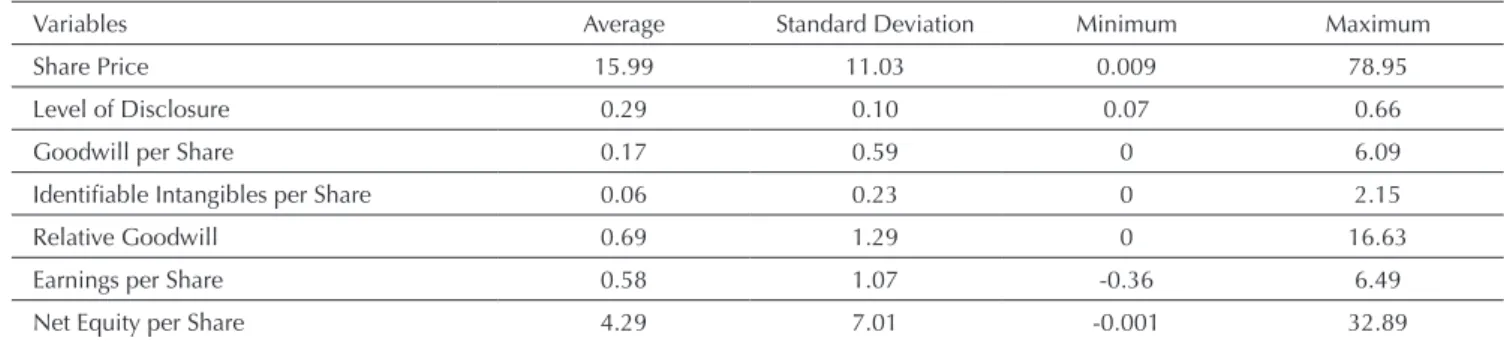
Table 2 presents the results from the descriptive statistic related to the variables used in this study, in which 196
cases of business combinations occurring between 2002 and 2013 were analyzed.
Table 2 Descriptive statistics of the variables used in the study
Variables Average Standard Deviation Minimum Maximum
Share Price 15.99 11.03 0.009 78.95
Level of Disclosure 0.29 0.10 0.07 0.66
Goodwill per Share 0.17 0.59 0 6.09
Identii able Intangibles per Share 0.06 0.23 0 2.15
Relative Goodwill 0.69 1.29 0 16.63
Earnings per Share 0.58 1.07 -0.36 6.49
Net Equity per Share 4.29 7.01 -0.001 32.89
Note. Share Price = share price three months after the close of fi nancial period n; Level of Disclosure = disclosure index for the business combinations included in the study sample; Goodwill per Share = goodwill value recognized in a business combination, divided by the total number of company shares; Identifi able Intangibles per Share = total value of identifi able intangibles recognized in a business combination, divided by the total number of company shares; Relative Goodwill = goodwill value divided by the value of compensation related to a business combination; Earnings per Share = net value of earnings (profi t or loss) from fi nancial period n (in which the business combination occurred), divided by the total number of company shares; Net Equity per Share = value of Net Equity in period n, divided by the total number of company shares.
Source: Data from the study.
It can be perceived in Table 2 that the average level of disclosure carried out by the sample in this study is low (an average of 0.29), with the maximum level reaching 0.66 and the minimum level only 0.07. h e analyzed companies need to improve their disclosure on business combinations carried out.
Table 2 also shows that goodwill has a signii cant value
in some business combinations carried out by publicly traded Brazilian companies, considering that the average relative goodwill obtained a value of 0.69, which indicates that, on average, 69% of the compensation value paid by the acquirer in the business combinations corresponds to acquired goodwill.
with the identii able intangibles per share, it is found that the value of goodwill recognized in the business combinations analyzed tends to be greater than the value of identii able intangibles. h is result suggests that the companies pay for a set of intangibles that were not individually identii ed at the time of the transaction, based on the expectation of proi tability, which they record
in their assets as goodwill.
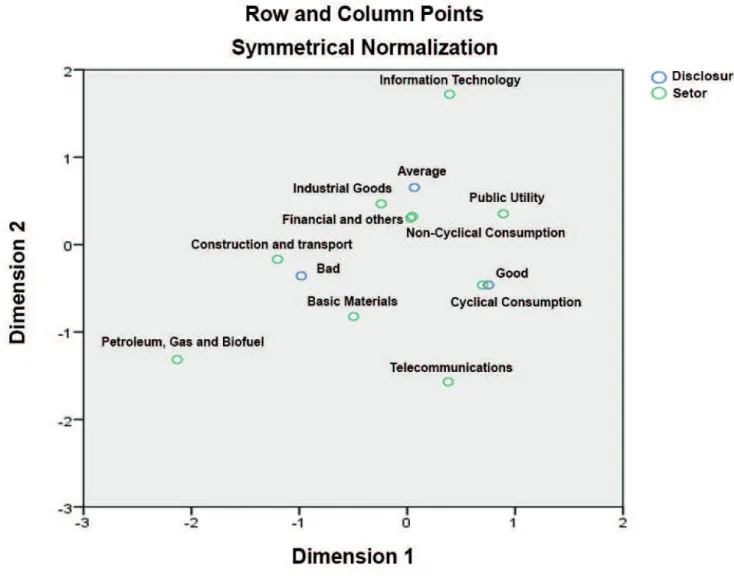
Complementarily, Correspondence Analysis (ANACOR) was carried out to verify the connection that exists between levels of disclosure and the sectors in which the companies analyzed in this study operate. Figure 1 shows the results verii ed.
Figure 1. Perceptual map level of disclosure by sector.
Source: Data from the study.
Based on Figure 1, it can be claimed that a connection exists between: (i) good disclosure levels and the cyclical consumption sector; (ii) average disclosure levels and the industrial goods, non-cyclical consumption, i nancial and others sectors; (iii) bad disclosure levels and the construction and transport and basic materials sectors. h ese connections are possible due to the closeness in which the related categories are positioned.
Moreover, the public utility sector was between the good and average disclosure levels, given that it is positioned close to the two categories mentioned.
combinations, goodwill per share, identii able intangibles per share, relative goodwill, earnings per share, and net
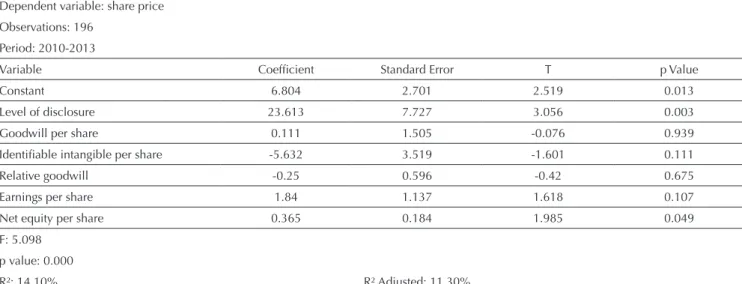
equity per share, as independent variables. Table 3 presents the results found.
h e “p value” from the model was 0.000, revealing that it is signii cant to 1%; that is, the explanatory variables that compose the model are together signii cant for explaining the dependent variable “share price”.
h e value of R2 indicates that 14.10% of the variations
in the share prices of publicly traded Brazilian companies that carried out business combinations between 2010 and 2013 can be explained by a model involving the following variables: level of disclosure on business combinations carried out in the year, goodwill per share, identii able intangible per share, relative goodwill, earnings per share, and net equity per share.
However, by carrying out an individual analysis regarding the explanatory power of each variable composing the model, only the “level of disclosure on business combinations carried out in the year” and “net equity per share” are signii cant to 5%, for explaining the dependent variable “share price”. Both are positively associated with share price, which suggests that the greater the level of disclosure and net equity per share, the higher the price attached to the share.
It should be noted that the variable “level of disclosure on business combinations carried out in the year” presented 1% signii cance, agreeing with hypothesis 1 in this study. On the other hand, hypothesis 2 was rejected, given that
the variable “goodwill per share” was not signii cant in the regression model.
h e result from the regression model also allows it to be observed that the variable “earnings per share” was signii cant to 10%, with a positive coeffi cient, which suggests that the higher the earnings per share, the higher the share price.
h e greater explanatory power of net equity per share in relation to earnings per share is consistent with the results already revealed in the study from Lopes (2002b), in which the author explains that this result may be related with the fact that most companies in Brazil have a concentrated ownership structure and that this may aff ect the relevance of net income.
h e variables “identii able intangible per share” and “relative goodwill” presented a negative coefficient, which could suggest that the higher the value of these variables, the lower the share price would be; yet, neither demonstrated statistical signii cance in the model, and thus, the results from this study do not support such inferences regarding these two variables.
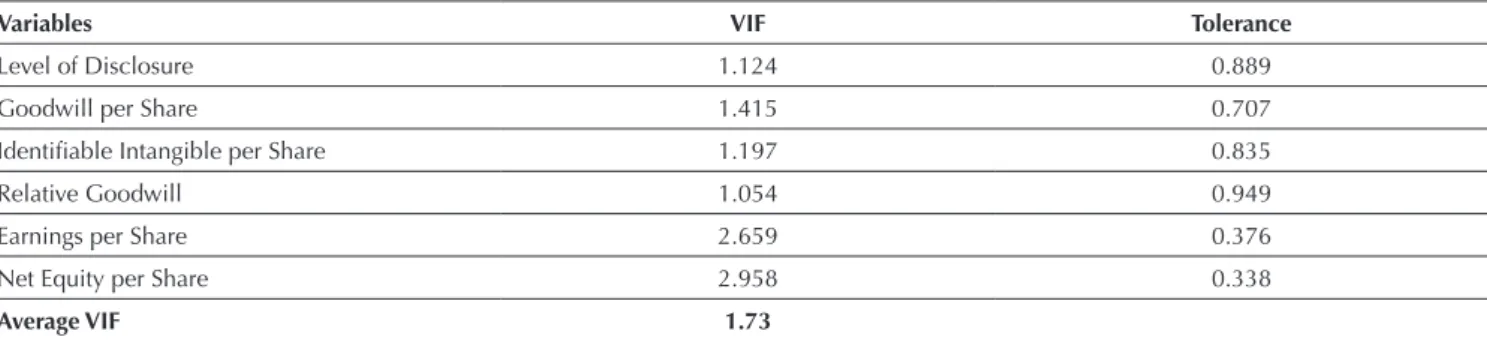
With regards to the validity assumptions in the regression model, for collinearity analysis the VIF and Tolerance tests were carried out. Table 4 presents the results found.
Table 3 Results from the multiple regression model
Dependent variable: share price
Observations: 196
Period: 2010-2013
Variable Coefi cient Standard Error T p Value
Constant 6.804 2.701 2.519 0.013
Level of disclosure 23.613 7.727 3.056 0.003
Goodwill per share 0.111 1.505 -0.076 0.939
Identii able intangible per share -5.632 3.519 -1.601 0.111
Relative goodwill -0.25 0.596 -0.42 0.675
Earnings per share 1.84 1.137 1.618 0.107
Net equity per share 0.365 0.184 1.985 0.049
F: 5.098
p value: 0.000
R²: 14.10% R² Adjusted: 11.30%
h e results from the two tests reveal that the model does not present problematic collinearity, given that the VIF values were not higher than 3 and the Tolerance test values were not lower than 0.10.
With regards to residual homoskedasticity, the Pesarán-Pesarán test was carried out, which according to Cunha and Coelho (2009) was developed to examine the existence of homoskedasticity; that is, whether the variance in residuals remains constant over the whole range of independent variables. When this assumption is not met, a heteroskedasticity problem exists, and measures need to be taken to correct this problem. h e hypotheses tested are: H0, indicating that the residuals are
homoskedastic, and H1, representing that the residuals are heteroskedastic.
h e Pesarán-Pesarán test resulted in a Sig. value of 0.960, accepting the null hypothesis that states that the residuals are homoskedastic. h erefore, there is no problem of heteroskedasticity in the model.
Residual normality was analyzed using the Kolmogorov-Smirnov (K-S) test. h e Sig. value from the K-S test resulted in 0.121. h is result indicates that the test for the model accepted hypothesis H0, which attests that the distribution is normal. h us, the assumption of normality was fuli lled.
5 CONCLUSIONS
h is study aimed to verify the value relevance of levels of disclosure on business combinations and of the goodwill recognized in publicly traded Brazilian companies. h e results from the study showed that:
i. h e variable “level of disclosure” on business combinations was positively signii cant to 1% for explaining share prices in the sample analyzed; ii. h e variable “net equity per share” was positively
signii cant to 5% for explaining share prices in the sample analyzed;
iii. h e variable “earnings per share” was positively signii cant to 10% for explaining share prices in the sample analyzed; and
iv. h e variables “goodwill per share”, “identii able intangible per share”, and “relative goodwill” recognized in the business combinations were not signii cant for explaining share prices in the sample analyzed.
In relation to the value relevance of disclosure on business combination carried out by Brazilian companies,
the results revealed that investors tend to value companies that provide more information regarding transactions carried out, thus coni rming hypothesis H1 in this study.
h e results suggest that shares in companies that present a greater level of disclosure, on average, tend to be more highly valued by investors. h ese results are consistent with the i ndings of Hassan and Mohd-Saleh (2010).
In relation to the value relevance of goodwill recognized in business combinations, hypothesis H2 was rejected and the results suggest that the value of goodwill recognized in business combinations is not relevant for explaining share prices in Brazil. h is result may be related with the low level of goodwill disclosure in Brazil.
Despite the results related to the value relevance of goodwill not presenting signii cance, it is important to highlight that, by comparing maximum value of goodwill per share with identii able intangibles per share, it is found that the goodwill value recognized in the business combinations analyzed tends to be higher than the value of identii able intangibles. h is result allows for it to be suggested that, in a lot of the business combinations
Table 4 VIF and Tolerance Tests
Variables VIF Tolerance
Level of Disclosure 1.124 0.889
Goodwill per Share 1.415 0.707
Identii able Intangible per Share 1.197 0.835
Relative Goodwill 1.054 0.949
Earnings per Share 2.659 0.376
Net Equity per Share 2.958 0.338
Average VIF 1.73
occurring in Brazil between 2010 and 2013, the companies were not able to recognize intangibles that qualii ed for individual recording, thus allocating the largest portion to goodwill.
Additionally, the average level of disclosure on business combinations in Brazil is low, and it is not suffi cient for providing an adequate overview of the methods used and of the corresponding assets acquired in business combinations; thus, investors appear to value companies with greater transparency.
However, it is important to stress that the results from this study are limited to the sample and period analyzed; that is, they cannot be generalized for other companies or diff erent periods.
Also worth highlighting as a limitation in this study is
the fact that the metric used to measure levels of disclosure was elaborated based solely on CPC 15 (R1) and did not cover other normative bases. Moreover, the data was collected using the qualitative method, and in this case, the role of the researcher was crucial in analyzing the disclosure carried out by the companies.
Another limitation in this study relates to the fact that the companies did not carry out business combinations in all of the years, making a time series analysis of the level of disclosure in the sample impossible.
It is suggested, for subsequent research, that a comparative study be carried out involving the value relevance of levels of mandatory disclosure in Brazilian (emerging market) companies and companies located in a developed market.
REFERENCES
AbuGhazaleh, N. M., Al-Hares, O. M., & Haddad, A. E. (2012). h e Value Relevance of goodwill impairments: UK Evidence. International Journal of Economics and Finance, 4(4), 206-216. Al-Akra, M., & Ali, M. (2012). h e value relevance of corporate
voluntary disclosure in the Middle-East: h e case of Jordan. Journal of Accounting and Public Policy, 31(5), 533-549. Alfaraih, M. M., & Alanezi, F. S. (2011). Does voluntary disclosure
level aff ect the value relevance of accounting information? Accounting & Taxation, 3(2), 65-84.
American Appraisal (2012). Global M&A Valuation Outlook. Retrieved from http://www.american-appraisal.com.br/AA-Files/Library/PDF/GlobalMAValuationOutlook.pdf.
Baboukardos, D., & Rimmel, G. (2014). Goodwill under IFRS: Relevance and disclosures in an unfavorable environment. Accounting Forum, 38(1), 1-17.
Ball, R., Kothari, S. P., & Robin, A. (2000). h e eff ect of
international institutional factors on properties of accounting earnings. Journal of Accounting and Economics, 29(1), p. 1-51. Barth, M. E., Beaver, W. H., & Landsman, W. R. (2001). h e
relevance of the value relevance literature for i nancial accounting standard setting: another view. Journal of Accounting and Economics, 31(1), 77–104.
Beatty, A., & Weber, J.(2006). Accounting discretion in fair value estimates: an examination of SFAS 142 goodwill impairments. Journal of Accounting Research, 44(2), 257-288.
Beaver, W. H. (2002). Perspectives on recent capital market research. h e Accounting Review, 77(2), 453-474. Bokpin, G. A. (2013). Determinants and value relevance of
corporate disclosure. Journal of Applied Accounting Research, 14(2), 127-146.
Bushee, B. J., & Noe, C. F. (1999). Disclosure quality, institutional investors, and stock return volatility. Retrieved from
https://www.researchgate.net/proi le/Christopher_ Noe/publication/228171436_Disclosure_Quality_ Institutional_Investors_and_Stock_Return_Volatility/ links/0deec52a05b6a45390000000.pdf.
Carlin, T. M., & Finch, N. (2010). Evidence on IFRS goodwill impairment testing by Australian and New Zealand i rms. Managerial Finance, 36(9), 785-798.
Cazavan-Jeny, A. (2004). Le ratio market-to-book et la reconnaissance des immatériels – une étude du marché français. Comptabilité-Contrôle-Audit, 10(2), 99-124. Chen, C., Kohlbeck, M., & Wari eld, T. (2008). Timeliness of
impairment recognition: Evidence from the initial adoption of SFAS 142. Advances in Accounting, 24(1), 72-81.
Chi, L-C., & Tang, T-C. (2007). Impact of reorganization announcements on distressed-stock returns. Economic Modelling, 24(5), 749-767.
Comitê de Pronunciamentos Contábeis (2011). Pronunciamento Técnico CPC 15 R1, de 03 de junho de 2011. Combinação de negócios. Retrieved from http://www.cpc.org.br/CPC.
Comitê de Pronunciamentos Contábeis (2010). Pronunciamento Técnico CPC 04 R1, de 05 de novembro de 2010. Ativo intangível. Retrieved from http://www.cpc.org.br/CPC. Dahmash, F. N., Durand, R. B., & Watson, J. (2009). h e value
relevance and reliability of reported goodwill and identii able intangible assets. h e British Accounting Review, 41(2), 120-137.
Dalmácio, F. Z., Rezende, A. J., Lima, E. M., & Martins, E. (2011). A relevância do goodwill no processo de avaliação das empresas brasileiras. BASE - Revista de Administração e Contabilidade da Unisinos, 8(4), 359-372.
Davis-Friday, P. Y, Folami, L. B., Liu, C.-S., & Mittelstaedt, H. F. (1999). h e value relevance of i nancial statement recognition vs. disclosure: evidence from SFAS no. 106. h e Accounting Review, 74(4), 403-423.
Detzen, D., & Zülch, H. (2012). Executive compensation and goodwill recognition under IFRS: Evidence from European mergers. Journal of International Accounting, Auditing and Taxation, 21(2), 106-126.
Giuliani, M., & Brännström, D. (2011). Dei ning goodwill: a practice perspective. Journal of Financial Reporting and Accounting, 9(2), 161-175.
Godoy, C. R., & Santos, A. (2006). Contabilidade para fusões e aquisições de empresas: soluções históricas para problemas contemporâneos. Revista de Administração, 41(1), 29-42. Godfrey, J. M., & Koh, P-S. (2001). h e relevance to i rm valuation
of capitalizing intangible assets in total and by category. Australian Accounting Review, 11(24), 39-48.
Hassan, M. S., & Mohd-Saleh, N. (2010). h e value relevance of i nancial instruments disclosure in Malaysian i rms listed in the main board of Bursa Malaysia. Int. Journal of Economics and Management, 4(2), 243-270.
Hassan, O. A. G., Romilly, P., Giorgioni, G., & Power, D. (2009). h e value relevance of disclosure: Evidence from the
emerging capital market of Egypt. h e International Journal of Accounting, 44(1), 79-102.
Hayn, C., & Hugues, P. J. (2006). Leading indicators of goodwill impairment. Journal of Accounting, Auditing & Finance, 21(3), 223-265.
Healy, P. M.; Palepu, K. G., & Ruback, R. S. (1992). Does corporate performance improve at er mergers? Journal of Financial Economics, 31(2), 135-175.
Healy, P. M., Hutton, A. P., & Palepu, K. G. (1999). Stock performance and intermediation changes surrounding sustained increases in disclosure. Contemporary Accounting Research, 16(3), 485-520.
Henning, S. L, Lewis, B. L., & Shaw, W. H. (2000). Valuation of the components of purchased goodwill. Journal of Accounting Research, 38(2), 375-386.
Jahmani, Y., Dowling, W. A., & Torres, P. D. (2010). Goodwill impairment: a new window for earnings management. Journal of Business & Economics Research, 8(2), 19-23.
Jennings, R., Robinson, J., h ompson, R. B., & Duvall, L. (1996). h e relation between accounting goodwill numbers and equity values. Journal of Business Finance & Accounting, 23(4), 513-533.
Jensen, M. C., & Meckling, W. H. (1976). h eory of the i rm: managerial behavior, agency costs and ownership structure. Journal of Financial Economics, 3(4), 305-360.
Kang, T., & Pang, Y. H. (2005). Economic development and the value-relevance of accounting information - a disclosure transparency perspective. Review of Accounting and Finance, 4(1), 5-31.
Klann, R. C., Beuren, I. M., & Hein, N. (2015). Canonical relationship between performance indicators based on Brazil, US and IFRS accounting standards of Brazilian and United Kingdom companies. Journal of Accounting and Taxation, 7(1), 1-12.
Lapointe-Antunes, P., Cormier, D., & Magnan, M. (2009). Value relevance and timeliness of transitional goodwill-impairment losses: Evidence from Canada. h e International Journal of Accounting, 44(1), 56–78.
Leuz, C., & Verrecchia, R. E. (2000). h e economic consequences of increased disclosure. Journal of Accounting Research, 38 (supplement: Studies on Accounting Information and the Economics of the Firm), 91-124.
Li, Z., Shroff , P. K, Venkataraman, R., & Zhang, I. X. (2011). Causes and consequences of goodwill impairment losses. Rev Account Stud, 16(4), 745-778.
Lopes, A. B. (2002a). A informação contábil e o mercado de capitais. São Paulo: Pioneira h omson Learning.
Lopes, A. B. (2002b). h e Value Relevance of Earnings and Book Values in Brazil: Old versus New Economy. In Anais do 26º Encontro Nacional da Associação Nacional de Pós-Graduação e Pesquisa em Administração, Salvador, BA, Brasil.
Malacrida, M. J. C., & Yamamoto, M. M. (2006). Governança corporativa: nível de evidenciação das informações e sua relação com a volatilidade das ações do Ibovespa 2006. Revista de Contabilidade & Finanças, 17(edição especial), 65-79. Mario, C., Baboukardos, D., Cunningham, G. M., & Hassel,
L. G. (2011). h e impact of IFRS on reporting for business combinations: an in-depth analysis using the telecommunications industry. In Annals of the Faculty of Economics, University of Oradea, 1(1), 557-593. Retrieved from
http://steconomiceuoradea.ro/anale/volume/2011/n1/054.pdf.
Martins, E., Gelbcke, E. R., Santos, A., & Iudícibus, S. (2013). Manual de Contabilidade Societária: aplicável a todas as sociedades de acordo com as normas internacionais e do CPC. São Paulo: Atlas.
Mortensen, R. (1994). Accounting for business combinations in the global economy: purcharge, pooling, or? Journal of Accounting Education, 12(1), 81-87.
Nakayama, W. K. (2012). Divulgação de informações sobre operações de combinação de negócios na vigência do
pronunciamento técnico CPC 15 (Master’s Degree). Faculdade de Economia, Administração e Contabilidade, Universidade de São Paulo, São Paulo, SP, Brasil.
Nakayama, W. K., & Salotti, B. M. (2014). Fatores determinantes do nível de divulgação de informações sobre combinações de negócios com a entrada em vigor do pronunciamento técnico CPC 15. Revista de Contabilidade & Finanças, 25(66), 267-280. Ohlson, J. A. (1995). Earnings, book values, and dividends in
equity valuation. Contemporary Accounting Research, 11(2), 661-687.
Oliveira, L., Rodrigues, L. L., & Craig, R. (2010). Intangible assets and value relevance: evidence from the Portuguese stock exchange. h e British Accounting Review, 42(4), 241-252. Patel, S. A., Balic, A., & Bwakira, L. (2002). Measuring
transparency and disclosure at i rm level in emerging markets. Emerging Markets Review, 3(4), 325-337.
Petersen, C., & Plenborg, T. (2010). How do i rms implement impairment tests of goodwill? ABACUS -A Journal of Accounting, Finance and Business Studies, 46(4), 419-446. Ramanna, K., & Watts, R. L. (2012). Evidence on the use of
unverii able estimates in required goodwill impairment. Rev Account Stud, 17(4), 749–780.
Ramos, D. A., & Lustosa, P. R. B. (2013). Verii cação empírica da value relevance na adoção das normas internacionais de contabilidade para o mercado de capitais brasileiro. Contexto, 13(25), 70-83.
on the value relevance of earnings and book value. BBR - Brazilian Business Review, 2(1), 33-52.
Samkin, G., & Deegan, C. (2010). Calculating non-controlling interest in the presence of goodwill impairment. Accounting Research Journal, 23(2), 213-233.
Schipper, K. (2007). Required disclosures in i nancial reports. he Accounting Review, 82(2), 301-326.
Shalev, R. (2009). h e information content of business
combination disclosure level. h e Accounting Review, 84(1), 239-270.
Silva, A. F., Macedo, M. A. S., & Marques, J. A. V. C. (2012). Análise da relevância da informação contábil no setor brasileiro de energia elétrica no período de 2005 A 2007: uma discussão com foco nas variáveis LL, FCO E EBITDA. Revista Universo Contábil, 8(2), 6-24.
Tsalavoutas, I., & Dionysiou, D. (2014). Value relevance of IFRS
mandatory disclosure requirements. Journal of Applied Accounting Research, 15(1), 22-42.
Uyar, A., & Kılıc, M. (2012). Value relevance of voluntary disclosure: evidence from Turkish i rms. Journal of Intellectual Capital, 13(3), 363-376.
Vafaei, A., Taylor, D., & Ahmed, K. (2011). h e value relevance of intellectual capital disclosures. Journal of Intellectual Capital, 12(3), 407-429.
Verrecchia, R. E. (2001). Essays on disclosure. Journal of Accounting and Economics, 32(1), 97-180.
Xu, W., Anandarajan, A., & Curatola, A. (2011). h e value relevance of goodwill impairment. Research in Accounting Regulation, 23(2), 145-148.
Yamaji, N. & Miki, J. (2011). h e value relevance of goodwill and goodwill amortization: evidence from listed Japanese companies. BA Business & Accounting Review, 7, 19-30.
Address for correspondence:
Maíra Melo de Souza
Universidade Federal de Santa Catarina, Departamento de Ciências Contábeis Campus Reitor João David Ferreira Lima, s/n – CEP: 88040-900