Known unknowns, Google Earth, plate tectonics and
Mt Bellenden Ker: some thoughts on locality data
Robert Mesibov1,
1 Queen Victoria Museum and Art Gallery, Launceston, Tasmania, Australia 7250
Corresponding author:Robert Mesibov ([email protected])
Academic editor:L. Penev | Received 26 October 2012 | Accepted 23 November 2012 | Published 30 November 2012
Citation: Mesibov R (2012) Known unknowns, Google Earth, plate tectonics and Mt Bellenden Ker: some thoughts on locality data. ZooKeys 247: 61–67. doi: 10.3897/zookeys.247.4195
Abstract
Latitude/longitude data in locality records should be published with spatial uncertainties, datum(s) used and indications of how the data were obtained. Google Earth can be used to locate sampling sites, but the underlying georegistration of the satellite image should be checked. he little-known relabelling of a set of landmarks on Mt Bellenden Ker, a scientiically important collecting locality in tropical north Queens-land, Australia, is documented as an example of the importance of checking records not accompanied by appropriately accurate latitude/longitude data.
Keywords
Spatial data, latitude/longitude, georeferencing
Missing numbers
With the debut of Biodiversity Data Journal (http://www.pensoft.net/journals/bdj) not
far of, I have started thinking, as a Pensoft editor, about the tables of locality data that are likely to be submitted. Will the authors have read the “Guide to Best Practices in Georeferencing”? (Chapman and Wieczorek 2006) produced for GBIF? Will the lo-cality records be tabulated using Darwin Core categories for location (http://rs.tdwg. org/dwc/terms/index.htm#locationindex), or at least with ields that can easily be con-verted to their Darwin Core equivalents?
I suspect not. To judge from what I often see in recent research papers, a location will be speciied simply as a latitude/longitude from a single reading of a handheld
www.zookeys.org
Copyright Robert Mesibov. This is an open access article distributed under the terms of the Creative Commons Attribution License 3.0 (CC-BY), which permits unrestricted use, distribution, and reproduction in any medium, provided the original author and source are credited.
GPS receiver (standalone operation), together with an inexact description that checks the latitude/longitude by giving a general idea of the location, something like ca 5 km S of Woop Woop [an imaginary town], 22°48’20.6”S, 124°33’10.4”E
here are two numbers missing here. One is the datum for the latitude/longitude. While most GPS users set their receivers to the WGS84 datum, another datum may have been used in order to allow checking of the latitude/longitude or grid reference on a paper map based on a local datum. Datum diferences are not trivial. For example, there is ca 200 m distance between the WGS84 location of a site in Australia and its corresponding location on a map referenced to the long-used AGD66 datum. Locality data tables should therefore include a ield for specifying the datum or for noting that the datum is unknown. Compilers should not assume that if no datum is speciied, then the datum for that location must have been WGS84.
he second missing number is an uncertainty estimate. We don’t know whether the location is a spot or a large area, and if the latter, what relation the latitude/longi-tude has to the area sampled. We can be reasonably sure that the latilatitude/longi-tude/longilatitude/longi-tude is too accurate, even for a spot sample. he implied uncertainty is ±0.05”, which at the given latitude represents about 1.5 m in either latitude or longitude. he GPS receiver’s manufacturer probably didn’t claim that high an accuracy. For example, the owner’s manual for the Garmin GPSMap®62S, a popular handheld GPS receiver, says only that 95% of waypoints will be within 10 m of the stated position in typical use.
Good practice is to specify an uncertainty, and not just to imply one. A possible entry for an uncertainty ield is the accuracy as reported by the GPS receiver for that particular reading; a column heading in the data table might be “GPS accuracy dec-laration” or something similar. In my part of the world, GPS accuracy declarations after a few minutes at a spot are generally in the range 5-10 m in the open air and 15–30 m in forest.
For many biological samplers, however, a collecting site is not a spot, but a small area over which a number of specimens are collected. A good way to report that loca-tion is to give the latitude/longitude of the centre of the site. he uncertainty can then be approximated as the radius of a circle containing the area searched, following the Darwin Core deinition of uncertainty: “he horizontal distance (in meters) from the given decimalLatitude and decimalLongitude describing the smallest circle containing the whole of the Location” (http://rs.tdwg.org/dwc/terms/index.htm#coordinateUnc ertaintyInMeters).
ca 5 km S of Woop Woop, 22°48'20.6"S, 124°33'10.4"E, ±15 m, WGS84. hat’s better, but something is still missing.
outrageous numbers
0.01” igures correspond to about 30 cm in latitude and longitude, or ±15 cm. How did the collector get those numbers?
Possibly from Google Earth. With coordinates set to degrees, minutes and seconds, the status bar at the bottom of a Google Earth window reports the cursor location to the nearest 0.01 second of latitude and longitude. You can zoom in as much as you like to see a collecting site, then just place the cursor on the site and read of the latitude/ longitude, which will be outrageously accurate.
Since the latitude/longitude is not a GPS reading, it would be sensible to round the igures of to the nearest second. Uncertainty in this case depends in part on how accurately Google Earth has placed the satellite image on its mathematical model of the globe, a procedure known as georegistration. he accuracy of georegistration can vary from image to image and from date to date in an image series. One site I looked at in Queensland had shifted more than 100 m between image dates.
Google Earth can be very useful for locating sampling sites if GPS reception is poor or if GPS accuracy declarations are large. It’s a good idea, however, to check the georegistration by getting at least one GPS reading at a spot (somewhere near the site) which will be clearly distinguishable on the satellite image. Even better, compare the known location of an oicial survey mark in the vicinity with its Google Earth loca-tion. In either case, the uncertainty speciied for a position located using Google Earth should be at least the diference found between the Google Earth latitude/longitude and the corresponding igures for a GPS reading or a survey mark. (I recently checked a survey mark in my home town. Google Earth put it 2-3 m from its actual location. Not bad, but not as good as the implied ±15 cm.)
Here in Australia, at least, there is an additional complication. he Australian Plate is moving northeast towards Papua New Guinea at about 7 cm/yr and carrying with it the survey reference framework, GDA, standardised in 1994. Google Earth, like the GPS system, is based on the WGS84 framework, which for all practical purposes is independent of earth movements. In 2012, there is a more than a metre horizontal diference between GDA and WGS84, thanks to plate tectonics.
Complications aside, locality data tables should always contain a ield for the source of latitude/longitude data, i.e. map, GPS, Google Earth, etc. he source will then stay with the record if the record is separated from the table’s metadata.
ca 5 km S of Woop Woop, 22°48'20.6"S, 124°33'10.4"E, ±15 m, WGS84, GPS. Much better!
Numbers helped by words
A description like ca 5 km S of Woop Woop is obviously not as accurate as a GPS
– “Provide a descriptive locality, even if you have geographic coordinates. he locality should be as speciic, succinct, unambiguous, complete, and as accurate as pos-sible, leaving no room for uncertainty in interpretation.”
– Localities used as reference points should be stable – i.e., places (towns, trig points, etc.) that will remain for a long time after the collection events. Do NOT use temporary locations or waypoints as the key reference location. You may have made an accurate GPS recording for the temporary location and then referenced future collec-tions from that point (e.g., 200 m SE of the Land Rover), and that may make perfect sense for that series of collections. It is meaningless, however, when those collections are later broken up and placed in a museum under a taxonomic arrangement, and no longer have a link to where the ‘Landrover’ was.
– If recording locations along a path (road, river, etc.) it is important to also re-cord whether the distances were measured along the path (‘by road’) or as a direct line from the origin (‘by air’).
– Hint: he most speciic localities are those described by a) a distance and heading along a path from a nearby and well-deined intersection, or b) two cardinal ofset distances from a single persistent nearby feature of small extent. “[Example given for the latter: “ice ield below Cerro El Plomo, 0.5 km S and 0.2 km W of summit, Region Metropolitana, Chile. ”]”
Nevertheless, even the best landmark-based descriptions can stray from the truth if the landmarks themselves change, as the following example shows. I am describing it in some detail because the locality involved has yielded numerous new animal and plant species, and avoidable georeferencing errors are possible at this scientiically im-portant locality.
unstable numbers
he Bellenden Ker Range in tropical north Queensland has attracted scientiic explorers and collectors since the late 19th century. Much of the Range lies less than 10 km from the Coral Sea, and access is relatively easy from the coastal Bruce Highway between the towns of Gordonvale and Innisfail, and from the Atherton Tableland to the west. he densely vegetated Bellenden Ker Range has Queensland’s highest mountain (Mt Bartle Frere, 1622 m) and Australia’s wettest weather station (Mt Bellenden Ker, 8150 mm/yr).
In the early 1970s a cableway was built to access a telecommunications and broad-cast facility on the summit of Mt Bellenden Ker (Fig. 1). Formerly operated by Tel-ecom Australia (now Telstra), the Mt Bellenden Ker Cableway and Transmission Facil-ity is currently owned and managed by Broadcast Australia.
Over the past four decades the cableway has not only ofered access to Mt Bellen-den Ker for biological sampling, but has also provided a simple system of landmarks, namely the nine cableway support towers. hese landmarks have often been used to georeference collecting localities, with no accompanying latitude/longitude or only an
Hal-ford & A.J. Ford, 2009 (Rubiaceae): ‘National Park Reserve 904, Wooroonooran, just S of tower 9, Mt Bellenden Ker cableway’ (Halford and Ford 2009).
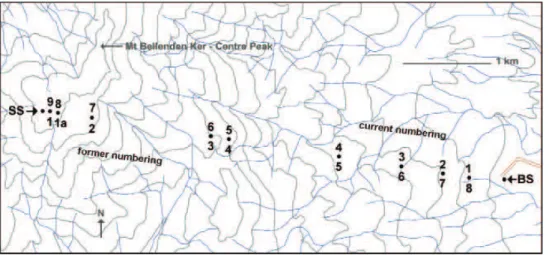
It is not generally known, however, that the tower numbering was reversed in about 1997 when the cableway changed owners. Whereas Telecom numbered the tow-ers from the top of the mountain to the bottom, the new system numbtow-ers the towtow-ers
Figure 1. View of the Mt Bellenden Ker cableway from the east in June, 1976. Lower towers are labelled with their current numbers. Image by Len Webb, reproduced with the permission of the copyright holder, Griith University.
from bottom to top. Figure 2 shows the current and former tower numbering, and Table 1 gives latitude/longitude for each of the cableway landmarks.
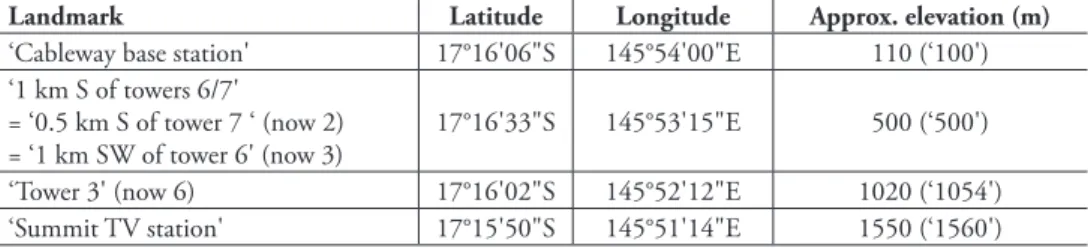
Table 2 lists correct locations for the principal cableway sites sampled during the 1981 Earthwatch/Queensland Museum expedition, the source of a very large number of insect and other zoological samples (Queensland Museum 1982, Monteith and Davies 1992). he sites were referenced to the older tower numbering, and were ofset various distances from the landmarks indicated on specimen labels.
Table 1. Spatial data (WGS84) for the landmarks mapped in Fig. 2. Positional uncertainty is ±50 m.
Landmark Latitude Longitude Approx. elevation (m)
Cableway base station 17°16'12"S 145°54'00"E 100
Tower 1 (formerly 8) 17°16'11"S 145°53'46"E 210
Tower 2 (formerly 7) 17°16'10"S 145°53'37"E 300
Tower 3 (formerly 6) 17°16'07"S 145°53'22"E 360
Tower 4 (formerly 5) 17°16'04"S 145°53'00"E 500
Tower 5 (formerly 4) 17°15'59"S 145°52'20"E 970
Tower 6 (formerly 3) 17°15'58"S 145°52'13"E 1030
Tower 7 (formerly 2) 17°15'53"S 145°51'31"E 1450
Tower 8 (formerly 1a) 17°15'51"S 145°51'18"E 1530
Tower 9 (formerly 1) 17°15'51"S 145°51'15"E 1550
Summit TV station 17°15'50"S 145°51'13"E 1550
Table 2. Spatial data (WGS84) for the principal cableway sampling sites of the 1981 Earthwatch/ Queensland Museum expedition, based on the older tower numbering. Positional uncertainty is ±100 m.
Landmark Latitude Longitude Approx. elevation (m)
‘Cableway base station' 17°16'06"S 145°54'00"E 110 (‘100')
‘1 km S of towers 6/7'
= ‘0.5 km S of tower 7 ‘ (now 2) = ‘1 km SW of tower 6' (now 3)
17°16'33"S 145°53'15"E 500 (‘500')
‘Tower 3' (now 6) 17°16'02"S 145°52'12"E 1020 (‘1054')
‘Summit TV station' 17°15'50"S 145°51'14"E 1550 (‘1560')
Conclusion
Acknowledgements
For assistance with the Bellenden Ker issue I am grateful to Spiro Buhagiar (Bellenden Ker, Queensland) and Broadcast Australia, and especially to Geof Monteith (Queens-land Museum), who very kindly checked his notes on the 1981 expedition. I thank Griith University for permission to publish the image in Figure 1.
references
Chapman AD, Wieczorek J (Eds) (2006) Guide to Best Practices for Georeferencing. Global Biodiversity Information Facility, Copenhagen, 80 pp. [Available online at http://www. gbif.org/orc/?doc_id=1288]
Halford DA, Ford AJ (2009) Two species of Morinda L. (Rubiaceae) from north-east Queens-land. Austrobaileya 8: 81–90.
Monteith GB, Davies VT (1992) Preliminary account of a survey of arthropods (insects and spiders) along an altitudinal rainforest transect in tropical Queensland. In: Werren G, Ker-shaw P (Eds) he rainforest legacy, vol. 2. Flora and fauna of the rainforest. Special Austral-ian heritage publication series 7(2). AustralAustral-ian Government Publishing Service, Canberra, 345–362.