Pedro Daniel Manta de Almeida
Licenciado em Ciˆencias da Engenharia Electrot´ecnica e de Computadores
An RF LC Q-enhanced CMOS filter using
Integrated Inductors with layout
optimization
Disserta¸c˜ao apresentada para obten¸c˜ao do Grau de Mestre em Engenharia Electrot´ecnica e de Computadores, pela Universidade Nova
de Lisboa, Faculdade de Ciˆencias e Tecnologia.
Orientador : Maria Helena Silva Fino, FCT-UNL
J´uri:
Presidente: Prof. Fernando Jos´e Vieira do Coito
Arguentes: Prof. Luis Bica de Oliveira
Vogais: Prof. Maria Helena Silva Fino
Prof.
i
RF LC Q-enhanced CMOS filter using Integrated Inductors with layout
opti-mization
Copyright ➞ Pedro Daniel Manta de Almeida, Faculdade de Ciˆencias e Tecnologia, Uni-versidade Nova de Lisboa
A Faculdade de Ciˆencias e Tecnologia e a Universidade Nova de Lisboa tˆem o direito,
perp´etuo e sem limites geogr´aficos, de arquivar e publicar esta disserta¸c˜ao atrav´es de
ex-emplares impressos reproduzidos em papel ou de forma digital, ou por qualquer outro meio
conhecido ou que venha a ser inventado, e de a divulgar atrav´es de reposit´orios cient´ıficos
e de admitir a sua c´opia e distribui¸c˜ao com objectivos educacionais ou de investiga¸c˜ao,
To my parents and my girlfriend
Acknowledgements
I am deeply grateful to my advisor Prof. Helena Fino for her expert guidance,
stimu-lating suggestions, patience, constant encouragement and never-ending supports.
I must to thank all my colleagues and friends that I have interacted with in the past few
years. They exposed me to a variety of challenging, invigorating and enjoyable experiences.
I want to give a special thanks to a very important person in my life, Carlota Faria,
for the encouragement and motivation in the long journey of my research and for helping
me stay focused and stabilized.
Finally, a special thanks to my parents, Isabel e Daniel Almeida, for their love and
support. My parents have always believed in and encouraged me in all my endeavors and
without their support I would never have been able to accomplish what I have now.
You all deserve the best.
Abstract
The advancement of CMOS technology led to the integration of more complex
func-tions in a single chip. In the particular of wireless transceivers, integrated LC tanks are
becoming popular both for VCOs and integrated filters. The design of a 2nd order CMOS
0.13 µm Q-enhanced integrated LC filter for a frequency of 2.44 GHz is presented. The
intent of this filter is to create a circuit for integrated wireless receiver and minimize the
requirement for off-chip passive filter components, reducing the overall component count
and size of wireless devices and systems. For RF applications the main challenge is still
the design of integrated inductors with the maximum quality factor. For that purpose,
tapered, i.e, variable width inductors have been introduced in the literature. In this work,
a characterization of variable width integrated inductors is proposed. This inductor model
is then integrated into an optimization procedure where inductors with a quality factor
improvement are obtained.
Keywords: Inductor layout optimization, variable metal width, integrated RF inductor, Q-enhanced RF LC filter.
Resumo
Com o avan¸co da tecnologia CMOS surgiram funcionalidades mais complexas num
´
unico circuito integrado. No caso particular de emissores-receptores sem fios, tanques
integrados LC est˜ao a tornar-se populares, tanto para VCOs (Osciladores controlados por
tens˜ao) como para filtros integrados. O projecto de um filtro LC integrado de segunda
ordem com melhoramento de factor de qualidade ´e apresentado neste trabalho. A inten¸c˜ao
deste filtro ´e a de criar um circuito integrado para a recep¸c˜ao sem fios minimizando o
requisito de componentes passivos n˜ao integrados, reduzindo o n´umero de componentes e
tamanho global de dispositivos sem fios e sistemas. Para aplica¸c˜oes de RF (Frequˆencia de
r´adio) o principal desafio ainda ´e o projecto de bobines integradas com elevado factor de
qualidade. Para este efeito, bobines de espessura vari´avel tˆem sido propostas por v´arios
autores. Nesta tese ´e proposta uma caracteriza¸c˜ao de bobines integradas de espessura
vari´avel. Este modelo de bobine ´e ent˜ao integrado num processo de optimiza¸c˜ao, onde s˜ao
obtidas bobines com uma melhoria de factor de qualidade
Palavras Chave:Optimiza¸c˜ao geom´etrica da bobibe, espessura vari´avel, bobine integrada, Filtro LC com melhoramento do factor de qualidade
Contents
Acknowledgements v
Abstract vii
Sum´ario ix
1 Introduction 1
2 Integrated inductors 5
2.1 Introduction . . . 5
2.2 Inductor model . . . 6
2.2.1 Metal length . . . 8
2.2.2 Series Inductance . . . 9
2.2.3 Series Resistance . . . 10
2.2.4 Crossover Capacitance . . . 11
2.2.5 Oxide Capacitance . . . 11
2.2.6 Substrate Resistance and Capacitance . . . 12
2.3 Quality Factor of an Inductor . . . 12
2.4 Working Examples . . . 15
2.4.1 Conclusion . . . 17
3 Integrated inductors with variable width 19 3.1 Introduction . . . 19
3.2 Variable width inductors . . . 20
3.2.1 Modeling variable inductors . . . 23
3.3 Validation of the model . . . 26
3.4 Optimization . . . 27
3.4.1 Example 1 . . . 28
3.4.2 Example 2 . . . 28
3.4.3 Conclusion . . . 29
4 An RF LC Q-Enhanced CMOS filter 31 4.1 Introduction . . . 31
xii CONTENTS
4.2 Tuned Amplifiers . . . 32
4.3 Principles of Q enhancement . . . 34
4.4 Integrated Filters design . . . 39
4.4.1 Simulation results . . . 42
4.4.2 gmLC filter with regular integrated inductor . . . 42
4.4.3 gmLC filter with optimized integrated inductor . . . 44
4.4.4 Conclusions . . . 46
5 Conclusions 49
Bibliography 51
List of Figures
1.1 Typical radio receiver [1] . . . 2
2.1 Typical layout of an integrated spiral inductor . . . 6
2.2 Simple 1-port model . . . 7
2.3 On-chip implementation of a spiral inductor . . . 7
2.4 π circuit equivalent model of a spiral inductor . . . 8
2.5 One port equivalent model of π model . . . 13
2.6 Frequency dependence of 2.6(a) inductance and 2.6(b) the quality factor of spiral inductor . . . 16
2.7 Frequency dependence of 2.7(a) inductance and 2.7(b) the quality factor of spiral inductor . . . 17
2.8 Frequency dependence of 2.8(a) inductance and 2.8(b) the quality factor of spiral inductor . . . 17
3.1 Variable width square inductor [2] . . . 21
3.2 A regular spiral inductor divided by segments . . . 22
3.3 A non-uniform width spiral inductor divided by segments . . . 22
4.1 Frequency response of a tuned amplifier . . . 32
4.2 The basic principle of tuned amplifier is illustrated using a MOSFET with a tuned circuit load. Bias details are not shown. . . 32
4.3 Active Q-enhancement using negative resistance . . . 34
4.4 Q-enhancement technique applied to a RLC filter . . . 35
4.5 Q-enhanced LC bandpass filter . . . 36
4.6 A 2nd Q-enhanced on-chip LC bandpass filter . . . 43
4.7 Frequency response of the RF LC Q-enhanced filter using a regular spiral inductor . . . 44
4.8 Frequency response of the RF LC Q-enhanced filter using an optimized spiral inductor . . . 45
4.9 Frequency response of the RF LC Q-enhanced filter using a regular spiral inductor . . . 47
xiv LIST OF FIGURES
List of Tables
2.1 Modified Wheeler Expression’s coefficients . . . 9
2.2 UMC130 - Technological Parameters . . . 15
2.3 Spiral inductor design constraints . . . 16
2.4 Results comparison with ASITIC - 710 MHz . . . 16
3.1 Validity of the optimization model . . . 26
3.2 Results comparison with ASITIC . . . 26
3.3 Validity of the optimization model . . . 26
3.4 Spiral inductor design constraints . . . 27
3.5 UMC130 - Technological Parameters . . . 27
3.6 Spiral inductor design constraints for inductance of 1nH . . . 28
3.7 Results comparison with ASITIC . . . 28
3.8 Spiral inductor design constraints for inductance of 2 nH . . . 28
3.9 Results comparison with ASITIC . . . 29
4.1 Inductor of 1 nH used in filter . . . 40
4.2 Values of the Gneg and C . . . 40
4.3 Value of the Width of the transistors MOS . . . 41
4.4 Value of the Width of the transistors MOS (4,5,6) . . . 42
4.5 Modelπ components values . . . 43
4.6 Simulation results . . . 44
4.7 Modelπ components values . . . 45
4.8 Simulation results . . . 45
4.9 Fine tuning resulting values . . . 46
4.10 Simulation results . . . 47
Chapter 1
Introduction
The radio frequency (RF) and wireless market has suddenly expanded to unimaginable
dimensions. With the emergence of cellular phone, wireless local-area network (WLAN)
and Bluetooth technology, we are standing on the threshold of a new radio frequency
epoch. In the field of communication circuit design, the realization of the complete
in-tegration of RF transceivers and digital signal processing blocks onto a single integrated
circuit (IC) is a logical area in which to develop system-on-chip (SoC) solutions [3]-[4].
By doing this, the cost and the difficulty of assembly and tuning are reduced drastically.
Presently, the growing demand for multi-functional wireless communications systems is
becoming increasingly evident. Meanwhile, the lower cost and faster advance of CMOS
processes has motivated extensive efforts in designing RF CMOS circuits. CMOS
tech-nologies exhibit properties and limitations that directly impact the design of a receiver
from the architecture level to the device level and from the RF front end to the baseband
processor.
In the long term, traditionally analog functions of a radio receiver (see figure 1.1 will
be replaced with software or digital hardware. The final goal of a radio receiver would be
to digitalize the radio frequency (RF) signal at the out put of the antenna, allowing the
implementation of all receiver funtions in either digital hardware or software [5].
Achieving this would be very interesting for many reasons. It would reduce product
development time and costs. It would also allow to implement new functions that are
impossible to implement in analog hardware. Another great advantage would be the
2 CHAPTER 1. INTRODUCTION
possibility of creating receivers designed to allow reception of different modulation types.
Mixer
LO sine
Output
RFin RF Band
Select Filter RF Amp
IF Bandpass Filter Image
Reject Filter IF Amp Demodulator
Figure 1.1: Typical radio receiver [1]
The ever increasing demand for wireless communications motivates in reducing
com-plexity, cost, power dissipation, and the number of external components in selecting
re-ceiver architecture (figure 1.1). The integrated inductors spiral plays an important role
in the development of Si RF ICs. The spiral inductor has a great influence on the
per-formance of many RF circuits. The obvious example is the LC tank, in which the quality
factor Qof the spiral inductor determines the bandwidth and the resonance impedance of
the LC tank. Another example is the bandpass filter built with inductor and capacitors, in
which the quality factor of the spiral inductor determines the insertion loss [6]. Following
the success in fabrication, intensive research has been conducted in the modeling of spiral
inductors on silicon. One approach is to use a compact circuit model. In other way, a
lot of work has been done in the synthesis and optimizations of spiral inductors in silicon.
The purpose of this thesis is to present an optimization method for the design of spiral
inductors. The focus for this optimization is on the geometric layout of the spiral
induc-tor. We develop a theory based on fundamental electronic principles that yields simple,
accurate inductance expression for on-chip spiral inductors of various geometries.
Besides the introduction, this thesis contains 4 chapters. In Chapter 2 an introduction
to integrated spiral inductors is presented, and the well known pi-model is introduced.
Analytical physics-based expressions for the model elements are givel, and finally working
examples proving the validity of the model are shown. In Chapter 3 the adequation of
3
validating this model, optimization methodologies are applied to the design of variable
width inductors, leading to final designs with quality factor improvement ( for the same
area) in the order of 20%. In Chapter 4 the variable with integrated inductors are used
for designing LC-filters. Examples considering the application for 2.44 GHz are presented.
Chapter 2
Integrated inductors
The growth of wireless applications in the low GHz frequency range has been a catalyst
in numerous research activities to develop wireless applications. CMOS is considered a
technology of choice in the integration of radio frequency systems in the low frequency
range (up to a maximum of 10 GHz) because of the relatively lower costs in developing
single chip solutions over other semiconductor processes. For RFIC in CMOS, planar
inductors will have a dominant role in defining the achievable performance of the system
as a whole. Depending on the technology possibilities, several metal layers may be used
and different geometries can be adopted. In this work a 0.13µm CMOS technology is used
for implementing spiral inductors. In this chapter we review on-chip inductor realization
and see how they can be modeled.
2.1
Introduction
Inductors are components used to store energy in the form of magnetic field. However
integrated inductors are not easy to implement because of their non-ideal behaviour that
entail a myriad of trade-offs. Parasitic effects, such as coupling capacitance and losses
related to the integration substrate, affect these devices, degrading their performance [7].
In order to understand these trade-offs, both vertical and lateral of the layout have to be
considered.
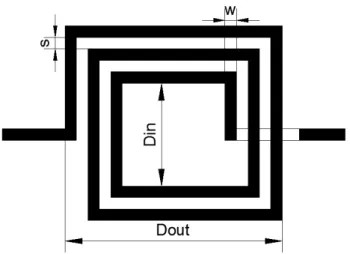
Figure 2.1 shows a typical implementation of an integrated spiral inductor where the
important physical dimensions of the spiral inductor are identified: inner diameter (din),
6 CHAPTER 2. INTEGRATED INDUCTORS
Figure 2.1: Typical layout of an integrated spiral inductor
outer diameter (dout), space between turns (s) and width of metal trace (w). Since we
have chosen to fill in the spiral down to the inner diameter,
dout=din+ 2nw+ 2(n−1)s (2.1)
.
The top and outermost end of the inductor are directly connected to a port while
the inner end is connected to the metal strip or air bridge from beneath. Generally, the
uppermost layer of metal is used for construction as it offers a low resistance to the current.
2.2
Inductor model
Quality factor (Q) of inductors in RFIC applications is poor. For achieving high
Q geometrical parameters of the inductors should be carefully determined so that the
highest Q for the given technology may be obtained. Since inductor design parameters
are highly correlated, optimization based design metodology are usually adopted. Since
electromagnetical simulation is a time consuming process, designers usually adopt inductor
models as a way of increasing the efficiency of the design task. Regarding integrated
inductor models the approach can be found accurate with literature.
While many simulation techniques focus on determining the complete network
behav-ior of an integrated inductor such as its 1- or 2-port s-parameters, this information is not
2.2. INDUCTOR MODEL 7
inductors, may in fact be understood from the s-parameters, but designers are generally
interested in including one inductor device within a larger circuit or system. In this case,
it is necessary to have a more compact representation of the device for its inclusion in a
larger system. For this purpose, various models of integrated circuits represent compact
inductors have been developed [8].
The simplest model available for representing inductors, showed in figure 2.2, is useful
for characterizing the device’s behavior at low frequencies and is composed of an inductor
in series with a resistor that represents the ohmic losses along the length of the inductor.
L R
Figure 2.2: Simple 1-port model
This representation can be easily extracted directly from the 1-port complex impedance
of the device, Zin =R+jωL. However, at higher frequencies parasitic capacitors must
be taken into account and this model becomes insufficient.
In order to take into account the losses over a range of frequencies, circuits models of
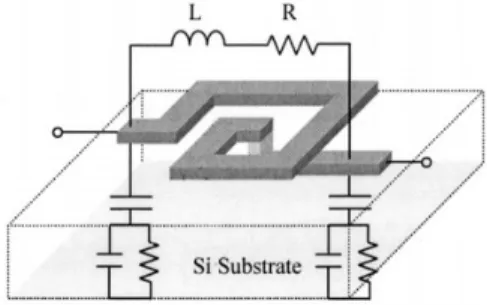
spiral inductors on silicon, such as the simpleπ-model proposed in [9] and represented in
figures 2.3 and 2.4.
Figure 2.3: On-chip implementation of a spiral inductor
However and notwithstanding the fact that more accurate models have been proposed
and developed, the simpleπ-model of spiral inductor on silicon is the most common model
used by the designers due to its simplicity. Its parameters are easy to adjust to empirical
data and they have a clear physical meaning. As a trade-off, this is a narrow band model
8 CHAPTER 2. INTEGRATED INDUCTORS
Ls Rs
Cs
Cox Cox
Rsi Csi Rsi Csi
Figure 2.4: π circuit equivalent model of a spiral inductor
frequencies. For this reason it is normally used only to model the spiral at frequencies
under few GHz.
So, in this circuit model, the inductorLsmodels the inductance of the spiral inductor
and the resistor Rs models the resistance of the metal trace. The capacitor Cs represent
the direct coupling through the overlap between the spiral and the underpass. The oxide
capacitanceCox is the capacitive coupling between the inductor and the substrate through
the oxide layer and the resistance and capacitance of the substrate, referred to ground, are
modeled byRsiand Csi, respectively. The characteristics of each in this equivalent circuit
model elements are strongly dependent on the inductor shape and on the technological
parameters of the CMOS process used. In the next subsections, the analytical expressions
for the evaluation of the π-model element values is presented.
2.2.1 Metal length
For the accurate calculation the length of the inductor be performed accurately a
decomposition of the inductor in its elementary segments was accomplished. Our formula
is derived in an inductor provided with a hollow center of an arbitrary inner diameter din
that affects linearly the total length, l:
l= 4n(din+w) +n(w+s) + 4n(n−1)(w+s). (2.2)
2.2. INDUCTOR MODEL 9
spiral have an half turn it is necessary to add the length of that half turn,
length of half inductor= 2(din+w) +ni(w+s) (2.3)
whereni corresponds to the integer part of the number of turns.
2.2.2 Series Inductance
The knowledge of series inductance is a critical point to engineers who develop and
use on-chip inductors for RFICs. The inductance represents the magnetic energy stored
in the device, although parasitic components may store energy as well. For the evaluation
of the inductance, several approaches have been proposed, based either on fitting process
to experimental values [4] or through physics-based equations (modified Wheeler formula)
[10], where
LS =K1µ0 n2
davg
(1 +K2ρ). (2.4)
Given that, K1 and K2 are coefficients allowing the model to be adopted to several
inductors shapes and are seen in Table 2.1,
Table 2.1: Modified Wheeler Expression’s coefficients
Inductor shape K1 K2
Square 2.34 2.75
Hexagonal 2.33 3.82
Octagonal 2.25 3.55
n is the number of turns,davg is the average diameter given by,
davg = 1
2(din+dout) (2.5)
and ρ is the fill ratio defined as
ρ= (dout−din)
(dout+din) (2.6)
.
10 CHAPTER 2. INTEGRATED INDUCTORS
will have different inductance values. The fuller one has a smaller inductance because its
inner turns are closer to the center, thus contributing less positive mutual inductance and
more negative mutual inductance [4].
2.2.3 Series Resistance
Series resistance RS arises from the metal resistivity in the inductor and is closely
related to the quality factor. As such, the series resistance is an important key parameter
for inductor modeling. The electric resistance in a metal trace conductor is given by,
RSdc = l
σwt (2.7)
where the resistance dependence on the metal conductivity,σ, is explicit and the metal
dimension is reflected byw,w andt (track thickness). The previous equation is valid for a
conductor where the current density is uniform, typically at DC and low frequency circuits.
On the other hand, when the inductor operates at high frequencies Eddy currents are
induced on the conductor, leading to a non-uniform current distribution, formerly know
as the skin effect [11]. This means that for hight frequencies, the useful conducting area
in a conductor is reduced. The most critical parameter presenting in the skin effect is the
skin depth and can be determined by [12],
δ=
r ρ
πµf (2.8)
where f is the frequency and µ is the magnetic permeability of free space andσ the
conductivity of the conductor.
Due to skin effect, for high frequencies RS becomes a function of frequency given by
RS =
l
σwδ(1−e−t/δ) (2.9)
For a planar conductor the previous equation just takes into account the top and the
bottom walls of the conductor. This approximation is not a problem if the conductor width
is greater than thickness. If not, neglecting the conductor side walls, can introduce a huge
2.2. INDUCTOR MODEL 11
the conductor resistance were proposed where k is a correction factor that depends onw
and t [11], [13].
lim
f→0Rac=Rdc= l
σwt (2.10)
lim f→∞
Rac =k l
2σδ(w+t) (2.11)
RS = q
R2
dc+R2ac (2.12)
2.2.4 Crossover Capacitance
The capacitance, CS, appears between the spiral and the underpass necessary to
connect the inner turn to the outside of the spiral inductor. For the evaluation of this
capacitance, all overlap capacitances are considered [14] and it is calculated by
CS =ncw2 εox toxM1−M2
(2.13)
whereεox is the oxide permittivity,nc is the number of overlaps and toxM1−M2 is the
oxide thickness between the spiral upper and lower metal.
2.2.5 Oxide Capacitance
Between the spiral metal and the silicon substrate, the parasitic capacitance, Cox is
formed. An usually adopted equation to estimate this capacitance is
Cox= 1 2
εox
toxlw (2.14)
wheretox is the thickness of the SiO2 between the inductor and the substrate and lw
12 CHAPTER 2. INTEGRATED INDUCTORS
2.2.6 Substrate Resistance and Capacitance
The substrate parasitic elements are a consequence of the time-varying magnetic field
that penetrates into the silicon substrate, leading to power loss as well as a reduction in
the spiral inductance. The substrate capacitance and resistance are given by
Csi= 1
2Csublw (2.15)
Rsi= 2
Gsilw (2.16)
where Gsub is the substrate conductance per unit area and Csub is the substrate
ca-pacitance per unit area, where,
Gsub= σsi hsi
(2.17)
and
Csub= ε0εr
hsi
(2.18)
given thatσsi and hsi are the substrate height and conductivity [14].
2.3
Quality Factor of an Inductor
The quality factor (Q) of an inductor gives a measure of the goodness of the
induc-tor and is usually adopted as the characteristic to be used when comparing inducinduc-tors
performance. The general expression for the quality factor is [6]:
Q= 2π energy stored
energy loss in one oscillation cycle (2.19)
.
For inductors, the only desirable source of storing energy is magnetic field and hence
any source of storing electric energy such as capacitances is considered as a parasitic. This
2.3. QUALITY FACTOR OF AN INDUCTOR 13
Q= 2πpeak magnetic energy − peak electric energy
energy loss in one oscillation cycle (2.20)
.
From equation 2.20 it is possible to realize that Q is zero for the frequency at which
the peak magnetic energy is the same as the electric energy. That frequency is called the
self-resonance frequency (SRF). This means that an inductor maintains is behaviour for
operating frequencies below the self-resonance frequency, but for higher frequencies the
component does not behave as an inductor and presents capacitive performances.
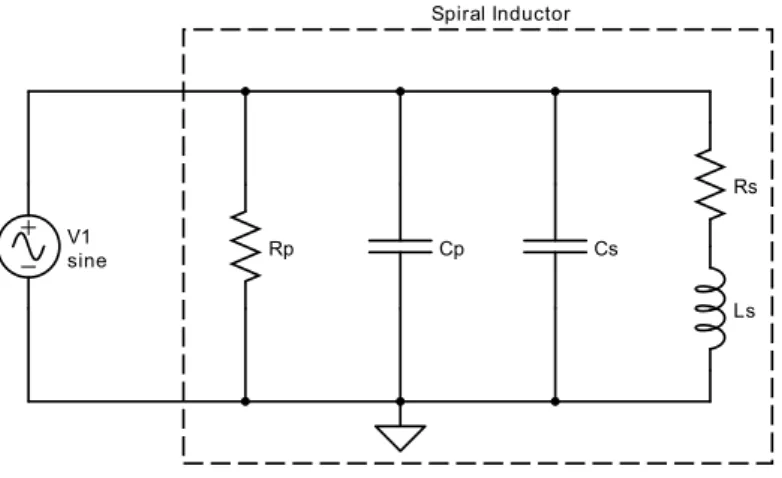
The π-model presented in figure 2.4 takes into account a set of various parasitic and
loss elements, allowing to rewrite equation 2.20 as function of the passive elements. To
do this, the circuit model is first transformed into its equivalent circuit with one port
connected to the ground (Figure 2.5).
V1
sine Rp Cp Cs
Rs Ls Spiral Inductor
Figure 2.5: One port equivalent model of π model
This configuration aims to simplify the analysis of the Q behavior. The parasitic
elements Cox, Rsi and Csi are replaced by its parallel equivalents Cp and Rp. These
elements continue to be frequency dependent and are calculated as [6].
Rp = 1 ω2C2
oxRsi
+Rsi(Cox+Csi) 2
C2 ox
(2.21)
Cp =Cox1 +ω 2
(Cox+Csi)CsiR2 si 1 +ω2(C
ox+Csi)2R2si
14 CHAPTER 2. INTEGRATED INDUCTORS
Then, in order to obtain Q, we can calculate the energy associated to each of the
passive elements in the equivalent circuit. The peak magnetic energy is related with the
inductance Ls and given by
Epeak magnetic= 1 2LsV 2 0 = V2 0Ls 2·[(ωL2
s) +R2s]
(2.23)
where V0 is the peak voltage at the inductor branch. The peak electric energy store
in parasitic capacitances is
Epeak electric= 1 2CV
2 0 =
V2
0(Cs+Cp)
2 (2.24)
and for last the energy loss in one oscillation cycle is
Eloss in one oscillation cycle= 2π ω · V2 0 2 · 1 Rp
+ Rs
(ωLs)2+R2s
(2.25)
According to definition (2.20) and replacing equations (2.23)-(2.25), the quality factor
can be calculated as
Q = 2πpeak magnetic energy − peak electric energy
energy loss in one oscillation cycle
= ωLs
Rs ·
Rp Rp+
(ωLs/Rs) +
1 Rs
·
1−R 2
s(Cs+Cp)
Ls −ω
2
Ls(Cs+Cp)
(2.26)
Note that Q increases with increasing LS and with decreasing RS. Moreover, it
appears form 2.26 should increase monotonically with the frequency. However, this is not
the case. At higher frequencies the substrate losses becomes a dominant factor for Q. We
can see three different terms in previous equation. The first one represents an almost ideal
inductor, where just the magnetic field stored and the ohmic losses are considered. The
last two terms on the right-hand side of 2.26 denote the substrate loss factor and
self-resonant factor. On-chip inductors are normally built on a conductive Si substrate, and
the substrate loss is due mainly to the capacitive and inductive coupling. The capacitive
2.4. WORKING EXAMPLES 15
consequences: changes the substrate potential and induces the displacement current. The
inductive coupling is formed due to time-varying magnetic field penetrating the substrate
and such a coupling induces the eddy current flow in the substrate. Both the displacement
and currents give rise to the substrate loss and thereby degrade the inductor performance.
An important conclusion we can take from the equation 2.26. IfRp approaches to infinity,
the substrate loss factor approaches the unity. SinceRp approaches infinity whenRsi goes
to zero of infinity (see equation 2.21), the quality factor can be improved by making the
silicon substrate either a short or a open [15].
A more expedite process to calculate Q could be achieved by measuring the input
impedance of the circuit with one port grounded. The energy stored in the inductor, is
linked to the imaginary part of the input impedance Zin; whereas the real part ofZin is
proportional to the energy dissipated in resistances. With this approach, the equation
2.26 for the quality factor is reduced to
Q= Im(Zin)
Re(Zin). (2.27)
2.4
Working Examples
In order to verify the accuracy of the model (π-model) described, simulations for
inductor of 1, 2 and 3 nH were performed. The inductors were implemented using the top
metal level of a 0.13 µm digital CMOS process. The technological parameters shown in
Table 2.2 were used.
Table 2.2: UMC130 - Technological Parameters
Parameter Value Parameter Value
ε0 8.85e-12 tox (µm) 600
εr 1 Csub(F/m2) 4.0e-6
σ (Ωm) 1/2.65e-8 Gsub 2.43e5
For the metal spacing, a minimum space between tracks of 1.5µm is always assumed.
In table 2.3 the dimensions of the inductors implemented are summarized. In this
example a working frequency of 710 MHz was considered.
16 CHAPTER 2. INTEGRATED INDUCTORS
Table 2.3: Spiral inductor design constraints Inductor w (µm) din (µm) n dout (µm)
1 nH 13.8 69.5 2.5 143
2 nH 14.5 137 2.5 214
3 nH 22.3 204 2.5 320
and Simulations of Spiral Inductors and Transformers for Integrated Circuits) yielding
results shown in Table 2.4.
Table 2.4: Results comparison with ASITIC - 710 MHz
L Q
Model ASITIC εL (%) Model ASITIC εQ (%)
1.00 nH 1.05 nH 4.5 5.38 4.63 13.9
2.00 nH 2.09 nH 4.6 6.89 6.23 6.23
3.00 nH 3.14 nH 4.8 10.5 9.35 11.0
Analyzing the results for these three working examples we observe close agreement
between our formulas and the measured data from ASITIC, with a maximum relative
error in order of 10 %. A major limitation in the design, modeling and simulation of
spiral is the difference between our circuit model of the spirals inductor and the ASITIC.
Then we can conclude that the results are quite acceptable to the chosen frequency of test.
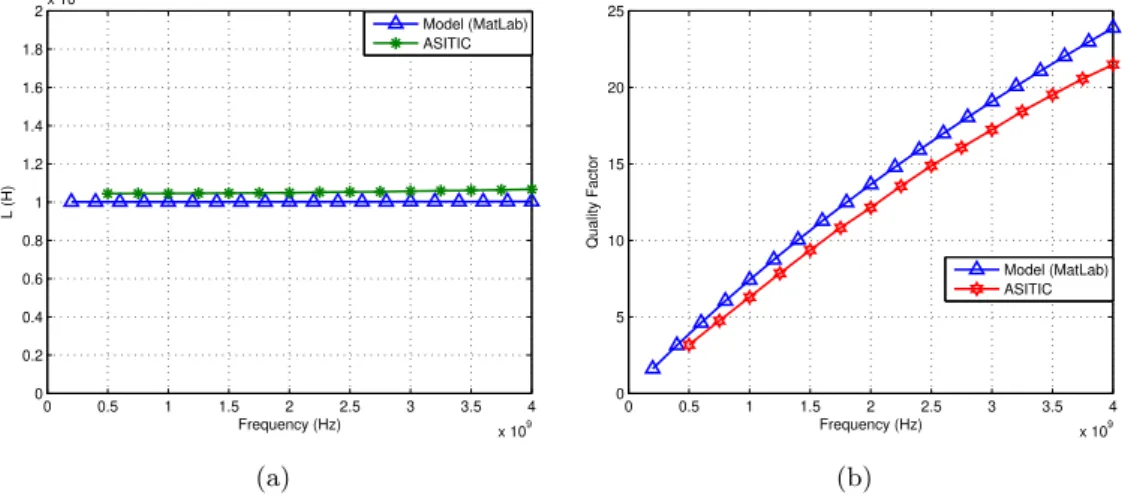
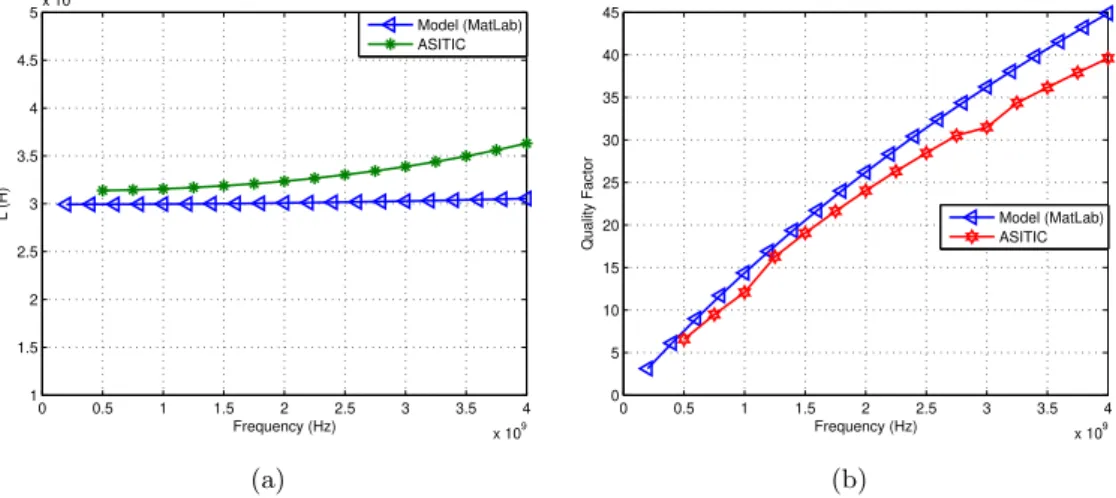
For the model to be more accurately validate it will be necessary to prove it to various
frequencies. The figures 2.6, 2.7 and 2.8 shows the results of these three inductors for a
range of frequencies and comparing likewise with ASITIC.
0 0.5 1 1.5 2 2.5 3 3.5 4 x 10⁹ 0 0.2 0.4 0.6 0.8 1 1.2 1.4 1.6 1.8
2x 10 −9 Frequency (Hz) L (H) Model (MatLab) ASITIC (a)
0 0.5 1 1.5 2 2.5 3 3.5 4 x 10⁹ 0 5 10 15 20 25 Frequency (Hz) Quality Factor Model (MatLab) ASITIC (b)
2.4. WORKING EXAMPLES 17
0 0.5 1 1.5 2 2.5 3 3.5 4 x 10⁹ 1 1.2 1.4 1.6 1.8 2 2.2 2.4 2.6 2.8
x 10−9
Frequency (Hz)
L (H)
Model (MatLab) ASITIC
(a)
0 0.5 1 1.5 2 2.5 3 3.5 4 x 10⁹ 0 5 10 15 20 25 30 35 Frequency (Hz) Quality Factor Model (MatLab) ASITIC (b)
Figure 2.7: Frequency dependence of 2.7(a) inductance and 2.7(b) the quality factor of spiral inductor
0 0.5 1 1.5 2 2.5 3 3.5 4 x 10⁹ 1 1.5 2 2.5 3 3.5 4 4.5
5x 10 −9 Frequency (Hz) L (H) Model (MatLab) ASITIC (a)
0 0.5 1 1.5 2 2.5 3 3.5 4 x 10⁹ 0 5 10 15 20 25 30 35 40 45 Frequency (Hz) Quality Factor Model (MatLab) ASITIC (b)
Figure 2.8: Frequency dependence of 2.8(a) inductance and 2.8(b) the quality factor of spiral inductor
2.4.1 Conclusion
The figures reveals the excellent match between the values calculated and ASITIC. For
high frequencies, the magnetic field effect seems to be a dominant factor. TheQ increases
with the frequency up to the peak value and then drops at higher frequencies due to the
parasitic capacitance. Despite of this limitations we can conclude that the model we have
Chapter 3
Integrated inductors with variable
width
3.1
Introduction
The main goals for the design of an integrated inductors consist of:
❼ high quality factor (Q factor) in order to obtain low-power loss and high-storage
energy inductor,
❼ self-resonance frequency well above the frequency of operation in order to guarantee
minimum inductance,
❼ high inductance per unit area in order to obtain highly integrated efficiency,
❼ high robustness in order to minimize the process derivation [16]
In this work, we try to improve the spiral inductor’s Q for frequency range behind
the self-resonance frequency, which can be easily installed into present CMOS technology
without a special process change. The degradation of theQ-factor of monolithic inductors
was attributed to substrate and metal loss, especially for silicon based technology. Using
highly resistive substrate and a high level metal layer can prevent substrate losses. The
metal loss was attributed to Ohm loss and eddy-current loss. Technologies such as using
copper metal, a thick metal layer, and a multilevel metal layer have been employed in order
20 CHAPTER 3. INTEGRATED INDUCTORS WITH VARIABLE WIDTH
to prevent the metal loss. One of the goal of this work is to reduce the series resistanceRs,
arising from the resistivity of the metal, reducing the eddy current loss and consequently
improving the Q factor. This is helpful for the design of low-power consumption and
high-performance RFICs. So, a variable metal width of the spiral inductor was proposed.
The basic idea is to increase the line width by arithmetic-progression.
Although this method can operate at low frequencies where the current density in a
wire is uniform, as the frequency increases the skin effect pulls more current to the outer
cross section of the metal wire and the so-called skin depth (i.e., the depth in which the
current flows) is reduced with increasing frequency (see equation (2.8)). Thus, the skin
effect increases the series resistance at high frequencies, and the approach of increasing the
line width would not be effective. According to an earlier study, the larger the cross section,
the lower the onset frequency at which the skin effect dominates the series resistance.
Furthermore, a wider metal line would occupy more area, which increases the fabrication
cost [17]. In this chapter we present one possible solution to this problem.
3.2
Variable width inductors
For a conventional spiral inductor with uniform metal width the influence of
mag-netically induces losses is much more important in the inner turn of the coil, where the
magnetic field reaches its maximum. To avoid this effect, some authors proposed an
op-timization by maximizing the internal diameter [7],[17]. However this is not the best
procedure to improve the quality factor of the integrated inductor, since increasing the
inner diameter increases the occupied area which goes against one of the designers goals.
One method is to employ the so-called tapered inductor, in which the line width
increases toward the outer turn of the spiral. In this way a reduced series resistance leads
to an improve of the quality factor. In this work, square inductors, where each segment
shows a width increment of ∆w, as illustrated in figure 3.1, are considered.
Since each segment will show an increment of both width and length new equations
will be proposed, relying on the dimensions of each segment of the inductor. The width
3.2. VARIABLE WIDTH INDUCTORS 21
Figure 3.1: Variable width square inductor [2]
wi =w+ni∆w (3.1)
where ni is the number of the segment, and w is the initial metal width. So, the
starting point for the derivation of our formulas is a common point with the precise
analytical algorithm: decomposition of an inductor into segments as shown in figures 3.2
and 3.3.
Taking that into account that the basic structure for supporting all the inductor
segments characterization is a matrix of four columns (one for each segment per turn) and
n line (one per inductor turn). Initially, a matrix lij containing every segment length
lij =
l11 l12 l13 l14
l21 l22 l23 l24
l31 l32 l33 l34
..
. ... ... ...
ln1 ln2 ln3 ln4
(3.2)
22 CHAPTER 3. INTEGRATED INDUCTORS WITH VARIABLE WIDTH 1 2 3 4 5 6 7 8
Figure 3.2: A regular spiral inductor divided by segments
1 2 3 4 5 6 7 8
Figure 3.3: A non-uniform width spiral inductor divided by segments
wij =
w11 w12 w13 w14
w21 w22 w23 w24
w31 w32 w33 w34
..
. ... ... ...
3.2. VARIABLE WIDTH INDUCTORS 23
are generated.
In chapter 2 we see that the model components of the integrated inductors are based
on their geometrical parameters. So, given that these parameters are modified by the
introduction of the increase in the metal width, new expressions for the π-model are
needed.
3.2.1 Modeling variable inductors
For determining the analytical expressions for the calculation of the component values
of theπ-model is necessary to characterize the width,wi, and the length,lifor each segment
of the spiral inductor. The new expression for each component are presented below, based
upon the expressions used to model a regular inductor.
a) Series Inductance, LS
Regarding theπ-model inductance, Lsanalytical equation 2.2.2 we see that a new way for
evaluatingdout must be adopt because of the change in geometry parameters of the metal
strip and expression, and it is given by
dout=din+ (2n+ 1)w+ (2n−1)s+ (2n(2n+ 1))∆w (3.4)
But, at this point there is a easier way to calculate thedoutof the inductor. Considering
the basic matrices in (3.2) and (3.3), the outer diameter is obtained by
dout=ln3+wn4 (3.5)
whereln3 is the third segment’s length andwn4 is the last segment’s width of the last
turn. The resulting equation of series inductance for a non-uniform inductor width takes
the same form of the expression for a regular width spiral inductor, replacing the outer
diameter. Thus
LS =K1µ0 n2
davg
(1 +K2ρ). (3.6)
24 CHAPTER 3. INTEGRATED INDUCTORS WITH VARIABLE WIDTH
b) Series Resistance, RS
For the evaluation of the series resistance, RS, is necessary to be more careful, since
the maths inherent is a little more complex. As we see in 2.2.3 the expressions that are
used to calculate RS, 2.10 and 2.11, depends on the dimensions of the inductor.
For this purpose two new matrix (3.7) and (3.8) based on the matrices containing the
lengths and widths of each segment are generated (3.2 and 3.3).
lij wij = l11 w11 l12 w12 l13 w13 l14 w14 l21
w21 w22l22 w23l23 w24l24 l31 w31 l 32 w32 l 33 w33 l 34 w34 .. . ... ... ...
ln1 wn1
ln2 wn2
ln3 wn3
ln4 wn4
(3.7) lij
wij +t
= l11
w11+t w12+l12 t w13+l13 t w14+l14 t l21
w21+t l 22 w22+t l
23 w23+t l
24 w24+t l31
w31+t l 32 w32+t l
33 w33+t l
34 w34+t ..
. ... ... ...
ln1 wn1+t
ln2 wn2+t
ln3 wn3+t
ln4 wn4+t
(3.8)
Following our line of thinking, the resultant series resistance is a sum of the resistance
of all segments in particular. In other words, each segment will have a different resistance
because of their different dimensions. Thus,
Rdc= 1 σt n X i=1 4 X j=1 lij wij (3.9a)
Rac = k
2σδ n X i=1 4 X j=1 lij wij+t
(3.9b)
c) Crossover Capacitance, CS
3.2. VARIABLE WIDTH INDUCTORS 25
the outside of the spiral inductor. As the width of the metal strip is increased for each
segment, the final metal width is larger than the initial one. The capacity is formed by
two plates with different areas. Assuming that the plates are relatively close that there is
low leakage flux, the capacitance is formed by the lower plate area. Thus, only the initial
width of the metal is considered and this element can be calculated by,
CS =ncw2 εox toxM1−M2
(3.10)
d) Oxide Capacitance, Cox
As already discussed in 2.2.5 this capacity is formed between the metal strip and the
silicon substrate. Analyzing the expression we see that this component also depends on
the dimensions of each segment of the coil. Picturing the 3d-image of the spiral inductor
and keeping in mind that we are considering aπ-model for each segment we came to the
conclusion that the oxide capacitances of all the segments are in parallel. So the totalCox
is the sum of them all and is given by,
Cox = 1 2 εox tox n X i=1 4 X j=1
lijwij. (3.11)
e) Substrate Capacitance, Csi and Resistance, Rsi
The mindset for the evaluation of the new expressions of substrate resistance and
capacitance is similar. From the sectional view we can see that the substrate capacitances
of all segments of the inductor are in parallel resulting in the total substrate capacitance,
Csi= 1 2Csub
n X i=1 4 X j=1
lijwij. (3.12)
For the substrate resistance, the only different is in the parallel of resistances. But
treating these as conductances, we can sum them and invert the result. Thus,
Rsi = 2 Gsub n X i=1 4 X j=1 1 lijwij
26 CHAPTER 3. INTEGRATED INDUCTORS WITH VARIABLE WIDTH
In section 3.3 a validation of the proposed model by comparasion with ASITIC is
performed.
3.3
Validation of the model
To prove the validity of the proposed model was carried out the following test.
Main-taining constant the geometric parameters of the Table 3.1 and varying the increment
value of width (∆w) the results shown in Table 3.2 were obtained.
Table 3.1: Validity of the optimization model w (µm) din (µm) n
10.5 134 2.5
Table 3.2: Results comparison with ASITIC
Inductor ∆w (µm) dout (µm) L Q
Model ASITIC εL (%) Model ASITIC εQ (%)
1 0.0 191 2.01 2.14 6.5 16.30 15 8.0
2 0.1 194 2.01 2.07 2.9 16.91 17.7 4.7
3 0.25 199 2.00 2.07 3.5 17.71 18.21 2.8
4 0.5 205 1.98 2.04 3.1 18.95 19.32 1.9
5 1.0 220 1.96 2.04 4.3 21.19 20.87 1.5
6 2.5 257 1.93 1.97 2.0 26.85 23.33 13.1
By the results in Table 3.2 it is quickly to realize that the quality factor increases
with the variation of the width (∆w) and hence the total area of the inductor. Note also
a maximum relative error of around 10% in value compared with ASITIC, from which we
can conclude that our model is a valid layout optimization. In Table 3.3 a ratio between
the increase of the area occupied by the integrated inductor and the increase of the quality
factor is presented.
Table 3.3: Validity of the optimization model
Inductor Increased Area (%) Improvement Q (%) Imp.Q/Inc.Area
2 1.8 3.6 2
3 4.3 7.9 1.84
4 7.1 14.0 1.97
5 13.4 23.1 1.73
6 25.9 39.3 1.52
3.4. OPTIMIZATION 27
quality factor in relation to the occupied area. Following this line of reasoning is to be
expected that we can get a higher quality factor for the same area using variable metal
width spiral inductors.
3.4
Optimization
In order to confirm this theory, a set of square spiral inductors has been designed
using an optimization based tool for the automatic design of spiral inductors [18]. The
efficiency of the tool is accomplished by the inductor π-model. The proposed tool offers
the designer the possibility for obtaining the layout parameters for the desired inductance
value. The solution is obtained considering constraints in the design variables which are
defined by the designer (see Table 3.4).
Table 3.4: Spiral inductor design constraints
Parameter Min Step Max
w (µm) 5.0 0.5 100.0
∆w (µm) 1 0.25
-s (µm) 1.5 -
-din (µm) 20.0 0.5 200.0
n 1.5 0.5 15.5
dout - - 700
These constraints consider not only upper/lower bounds on the variable values, but
also a discretization of the values according to the technology. The technological
parame-ters shown in Table 3.5 were used.
Table 3.5: UMC130 - Technological Parameters
Parameter Value Parameter Value
ε0 8.85e-12 tox (µm) 600
εr 1 Csub(F/m2) 4.0e-6
σ (Ωm) 1/2.65e-8 Gsub 2.43e5
The designer may also choose which performance parameter is to be optimized, such as
maximizing the quality factor, Q, at a predefined operation frequency, or the minimization
of the area occupied. This tool was developed in Matlab [19] and the validity of the solution
obtained was checked against results from simulation with ASITIC simulator.
28 CHAPTER 3. INTEGRATED INDUCTORS WITH VARIABLE WIDTH
design fixed width designs, for a approximately equal area, is presented. A set of examples
for a spiral inductors at a working frequency of 2.44 GHz was considered.
3.4.1 Example 1
In this example a spiral inductor of 1 nH was considered. The spiral inductor
con-straints design obtained for a fixed width layout as well as for ∆w of 1.5µm are represented
in Table 2.3. In the Table 3.7, the simulation results obtained with ASITIC for each case
are represented.
Table 3.6: Spiral inductor design constraints for inductance of 1nH Inductor w (µm) din (µm) n dout (µm) ∆w (µm)
1 13.0 69 2.5 153 0.0
2 5.75 42.3 3 153 1.5
Table 3.7: Results comparison with ASITIC
Inductor L Q Improvement (%)
Model ASITIC εL (%) Model ASITIC εQ (%)
1 1.00 1.06 7 6.86 6.04 12
2 1.01 1.03 2 8.13 7.76 5 18
In the last columns the relative improvement in the quality factor from using
incre-mental width is given.
3.4.2 Example 2
In this example a spiral inductor of 2 nH was considered. The spiral inductor
con-straints design obtained for a fixed width layout as well as for ∆w of 0.5, 0.75, 1 and 2
µm are represented in Table 3.8. In the Table 3.9, the simulation results obtained with
ASITIC for each case are represented.
Table 3.8: Spiral inductor design constraints for inductance of 2 nH Inductor w (µm) din (µm) n dout (µm) ∆w (µm)
1 10.5 134 2.5 191 0.0
2 10.0 97 3.0 190 0.75
3 11.8 67.8 3.5 182 0.5
4 5.75 96.3 3.0 173 1.0
3.4. OPTIMIZATION 29
Table 3.9: Results comparison with ASITIC
Inductor L Q Improvement (%)
Model ASITIC εL (%) Model ASITIC εQ (%)
1 2.00 2.14 6.5 16.3 15.0 8.0
2 2.01 1.92 4.6 21.3 20.4 4.2 24
3 2.00 1.91 4.6 22.4 21.3 4.8 27
4 2.00 1.90 4.8 17.7 17.5 1.0 8
5 2.00 1.86 7.0 20.7 19.2 7.7 21
In the last columns the relative improvement in the quality factor from using
incre-mental width is given.
3.4.3 Conclusion
The validity of the model was shown through two working examples considering the
design of 1.0nH and 2.0nH inductors at a working frequency of 2.44 GHz. From the
examples presented a quality factor improvement in the order of 10% to 30% may be
Chapter 4
An RF LC Q-Enhanced CMOS
filter
4.1
Introduction
Surface acoustic wave (SAW) filters are applied extensively in today’s communication
equipment. These high performance components have reached a key position in current
communication technology assisting the efforts to increase the spectral efficiency of limited
frequency bands for higher bit rates. During the last decades, driven by the boom of the
wireless technology business, great and important progress in SAW device performance
was made, and a variety of innovative applications were developed. The developments
are based on technological improvements. The reduced size and weight of the complete
system will be an advantage in all kinds of portable electronic products. Moreover,
re-ceiver architectures in telecommunication systems use higher IF frequencies to improve
the interfering signal rejection. The allocations of radio frequency spectrum has led to
the development of small and low-cost wireless products. The commercial sector has
re-sponded with increasing levels of integration. Researchers have attempted to design high
Q bandpass filters by enhancing lossy integrated inductors. Shunt mounted resonator,
composed of an inductor and capacitor in parallel is presented to realize RF bandpass
filter. The design of the integrated on-chip 1.2V 2.44 GHz Q-enhanced LC filter using
silicon CMOS process is presented in this chapter.
32 CHAPTER 4. AN RF LC Q-ENHANCED CMOS FILTER
4.2
Tuned Amplifiers
Highly selective bandpass filters have long been implemented with tuned amplifiers. In
figure 4.1 the amplitude response of a tuned amplifier is represented, which may be
char-acterized by the central frequency,ω0, and the 3-dB bandwidth,B. In many applications,
the 3-dB bandwidth is less than 5% of ω0 [20]
Gain (dB)
Frequency (Hz)
f1 f0 f2
C
ent
er
fr
equ
ec
y
3 dB
Bandwidth
Figure 4.1: Frequency response of a tuned amplifier
The basic principle in the design of tuned amplifiers is the use of parallel RLC circuit
as the load, or at the input, of a BJT or a FET amplifier. In figure 4.2 a MOSFET class
A amplifier, having a tuned-circuit load is illustrated. For the sake of simplicity, the bias
details are not included. Since this circuit uses a single tuned circuit, it is known as a
single-tuned amplifier [20].
Vi
RL CL L
Vo
(a)
Vi gmVi R C L Vo
+
-(b)
Figure 4.2: The basic principle of tuned amplifier is illustrated using a MOSFET with a tuned circuit load. Bias details are not shown.
de-4.2. TUNED AMPLIFIERS 33
notes the parallel equivalent of RL and the MOSFET output resistance ro, andC is the
parallel equivalent ofCLand the FET output capacitance (usually very small). From the
equivalent circuit we may write,
Vo =−gmVi
YL
=− gmVi
sC+ 1 R+
1 sL
(4.1)
The voltage gain is a second-order bandpass function and can be expressed as
Vo Vi
=−gm C
s s2+ 1
RCs+ 1 LC
(4.2)
We may thus conclude that the tuned amplifier has a center frequency of
ω0 = √1
LC (4.3)
a 3-dB bandwidth of
B = 1
RC (4.4)
a quality factor of
Q≡ ω0
B =ω0RC (4.5)
and a center-frequency gain of
Vo(jω0) Vi(jω0)
=−gm C
jω0
(jω0)2+Bjω0+ω2 0
=−gm C
jω0
(−ω0)2+Bjω0+ω02
=−gmR (4.6)
In the case of wireless transmitters it is necessary to implement filters of very high
selectivity. In these cases LC filters may be employed. The use of integrated inductors
in CMOS technology raises problems for the implementation of high selectivity LC filters
selectivity due to the difficulty of designing coils with high quality factor operating at RF
frequencies. For wireless applications fully integrated highly selective bandpass filters are
34 CHAPTER 4. AN RF LC Q-ENHANCED CMOS FILTER
must be adopted. In the next section a brief description of a Q-enhancement technique
using a negative active resistancegm will be presented.
4.3
Principles of
Q
enhancement
Q enhancement has long been used in LC circuits for signal amplification, signal
selection and for generating stable oscillation [21]. In this section, our discussion is focused
on theQ-enhancement in integrated LC filters. If a high selectivity LC resonator is desired
some form ofQ-enhancement is needed to increase the quality factor of resonators designed
with lossy on-chip resonator.
Regardless of the coupling mechanism between the resonators, losses associated with
the on-chip reactive components change the center frequency and the loaded quality factor
of the filter. Having estimated and modeled the total resistive loss of the resonator, a active
device to create a negative resistance, (-1/Gneg), exactly the opposite caused by the losses
of reactive components can be added to compensate its effect as shown in figure 4.3.
Although methods that include phase-shifted current feedback via coupled inductors
have been investigated, the direct use of active devices as negative resistors is the
preva-lent Q-enhancement technique [3]. This way, combining the reactive component with a
negative resistance, the real part of the total impedance is reduced, eliminated or even
made negative, depending on the value of the negative resistance used. We can say that
the quality factor of the original lossy component can be improved (enhanced) by the
negative resistance and resulting component can replace the original used in the LC filter.
This Q-enhancement technique is shown in figure 4.4.
L C
Rs
C L R C L Rp -R
Figure 4.3: Active Q-enhancement using negative resistance
Assuming that a lossy inductor with a quality factor ofQ0 can be simplistically
4.3. PRINCIPLES OFQENHANCEMENT 35
Vi sine
C
Ls
Rs
-Rneg Gin
Gneg
Vout Lp ≈ Ls Rp = (1 + Q0*Q0) Rs
Figure 4.4: Q-enhancement technique applied to a RLC filter
RS = ωL
Q0 (4.7)
These losses can be compensated by connecting the negative resistance in parallel with
the LC tank. Assuming that the quality factor of the tank capacitance is much larger than
the inductor, the series combination of the inductor (LS) and its loss RS can be modeled
as a parallel combination of an inductanceLP and resistanceRP given by
LP =LS(1 + 1 Q2
0
)≈LS =ωLQ0 (4.8)
and
RP =RS(1 +Q20) =ωLQ0 (4.9)
If the inductor quality factorQ0is large enough then,LP ∼=L. The frequency response
of the filter in the figure 4.5 can be approximated as
H(s) = Vo(s) Vin(s)
∼
= Gm
GP −Gneg+sL1P +sC
36 CHAPTER 4. AN RF LC Q-ENHANCED CMOS FILTER L L Vout M4 M5 C M6
Vin +
Vin-Vgm -Gneg M2 M3 M1 Vq Gin Rp Lp Vdd
Figure 4.5: Q-enhanced LC bandpass filter
or
H(s) = Vo(s) Vin(s)
∼
=
−Gm
C s s2+ GP−Gneg
C +
1 LC
= −A0
ω0 Qs s2+ω0
Qs+ω 2 0
(4.11)
From which we may conclude that the central frequency will be given by
ω0 = √1
LC (4.12)
Also from equation 4.11 we may conclude that the filter quality factor will be given
by
Q= C
1 √
LC GP −Gneg
=
q C L (GP −Gneg)
(4.13)
The filter central gain, A0 will be given by
A0 = Gm
C Q
ω0 =
Gm GP −Gneg
4.3. PRINCIPLES OFQENHANCEMENT 37
and the bandwidth, B can be described as:
B = ω0
Q =
q 1
LC(GP −Gneg) q
C L
(4.15)
As 4.12 shows, the quality factor of the inductor (Q0) does not modify the center
frequency but increases the Q of the resonator. Thus at high frequencies, due to the
higher losses, a larger Gneg is required which results in changing both Q. Note that the
equation 4.13 is valid only around the LC tank’s resonant frequency, due to the fact that
the equivalent parallel conductance from the inductor loss varies with frequency.
Considering the circuit implementation of a second-order Q-enhanced LC filter in
4.5, the center frequency tuning is achieved through varactors which are PMOS
transis-tors implemented in separate wells (in an n-well technology) and with their drain/source
terminals connected together to the well terminal. The capacitance seen by the gate is
adjusted by changing the voltageVf and exploiting the variation of the gate capacitance
when the transistor goes from weak inversion to the accumulation region.
The operation of a MOSFET can be separated into three different modes, depending
on the voltages at the terminals. In the saturation or active mode the switch is turned
on when Vgs > VT and Vgs > Vds−VT and a channel is created which allows current to
flow between the drain and the source. The drain current is weakly dependent upon drain
voltage and controlled primarily by the gate-source voltage, and modeled approximately
as:
Id= 1 2µnCox
W
L(Vgs−VT) 2
(4.16)
A key design parameter, the MOSFET transconductance gm is:
gm = ∂Id
∂Vgs = ∂ ∂Vgs 1 2µnCox W
L(Vgs−VT) 2
=µnCoxW
L(Vgs−VT) (4.17)
The cross coupled transistor M2-M3 form the negative transconductance-Gneg which
38 CHAPTER 4. AN RF LC Q-ENHANCED CMOS FILTER
is dependent on the control voltage, Vq. Considering that the transistors M2 and M3 are
equal, we know that,
ID2,3 = 1 2ID1 ⇔
⇔ 12µnCox
W L
2,3
(Vgs−VT)2 = 1 2 1 2µnCox
W
L
1
(Vq−VT)2
⇔ (Vq−VT)2 = 1 2 W L 1 W L
2,3
(Vq−VT)2 (4.18)
Using the equation 4.16 results in,
Gneg=µnCox s 1 2 W L 1 W L
2,3
(Vq−VT) (4.19)
where (W/L)2,3 and (W/L)1 refer to the (W/L) ratios of M2,3 and M1 in figure 4.5,
respectively. To simplify the formulas we consider that
βq = 0.5µCox s
0.5
W
L
2,3 W L 1 (4.20) so,
Gneg=βq(Vq−VT) (4.21)
Following the same reasoning, the control voltage Vgm changes the transconductance
Gm of the input differential pair M4-M5 thus, changing the peak amplitude gainA0 of the
filter while keeping theQ invariant. Note thatGm as a function ofVgmcan be expressed
as
Gm =βm(Vgm−VT) (4.22)
where
βm= 0.5µCox s
0.5
W
L
4,5 W L 6 (4.23)
respec-4.4. INTEGRATED FILTERS DESIGN 39
tively.
Thus using 4.19 and 4.22 the peak amplitude gain A0 defined in equation 4.10, can
be expressed as,
A0 = Gm
GP −Gneg
= 2βm(Vgm−VT) GP −βq(Vq−VT)
. (4.24)
In similar way the quality factor Q can be expressed as,
Q=
q C L
GP −βq(Vq−VT)
. (4.25)
4.4
Integrated Filters design
Like analog circuit in general, radio-frequency integrated circuit (RFIC) designs suffer
from required trade-offs that include linearity, noise, power, frequency, gain and supply
voltage [1].
The circuit design investigated in this work introduces a loss-compensated
second-order RF filter that is to be implemented in a standard 0.13µm CMOS process. This filter
uses an on-chip resonant tank comprised of an spiral integrated inductor and a
capaci-tance that is a combination of the1 circuit parasitics as well as specifically incorporated
passive elements. Loss compensation is achieved by using a transconductor that emulates
negative resistance. This particular topology is a circuit solution for the Q-enhancement
as explained in the section 4.3.
An operational objective of this work is to implement a Q-enhanced LC filter with
center frequency of 2.44 GHz and 3-dB bandwidth of 84 MHz and a maximum gain of 15
dB. One of the trade-offs suffered when incorporating active on-chip filters to replace the
passive off-chip counterparts is in the required power consumption. In wireless devices
circuit topologies that maximize the time of operation are a primary concern.
This section provide details regarding theQ-enhanced LC filter including circuit
oper-ational characteristic, design methodology, physical layout considerations and simulation
results.
40 CHAPTER 4. AN RF LC Q-ENHANCED CMOS FILTER
to realize the specifications of the filter. In this case, we have,
ω0= 2π·2.44·109 = 1.5331·1010rad/s (4.26)
and
B = 2π·84·106
rad/s (4.27)
In order to prove the advantage of using optimized integrated spiral inductors two
designs of the LC filter were performed. So, a comparison between the non-optimized
(fixed width) and the optimized integrated inductor (variable width) is performed. An
inductor of 1 nH was considered to implement this filter since it is a reasonable value for
the envisaged central frequency. In table 4.1 the layout dimensions as well as the values of
the inductance and resistance of the inductors used to implement the filter is presented.
Table 4.1: Inductor of 1 nH used in filter
w (µm) din (µm) n dout (µm) ∆w (µm) L(nH) R(Ω) Q
7.75 68.8 2.5 112 0.0 1.00 1.4 11.0
5.5 47.5 3.0 114 0.75 1.00 1.133 13.55
Its possible to size the values of the transconductance, Gneg, and of the capacitance
solving the following system of equations given by 4.12 and 4.15. Thus,
ω0 =
q 1 LC
B = GP−Gneg
C
(4.28)
results in
Table 4.2: Values of theGneg and C
Regular inductor Optimized inductor
Gneg (mS) 3.7 2.6
C (pF) 4.25 4.25
In order to obtain this values of the Gneg we have to size the dimensions of the
4.4. INTEGRATED FILTERS DESIGN 41
Gneg =µCox s
0.5
W L 1 W L
2,3
(Vq−VT) (4.29)
To simplify the sizing of transistors to obtain the desired Gneg, it was decided to design
the three transistors with the same size andL=L1=L2=L3= 600µm since the length
should be greater than three times the minimum allowed by the technology (3×130µm).
Substituting in the above equation, the width of transistor MOS in order to obtain the
value of theGneg is given by,
W = GnegL
µnCox √
0.5(Vq−VT)
(4.30)
For the technological parameters we have considered µnCox equals to 309·10−6 µm
and aVT is 0.27 V. These values were obtained from simulations in Cadence. The value of
Vq is 0.8 V as a way of having the transistors working in moderate inversion. Given that
we are now able to determine the exact value for the width of the transistor. The table
4.3 shows the value of the W for both regular and optimized inductor.
Table 4.3: Value of the Width of the transistors MOS Regular inductor Optimized inductor
MOS Width (µm) 18.7 13.14
Now we must design the size of the transistorsM4,M5 andM6 in order to obtain the
desired gain, A0. Assuming we want a gain of 15dB, by equation 4.24 we know that,
Gm= (Gp−Gneg)A0 (4.31)
In the previous section we demonstrated in equation 4.22 that,
Gm=µnCox s
0.5
W L 6 W L
4,5
(Vgm−VT) (4.32)
Again, to simplify the sizing of transistors to obtain the desired gm, it was decided to
42 CHAPTER 4. AN RF LC Q-ENHANCED CMOS FILTER
equals to 309·10−6
,VT is 0.27 V andVgm is 0.8 V.
Substituting in the above equation, the width of transistor MOS in order to obtain
the value of the Gneg is given by,
W = gmL
µnCox√0.5(Vgm−VT)
(4.33)
The table 4.3 shows the value of theW extracted from equation 4.33 for both regular
and optimized inductor.
Table 4.4: Value of the Width of the transistors MOS (4,5,6) Regular inductor Optimized inductor
Gm (mS) 12.1 12.3
MOS Width (µm) 62.8 63.6
To verify the design of theQ-enhanced RF bandpass filter, the filter was simulated in
a UMC130 standard CMOS process using the Cadence design environment.
4.4.1 Simulation results
In this section the results of the simulations, namely the passband response are
pre-sented. Two implementations of the filter were performed. The first implementation using
a regular integrated inductor, ie, with fixed width. In the second implementation an
opti-mized integrated inductor with non-uniform metal width was used proving that the filter
maintain the good performance with this type of inductor.
As illustrated in figure 4.6, for the simulation of the inductor the corresponding
pi-model was used. As previously explained, the value of the π-model resistance RS is
frequency dependent. Yet, since we are considering its inclusion in a highly selective filter,
using a fixedRS value obtained for the center frequency is a good approach.
4.4.2 gmLC filter with regular integrated inductor
The figure 4.6 shows the schematic of a second order Q-enhanced LC filter using
a regular integrated inductor. Using the input values of the table 4.1 presented in the
previous section for the case of ∆w= 0 we obtained the following values of the model-π
4.4. INTEGRATED FILTERS DESIGN 43 M4 M5 C M6 M2 M3 M1 Vin+ sine Vgm Vin-sine Vdd Vq s p ir al in d u c to r s p ir al i n d u c to r Ls Rsi Csi Rs Cox Rsi1 Csi Cox Cs
Figure 4.6: A 2nd Q-enhanced on-chip LC bandpass filter
Table 4.5: Model π components values
LS (H) RS (Ω) CS (F) Cox (F) Csi (F) Rsi (Ω)
1e-9 1.4 0.751e-15 22.8e-15 0.526e-15 5.61e8
The filter passband response measurements performed using AC analysis in the
Ca-dence simulator is shown in figure 4.7.
The measured gain of 12.65 dB at the center frequency of 2.405 GHz is lower than the
originally designed filter gain in approximately 2.5 dB. Figure 4.7 also illustrates that the
filter center frequency is shifted slightly lower than the required f0 of 2.44 GHz specified
for the targeted Bluetooth application, falling within 1.43% of the design goal. The table
4.6 compares the predicted and the simulated results.
Analysing the results presented in the table 4.6 it could be concluded that the method
44 CHAPTER 4. AN RF LC Q-ENHANCED CMOS FILTER
2 2.1 2.2 2.3 2.4 2.5 2.6 2.7 2.8 2.9
x 109 −10
−5 0 5 10 15
fc: 2.405e+009 A: 12.65
Frequency (Hz)
Gain (dB)
AC Response
Figure 4.7: Frequency response of the RF LC Q-enhanced filter using a regular spiral inductor
Table 4.6: Simulation results
Targeted values Achieved values εr(%)
Gneg (mS) 3.7 3.87 4.59
Gm (mS) 12.1 11.14 7.93
fc (GHz) 2.44 2.405 1.43
BW (MHz) 84 90 7.14
Quality factor 29 26.72 8
Output Gain (dB) 15 12.65 15.67
The largest relative error was obtained in the output gain of approximately 16%. This
errors were already expected since the parasitic capacities of the transistors are not taken
into account and the quadratic model of MOS transistors is not the most appropriate for
the technology used.
4.4.3 gmLC filter with optimized integrated inductor
For the implementation of the second order Q-enhanced LC filter using a optimized
integrated inductor studied in chapter 3 the filter design used was the same (see figure
4.6, but now using the input values of the table 4.1 for the case of ∆w= 0.75. The table
4.7 shows the value of the model-π components obtained.
The frequency response of the filter is shown in figure 4.8.
![Figure 1.1: Typical radio receiver [1]](https://thumb-eu.123doks.com/thumbv2/123dok_br/16573817.738118/20.892.149.742.223.389/figure-typical-radio-receiver.webp)

![Figure 3.1: Variable width square inductor [2]](https://thumb-eu.123doks.com/thumbv2/123dok_br/16573817.738118/39.892.265.616.131.468/figure-variable-width-square-inductor.webp)