Vol. 26, No. 6, November–December 2003
Equilibria of Multibody Chain in Orbit Plane
Anna D. Guerman¤
University of Beira Interior, 6201-001 CovilhQa, Portugal
We study equilibria of a multibody system in the orbit plane within the framework of a model of n + 1 material points connected by n light rods into an n-link chain. The junctions are spherical hinges. The center of mass of the system moves along a circular orbit. The equilibrium equations are reduced to a fairly simple form that enables their analysis. We nd all the equilibria of an n-link chain in the orbit plane and prove that each rod can occupy one of the following three positions: it can be directed along the tangent to the orbit of the center of mass of the chain; it can be a member of a group of adjacent vertical rods, being the center of mass of this group situated on the tangent to the orbit; and, nally, an oblique orientation is possible if the rod joins either two vertical groups of rods or the end of a vertical group with the tangent to the orbit. It is shown that the number of equilibria does not exceed 22n. We include the analysis of two examples (three- and four-link chains) and represent the schemes of all
the realizable equilibria in these cases.
I. Introduction
O
RBITAL dynamicsof a system of connectedbodies is of great interest due to its numerous possible applications, including orbital stations,robots, tetheredsystemswith multiple payloads,and formation ying. The rst studies on the subject were published in the early 1960s and were followed by much scienti c research and many engineering projects. A large part of this work is dedicated to the behavior of two tethered bodies. However, there exists sig-ni cant interest for multibody systems, inspired by various space programs under development. The study of multibody systems is mainly focused on numerical analysis(see, for instance, Refs. 1–4). Analyticalresearchis mostly restrictedeitherto systemswith a small number of connected bodies (see Refs. 5–9 for chains with two or three bodies) or to systems with speci c additionalconditions(such as the orbiting ring studied in Refs. 10 and 11).In this paper, we suggest an analytical study of a system that includes an arbitrary number of satellites joined into an open chain by light rigid rods. We impose no restrictions on the masses of satellites or the lengths of the links. We model the satellites by material points and suppose that the mass of the links is negligible compared with the masses of the satellites. (This approach is used in most analytical studies of tethered systems, such as Refs. 6–9 and 11.) We study equilibrium con gurations of this system in the orbital reference frame.
Some particular cases of this problem were examined previously. The two-member chain (double pendulum) is a particular case of two connected bodies whose in-plane equilibria were studied in Ref. 5. The model we consider was used7¡9to study equilibria of
three linked material points. It was shown that there exist only three kinds of in-plane con gurations: both rods directed along the local vertical; both rods aligned with the tangent to the orbit of the center of masses; and one rod vertical while the other is in an oblique posi-tion. The in-plane equilibria of a two-link chain were studied,7and
the principal frequencies of small-amplitude motions about these equilibria were determined. All the spatial equilibria of a double pendulum were found in Ref. 8. A study of equilibria of a double pendulum in the plane of a circular orbit was performed in Ref. 9, and stability of all the in-plane con gurations was analyzed.
Presented as Paper AAS 02-169 at the AAS/AIAA 12th Space Flight Me-chanics Meeting, San Antonio, TX, January 2002; received 7 June 2002; revision received 2 April 2003; accepted for publication 8 May 2003. Copy-right c° 2003 by Anna D. Guerman. Published by the American Institute of Aeronautics and Astronautics, Inc., with permission. Copies of this paper may be made for personal or internal use, on condition that the copier pay the $10.00 per-copy fee to the Copyright Clearance Center, Inc., 222 Rose-wood Drive, Danvers, MA 01923; include the code 0731-5090/03 $10.00 in correspondence with the CCC.
¤Assistant Professor, Department of Electromechanical Engineering;
[email protected]. Member AIAA.
II. Posing the Problem
Let us considera system of nC 1 materialpoints, A0, A1, : : : , An,
with respectivemasses m0, m1, : : : , mn. These points are connected
by n lightrigidrods (akD Ak ¡ 1Ak; kD 1; : : : ; n) intoan openchain.
The junctions are spherical hinges. The gravitational eld of the Earth is supposed to be central Newtonian. The center of mass of the system O moves along a circular orbit with angular velocity !. To describe the behavior of this system we use the orbital refer-ence frame O x yz. Its z axis follows the local vertical, the x axis is tangent to the orbit and points in the direction of the velocity of point O, and so the y axis is normal to the plane of the orbit. The orientation of the rod akD Ak ¡ 1Ak is described by the angle Ák
between the rod akand the z axis (Fig. 1).
The components of the vector akD Ak ¡ 1Akare
akx D »kD aksin Ák; ak yD ´kD 0
akzD ³kD akcos Ák (1)
The coordinates of the point Ak(kD 1; : : : ; n) in the orbital frame
are xkD x0C k X s D 1 »s; ykD 0; zkD z0C k X s D 1 ³s (2)
where x0, y0, and z0are the coordinates of the rst satellite in the
chain A0. We denote by x¤, y¤, and z¤the coordinates of the center
of mass O of the structure. For this choice of the reference frame, x¤D y¤D z¤D 0, and we obtain n X k D 0 mkxkD M x¤D 0; n X k D 0 mkzkD Mz¤D 0 (3)
Then one can determine the position of the point A0:
x0D ¡ 1 M n X s D 1 Mn s»s; z0D ¡ 1 M n X s D 1 Mn s³s (4)
We use the notation Mj i D j X p D i mp; M0nD M
(the total mass of the chain). Thus, the system considered has n degrees of freedom, and Ák(kD 1; : : : ; n) representthe generalized
coordinates.
The kinetic energy T of the system is T D12 n X k D 0 mk © [PxkC !.zkC rO/]2C .Pzk¡ !xk/2 ª (5) 942
Fig. 1 Orientation angles.
Its gravitationalpotential energy is
V D ¡!2r3 O n X k D 0 mk rk (6)
where rkis the distance between the point Akand the center of the
Earth,
rkD
p x2
k C .rOC zk/2 (7)
andrOrepresentsthis distancefor the centerof mass O of the system
(that is, rOis the radius of the orbit). Calculating the function V and
taking into account the terms up to the second order of ak=rO, one
gets V D ¡!2r3 O n X k D 0 mk £ x2 kC .rOC zk/2 ¤¡1 2 D ¡!2r2 O n X k D 0 mk ³ 1C 2rzk O C x2 kC z2k r2 O ´¡1 2 D ¡!2r2 O n X k D 0 mk ³ 1¡rzk O ¡ x2 k¡ 2z2k r2 O ´ D ¡M!2r2 OC !2 2 n X k D 0 mk ¡ x2 k¡ 2z2k ¢ (8) [We used relation (3) once more.]
III. Equations of Equilibria Equilibria of the chain correspond to the solutions
ÁkD Ák0D const (9)
of the equations @.T0¡ V /
@ Ák D 0; k D 1; : : : ; n
(10)
where T0represents the part of T independentof the velocities, and
T0¡ V is sometimes referred to as the dynamic potential.
Simpli-fying the term T0using relation (3), one gets
T0¡ V D 3! 2 2 n X k D 0 mkz2kC const (11)
and so the in-plane equilibrium con gurations of the chain are de-scribed by the following equations:
n X k D 0 mkzk@ zk @Áp D 0; p D 1; : : : ; n (12)
Substituting Eq. (4) into system (2), we arrive at
zkD 1 M ³Xk s D 1 Ms ¡ 1 0 ³s¡ n X s D k C 1 Mn s³s ´ ; 0· k · n (13)
For the sake of uniformity we assume the convention that
0 X s D 1 Ms ¡ 1 0 ³sD 0; n X s D n C 1 Mn s³sD 0 So @ zk @Áp D 8 > < > : 1 MM n papsin Áp; for k < p; 0· k; p · n ¡M1 Mp ¡ 1 0 apsin Áp; for k ¸ p (14)
and rather tedious calculations lead to the following:
n X k D 0 mkzk @ zk @Áp D " p ¡ 1 X k D 0 1 M2mk Á k X s D 1 Ms ¡ 1 0 ³s¡ n X s D k C 1 Mn s³s ! Mn p ¡ n X k D p 1 M2mk Á k X s D 1 Ms ¡ 1 0 ³s¡ n X s D k C 1 Mn s³s ! Mp ¡ 1 0 # apsin Áp D apsin ÁM2 p " Mn p Á p ¡ 1 X s D 1 Ms ¡ 1 0 Msp ¡ 1³s¡ p X s D 1 Ms ¡ 1 0 Msn³s ¡ n X s D p C 1 Mp ¡ 1 0 Msn³s ! C Mp ¡ 1 0 Á n X s D p C 1 Ms ¡ 1 p Msn³s ¡ p X s D 1 Ms ¡ 1 0 Mnp³s¡ n X s D p C 1 Ms ¡ 1 0 Msn³s !# D ¡apsin ÁM p Á Mn p p X s D 1 Ms ¡ 1 0 ³sC M0p ¡ 1 n X s D p C 1 Mn s³s ! (15) Finally we arrive at the following system:
sin Ák¢ .bkz/ D 0; k D 1; : : : ; n (16) Here zD .³1; : : : ; ³n/T, b1D .1=M2/ ¡ m0M1n; m0M2n; : : : ; m0.mn ¡ 1C mn/; m0mn ¢ (17) bn D .1=M2/ £ m0mn; .m0C m1/mn; : : : ; M0n ¡ 2mn; M0n ¡ 1mn ¤ bkD .1=M2/ £ m0Mkn; .m0C m1/Mkn; : : : ; M0k ¡ 2Mnk; M0k ¡ 1Mkn; Mk ¡ 1 0 Mk C 1n ; : : : ; M0k ¡ 1mn ¤ ; 2· k · n ¡ 1 (18)
Here bkis the row k of the matrixB.nI m0; : : : ; mn/ with the element
in row i and column j equal to
bi; jD 8 > < > : 1 M2M j ¡ 1 0 Min; for j · i 1 M2M0i ¡ 1Mnj; for j < i (19)
IV. Properties of the Mass Matrix
We now describesome importantpropertiesof the matrixB. They will be our main tool in the analysisof system (16). These properties permit us to identify some elementary equilibrium con gurations and then to describe all possible equilibria using superposition.
In the following analysis, we denote byDJ the matrix obtained
fromB by exclusion of rows and columns with numbers in the set J : DJD .bi; jji; j =2 J/; dk J stands for the kth column ofB without
elements with indices from J : dk JD .bj;kj j =2 J/Tand zJstands for
the column z without these elements: zJD .³jj j =2 J/T.
Property 1: The neighboring rows of this matrix satisfy the relations
.M=mk ¡ 1/.bk¡ bk ¡ 1/C .M=mk/.bk¡ bk C 1/D ek
k D 2; : : : ; n ¡ 1 .M=m0/b1C .M=m1/.b1¡ b2/D e1
.M=mn ¡ 1/.bn¡ bn ¡ 1/C .M=mn/bnD en (20)
where ekD .±k1; : : : ; ±kn/ designates the kth row of the identity
matrix n£ n (±k jis the Kronecker symbol).
Property 2: For J D fk C 1; : : : ; k C rg; k ¸ 1; k C r · n, the matrix DJ coincides with B for the .n ¡ r/-link chain with
the masses QmjD mj, jD 1; : : : ; k ¡ 1; QmkD Mkk C r, QmjD mj C r, j D k C 1; : : : ; n ¡ r: DJD B ¡ n ¡ rI m0; : : : ; mk ¡ 1; Mkk C r; mk C r C 1; : : : ; mn ¢ (21) In the particular case JD f1; : : : ; rg, DJ coincides with the mass
matrix B for the .n ¡ r/-link chain with the masses Qm1D M0r,
QmjD mj C r, jD 2; : : : ; n ¡ r.
Properties 1 and 2 can be proved by direct substitution. Property 3: The matrix B does not degenerate:
detB D .m0m1; : : : ; mn/
¯
Mn C 16D 0 (22)
We prove this equality by induction.
For nD 1, one gets B D m0m1=M2, and the statement is true.
Now we suppose that Eq. (22) is valid for nD k ¡ 1 and prove it for nD k. For the latter case we apply Eq. (20) to the last row of B and get
detB D mk ¡ 1mk
M .mk ¡ 1C mk/
detDJ (23)
where JD fng. In accordancewith Eq. (21), DJD B.k ¡ 1I m0; : : : ;
mk ¡ 2; mk ¡ 1C mk/, and we can use Eq. (22):
detDJ D [m0m1; : : : ; mk ¡ 2.mk ¡ 1C mk/] ¯ Mk (24) Finally, detB D mk ¡ 1mk M.mk ¡ 1C mk/ m0m1; : : : ; mk ¡ 2.mk ¡ 1C mk/ Mk D Qk j D 0mj Mk C 1 (25)
which proves equality (22) for an n-link chain.
Property 4: For an arbitrary set J , the matrix DJdoes not
degen-erate either:
detDJ6D 0 (26)
Suppose that JDSsJs, where JsD fksC 1; : : : ; ksC rsg.
Ap-plying Property 2 s times, one concludes thatDJcoincides with the
matrixB for a p-link chain (p D n ¡Psrs) with masses QmjD mj,
j =2 J1D J S .Ssks/, QmksD M ksC rs ks . Thus, detDJD Q Qmj Mp C 1 6D 0 (27)
V. Equilibrium Con gurations
In this section, we describe all of the possible solutions of sys-tem (16) and the corresponding con gurations of a chain with an arbitrary number of satellites. These general results will later be illustrated in Sec. VI by two particular cases: equilibria of a three-link chain with different masses of satellites and lengths of the three-links (Fig. 2) and equilibria of a four-link chain with equal masses of points and lengths of rods (Figs. 3–6).
In Eqs. (16), both factors can vanish independently.Thus, to de-scribe all the equilibria we have to study all these possibilities.
a) b) c) d) e) f)
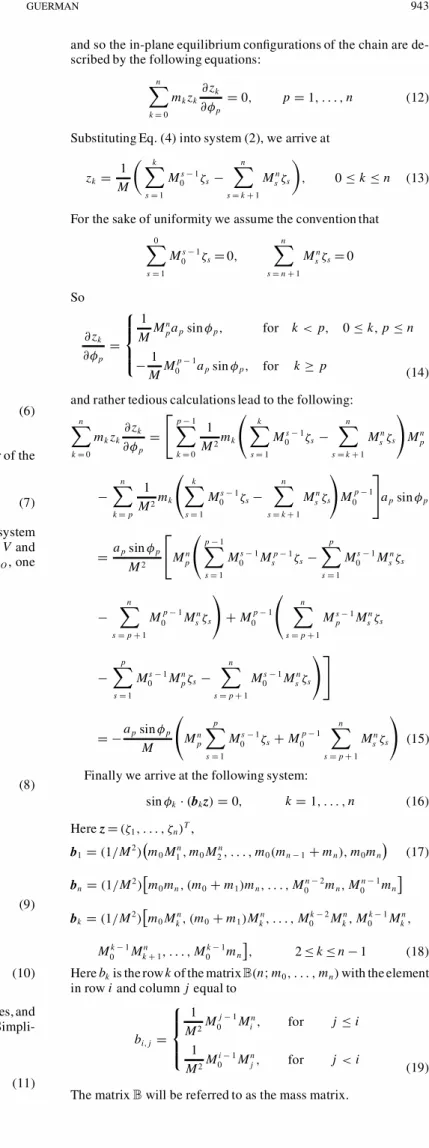
Fig. 2 Study of a three-link chain: a–d) existing equilibrium con gu-rations and e and f) equilibria cannot be realized.
a)
b)
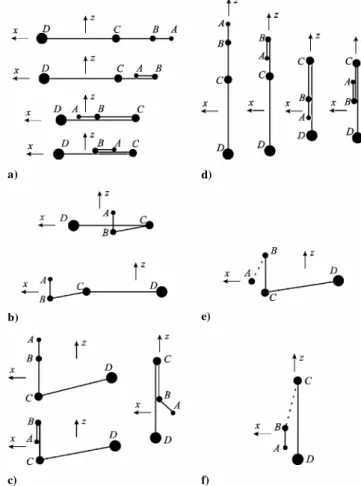
Fig. 3 Equilibria of a four-link chain: a) horizontal and b) vertical con gurations.
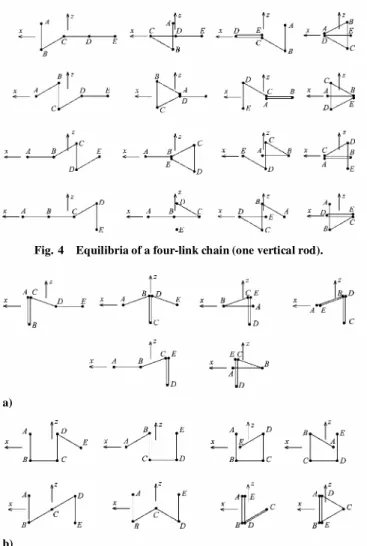
Fig. 4 Equilibria of a four-link chain (one vertical rod).
a)
b)
Fig. 5 Equilibria of a four-link chain: a) one group of two adjacent rods and b) two separate vertical rods.
a)
b)
Fig. 6 Equilibria of a four-link chain: a) one group of three vertical rods and b) two groups of vertical rods.
Equality sin ÁkD 0 means that the kth rod is vertical, and so we
will study equilibrium con gurations depending on the number of vertical rods and their positions in the chain.
A. Horizontal Con gurations
We start the analysis considering the case when
n
Y
k D 1
sin Ák6D 0 (28)
The equilibriumcon gurations correspondto the solutions of linear system
Bz D 0 (29)
with nonzero determinant (22). So the unique solution of Eqs. (16) is
z D 0 (30)
which means, in terms of angles Ák, that
cos ÁkD 0; k D 1; : : : ; n (31)
The orientationof the kth member correspondsto ÁkD §¼=2. Thus,
in this case there are 2nequilibria that exist for any lengths of the
rods and masses of the satellites. All of them correspond to posi-tions of the chain with all links pointed along the tangent to the orbit. Examples of such con gurations are provided in Figs. 2a and 3a.
B. One Vertical Rod
Consider now the case when there is only one number k for which sin ÁkD 0. The correspondingrod is parallel to the local
ver-tical O z. Then ÁkD 0 or ÁkD ¼, cos ÁkD §1; and ³kD ³k.0/D §ak.
The equations that describe the equilibrium con gurations of the chain are b1;1³1C ¢ ¢ ¢ C b1;k ¡ 1³k ¡ 1C b1;k³k.0/ C b1;k C 1³k C 1C ¢ ¢ ¢ C b1;n³nD 0 b2;1³1C ¢ ¢ ¢ C b2;k ¡ 1³k ¡ 1C b2;k³k.0/ C b2;k C 1³k C 1C ¢ ¢ ¢ C b2;n³nD 0 :: : bk ¡ 1;1³1C ¢ ¢ ¢ C bk ¡ 1;k ¡ 1³k ¡ 1C bk ¡ 1;k³k.0/ C bk ¡ 1;k C 1³k C 1C ¢ ¢ ¢ C bk ¡ 1;n³nD 0 ³kD ³k.0/ bk C 1;1³1C ¢ ¢ ¢ C bk C 1;k ¡ 1³k ¡ 1C bk C 1;k³k.0/ C bk C 1;k C 1³k C 1C ¢ ¢ ¢ C bk C 1;n³nD 0 :: : bn;1³1C ¢ ¢ ¢ C bn;k ¡ 1³k ¡ 1C bn;k³k.0/ C bn;k C 1³k C 1C ¢ ¢ ¢ C bn;n³nD 0 (32)
This system can be represented as
DJzJ D ¡dk J³k.0/; J D fkg (33)
(Here the kth row is omitted.)
Suppose rst that kD 2; : : : ; n ¡ 1. One can notice that it is pos-sible to apply transformation (20) to all the lines of Eq. (32) except the (k¡ 1/th and (k C 1)th ones, and so this system is equivalent to ³1D 0; : : : ; ³k ¡ 2D 0; ³kD ³k.0/; ³k C 2D 0; : : : ; ³nD 0
bk ¡ 1;k ¡ 1³k ¡ 1C bk ¡ 1;k³k.0/C bk ¡ 1;k C 1³k C 1D 0
Now we use the expressionsfor bi; jto determine ³k ¡ 1, ³k C 1and the
respective angles of orientation of the rods: ³k ¡ 1D ¡³k.0/[mk=.mk ¡ 1C mk/]
cos Ák ¡ 1D ¡.ak=ak ¡ 1/[mk=.mk ¡ 1C mk/] cos Ák
³k C 1D ¡³k.0/[mk ¡ 1=.mk ¡ 1C mk/]
cos Ák C 1D ¡.ak=ak C 1/[mk ¡ 1=.mk ¡ 1C mk/] cos Ák (35)
The condition of existence of this equilibrium is .ak=ak ¡ 1/[mk=.mk ¡ 1C mk/] < 1
.ak=ak C 1/[mk ¡ 1=.mk ¡ 1C mk/] < 1 (36)
[If .ak=ak ¡ 1/[mk=.mk ¡ 1C mk/]D 1 or .ak=ak C 1/[mk ¡ 1=
.mk ¡ 1C mk/]D 1; the rod ak ¡ 1 or ak ¡ 1 is also aligned with the
local vertical; we do not consider this case here.] For kD 1 the solution is given by the formulas ³2D ¡³1.0/[m0=.m0C m1/]
cos Á2D ¡.a1=a2/[m0=.m0C m1/] cos Á1
if .a1=a2/[m0=.m0C m1/] < 1 (37)
and for kD n one gets
³n ¡ 1D ¡³n.0/[mn=.mn ¡ 1C mn/]
cos Án ¡ 1D ¡.an=an ¡ 1/[mn=.mn ¡ 1C mn/] cos Án
if .an=an ¡ 1/[mn=.mn ¡ 1C mn/] < 1 (38)
Thus, the equilibrium con gurations in this case are as follows: The rod ak is aligned with the local vertical. The center of mass
of the system of two points Ak ¡ 1and Akconnected by the rod ak
belongs to the x axis. All other rods of the chain except the direct neighbors of akare also situated on the x axis. (Examples are given
by Figs. 2b, 2e, and 4.) Such equilibria exist if the lengths of the rods ak ¡ 1and ak C 1(or of one of these rods if kD 1 or n) suf ce to
allow this con guration:
ak ¡ 1> ak[mk=.mk ¡ 1C mk/]
ak C 1> ak[mk ¡ 1=.mk ¡ 1C mk/] (39)
Because one can indicate two values of Ákwith the same cosine, the
number of equilibria of this type does not exceed n¢ 2n. C. One Group of Vertical Rods
Suppose that in system (16) sin ÁjD 0 iff j 2 J D fk C 1; : : : ;
k C rg. (This means that some group of r adjacent rods is aligned with the local vertical.) Then cos ÁjD §1, and ³jD ³.0/j D §aj
for j2 J. One can use property (20) to show that ³jD 0 for
j =2 JSfk; k C r C 1g. For ³k and ³k C r C 1 one arrives at the
fol-lowing system of equations: Mk ¡ 1 0 Mkn³kC M0k ¡ 1Mk C 1n ³k C 1.0/ C ¢ ¢ ¢ C M0k ¡ 1Mk C rn ³k C r.0/ C Mk ¡ 1 0 Mk C r C 1n ³k C r C 1D 0 Mk ¡ 1 0 Mk C r C 1n ³kC M0kMk C r C 1n ³k C 1.0/ C ¢ ¢ ¢ C M0k C r ¡ 1Mk C r C 1n ³k C r.0/ C Mk C r 0 Mk C r C 1n ³k C r C 1D 0 (40)
Simplifying Eqs. (40), we get
³kC ³k C 1.0/ C ¢ ¢ ¢ C ³k C r.0/ C ³k C r C 1D 0 Mk C r k ³kC Mk C 1k C r³k C 1.0/ C ¢ ¢ ¢ C mk C r³k C r.0/ D 0 (41) and so ³kD ¡ ¡ Mk C r k C 1³k C 1.0/ C ¢ ¢ ¢ C mk C r³k C r.0/ ¢¯ Mk C r k ³k C r C 1D ¡ ¡ mk³k C 1.0/ C ¢ ¢ ¢ C Mkk C r ¡ 1³k C r.0/ ¢¯ Mk C r k (42)
Equalities (41) show that the center of mass of the group of vertical rods should lie on the local horizontal. There are no more than 2n
equilibrium con gurations corresponding to solution (42). One of them exists if the lengths of the rods allow it:
¡Mk C r k C 1³ .0/ k C 1C ¢ ¢ ¢ C mk C r³k C r.0/ ¢¯ Mk C r k < ak ¡mk³.0/ k C 1C ¢ ¢ ¢ C Mkk C r ¡ 1³k C r.0/ ¢¯ Mk C r k < ak C r C 1 (43) In case the group of vertical rods is located at one of the ends of the chain we get only one equationcorrespondingto the neighboring rod: m0Mr C 1n ³1.0/C ¢ ¢ ¢ C Mr ¡ 10 Mr C 1n ³r.0/C Mr0Mr C 1n ³r C 1D 0 (44) so that ³r C 1D ¡ ¡ m0³1.0/C ¢ ¢ ¢ C M0r ¡ 1³r.0/ ¢¯ Mr 0 (45) for kD 0, and Mk ¡ 1 0 Mkn³kC M0k ¡ 1Mk C 1n ³k C 1.0/ C ¢ ¢ ¢ C M0k ¡ 1mn³n.0/ (46) and so ³kD ¡ ¡ Mn k C 1³k C 1.0/ C ¢ ¢ ¢ C mn³n.0/ ¢¯ Mn k (47)
for kC r D n. The respectiveequilibriumcon gurationspossess the aforementionedpropertiesdescribedfor the case of an internalgroup of vertical rods (see Figs. 2c, 5a, and 6a).
System (16) also admits the solution
sin Áj D 0; j D 1; : : : ; n (48)
which implies that the whole chain is situated on the local vertical. All the 2n con gurations are possible in this case (see Figs. 2d
and 3b).
D. Two or More Groups of Vertical Rods
With no loss of generality, let us consider the case of two groups of vertical rods.
Suppose that sin ÁjD 0 only for j 2 J D J1
S
J2, J1D
fk1C 1; : : : ; k1C r1g, J2D fk2C 1; : : : ; k2C r2g with k1C r1C
1· k2. Then cos ÁjD §1, and ³jD ³.0/j D §ajfor j2 J. Equations
of equilibria are now DJzJD ¡ µ X j 2 J1 dj J³.0/j C X j 2 J2 dj J³.0/j ¶ (49)
Along with Eqs. (49), let us study the following two systems: DJzJD ¡ X j 2 J1 dj J³j.0/ (50) DJ1zJ1D ¡ X j 2 J1 dj J1³ .0/ j (51)
System (50) was obtained from Eqs. (49) by putting ³.0/
j D 0
for j2 J2. In accordance with Eq. (26), systems (49–51)
have unique solutions. Obviously, system (51) is the system of equilibrium equations for a single group of vertical rods. It was examined before, and the solution implies ³.0/
j D 0
for j2 f1; : : : ; k1¡ 1; k1C r1C 2; : : : ; kng, including j 2 J2. It
means that the unique solution of system (50) is ³jD 0 for
[or Eq. (45) if k1D 0] by putting k ! k1; r! r1. Studying in the
same way the systems
DJzJ D ¡ X j 2 J2 dj J³.0/j (52) DJ2zJ2D ¡ X j 2 J2 dj J2³ .0/ j (53)
one arrives at the conclusion that the solution of Eq. (53) is ³jD 0 for j =2 J2
S
fk2; k2C r2C 1g and ³k2, ³k2C r2C 1 are
cal-culated by Eqs. (42) [or Eq. (47) if k2C r2D n) with
substitu-tion k! k2; r! r2. So the solution of Eq. (52) is ³jD 0 for
j =2 JSfk2; k2C r2C 1g with the same values of ³k2and ³k2C r2C 1.
To get the solutions of the initial system (49), one has to sum the solutions of Eqs. (50) and (52). Thus the solutions of system (16) that correspondto two (or more) groups of verticalrods can be found by the superpositionof solutions obtained for each group of vertical rods separately.
The respective equilibria con gurations represent two groups of vertical rods with their centers of mass situated on the x axis. For these rows ³jD ³.0/j D §ajfor j2 J. If these groups have no
com-mon neighbor, the orientations of the neighbor rods are described by Eqs. (42) [or Eqs. (45) and (47) if it is the case]. These rods connect the vertical groups with the rest of the chain that is oriented horizontally.
If k1C r1C 1 D k2, that is, the vertical groups have a common
neighbor, its orientation is described by the relation
Q³k2D ³k1C r1C 1C ³k2 (54)
where ³k1C r1C 1 is given by Eqs. (42) with the substitution
k ! k1; r! r1, and ³k2is givenwith the substitutionk! k2; r! r2.
The only difference with the preceding case is that the common neighbor of the vertical groups should be oriented so as to guaran-tee that their centers of mass still belong to the local horizontal(see Figs. 2f, 5b, and 6b).
Obviously, the same procedure can be applied to study equilib-rium con gurations with three or more groups of vertical rods. This type of equilibrium exists if the inclined rods are long enough.
E. Number of Equilibria
The total number of equilibria in the plane of the orbit does not exceed product of the number of possible choices of vertically ori-ented rods and the number of respectivecon gurations of the chain: N · 2n¢ 2nD 22n (55)
The exact number of equilibriacan be determined by taking into ac-countthe lengthsof the linksand the massesof the points A0; : : :,An.
VI. Examples
We consider two examples to illustrate the general results ob-tained in Sec. V. The rst is a three-link chain with different mem-bers; the second one is a four-link chain with equal masses of the satellites and lengths of the connecting rods. Equilibria of these structuresare schematically represented by Figs. 2–6. Even in these cases of relatively few links, we have too many con gurations to depict them all, and so we indicatethe type of symmetry that permits one to obtain the remaining equilibria.
A. Three-Link Chain
Figure 2 illustrates the results of analysis of equilibrium con g-urations for a three-link chain that consists of four material points A, B, C, and D: The masses of the points are respectivelymAD m,
mBD 2m, mCD 4m, and mDD 8m. The connecting rods have the
lengths lA BD l, lBCD 2l, and lC DD 4l. Figure 2a shows four of
the existing 23D 8 horizontal con gurations; the other four are
symmetric with respect to the z axis. Figure 2b represents two es-sentially different con gurations with one vertical rod; the other six equilibria are obtained by re ections with respect to x and/or z
axes. For this chain, there are no equilibria where either BC or C D is the only vertical rod; the reason is illustrated in Fig. 2e. In this con guration, zBD 2lBC=3D 4l=3, but point A should lie on the x
axis. This is possible only if lA B> 4l=3, which is not the case. All
essentially different existing equilibria with a group of two vertical rods are shown in Fig. 2c. (The remaining nine con gurations are obtained by symmetries with respect to x and/or z axis.) For this chain, there are no equilibria with two groups of vertical rods. As shown in Fig. 2e, the existence of such equilibria would imply that lBC> zC¡ zBD 2lC D=3¡ lA B=3D 7l=3. In Fig. 2d, one can seefour
existing vertical con gurations; the other four are symmetric with respect to the x axis. In this case there exist 36 equilibrium con g-urations of the chain. [The upper bound of Eq. (55) is 26D 64.]
B. Four-Link Chain
Now let us consider equilibria of a four-link chain in the plane of a circular orbit. To simplify the calculations we choose a system of ve material points A, B, C, D, and E of equal masses. The lengths of the links are also equal. Figures 3–6 represent schematically ve groups of possibleequilibria.Figure 3 shows all essentiallydifferent equilibria, where the rods are either all horizontal or all vertical; the others are symmetric with respect to z or x axis correspondingly. Figures 4–6 show schemes of existing equilibria where orientations of rods may differ; the rest of them are symmetric with respect to x and/or z axis. The total number of equilibrium con gurations is N D 192. The difference between the estimate (55) and the actual quantity 28¡ 192 D 64 originates in the speci c dimensions of the
chain. For example, a unique group of two verticalrods alignedwith the same direction proves impossible, because the rod adjacent to this group would have to be vertical as well. Consequently, we deal with the case of three adjacent vertical rods (two of them pointing in the same direction, and the third in the opposite one), which are represented in Fig. 6.
VII. Conclusions
We study equilibria of a multibody connected system within the framework of the model of an n-link chain. All possible con gura-tions in the plane of a circular orbit are described. It is shown that each rod of the chain can occupy one of the following positions:
1) It can be directed along the local horizontal O x (tangent to the orbit).
2) It can be a member of a group of k consequent vertical rods and is the center of mass of this group situated on the axis O x.
3) An oblique orientation is possible if the rod joins either two vertical groups of rods or the end of a vertical group with the axis O x.
Each of these con gurationsexistswhen the lengthsof the oblique rods (if there are any) allow it. The total number of equilibria does not exceed 22n.
For the particular case of a two-member link the results obtained coincide with those of Refs. 5–9.
Acknowledgments
This work is supported by the Portuguese Foundation for Sci-ence and Technology. We express our gratitude to A. K. Misra for interesting discussions of the problem.
References
1Keshmiri, M., Misra, A. K., and Modi, V. J., “General Formulation for
N-Body Tethered Satellite System Dynamics,” Journal of Guidance,
Con-trol, and Dynamics, Vol. 19, No. 1, 1996, pp. 75–83.
2Kalantzis, S., Modi, V. J., Padhan,S., and Misra, A. K., “Order-N
Formu-lation and Dynamics of MultibodyTethered Systems,” Journal of Guidance,
Control, and Dynamics, Vol. 21, No. 2, 1998, pp. 277–285.
3Chen, Y., Modi, V. J., De Silva, C. W., and Misra, A. K., “On the
Performance of Variable Geometry Manipulators: Part I—Three Dimen-sional Order N Formulation,” Acta Astronautica, Vol. 49, No. 1, 2001, pp. 1–12.
4Nagata, T., Modi, V. J., and Matsuo, H., “Dynamics and Control of
Flexible Multibody Systems—Part I: General Formulation with an Order N Forward Dynamics,” Acta Astronautica, Vol. 49, No. 11, 2001, pp. 581–594.
5Sarychev, V. A., “Positions of Relative Equilibriumfor Two Bodies
Con-nected by a Spherical Hinge in a Circular Orbit,” Cosmic Research, Vol. 5, No. 3, 1967, pp. 360–364.
6Lorenzini, E. C., “A Three-Mass Tethered System for
Micro-g/Variable-gApplications,” Journalof Guidance,Control,and Dynamics, Vol. 10, No. 3, 1987, pp. 242–249.
7Misra, A. K., Amier, Z, and Modi, V. J., “Attitude Dynamics of
Three-Body Tethered Systems,” Acta Astronautica, Vol. 17, No. 10, 1988, pp. 1059–1068.
8Sarychev, V. A., “Equilibria of a Double Pendulum in a Circular Orbit,”
Acta Astronautica, Vol. 44, No. 1, 1999, pp. 63–65.
9Misra, A. K., “EquilibriumCon gurations of Tethered Three-Body
Sys-tems and Their Stability,” Spaceight Mechanics 2001, Advances in the Astronautical Sciences, Vol. 108, Pt. 2, Univelt, San Diego, CA, 2001, pp. 1757–1773.
10Breakwell, J. V., “Stability of an Orbiting Ring,” Journal of Guidance
and Control, Vol. 4, No. 2, 1981, pp. 197–200.
11Beletsky, V. V., and Levin, E. M., “Stability of a Ring of
Connected Satellites,” Acta Astronautica, Vol. 12, No. 10, 1985, pp. 765–769.